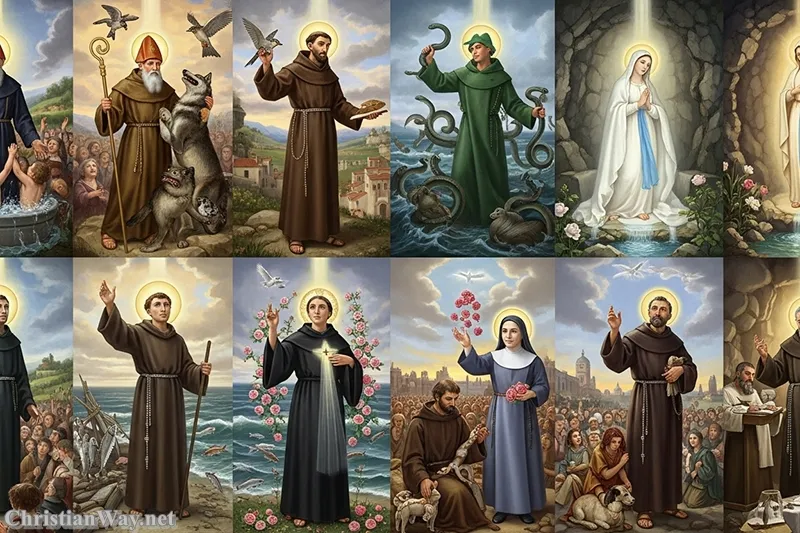
Dear friends, in a world that clamors for recognition, accumulates wealth, and measures worth by productivity, the call of the Gospel often sounds like a contradiction. We are invited to a different kind of kingdom, one where the first are last, and the poor are the true possessors of the earth. When we speak of the saints of humility and poverty, we are not speaking merely of those who lacked money or influence. We are speaking of those who understood the profound theological truth of Kenosis—self-emptying.
Throughout the history of the Church, God has raised up men and women who realized that to be filled with the Divine, one must first empty oneself of the ego, of attachment to material things, and of the desire for worldly praise. These saints did not view poverty as a curse to be endured, but as a “Lady” to be courted, or a “privilege” to be defended. They understood that the cluttered heart has no room for the Holy Spirit.
As we walk through this list together, I invite you to read not with a spirit of academic curiosity, but with a heart open to formation. Let the lives of these holy men and women challenge the areas of our lives where we hold on too tightly—whether to our possessions, our reputation, or our pride. Here, at Christian Way, we believe that the path down is often the only way up toward Heaven.
Let us quiet our hearts and step into the presence of these spiritual giants who made themselves small for the sake of the Great King.
Table of The Top 10 Saints of Humility and Poverty
| Saint | Era | Region | The Essence of Their Poverty |
|---|---|---|---|
| 10. St. Elizabeth of Hungary | 13th Century | Hungary/Germany | Royal dignity bowed in service to the sick. |
| 9. St. Vincent de Paul | 17th Century | France | Seeing the face of Christ in the destitute. |
| 8. St. Anthony of the Desert | 3rd-4th Century | Egypt | The radical abandonment of the world for silence. |
| 7. St. Martin de Porres | 16th-17th Century | Peru | Humility in menial tasks and racial prejudice. |
| 6. St. Benedict Joseph Labre | 18th Century | France/Italy | The holiness of the rejected beggar. |
| 5. St. Therese of Lisieux | 19th Century | France | Spiritual poverty and the “Little Way.” |
| 4. St. Seraphim of Sarov | 18th-19th Century | Russia | Asceticism leading to the acquisition of peace. |
| 3. St. Clare of Assisi | 13th Century | Italy | Fighting for the “Privilege of Poverty.” |
| 2. St. Teresa of Calcutta | 20th Century | India | Serving the poorest of the poor in the modern age. |
| 1. St. Francis of Assisi | 12th-13th Century | Italy | The total stripping of self to wed Lady Poverty. |
10. St. Elizabeth of Hungary: The Princess of Bread
We begin our journey in the courts of nobility, a place where one least expects to find the spirit of poverty. St. Elizabeth of Hungary presents us with a beautiful paradox: a princess draped in fine silks who secretly wore a hair shirt beneath them. Married at a young age to Louis IV of Thuringia, she possessed every worldly comfort available to a medieval royal. Yet, her heart was captivated not by the jewels in her coffer, but by the suffering of the peasants outside her castle walls. She famously emptied the royal granaries during a famine to feed the starving, often distributing the bread herself.

Theologically, Elizabeth teaches us that poverty of spirit is accessible even to those with material means, provided they view their wealth as stewardship rather than ownership. She saw Christ in the leper and the beggar. When her husband died, she was stripped of her position and power, yet she embraced this fall from grace, becoming a Third Order Franciscan and spending her remaining days caring for the sick in a hospital she founded. She traded the crown of gold for the crown of charity.
For us today, Elizabeth is a challenging reminder that we cannot let our comfortable stations in life insulate us from the suffering of others. Her humility was not just in giving money, but in physically touching the wounds of the poor—an act that terrified the nobility of her time. She shows us that true nobility is found in service, and that the hand that gives is more blessed than the hand that rules.
Spiritual Highlights
- Patronage: Bakers, beggars, brides, and charities.
- Key Moment: The “Miracle of the Roses,” where bread she was smuggling to the poor miraculously appeared as roses when she was confronted.
- Scripture: “He has cast down the mighty from their thrones and has lifted up the humble.” (Luke 1:52)
9. St. Vincent de Paul: The Apostle of Charity
Moving to 17th-century France, we encounter a priest whose name has become synonymous with organized charity. St. Vincent de Paul did not start as a saint; initially, he sought the priesthood to secure a comfortable retirement for himself and his family. However, through a slow and painful conversion of heart, witnessed through the suffering of the galley slaves and the rural peasantry, Vincent’s eyes were opened. He realized that the poor were not a social problem to be solved, but the suffering members of the Body of Christ.

Vincent’s theology of poverty was incarnational. He taught his followers that when they went to the poor, they should treat them with the same dignity as they would a king, because “the poor have much to forgive us.” He understood that giving soup and bread was the easy part; giving respect, love, and genuine humility was the true challenge. He famously said, “You must love them very much, for only your love will make them forgive you the bread you give them.”
This strikes a chord for the modern volunteer. It is easy to write a check or volunteer for an hour to feel good about ourselves. St. Vincent challenges us to examine the posture of our hearts. Do we serve to boost our ego, or do we serve because we recognize our own spiritual poverty? He calls us to a humility that bridges the gap between the “helper” and the “helped,” realizing that before God, we are all beggars.
Spiritual Highlights
- Legacy: Founder of the Congregation of the Mission and the Daughters of Charity.
- Key Quote: “Go to the poor: you will find God.”
- Scripture: “Amen, I say to you, whatever you did for one of these least brothers of mine, you did for me.” (Matthew 25:40)
8. St. Anthony of the Desert: The Voice in the Wilderness
In the 3rd century, a young Egyptian man heard the Gospel being read in church: “If you wish to be perfect, go, sell what you have and give to the poor, and you will have treasure in heaven.” Unlike many of us who might rationalize these words away, Anthony took them literally. He sold his substantial inheritance, ensured his sister was cared for, and walked into the deep desert. He is the father of monasticism, a man who sought God in the radical stripping away of all distraction.

Anthony’s poverty was absolute. He lived in tombs and abandoned forts, battling demons and the temptations of memory. This was not poverty for the sake of punishment, but for the sake of clarity. In the silence of the desert, stripped of social status, comfort, and conversation, Anthony discovered that the human heart is a battlefield. His humility lay in his reliance on Christ’s name to conquer the darkness within. He became a physician of souls, not by studying in universities, but by studying his own frailty in the sand.
In our noise-polluted age, St. Anthony stands as a stark beacon. We are often terrified of silence and emptiness, filling every moment with digital noise. Anthony invites us to unplug, to step back, and to realize that we do not need “things” to be whole. He teaches us that when we have nothing but God, we finally realize that God is enough.
Spiritual Highlights
- Title: The Father of All Monks (Abba Anthony).
- Wisdom: He taught that the devil fears humility above all else, for the devil can mimic fasting and vigils, but cannot mimic obedience.
- Scripture: “The voice of one crying in the wilderness: Prepare the way of the Lord.” (Mark 1:3)
7. St. Martin de Porres: The Saint of the Broom
In the bustling city of Lima, Peru, lived a man whose very birth placed him on the margins of society. The son of a Spanish nobleman and a freed slave of African and Indigenous descent, Martin de Porres was looked down upon for his mixed race. By law, he could not become a full member of the Dominican Order, so he entered as a “donado”—a lay helper. He was given the tasks no one else wanted: sweeping the floors, cleaning the toilets, and tending to the sick. And in these lowly tasks, he found the high road to holiness.
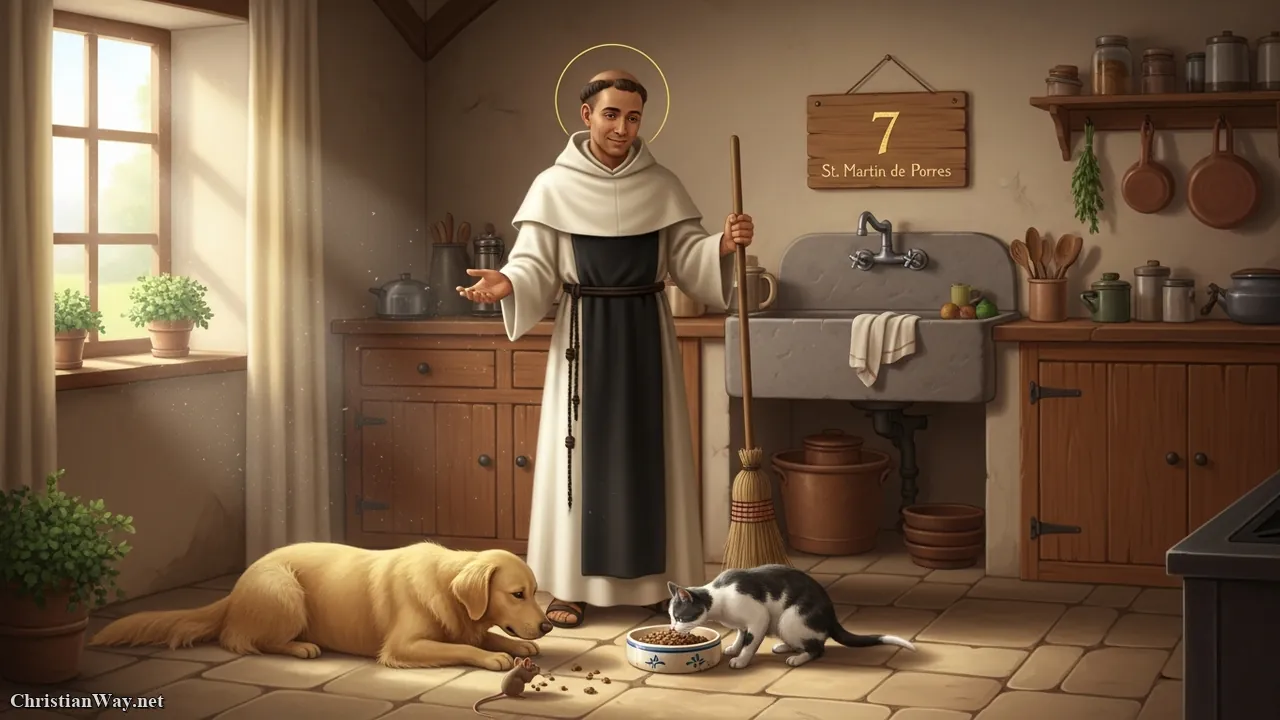
St. Martin is often depicted with a broom, a symbol of his sanctity. He did not resent his lowly position; rather, he embraced it with a joy that baffled his contemporaries. His humility was so profound that when his priory was in debt, he offered to be sold as a slave to raise the money. Theologically, Martin embodies the “hidden life” of Jesus at Nazareth. He sanctified the mundane. He showed that the value of work is not in the prestige of the title, but in the love with which it is performed.
Pastoral care often involves grandiose ideas, but St. Martin brings us back to the kitchen sink and the laundry room. He speaks to those who feel invisible, marginalized, or underappreciated. His life assures us that God sees what the world overlooks. Every sweep of the broom, when done for the love of God, is a prayer more powerful than the orations of the proud.
Spiritual Highlights
- Charisms: Known for bilocation and an extraordinary rapport with animals (even mice).
- Virtue: He accepted insults regarding his race with perfect patience, turning them into opportunities for prayer.
- Scripture: “The greatest among you must be your servant.” (Matthew 23:11)
6. St. Benedict Joseph Labre: The Beggar Saint
St. Benedict Joseph Labre is perhaps the most unsettling saint on this list for the modern mind. He was not a monk in a monastery, nor a priest serving the poor; he was a homeless drifter. After being rejected by multiple religious orders who found him too eccentric, he realized his vocation was to be a pilgrim on the roads of Europe. He lived in absolute squalor, wearing rags, never bathing, and sleeping in the ruins of the Colosseum in Rome. He possessed nothing but a breviary, a rosary, and the clothes on his back.
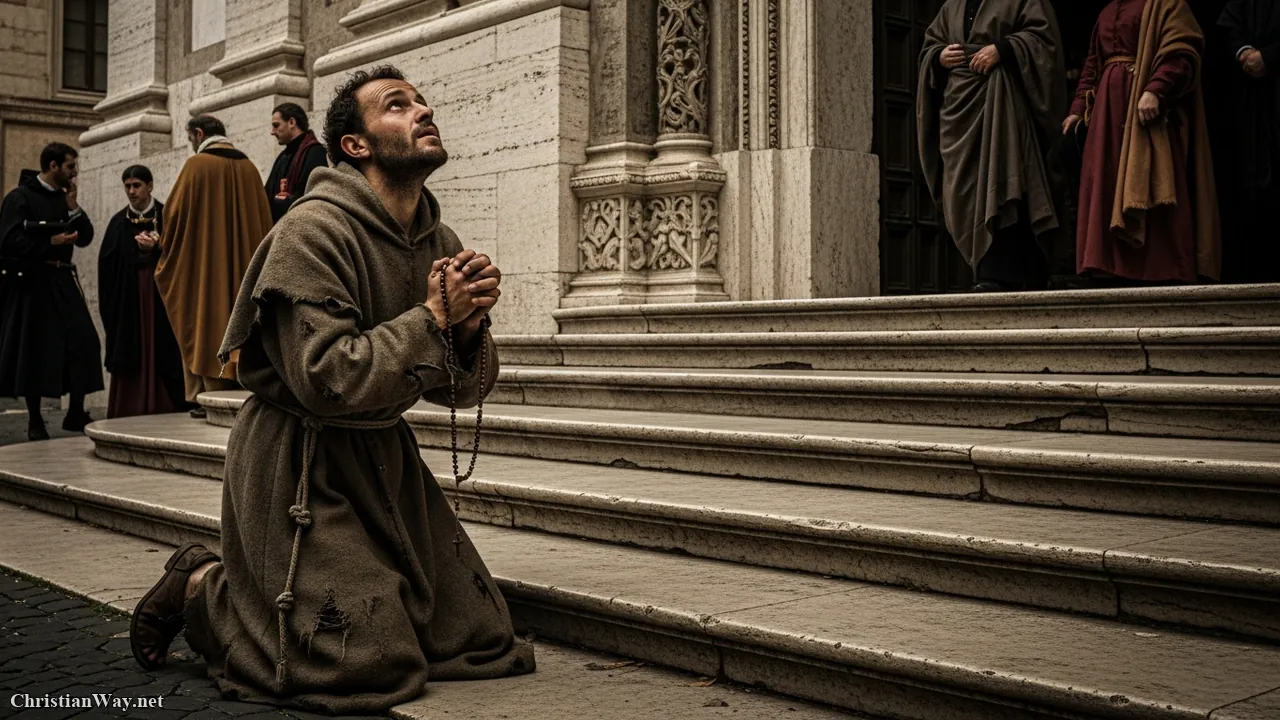
Why is he a saint? Because beneath the dirt and the rags beat a heart of pure adoration. He spent his days in churches, gazing at the Eucharist for hours, earning him the title “The Lover of the Forty Hours.” His poverty was a prophetic sign against the Enlightenment era’s obsession with reason, hygiene, and success. He became a “fool for Christ,” mirroring the suffering Servant who had “no place to lay his head.” His humility was in accepting the scorn and revulsion of others without a word of defense.
Benedict Joseph Labre challenges our sanitised version of Christianity. We like our poverty to be neat and manageable. He reminds us that the Holy Spirit blows where He wills, sometimes in the most unkempt vessels. He teaches us not to judge the spiritual state of a person by their outward appearance, for the beggar on the street corner may be closer to God than the theologian in the library.
Spiritual Highlights
- Patronage: Homeless people, pilgrims, and those with mental illness.
- Devotion: He shared the little food he begged with others who were hungry.
- Scripture: “God chose the foolish of the world to shame the wise, and God chose the weak of the world to shame the strong.” (1 Corinthians 1:27)
5. St. Therese of Lisieux: The Little Flower
St. Therese of Lisieux brings us a different flavor of poverty: spiritual poverty. Living in a cloistered Carmelite convent, she did not face starvation or homelessness. Her struggle was internal. She realized early on that she was too small to climb the “rough stairway of perfection” that great saints like Anthony or Vincent ascended. She felt empty of great virtues and incapable of great deeds. Instead of despairing, she threw herself into the arms of Jesus, trusting that He would be her elevator.
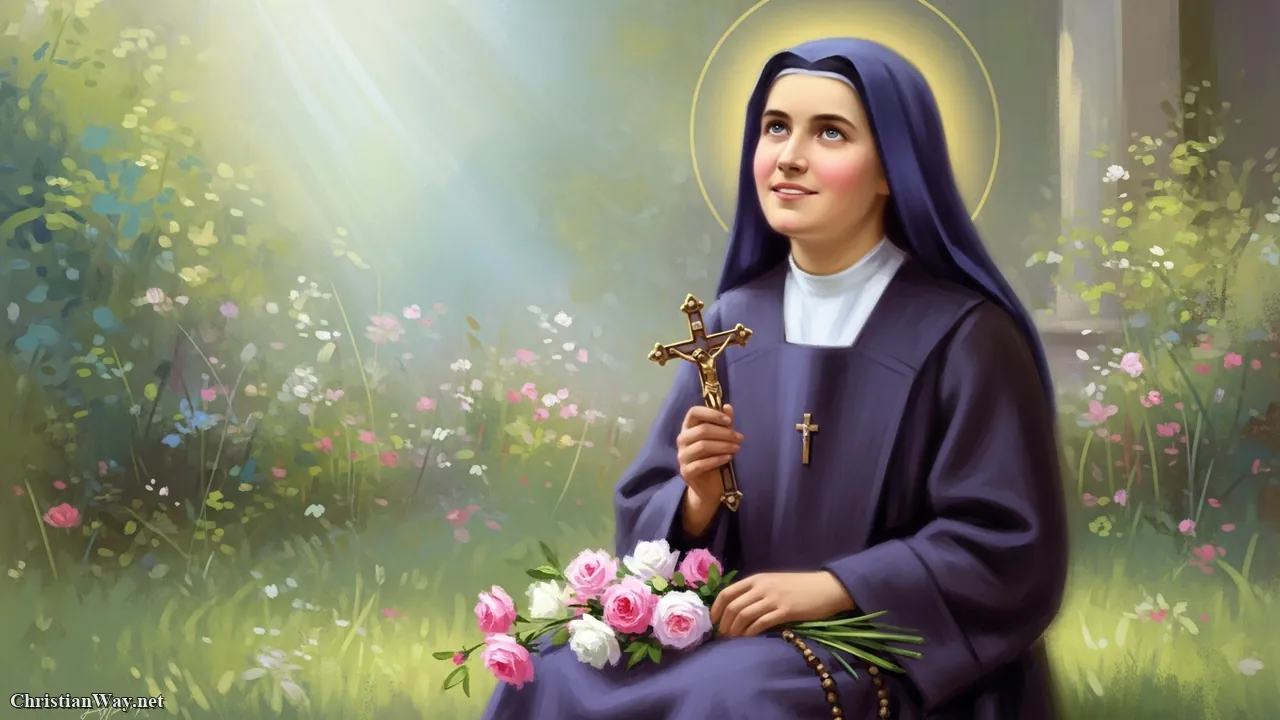
This is the “Little Way.” It is the theology of remaining small. Therese celebrated her own weakness because she knew that it made room for God’s grace. Her humility was found in doing the smallest things—folding a napkin, smiling at a difficult sister, swallowing a complaint—with immense love. She called herself a “grain of sand” to be trampled underfoot, desiring to be forgotten by the world so she could be known only by Jesus.
This message is a healing balm for the perfectionist. So many of us burn out trying to be “great” Christians. Therese whispers to us: “You do not need to be great; you need to be little.” She teaches us to accept our limitations and our failures not with anger, but with a gentle humility that trusts entirely in the mercy of the Father.
Spiritual Highlights
- Title: Doctor of the Church (despite dying at 24 with no formal education).
- Metaphor: The “Elevator” of God’s arms lifting her to holiness.
- Scripture: “Unless you turn and become like children, you will not enter the kingdom of heaven.” (Matthew 18:3)
4. St. Seraphim of Sarov: The Light of the East
From the mystical forests of Russia comes St. Seraphim, one of the most beloved saints of the Orthodox tradition. Like St. Anthony, he withdrew to the forest for prayer, living in a small log cabin and eating only vegetables from his garden. He endured a brutal attack by robbers that left him permanently hunched, yet he never sought justice or revenge. His poverty was marked by a radiant joy; he greeted every visitor, regardless of the season, with the Paschal greeting: “My joy, Christ is risen!”

Seraphim’s famous teaching was that the goal of the Christian life is the “acquisition of the Holy Spirit.” He demonstrated that true humility leads to a peace so profound that it affects the physical world around us. It is said that wild bears would eat from his hand, tamed not by force, but by the saint’s holiness. He lived simply, dressed in a white smock, yet his spirit was rich with the uncreated light of God.
St. Seraphim’s life asks us: What is the atmosphere we carry with us? Do we carry the stress and noise of our possessions, or the peace of the Holy Spirit? His famous words, “Acquire a peaceful spirit, and around you thousands will be saved,” remind us that our personal sanctity and humility are the greatest gifts we can offer to a troubled world.
Spiritual Highlights
- Event: The Transfiguration in the snow, where his face shone like the sun while talking to Motovilov.
- Practice: Praying on a rock for 1,000 nights with hands raised to heaven.
- Scripture: “The fruit of the Spirit is love, joy, peace, patience…” (Galatians 5:22)
3. St. Clare of Assisi: The Privilege of Poverty
St. Clare was the spiritual sister and close friend of St. Francis, but she was a powerhouse of humility in her own right. Born into nobility, she ran away from home to follow Francis, cutting her hair and trading her jewels for a rough tunic. When she founded the order of the “Poor Ladies” (now the Poor Clares), church authorities tried to force them to own property for their security. Clare refused. She famously stood firm against the Pope himself, not in arrogance, but in a desperate plea for the “Privilege of Poverty”—the right to own absolutely nothing.

For Clare, poverty was not about suffering; it was about freedom. She saw that possessions create walls—walls between people, and walls between the soul and God. By owning nothing, the sisters were forced to rely entirely on God’s providence and the kindness of others. This total vulnerability was her path to union with the Crucified Christ.
In a culture obsessed with security, insurance, and retirement plans, St. Clare is a radical disruption. She invites us to ask: What are we so afraid of losing? Her life proves that security is not found in a bank account, but in the faithful love of the Creator. She held up the Eucharist to turn away invading armies, proving that a humble woman with bread is stronger than soldiers with swords.
Spiritual Highlights
- Iconography: Often depicted holding a monstrance.
- Legacy: The first woman to write a Rule of Life for a religious order.
- Scripture: “Blessed are the poor in spirit, for theirs is the kingdom of heaven.” (Matthew 5:3)
2. St. Teresa of Calcutta: The Saint of the Gutters
In our own time, the diminutive figure of Mother Teresa stands as a giant of humility. She left the safety of her initial teaching order to walk into the slums of Calcutta, stepping over sewage to reach the dying. She did not create a complex NGO; she simply picked up the person in front of her. Her theology was grounded in the “Five Finger Gospel” she taught on her hand: “You-Did-It-To-Me” (referencing Matthew 25).
Mother Teresa’s poverty was twofold. Physically, she lived as the poor lived, owning only two saris and a bucket for washing. But spiritually, she experienced a profound “dark night of the soul” for decades. She felt rejected by God, empty and dry. Yet, she greeted the world with a smile. This was the ultimate humility: to serve God faithfully even when she felt no consolation, sharing in the thirst of Jesus on the Cross.
She challenges the modern notion that we must “feel” spiritual to be holy. She teaches us that love is a choice, not a feeling. Her mission was to the “unwanted, the unloved, the uncared for.” She forces us to look at the people in our own lives—our families, our workplaces—who are spiritually lonely, and to offer them the smile of Christ.
Spiritual Highlights
- Mission: The Missionaries of Charity.
- Key phrase: “I Thirst” (inscribed in every one of her chapels).
- Scripture: “I was hungry and you gave me food, I was thirsty and you gave me drink.” (Matthew 25:35)
1. St. Francis of Assisi: The Mirror of Christ
We arrive at the summit of our list, the “Poverello,” the little poor man of Assisi. No saint in history, perhaps other than the Virgin Mary, has so perfectly mirrored the humility of Jesus. Francis was the son of a wealthy cloth merchant, destined for business and war. But God called him to “repair My church.” Francis’s response was total. In the town square, he stripped naked, handing his fine clothes back to his father, declaring that he now had only one Father in heaven.
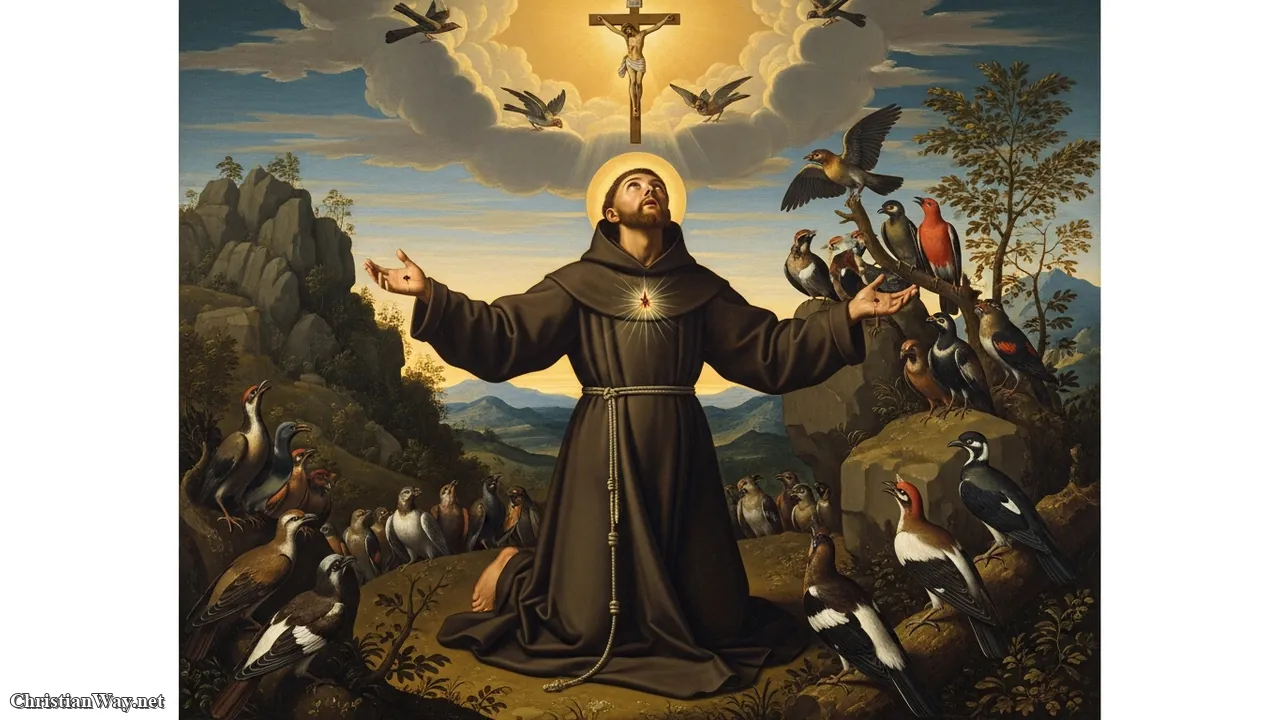
Francis wed “Lady Poverty” with the romance of a troubadour. He saw the entire world as a brotherhood—Brother Sun, Sister Moon, and even the wolf. This was not pantheism; it was a humility that recognized he was a creature, just like the birds and the trees. He did not consider himself above creation, but part of a choir singing God’s praise. He sought to be the “lesser brother” (Minor) to everyone, subjecting himself to all.
St. Francis is number one because his poverty changed the world. He saved the Church not by power, but by returning it to the Gospel. He bears the stigmata—the wounds of Christ—because he emptied himself so completely that Christ filled him physically. He calls us to the joy of simplicity. He asks us to look at our lives and see what baggage is weighing us down, preventing us from running freely into the arms of God.
Spiritual Highlights
- The Canticle: Author of the Canticle of the Sun.
- The Stigmata: The first recorded saint to receive the physical wounds of Christ.
- Scripture: “Foxes have dens and birds of the sky have nests, but the Son of Man has nowhere to rest his head.” (Luke 9:58)
Conclusion
Beloved friends, we have journeyed from the palaces of Hungary to the deserts of Egypt, from the slums of Calcutta to the hills of Assisi. These ten saints, diverse in their backgrounds, sing a single harmonious note: God resists the proud, but gives grace to the humble.
It is natural to feel intimidated by such radical sanctity. But remember, they were human, made of the same dust as you and I. They struggled, they wept, and they had to choose, day by day, to let go of self. We may not be called to live in a cave or give away our homes, but we are all called to the poverty of spirit—to acknowledge that without God, we can do nothing.
Let us pray for the grace to descend. To step down from the pedestal of our ego. To unclench our hands from the things that possess us. For it is only when our hands are empty that God can fill them with Himself.
— Fr. John Matthew, for Christian Way