Dear friends in Christ,
There are people whose lives seem to carry a quiet light into places where the world has almost forgotten how to hope. They do not always stand in halls of power. They may not possess wealth, influence, or the kind of success that captures public attention. Yet when they enter a room, when they kneel beside a suffering person, when they speak a word of kindness to someone who feels invisible, the love of God becomes more believable.
Saint Mother Teresa of Calcutta was such a person. For much of the world, she became known as the small woman in the white sari with blue borders, walking through the streets of Calcutta and caring for the dying, the abandoned, the hungry, the sick, and the unwanted. She became known as the “saint of the gutters,” not because she glorified poverty or suffering, but because she was willing to go where many people were afraid to look. She saw human beings lying in the dust, forgotten by society, and she saw in them the face of Jesus Christ.
Yet the deepest truth about Saint Mother Teresa of Calcutta is not simply that she cared for the poor. The deepest truth is that she loved Christ. Her hands served the dying because her heart had first been claimed by the love of Jesus. Her compassion was not merely human sympathy, though she possessed that in abundance. It was the fruit of prayer. It was the answer of a soul that heard Christ’s cry from the Cross: “I thirst” (John 19:28).

Mother Teresa understood that this thirst of Jesus was not only physical. It was the thirst of God for the human heart. Christ thirsts for those who have wandered far from Him. He thirsts for the lonely, the broken, the proud, the ashamed, the faithful, and the doubting. He thirsts for every person who has forgotten that they are loved. And because Mother Teresa heard this cry, she spent her life bringing love into the places where love seemed absent.
Her witness speaks powerfully to our time. We live in a world that is more connected than ever, yet many people feel deeply alone. We can speak to hundreds of people through screens, but still wonder whether anyone truly sees us. We may live in homes full of possessions, but feel empty inside. We may be surrounded by crowds and still carry a hidden ache that no one knows.
Mother Teresa reminds us that the human heart does not need only comfort, success, or approval. It needs love. It needs the love of God, and it needs the tenderness of another human being who is willing to stop, listen, serve, and remain present. Her life invites us to look again at the people around us. It invites us to see Christ where we have stopped expecting to find Him. And it gently asks us a question that may change the way we live: Who is waiting for my love today?
The Child from Skopje Who Belonged to God
Saint Mother Teresa was born Anjezë Gonxhe Bojaxhiu in 1910 in Skopje, then part of the Ottoman Empire. She was raised in a Catholic family of Albanian heritage, and from an early age she was formed by prayer, generosity, and concern for those in need. Her mother taught her not simply to speak about kindness, but to practice it. The poor were never meant to remain an idea. They were people with names, wounds, stories, and dignity.
As a young woman, she felt called to give her life entirely to God. She left her home and entered the Sisters of Loreto, eventually traveling to India. There she became a teacher and later served as headmistress at a school in Calcutta. For years, she lived a faithful religious life marked by prayer, teaching, community, and the ordinary duties entrusted to her.
It is important to remember this hidden beginning. Before Mother Teresa became known throughout the world, she was first a young woman learning to say yes to God in the ordinary rhythms of religious life. She prayed. She taught. She obeyed. She waited. She learned that holiness is rarely built through one great dramatic decision alone. It is formed through many small acts of faithfulness.
This is a consolation for us. We may imagine that God only uses people who are extraordinary in the eyes of the world. We may think that our lives are too ordinary, too busy, too broken, or too unnoticed to carry any spiritual meaning. But God often begins His greatest work in hidden places. He begins in the kitchen where a parent prepares food with love. He begins in the classroom where a teacher patiently encourages a discouraged child. He begins in the hospital room where someone holds the hand of a sick relative. He begins in the quiet prayer of a person who has no audience but God.
The life of Mother Teresa tells us that no faithful act is wasted. A life offered to Christ may appear small to the world, but heaven sees every hidden sacrifice.
A Call Within a Call
In 1946, while traveling by train from Calcutta to Darjeeling, Mother Teresa experienced what she later described as a “call within a call.” She felt that Jesus was asking her to leave the security of the convent school and to serve Him among the poorest of the poor. It was not a call to abandon prayer, religious life, or the Church. It was a call to carry the love she had received in prayer into the streets where suffering was most visible.
This call was costly. It required courage. It meant stepping into uncertainty without knowing how the future would unfold. It meant leaving familiar routines, trusted surroundings, and the protection of a life she had known for many years. Yet Mother Teresa believed that Christ Himself was asking her to go.
Every Christian may not receive such a dramatic calling. But every Christian is called to listen. God often speaks quietly. He may speak through a burden we cannot ignore, through a person whose suffering moves us deeply, through a repeated desire to serve, through a word of Scripture that remains in our hearts, or through a need that seems placed directly before us.
Sometimes we are afraid to listen because we worry that God will ask too much. Yet God never calls us in order to destroy us. He calls us because He desires to make our lives fruitful. He may lead us beyond comfort, but He never leads us away from love. He may ask us to surrender certain plans, but He gives us something deeper in return: the joy of becoming who we were created to be.
Mother Teresa did not know all that her yes would require. She simply knew that Jesus had called. And she answered.
“I Thirst”: The Heart of Her Mission
At the center of Mother Teresa’s spirituality was the cry of Jesus from the Cross: “I thirst.” These words became the spiritual foundation of the Missionaries of Charity, the religious congregation she founded in 1950. In their chapels, the words “I thirst” were placed near the crucifix as a constant reminder that Christ longs for every human soul.
To many people, these words may sound distant or mysterious. We know thirst as a physical need. We understand what it means to long for water after heat, work, illness, or exhaustion. But the thirst of Christ reaches deeper. Jesus thirsts for love. He thirsts for the return of the sinner. He thirsts for the healing of the wounded. He thirsts for the hearts of those who believe they have been forgotten.
This is one of the most tender truths of the Christian faith. God does not love us from a distance. He does not simply observe our lives with cold approval or disappointment. In Jesus Christ, God comes near. He enters human weakness. He knows hunger, rejection, fatigue, betrayal, tears, pain, and death. From the Cross, He reveals not only the depth of human suffering but also the depth of divine love.
Mother Teresa saw the poor through this light. When she looked at someone abandoned on the street, she did not see merely a social problem. She saw a person for whom Christ had died. She saw someone whose life was infinitely precious in the eyes of God. She saw Jesus in His distressing disguise.
This does not mean that she romanticized suffering. Poverty is not beautiful when it crushes people. Hunger is not holy when it destroys a child’s health. Loneliness is not a virtue when it leaves an elderly person unseen. Disease is not a blessing simply because it makes someone weak. Mother Teresa did not praise suffering for its own sake. She responded to suffering with love because she believed that every person deserved to be treated with dignity.
The Face of Christ in the Poor
Jesus tells us, “Whatever you did for one of the least of these brothers and sisters of mine, you did for me” (Matthew 25:40). These words are among the most challenging in the Gospel. They ask us to see Christ not only in the church, in prayer, or in the sacraments, but also in the hungry, the sick, the imprisoned, the lonely, the poor, and the forgotten.
Mother Teresa took these words seriously. She allowed them to shape the whole direction of her life. She cared for people who were dying alone. She welcomed those who had been rejected by society. She served children, people with illness, and those who had no one else to care for them. She did not ask whether a person was useful, important, educated, wealthy, or grateful. She saw a human being, and that was enough.
The poor are not always found only in the streets of a great city. There is poverty in every place. There is the poverty of hunger, certainly. But there is also the poverty of loneliness, rejection, fear, shame, grief, and spiritual emptiness. A person may have a full bank account and still be starving for affection. A teenager may have hundreds of online followers and still feel unseen. A parent may smile before others while carrying unbearable worries in silence. A person who has made serious mistakes may believe that they no longer deserve love.
Mother Teresa often spoke about the loneliness of the modern world. She recognized that some of the deepest poverty is found where people have everything except someone who truly loves them. This is why her message remains so important. It calls us not merely to give things, but to give ourselves.
A meal is important. Medicine is important. Shelter is important. But so is a hand held in compassion. So is a conversation without judgment. So is the willingness to remember another person’s name. So is the decision to sit beside someone who is grieving rather than offering empty words and quickly walking away.
The Saint of the Gutters and the Sacredness of Every Life
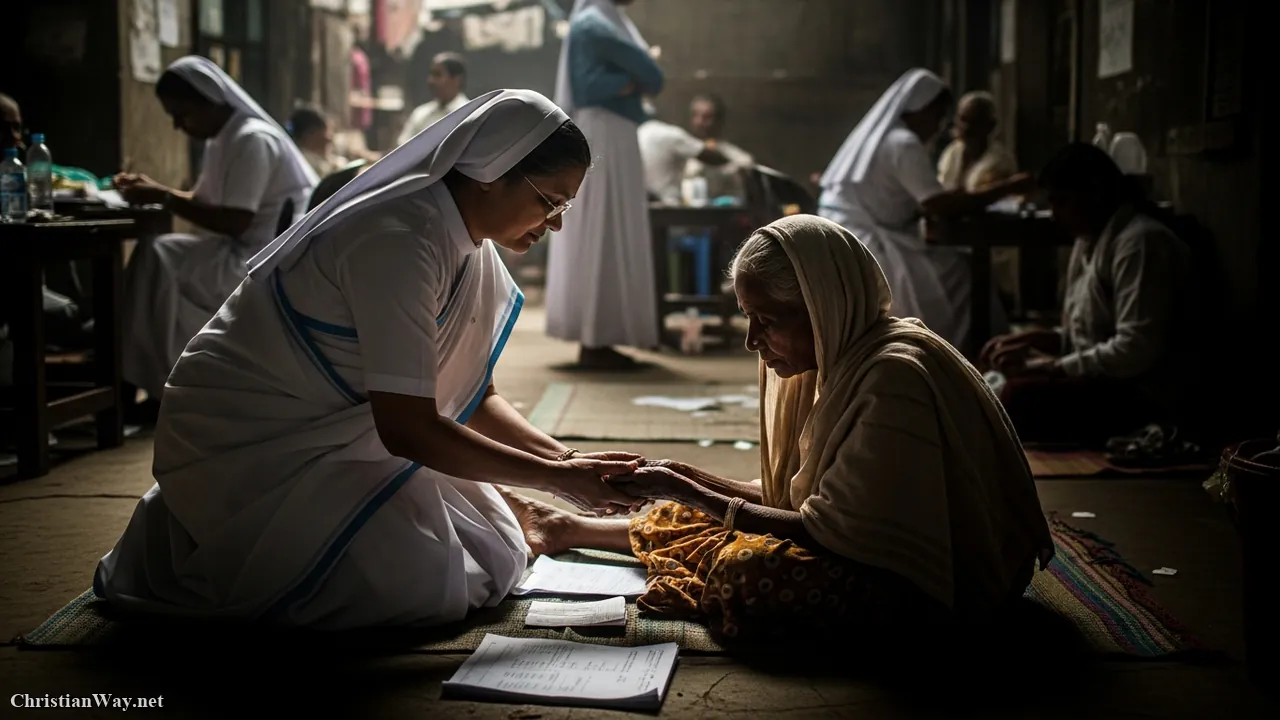
The title “saint of the gutters” has become closely associated with Mother Teresa because of her work among people who were dying in the streets of Calcutta. Yet we should hear this title with reverence. She did not go to the gutters because she believed that some people belonged there. She went because she believed no one should be left there alone.
The world can be quick to turn away from suffering. We do this not always because we are cruel, but because suffering frightens us. It reminds us that life is fragile. It tells us that wealth cannot protect us from every loss. It confronts us with questions we would rather avoid: What happens when strength fails? What happens when someone cannot repay us? What happens when love requires sacrifice?
Mother Teresa did not turn away. She walked toward the suffering person. She saw someone who needed to be loved before death, someone who needed to know that their life had meaning, someone who needed to hear that they were not abandoned.
This is the sacredness of every human life. Human dignity does not depend on health, beauty, independence, intelligence, social status, or usefulness. A person remains precious when weak. A person remains precious when elderly. A person remains precious when disabled, sick, poor, imprisoned, grieving, or near death. The value of a human life is not measured by what it produces. It is measured by the love of God.
Mother Teresa’s witness challenges a world that sometimes treats the weak as burdens. She asks us to remember that the person who cannot speak clearly still has a soul. The person who needs care still has dignity. The person who is dying still deserves tenderness. The unborn child, the elderly neighbor, the sick parent, the stranger in need, and the person society has rejected all remain beloved by God.
To defend human dignity is not merely to speak beautiful words. It is to make room. It is to serve. It is to protect. It is to refuse to treat anyone as disposable.
Love Begins at Home
Many people admired Mother Teresa because she served the poor in faraway places. Yet she often reminded people that love begins at home. This was one of her simplest and most searching teachings. We may dream of changing the world while neglecting the people closest to us. We may speak about compassion while remaining impatient with our family. We may care deeply about public suffering while failing to notice the quiet wounds within our own homes.
Love begins in the ordinary places where God has placed us. It begins with the way we speak to our spouse when we are tired. It begins with the patience we show our children when they make mistakes. It begins with the attention we give to an aging parent. It begins with forgiving a sibling. It begins with listening to a friend who is struggling. It begins with resisting the temptation to gossip, criticize, or humiliate.
This does not mean that family life is always easy. Many homes carry pain. There are families divided by old wounds, misunderstandings, addiction, financial stress, illness, betrayal, and grief. Some people long for a loving home because they never experienced one. Mother Teresa’s words must never be used to make anyone feel guilty for circumstances they cannot control.
But her message remains true: every person can begin where they are. A home can become more peaceful through one act of kindness. A relationship can begin to heal through one honest apology. A child can feel safer through one patient response. A lonely person can feel remembered through one visit or message.
The love of Christ is not always dramatic. Often, it is quiet. It is the love that chooses gentleness when irritation is easier. It is the love that offers help without waiting to be asked. It is the love that stays present when another person is difficult to love.
The Vocation of Small Things
Mother Teresa is remembered for saying that we are not all called to do great things, but we can do small things with great love. This is not an invitation to settle for a shallow life. It is an invitation to understand the greatness hidden within ordinary faithfulness.
A glass of water given with kindness can become holy. A meal prepared for someone who is tired can become holy. A room cleaned without complaint can become holy. A child comforted after a bad dream can become holy. A difficult conversation handled with patience can become holy. A prayer offered for someone who has hurt us can become holy.
The world often teaches us that only large achievements matter. We are encouraged to seek attention, recognition, success, and influence. But the Kingdom of God often grows in ways the world does not notice. Jesus speaks of a mustard seed, small and easily overlooked, yet capable of becoming something large enough to offer shelter.
The small acts of love we offer each day may seem insignificant. Yet when they are given to Christ, they become part of His work in the world. We may never see the full fruit of our kindness. We may never know how a gentle word changed another person’s day. We may never know how a hidden prayer strengthened someone in a moment of despair. But God sees.
The Dark Night of Faith
One of the most moving and misunderstood parts of Mother Teresa’s spiritual life is the long darkness she experienced in prayer. After her death, letters written to spiritual directors and close spiritual guides revealed that for many years she felt little or no emotional consolation in her relationship with God. Though she continued to serve, pray, and speak about the love of Christ, she often experienced inward dryness, loneliness, and a painful sense of God’s absence.
This revelation surprised many people. The world had seen Mother Teresa as a radiant figure of faith. People assumed that someone who spoke so confidently about Christ must always feel His presence. But the spiritual life is often more mysterious than that. Faith is not always a feeling. Love for God is not always accompanied by comfort.
Many believers know this struggle. There are seasons when prayer feels alive and peaceful. Scripture seems to speak directly to the heart. We sense God’s nearness in a deep and consoling way. But there are also seasons when prayer feels dry. We kneel, yet our minds wander. We ask for help, yet answers do not come. We attend worship, yet feel empty. We wonder whether God has forgotten us.
Mother Teresa’s hidden darkness teaches us that such experiences do not necessarily mean that faith has failed. Sometimes faith is purified precisely when consolation disappears. The soul continues to say yes to God, not because it feels rewarded, but because it trusts His love even in darkness.
Jesus Himself entered darkness on the Cross. He cried, “My God, my God, why have you forsaken me?” (Matthew 27:46). These words do not mean that the Father truly abandoned the Son. They reveal the depth to which Christ entered human suffering. He entered the place where people feel alone. He entered the cry of every heart that wonders whether anyone is listening.
Mother Teresa’s darkness joined her more deeply to this mystery. Her service was not built on constant emotional comfort. It was built on fidelity. She continued to love when she did not feel love. She continued to pray when prayer felt empty. She continued to serve when her own heart was carrying pain.
Light That Shines in Darkness
The darkness of Mother Teresa’s soul did not extinguish her mission. In a mysterious way, it made her witness even more profound. She did not serve the poor because she always felt strong. She served because she believed that Christ was present, even when she could not sense Him.
This is a powerful word for anyone who feels weak today. You may be faithful and still feel tired. You may pray and still have questions. You may love God and still experience sadness. You may serve others while carrying your own hidden wounds. None of this means that you are failing.
The Christian life is not a path in which every day feels bright. It is a journey through joy and sorrow, consolation and dryness, strength and weakness. What matters is not whether we always feel close to God. What matters is whether we continue to turn toward Him.
The Gospel tells us, “The light shines in the darkness, and the darkness has not overcome it” (John 1:5). The light of Christ does not always remove darkness immediately. But darkness cannot defeat it. Even when we cannot see the road ahead, Christ remains with us.
Mother Teresa’s hidden suffering invites us to become more compassionate toward those who struggle silently. Many people smile while carrying grief. Many continue to work while facing anxiety. Many care for others while feeling empty inside. A word of understanding, a prayer, or a simple presence can become a ray of light in someone’s darkness.
Mercy Without Conditions
Mother Teresa’s life was an expression of mercy. She did not serve only people who could repay her. She did not offer compassion only to those who were easy to love. She cared for people in situations that many others found uncomfortable or frightening.
This is the mercy of Christ. Jesus did not wait for sinners to become perfect before He approached them. He ate with tax collectors. He spoke to people others avoided. He touched the sick. He welcomed children. He forgave the woman caught in sin. He restored dignity to those who had been shamed by society.
Mercy is not weakness. Mercy is the strength to love when there is no reward. It is the courage to see a person’s humanity beneath their wounds, mistakes, or reputation. It is the willingness to believe that no one is beyond the reach of grace.
This does not mean that mercy ignores truth. Mother Teresa believed deeply in the truth of the Gospel and the moral call of Christian life. But she understood that truth must be offered with love. A truth spoken without compassion can become a weapon. A moral teaching presented without tenderness can push a wounded person further into despair.
Christ calls us to hold truth and mercy together. We are to name sin honestly, but never to hate the sinner. We are to defend life, but never to abandon people in pain. We are to seek justice, but never to lose compassion. We are to remain faithful to what is right, while remembering that we ourselves depend on the mercy of God every day.
A Mother to the Lonely
There is a reason why people around the world called her “Mother.” The title was not only connected to her religious vocation. It reflected the kind of presence she offered. A mother sees the person who is overlooked. A mother notices hunger. A mother recognizes tears that others miss. A mother gives comfort, even when she is tired.
Mother Teresa became a spiritual mother to countless people because she made others feel seen. She looked into the eyes of those who had been ignored. She touched people whom others were afraid to touch. She spoke to them as persons, not as problems.
Our world has many people who are lonely. Some are lonely because they live alone. Others are lonely within a marriage, a family, a school, or a workplace. Some people are lonely because they are grieving. Some are lonely because they are ashamed of past choices. Some are lonely because they believe no one could understand their pain.
Mother Teresa reminds us that we do not have to solve every problem in order to love someone. Sometimes the greatest gift is presence. We can sit beside the grieving. We can listen to the anxious. We can call the person who has withdrawn. We can welcome the newcomer. We can visit the sick. We can ask someone, “How are you really doing?” and wait long enough to hear the answer.
This is how the love of Christ becomes visible. Not always through grand speeches, but through attention. Through patience. Through staying.
The Church Renewed by Love for the Least
The Church is renewed whenever Christians return to the heart of the Gospel. She is renewed when believers remember that Jesus came not to be served, but to serve. She is renewed when the poor are welcomed, when children are protected, when the sick are cared for, when the sinner is invited home, and when the lonely are not forgotten.
Saint Mother Teresa of Calcutta did not attempt to renew the world through arguments alone. She renewed hearts through acts of mercy. She showed that the credibility of Christian faith is closely connected to the way Christians love.
The Church speaks of doctrine, worship, sacraments, prayer, and moral truth because these things lead us toward Christ. But all of them must bear fruit in love. Saint Paul writes, “If I have faith that can move mountains, but do not have love, I am nothing” (1 Corinthians 13:2).
This is a serious and beautiful challenge. We may know many religious truths, yet remain impatient. We may attend worship faithfully, yet refuse to forgive. We may defend the Church publicly, yet ignore the person suffering at our door. Mother Teresa reminds us that faith becomes believable when it becomes compassionate.
The renewal of the Church does not begin only in large institutions or public events. It begins in the heart. It begins when someone chooses to pray instead of complain. It begins when a family chooses reconciliation. It begins when a parish notices the lonely. It begins when a Christian serves quietly without seeking praise.
Every act of love offered in the name of Christ becomes a small renewal of the world.
A Saint for Those Who Feel Small
Many people look at the life of Mother Teresa and feel admiration, but also distance. They may think, “I could never do what she did. I do not have her courage. I do not have her faith. I do not have the opportunity to serve in such dramatic ways.”
But Mother Teresa would likely remind us that we are not called to copy another person’s vocation. We are called to be faithful to our own. God does not ask every person to travel to Calcutta. But He does ask every person to love where they are.
The question is not, “Can I do everything?” The question is, “What is Christ asking of me today?” Perhaps He is asking you to forgive. Perhaps He is asking you to pray for someone you have stopped caring about. Perhaps He is asking you to be more patient with your family. Perhaps He is asking you to notice the poor person on your street. Perhaps He is asking you to give time, money, attention, or mercy.
No act of love is too small when it is offered to God. The hand that feeds a child, the voice that comforts a friend, the person who sits with someone dying, the worker who acts honestly, the student who refuses cruelty, the elderly person who prays faithfully—all of these can become instruments of God’s mercy.
We do not need to be famous to be holy. We need only to belong to Christ.
Reflect and Pray
Dear friends, Saint Mother Teresa of Calcutta teaches us that the world is changed when we allow the love of Jesus to enter the smallest parts of our lives. She teaches us to see Christ in the poor, the lonely, the sick, the forgotten, and the wounded. She teaches us that a life of prayer must become a life of love.
Perhaps there is someone near you who is waiting to be seen. Perhaps there is a person who needs forgiveness, encouragement, food, comfort, or simply your presence. Perhaps you are the one who feels unseen, wounded, or alone. Bring all of this to Christ.
Do not be afraid of your weakness. Do not be ashamed of your need. Jesus thirsts for you. He desires your heart. He does not ask you to become perfect before coming to Him. He asks only that you open the door.
May Saint Mother Teresa of Calcutta pray for us, that we may love with humility, serve with tenderness, remain faithful in darkness, and recognize Christ in every person placed before us.
Lord Jesus Christ, You thirst for our love and come to us in the poor, the suffering, and the forgotten. Through the intercession of Saint Mother Teresa of Calcutta, give us eyes that see with compassion, hands that serve with gentleness, and hearts that remain faithful even in darkness. Teach us to love in small things with great love, until the light of Your mercy shines through our lives. Amen.
— Fr. John Matthew