Dear friends in Christ,
There are saints whose lives are remembered through many written pages: sermons, letters, miracles, journeys, and dramatic moments preserved clearly through the centuries. Then there are saints whose names reach us almost like a quiet lamp from a distant night. Saint Anacletus, also known as Cletus, belongs to this second kind of witness. We know comparatively little about the outward details of his life, yet the Church has remembered him with reverence as one of the earliest successors in the Church of Rome, serving in the fragile years after the apostolic age had begun to take root.
His story is precious precisely because it teaches us that not every faithful life is recorded in great detail. Not every servant of Christ is remembered by dramatic speeches. Some strengthen the Church through steady prayer, patient leadership, quiet courage, and the humble work of helping others remain close to the Gospel. Their names may not fill many pages of history, but their faithfulness becomes part of the foundation upon which later generations stand.
Saint Anacletus lived at a time when Christianity was still young. The first witnesses of the Resurrection had preached Christ crucified and risen. Communities of believers were gathering in homes, praying together, breaking bread, caring for the poor, and learning how to remain faithful in a world that often misunderstood them. The Church did not yet possess the visible strength, institutions, or security that would come in later centuries. She was a pilgrim people, small in number yet filled with the promise of Christ.
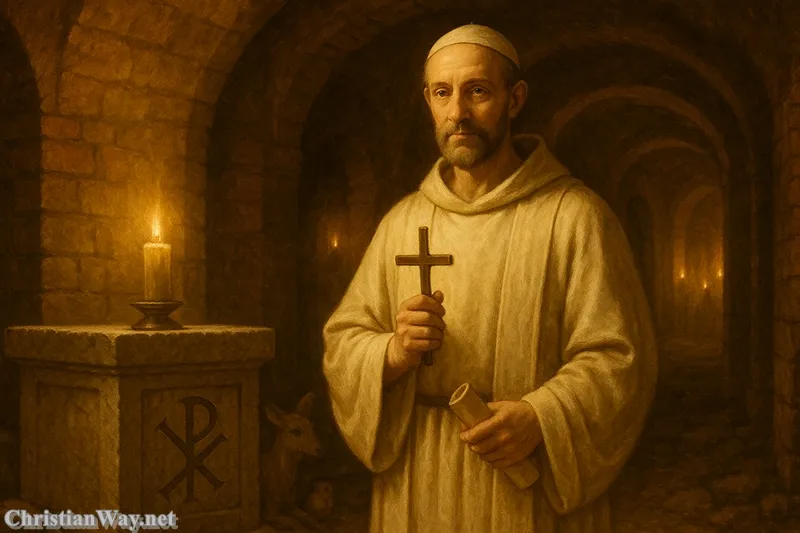
To lead during such a time required courage. It required humility. It required a heart that trusted the words of Jesus: “I am with you alway, even unto the end of the world” (Matthew 28:20). Saint Anacletus could not rely on worldly power. He could not protect the Church through wealth, armies, or public influence. His strength had to come from the same place from which the Church has always drawn her life: the risen Christ.
The witness of Saint Anacletus speaks gently to Christians today. We too live in a world where faith can feel fragile. We see confusion, distraction, indifference, suffering, division, and fear. We may wonder whether our small acts of prayer, service, honesty, and love truly matter. Saint Anacletus reminds us that the Kingdom of God often grows through hidden faithfulness. A life offered quietly to Christ can strengthen more people than we may ever know.
Biographical and Spiritual Profile
| Attribute | Detail |
|---|---|
| Name | Saint Anacletus, also called Cletus or Anencletus |
| Place in the Early Church | Traditionally remembered as the third Bishop of Rome and third Pope |
| Pontificate | Traditionally dated around 80–92 |
| Predecessor | Saint Linus |
| Successor | Saint Clement I |
| Historical Record | Limited; many details are preserved through later tradition rather than direct contemporary writings |
| Spiritual Witness | Humble continuity, unity in apostolic faith, pastoral steadiness, and service to the growing Church |
The historical record surrounding Saint Anacletus is brief, but the Holy See’s traditional list places him between Saint Linus and Saint Clement in the earliest succession of Roman bishops.
A Shepherd in the Dawn of the Church
To understand Saint Anacletus, we must first enter the spiritual atmosphere of the early Church. Christianity was not yet a respected religion of the Roman Empire. Believers did not gather in magnificent cathedrals. They often met in homes, in hidden places, or wherever a small community could pray together in safety and love.
The Church was still learning how to preserve the apostolic faith while welcoming people from many backgrounds. Some believers had come from Jewish roots and knew the Scriptures of Israel deeply. Others had come from the nations and were hearing the name of Jesus for the first time. Some were wealthy, while others were poor. Some were free, while others were slaves. Yet all were called into one body through baptism and faith in the risen Lord.
Saint Paul wrote, “For by one Spirit are we all baptized into one body” (1 Corinthians 12:13). These words were not merely a beautiful idea. They were a difficult reality to live. People of different cultures, languages, social positions, and personal histories were asked to become brothers and sisters in Christ.
The task of early Christian leaders was therefore not simply organizational. It was deeply spiritual. They had to help believers remember who they were. They had to guard the Gospel from confusion. They had to encourage the weak, comfort the grieving, correct those who had wandered, and preserve unity among people who were still learning how to love one another as Christ had commanded.
This is the world in which Saint Anacletus served.
He was not asked to create a Church from nothing. Christ had already founded His Church. The apostles had already proclaimed the Resurrection. The Holy Spirit had already descended at Pentecost. But Saint Anacletus was called to continue the work of faithfulness. He helped carry forward what he had received.
This is one of the most beautiful meanings of Christian leadership. A faithful shepherd does not invent a new Gospel. He receives the Gospel with gratitude, guards it with humility, and hands it on with love. He does not place himself at the center. He points toward Christ.
The Strength of Those Who Continue
Many people admire beginnings. We celebrate the first person to dream, the first to build, the first to speak, and the first to take a brave step. But there is also holiness in continuing.
Someone must remain after the first excitement fades. Someone must keep praying after a movement becomes ordinary. Someone must teach children the faith after the original witnesses have gone home to God. Someone must preserve unity when misunderstandings arise. Someone must keep the lamp burning.
Saint Anacletus belongs to these faithful servants of continuity.
The Church needed apostles who proclaimed Christ boldly. But she also needed shepherds who would strengthen communities after the apostles had gone. She needed men and women who would keep gathering the faithful, teaching the truth, caring for the poor, and celebrating the life of Christ in worship.
There is a lesson here for every Christian. Not all of us are called to begin great things. Many of us are called to continue faithfully in the place where God has already planted us.
A mother continues to pray for her children year after year. A father continues to work honestly, even when no one praises him. A priest continues to celebrate the sacraments in seasons of consolation and fatigue. A teacher continues to form young minds. A friend continues to remain present during another person’s suffering.
The world may not notice such faithfulness. Heaven does.
A Name That Speaks of Unity
The names Anacletus and Cletus have been connected in Christian memory from the earliest centuries. Historical sources sometimes use the names differently, and ancient lists do not always agree in every detail. Yet the Church has traditionally remembered them as referring to the same early successor of Saint Peter.
This small historical complexity can become a spiritual lesson. The Church is not held together by perfect human memory, flawless historical records, or the strength of individual personalities. She is held together by Christ.
The names of early shepherds may sometimes seem distant to us. Their stories may not be preserved as clearly as those of Saint Peter, Saint Paul, Saint John, or the great saints of later centuries. Yet their place in the Church’s memory reminds us that the Gospel has always been carried through generations of ordinary believers.
There is something deeply consoling about this. God does not build His Church only through famous people. He also works through those who are remembered only by a name, a brief line, a quiet tradition, or a hidden act of faithfulness.
The Lord knows every servant who has loved Him.
He knows the grandmother who taught a child to pray. He knows the man who worked quietly to support his family with integrity. He knows the woman who cared for a sick relative without recognition. He knows the believer who remained faithful through years of loneliness. He knows the person who returned to confession after a long absence and began again.
Human history may forget many names. God does not.
Jesus says, “Rejoice, because your names are written in heaven” (Luke 10:20). This promise is greater than earthly recognition. Saint Anacletus is remembered because he belonged to Christ and served Christ’s people. His life invites us to seek the same grace.
The Church Is More Than Its Visible Leaders
It is easy to think of the Church only through visible figures: popes, bishops, priests, theologians, missionaries, saints, and public teachers. These people matter. Their leadership can bless generations. But the Church is also carried through the hidden faithfulness of countless believers.
The Church survives because ordinary Christians pray.
She survives because parents teach children to say the name of Jesus.
She survives because believers forgive when resentment would be easier.
She survives because people visit the sick, serve the poor, and care for those who feel forgotten.
She survives because someone keeps the faith alive in a home where others have grown distant.
Saint Anacletus reminds us that the Church is never only a structure. She is a living body. Christ is her head. Every baptized person has a place within her life.
When we feel small, we should remember this. The smallest faithful act can become part of something much larger than ourselves.
Holding Fast to the Apostolic Faith
One of the great needs of the early Church was the preservation of apostolic teaching. The first Christians had received the Gospel from those who had known Jesus, seen His works, witnessed His death, and proclaimed His Resurrection.
But as the years passed, the Church faced a new challenge: how could the faith be handed on faithfully to those who had not seen Christ with their physical eyes?
The answer was not merely through written words, though the Scriptures were and remain essential. It was also through worship, preaching, prayer, the teaching of the Church, the witness of holy lives, and the continuity of pastoral care.
Saint Paul urged the Christians of Thessalonica, “Stand fast, and hold the traditions which ye have been taught” (2 Thessalonians 2:15). This was not a call to cling to empty customs. It was a call to remain faithful to the living truth of Jesus Christ.
The early Church had to resist the temptation to reshape the Gospel according to convenience. Some people wanted a faith without the Cross. Others wanted a Christ who fit easily into the expectations of the world. Others were tempted to divide believers into groups based on personalities, social status, or private interpretations.
But the Church had received something sacred. She had received the proclamation that Jesus Christ is Lord, that He died for our sins, rose from the dead, and opened the way to the Father.
Saint Anacletus served in an age when this faith needed to be protected with courage and tenderness. He belonged to the generation entrusted with helping Christians remain rooted in what they had received.
Faithfulness Is Not Stagnation
Some people hear the word “tradition” and imagine something lifeless, rigid, or distant from real life. But Christian tradition, at its best, is living memory.
It is the Church remembering who Jesus is.
It is the Church remembering His words when the world forgets them.
It is the Church remembering that mercy and holiness belong together.
It is the Church remembering that the Cross leads to Resurrection.
It is the Church remembering that every human person is loved by God.
Saint Anacletus did not strengthen the Church by offering novelty. He strengthened her by helping believers remain close to the apostolic faith.
This is needed today as much as ever. We live in a time when many voices compete for our attention. People promise happiness, success, identity, and freedom in countless different ways. Yet the heart remains restless when it is separated from God.
The Christian faith does not become outdated because the world changes. The human heart still longs for forgiveness. It still longs for truth. It still longs to be loved. It still fears death. It still seeks meaning.
The Gospel remains new because Christ remains alive.
The Quiet Work of Building Communion
The title of pope or bishop can sound powerful to modern ears. But in the early Church, leadership was not a position of worldly safety. To be known as a Christian leader could bring suspicion, danger, suffering, or death.
The shepherds of the early Church had to lead with courage. Yet their courage was often quiet. They cared for communities that were small, vulnerable, and sometimes divided. They had to encourage believers who felt afraid. They had to remind Christians that Christ was greater than the hostility of the world.
Saint Anacletus likely knew that the Church could not survive through fear. A frightened community can become closed, suspicious, and divided. But a community rooted in Christ can remain united even when circumstances are difficult.
The Acts of the Apostles gives us a beautiful image of the first believers: “They continued stedfastly in the apostles’ doctrine and fellowship, and in breaking of bread, and in prayers” (Acts 2:42).
This verse contains the foundation of Christian life.
The apostles’ doctrine gave believers truth.
Fellowship gave them unity.
The breaking of bread gave them spiritual nourishment.
Prayer gave them strength.
These four elements remain essential today. A Church without truth loses direction. A Church without fellowship becomes cold. A Church without worship becomes weak. A Church without prayer forgets that her life comes from God.
Saint Anacletus served the Church in this spirit. His legacy is not a collection of famous speeches. It is the preservation of communion. It is the quiet work of helping believers remain one in Christ.
Unity Is a Spiritual Work
Christian unity is not easy. It was not easy in the first century, and it is not easy now.
People bring different experiences, wounds, cultures, personalities, and opinions into the Church. Some are quick to speak. Others are quiet. Some prefer old customs. Others long for new approaches. Some are wounded by past experiences. Others are impatient with anything that slows them down.
Yet Jesus prayed, “That they all may be one” (John 17:21).
Unity does not mean that every person becomes identical. It does not mean that every question disappears. It means that Christ becomes greater than our divisions.
Saint Anacletus reminds us that unity must be protected. It must be prayed for. It must be served through humility.
We strengthen unity when we speak with kindness.
We strengthen unity when we refuse gossip.
We strengthen unity when we pray for those with whom we disagree.
We strengthen unity when we remember that no Christian belongs to himself alone.
The Church is the family of God. Families can struggle, but they are called to remain in love.
A Faith That Grew in Hidden Places
One of the most moving aspects of the early Church is that it grew without the things the world usually considers necessary for success.
It had no large buildings.
It had no political power.
It had no armies.
It had no public campaigns.
It had no wealth to impress the Empire.
And yet it grew.
Why?
Because people encountered the living Christ.
They saw Christians forgive when others sought revenge.
They saw believers care for the sick and poor.
They heard the Gospel preached with courage.
They saw martyrs refuse to deny the Lord.
They discovered communities where people were welcomed as brothers and sisters.
The Church grew because the love of Christ became visible.
Saint Anacletus served during this hidden growth. He did not need to make the Church impressive by worldly standards. He needed to help her remain faithful.
This is a powerful lesson for modern Christians. We can become anxious when the Church seems weak in the eyes of the world. We may worry about numbers, influence, reputation, criticism, or cultural change.
These concerns can be understandable. But the Church has never depended ultimately on public approval. She depends on Christ.
Jesus said that the Kingdom of God is like a mustard seed: small, almost unnoticed, yet destined to grow (Matthew 13:31–32). The Kingdom often begins in places the world overlooks.
A quiet prayer before sleep.
A Bible opened after years of silence.
A family meal begun with thanksgiving.
A person choosing forgiveness.
A teenager deciding not to follow a harmful path.
A believer visiting someone who is lonely.
These may seem small. But God can use small things to change lives.
The Hidden Seeds of Holiness
Many people become discouraged because they do not see immediate results from their faithfulness. They pray for years and still wait. They try to raise children in faith and fear they are failing. They serve in a parish and wonder whether anyone notices. They seek to live honestly in a difficult workplace and feel alone.
Saint Anacletus offers a quiet answer: remain faithful.
The seeds of holiness often grow beneath the surface.
A child may remember a parent’s prayer decades later.
A kind word may prevent someone from giving up.
A quiet act of charity may become the first sign that God has not forgotten a suffering person.
A faithful example may inspire someone who never tells you.
The Lord sees the work done in secret.
Jesus says, “Thy Father which seeth in secret shall reward thee openly” (Matthew 6:4). This does not mean that every faithful act will receive praise in this world. It means that nothing done in love is lost before God.
The Courage to Serve Without Recognition
Saint Anacletus is a patron in spirit for all those who serve without applause.
The world often tells us that our lives matter only if we are visible. We are encouraged to display achievements, seek attention, measure influence, and compare ourselves with others. Even good works can become distorted when we begin to do them mainly to be admired.
But the Gospel teaches another way.
Jesus washed the feet of His disciples.
He touched the sick.
He spoke with those others avoided.
He carried the Cross.
He gave Himself without demanding recognition.
Saint Anacletus followed this path of service. His name is remembered, but his personal life remains largely hidden. Yet the Church has not forgotten him. His hiddenness became part of his witness.
There is freedom in not needing to be seen by everyone.
A person who serves Christ does not need to win every argument.
A person who loves Christ does not need to prove their importance.
A person who belongs to Christ can do good quietly and trust that God sees.
This does not mean that we should hide the Gospel out of fear. Christians are called to witness boldly. But our goal is not to make ourselves famous. Our goal is to make Christ known.
John the Baptist expressed this beautifully when he said of Jesus, “He must increase, but I must decrease” (John 3:30).
This is the secret of spiritual freedom.
When God Asks Us to Be Faithful, Not Famous
There are people who will never preach before crowds, write books, lead ministries, or receive public recognition. Yet they may be among the holiest people in the Church.
The elderly woman who prays daily for her family.
The worker who refuses dishonesty.
The young person who remains pure in a culture that mocks holiness.
The parent who sacrifices quietly for children.
The caregiver who shows tenderness to someone who cannot repay it.
The believer who remains faithful during illness.
These people may never be known by the world. But they are known by God.
Saint Anacletus reminds us that the strength of the Church has always rested upon such hidden servants.
The Church as a Home for the Wounded
The early Church was not made up of perfect people. It was made up of people who had encountered mercy.
Some had been sinners.
Some had been fearful.
Some had been selfish.
Some had been proud.
Some had suffered terribly.
Yet Christ called them into a new life.
The Church needed leaders who could hold truth and mercy together. A leader who speaks only of rules can crush wounded hearts. A leader who speaks only of comfort without truth can leave people lost. But Christ offers both: mercy that heals and truth that sets free.
Saint Anacletus served in a Church shaped by this tension. Christians were called to holiness, but they were also called to forgive. They were told to reject sin, but they were also taught that God’s mercy is greater than human failure.
Saint Paul writes, “Bear ye one another’s burdens, and so fulfil the law of Christ” (Galatians 6:2).
This is what the Church is meant to be: a people who help one another carry burdens.
There are many burdens in the world today. People carry grief, anxiety, addiction, family conflict, financial stress, shame, illness, loneliness, and fear about the future. Some people come to church carrying wounds they have never spoken aloud.
The Church must be a place where truth is spoken gently, where repentance is possible, where the lonely are welcomed, and where no one is reduced to their worst moment.
The Mercy That Keeps People Near Christ
There are people who have stopped praying because they feel unworthy. There are people who avoid churches because they are afraid of judgment. There are people who believe they have gone too far for God to receive them.
But Christ says, “Him that cometh to me I will in no wise cast out” (John 6:37).
Saint Anacletus reminds us that the Church is strongest when she reflects this heart of Christ.
We do not welcome people because sin does not matter. We welcome people because grace is real.
We do not ignore wounds. We bring them to Jesus.
We do not pretend that conversion is easy. We walk beside one another.
We do not make ourselves the judge of another soul. We point people toward the mercy of God.
This is how the Church remains alive through every generation.
A Legacy of Steadfastness
When we think of the legacy of Saint Anacletus, we should not imagine that it rests on grand monuments or detailed writings. His legacy is simpler and perhaps more enduring.
He helped carry the Church through a vulnerable season.
He stood in the succession of those entrusted with pastoral responsibility in Rome.
He served after Saint Linus and before Saint Clement.
He belonged to the generation that helped preserve the apostolic faith after the first proclamation of the Gospel had begun to spread beyond Jerusalem.
The early Church needed leaders who would not abandon their people when danger came. She needed shepherds who would guard unity, encourage prayer, and keep Christ at the center.
Saint Anacletus reminds us that history is often sustained by people who quietly refuse to let faith die.
A nation may remember kings and generals. The Church remembers saints.
A culture may celebrate wealth and influence. Heaven celebrates faithfulness.
A person may feel small and unnoticed. But if that person belongs to Christ, their life has eternal meaning.
Saint Anacletus stands before us as a witness of steadfastness. He teaches us that faith is not always dramatic. Sometimes faith is simply remaining where God has placed us and continuing to love.
What His Witness Means for Us Today
The life of Saint Anacletus asks us a few gentle but searching questions.
Are we faithful in the small responsibilities God has given us?
Do we remain close to Christ when life feels ordinary?
Do we strengthen unity in our families, parishes, and communities?
Do we preserve the faith entrusted to us, or do we allow distraction to weaken our spiritual life?
Do we pray for the Church and for those who lead her?
Do we remember that Christ can use even a quiet life for His glory?
These questions are not meant to burden us. They are meant to awaken us.
The world does not need more Christians who seek attention. It needs Christians who seek holiness.
It needs people who pray.
It needs people who forgive.
It needs people who serve.
It needs people who keep hope alive.
Saint Anacletus reminds us that the Church has always been strengthened by such people.
Reflect and Pray
Dear friends, Saint Anacletus comes to us from a distant century, yet his witness feels close to the heart. He reminds us that Christ does not ask every person to become famous. He asks us to become faithful.
Perhaps your life feels ordinary at this moment. Perhaps you are carrying responsibilities that no one sees. Perhaps you are trying to keep faith alive in your home, your work, or your heart. Perhaps you feel too small to make any difference.
Do not lose heart.
The early Church was small. It was vulnerable. It was often misunderstood. Yet Christ was with her. The same Christ is with you now.
Your prayer matters.
Your faithfulness matters.
Your forgiveness matters.
Your quiet acts of love matter.
May Saint Anacletus pray for us, that we may remain steadfast in the apostolic faith, humble in service, generous in mercy, and strong in the hope of Jesus Christ.
Lord Jesus Christ,
You strengthened Your early Church
through the faithful service of Saint Anacletus.
Teach us to remain close to You
when faith feels difficult or unseen.
Give us courage to guard the truth of the Gospel,
hearts that seek unity rather than division,
and hands ready to serve those in need.
Bless Your Church throughout the world.
Strengthen her shepherds, comfort her wounded children,
and make every Christian home
a place of prayer, mercy, and hope.
May we live not for our own glory,
but for the glory of Your holy name.
Amen.
May the peace of Christ guard your heart, and may the quiet faithfulness of Saint Anacletus strengthen you on every step of the way.
— Fr. John Matthew