Dear friends in Christ,
There are moments in the history of the Church when the voice of one faithful servant becomes a lamp for generations yet unborn. Saint Clement I lived near the end of the first century, when many of the apostles had already completed their earthly mission and the young Church was learning how to remain faithful in a difficult world. Christians had no grand buildings, no public power, and no guarantee of safety. They were a small people scattered across cities of the Roman Empire, gathering for prayer, listening to the Scriptures, breaking bread, caring for the poor, and confessing Jesus Christ as Lord.
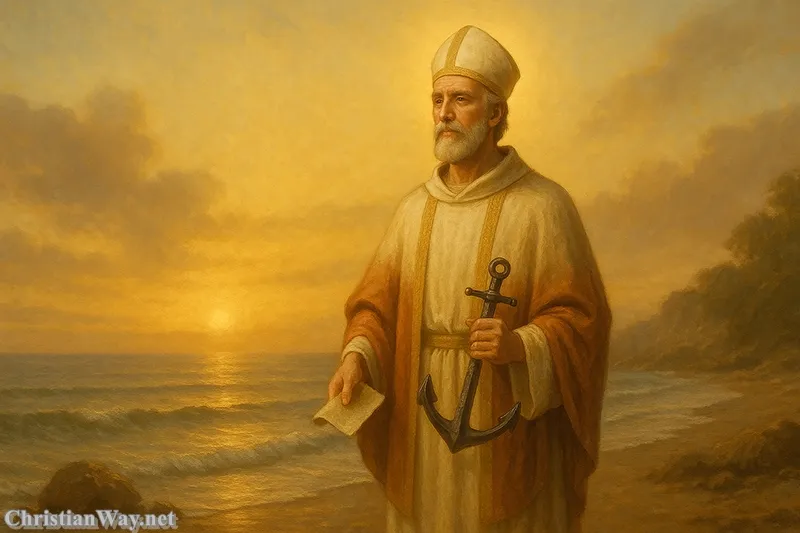
In this fragile and holy beginning, Saint Clement I emerged as a shepherd whose concern reached beyond his own local community. Catholic tradition remembers him as the fourth Pope of the Catholic Church, the third successor of Saint Peter after Linus and Anacletus. He served the Church of Rome during the final years of the first century, close enough to the apostolic age that later writers remembered him as a man who had received the echo of apostolic preaching and tradition.
Yet Saint Clement I is not remembered simply because he held an office in the Church. He is remembered because, when a Christian community was wounded by conflict, he did not answer division with further division. He called believers back to humility, repentance, peace, order, and love. He reminded them that the Church belongs to Christ, not to the loudest voice, the strongest personality, or the most determined faction.
This message is still deeply needed. We live in an age when people are often quick to argue and slow to listen. Families can be divided by old wounds. Communities can become bitter over differences. Christians may be tempted to treat one another as enemies rather than brothers and sisters redeemed by the same Lord. Even within the Church, we can forget that truth must always be carried by love, and that faithfulness must never become an excuse for pride.
Saint Clement I stands before us as a gentle but firm witness. He teaches us that unity is not weakness. It is not pretending that problems do not exist. It is not allowing confusion or injustice to continue without being addressed. True unity is born when people return together to Christ, humble themselves before God, seek forgiveness, and remember that no personal ambition is worth the breaking of the Body of Christ.
His life reminds us that the Church has always needed faithful guardians of peace. Some are bishops, priests, pastors, and teachers. Others are parents who calm a divided home, grandparents who pray for reconciliation, young people who refuse to spread hatred, workers who choose honesty over rivalry, and ordinary believers who remain gentle when the world around them becomes harsh.
Saint Clement I invites us to ask a quiet question: Am I helping to build peace in the places where God has placed me, or am I adding to the noise, fear, and division?
Saint Clement I at the Edge of the Apostolic Age
The historical details of Saint Clement I’s life are limited. We do not know every moment of his childhood, his conversion, or his daily ministry in Rome. The earliest Christians were not writing biographies in the way modern historians do. Their concern was the Gospel, the worship of God, the life of the community, and the faithful handing on of what had been received from the apostles.
Still, the Church preserved an important memory of Clement. He was remembered as Bishop of Rome in the final years of the first century. The Holy See identifies him as the fourth Pope, while Pope Benedict XVI described him as the third successor of Saint Peter, following Linus and Anacletus. This language reflects the Catholic understanding of the succession of bishops in Rome, even though the exact administrative forms of the early Church were simpler than those of later centuries.
The greatness of Clement does not depend upon how many historical details have survived. His greatness is revealed in what remains: a letter written to a suffering and divided Christian community in Corinth. That letter has become one of the most precious texts from the earliest generations after the New Testament.
The Church in Corinth had known conflict before. Saint Paul had already written to the Corinthians about jealousy, factions, pride, moral confusion, and the danger of Christians dividing themselves into competing groups. He pleaded with them in the name of Christ: “I urge you, brothers and sisters, in the name of our Lord Jesus Christ, that all of you agree in what you say, and that there be no divisions among you” (1 Corinthians 1:10).
Years later, the Church in Corinth again fell into serious difficulty. Some elders of the community had been removed by a group of younger members, and the peace of the Church was deeply damaged. Clement, writing from Rome, addressed the crisis with remarkable seriousness and tenderness. He did not treat division as a small inconvenience. He saw it as a spiritual wound that needed healing through humility, repentance, and renewed love.
This is one of the first reasons Saint Clement I remains so important today. He understood that Christian unity is not merely a pleasant idea. It is part of our witness to Christ. When believers become consumed by rivalry, resentment, and self-importance, the world sees something very different from the love Jesus commanded.
Our Lord prayed to the Father, “That they may all be one, as you, Father, are in me and I in you, that they also may be in us” (John 17:21). The unity of Christians is meant to reveal something of the unity between the Father and the Son. It is not simply organizational harmony. It is a visible sign that Christ has gathered people from different histories, personalities, weaknesses, and cultures into one family of faith.
Saint Clement understood that this unity had to be protected. Not with violence. Not through humiliation. Not through human pride. But through the difficult and holy work of calling people back to the heart of the Gospel.
A Shepherd Who Spoke for Peace
Clement’s letter was not written as a personal display of authority. It was written in the name of the Church in Rome to the Church in Corinth. This is important. His concern was not self-promotion. It was communion.
The letter speaks with the voice of a community that grieved over the suffering of another community. Rome was not untouched by the pain of Corinth. The wounded unity of one local Church mattered to another. This reveals something beautiful about early Christianity: believers understood themselves as belonging to one Body.
When one part of the Body suffers, all suffer. When one family is broken, the whole Church is called to pray. When one Christian falls into sin, others are not invited to gloat or condemn, but to mourn, intercede, and seek restoration.
This is very different from the spirit of the world. The world often teaches us to enjoy another person’s failure, to defend our side at any cost, and to treat disagreement as a chance to prove our superiority. But Clement calls Christians to something deeper. He calls them to remember that they belong to Christ before they belong to any faction.
Saint Clement urged the Corinthians toward humility. He warned against envy, rivalry, boasting, and self-assertion. He called believers to seek peace rather than victory over one another. In one passage, he writes, “Let us do all those things which pertain to holiness.”
Holiness, for Clement, was not separated from unity. A person cannot claim to love God while continually tearing down brothers and sisters. A community cannot claim to be faithful while allowing pride and resentment to become stronger than charity.
This is a lesson for every Christian home, parish, school, workplace, and community. Sometimes the greatest act of holiness is not saying the sharpest thing we are capable of saying. Sometimes it is choosing silence until the heart has become gentle. Sometimes it is apologizing first. Sometimes it is listening to someone we have misunderstood. Sometimes it is refusing to repeat a rumor. Sometimes it is praying for a person who has hurt us.
Saint Clement I teaches that peace is not passive. Peace is an act of courage.
The Wound of Division in the Early Church
The early Church was holy, but it was not made up of perfect people. The apostles themselves had to correct misunderstandings, conflicts, jealousies, and divisions. Saint Paul wrote to churches where people argued about leadership, worship, moral behavior, and the place of different cultural traditions.
This should comfort us. Sometimes Christians become discouraged when they see weakness within the Church. They may imagine that the Church should be free from every conflict, every failure, every scandal, and every human limitation. But from the beginning, the Church has been made up of people who need grace.
The Church is holy because Christ is holy. She is sustained by the Holy Spirit, nourished by the Word of God, and sanctified through prayer and sacramental life. Yet her members are still learning how to love. We still carry pride. We still struggle with fear. We still need forgiveness. We still need to return again and again to the Cross.
Saint Clement’s letter shows us that the answer to division is not despair. The answer is conversion.
When the Corinthians became divided, Clement did not tell them that their conflict proved Christianity had failed. He called them back to the mercy of God. He reminded them of the humility of Christ. He encouraged them to remember the examples of faithful servants who had chosen obedience over self-interest.
This is the Christian way. We do not hide sin, but neither do we surrender to it. We name the wound, bring it into the light, seek healing, and begin again.
Every family knows something of this struggle. A harsh word may be spoken. A misunderstanding may grow. Someone may feel unseen, rejected, or taken for granted. Over time, small hurts can become walls. People may live in the same home but carry distance in their hearts.
Saint Clement I would remind us that no wall is stronger than grace when people are willing to humble themselves before God. Reconciliation may take time. Trust may need to be rebuilt slowly. Some wounds require wise counsel, patient conversation, and sincere repentance. But the Gospel never teaches us to accept hatred as permanent.
Jesus says, “Blessed are the peacemakers, for they will be called children of God” (Matthew 5:9). A peacemaker is not someone who avoids difficult truth. A peacemaker is someone who brings Christ into places where sin has caused separation.
The same is true in parishes and Christian communities. Different personalities, preferences, traditions, and opinions can become sources of unnecessary tension. One person wants change quickly. Another fears change. One values silence. Another values activity. One is passionate about teaching. Another is focused on service to the poor. These differences can enrich the Church when they are rooted in love. But when pride enters, even good desires can become weapons.
Clement teaches us to ask: Am I seeking the good of the Church, or am I simply seeking my own way?
Unity Is Not the Same as Uniformity
Christian unity does not mean that every person must have the same personality, culture, or spiritual gift. The apostles themselves were not alike. Peter was bold and impulsive. John was contemplative and deeply tender. Thomas asked difficult questions. Matthew came from a very different background than Simon the Zealot. Paul and Barnabas experienced serious disagreement, yet both continued serving the Gospel.
The Church is not a collection of identical people. It is the Body of Christ, made up of many members.
Saint Paul writes, “There are different kinds of spiritual gifts but the same Spirit; there are different forms of service but the same Lord” (1 Corinthians 12:4–5). Unity is not created by removing all difference. Unity is created when every difference is offered back to Christ in love.
This is why humility is so essential. Pride says, “My way is the only way.” Humility says, “Lord, help me serve Your will.” Pride says, “I must be recognized.” Humility says, “May Christ be glorified.” Pride says, “I will not forgive.” Humility says, “Give me the grace to begin again.”
Saint Clement I did not call the Corinthians to become weak or silent. He called them to become humble. There is a great difference.
Humility is not thinking badly of oneself. It is seeing oneself truthfully before God. It is remembering that every gift has been received. It is knowing that we are sinners in need of mercy. It is recognizing that another person may have wounds we do not understand. It is trusting that Christ is greater than our need to defend ourselves.
In a divided world, humility may be one of the rarest and most beautiful forms of strength.
The Letter That Preserved the Church’s Peace
Clement’s letter to Corinth was written sometime near the end of the first century, traditionally after the persecution associated with the reign of Emperor Domitian. It addressed a conflict that had disturbed the peace of the Corinthian Christians and placed the community’s harmony in danger.
The letter is sometimes called First Clement, or 1 Clement. It is not part of the New Testament, yet it was treasured by many early Christians because it carried the voice of a Church still close to the apostolic generation. Its pages are filled with Scripture, prayer, examples from the history of Israel, reflections on Christ, and practical appeals for peace.
Clement did not treat unity as a human achievement. He rooted it in God. He reminded the Corinthians that they had received grace before they had done anything to earn it. God had called them, forgiven them, and made them His people. Therefore, their lives should reflect the gift they had received.
This is one of the deepest truths of Christian faith. We do not begin with our own goodness. We begin with the mercy of God.
Sometimes people imagine that holiness means climbing upward toward God through effort alone. But the Gospel begins with God coming down to us in Jesus Christ. He seeks the lost. He heals the wounded. He forgives the sinner. He gives us grace before we are able to respond fully.
Clement understood this. His call to repentance was not harsh or hopeless. It was rooted in the belief that God desires to restore His children. He wrote that the blood of Christ had opened the grace of repentance for all humanity.
Repentance is not merely feeling ashamed. It is turning the heart back toward God. It is allowing grace to change the direction of our life. It is admitting where pride, envy, anger, dishonesty, selfishness, or bitterness have taken root within us.
Every Christian community needs this spirit of repentance. When there is conflict, it is easy to focus only on the sins of others. We can become experts at explaining why someone else is wrong. But Clement invites us to begin closer to home. What is happening in my own heart? Where have I contributed to division? Where have I spoken carelessly? Where have I refused to listen? Where have I allowed resentment to become more important than love?
This is not an easy question. Yet it is a freeing one.
The Church cannot be renewed only by criticizing others. She is renewed when believers allow Christ to renew them personally.
Peace Begins With the Conversion of the Heart
There is a temptation to think peace depends first on changing structures, solving arguments, or removing difficult people from our lives. These things may sometimes be necessary. But Christian peace begins even more deeply: it begins when the heart turns toward God.
A person can be surrounded by conflict and still become a source of peace. A parent may be carrying financial worry, illness, or exhaustion, yet speak gently to a child. A teacher may face difficult students, yet refuse to humiliate them. A worker may be treated unfairly, yet choose integrity. A Christian may disagree strongly with another person, yet continue to pray for them.
This is the peace Saint Clement I teaches. It is not superficial calm. It is a peace rooted in Christ.
Jesus says, “Peace I leave with you; my peace I give to you. Not as the world gives do I give it to you” (John 14:27). The world’s peace often depends on circumstances. It disappears when comfort is threatened. Christ’s peace remains even in difficulty because it comes from communion with Him.
Saint Clement’s letter reminds us that peace must be practiced. It is practiced when we apologize. It is practiced when we forgive. It is practiced when we refuse to make another person’s weakness a source of entertainment. It is practiced when we pray for those who oppose us. It is practiced when we choose honesty without cruelty.
The peace of Christ is not weak. It is strong enough to stand in the middle of conflict without becoming consumed by it.
Saint Clement I and the Apostolic Faith
One of the important themes in Clement’s letter is the continuity between Christ, the apostles, and the leaders who served the Christian communities after them. He spoke of Christ being sent by the Father and the apostles being sent by Christ. He then described how the apostles appointed trusted servants to care for the communities that would continue after them.
This teaching was especially important because the early Church needed to remain connected to the Gospel it had received. Christianity was never meant to be reinvented according to the changing preferences of each generation. The Church was called to guard the faith handed down from Christ through the apostles.
For Catholic Christians, this continuity is expressed through apostolic succession: the bishops who succeed the apostles in teaching, worship, pastoral care, and service. The Bishop of Rome, as successor of Saint Peter, holds a particular responsibility for unity within the universal Church.
Yet the spiritual meaning of apostolic continuity belongs to every Christian. It means receiving the faith with gratitude rather than treating it as private property. It means allowing Scripture, prayer, worship, and the wisdom of the Church to shape us. It means remembering that the Gospel is larger than our opinions, our culture, our political loyalties, or the trends of our time.
Saint Clement I did not see ministry as a path to personal power. He saw it as service. The Church’s leaders were called to serve the people of God, preserve communion, celebrate worship faithfully, preach the truth, and care for souls.
This is the pattern of Christ Himself. Jesus said, “The Son of Man did not come to be served but to serve and to give his life as a ransom for many” (Mark 10:45).
Every form of Christian leadership must return to this truth. A bishop, priest, pastor, parent, teacher, employer, or community leader is not called to dominate others. He or she is called to serve.
When authority becomes prideful, people are wounded. When authority becomes humble and Christ-centered, people are strengthened.
Saint Clement reminds us that the Church needs faithful leaders, but she also needs faithful people who pray for those who lead. It is easy to criticize leaders from a distance. Sometimes correction is necessary, and truth must never be hidden. Yet Christians are also called to pray that those entrusted with responsibility may have wisdom, courage, purity of heart, and deep love for the people they serve.
The Faith We Receive Must Become the Faith We Live
It is possible to know many things about Christianity and still fail to live as a disciple. We may know Bible verses, Church history, theological terms, and moral teachings, but if these things do not make us more loving, patient, honest, and humble, then we have not allowed the Gospel to reach the deepest part of our heart.
Saint Clement I speaks not only to scholars or clergy. He speaks to every believer who wants faith to become real.
The faith handed down by the apostles is not merely information. It is life in Christ.
It is the courage to forgive when forgiveness feels impossible. It is the humility to admit when we are wrong. It is the strength to remain honest when dishonesty would be easier. It is the willingness to serve someone who cannot repay us. It is the decision to remain faithful in prayer when God seems silent.
The Church becomes convincing when Christians live this way.
A child who sees a parent praying after an argument learns something about grace. A neighbor who receives kindness from a Christian family sees something of the Gospel. A worker who refuses corruption becomes a witness to Christ. A young person who remains pure, compassionate, and courageous in a cynical world becomes a living sermon.
Saint Clement’s legacy is not only a letter from the past. It is a call to become people who preserve the unity of the Church through the witness of our own lives.
The Church Needs Clement’s Wisdom Today
The world has changed greatly since the first century. We have technology, instant communication, global travel, social media, economic systems, and political divisions that Clement could never have imagined. Yet the human heart remains much the same.
We still struggle with envy. We still want to be admired. We still fear being forgotten. We still become angry when others disagree with us. We still find it difficult to forgive. We still need Christ.
In many ways, the divisions of our age are intensified by speed. A person can speak harshly to thousands of strangers in a few moments. Rumors spread quickly. Misunderstandings become public. People are tempted to react before they pray, judge before they listen, and condemn before they understand.
Saint Clement I offers another way.
He teaches us to slow down before responding. He teaches us to examine our hearts. He teaches us to remember that another Christian is not our enemy simply because we disagree. He teaches us that unity is worth protecting.
This does not mean Christians should abandon truth. Truth matters deeply. The Gospel is not something we may reshape according to convenience. But truth without love becomes hard and cold. Love without truth becomes confused and shallow. Christ calls us to both.
Saint Paul writes, “Speaking the truth in love, we are to grow in every way into him who is the head, Christ” (Ephesians 4:15). Truth must lead us toward Christ. Love must reveal Christ. Neither can be separated from the other.
The Church today needs people who can hold conviction without contempt. She needs people who can disagree without hatred. She needs people who pray before they speak, listen before they judge, and forgive before bitterness becomes permanent.
Perhaps you know someone who has become distant from the Church because of a painful conflict. Perhaps they were wounded by a harsh word, ignored in a time of need, treated unfairly, or made to feel unwelcome. Saint Clement’s message is especially important here. The Church must always be a place where wounded hearts can find healing in Christ.
Every parish, family, and Christian community should ask: Are people encountering the mercy of Jesus among us?
Building Unity in Ordinary Life
The call to unity may sound very large, but it begins in ordinary places.
It begins at the breakfast table, when we choose patience instead of irritation.
It begins in a marriage, when one spouse decides to listen rather than defend.
It begins between parents and children, when forgiveness is offered after a difficult day.
It begins in a workplace, when a person refuses to join gossip or resentment.
It begins in a parish, when someone welcomes the newcomer who seems uncertain or alone.
It begins online, when we choose not to humiliate others for attention.
The unity of the Church is not preserved only through councils, official documents, or public statements. It is preserved through countless hidden acts of love.
Saint Clement I understood that a divided community could not effectively reveal Christ to the world. The same is true today. When Christians love one another faithfully, the world sees something that cannot be explained by politics, success, or personal preference. It sees the grace of God.
Jesus said, “This is how all will know that you are my disciples, if you have love for one another” (John 13:35).
The world may not understand every doctrine immediately. It may not understand every tradition or form of worship. But it can recognize love. It can recognize forgiveness. It can recognize a community where people carry one another’s burdens rather than tearing each other apart.
This is the mission Saint Clement I still gives to the Church.
The Quiet Strength of a Shepherd
Saint Clement I was not remembered because he sought fame. He was remembered because he served faithfully at a time when faithfulness mattered greatly.
There is a kind of leadership the world admires because it is loud, forceful, and impressive. But the leadership of Clement was different. It was the leadership of someone who cared for the Church enough to speak when unity was threatened.
He did not remain silent when conflict was harming the Christian community. Yet he did not speak with cruelty. He called people back to Christ.
This is the quiet strength every Christian should desire.
We need fathers and mothers who lead their homes with prayerful courage. We need teachers who protect the dignity of children. We need pastors and priests who serve without seeking praise. We need young people who are not ashamed of kindness. We need workers who choose honesty when no one is watching.
The Church is strengthened whenever someone chooses service over self-interest.
Saint Clement I reminds us that we may not be called to do famous things, but we are all called to do faithful things. We may never write a letter that is read across centuries. We may never hold an important title. But we can still become builders of peace.
A quiet prayer can build peace.
A sincere apology can build peace.
A meal shared with someone lonely can build peace.
A patient word can build peace.
A refusal to gossip can build peace.
A heart that forgives can build peace.
These small acts are not small in the Kingdom of God.
Reflect and Pray
Dear friends, Saint Clement I invites us to look honestly at the places where division has entered our lives. Perhaps there is a broken relationship in your family. Perhaps there is tension at work. Perhaps you have carried resentment against someone for a long time. Perhaps you feel wounded by the Church, or perhaps you have unknowingly wounded another person.
Bring these things to Christ.
Do not allow bitterness to become your home. Do not allow pride to become stronger than grace. The Lord who prayed for the unity of His disciples can bring healing even into the places that feel deeply broken.
Ask Saint Clement I to pray for you, that your heart may become gentle, truthful, faithful, and courageous. Ask for the grace to become a builder of peace in your family, your parish, your work, and your community.
Let us pray:
Lord Jesus Christ,
You prayed that Your disciples might be one
as You and the Father are one.
Through the prayers of Saint Clement I,
heal every division within Your Church.
Bring peace to families burdened by conflict,
comfort to those wounded by harsh words,
and humility to hearts hardened by pride.
Teach us to speak truth with love,
to forgive as You forgive us,
and to seek unity without abandoning faithfulness.
Give wisdom and courage to all who lead Your people.
Give patience to those who carry hidden burdens.
Make us servants of peace in a divided world,
that others may see Your love alive within us.
May Saint Clement I pray for us,
that we may remain faithful to the Gospel
and preserve the unity of Your Church
through humility, mercy, and love.
Amen.
May the peace of Christ guard your heart, heal every wound of division, and make you a faithful servant of unity wherever you are.
— Fr. John Matthew