Dear friends in Christ,
There are times when the Church and the world seem to be surrounded by confusion. Voices grow louder, divisions become sharper, and many people begin to wonder whether truth can still be spoken with love or whether faith can remain steady without becoming harsh. In such seasons, God often raises up servants who remind His people that courage does not have to be cruel, that reform does not have to be reckless, and that holiness is never separated from prayer.
Saint Pius V was such a servant.
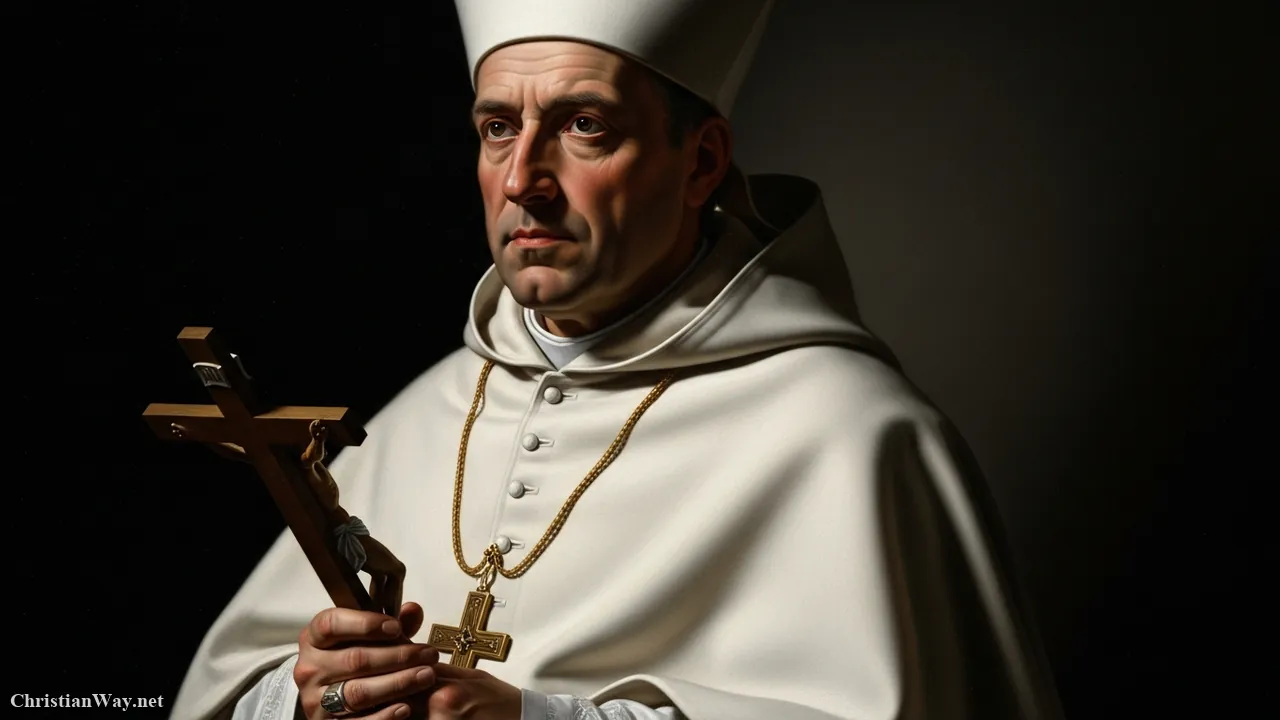
He was born into poverty, formed as a Dominican friar, shaped by study and silence, and eventually called to bear the heavy responsibility of the papacy. Yet even after becoming pope, he remained inwardly what he had always sought to be: a religious man who belonged to God. He did not desire luxury, applause, or the ease that often surrounds power. He desired fidelity. He desired that the Church would be renewed not by surrendering to the spirit of the age, but by returning more deeply to Christ.
Saint Pius V: The Indomitable Friar-Pope is the story of a man whose strength was not rooted in personality alone. His courage came from prayer. His firmness came from love for truth. His reforms came from a desire to protect ordinary believers, priests, families, and communities from confusion and spiritual neglect. His heart was serious, but it was not empty of mercy. He cared for the poor, defended the vulnerable, and believed that the Church must be visibly shaped by the Gospel she proclaimed.
His life speaks to every Christian who feels tired of confusion. It speaks to parents trying to raise children in faith. It speaks to priests, pastors, teachers, and leaders who carry responsibility. It speaks to those who must make difficult decisions without knowing whether others will understand. It speaks to all who wonder how to remain faithful to Christ when the world around them seems restless, divided, or uncertain.
Saint Pius V teaches us that reform begins not with anger toward others, but with surrender before God. It begins when we allow Christ to search our own hearts. It begins when we stop asking only how the world should change and begin asking, “Lord, where do You desire to renew me?”
A Friar Formed in Prayer Before He Was Called to Lead
Saint Pius V was born Antonio Ghislieri in 1504 in Bosco Marengo, a small town in northern Italy. His family was poor, and his early life did not suggest that he would one day become pope. He knew the simplicity of ordinary labor, the limits of material security, and the quiet dignity of a life lived without worldly prominence.
As a young man, Antonio entered the Dominican Order. The Dominicans were known for prayer, study, preaching, and a strong commitment to defending and teaching the faith. Their founder, Saint Dominic, had understood that the Church needed men and women who could preach truth with clarity while remaining close to the poor and grounded in prayer.
Antonio embraced this calling seriously.
He did not enter religious life to escape responsibility. He entered it to give himself more completely to Christ. He studied theology, served as a teacher and preacher, and learned the discipline of obedience. He came to understand that truth is not merely a collection of ideas. Truth is a way of belonging to God.
Jesus said, “I am the way, the truth, and the life” (John 14:6).
For Saint Pius V, to defend truth meant first to belong to Christ. It meant living under the authority of the Gospel. It meant allowing prayer, Scripture, discipline, and love for the Church to shape the conscience.
Poverty and Prayer Before Papal Power
One of the most striking things about Saint Pius V is that he never completely left behind the spirit of the friar.
Many people change when they receive authority. A person may begin with good intentions, but power can make the heart proud. Wealth can make the soul forgetful. Praise can quietly become addictive. A leader may start serving others and slowly begin expecting others to serve him.
Pius V resisted this temptation.
Even as pope, he remained personally simple. He continued to wear the white habit of his Dominican order, a practice that would become associated with later popes. He preferred seriousness to display. He was not interested in making the papacy a place of worldly comfort. He wanted it to be a place of service.
This does not mean that he was without human weakness or that every decision he made was easy to understand from a modern perspective. Saints are not people without limitations. They are people who keep returning to God and allow grace to form them over time.
The spiritual strength of Saint Pius V came from the fact that he had learned, long before becoming pope, to kneel.
This is an important lesson for every Christian.
The person who does not know how to kneel before God will eventually kneel before something else: public opinion, wealth, fear, ambition, comfort, anger, or the desire to be admired.
But the person who kneels before Christ becomes free.
This freedom does not mean that life becomes easy. It means that worldly pressures no longer have the final word over the soul.
A Pope Called to Renew the Church
Saint Pius V was elected pope in 1566, only a few years after the Council of Trent had concluded. The Council had been one of the most important gatherings in the history of the Catholic Church. It had addressed serious questions about doctrine, worship, priestly formation, reform, and the response of the Church to the divisions of the Reformation.
But a council is not enough by itself.
A council may write documents, clarify teachings, and guide the Church. Yet its vision must still be lived. Priests must be formed. Bishops must serve faithfully. Families must be supported. Ordinary believers must receive clear teaching. Worship must lead hearts toward Christ. Communities must become places where holiness can grow.
This was the task Saint Pius V received.
He did not see reform as a matter of changing external appearances alone. He understood that true renewal must reach the heart. A Church can have beautiful buildings, solemn ceremonies, learned books, and public influence, yet still become spiritually weak if its members forget prayer, humility, charity, and the call to conversion.
Saint Pius V wanted the Church to return to the sources of her life: Scripture, the sacraments, sound teaching, prayer, moral integrity, and pastoral care.
Reform Is a Return to Christ
The word “reform” can sometimes make people nervous. Some hear it and think of chaos. Others hear it and think of rejecting the past. But the deepest Christian reform is not the destruction of what is holy. It is the return to what is essential.
Jesus began His public ministry with a call to conversion: “Repent ye, and believe the gospel” (Mark 1:15).
This call is not only for those outside the Church. It is for all of us.
The Christian life is a continual return.
We return to prayer when we have become distracted.
We return to forgiveness when resentment has grown.
We return to truth when fear has led us into compromise.
We return to humility when pride has become hidden within our service.
We return to Christ when we have begun living as though everything depends only on ourselves.
Saint Pius V understood that the Church needed this return. He worked to strengthen the formation of clergy, to encourage bishops to live responsibly, and to make the teaching of the faith more accessible to ordinary people.
He wanted priests to know that their ministry was not a career. It was a calling.
He wanted bishops to remember that authority is service.
He wanted families to understand the faith they professed.
He wanted worship to be reverent, clear, and centered on the mystery of Christ.
This is still needed today.
A Christian community becomes weak when leaders seek comfort rather than service. It becomes confused when people are afraid to teach truth. It becomes cold when doctrine is separated from mercy. It becomes divided when individuals care more about winning arguments than becoming holy.
Saint Pius V calls us back to the heart of renewal: Christ must remain at the center.
The Catechism, the Liturgy, and the Care of Souls
One of Saint Pius V’s great achievements was his work to help implement the teachings and pastoral direction of the Council of Trent. He supported the publication of the Roman Catechism, a guide intended especially to help priests teach the faith clearly and faithfully.
This mattered because ordinary Christians need more than vague religious language.
They need to know who God is.
They need to understand the Gospel.
They need to know why prayer matters.
They need to understand the sacraments.
They need help in forming conscience.
They need the assurance that mercy is real.
They need guidance for marriage, family life, work, suffering, and death.
The faith cannot be passed on only through habit. It must be received personally. It must enter the mind and heart. It must become something that shapes how we love, forgive, work, speak, and hope.
Saint Pius V also revised the Roman Breviary and promulgated a revised Roman Missal. These reforms sought to preserve clarity and unity in the worship of the Church.
For him, the liturgy was not simply a public performance. It was the prayer of the Church. It was the place where the people of God were drawn into the mystery of Christ’s death and resurrection.
Worship Must Form the Heart
Worship matters because human beings become like what they love.
If we love wealth above all things, our hearts become restless.
If we love approval above all things, our souls become fragile.
If we love comfort above all things, we may become unable to sacrifice.
But when we love Christ, the heart begins to change.
The liturgy teaches us to look away from ourselves.
We confess that we need mercy.
We listen to Scripture.
We receive the Gospel.
We pray for the world.
We remember the sacrifice of Christ.
We are invited to place our own lives upon the altar of love.
Saint Pius V understood that worship should not be shaped merely by personal preference. It should lead us into something greater than ourselves.
This is a difficult lesson in a culture that often treats everything as a matter of taste.
We may ask, “Do I like this?”
But the deeper question is, “Does this draw me nearer to God?”
Does it help me become more humble?
Does it awaken gratitude?
Does it lead me toward repentance?
Does it help me love my neighbor more faithfully?
True worship does not flatter us. It transforms us.
Saint Paul writes, “Be not conformed to this world: but be ye transformed by the renewing of your mind” (Romans 12:2).
The liturgy, when received with faith, becomes part of this renewal.
Moral Courage in a Time of Pressure
Saint Pius V lived in a period of conflict, political tension, religious division, and great uncertainty. Europe was deeply wounded by disputes that involved theology, kingdoms, power, loyalty, and fear. It was not a simple age, and we should not speak of it as though every decision can be judged easily from a distance.
Yet one truth remains clear: Pius V believed that faithfulness sometimes requires courage.
He knew that a pope could not simply say whatever people wished to hear. He could not allow fear of criticism to determine his teaching. He believed that the Church must remain rooted in the faith she had received from Christ and the apostles.
This kind of courage is still needed.
Many people today are tempted to shape their beliefs around popularity. We may be afraid of being judged. We may avoid difficult truths because we do not want conflict. We may convince ourselves that silence is always peace.
But silence is not always peace.
There are times when silence protects the vulnerable.
There are times when silence allows anger to cool.
There are times when silence is wise.
But there are also times when silence becomes an escape from responsibility.
A parent may need to correct a child lovingly.
A worker may need to refuse dishonesty.
A teacher may need to defend someone being mistreated.
A pastor may need to speak truth even when people are uncomfortable.
A Christian may need to remain faithful to conscience even when others do not understand.
Saint Pius V teaches us that courage must be joined to humility. We are not called to become harsh. We are not called to enjoy conflict. We are not called to speak loudly merely to make ourselves feel strong.
We are called to be faithful.
Truth Must Always Be Carried With Love
The firmness of Saint Pius V can challenge us because firmness is often misunderstood.
Some think firmness means arrogance.
Some think conviction means refusing to listen.
Some think defending truth requires treating others as enemies.
But the Gospel never permits us to separate truth from love.
Jesus was full of grace and truth.
He forgave sinners, yet called them to conversion.
He welcomed the broken, yet did not pretend that sin could heal them.
He showed mercy, yet also spoke clearly about the Kingdom of God.
Saint Pius V’s life reminds us that the Church must not lose the courage to teach. But it also reminds us that teaching must come from a heart that has been softened by prayer.
A person who speaks truth without love may become cruel.
A person who speaks love without truth may become unclear.
The Christian path is more difficult and more beautiful: truth in love.
Saint Paul writes, “Speaking the truth in love, may grow up into him in all things, which is the head, even Christ” (Ephesians 4:15).
This is the path of mature faith.
The Battle of Lepanto and the Need for Peace
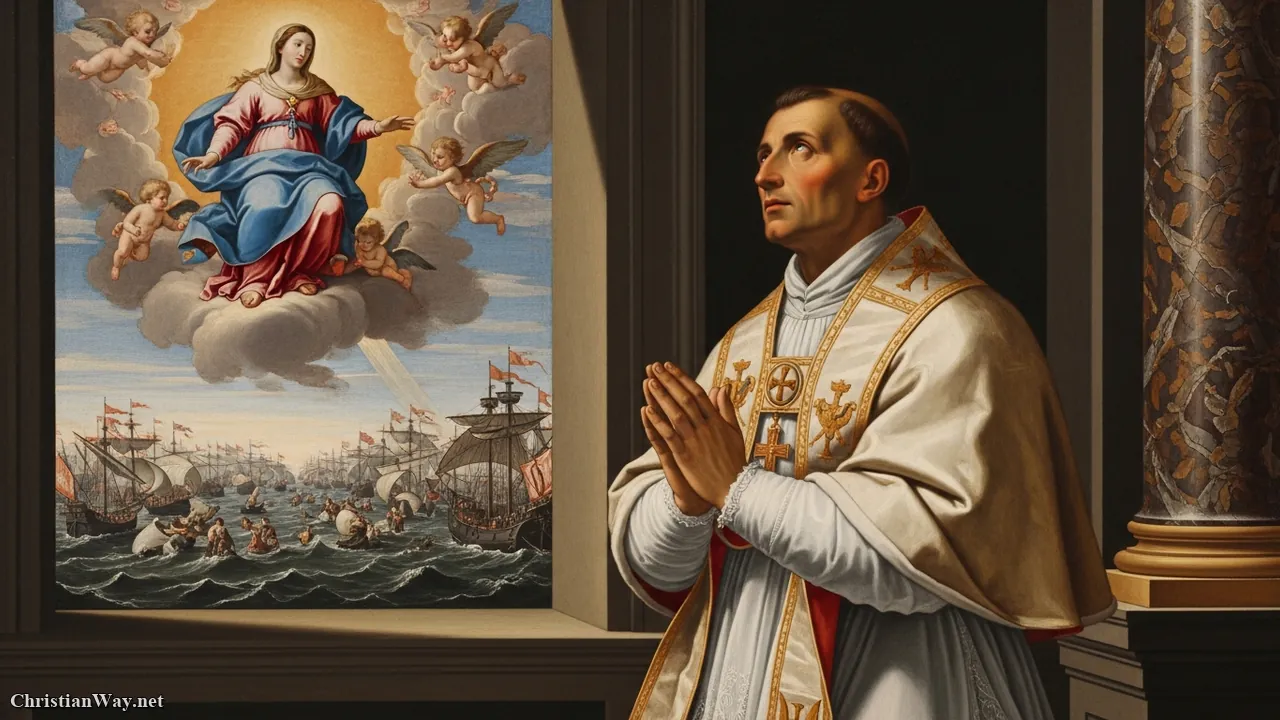
Saint Pius V is often remembered in connection with the Battle of Lepanto in 1571. The conflict occurred within a complex historical period marked by military threat, political alliances, religious tension, and fear across the Mediterranean world.
Pius V worked to unite Christian rulers in defense against the Ottoman naval expansion. When the Holy League achieved victory at Lepanto, he attributed the outcome to the intercession of the Blessed Virgin Mary and encouraged gratitude to God.
This event became strongly connected with the feast of Our Lady of Victory, later associated with Our Lady of the Rosary.
Yet we should approach this history carefully.
Christian faith must never celebrate violence for its own sake. War always brings suffering. Families lose fathers and sons. Communities are wounded. Human beings created in the image of God are caught in fear, pain, and death.
The Church does not exist to glorify conflict. Christ said, “Blessed are the peacemakers” (Matthew 5:9).
But history also contains moments when leaders face grave threats and difficult decisions. Saint Pius V believed that he was defending Christian communities facing danger. His response was not only political. It was spiritual. He called people to prayer, repentance, and trust in God.
Prayer Is Not Escape From Reality
One of the beautiful lessons connected with Saint Pius V is his confidence in prayer.
Some people think prayer is passive. They imagine that praying means avoiding responsibility or refusing to act. But Christian prayer is not escape. It is the placing of reality before God.
Prayer gives courage to act wisely.
Prayer purifies motives.
Prayer helps us resist panic.
Prayer reminds us that we are not the saviors of the world.
Prayer teaches us that even when we must act, we remain dependent on God.
Saint Pius V urged the faithful to pray the Rosary, not as a magical formula, but as a way of contemplating Christ through the eyes of Mary.
The Rosary brings us into the mysteries of the Gospel.
We remember the incarnation.
We remember the hidden life of Jesus.
We remember His suffering.
We remember His resurrection.
We remember the glory of God.
For Catholics, Mary is not a distraction from Jesus. She is the mother who always leads us toward her Son.
At Cana, Mary says, “Whatsoever he saith unto you, do it” (John 2:5).
This is the heart of genuine Marian devotion.
It leads us to Jesus.
It helps us remain near Jesus.
It teaches us to trust Jesus.
Christians from different traditions may express devotion to Mary differently. Yet all followers of Christ can recognize her as the woman who said yes to God, who bore the Savior, and who remained faithful near the Cross.
Saint Pius V reminds us that prayer is not weakness. It is one of the deepest sources of Christian strength.
The Pope Who Remembered the Poor
It would be easy to remember Saint Pius V only for reform, doctrine, and public events. But his life also included a profound concern for the poor and suffering.
He lived simply, even as pope. He did not see wealth as proof of holiness. He understood that the Church must care for those who have little. He supported hospitals, works of charity, and aid for people in need.
This is essential.
A Church that speaks about truth but ignores the hungry has not understood the Gospel.
A Christian who attends worship but despises the poor has not understood Christ.
A leader who protects institutions but forgets wounded people has forgotten the One who washed the feet of His disciples.
Jesus says, “I was an hungred, and ye gave me meat: I was thirsty, and ye gave me drink: I was a stranger, and ye took me in” (Matthew 25:35).
These words are not merely poetic. They reveal where Christ waits for us.
He waits in the hungry.
He waits in the sick.
He waits in the lonely.
He waits in the refugee.
He waits in the elderly person who feels forgotten.
He waits in the child who needs protection.
He waits in the person who has made mistakes and believes no one could still love them.
Saint Pius V understood that reform must touch not only books, ceremonies, and institutions. It must touch the way Christians care for human beings.
Simplicity Is a Form of Freedom
We live in a world that often teaches us to measure ourselves by possessions.
We may think we need more money, more comfort, more status, more technology, more admiration, more proof that we matter.
But possessions can become heavy.
The more we build our identity around what we own, the more afraid we become of losing it.
Saint Pius V’s simplicity was not contempt for material things. Food, housing, work, medicine, and security are real needs. God does not ask people to pretend that poverty is easy.
But simplicity is the freedom to remember that our lives do not depend on luxury.
It is the ability to say, “I have received this gift, but it does not own me.”
It is gratitude without greed.
It is generosity without display.
It is the willingness to share.
A simple heart is not a small heart. It is a heart with room for God and for others.
The Indomitable Friar-Pope and the Call to Persevere
The word “indomitable” means unable to be defeated in spirit.
Saint Pius V was indomitable not because he never faced opposition, but because he refused to let opposition turn him away from what he believed God had called him to do.
He knew criticism.
He knew the burden of leadership.
He knew that reform would not make everyone happy.
He knew that many forces in society wanted the Church to become weaker, quieter, or more easily shaped by political power.
But he persevered.
This is a word many of us need.
Perseverance does not mean stubbornly refusing all correction. We must remain humble. We must listen. We must repent when we are wrong. We must seek wise counsel.
But perseverance means refusing to give up on what is good simply because it is difficult.
A parent perseveres in love during exhausting years.
A student perseveres in study when progress feels slow.
A husband or wife perseveres in faithfulness through seasons of misunderstanding.
A person struggling with addiction perseveres in seeking help after failure.
A worker perseveres in integrity when dishonesty appears easier.
A Christian perseveres in prayer when God seems silent.
Saint Pius V reminds us that holiness is often less dramatic than people imagine. It is the quiet decision to remain faithful one day more.
Strength Is Not Loudness
The world often mistakes noise for strength.
People shout to prove they are right.
They insult to prove they are powerful.
They demand attention to prove they matter.
But Saint Pius V’s life teaches another kind of strength.
True strength is a heart that remains steady before God.
It is the father who keeps praying for his children.
It is the mother who chooses patience even when exhausted.
It is the priest who remains faithful to prayer when no one sees.
It is the worker who refuses corruption.
It is the young person who chooses goodness when others mock it.
It is the elderly person who continues to trust God through illness.
It is the wounded person who chooses not to become bitter.
This strength may be quiet. But heaven sees it.
Jesus said, “He that shall endure unto the end, the same shall be saved” (Matthew 24:13).
Endurance is not glamorous. But it is holy.
A Saint for Leaders, Priests, and Ordinary Christians
Saint Pius V speaks particularly to those who carry responsibility.
He speaks to priests and pastors who must teach, comfort, guide, and correct.
He speaks to bishops and Church leaders who must remember that authority exists for service.
He speaks to parents who must lead children with both discipline and tenderness.
He speaks to teachers who shape young minds.
He speaks to business owners who make decisions affecting workers and families.
He speaks to public leaders who must remember that power is never absolute.
He speaks to every Christian who has influence over another person.
Authority is dangerous when it becomes self-serving.
Jesus gives us another model.
He says, “Whosoever will be chief among you, let him be your servant” (Matthew 20:27).
This is the heart of Christian leadership.
A leader does not exist to be admired.
A leader exists to serve.
A parent serves by loving, guiding, correcting, and protecting.
A teacher serves by helping students grow.
A pastor serves by leading people toward Christ.
A public servant serves by seeking justice and the common good.
A business owner serves by treating workers fairly.
Saint Pius V’s reforms were rooted in this conviction: the Church must not use authority to elevate itself. She must use authority to lead souls toward God.
The Ordinary Christian Has a Mission Too
It is easy to think that saints belong only to popes, priests, missionaries, and religious communities.
But every baptized Christian has a mission.
Your mission may be hidden.
It may be raising children.
It may be caring for aging parents.
It may be working honestly.
It may be encouraging a friend.
It may be praying for someone who has lost hope.
It may be bringing peace into your home.
It may be refusing gossip.
It may be offering help to someone who cannot repay you.
It may be returning to God after years of distance.
Saint Pius V teaches us that the Church is renewed not only through large reforms. She is renewed through ordinary believers who take faith seriously.
The Church grows stronger when homes become places of prayer.
She grows stronger when people forgive.
She grows stronger when workers live honestly.
She grows stronger when young people discover that Christ is worthy of their lives.
She grows stronger when the poor are welcomed.
She grows stronger when Christians love one another enough to speak truth with humility.
Faithfulness in a Restless Age
Our age has its own forms of confusion.
We are surrounded by information, yet many people feel less certain about truth.
We are more connected through technology, yet many people feel lonely.
We have more comfort than previous generations, yet many hearts remain restless.
We hear countless opinions, yet many people do not know whom to trust.
In such a world, Saint Pius V offers a needed reminder: faith must be rooted.
A tree cannot survive if its roots are shallow.
A family cannot remain strong if love is built only on convenience.
A conscience cannot remain clear if it is shaped only by popular opinion.
A Christian cannot remain faithful if prayer becomes an occasional decoration.
We need roots.
We need Scripture.
We need worship.
We need the sacraments.
We need Christian friendship.
We need silence.
We need moments when we stop listening to the noise of the world and begin listening again to Christ.
Saint Pius V did not call people to fear the world. He called them to live in the world with a heart centered on God.
This is our call too.
We are not asked to become angry at everyone around us.
We are not asked to hide from society.
We are not asked to treat people who disagree with us as enemies.
We are asked to become faithful witnesses.
To love Christ.
To seek truth.
To serve the poor.
To pray deeply.
To remain humble.
To speak with charity.
To persevere.
Reflect and Pray
Dear friends, Saint Pius V reminds us that God does not need loud or powerful people in order to renew His Church. He looks for hearts willing to pray, serve, repent, and remain faithful.
Perhaps you are facing a difficult responsibility. Perhaps you are trying to lead a family, carry a burden, make a decision, or remain faithful in a world that feels confusing. Perhaps you are tired of conflict. Perhaps you fear that truth and love cannot remain together.
Do not lose heart.
Christ is still the Lord of His Church.
He still calls ordinary people into holiness.
He still strengthens the weak.
He still gives courage to those who ask.
He still brings light into places of confusion.
Saint Pius V, indomitable friar-pope and faithful servant of Christ, pray for us. Teach us to seek God before seeking approval. Help us to love truth without becoming proud, to serve the poor without seeking praise, and to persevere when faithfulness becomes difficult. Pray for priests, pastors, parents, teachers, leaders, and all who carry responsibility for others.
Lord Jesus Christ,
You are the truth that sets us free
and the mercy that heals the wounded heart.
Through the prayers of Saint Pius V,
renew Your Church in holiness, courage, and love.
Give us roots in Your Word,
reverence in prayer,
clarity in conscience,
and tenderness toward those who suffer.
When we are afraid, strengthen us.
When we are proud, humble us.
When we are confused, guide us.
When we are tired, renew our hearts.
May our lives become a quiet witness
to Your truth, Your mercy, and Your peace. Amen.
May the faithful courage of Saint Pius V strengthen your heart, deepen your prayer, and help you remain rooted in Christ through every season of life.
— Fr. John Matthew