Dear friends in Christ,
There are moments in the life of the Church when difficult questions can no longer remain quiet. Questions about truth, grace, authority, worship, conscience, and the mercy of God may begin in the heart of one person, but they soon reach families, congregations, nations, and generations yet to come. The Protestant Reformation was one of those moments. It was not simply a dispute among scholars, nor merely a conflict between religious leaders and political rulers. At its deepest, it was a struggle over the Gospel itself: How is a sinner made right with God? What place should Scripture hold in the life of the Church? How should Christians worship, pray, and live? Where does the true authority of the Church rest?
The Protestant Reformation changed the course of Christian history. It reshaped worship, encouraged Bible translation, strengthened the role of preaching, called attention to the conscience of the believer, and gave rise to many Christian traditions that continue to serve Christ around the world today. Yet it also brought sorrowful division, political conflict, persecution, and wounds within the visible body of Christ. To remember the Reformation faithfully, therefore, we must neither romanticize it nor dismiss it. We must receive its gifts with gratitude, grieve its failures with honesty, and allow its deepest questions to lead us again toward Jesus Christ.
The Reformers were not perfect people. Martin Luther, John Calvin, Ulrich Zwingli, Thomas Cranmer, Menno Simons, William Tyndale, and many others lived in a harsh and unstable age. They could be courageous and insightful, but they could also be severe, impatient, and shaped by the fears of their time. Yet many of them shared a sincere desire to see the Church renewed by the Word of God and centered more clearly upon the grace of Christ.
Their questions remain important because the Church in every generation faces the temptation to forget its first love. Religious institutions can become concerned with status, money, power, custom, or reputation. Christian leaders can become more interested in defending themselves than serving the flock. Believers can begin to rely on outward practices while neglecting the inner work of repentance, faith, and love. The Protestant Reformation reminds us that the Church belongs to Christ, not to any human leader, nation, or tradition.
This history invites us not only to look backward, but also to look inward. Each of us must ask: Have I trusted in the mercy of Christ, or have I tried to earn God’s love through fear? Do I read Scripture with humility, allowing it to correct and comfort me? Do I worship God with a sincere heart? Do I seek truth while still loving those who disagree with me? These questions are not only questions from the sixteenth century. They are questions for every Christian soul.
The Longing for Reform Was Older Than the Reformation
The Protestant Reformation did not begin in an empty or faithless world. For many centuries before the sixteenth century, the Christian Church had carried the Gospel across Europe and beyond. Monasteries preserved learning and prayer. Churches cared for the poor, welcomed pilgrims, taught children, and offered comfort in times of illness and death. The faith of the ancient Church had been handed down through Scripture, creeds, worship, councils, missionaries, saints, and generations of ordinary believers who loved Christ sincerely.
It would be unfair to describe the medieval Church as though it contained no light. Many faithful Christians lived lives of profound holiness before the Reformation. Men and women devoted themselves to prayer, service, charity, education, and care for those who suffered. The Church’s life was woven deeply into the rhythm of society: the bells that marked the hours of prayer, the feasts that shaped the year, the hospitals and schools founded in the name of Christ, and the countless acts of mercy performed quietly in villages and cities.
Yet human weakness was present as well. Where there is religious authority, there is always the temptation to misuse it. Where there is wealth, there is the temptation to forget the poor. Where there is influence, there is the temptation to protect the institution more than the people whom Christ has entrusted to its care. Some clergy lived lives far removed from the humility of the Gospel. Some Church offices became entangled with political ambition. Some ordinary believers received little clear teaching about Scripture, grace, forgiveness, and the saving work of Christ.
The practice of indulgences became one of the most visible concerns. In Christian teaching, repentance had always included the truth that sin carries consequences and that forgiveness calls people into a changed life. But in some places, indulgences were preached and sold in ways that caused people to believe spiritual security could be purchased. For those who feared death, judgment, or the suffering of loved ones, such messages could become a source of deep anxiety.
Reform Begins with Repentance
The desire for reform was not necessarily a desire to destroy the Church. Many who called for renewal loved the Church and believed it needed to become more faithful to Christ. They wanted Christians to hear the Gospel more clearly. They wanted preaching to be rooted in Scripture. They wanted worship to nourish faith rather than confusion. They wanted the mercy of God to be proclaimed freely to people burdened by guilt and fear.
The Church is always in need of renewal because the people within the Church are always in need of grace. Even the most beautiful tradition can become empty if it is no longer connected to love. Even the most faithful doctrine can become harsh if it is spoken without mercy. Even good practices can become burdens when they no longer lead people toward Christ.
Jesus spoke sternly to those who honored God with outward words while keeping their hearts far from Him. He did not condemn worship, prayer, Scripture, or holiness. He called His people back to the true purpose of these gifts: communion with God and love for neighbor. The Reformers believed that the Church needed to hear this call again.
In every generation, Christian renewal begins not with prideful criticism of others, but with repentance in our own hearts. We cannot ask the Church to become more faithful while refusing to let Christ examine us. The deepest reform is not merely structural. It is spiritual. It begins when people return to prayer, return to Scripture, return to humility, and return to the mercy of Christ.
Martin Luther and the Question of Grace
Martin Luther became the most famous figure of the Protestant Reformation because his personal struggle touched one of the deepest concerns of the Christian life. Born in Germany in 1483, Luther became an Augustinian monk and later a priest and professor. He was not initially seeking to divide the Church. He was seeking peace with God.
Luther took sin seriously. He prayed, fasted, confessed, studied, and tried to live faithfully. Yet he remained troubled by the question of whether he could ever be righteous enough before a holy God. His heart carried the fear that many people still know today: What if I have not done enough? What if I am not good enough? What if God sees every weakness I try to hide?
As Luther studied the letters of Saint Paul, especially Romans and Galatians, he began to understand the Gospel in a new way. He came to believe that the righteousness of God was not simply a standard that condemned sinners, but also a gift offered to those who trust in Christ. The words of Scripture became a source of freedom: “The just shall live by faith” (Romans 1:17).
For Luther, salvation was not something people could earn through religious effort. It was the gift of God’s grace. Christ had already done what human beings could not do for themselves. Through His death and resurrection, Jesus opened the way of forgiveness and reconciliation with God. Faith was the open hand that received this gift.
The Ninety-Five Theses and a Wider Conflict
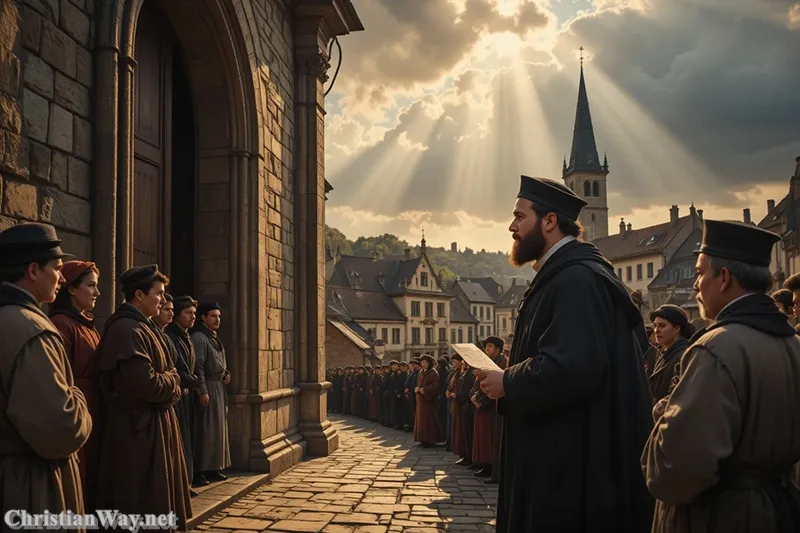
In 1517, Luther wrote his Ninety-Five Theses, challenging the preaching and sale of indulgences. These statements were intended to provoke discussion, but they spread quickly through the printing press. What began as a debate about one practice soon became a much wider conflict over authority, Scripture, the papacy, the sacraments, and the meaning of salvation.
Luther’s deepest concern was pastoral. He feared that people were being led to trust in religious transactions rather than in the mercy of Christ. He wanted them to understand that true repentance is not fear of punishment alone. It is a turning of the heart toward God. It is the sorrow of a person who has wandered from love and desires to return home.
The grace Luther preached was not cheap grace. It was not permission to live carelessly or ignore the call to holiness. Rather, it was the declaration that good works flow from faith; they do not purchase salvation. A tree does not bear fruit in order to become alive. It bears fruit because it has life within it. In the same way, a believer serves, forgives, gives, and obeys because God’s grace has begun to transform the heart.
This message remains deeply comforting. Many people still live as though God’s love must be earned. They measure themselves against others, carry hidden shame, and fear that they will never be enough. The Gospel says that Christ meets us before we have achieved anything. He comes to the weary, the guilty, the uncertain, and the wounded. He does not ask us to save ourselves before coming to Him. He comes because we cannot save ourselves.
Scripture Heard in the Language of the People
One of the great gifts associated with the Protestant Reformation was the renewed emphasis on Scripture. The Reformers believed that the Bible should not remain distant from ordinary believers. It should be read, preached, prayed, sung, studied, and carried into the daily life of the Church.
For many people in the sixteenth century, access to Scripture was limited. The Bible was often heard in Latin, a language not easily understood by ordinary worshippers. Clergy and scholars played an important role in teaching the faith, but Reformers became increasingly convinced that people should be able to hear and read the Word of God in their own language.
This desire gave strength to translators such as William Tyndale, whose English translation of the New Testament helped shape generations of English-speaking Christians. Tyndale believed that Scripture should not belong only to scholars or religious leaders. He wanted farmers, laborers, children, mothers, and ordinary people to hear the words of Christ directly.
Bible translation was not merely an academic task. It was an act of pastoral love. It gave people language for prayer, comfort in sorrow, courage in suffering, and guidance for daily life. It allowed Christians to hear the parables of Jesus, the Psalms of Israel, the letters of Saint Paul, and the promises of Revelation in words that entered the heart naturally.
Scripture Is Not a Weapon
The Reformers’ love for Scripture remains an important gift, but it also carries a warning. The Bible can be misused when it is treated as a weapon to defeat others rather than as a living word that calls us to repentance. It is possible to quote Scripture while refusing its message of humility, mercy, justice, and love.
Jesus Himself was tempted in the wilderness by words taken from Scripture. The difference was not in the words themselves, but in the heart that used them. The Word of God must be received prayerfully. It must be read in the light of Christ, who is full of grace and truth.
When Christians open the Bible, they are not simply collecting arguments. They are entering the story of God’s saving love. They are hearing the voice of the One who created the world, called a people, spoke through the prophets, came near in Jesus Christ, died and rose again, and promised to make all things new.
Scripture gives courage, but it also humbles us. It tells us that we are sinners in need of mercy. It reminds us that no one is righteous by personal achievement alone. It calls us to forgive as we have been forgiven. It commands us to care for the poor, love our enemies, resist pride, and seek peace.
The Protestant Reformation helped many Christians rediscover the importance of hearing Scripture in the language of the people. This remains a holy responsibility today. The Bible must not become a book placed on a shelf and forgotten. It must become bread for the journey, light for the path, and a mirror in which we see our own hearts honestly.
Many Reform Movements, One Search for Faithfulness
The Protestant Reformation was not one single movement with one united voice. Different reformers shared certain concerns, but they often disagreed deeply about worship, Church leadership, baptism, Holy Communion, the relationship between Church and state, and the meaning of Christian freedom.
In Zurich, Ulrich Zwingli led a reform movement that placed strong emphasis on the authority of Scripture. He believed worship should be purified of practices that did not appear clearly rooted in the Bible. Churches became simpler. Images were removed in many places. Preaching, Scripture reading, prayer, and congregational participation became central.
Zwingli also differed from Luther on the meaning of the Lord’s Supper. Luther believed that Christ was truly present in a profound sacramental way. Zwingli emphasized Communion as a memorial meal, a sacred remembrance of Christ’s death and a public confession of faith. Their disagreement was not small, because the Lord’s Supper stands at the heart of Christian worship. It concerns how believers understand Christ’s presence among His people.
John Calvin, who would become influential in Geneva and throughout the Reformed tradition, emphasized the glory and sovereignty of God. He taught that salvation is entirely rooted in divine grace and that the Holy Spirit renews believers from within. Calvin also stressed the importance of worship, education, pastoral care, discipline, and a Church ordered for the spiritual good of its people.
In England, the Reformation followed a more complicated path because political conflict became intertwined with theological reform. Thomas Cranmer, Archbishop of Canterbury, helped shape the Book of Common Prayer, which gave English-speaking Christians words for worship, confession, baptism, marriage, burial, and Holy Communion. Through its beauty and clarity, it brought the rhythms of Christian prayer into the language of ordinary people.
The Radical Reformers and the Call to Visible Discipleship
Other Christians believed that the reform movements led by Luther, Zwingli, and Cranmer did not go far enough. These groups, often called Radical Reformers, sought a more complete separation from the structures of established Christianity. Among them were the Anabaptists, who rejected infant baptism and believed that baptism should follow a personal confession of faith.
Anabaptist communities often placed great emphasis on peace, mutual aid, simplicity, and visible discipleship. They asked whether Christians could truly follow Jesus while embracing violence, political power, or social inequality. Many of them believed the Church should be a voluntary community of committed believers rather than a body tied closely to the state.
Menno Simons became one of the best-known Anabaptist leaders. His followers, later called Mennonites, sought to live out a faith marked by humility, nonviolence, mutual care, and obedience to Christ. Their witness reminds Christians that faith is not only something believed in the mind. It must become visible in the way believers treat enemies, care for the poor, speak honestly, and live in peace.
Many Radical Reformers suffered persecution from Catholics and Protestants alike. Their suffering is a painful reminder that Christians have not always protected the freedom of conscience they themselves desired. The history of the Reformation teaches us that truth must never be defended through cruelty. Christ does not call His people to win through hatred. He calls them to bear witness through love.
Grace, Faith, Christ, Scripture, and the Glory of God
The beliefs of the Protestant Reformers are often summarized through several central emphases. These phrases are helpful, not because they explain every Protestant tradition completely, but because they point toward the heart of the Reformation’s concern.
The Reformers emphasized that salvation comes through grace. Grace is the undeserved love of God. It is God moving toward us before we have earned anything. It is the mercy that forgives sin, heals guilt, restores hope, and gives strength to begin again.
Saint Paul writes, “For by grace are ye saved through faith; and that not of yourselves: it is the gift of God” (Ephesians 2:8). These words became central for many Reformers because they protected the Gospel from becoming a system of spiritual achievement. Salvation is not a reward for the morally impressive. It is a gift received through Christ.
Faith, in this understanding, is not merely agreeing that certain beliefs are true. Faith is trusting oneself to Jesus Christ. It is resting in His mercy. It is believing that His death and resurrection are not distant events, but the source of forgiveness and new life for the world.
The Reformers also emphasized the centrality of Christ. Jesus is not simply one part of the Christian life. He is its foundation. He is the Savior who reconciles humanity to God. He is the Good Shepherd who seeks the lost. He is the Bread of Life for the hungry soul. He is the Light of the World for those walking in darkness.
Grace That Changes the Heart
The Reformers did not teach that grace removes the call to holiness. They taught that grace makes holiness possible. A Christian is not saved by works, but a Christian who has received grace is called to bear the fruit of grace.
This fruit may appear in many quiet ways. It appears when a person chooses honesty over deception. It appears when someone forgives an injury that has been carried for years. It appears when a family cares for a sick relative without recognition. It appears when a believer gives generously, prays faithfully, resists temptation, and serves those in need.
The Christian life is not a desperate effort to impress God. It is a response to the love already given in Christ. We do not obey in order to become loved. We obey because we are loved. We do not serve because we fear being rejected. We serve because Christ has welcomed us into His mercy.
The Reformers also spoke often about the glory of God. This is not an abstract religious phrase. It means that all of life belongs to God. Work, family, study, worship, rest, service, suffering, and joy can all become places where we honor Him. A farmer working faithfully, a mother raising children with patience, a teacher guiding students with integrity, a doctor caring for the sick, and an elderly person praying through loneliness can all live for the glory of God.
Worship, Vocation, and the Whole Life Before God
The Protestant Reformation transformed worship in many places. The use of local languages allowed people to understand prayers, Scripture readings, and sermons more fully. Congregational singing became increasingly important. Preaching was given a central place. The Bible was read publicly and explained in ways meant to connect with ordinary life.
These changes were not merely about style. They reflected a conviction that worship should form the whole people of God. The Church was not meant to be a place where a few people acted while everyone else watched silently. Believers were called to pray, sing, listen, confess, receive, and respond.
At the same time, different Protestant traditions developed different ways of worship. Some retained liturgical forms and sacramental rhythms. Others adopted simpler services focused on preaching and prayer. Some used choirs, written prayers, vestments, and church seasons. Others emphasized spontaneous prayer, plain settings, and simplicity.
These differences continue today. Yet beneath them is a shared question: Does worship lead people toward Christ? Does it help them hear the Word of God, confess their sins, receive grace, and go into the world with hearts shaped by love?
Every Christian Has a Calling
Another important Reformation idea was the dignity of ordinary vocation. Before the Reformation, many people viewed monks, priests, and religious leaders as having a more spiritual calling than farmers, parents, craftsmen, or workers. The Reformers challenged this way of thinking.
They taught that every faithful task can become an offering to God. A person does not need to leave ordinary life behind in order to serve Christ. The home, the workplace, the school, the field, and the marketplace can all become places of Christian discipleship.
This is a deeply comforting truth. Most Christians will never preach to thousands, write a theological book, or lead a great movement. But every Christian is called to love God and neighbor where they are. The person who speaks gently in a difficult family conversation, who works honestly, who raises children with patience, who visits the lonely, or who refuses corruption is living a holy vocation.
The Protestant Reformation helped many believers rediscover that the whole of life belongs to God. Worship does not end when the service ends. Prayer does not belong only inside a church building. Faith must enter the kitchen, the office, the classroom, the hospital room, the streets, and the hidden places of the heart.
The Reformation’s Wounds and the Call to Repentance
The Protestant Reformation brought many gifts, but it also brought great sorrow. The division between Catholic and Protestant Christians became one of the deepest wounds in Western Christianity. Families, towns, and nations were divided. Religious conflict became entangled with political ambition. Wars were fought. People were imprisoned, exiled, tortured, and killed because of their beliefs.
Catholics persecuted Protestants. Protestants persecuted Catholics. Protestants sometimes persecuted other Protestants. Christians who had been commanded to love one another often treated one another as enemies. This history should humble every believer.
It is not enough to speak proudly of one tradition’s victories while ignoring the suffering of others. The cross of Christ does not allow us to rejoice in the humiliation of our brothers and sisters. Jesus prayed for His followers, “That they all may be one” (John 17:21). His prayer does not erase serious theological differences, but it does call Christians to reject contempt, hatred, and cruelty.
The divisions of the Reformation remain visible today. Catholics, Lutherans, Reformed Christians, Anglicans, Baptists, Methodists, Pentecostals, Mennonites, Evangelicals, and many others worship in different communities and hold different convictions. Some differences concern matters of great importance: the sacraments, Church authority, ministry, salvation, Scripture, and the nature of the Church itself.
Truth and Love Must Remain Together
Christian unity cannot be built by pretending that differences do not exist. Real unity requires honesty. It requires people to speak clearly about what they believe while still recognizing the dignity of those who disagree.
But truth without love becomes harshness. Love without truth becomes confusion. Christ calls His people to hold both together. He is full of grace and truth. He speaks clearly about sin, but He also offers mercy. He calls people to repentance, but He never delights in their shame.
In recent generations, Christians from many traditions have begun to pray together, study Scripture together, serve the poor together, and seek deeper understanding across old divisions. These efforts do not solve every theological question, but they are signs of hope. They remind us that the body of Christ is larger than our own denomination, culture, or history.
The Protestant Reformation calls us to continue asking difficult questions, but it also calls us to ask them with humility. We must never assume that our own community has nothing to learn. Every Christian tradition needs grace. Every Church needs renewal. Every believer needs repentance.
The Lasting Legacy of the Protestant Reformation
The legacy of the Protestant Reformation can be seen in many parts of Christian life today. Its influence helped encourage Bible translation, literacy, theological education, congregational singing, lay participation, preaching, missionary work, and the formation of many Protestant churches around the world.
The Reformers’ insistence that ordinary believers should have access to Scripture has shaped countless Christian communities. Today, Christians can read the Bible in many languages, gather in study groups, listen to sermons, pray through the Psalms, and share the words of Christ within their families. This gift should not be taken lightly. It came through the courage and sacrifice of translators, teachers, pastors, and believers who believed that the Word of God belongs among the people of God.
The Reformation also encouraged believers to think seriously about conscience. A Christian must obey God above every human authority. This principle can be difficult, because conscience must be formed by Scripture, wisdom, humility, prayer, and love. It is not simply personal preference. Yet it remains important. There are moments when Christians must speak truth, protect the vulnerable, resist injustice, and remain faithful even when it costs them.
The Protestant Reformation also contributed to a greater sense that all believers have a role in the Church’s mission. Ministers and pastors remain important, but the Church is not built by clergy alone. Every believer has gifts to offer. Some teach. Some pray. Some serve the poor. Some care for children. Some offer hospitality. Some encourage the discouraged. Some work quietly in places few people notice.
A Legacy That Still Calls Us Back to Christ
The greatest legacy of the Reformation is not a set of historical names or arguments. It is the continuing call to return to Christ. The Church must always return to the One who is its foundation. It must return to the Gospel when fear has taken over. It must return to Scripture when human opinions become louder than God’s Word. It must return to grace when people become burdened by shame. It must return to love when division has hardened hearts.
This call is needed in the modern world as much as it was in the sixteenth century. Many people today are exhausted by constant pressure. They feel they must prove their worth through work, success, appearance, wealth, or approval. They carry guilt from the past, anxiety about the future, and loneliness in the present.
The Gospel still speaks into these wounds. It tells us that God’s love is not earned. It tells us that Christ came for sinners, not for those who imagine themselves perfect. It tells us that repentance is not a door into despair, but a road home. It tells us that grace does not leave us unchanged, but patiently forms us into people of truth, compassion, and courage.
Faith in Daily Life: Reforming the Heart
The Protestant Reformation was a turning point in the history of Christian faith, but the work of reform is not only something that happened centuries ago. Every Christian heart needs renewal. Every family needs grace. Every church needs to ask whether it is still living close to Christ.
A person may know the language of faith and still live far from God. We may attend worship while refusing to forgive. We may quote Scripture while neglecting the poor. We may speak about grace while being harsh toward others. We may defend Christian truth while failing to show the gentleness of Christ.
The most important reformation is the reformation of the heart. It begins when we ask God to show us where pride has grown, where resentment has taken root, where fear has replaced faith, and where we have forgotten the mercy we ourselves have received.
This inner renewal often happens quietly. It may happen when someone apologizes after years of distance. It may happen when a person begins reading Scripture again after a long season of neglect. It may happen when a family prays together through hardship. It may happen when a believer chooses compassion rather than anger.
Christ is still calling His people to return to Him. He is still speaking peace to anxious hearts. He is still forgiving those who repent. He is still sending the Holy Spirit to strengthen the weak, comfort the grieving, and give courage to those who seek to live faithfully.
Reflect and Pray
Dear friend, the Protestant Reformation was a turning point in the history of Christian faith because it raised questions that still matter today. It called the Church to remember the grace of God, the authority of Scripture, the centrality of Christ, and the dignity of every believer’s calling.
Yet its history also teaches us humility. Christians have not always spoken or acted with love. We have sometimes defended truth without tenderness and protected our own traditions without listening to the pain of others. The Church must always return to Christ, who alone is its Savior and Shepherd.
Perhaps you belong to a Protestant tradition. Perhaps you are Catholic, Orthodox, Anglican, or part of another Christian community. Perhaps you are still searching, carrying questions that have not yet found words. Wherever you are, the mercy of Christ remains near.
He does not ask you to earn His love. He invites you to receive it. He does not ask you to hide your weakness. He calls you to bring it into His light. He does not promise that the road will always be easy, but He promises to walk with those who turn toward Him.
Let us pray:
Lord Jesus Christ, You are the foundation of Your Church and the source of every true renewal. Forgive us where pride, fear, or division have wounded Your people. Teach us to love Your Word, trust Your grace, and follow You with humble hearts. Give us courage to speak truth with gentleness, to serve others with compassion, and to seek unity without abandoning faithfulness. May Your mercy reform our hearts each day, and may Your peace guide Your Church into deeper love. Amen.
— Fr. John Matthew