Dear friends in Christ,
Every human heart worships something. We may not always use that word, yet we all give our deepest attention, trust, longing, and devotion to someone or something. Some place their hope in success, wealth, recognition, comfort, power, or the approval of others. Some spend their strength chasing security that never truly settles the soul. Others carry a hidden hunger that no achievement seems able to satisfy. Beneath all these desires is a deeper longing: the longing to know why we are here, whom we belong to, and where our restless hearts may finally find peace.
Christian worship begins in that longing, but it does not end there. Worship is the response of the human heart to the God who has first loved us. It is the creature turning toward the Creator, the forgiven sinner turning toward the Savior, and the weary pilgrim turning toward the One who gives life. Worship is not simply a church service, a hymn, a sermon, or a religious habit performed once a week. It is the offering of the whole person to God in faith, gratitude, reverence, and love.
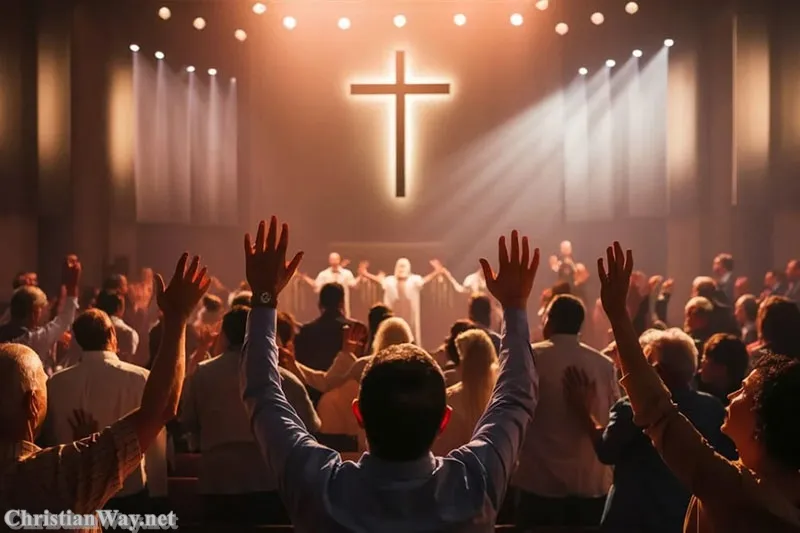
When Christians gather for worship, they do not come merely to hear inspiring thoughts or to enjoy familiar music. They come to meet God together. They come to remember who He is: holy, merciful, faithful, and worthy of all praise. They come to hear His Word, confess their need, receive His grace, pray for the world, and be sent again into daily life as witnesses of Christ.
Yet Christian worship takes many forms. In a quiet village church, believers may sing ancient hymns slowly beneath stained-glass windows. In an Orthodox church, incense may rise as the faithful chant prayers that have carried generations through suffering and joy. In a Catholic Mass, bread and wine are offered at the altar in remembrance of Christ’s sacrifice and presence. In a Protestant congregation, worship may include Scripture, preaching, spontaneous prayer, contemporary songs, and the joyful voices of a gathered community. In a home, a parent may pray with a child before sleep. In a hospital room, a frightened person may whisper the name of Jesus. In a lonely moment of grief, tears offered honestly before God may become a prayer more truthful than many words.
Christian worship is wide enough to include all these moments, yet its purpose remains one: to glorify God and to draw His people more deeply into the life of Christ. It is not meant to make us feel important. It is meant to remind us that God is God, that His mercy is greater than our weakness, and that our lives find their true meaning when they are offered back to Him.
Worship Begins with the God Who Draws Near
The deepest truth about worship is that it begins with God, not with us. We do not worship in order to persuade a distant God to notice us. We worship because He has already made Himself known. He created the world in love. He called a people to Himself. He spoke through prophets. He entered human history in Jesus Christ. He died and rose again so that those who were far from God might be brought near.
The Bible is filled with this divine initiative. God calls Abraham from his homeland. He speaks to Moses from the burning bush. He leads Israel through the wilderness. He gives His people words of praise, lament, confession, and hope through the Psalms. Then, in the fullness of time, He sends His Son into the world.
Jesus does not reveal a God who is hidden behind cold distance. He reveals a Father who seeks His children. He tells the story of the prodigal son not to describe a father waiting with anger, but a father watching, running, embracing, and restoring. He touches the sick, welcomes the outcast, forgives the sinner, and weeps with those who mourn. Christian worship is possible because God has first opened the way.
This is why worship is not merely human effort. It is a response to grace. We praise because God has been good before we knew how to praise. We confess because His mercy is already greater than our sin. We sing because the love of Christ has given the heart a new song. We kneel because the One before whom we kneel is also the One who has come near to lift us up.
The apostle John writes, “We love him, because he first loved us” (1 John 4:19). The same can be said of worship. We worship Him because He has first revealed Himself as worthy of worship. The Christian does not come before God to invent a relationship. He comes to receive the relationship God has given through Christ.
Worship Is Not Escaping Life but Seeing Life Truly
Some people imagine worship as an escape from the real world. They may see it as something reserved for church buildings, religious music, or private moments that have little connection to work, family, suffering, and daily responsibility. But Christian worship is meant to do the opposite. It teaches us to see life more truthfully.
In worship, we remember that we are not self-created. Our lives are gifts. Our time is a gift. Our strength is a gift. The people we love are gifts. Even the breath in our lungs is received, not earned. Worship brings us back to reality because it places God at the center.
When God is forgotten, lesser things begin to take His place. Success becomes an idol. Comfort becomes an idol. Politics becomes an idol. Pleasure becomes an idol. Fear becomes an idol. Even religious activity can become an idol when it is used to make us feel superior to others.
Worship frees us from these false masters. It teaches us to say, “You alone are God. You alone are worthy. You alone can hold the deepest part of my life.” This is not a loss of freedom. It is the beginning of freedom.
The person who truly worships God does not become less engaged with the world. He becomes more able to love the world rightly. She becomes less controlled by the praise or criticism of others. The heart begins to rest in God and is therefore able to serve without constantly needing recognition.
Worship in Spirit and in Truth
One of the most important teachings of Jesus about worship is found in His conversation with the Samaritan woman at the well. She asks Him about the proper place of worship, because Jews and Samaritans had different traditions and different sacred places. Jesus responds by leading the conversation beyond a debate about location. He says that the true worshipers will worship the Father “in spirit and in truth” (John 4:23).
These words are rich with meaning. Worship in spirit does not mean worship without the body, without community, or without visible forms. Christians worship with voices, hands, songs, water, bread, wine, silence, kneeling, standing, and gathered prayer. The body matters because God created the body and because Christ took on human flesh.
To worship in spirit means that worship must come from the heart made alive by the Holy Spirit. It cannot be merely outward performance. A person can sing every hymn, attend every service, know every response, and still remain far from God inwardly. God is not impressed by words that do not lead to love.
To worship in truth means that worship is rooted in who God truly is. Christians do not worship an image of God shaped only by personal desire. They worship the Father revealed through Jesus Christ, in the power of the Holy Spirit. Worship must be formed by Scripture, by the Gospel, by the truth of Christ’s death and resurrection, and by the call to live in love.
Spirit and truth belong together. Worship without truth can become shallow emotion. Worship without the Spirit can become empty routine. The Christian life needs both the warmth of a living heart and the steady light of God’s revealed truth.
The Heart of Worship Is Love
The purpose of worship is not to make God more glorious, as though He lacked something without our praise. God is already holy, already perfect, already full of glory. Our worship does not add to His greatness. Rather, it changes us by helping us recognize His greatness.
When we worship God, we are brought back into right relationship with Him. Pride begins to soften. Fear begins to loosen. Gratitude begins to grow. We remember that we are loved, forgiven, called, and held.
This is why worship must always lead toward love. Jesus teaches that the greatest commandment is to love God with all the heart, soul, mind, and strength, and to love one’s neighbor as oneself. Worship that does not deepen love has not reached its true purpose.
A person may sing loudly, pray beautifully, and speak passionately about God, yet still be harsh in the home, dishonest in work, indifferent to the poor, or unwilling to forgive. Such worship becomes divided. The lips praise God, but the life refuses to reflect His mercy.
True worship does not end when the service ends. It continues in patience, honesty, generosity, courage, humility, and compassion. It becomes visible in the way we treat the people placed before us.
The Biblical Roots of Christian Worship
Christian worship did not begin in a vacuum. It is rooted deeply in the worship of Israel and fulfilled in the life, death, and resurrection of Jesus Christ.
In the Old Testament, worship included sacrifice, prayer, music, feast days, pilgrimage, offerings, fasting, and the reading of God’s law. The temple in Jerusalem became a central place of worship, not because God could be contained within walls, but because He had chosen to meet His people there in a special way.
The Psalms remain one of the greatest schools of worship in all Scripture. They teach believers how to praise when they are joyful, how to cry out when they are afraid, how to confess when they have sinned, and how to wait when God seems silent. The Psalms do not pretend that faith is always easy. They bring the whole human heart before God.
“Come, let us worship and bow down,” says Psalm 95, “let us kneel before the Lord our maker.” These words show the humility of worship. We kneel not because we are worthless, but because we recognize the One who made us and loves us.
In Jesus, worship is brought to its fullness. He is not merely a teacher of worship; He is the true meeting place between God and humanity. Through His incarnation, God comes near. Through His cross, sin is defeated. Through His resurrection, death loses its final power. Through His Spirit, believers are brought into communion with the Father.
The early Christians continued to pray, sing psalms, read Scripture, share meals, care for the poor, and gather around the breaking of bread. Their worship was not detached from daily life. It formed a community in which people shared possessions, prayed for one another, and bore witness to the risen Christ.
Worship and Sacrifice after the Cross
The cross changes the meaning of sacrifice. Christians do not bring sacrifices to God in order to earn His favor. Christ has given Himself once for all. His love is complete. His mercy is not purchased by human effort.
Yet Christians are still called to offer their lives to God. Saint Paul writes, “Present your bodies a living sacrifice, holy, acceptable unto God, which is your reasonable service” (Romans 12:1). This is a beautiful description of Christian worship.
A living sacrifice is not an offering placed on an altar and destroyed. It is a life willingly given to God. It is the daily decision to belong to Christ in work, family, speech, choices, suffering, and service.
This means worship continues when we forgive someone who has hurt us. It continues when we choose honesty rather than deception. It continues when we care for a sick family member, give generously to someone in need, remain faithful in a difficult responsibility, or resist the temptation to live only for ourselves.
The worship of the gathered Church and the worship of daily life belong together. One strengthens the other. We gather to remember Christ, and then we are sent into the world to live as His people.
The Forms of Christian Worship
Christian worship can take many forms because the Church has lived across many nations, languages, cultures, and centuries. The Gospel remains the same, but its songs, prayers, gestures, architecture, music, and patterns of gathering can vary greatly.
Some Christians worship in highly liturgical settings. Their services follow an ordered pattern, often including Scripture readings, prayers, hymns, confession, creeds, a sermon, intercessions, and the Eucharist or Holy Communion. These forms can give worship a deep sense of continuity. Believers pray words that have nourished Christians for centuries. They are reminded that they belong to a Church larger than their own generation.
Other Christians worship in a more spontaneous style. Their gatherings may include extended singing, open prayer, preaching, testimonies, and moments when people respond freely to the movement of the Holy Spirit. These forms can express the immediacy, joy, and personal trust of faith.
Neither ancient liturgy nor spontaneous expression is holy merely because of its style. A carefully structured service can become lifeless if the heart is absent. A lively service can become shallow if emotion is separated from truth. The question is always whether worship is centered on God, rooted in Christ, formed by Scripture, and bearing the fruit of love.
Prayer, Scripture, and Preaching
Prayer is one of the central forms of worship. Christians pray in many ways: through written prayers, spontaneous words, silence, intercession, confession, thanksgiving, and the Lord’s Prayer.
Prayer teaches the heart to depend on God. It reminds us that we are not in control of everything. It makes room for gratitude and confession. It lifts the needs of the world before the Father. It teaches us to ask not only for our own comfort, but for healing, peace, justice, wisdom, mercy, and the coming of God’s kingdom.
Scripture is also central to Christian worship. The Bible is read not merely as an ancient text, but as the living Word that speaks into the life of the Church. Through Scripture, believers hear again the story of creation, covenant, deliverance, incarnation, cross, resurrection, and hope.
Preaching helps the Church receive and apply the Word of God. A faithful sermon does not draw attention to the preacher’s personality. It points people toward Christ. It brings the Gospel into the real struggles of life: grief, work, family, temptation, loneliness, injustice, fear, and hope.
When Scripture and preaching are rooted in humility, they become instruments of healing. They remind believers that God’s Word is not meant to condemn the wounded without mercy. It is meant to call, comfort, correct, forgive, and transform.
Singing and Sacred Music
Music has always been part of Christian worship because the human heart often sings what it cannot fully say in ordinary speech. A hymn can carry theology into memory. A psalm can give voice to sorrow. A simple chorus can become a prayer of trust during a difficult season. A choir can help an entire congregation lift its eyes beyond daily burdens.
The Bible repeatedly calls God’s people to sing. Saint Paul encourages believers to speak to one another “in psalms and hymns and spiritual songs” (Ephesians 5:19). Singing is not merely decoration for worship. It is a way of proclaiming faith together.
Different traditions use different forms of music. Some treasure ancient chant, organ music, and hymns that have been sung for centuries. Others use contemporary instruments and songs written in the language of the present generation. Both can be beautiful when they help people worship God rather than simply seek entertainment.
The question is not whether worship music sounds old or new. The question is whether it leads the heart toward God. Does it help people remember Christ? Does it make room for reverence, confession, joy, hope, and surrender? Does it deepen love for God and neighbor?
Silence, Gesture, and the Worship of the Body
Worship is not only about words. The body also participates. Christians stand to hear the Gospel, kneel in repentance, raise hands in praise, bow in reverence, make the sign of the cross, receive bread and wine, light candles, and sit quietly before God.
These gestures are not empty when they express what the heart longs to say. Kneeling says, “You are God, and I need You.” Standing says, “I am ready to hear and respond.” Raising hands says, “I receive Your mercy and offer myself to You.” Silence says, “I am here, Lord. Speak.”
In a noisy world, silence has become especially precious. Many people live surrounded by constant information, messages, demands, and distractions. Silence in worship can feel uncomfortable at first, yet it can become a place where the heart finally hears its own deepest needs.
The prophet Elijah did not find God in the wind, earthquake, or fire, but in a still small voice. Christian worship makes room for this quiet presence. It reminds us that God is not always found in intensity. Sometimes He comes gently, patiently, and almost unnoticed.
Catholic, Orthodox, and Protestant Forms of Worship
Catholic worship centers on the Mass, where Scripture is proclaimed, prayers are offered, and the Eucharist is celebrated. Catholics believe that Christ is truly present in the Eucharist, and the Mass is therefore understood not simply as a remembrance of Jesus, but as a sacred participation in His saving sacrifice and a reception of His grace.
Catholic worship often includes a rich rhythm of liturgical seasons: Advent, Christmas, Lent, Holy Week, Easter, Pentecost, and the feasts of saints. These seasons help believers enter the story of Christ throughout the year. The Church does not merely remember an event once; it returns prayerfully to the mysteries of Christ’s life so that they may shape the heart again and again.
Eastern Orthodox worship is often marked by deep reverence, beauty, chant, icons, incense, and a strong awareness that worship joins heaven and earth. The Divine Liturgy is not treated as a performance for an audience. It is the prayer of the whole people of God. The faithful stand, sing, bow, cross themselves, and enter a sacred rhythm that has formed Christian communities for centuries.
Orthodox Christians often speak of worship as participation in the mystery of God. The beauty of icons, candles, chanting, and sacred space is not intended to distract from God. It is meant to help the heart recognize that all creation is called to glorify Him.
Protestant worship takes many forms. Lutheran and Anglican worship often preserves a liturgical structure that includes Scripture, prayers, confession, hymns, preaching, and Holy Communion. Reformed churches may place particular emphasis on the reading and preaching of Scripture, congregational singing, prayer, and the faithful proclamation of the Gospel. Methodist traditions often unite structured worship with strong emphasis on personal holiness, grace, and service.
Baptist and evangelical worship frequently emphasizes personal conversion, biblical preaching, congregational singing, prayer, fellowship, and the direct call to follow Christ. Pentecostal and charismatic worship may include spontaneous prayer, joyful praise, testimony, and a strong expectation of the Holy Spirit’s active presence.
These traditions differ in practice, language, and theological emphasis. Yet at their best, all are seeking to honor Christ, hear His Word, receive His grace, and form believers for lives of love.
Worship, Veneration, and the Honor Due to God Alone
In Catholic and Orthodox traditions, people may encounter icons, images, candles, saints’ feast days, and prayers asking for the intercession of the saints. These practices can sometimes be misunderstood by Christians from other traditions.
Catholic and Orthodox teaching makes a clear distinction between worship, which belongs to God alone, and honor or veneration given to saints as faithful witnesses of Christ. The saints are not worshiped as gods. They are remembered because their lives point toward the grace of Christ and because they remind believers that holiness is possible.
Mary, the mother of Jesus, is honored in a unique way because of her place in salvation history, yet Christian worship remains directed to the Father, through the Son, in the Holy Spirit. Mary’s own words in Scripture reveal the proper direction of all devotion: “My soul doth magnify the Lord” (Luke 1:46).
Christians who do not practice these forms of devotion may approach worship differently, often emphasizing direct prayer to God, Scripture, preaching, and congregational praise. These differences should be discussed honestly, but never with contempt. The goal of Christian worship is not to prove that one tradition is more impressive than another. The goal is to glorify God and become more like Christ.
Worship Is More Than a Sunday Gathering
Sunday worship is precious because Christians gather as the Body of Christ. They come together to praise, hear the Word, receive the sacraments where they are celebrated, encourage one another, and be sent into the world.
Yet Christian worship cannot remain inside a church building. The person who sings “Holy, holy, holy” on Sunday is called to live with holiness on Monday. The person who receives forgiveness is called to forgive. The person who prays for peace is called to become a peacemaker. The person who gives thanks for daily bread is called to remember those who hunger.
This is why Saint Paul speaks of offering our bodies as living sacrifices. Worship enters the kitchen, the office, the classroom, the market, the factory, the road, the hospital, and the family home. It shapes the way we speak, spend money, use time, treat strangers, and respond when life becomes difficult.
A parent caring patiently for a child can worship God. A worker refusing dishonesty can worship God. A student choosing kindness rather than cruelty can worship God. A person visiting someone who is lonely can worship God. A believer quietly praying before a hard conversation can worship God.
The whole life becomes worship when it is offered to Christ.
The Worship of Work, Rest, and Service
Work can become an offering to God when it is done with honesty, care, and love. This does not mean every job is easy or every workplace is fair. Many people work under pressure, fatigue, or difficult conditions. Yet even there, the Christian can ask God to give strength, wisdom, patience, and integrity.
Rest can also become worship. In a culture that tells people their worth depends on constant achievement, rest becomes an act of trust. It says, “The world does not depend entirely on me. God is still God when I stop.” Sabbath rest reminds us that we are loved not only for what we produce, but for who we are in Christ.
Service is worship when it flows from love. Feeding the hungry, caring for the sick, visiting the lonely, protecting the vulnerable, and giving generously are not separate from worship. They are worship made visible.
Jesus teaches that when we care for “the least of these,” we are serving Him. This does not mean that mercy replaces prayer, Scripture, or gathered worship. It means that worship without mercy is incomplete.
When Worship Feels Difficult
There are seasons when worship feels joyful. The songs rise easily. The prayers feel warm. The heart is grateful. But there are also seasons when worship feels dry, distracted, or painful.
A person may come to church carrying grief. Someone may sit in a pew after losing a loved one. Another may sing while struggling with anxiety, illness, financial pressure, or family conflict. Some may feel unworthy because of past sin. Others may feel tired of praying because they have not seen the answers they hoped for.
God does not ask us to pretend in worship. The Psalms teach us to bring the whole heart before Him. There are psalms of praise, but there are also psalms of lament. There are songs of victory, but also cries of confusion and sorrow.
Sometimes worship is not the feeling of joy. Sometimes worship is simply showing up. It is sitting quietly before God when we have no words. It is singing one line through tears. It is opening the Bible even when the heart feels numb. It is whispering, “Lord, I am here.”
This faithfulness is precious to God. He is not measuring the strength of our emotions. He is receiving the sincerity of our hearts.
Worship Is Not Performance
One of the dangers in modern Christian life is the temptation to treat worship as performance. This can happen in any tradition. A choir may become more concerned with applause than prayer. A preacher may become more concerned with personality than truth. A congregation may judge worship only by whether it felt exciting, comfortable, or familiar.
But worship is not about entertaining people. It is about turning people toward God.
Beauty has a place in worship. Music can be beautiful. Architecture can be beautiful. Liturgical movement can be beautiful. Preaching can be beautiful. But beauty becomes shallow when it serves vanity rather than reverence.
The purpose of worship is not to make us consumers asking, “Did I enjoy this?” The deeper question is, “Did this draw me nearer to God? Did it help me see Christ? Did it awaken gratitude, repentance, faith, and love?”
Worship and Christian Unity
Christians around the world worship in different languages and styles. Some pray beside icons. Some pray in simple rooms without decorations. Some sing ancient hymns. Some sing new songs with guitars and drums. Some celebrate the Eucharist every week. Some receive Communion less frequently. Some pray from written liturgies. Some pray in spontaneous words.
These differences are real, and they should not be dismissed. Yet worship can also remind Christians of what they share. All who confess Jesus Christ as Lord are called to praise the Father, receive the grace of the Son, and live by the power of the Holy Spirit.
Jesus prayed that His followers might be one. Christian unity does not mean erasing every difference or pretending that theological questions do not matter. It means seeking truth with humility and refusing to let disagreement become hatred.
When Christians worship with sincere hearts, they are drawn toward the same center: Christ. The closer we come to Him, the more we are called to love one another.
This is especially important in a world divided by anger, ideology, fear, and suspicion. Worship teaches us that no nation, culture, political movement, or personal ambition deserves the place that belongs to God alone. Before the throne of God, all human pride must bow.
Reflect and Pray
Dear friend, Christian worship is not reserved for the strong, the learned, or the spiritually impressive. It is the gift of God to every heart that turns toward Him.
Perhaps you worship with a great congregation each week. Perhaps you pray quietly in a small room. Perhaps your faith is strong today, or perhaps you are only trying to hold on. Bring what you have to God. Bring your gratitude, your questions, your weariness, your joy, and your need.
The Lord is not waiting for perfect words or perfect emotions. He is inviting you into His presence. He is calling you to see again that your life belongs to Him, that His mercy is greater than your weakness, and that every ordinary day can become an offering of love.
Let us pray:
Lord Jesus Christ, You are worthy of all praise, honor, and glory. Teach us to worship You in spirit and in truth. Purify our hearts from pride, distraction, and fear. Give us grateful hearts when life is joyful, faithful hearts when life is difficult, and merciful hearts in all that we do. May our prayers, songs, work, service, rest, and daily choices become an offering of love to You. Draw Your Church into deeper unity, and make our lives a quiet witness to Your grace. Amen.
May the peace of Christ dwell richly in your heart, and may every act of worship draw you nearer to the love of God.
— Fr. John Matthew