A pastoral reflection on suffering, human freedom, the cross of Christ, and the hope that God will make all things new again.
Dear friends in Christ,
Few questions reach as deeply into the human heart as this one: If God is good, why is there so much suffering? It is not merely a question for philosophers or theologians. It rises from hospital rooms, gravesides, ruined homes, broken marriages, anxious nights, and prayers that seem to receive no answer. It is asked by the parent watching a child endure illness, by the innocent person wounded through another’s cruelty, by the family caught in war, and by the lonely soul who wonders why God feels so far away.
Sometimes the question is spoken with anger. Sometimes it is whispered through tears. Sometimes it is carried silently for years because the sufferer fears that questioning God may be a sign of weak faith. Yet the Bible does not silence this question. Scripture gives us Job, who demanded to know why calamity had overtaken him. It gives us Jeremiah, who lamented the pain of his people. It gives us the psalmists, who cried, “How long, O Lord?” It even brings us to Jesus Christ upon the cross, praying the anguished words of Psalm 22: “My God, my God, why have you forsaken me?”
Christian faith does not require us to pretend that suffering is small, simple, or easily explained. Nor does it offer a neat formula capable of making every tragedy understandable. The Gospel gives us something deeper than an explanation. It reveals a God who enters our suffering, bears it in His own flesh, defeats its ultimate power through the resurrection, and promises that sorrow will not have the final word.
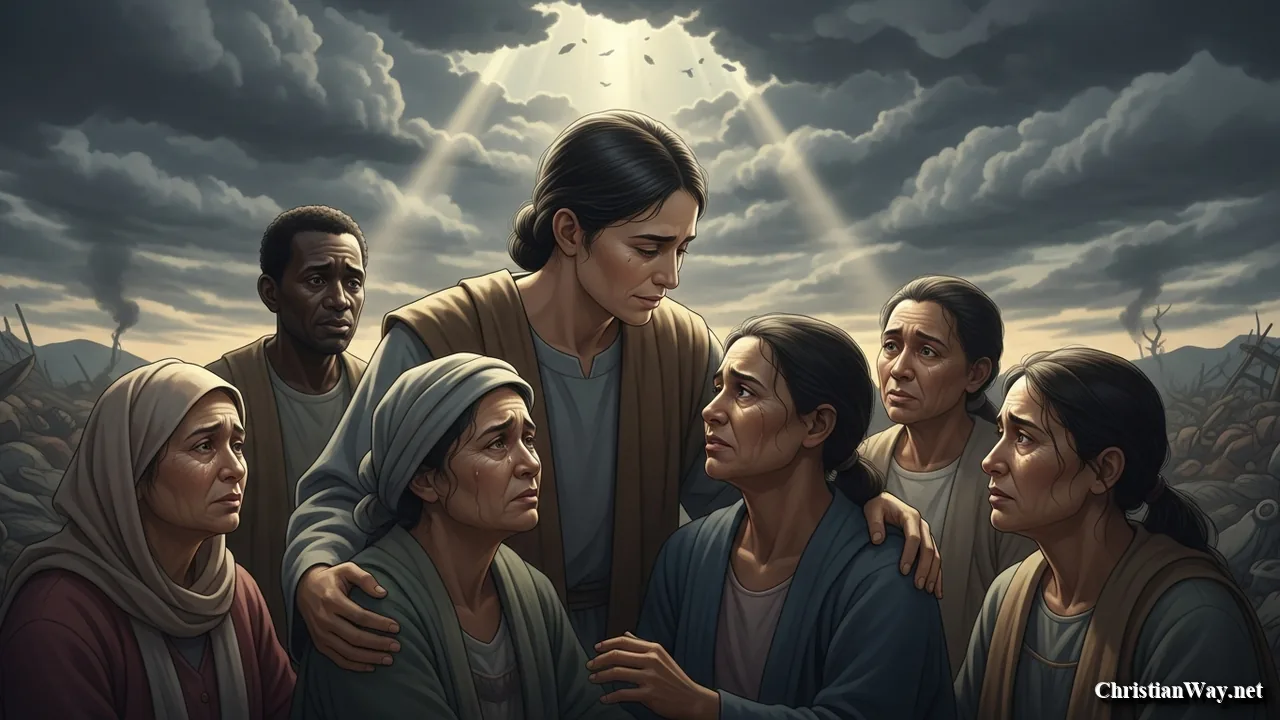
We must approach this mystery slowly and reverently. There are truths that can help us understand why suffering exists, but no theological argument should ever be used to dismiss the tears of a wounded person. Before suffering becomes a problem to be discussed, it is a burden to be carried. Before we speak, we must learn to stand beside those who mourn. And before we attempt to defend the goodness of God, we must look at the face of Jesus, in whom God’s goodness is revealed not from a safe distance but from the heart of human pain.
The Question of Suffering Is Also a Question About God
When we ask, “If God is good, why is there so much suffering?” we are usually holding several convictions together. We believe that God is good. We believe that God is powerful. We see that terrible suffering exists. The tension between these truths can feel unbearable.
If God were good but powerless, perhaps He would desire to help but be unable to do so. If God were powerful but not good, suffering might simply reveal His indifference or cruelty. But Christianity proclaims that God is both perfectly good and sovereign over creation. How, then, can evil and suffering exist within a world made and sustained by Him?
The first Christian response is not to deny the tension. Scripture does not present the world as it presently exists as an uncomplicated reflection of God’s will. The Bible begins with creation declared good, but it quickly tells the story of rebellion, mistrust, violence, exile, and death. The world we inhabit is God’s creation, yet it is also a creation wounded by sin and awaiting restoration.
This distinction matters. Christians do not believe that cruelty, disease, oppression, betrayal, and death reveal the deepest intention of God. They belong to a world that has fallen away from its original harmony. They are real, terrible, and permitted for a time, but they are not eternal. God’s final purpose is not suffering but communion, healing, holiness, resurrection, and life.
God’s Goodness Is Revealed in Jesus Christ
For Christians, the goodness of God is not an abstract theory. It has a face.
Jesus said, “He who has seen me has seen the Father.” When we want to know what God is like, we look to Christ. We see Him touching those whom society rejected, feeding the hungry, welcoming children, forgiving sinners, weeping with the bereaved, and confronting religious hypocrisy. We see Him moved with compassion by the suffering of the crowds. We see Him healing the sick, restoring dignity to the excluded, and offering hope to those burdened by shame.
Nowhere in the Gospels does Jesus treat suffering as trivial. When He met a grieving widow, He did not lecture her about providence before raising her son. When Mary wept at the tomb of Lazarus, Jesus did not rebuke her grief. He wept with her. When people came to Him in pain, He received them with mercy.
The life of Christ prevents us from imagining God as cold or distant. Whatever mysteries remain concerning suffering, we know that indifference is not found in the heart of God. In Jesus, God draws near. He does not observe human misery from a heavenly balcony. He enters our history, shares our vulnerability, and allows the violence of the world to fall upon Him.
God Did Not Create Evil as a Good Thing
Christian theology has traditionally understood evil not as a substance created by God but as a corruption, deprivation, or distortion of something good. Saint Augustine described evil as a lack of the goodness that ought to be present, much as darkness is the absence of light or decay is the corruption of living tissue.
A knife can be used by a surgeon to save a life or by an attacker to wound the innocent. Intelligence can be used to seek truth or to manipulate others. Authority can protect the weak or exploit them. Human desires for love, security, recognition, and belonging are not evil in themselves, but they can become disordered and destructive.
God created human beings with bodies, minds, desires, relationships, and freedom. These are good gifts. Evil arises when created goods are rejected, abused, twisted, or separated from their proper purpose.
This does not remove the emotional weight of suffering. A grieving mother does not cease to grieve simply because evil has been defined philosophically. Yet this teaching protects an essential truth: God is not the creator of cruelty as cruelty. Hatred, abuse, deceit, and murder do not come from the holiness of God. They contradict His character.
The Apostle John writes that “God is light, and in him is no darkness at all.” The darkness is real, but it is not equal to God. Evil is parasitic. It cannot create; it can only damage what God has made. It cannot establish an eternal kingdom of its own. Its days are numbered.
Human Freedom Makes Love Possible—and Evil Possible
Much human suffering results from the choices of human beings. Wars are begun, children are neglected, communities are exploited, promises are broken, and violence is committed because people misuse their freedom.
Why would God give us freedom if He knew it could be used in such terrible ways?
Because without meaningful freedom, there can be no meaningful love. Love cannot be programmed or forced. A creature compelled to obey without any possibility of refusal might function flawlessly, but it could not love in the full personal sense. God created human beings not as machines but as persons capable of relationship, trust, creativity, moral responsibility, and self-giving.
The possibility of love therefore carries the possibility of rejection. The same freedom that allows a person to remain faithful also allows betrayal. The same hands that may feed the hungry can strike the innocent. The same voice that may comfort can deceive.
God’s gift of freedom is not evil. Yet the misuse of freedom produces devastating consequences.
Why Does God Not Stop Every Evil Choice?
We may still ask why God does not intervene every time someone is about to do harm. Why not restrain every violent hand, silence every lie, and prevent every act of betrayal?
At times, Christians believe, God does restrain evil in ways we may never recognize. A plan fails. A person changes direction. Help arrives unexpectedly. A warning is heard in time. Divine providence often works quietly through conscience, law, community, circumstances, and acts of courage.
But if God visibly overruled every harmful decision, human freedom would cease to have meaningful consequences. We would inhabit a world in which choices were only apparent. A person could attempt any evil, knowing that God would always cancel its effects. Moral responsibility would become an illusion.
This is not to say that God values freedom more than the people harmed by its abuse. The cross reveals the opposite: God values the wounded so greatly that He gives Himself for them. Yet His way of overcoming evil is not simply to abolish human agency. He works within history to judge evil, heal its victims, call sinners to repentance, and transform human beings from within.
We should also remember that God’s patience toward human sin is connected to His mercy. If He immediately destroyed every evildoer, none of us could stand, for sin has touched every human heart. God opposes evil, but He also gives time for repentance. His patience should never be confused with approval.
Those who commit injustice will answer before Him. Those who suffer injustice are neither forgotten nor unseen.
The World Is Wounded Beyond Individual Choices
Not all suffering is directly caused by a specific human decision. Earthquakes, genetic disorders, storms, infections, accidents, and many forms of illness belong to what theologians sometimes call natural suffering.
It is important not to accuse sufferers of causing their own pain. When Jesus encountered a man who had been blind from birth, His disciples asked whether the man or his parents had sinned. Jesus rejected that simplistic conclusion. The man’s condition was not a divine punishment for a particular personal sin.
Likewise, when a tower collapsed and killed eighteen people, Jesus did not say the victims were worse sinners than others. He warned His hearers against interpreting tragedy as proof of unusual guilt.
The Christian doctrine of the fall tells us that sin has consequences extending beyond isolated moral acts. Humanity and creation are deeply interconnected. When communion with God was fractured, disorder entered the human condition. Alienation touched our relationships, our inner lives, our bodies, and the created world itself.
Saint Paul writes in Romans 8 that creation “groans” as it awaits liberation. This is a powerful image. The world is beautiful and filled with signs of divine generosity, yet it is not presently in its completed state. Birth and death, growth and decay, wonder and danger exist side by side.
Christianity does not claim that every storm or disease can be traced to one identifiable sin. Rather, it teaches that the entire created order shares in a condition of brokenness. We are living between creation and new creation, between the garden of Genesis and the renewed world promised in Revelation.
A Stable World Necessarily Includes Risk
God has made a world with consistent patterns. Fire gives warmth but can also burn. Water sustains life but can also drown. Gravity enables us to walk but also makes falling possible. Cells reproduce and heal, yet their processes can become disordered.
A world in which natural laws constantly changed to prevent every injury would not be a world in which stable life, science, responsibility, or ordinary action could exist. We depend upon the reliability of creation even though that same reliability sometimes permits suffering.
This does not fully answer why a particular disaster was allowed. We must remain humble. General principles cannot explain every personal tragedy. But they help us see that a world capable of sustaining embodied, relational, responsible creatures must possess a real order rather than functioning as an endless series of miracles designed to remove every danger.
God can intervene miraculously, and Christians rightly pray for healing and protection. Yet miracles are signs of the coming kingdom, not the ordinary structure of the present age. Even those healed by Jesus eventually faced death. His miracles pointed beyond themselves toward the resurrection and the final renewal of all things.
Suffering Is Not Always Punishment
One of the most damaging religious responses to suffering is the assumption that every painful event is a direct punishment from God.
The Book of Job challenges this belief. Job’s friends were convinced that his suffering must have been caused by hidden sin. Their theology appeared orderly: good people prosper, bad people suffer, and therefore anyone who suffers greatly must have sinned greatly.
But God rebuked Job’s friends. They had spoken confidently where they should have remained humble. Job’s suffering could not be explained by their moral calculations.
There are times when sinful choices lead naturally to painful consequences. Addiction may damage health and relationships. Dishonesty may destroy trust. Violence may produce retaliation and imprisonment. Scripture also teaches that God disciplines those He loves, forming us in holiness.
Yet discipline is not the same as cruel punishment, and we are rarely qualified to declare why another person is suffering. Jesus repeatedly directs us away from judgment and toward compassion.
When we encounter suffering, our first question should not be, “What did this person do wrong?” It should be, “How can I love this person? How can I bear this burden with them?”
A theology that makes the sufferer feel condemned may speak about God while failing to reveal the heart of God.
God Can Bring Good From Suffering Without Calling Suffering Good
Christians often say that God brings good out of suffering. This is true, but it must be expressed carefully.
Suffering is not automatically holy. Trauma does not always make people stronger. Pain can embitter, isolate, and overwhelm. We should never tell someone enduring abuse to remain in danger because suffering is spiritually valuable. We should never treat preventable injustice as an opportunity for character development. Christians are called to protect the vulnerable, seek medical care, confront oppression, and relieve suffering wherever possible.
Yet God is able to enter what is evil and bring forth a good that evil never intended.
Joseph’s brothers sold him into slavery. Their action was sinful. Years later, after God had used Joseph to preserve many lives during famine, Joseph told them, “You meant evil against me; but God meant it for good.” He did not pretend their betrayal was good. He distinguished their intention from God’s redeeming purpose.
The supreme example is the crucifixion. The betrayal, false accusations, political cowardice, torture, and execution of Jesus were genuinely evil. God did not declare injustice good. Yet through this very event, He accomplished salvation. Human hatred became the place where divine love was most fully revealed. The instrument of death became the tree of life.
This is the pattern of redemption. God does not merely erase the past. He transforms it. Wounds may become places of compassion. Loss may deepen our awareness of what is eternal. A person who has known loneliness may become unusually attentive to the forgotten. One who has received mercy may become merciful.
We should not rush this process or demand that suffering immediately produce a lesson. Healing often takes years. Some wounds remain tender throughout earthly life. But no pain surrendered to God is beyond His power to redeem.
The Cross Is God’s Answer From Within Suffering
At the center of Christianity stands not a philosophical argument but a crucified Savior.
If God had remained distant from suffering, we might reasonably accuse Him of asking humanity to endure what He refused to touch. But in Jesus Christ, God enters the full depth of our condition.
Jesus knew hunger, exhaustion, misunderstanding, rejection, grief, betrayal, physical agony, public humiliation, and death. He was not protected from suffering by His innocence. Indeed, the sinless One suffered through the sins of others.
In Gethsemane, Jesus did not approach pain with emotional detachment. He was deeply distressed. He prayed that the cup might pass from Him. Christian courage is not the absence of fear or sorrow. Jesus teaches us that anguish may be brought honestly before the Father.
On Calvary, Christ entered the apparent silence of God. His cry of abandonment gives voice to all who feel forsaken. Yet even there, He entrusted Himself to the Father: “Into your hands I commend my spirit.”
The cross tells us that God does not watch human suffering without being moved. In a mystery beyond our full understanding, He bears it. The Son of God receives into Himself the violence, guilt, grief, and death of the world.
God Is Present Even When He Feels Absent
Suffering often creates a painful sense of divine absence. Prayer becomes difficult. Words that once gave comfort seem empty. The believer may wonder whether God has withdrawn.
The cross assures us that the feeling of abandonment is not proof of actual abandonment. Jesus Himself entered that darkness, yet the Father had not ceased to love the Son. Holy Saturday appeared to be the victory of death, but the hidden work of God was moving toward resurrection.
There are seasons when God’s presence is experienced through consolation, clarity, or peace. There are also seasons when faith must rest upon His character rather than upon our feelings.
In such times, we may pray very simply: “Lord, I do not understand. I cannot feel You. But hold me when I cannot hold onto You.”
Faith in suffering is not pretending that darkness is light. It is trusting that the darkness cannot extinguish the light of Christ.
The Resurrection Changes the Meaning of Suffering
Without the resurrection, the cross would remain only a tragic execution. With the resurrection, it becomes the place where death begins to lose its dominion.
Christian hope is not merely the belief that difficult circumstances will improve. Sometimes they do not improve in this life. Some illnesses are not healed. Some relationships are not restored. Some injustices remain unresolved. Every earthly life eventually reaches death.
The Gospel offers a hope stronger than optimism. Jesus Christ has risen bodily from the grave. Death is still an enemy, but it is a defeated enemy. It can wound us, separate us for a time, and fill our eyes with tears, but it cannot erase those who belong to Christ.
Paul declares that the sufferings of the present time are not worthy to be compared with the glory that will be revealed. He is not minimizing pain. Paul knew beatings, imprisonment, rejection, danger, and grief. He speaks as one who has suffered and yet has encountered the risen Lord.
The Christian promise is not that all suffering will be explained to our satisfaction. It is that all suffering will be overcome.
The Book of Revelation offers a vision of God dwelling with His people: “He will wipe away every tear from their eyes, and death shall be no more.” Notice the tenderness of the image. God does not merely announce that tears have ended. He wipes them away.
The hands that were pierced will touch the faces of the redeemed. Nothing will remain unhealed.
Why Does God Sometimes Seem to Delay?
The delay of God is one of the most difficult aspects of suffering. We pray, and the situation continues. We ask for justice, and the oppressor appears to prosper. We ask for healing, and the medical report worsens.
Scripture is honest about this waiting. The Psalms repeatedly cry, “How long?” The prophets ask why God tolerates violence. The martyrs in Revelation call for justice. Biblical faith does not forbid impatience before God. It teaches us to bring that impatience into relationship with Him.
We cannot always know why God delays. Sometimes circumstances are changing in ways we cannot yet see. Sometimes God is working in human hearts slowly, without violating their freedom. Sometimes an answer comes in a form different from what we requested. Sometimes the healing we seek will be completed only in the resurrection.
This is not emotionally easy. A future promise does not remove present pain. Yet Christian hope enables us to suffer without concluding that the present moment is the whole story.
A tapestry viewed from behind appears to be a confusion of knots and loose threads. From the front, a pattern is visible. This analogy is imperfect, especially when applied to devastating tragedy, but it points toward our limited perspective. We see only a fragment of history. God sees the whole and is weaving redemption through countless lives and generations.
We must not use providence to silence lament. But neither should we assume that God’s silence means inactivity. The tomb was silent on Holy Saturday. Resurrection was already near.
The Bible Gives Us Permission to Lament
Faithful Christians do not need to hide their sorrow from God. Lament is not unbelief. It is pain spoken within a relationship of trust.
The Psalms contain prayers of bewilderment, anger, grief, and protest. They ask why the wicked prosper, why the innocent suffer, and why God seems hidden. These prayers are included in Scripture because God welcomes honest hearts.
Lament refuses two false choices. It refuses to deny suffering, and it refuses to abandon God. It says, “This is terrible, Lord, and I am bringing it to You because I still believe You hear me.”
Jesus prayed the Psalms. When He cried, “My God, my God, why have you forsaken me?” He was entering the prayer of Israel and carrying the lament of humanity into the heart of God.
A suffering Christian may not be able to offer long prayers. Tears may become prayer. Silence may become prayer. A single sentence repeated through the night—“Jesus, have mercy”—may be enough.
The Church must make room for such prayer. Worship should not demand constant cheerfulness. There are times for songs of praise and times for mourning. Christian community becomes truthful when people are permitted to say, “I am not well,” without being treated as spiritual failures.
God Often Answers Suffering Through His People
When we ask where God is in a suffering world, part of the answer may be that He is calling us to become instruments of His compassion.
God feeds the hungry through hands that prepare and share food. He comforts the lonely through those who sit beside them. He protects the vulnerable through people who speak courageously. He brings healing through physicians, nurses, counselors, pastors, family members, and friends.
The parable of the Good Samaritan does not offer an abstract explanation for why a man was attacked. It shows what love must do when suffering is encountered. The Samaritan sees, draws near, binds the wounds, provides transportation, pays the cost, and promises continued care.
The priest and Levite may have possessed theological knowledge, but they passed by. The Samaritan became the neighbor because compassion moved him into action.
We must therefore be careful when discussing the problem of suffering. The question is not only, “Why does God allow this?” It is also, “What is God calling me to do about it?”
Perhaps God is calling someone to forgive, another to report abuse, another to provide shelter, another to fund medical treatment, another to visit the forgotten, and another to challenge an unjust system. Prayer and action belong together.
The Church betrays her mission when she explains suffering but refuses to relieve it. Christ has entrusted His compassion to His body. When one member suffers, all are called to suffer together.
Christian Traditions Emphasize Different Parts of the Mystery
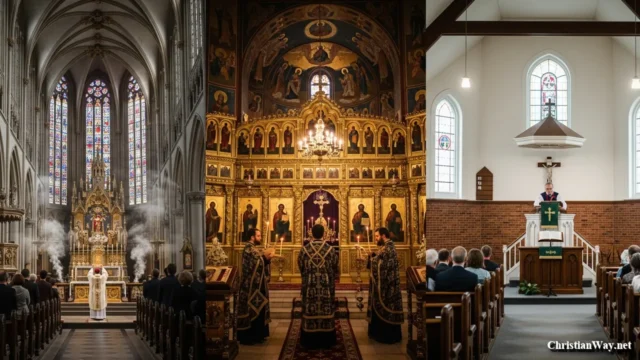
Across Catholic, Orthodox, Anglican, and Protestant traditions, Christians share the central conviction that God is good, creation is wounded by sin, Christ has entered human suffering, and the resurrection promises final victory.
Different traditions sometimes emphasize particular aspects of this mystery. Western Christian theology has often reflected upon free will, original sin, providence, and the redemptive meaning of the cross. Eastern Christianity frequently speaks of sin and death as diseases from which humanity needs healing, emphasizing Christ as the victorious physician who restores creation. Protestant traditions have strongly proclaimed God’s sovereignty, the sufficiency of grace, and the believer’s hope in the promises of Scripture. Catholic spirituality has often reflected upon uniting suffering with Christ while also insisting upon works of mercy and care for the vulnerable.
These emphases need not compete. Together, they remind us that suffering is a mystery larger than any single theory. It involves freedom, sin, mortality, spiritual conflict, human limitation, divine providence, moral formation, sacrificial love, and the hope of resurrection.
Christians may disagree about the precise relationship between God’s sovereignty and His permission of particular events. We should discuss such questions with humility. No tradition gives us permission to portray God as cruel, to blame victims, or to become passive before injustice.
The common ground beneath our differences is Jesus Christ crucified and risen.
What Suffering Can—and Cannot—Teach Us
Suffering can strip away illusions of self-sufficiency. It can reveal how deeply we need God and one another. It can soften our judgment of others, deepen prayer, reorder our priorities, and awaken compassion.
But suffering does not automatically accomplish these things. Pain can also lead to despair. Growth occurs not because suffering possesses magical goodness but because grace meets us within it.
The Letter of James speaks of trials producing perseverance. Paul writes that suffering can produce endurance, character, and hope. These passages should be received as promises of what God can do, not as commands to enjoy pain.
There is a difference between choosing a costly act of love and being harmed against one’s will. A parent may sacrifice sleep to care for a child. A missionary may accept hardship to serve others. A believer may endure ridicule rather than betray conscience. Such suffering can become an offering of love.
Abuse, exploitation, and preventable cruelty must not be sanctified. A person in danger should seek safety. Forgiveness does not require remaining exposed to harm. Carrying the cross never means cooperating with another person’s sin.
Jesus submitted to the Father’s saving mission, but He also confronted evil, escaped hostile crowds when His hour had not come, exposed hypocrisy, and defended the vulnerable. Christian discipleship includes patient endurance, but it also includes truthful resistance.
How Can We Continue to Believe That God Is Good?
We continue to believe not because we can explain every tragedy but because we have encountered the character of God in Jesus Christ.
We look at the manger and see a God who comes near. We look at Christ’s ministry and see compassion. We look at the cross and see self-giving love. We look at the empty tomb and see life stronger than death. We look at the saints and ordinary believers whose lives have been transformed by grace. We look at moments of forgiveness, courage, beauty, and mercy that appear even in the darkest places.
Faith does not remove every question. It gives us Someone to whom the questions may be brought.
Job never received a detailed explanation of the heavenly events surrounding his suffering. Instead, he encountered God. That encounter did not make his losses unreal, but it enlarged his vision. He discovered that reality was greater than the portion he could see.
There may be questions we carry into eternity. Perhaps, in the light of God, we will understand. Perhaps understanding will no longer be our greatest need because every wound will have been healed in His presence.
For now, faith means placing our trembling hands into the wounded hands of Christ.
Walking With Someone Who Is Suffering
When another person is in pain, we should resist the temptation to offer quick explanations. Even true statements can become cruel when spoken without tenderness.
A grieving person may not need a lecture about free will or the fallen world. They may need a meal, a listening ear, practical assistance, or someone willing to sit in silence.
Job’s friends did their best work before they began speaking. For seven days, they sat with him in grief. Their failure began when they tried to explain what they did not understand.
We can say, “I am sorry.” We can say, “This should not have happened.” We can say, “I am here.” We can ask, “What would help you today?” We can pray without forcing the sufferer to perform hope before they are ready.
The ministry of presence reflects the incarnation. God came to dwell among us. In the same way, Christians are called not merely to speak toward suffering but to enter the sufferer’s loneliness with love.
Sometimes no words are sufficient. A hand held in silence may become a sermon. A friend who continues to visit after others have moved on may become evidence that God has not forgotten.
When You Are the One Who Is Suffering
When suffering enters your own life, you do not have to solve the entire problem of evil before you are allowed to trust God. You may come to Him confused, angry, numb, or afraid.
Tell Him the truth. Read a lament psalm slowly. Ask trusted believers to pray when you cannot. Receive medical and psychological care when needed. Seek safety if another person is harming you. Allow the Church to carry you rather than trying to appear strong.
Do not interpret every dark emotion as a failure of faith. Jesus was sorrowful unto death in Gethsemane. The saints knew spiritual darkness, grief, and exhaustion. Human weakness is not a barrier to grace.
You may not recognize God’s work immediately. Healing is often quiet. It may begin with the strength to rise from bed, the courage to speak honestly, or the willingness to receive help.
The Lord may not answer every “why,” but He will not despise your broken heart. Christ is especially near to those who have nothing left to offer except their need.
The Final Christian Answer Is a Promise
If God is good, why is there so much suffering?
Because creation is wounded, human freedom is misused, and the world has not yet reached the fullness for which God made it. Because love requires real freedom, and embodied life exists within a stable but presently groaning creation. Because evil is permitted for a time, though it is never equal to God and will not endure forever.
Yet these truths, while important, are not the final Christian answer.
The final answer is Jesus Christ.
God has not abandoned the suffering world. He has entered it. He has taken its wounds into His own body. He has borne sin and death upon the cross. He has risen from the grave. He has poured out His Spirit. He is gathering a people who are called to resist evil, heal wounds, comfort the grieving, and bear witness to the coming kingdom.
One day, justice will be complete. Every hidden act will be revealed. Every unrepented cruelty will face judgment. Every faithful sacrifice will be remembered. Every child of God will be raised. Creation itself will be renewed.
Christian hope does not say that suffering was secretly harmless. It says that God is so powerful in love that even the deepest suffering cannot prevent His purpose from being fulfilled.
The wounds of the risen Jesus were not erased. They were transformed. They no longer spoke of defeat but of victorious love. This may be a glimpse of what God intends for all who belong to Him. Our history will not be denied, but it will be redeemed. Our scars will no longer ache with shame or grief. They will testify that grace carried us through the darkness and brought us home.
Reflect and Pray
Dear friend, perhaps this question is personal for you. Perhaps you are not asking about suffering in general but about one face, one diagnosis, one betrayal, one grave, or one prayer that seems unanswered.
You do not need to force yourself into an easy conclusion. Bring the question to Christ. Bring Him your disappointment as well as your faith. Bring Him the part of you that still hopes and the part that is tired of hoping.
Look upon the crucified Lord and remember: God is not untouched by your pain. Look upon the risen Lord and remember: your pain will not be eternal.
There will be a day when faith becomes sight, when mourning gives way to joy, and when the fragmented pieces of our stories are gathered into the peace of God. Until then, we walk together. We weep with those who weep. We resist what is evil. We care for the wounded. We pray for miracles. We trust when understanding fails. And we hold fast to the promise that neither suffering nor death can separate us from the love of God in Christ Jesus our Lord.
Let us pray:
Lord Jesus Christ,
You entered our wounded world
and carried our sorrows upon the cross.
Draw near to all who suffer today.
Comfort those who mourn,
protect those who are in danger,
strengthen those whose faith is weary,
and give courage to those who feel forgotten.
Forgive us when we offer easy answers
instead of compassionate love.
Make Your Church a shelter for the wounded,
a voice for the oppressed,
and a faithful witness to Your resurrection.
When we cannot understand Your ways,
help us to trust Your heart.
When we cannot feel Your presence,
hold us in Your mercy.
And when our earthly journey is complete,
bring us into the kingdom
where every tear is wiped away
and all things are made new.
May the peace of Christ guard your heart in every season, and may the light of His resurrection sustain you through every darkness.
— Fr. John Matthew