A pastoral reflection on why Christians differ in doctrine, worship, and practice while remaining called to unity in Christ.
Dear friends in Christ,
Anyone who begins to look seriously at Christianity soon encounters a question that can be both fascinating and troubling: if Christians worship the same Jesus Christ, read the same Bible, and confess faith in the same God, why are there so many different churches and denominations? Why do Catholics, Orthodox Christians, Anglicans, Lutherans, Reformed Christians, Baptists, Methodists, Pentecostals, and many others worship differently, organize their communities differently, and sometimes disagree about important matters of doctrine?
For some, these differences are merely historical curiosities. For others, they become a painful obstacle to faith. A person searching for God may wonder which church is true, which interpretation of Scripture can be trusted, and whether Christian division contradicts the prayer of Jesus that His disciples “all may be one” (John 17:21). Some Christians grow defensive about their own tradition. Others become discouraged and conclude that doctrine does not matter at all. Still others move from one congregation to another, searching for a community that feels spiritually alive, intellectually convincing, and faithful to Christ.
Yet the history of Christian denominations cannot be understood simply as a story of human stubbornness, nor should it be romanticized as though every division were harmless. It is a story in which sincere faith, theological conviction, cultural difference, political conflict, spiritual renewal, human sin, and the mysterious providence of God are woven together. Some divisions arose because Christians believed essential truths were at stake. Others were deepened by pride, fear, violence, ambition, or failures of charity. Many developed gradually over centuries rather than through one dramatic event.
To understand why Christian denominations differ, we must look patiently at history, theology, and practice. We must also look within the human heart. Christians are not disembodied minds discussing abstract ideas. We inherit languages, cultures, memories, wounds, institutions, and ways of praying. We receive the Gospel through particular communities, and those communities shape how we hear Scripture and understand the life of faith.
Still, beneath all these differences stands Jesus Christ. He is not divided. He remains the crucified and risen Lord, the eternal Son of the Father, the Savior of the world, and the Shepherd who continues to call His scattered people toward truth, holiness, and unity. Our purpose, therefore, is not to decide which Christians are worthy of contempt. It is to understand the roots of our differences honestly, to recognize the faith we share gratefully, and to seek the unity for which Christ prayed without pretending that serious disagreements do not exist.
One Lord at the Center of the Christian Faith
Before speaking about denominations, we must begin with what Christianity itself proclaims. The Christian faith did not begin with denominations. It began with Jesus Christ.
Jesus called disciples, proclaimed the kingdom of God, forgave sins, healed the sick, welcomed the rejected, confronted hypocrisy, and revealed the love of the Father. He was crucified under Pontius Pilate and rose from the dead. After His resurrection, He sent His disciples into the world, commanding them to make disciples of all nations, baptizing them and teaching them to obey all that He had commanded.
The first Christians did not think of themselves primarily as members of competing religious organizations. They understood themselves as the people of the new covenant, gathered by God through Christ and filled with the Holy Spirit. The Book of Acts describes the earliest believers in Jerusalem:
“And they continued stedfastly in the apostles’ doctrine and fellowship, and in breaking of bread, and in prayers.”
— Acts 2:42
These four elements—apostolic teaching, fellowship, the breaking of bread, and prayer—remain at the heart of Christian life. Christians across denominational boundaries continue to read the apostolic writings, gather in community, celebrate forms of sacramental or memorial worship, and pray in the name of Jesus.
The New Testament repeatedly emphasizes the unity of Christ’s people. Saint Paul writes:
“There is one body, and one Spirit, even as ye are called in one hope of your calling; one Lord, one faith, one baptism, one God and Father of all.”
— Ephesians 4:4–6
This unity is not merely emotional agreement. It is grounded in God Himself. Christians are called into one body because they belong to one Lord. The Church’s unity is therefore a gift before it is an achievement. At the same time, Christians are commanded to preserve and express that unity visibly through truth, love, patience, and reconciliation.
Unity Did Not Mean Perfect Uniformity
Even the earliest Christian communities were not identical in culture or custom. Jewish Christians continued to live within many patterns inherited from Israel, while Gentile converts came from Greek, Roman, Syrian, Egyptian, African, and Asian cultures. Some Christians ate foods that others avoided. Some observed particular days, while others did not. Different communities faced different pastoral problems.
The New Testament itself preserves these tensions. Acts 15 records a major dispute over whether Gentile converts had to be circumcised and observe the Mosaic law in the same way as Jewish believers. The apostles and elders gathered in Jerusalem, listened to testimony, searched the meaning of God’s work, and reached a decision for the wider Church.
Saint Paul also addressed conflicts concerning food, worship, spiritual gifts, leadership, and moral discipline. He did not demand that every Christian possess the same personality or cultural expression. Yet he insisted that diversity must remain ordered toward unity in truth and love:
“For as the body is one, and hath many members, and all the members of that one body, being many, are one body: so also is Christ.”
— 1 Corinthians 12:12
Christian diversity, therefore, is not automatically a sign of failure. The Church has always included different languages, spiritualities, customs, theological emphases, and forms of ministry. The problem arises when diversity becomes separation, when legitimate differences become mutual exclusion, or when Christians deny one another’s faithfulness to Christ without careful understanding.
What Is a Christian Denomination?
The word “denomination” is used broadly, but it does not describe every Christian tradition equally well. In common speech, it refers to an organized Christian body distinguished by particular beliefs, structures, worship practices, or historical origins. Baptists, Methodists, Presbyterians, and many Pentecostal bodies are commonly called denominations.
The Roman Catholic Church and the Eastern Orthodox Churches generally do not understand themselves as denominations in the same sense. Each claims a visible historical continuity with the Church founded by Christ and led by the apostles. The Oriental Orthodox Churches likewise possess ancient apostolic traditions and do not regard themselves merely as one modern option among many.
Anglicanism is often described as a communion rather than a single denomination because it consists of self-governing provinces joined by a shared heritage and relationship with the Archbishop of Canterbury. Lutheranism and Reformed Christianity include numerous national churches, confessional bodies, synods, and denominations. Evangelicalism is not one denomination at all, but a broad movement that crosses denominational boundaries.
The vocabulary can therefore become confusing. Words such as “church,” “communion,” “tradition,” “confession,” “movement,” and “denomination” overlap but are not identical. Still, the central question remains the same: why did Christians who confess Jesus Christ come to inhabit distinct ecclesial communities?
The answer begins in the ancient world.
The Early Church and the Development of Christian Doctrine
The first centuries of Christianity were marked by missionary expansion, persecution, theological reflection, and the gradual development of ecclesial structures. Christian communities spread throughout the Roman Empire and beyond it, reaching regions such as Armenia, Persia, Ethiopia, India, and North Africa.
As the Gospel entered different cultures, questions arose. How should Christians speak about the relationship between the Father, the Son, and the Holy Spirit? How could Jesus Christ be truly divine and truly human? Which writings should be received as Holy Scripture? How should bishops, priests, deacons, and local churches relate to one another?
Christians did not invent doctrine merely to satisfy intellectual curiosity. These questions touched worship and salvation. If Christ were not truly God, could He fully reveal God and save humanity? If He were not truly human, could human nature truly be healed and restored? If the Holy Spirit were merely a creature, could Christians worship Him with the Father and the Son?
Councils, Creeds, and the Defense of the Faith
The early Church responded to major controversies through prayer, biblical interpretation, pastoral teaching, and councils of bishops. The Councils of Nicaea in 325 and Constantinople in 381 played a decisive role in articulating the Church’s faith in the Trinity. The Nicene Creed confessed Jesus Christ as “God from God, Light from Light, true God from true God,” and the Holy Spirit as “the Lord, the giver of life.”
Later councils addressed the mystery of Christ’s person. The Council of Chalcedon in 451 taught that Jesus Christ is one person in two natures, truly divine and truly human, without confusion or separation.
These formulations were intended to protect the mystery proclaimed in Scripture. Yet theological language does not exist apart from culture and translation. Christians speaking Greek, Latin, Syriac, Coptic, Armenian, and other languages did not always use terms in precisely the same way. Political pressures, regional rivalries, imperial involvement, and failures of communication sometimes made reconciliation more difficult.
After the Council of Ephesus in 431, the Church of the East developed separately from the churches of the Roman Empire. After Chalcedon, the churches now known as the Oriental Orthodox Churches—including the Coptic, Armenian, Syriac, Ethiopian, Eritrean, and Malankara Orthodox traditions—did not accept the council’s definition as it was expressed and received by the imperial Church.
For centuries these separations were described almost entirely as doctrinal conflict. Modern theological dialogues, however, have shown that some historical disagreements were intensified by different terminology and mutual misunderstanding. Real historical and theological questions remain, but many Christians have come to recognize that their ancestors sometimes condemned one another without fully grasping what the other side intended to confess.
This does not mean doctrine was unimportant. It means that Christian division is often more complicated than a simple contrast between truth and obvious error.
The Division Between Eastern and Western Christianity
For roughly the first thousand years after Christ, Christians in the Greek-speaking East and Latin-speaking West remained in communion, though tensions increased over time. They shared the sacraments, honored many of the same saints, received the ancient creeds, and looked to the apostolic foundations of the Church.
Yet East and West developed in different cultural and political worlds. The western Roman Empire collapsed, while the Byzantine Empire continued in the East. Latin became dominant in Western theology, while Greek remained central in the East. Different liturgical customs, patterns of spirituality, and theological vocabularies emerged.
The Authority of the Bishop of Rome
One of the most important disagreements concerned the role of the Bishop of Rome, the pope. Christians in both East and West recognized Rome as an ancient apostolic church associated with Saints Peter and Paul. The Bishop of Rome held a position of great honor and often served as an important voice in theological disputes.
The disagreement concerned the nature and extent of that authority. The Western Church gradually developed a stronger understanding of universal papal jurisdiction. The Eastern Churches emphasized the shared authority of bishops gathered in council and generally understood the pope as first among the major patriarchs, but not as a universal bishop possessing immediate jurisdiction over every local church.
This difference did not appear suddenly in one year. It developed gradually through centuries of changing circumstances, competing interpretations, and political tensions.
The Filioque and Other Disputes
Another major controversy concerned the Latin word filioque, meaning “and the Son.” The original form of the Nicene-Constantinopolitan Creed confessed that the Holy Spirit “proceeds from the Father.” In the West, the phrase “and the Son” was gradually added to emphasize the relationship between Christ and the Spirit and to defend the divinity of the Son.
Eastern Christians objected both to the theology implied by the addition and to the fact that the creed had been altered without an ecumenical council. Western Christians believed the phrase expressed an orthodox theological truth. The dispute involved subtle questions about the eternal relations within the Trinity, but it was also tied to authority, language, and ecclesial trust.
Other disagreements concerned clerical celibacy, fasting customs, liturgical bread, and church discipline. None of these alone fully explains the rupture. The mutual excommunications associated with the year 1054 became a symbolic turning point, but communion between East and West deteriorated over a longer period.
The tragedy deepened in 1204 when Western crusaders captured and brutally sacked Constantinople, a Christian city. The violence left wounds that theological discussion alone could not easily heal.
The result was the enduring separation between what came to be known as the Roman Catholic Church in the West and the Eastern Orthodox Church in the East. Both preserved ancient liturgies, sacramental life, episcopal ministry, monastic spirituality, and devotion to the saints, yet they developed separately and continued to disagree about papal authority and certain theological formulations.
The Protestant Reformation and the Multiplication of Western Traditions
The most dramatic expansion of denominational diversity in Western Christianity came through the Protestant Reformation of the sixteenth century. The Reformation did not arise from a single cause, nor was it led by one united group with one theological program.
Late medieval Western Christianity possessed deep spiritual riches, including monastic renewal, scholastic theology, popular devotion, charitable institutions, and remarkable saints. At the same time, serious abuses and scandals existed. Some church offices had become entangled with wealth and political power. Clergy were not always well educated. The sale and preaching of indulgences were sometimes handled in misleading or exploitative ways. Many faithful Christians longed for moral reform, clearer preaching, and deeper engagement with Scripture.
The invention of the printing press accelerated the spread of ideas. Renaissance humanism encouraged scholars to study ancient biblical manuscripts and return to original sources. Political rulers saw opportunities to resist external control. Calls for reform that might once have remained local became international movements.
Martin Luther and Justification by Faith
In 1517, the German monk and theologian Martin Luther challenged the preaching of indulgences by circulating his Ninety-Five Theses. The controversy soon widened. Luther questioned the authority of the pope, appealed strongly to Scripture, and taught that sinners are justified by God’s grace through faith in Christ rather than through human merit.
Luther did not believe that good works were unnecessary. He taught that genuine faith bears fruit in love and obedience. His central concern was that salvation is God’s gift, received through trust in Christ, not something earned by human achievement.
Luther’s followers retained infant baptism, the historic creeds, liturgical worship, and a strong understanding of Christ’s presence in the Lord’s Supper. Lutheranism therefore differed from later Protestant movements that adopted less sacramental forms of worship.
The Reformed Tradition
In Switzerland, figures such as Huldrych Zwingli and John Calvin led reform movements with distinct emphases. Reformed theology stressed the sovereignty of God, the authority of Scripture, covenant theology, disciplined Christian living, and the reform of worship according to biblical principles.
Calvin taught a profound doctrine of union with Christ and emphasized that salvation is entirely rooted in divine grace. The Reformed tradition also became associated with teachings concerning election and predestination, though Reformed Christians have expressed these doctrines in different ways.
Church governance in the Reformed world often developed through elders and representative assemblies rather than bishops. Presbyterian churches emerged from this pattern, especially through the Scottish Reformation.
The Anglican Reformation
The English Reformation had theological, political, and personal dimensions. King Henry VIII’s break with papal authority was connected to his desire for an annulment, but the English Church’s later theological identity cannot be reduced to the king’s motives.
Under subsequent monarchs and church leaders, the Church of England received significant Protestant theology while retaining bishops, historic creeds, liturgical worship, and many elements of the ancient Christian inheritance. The Book of Common Prayer shaped Anglican spirituality through Scripture, sacramental worship, daily prayer, and a distinctive rhythm of reverence.
Anglicanism eventually developed a broad internal character. Some Anglicans emphasize the Catholic continuity of the Church, others its Reformation identity, and still others an evangelical or charismatic spirituality. This breadth has sometimes allowed communion across differences, but it has also created internal tensions.
The Radical Reformation
Some reformers believed that Lutherans, Reformed Christians, and Anglicans had not gone far enough. Groups later associated with the Anabaptist tradition rejected infant baptism, teaching that baptism should follow a personal confession of faith. They emphasized discipleship, community, nonviolence, simplicity, and separation between the Church and political power.
Many Anabaptists were persecuted by both Catholic and Protestant authorities. Their descendants include Mennonites, Amish communities, and related traditions. Their witness reminds the wider Church that Christian history includes not only debates among powerful institutions but also communities that suffered for conscience.
Revivals, Missions, and New Christian Movements
The denominational landscape continued to develop after the Reformation. Baptists emerged in the seventeenth century, emphasizing believer’s baptism, congregational life, religious liberty, and the authority of Scripture. Though Baptists share certain convictions, they are remarkably diverse in theology, worship, and organization.
In the eighteenth century, John and Charles Wesley led a renewal movement within Anglicanism that emphasized personal conversion, disciplined holiness, small-group fellowship, care for the poor, and the transforming work of grace. This movement became Methodism.
The Wesleyan tradition proclaimed that God’s grace not only forgives sin but also transforms the believer. Christian holiness was understood not as spiritual pride or sinless self-sufficiency, but as a life increasingly governed by love for God and neighbor.
In the nineteenth century, restorationist movements sought to recover what they regarded as the simplicity of New Testament Christianity. Holiness movements called Christians to deeper sanctification. Adventist communities emphasized the return of Christ, biblical prophecy, health, and Sabbath observance.
At the beginning of the twentieth century, Pentecostalism arose with a strong emphasis on the gifts of the Holy Spirit, healing, fervent prayer, evangelism, and a personal experience of God’s power. The movement spread rapidly across racial, national, and denominational boundaries. Charismatic renewal later brought similar emphases into Catholic, Anglican, Orthodox, and historic Protestant settings.
The global missionary movement also carried Christianity into new cultural settings. African, Asian, Latin American, and Pacific churches received older Christian traditions but also developed distinctive forms of worship, leadership, music, theology, and community life. Christianity is no longer centered primarily in Europe and North America. Its demographic and spiritual vitality is increasingly found in the Global South.
As the Gospel takes root in different cultures, new expressions of Christian faith continue to appear. Some represent healthy inculturation, allowing people to worship Christ through the language and beauty of their own heritage. Others risk blending Christianity with beliefs that conflict with the Gospel. Every Christian tradition must therefore practice both cultural openness and theological discernment.
Why Christians Interpret the Bible Differently
Most Christian denominations affirm the authority of Holy Scripture, yet they do not always agree about how that authority should function. This is one of the deepest reasons Christian denominations differ.
The disagreement is not usually about whether the Bible matters. It concerns how Scripture should be interpreted, who has authority to interpret it, and how Scripture relates to the Church’s living tradition.
Scripture and Sacred Tradition
Catholic and Orthodox Christians understand Scripture as belonging within the apostolic Tradition of the Church. The Bible was written, preserved, proclaimed, and recognized within the worshiping community. For them, Tradition does not simply mean later human customs. It refers to the living transmission of the apostolic faith through preaching, worship, doctrine, sacramental life, and the guidance of the Holy Spirit.
The Catholic Church teaches that Scripture and Sacred Tradition form one deposit of faith, authentically interpreted by the Church’s teaching office. The Orthodox Churches emphasize Holy Tradition as the entire life of the Church, particularly as expressed in Scripture, the ecumenical councils, the liturgy, the Fathers, the sacraments, and the continuing witness of holiness.
Protestant traditions generally affirm sola Scriptura, meaning that Scripture is the final and supreme authority for Christian doctrine. This does not necessarily mean that tradition has no value. Lutherans, Anglicans, Reformed Christians, and many other Protestants make extensive use of creeds, confessions, early Christian writers, and historical theology. The principle means that all traditions and teachings must ultimately be tested by Scripture.
Yet even among Protestants, interpretations differ. Some read the Bible through historic confessions. Others emphasize the guidance of the local congregation. Some focus on the plain meaning of the text, while others give greater attention to literary form, historical setting, and theological development.
Every reader approaches Scripture with assumptions, whether recognized or not. Family, culture, church teaching, personal experience, and language shape what we notice. This does not make truthful interpretation impossible, but it calls for humility. The Bible is not a private possession placed into the hands of isolated individuals. It is God’s Word given to the whole people of God.
Different Understandings of the Church
Christian denominations also differ because they understand the nature of the Church differently.
Catholic theology sees the Church as a visible, sacramental communion governed by bishops in apostolic succession and united with the Bishop of Rome. The Church is both a spiritual mystery and a visible society. Catholicism teaches that Christ entrusted a particular ministry to Peter and that this Petrine ministry continues in the papacy.
Eastern Orthodox Christianity also understands the Church as visible, sacramental, episcopal, and apostolic. Each local church gathers around its bishop, celebrates the Eucharist, and remains in communion with other Orthodox churches. The Orthodox reject universal papal jurisdiction and emphasize conciliarity—the shared discernment of bishops and the whole Church.
Anglicanism retains the historic episcopate and understands itself as part of the one, holy, catholic, and apostolic Church. Yet Anglicans differ among themselves about the precise meaning of apostolic succession, sacramental authority, and the relationship between Anglicanism and other Christian bodies.
Lutheran and Reformed traditions often define the visible Church in relation to the faithful preaching of the Gospel and right administration of the sacraments. Many Presbyterian churches are governed through elders and assemblies. Congregational churches emphasize the authority of the local congregation under Christ. Baptists generally affirm the autonomy of the local church while cooperating through associations and conventions.
Independent evangelical churches may have pastors, elder boards, apostolic networks, or other structures. Pentecostal churches range from highly organized denominations to independent congregations.
These systems are not merely administrative preferences. They reflect theological beliefs about how Christ governs His people, how teaching is preserved, and how spiritual authority should be exercised.
Grace, Faith, Works, and Salvation
One of the most sensitive areas of Christian difference concerns salvation. Christians agree that salvation comes through Jesus Christ and that humanity cannot save itself. Yet traditions explain the relationship among grace, faith, obedience, sacraments, and human freedom in different ways.
Catholic theology teaches that salvation is entirely initiated by God’s grace. Human beings cannot earn the first grace of justification. Through grace, however, the believer is truly renewed and enabled to cooperate with God. Faith must be living and active through love. Good works do not purchase salvation as though God were a merchant, but they are real fruits of grace and part of the transformed life God creates within us.
Orthodox theology often speaks of salvation as healing, participation, and theosis—being united with God by grace and becoming partakers of the divine nature. This does not mean becoming God by essence. It means being transformed through communion with the Father, Son, and Holy Spirit.
Lutheran theology strongly emphasizes justification by grace alone through faith alone because of Christ alone. The sinner is declared righteous on account of Christ, not because of personal merit. Good works necessarily flow from faith but do not form the basis of justification.
Reformed Christianity shares this emphasis while often placing it within a wider account of God’s covenant, election, and sovereign grace. Wesleyan and Methodist theology emphasizes prevenient grace, human response, assurance, and growth in holiness. Baptists and evangelicals frequently speak of personal conversion, repentance, faith, and being born again.
These traditions sometimes use the same words with different meanings or different words for closely related realities. At other times, genuine theological disagreements remain. Patient dialogue requires more than repeating slogans such as “faith versus works.” Nearly every historic Christian tradition teaches that salvation is impossible apart from grace and that genuine faith produces a changed life.
Saint Paul writes:
“For by grace are ye saved through faith; and that not of yourselves: it is the gift of God.”
— Ephesians 2:8
He immediately continues:
“For we are his workmanship, created in Christ Jesus unto good works.”
— Ephesians 2:10
Grace, faith, and a transformed life must not be separated. Christians disagree about how to describe their relationship, but Scripture calls every believer away from both self-righteousness and empty profession.
Baptism, the Eucharist, and the Sacramental Life
Christian worship differs greatly because denominations understand the sacraments differently.
Catholics and Orthodox Christians recognize seven sacraments or holy mysteries: baptism, confirmation or chrismation, the Eucharist, confession, marriage, ordination, and anointing of the sick. These are not merely symbolic reminders. They are actions through which Christ truly communicates grace to His people.
Anglicans usually speak of baptism and the Eucharist as the two great sacraments instituted by Christ, while also recognizing other sacramental rites. Lutheran churches likewise give a central place to baptism and Holy Communion, and some include confession and absolution in a broader sacramental sense.
Many Reformed Christians understand baptism and the Lord’s Supper as signs and seals of God’s covenant promises. Christ is truly present to believers in the Supper, though not in the same way taught by Catholicism or Lutheranism.
Baptists and many evangelical churches usually describe baptism and the Lord’s Supper as ordinances commanded by Christ. They often emphasize their symbolic and testimonial character, though beliefs vary concerning spiritual presence and grace.
Infant Baptism and Believer’s Baptism
Catholic, Orthodox, Anglican, Lutheran, Methodist, Presbyterian, and many Reformed churches baptize infants. They see baptism as entrance into the covenant community and often compare it with the inclusion of children in God’s covenant with Israel.
Baptists, many Pentecostals, and other evangelical groups practice believer’s baptism, holding that baptism should follow personal repentance and confession of faith. They often baptize by full immersion as a sign of dying and rising with Christ.
Both positions appeal to Scripture. Those who baptize infants point to the corporate nature of covenant life and household baptisms in the New Testament. Those who practice believer’s baptism emphasize the repeated connection among preaching, personal faith, repentance, and baptism.
The disagreement is not simply about water or age. It reflects different understandings of grace, faith, covenant, the Church, and Christian initiation.
The Presence of Christ in Holy Communion
At the Last Supper, Jesus took bread and said, “This is my body,” and took the cup, calling it His blood of the covenant. Christians have always treated this meal as central, but they explain Christ’s presence differently.
Catholic theology teaches transubstantiation: the substance of bread and wine becomes the Body and Blood of Christ while the appearances remain. Orthodox Christians confess the real change and true presence of Christ but are often less inclined to define the mystery through one philosophical explanation.
Lutherans confess that Christ’s true Body and Blood are received with the bread and wine, while rejecting some later explanations they believe go beyond Scripture. Reformed traditions affirm a real spiritual participation in Christ through faith. Many Baptists and evangelicals understand the meal primarily as a memorial, an act of obedience, fellowship, and proclamation of the Lord’s death.
These differences shape worship profoundly. In a Catholic or Orthodox church, the Eucharist is the central sacrificial and sacramental act of the gathered community. In many evangelical congregations, preaching occupies the central visible place, while Communion may be celebrated weekly, monthly, quarterly, or on special occasions.
Mary, the Saints, and the Communion of the Church
Catholics and Orthodox Christians honor the Virgin Mary as the Mother of God, a title affirmed at the Council of Ephesus to protect the truth that the one born from her is truly God incarnate. They also ask Mary and the saints to pray for them, believing that the Church in heaven and the Church on earth remain united in Christ.
Protestants generally honor Mary as the mother of Jesus and a model of faith but reject or avoid invoking the saints. They are concerned that such practices may obscure the unique mediation of Christ or lack sufficient biblical foundation.
Catholic and Orthodox Christians respond that asking a saint for prayer does not replace Christ any more than asking a Christian friend to pray does. Christ remains the one Savior and mediator through whom all prayer is offered.
Again, the disagreement involves more than devotional preference. It reflects different understandings of the Church, death, heavenly intercession, tradition, and the proper boundaries of Christian worship.
All Christians should at least hear Mary’s own words with reverence:
“My soul doth magnify the Lord, and my spirit hath rejoiced in God my Saviour.”
— Luke 1:46–47
Authentic devotion to Mary must magnify the Lord. Authentic Protestant caution must not lead to neglecting the woman whom Scripture calls blessed among generations. The mystery of Mary is meant to direct the Church toward Christ, not away from Him.
Differences in Worship and Spiritual Practice
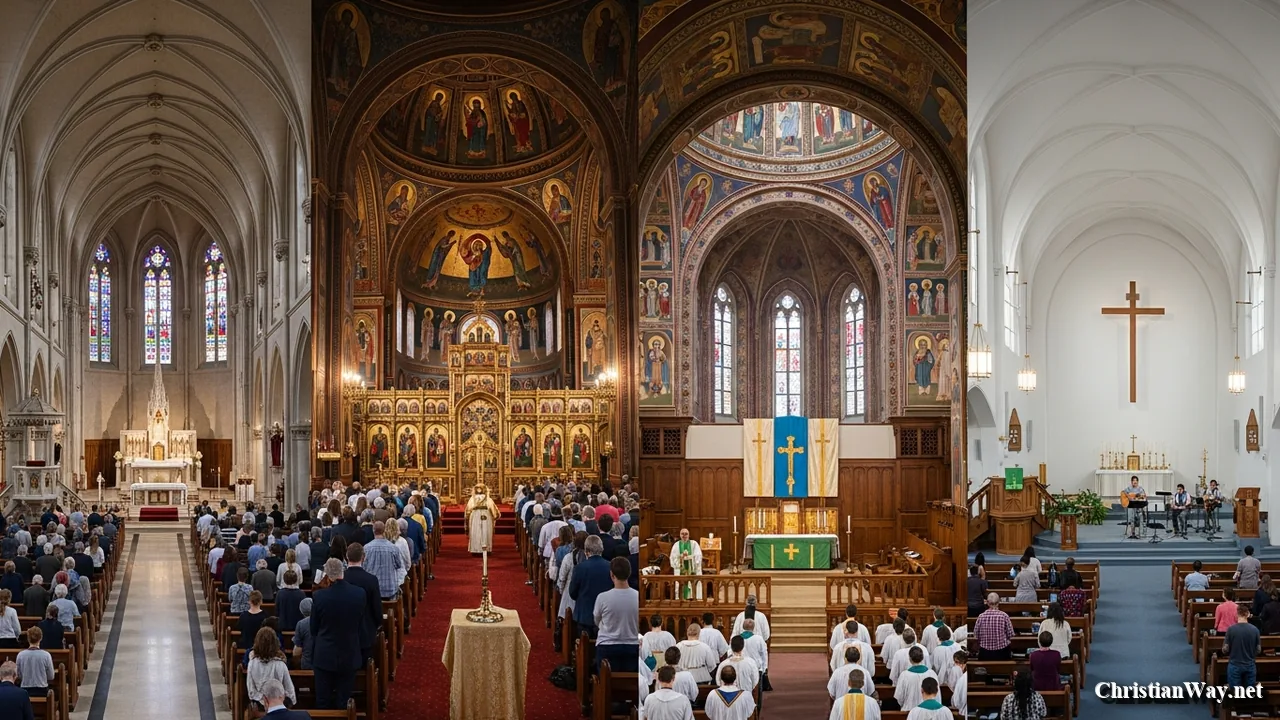
A person can often recognize denominational differences immediately upon entering a place of worship. An Orthodox Divine Liturgy may be filled with icons, incense, chanting, processions, and ancient prayers. A Catholic Mass follows a structured sacramental liturgy centered on Word and Eucharist. An Anglican service may resemble Catholic worship in one parish and evangelical worship in another.
Lutheran churches often combine liturgical order, congregational hymnody, preaching, and Communion. Reformed churches tend to emphasize biblical preaching, psalmody or hymns, reverent prayer, and ordered simplicity. Baptist services often center on preaching, congregational singing, personal testimony, and an invitation to respond in faith. Pentecostal worship may include spontaneous prayer, contemporary music, healing ministry, prophecy, and speaking in tongues.
These outward forms express deeper theological convictions. Liturgical churches emphasize continuity, sacred time, sacramental encounter, and the participation of the whole person in worship. Free-church traditions often emphasize intelligibility, personal response, congregational freedom, and openness to spontaneous movement of the Spirit.
Neither form automatically guarantees spiritual life. A beautiful liturgy can be attended without repentance. A lively service can generate emotion without lasting discipleship. Silence can be reverent or empty. Spontaneity can be Spirit-led or disorderly. The true test is whether worship faithfully proclaims Christ, conforms believers to His character, and leads the community into love of God and neighbor.
Jesus warns against worship that remains on the lips but does not reach the heart. Yet inward sincerity does not make outward order irrelevant. Christian worship is meant to unite truth and spirit:
“God is a Spirit: and they that worship him must worship him in spirit and in truth.”
— John 4:24
Culture, Politics, and the Wounds of History
Not every Christian division arose from theology alone. Political and cultural forces have often shaped denominational boundaries.
National identity became closely connected with religious affiliation in many regions. To be Greek or Russian was often associated with Orthodoxy. To be Italian, Spanish, Irish, or Polish was frequently associated with Catholicism. Scandinavian countries became largely Lutheran. England became Anglican. Scotland developed a Presbyterian identity.
Colonialism also complicated Christian mission. Missionaries sometimes brought education, medicine, Scripture translation, and courageous service. Yet Christianity was also at times entangled with political domination, cultural superiority, and exploitation. Indigenous peoples sometimes received the Gospel through institutions that failed to respect their dignity or culture.
Wars between Christian nations, coercive conversions, persecution, and discrimination created memories that lasted for generations. Catholics and Protestants persecuted one another in Europe. Anabaptists suffered under both. Orthodox and Catholic communities experienced political hostility and forced displacement. Ethnic and national conflicts became entangled with religious identity.
These wounds help explain why doctrinal conversations are rarely only about ideas. A theological statement may carry the emotional weight of lost homes, martyred ancestors, suppressed languages, or inherited fear.
Christians must therefore pursue reconciliation through truth. Forgiveness does not require forgetting history or pretending that injustice never occurred. It means bringing memory beneath the Cross, where sin is judged, victims are honored, repentance becomes possible, and enemies may slowly become brothers and sisters again.
Why New Denominations Continue to Appear
New denominations and independent churches continue to arise for several reasons.
Sometimes believers separate because of serious doctrinal disagreements. Questions concerning biblical authority, sexual ethics, ordination, church discipline, and the nature of marriage have divided churches in the modern period. In such cases, Christians may believe remaining within one institution would require them to compromise conscience.
Other divisions arise from disputes over leadership, property, personality, ethnicity, worship style, or control. A disagreement that begins with a local conflict can become a new network or denomination. Human pride and unresolved injury often hide beneath theological language.
At times, new communities emerge because existing churches have failed to reach particular people. Immigrant congregations preserve language and culture. New church movements develop forms of ministry suited to urban neighborhoods, university students, the poor, or people alienated from traditional institutions.
There are also times of genuine spiritual renewal when Christians rediscover neglected truths: the dignity of the poor, the call to holiness, the gifts of the Holy Spirit, the urgency of mission, the importance of Scripture, or the need for racial reconciliation. Renewal movements can bless older churches, but when mutual trust fails, they may become separate bodies.
Not every new movement is healthy. Charismatic leaders can become unaccountable. Congregations can be built around personality rather than Christ. Novel teachings may lack historical and biblical depth. Financial exploitation, spiritual manipulation, and claims of exclusive revelation can wound the faithful.
The New Testament therefore commands discernment:
“Beloved, believe not every spirit, but try the spirits whether they are of God.”
— 1 John 4:1
Christian freedom must remain joined to truth, humility, accountability, and holiness.
What Most Christians Still Share
The existence of serious disagreements must not blind us to the immense inheritance Christians share.
Catholic, Orthodox, Anglican, Lutheran, Reformed, Methodist, Baptist, Pentecostal, and many other Christians confess one God. Historic Christianity worships the Father, Son, and Holy Spirit. It proclaims that Jesus Christ is truly divine and truly human, that He died for our sins, rose bodily from the dead, reigns as Lord, and will come again.
Christians receive the Old and New Testaments as Holy Scripture, though they differ slightly concerning the Old Testament canon. They pray in the name of Jesus, baptize, gather for worship, preach the Gospel, care for the suffering, and seek to live according to Christ’s commandments.
Across denominational boundaries, believers recite the Lord’s Prayer:
“Our Father which art in heaven, Hallowed be thy name. Thy kingdom come. Thy will be done in earth, as it is in heaven.”
— Matthew 6:9–10
They read the Psalms. They hear Christ’s command to love God and neighbor. They confess the need for forgiveness. They stand at the foot of the Cross. They proclaim the empty tomb. They await the resurrection of the dead and the life of the world to come.
This shared faith does not erase differences, but it changes how Christians should speak about one another. We are not discussing strangers who happen to use similar religious vocabulary. We are speaking about people who call upon Jesus Christ, often with profound faith, sacrifice, courage, and love.
Many Christians have learned this unity through suffering. In prisons, hospitals, war zones, and places of persecution, denominational labels often become less important than the name of Christ. Catholic priests, Orthodox monks, Protestant pastors, evangelical missionaries, and ordinary believers have suffered together because they refused to deny their Lord.
The blood of martyrs asks the divided Church a difficult question: can those who die for the same Christ learn to love one another more deeply while they live?
How Christians Should Approach Denominational Differences
The proper response to denominational diversity is neither indifference nor hostility.
Indifference says doctrine does not matter. But doctrine concerns the identity of God, the person of Christ, the meaning of salvation, the nature of the Church, and the shape of Christian life. Truth matters because God matters.
Hostility treats other Christians primarily as enemies. It exaggerates differences, repeats caricatures, ignores holiness outside one’s own community, and speaks without love. This also betrays the Gospel.
The better path is faithful humility. Christians should know their own tradition well, not merely through slogans but through Scripture, history, worship, and serious teaching. They should also listen to other traditions as those traditions understand themselves. Catholics should not define Protestantism only by its weakest expressions. Protestants should not define Catholicism by abuses that Catholic teaching itself condemns. Western Christians should not treat Orthodoxy as a mysterious aesthetic experience without listening to its theology. Orthodox Christians should not assume every Western Christian has abandoned apostolic faith.
Ecumenical charity does not require pretending that all positions are identical. Love allows honest disagreement. Indeed, only those who care about one another can disagree fruitfully.
Saint Paul gives the Church a demanding vision:
“Speaking the truth in love, may grow up into him in all things, which is the head, even Christ.”
— Ephesians 4:15
Truth without love becomes a weapon. Love without truth becomes sentimentality. In Christ, truth and love belong together.
Choosing a Church Community
For someone searching for a church, denominational diversity can feel overwhelming. The search should begin with prayer rather than consumer preference. A church is not merely a provider of religious services. It is a community in which one receives teaching, worships God, learns obedience, bears burdens, serves others, and grows toward holiness.
Ask whether the community faithfully confesses Jesus Christ as Lord. Consider how it reads Scripture, understands the Trinity, proclaims the Cross and Resurrection, practices baptism and Communion, exercises spiritual authority, cares for vulnerable people, and forms believers in prayer and virtue.
Look not only at the beauty of Sunday worship but also at the fruit of the community. Are leaders accountable? Are the poor welcomed? Is repentance possible? Are questions treated with patience? Is power exercised as service? Are families, children, the lonely, and the suffering cared for? Does the church produce humility, mercy, courage, and love?
No earthly congregation is perfect. The Church is holy because Christ is holy, yet its members remain sinners in need of grace. A person who searches for a community without weakness will search forever. The deeper question is whether a church’s weaknesses are being brought honestly before Christ or concealed behind appearances.
Christian Unity as Repentance, Gift, and Calling
The unity of Christians will not be achieved merely through institutional negotiation. It requires conversion of heart.
Church leaders and theologians have an important role in resolving doctrinal disagreements. Historical research can correct misunderstandings. Formal dialogue can lead to common statements and renewed relationships. Shared service can build trust.
Yet unity also begins when ordinary Christians refuse contempt. It begins when we pray for Christians from other traditions, read their finest spiritual writings, acknowledge their suffering, and repent of false accusations. It grows when we can say, without abandoning conviction, “I may disagree with you, but I recognize your desire to follow Christ.”
Unity is not something Christians manufacture by lowering every theological standard. It is received from the Holy Spirit as believers are drawn more deeply into Christ. The closer we come to Him, the more clearly we see both the seriousness of truth and the ugliness of pride.
At the Cross, every denomination is humbled. No church tradition can save itself. No theological system died for the sins of the world. No bishop, reformer, preacher, council, confession, or institution rose from the grave. Only Jesus Christ is Savior.
This does not make the Church unnecessary. Christ loves the Church and gave Himself for her. But it reminds every Christian community that it exists to serve His glory rather than its own survival.
The prayer of Jesus remains before us:
“That they all may be one; as thou, Father, art in me, and I in thee.”
— John 17:21
This unity is deeper than cooperation and richer than organizational uniformity. It reflects the communion of the Father and the Son. Such unity must be truthful, holy, visible, loving, and rooted in God.
We may not see the complete healing of Christian division in our lifetime. Yet we are not excused from taking the next faithful step. Every act of honest dialogue, every shared prayer offered with integrity, every apology for past wrongdoing, every refusal to spread caricatures, and every work of mercy performed together becomes a small sign of the kingdom.
Reflect and Pray
Why do Christian denominations differ? They differ because the Church has passed through many centuries, languages, cultures, controversies, reforms, awakenings, and wounds. They differ because Christians interpret authority, salvation, sacraments, ministry, worship, and tradition in distinct ways. They differ because sincere conviction has sometimes demanded resistance, and because human pride has sometimes turned disagreement into division.
Yet the story does not end with separation.
Christ continues to gather His people. The Holy Spirit continues to awaken faith in Catholic cathedrals, Orthodox monasteries, Anglican parishes, Lutheran churches, Reformed congregations, Baptist chapels, Methodist communities, Pentecostal gatherings, house churches, and places where believers meet quietly under persecution.
Wherever the Gospel is faithfully proclaimed, wherever sinners repent, wherever the name of Jesus is honored, wherever the hungry are fed and the lonely welcomed, we may recognize signs of God’s grace. We need not deny real theological differences in order to rejoice when Christ is loved.
Perhaps the first question is not, “Why are there so many denominations?” but, “How is Christ calling me to live faithfully amid these divisions?” He may be calling us to study more deeply, speak more carefully, repent more honestly, and love more courageously.
The world does not need Christians who abandon truth for the sake of shallow agreement. Nor does it need Christians who defend truth with bitterness. It needs disciples whose convictions have been purified by the Cross—people who know what they believe, understand why they believe it, and still recognize the image of Christ in those from whom they differ.
Let us pray.
Lord Jesus Christ, Shepherd of Your people and Head of the Church, have mercy upon Your divided followers. Forgive us for the pride, fear, violence, indifference, and misunderstanding that have wounded Your Body. Preserve us from falsehood, but also preserve us from cruelty. Teach us to speak truth with love, to listen with humility, and to seek unity without compromising faithfulness.
Lead every Christian community more deeply into Your Word, Your holiness, and Your mercy. Heal the wounds of history. Purify our traditions of everything that obscures Your face. Strengthen all who confess Your name, especially those who suffer for their faith. May the Holy Spirit draw us toward that communion for which You prayed, so that the world may behold not our greatness, but Your redeeming love.
May the peace of Christ dwell richly in your heart, and may His light guide you toward truth, faithfulness, and love for all who call upon His holy name.
— Fr. John Matthew