Dear friends in Christ,
There are moments in life when the soul longs not only to hear that God is near, but to receive His nearness in a way that can be touched, remembered, and carried into the ordinary hours of the day. A grieving person may need more than a promise spoken from afar; he may need a hand laid gently upon his shoulder and a prayer whispered beside his bed. A child may need more than instruction about belonging; she may need to be welcomed visibly into a community that will pray for her and walk with her. A weary believer may need more than an idea of forgiveness; he may need to kneel, confess, hear words of mercy, and rise again with a heart made lighter.
For many Christians, this is where the sacraments become precious. They are not merely religious customs preserved from the past, nor are they empty ceremonies performed because tradition demands them. They are moments in which the invisible grace of God is received through visible signs: water poured in baptism, bread broken at the Lord’s table, oil placed upon the sick, hands laid in prayer, vows spoken in faithfulness, and words of forgiveness heard by a repentant heart.
Yet Christians do not all speak about sacraments in the same way. Catholic Christians speak of seven sacraments as sacred gifts entrusted by Christ to His Church. Eastern Orthodox Christians often speak of the Holy Mysteries, emphasizing that the whole life of the Church is filled with the hidden and life-giving presence of God. Protestant Christians, while sharing deep reverence for baptism and the Lord’s Supper, have developed a variety of understandings shaped by Scripture, the Reformation, and the spiritual needs of their particular communities.
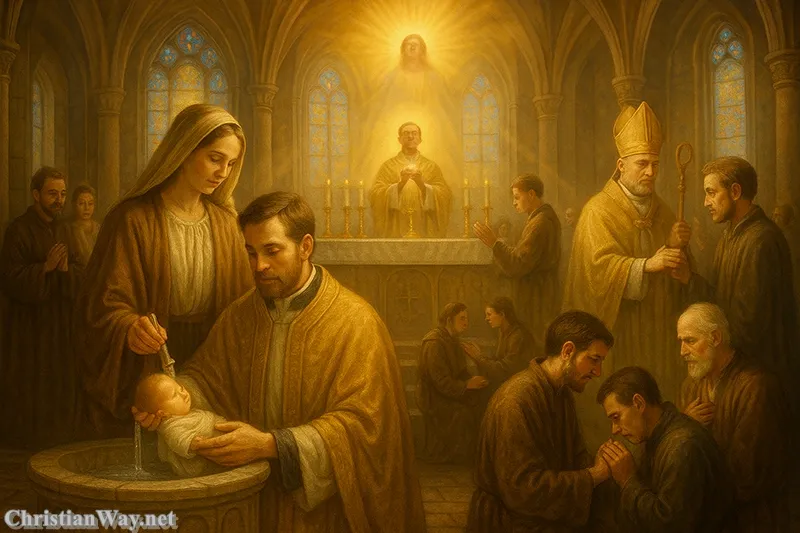
These differences can sometimes become sources of confusion or even division. One Christian may speak of the Eucharist as the true Body and Blood of Christ, while another may speak of the Lord’s Supper as a sacred memorial and proclamation of Christ’s saving death. One may receive confession as a sacrament of healing, while another may approach God directly in prayer with confidence that Christ alone forgives sins. One may see baptism as the beginning of a lifelong sacramental journey, while another may speak of it primarily as a public confession of personal faith.
Yet beneath these differences is a shared longing: to belong to Christ, to receive His grace, to remember His saving love, and to live as His disciples in the world. Christians may not always agree about how grace is received or how Christ is present in the sacred rites of the Church, but they are united in confessing that Jesus Christ is the Savior of the world, that He died and rose again, and that His people are called to live in faith, hope, and love.
To reflect on sacraments in Christianity is therefore not simply to compare doctrines. It is to ask a deeper question: How does Christ meet His people? How does the grace of God touch the human heart, the human body, the family, the Church, and the world? And how can Christians speak truthfully about their differences while still recognizing the faith they share in the Lord who prayed that His followers might be one?
What Christians Mean by Sacraments
The word sacrament has a rich history. In Christian tradition, it came to describe a sacred sign through which God communicates grace. The Latin word sacramentum was connected with ideas of consecration, oath, and holy commitment. In Greek-speaking Christianity, the word mystērion, meaning mystery, became especially important. This is why Eastern Orthodox Christians often speak not first of sacraments but of the Holy Mysteries.
The word mystery does not mean something confusing or hidden in the ordinary sense. It refers to something that belongs to the depth of God. A mystery is not a puzzle that the human mind eventually solves. It is a divine reality into which the human heart is invited. The Incarnation is a mystery: the eternal Son of God became truly human in Jesus Christ. The cross is a mystery: death becomes the place where divine love is revealed most fully. The resurrection is a mystery: Christ defeats death and opens a new life that the world could never create for itself.
The sacraments belong to this same pattern. They are earthly signs that point beyond themselves. Water is ordinary, yet in baptism it speaks of cleansing, new birth, and life in Christ. Bread and wine are ordinary, yet at the Lord’s table they draw believers into the remembrance, presence, sacrifice, and communion of Jesus. Oil is ordinary, yet in anointing it becomes a sign of healing, strength, consecration, and the nearness of the Holy Spirit.
This sacramental vision is rooted in the Christian belief that God does not despise the material world. God created the world and called it good. The Son of God did not save humanity by remaining distant from human flesh. He entered our world, took on a human body, walked dusty roads, ate with friends, touched lepers, wept at a grave, suffered on a cross, and rose bodily from the dead.
Because of this, Christians who hold a sacramental vision often see the created world as capable of bearing signs of grace. Water, bread, wine, oil, touch, spoken words, and human promises can become vessels through which God speaks to His people. They are not magical objects. They do not control God. Yet they can become holy signs because God chooses to meet His people through the material realities of life.
Grace Is Not an Idea but a Gift of God’s Life
At the center of every Christian understanding of sacrament is the word grace. Grace is not simply kindness, although it certainly includes the kindness of God. Grace is the free and undeserved gift of God’s life, mercy, forgiveness, strength, and love. It is God drawing near to humanity through Jesus Christ.
The New Testament speaks of grace as something that changes people. Saint Paul writes, “By grace are ye saved through faith; and that not of yourselves: it is the gift of God” (Ephesians 2:8). Grace is not something we earn by being good enough. It is the gift of God given to sinners, seekers, and weary hearts.
The sacraments, in traditions that emphasize them, are understood as places where this grace is received and nourished. They are not rewards for the spiritually successful. They are gifts for those who need God. Baptism speaks to the person who needs a new beginning. Confession speaks to the person burdened by sin. The Eucharist speaks to the person who needs spiritual nourishment. Anointing speaks to the person facing weakness, illness, or death. Marriage speaks to the couple who need God’s help to remain faithful. Ordination speaks to those called to serve the Church. Confirmation or chrismation speaks to believers who need the strengthening of the Holy Spirit.
Even Christians who do not use sacramental language in the same way often affirm that God meets His people through visible acts of worship, obedience, prayer, Scripture, fellowship, and remembrance. The question is not whether God can work through outward signs. Christians throughout history have believed that He can. The question is how these signs relate to grace, faith, salvation, and the life of the Church.
The Catholic Perspective: Seven Sacraments of Grace
In the Catholic Church, the sacraments are understood as seven sacred gifts instituted by Christ and entrusted to the Church. They are baptism, confirmation, the Eucharist, penance or reconciliation, anointing of the sick, holy orders, and matrimony.
These seven sacraments are often grouped according to the way they shape the Christian life. Baptism, confirmation, and the Eucharist are called the sacraments of initiation because they welcome, strengthen, and nourish the believer within the life of Christ and His Church. Reconciliation and anointing of the sick are often called sacraments of healing because they bring forgiveness, comfort, mercy, and spiritual strength. Holy orders and matrimony are called sacraments at the service of communion because they are connected to the building up of the Church through ministry, family life, and self-giving love.
For Catholics, the sacraments are not merely symbols that remind believers of God. They are effective signs of grace. This means that Christ truly acts through them. The grace given in the sacraments does not come from the holiness or personality of the minister performing them. It comes from Christ Himself, who remains faithful to His Church.
This does not mean that faith is unimportant. Catholic teaching does not treat the sacraments as mechanical rituals that work independently of the human heart. Faith, repentance, openness, and a desire to receive God’s grace are essential. Yet Catholic tradition also insists that grace is always first. God acts before the human person can fully respond. God comes searching before we know how deeply we need to be found.
Baptism: Dying and Rising with Christ
Baptism is the beginning of the sacramental life. In baptism, water is poured or the person is immersed in the name of the Father, the Son, and the Holy Spirit. Catholics understand baptism as the sacrament through which a person is cleansed from sin, reborn in Christ, and welcomed into the Church.
Saint Paul writes that believers are united to Christ in His death and resurrection: “Therefore we are buried with him by baptism into death: that like as Christ was raised up from the dead… even so we also should walk in newness of life” (Romans 6:4). Baptism is therefore not only about washing away what is old. It is about entering into a new life.
Catholics baptize infants as well as adults. Infant baptism is based on the belief that grace is God’s gift before it is human achievement. A child is welcomed into the covenant love of God and into the faith of the Church. Parents and godparents promise to raise the child in the Christian faith, trusting that the grace received in baptism will grow throughout life.
Adult baptism, especially at Easter, is also deeply meaningful in Catholic life. It is often preceded by a long journey of prayer, learning, repentance, and discernment. When adults receive baptism, confirmation, and the Eucharist, the Church celebrates the visible work of God in a life that has been drawn toward Christ.
The Eucharist: The Heart of Catholic Worship
For Catholics, the Eucharist is the center of Christian life. In the Mass, bread and wine are consecrated and received as the Body and Blood of Christ. Catholics believe that Christ is truly present in the Eucharist, not merely in the memory of believers, but in a profound and sacramental way.
At the Last Supper, Jesus took bread, gave thanks, broke it, and gave it to His disciples, saying, “This is my body which is given for you: this do in remembrance of me” (Luke 22:19). He also took the cup and spoke of His blood poured out for many. Catholics hear these words not simply as a symbolic reminder, but as a sacramental gift in which Christ gives Himself to His people.
The Catholic Church uses the word transubstantiation to describe the mystery of the Eucharist. This word means that the deepest reality of the bread and wine is changed by the power of Christ, even though their outward appearance remains the same. The Church does not claim that the Eucharist can be fully explained by human philosophy. Rather, it confesses that Christ is truly present and that His people are nourished by Him.
The Eucharist also reveals the Church as one body. Saint Paul writes, “For we being many are one bread, and one body: for we are all partakers of that one bread” (1 Corinthians 10:17). At the altar, Christians are reminded that they do not belong to Christ only as isolated individuals. They belong to one another in Him.
Reconciliation, Anointing, Orders, and Marriage
The sacrament of reconciliation, sometimes called confession or penance, is a place of healing and restoration. Catholics confess their sins to a priest, who offers absolution in the name of Christ. This practice is rooted in the belief that Jesus gave His apostles a ministry of forgiveness when He said, “Whose soever sins ye remit, they are remitted unto them” (John 20:23).
For many Catholics, confession is not primarily about fear or shame. It is about returning home. It is a moment to tell the truth about sin, receive mercy, and begin again. The priest does not replace Christ. Rather, he serves as an instrument through whom Christ’s forgiveness is declared.
The anointing of the sick is offered to those facing serious illness, frailty, surgery, or the approach of death. A priest prays over the person and anoints them with oil. The sacrament may bring physical healing according to God’s will, but its deepest purpose is spiritual strength, peace, courage, and union with Christ in suffering.
Holy orders is the sacrament through which bishops, priests, and deacons are ordained for service in the Church. Catholic teaching sees this ministry as connected to the apostolic mission of proclaiming the Gospel, celebrating the sacraments, and caring for the people of God.
Matrimony is the sacrament through which a man and a woman enter a lifelong covenant of faithful love. Catholic marriage is not simply a legal arrangement or private decision. It is understood as a sacred vocation in which husband and wife become signs of Christ’s faithful love for His Church.
The Orthodox Perspective: Holy Mysteries and the Life of God
Eastern Orthodox Christians share many convictions with Catholics concerning baptism, the Eucharist, confession, ordination, marriage, anointing, and the life of grace. Yet Orthodox Christianity often approaches these sacred realities through the language of mystery rather than through carefully defined categories.
Orthodox Christians commonly speak of seven Holy Mysteries, much as Catholics speak of seven sacraments. These include baptism, chrismation, the Eucharist, confession, marriage, ordination, and anointing. Yet Orthodox theology often resists making the number seven into a rigid limit. The whole life of the Church, when it is lived in communion with Christ, is seen as sacramental and mysterious.
This is not because Orthodox Christians are unclear about what they believe. Rather, they seek to preserve a sense of holy reverence before the mystery of God. They are often cautious about explaining divine realities too precisely, especially when human language may give the impression that the mystery has been reduced to a formula.
In Orthodox worship, the beauty of the liturgy itself carries sacramental meaning. Icons, incense, chant, candles, processions, sacred gestures, fasting, feasts, and the rhythm of the liturgical year all help believers enter more deeply into the presence of God. The Church is not understood merely as a place where people gather to hear teaching. It is a place where heaven and earth meet in prayer.
Baptism and Chrismation: Entering Fully into the Church
In Orthodox practice, baptism and chrismation are often celebrated together, especially when infants are baptized. After baptism in water, the newly baptized person is anointed with holy chrism, a consecrated oil, as a sign of the gift of the Holy Spirit.
This differs from the usual Catholic practice, where confirmation is often received later, especially in adolescence or adulthood. Yet both traditions see baptism and confirmation or chrismation as deeply connected to initiation into the Christian life.
Orthodox Christians often baptize by full immersion, reflecting the image of dying and rising with Christ. The newly baptized person may then receive communion, even as an infant. This practice expresses the belief that the whole Church, including children, belongs fully to the life of Christ.
The Orthodox emphasis here is not on intellectual understanding alone. A child may not yet be able to explain the faith, but the child can still be received into the life of grace, prayer, worship, and community. Faith grows gradually through the worshiping life of the Church.
The Eucharist as Holy Communion
Orthodox Christians believe that Christ is truly present in the Eucharist. Like Catholics, they confess that the bread and wine become the Body and Blood of Christ. Yet Orthodox theology generally prefers to guard this mystery with reverence rather than define the manner of change through a single philosophical explanation.
The Divine Liturgy is the central act of Orthodox worship. It is filled with Scripture, prayer, chant, incense, and the language of heaven. When the people gather for the Eucharist, they do not simply remember something that happened long ago. They enter sacramentally into the saving work of Christ.
The Eucharist is understood as communion with Christ and communion with the whole Church. It joins believers to the saints, the angels, the departed faithful, and the people gathered in worship. It is a foretaste of the heavenly banquet, where God will gather His people from every nation and every age.
Orthodox Christians often speak of salvation not only as forgiveness of sins, but as theosis, sometimes translated as divinization or participation in the life of God. This does not mean that human beings become God by nature. It means that through grace, believers are transformed and drawn into deeper communion with God. The sacraments are part of this lifelong journey of becoming more fully alive in Christ.
Protestant Perspectives: Word, Faith, and Holy Ordinances
The Protestant Reformation brought significant changes to the way many Christians understood sacraments. Reformers such as Martin Luther, Huldrych Zwingli, John Calvin, and later Protestant leaders sought to return the Church to what they believed was the central authority of Scripture and the saving grace of Christ received through faith.
Many Protestants were concerned that medieval religious practices had become overly complicated or detached from the clear message of the Gospel. They feared that people might rely on religious ceremonies without genuine repentance, faith, or trust in Christ. For this reason, many Protestant traditions emphasized that salvation is received through faith in Jesus Christ, not through human works or religious rituals.
Yet this does not mean that Protestants rejected baptism and the Lord’s Supper. Quite the opposite. Most Protestant traditions continue to honor these practices deeply because they were commanded by Christ. The difference lies in how they understand their meaning, their effect, and their relationship to grace.
Many Protestant communities use the word ordinances rather than sacraments. The word ordinance emphasizes that these practices were ordained or commanded by Jesus. Baptism and the Lord’s Supper are therefore acts of obedience, proclamation, remembrance, and communal faithfulness.
Other Protestant traditions still use the word sacrament, especially Lutherans, Anglicans, Methodists, and many Reformed Christians. They may define sacraments differently from Catholics and Orthodox Christians, but they do not necessarily see them as empty symbols. Many understand them as holy signs through which God strengthens faith and communicates grace.
Lutheran Perspectives: Christ’s Promise Joined to Visible Signs
Lutherans usually recognize baptism and the Lord’s Supper as sacraments because they are commanded by Christ, joined to visible elements, and connected with a promise of grace. Some Lutherans also speak of confession and absolution in a sacramental way because Christ gives His promise of forgiveness through spoken words.
Martin Luther strongly defended baptism. He believed that baptism is not merely human obedience, but God’s action and promise. For Lutherans, baptism is a gift through which God claims the believer, forgives sins, and gives new life in Christ.
Lutherans also believe in the real presence of Christ in the Lord’s Supper. They do not usually use the Catholic term transubstantiation, but they confess that Christ truly gives His Body and Blood in, with, and under the bread and wine. The Lord’s Supper is not merely a mental remembrance. It is a sacramental gift in which Christ gives Himself to His people.
This means that Lutheran theology often stands closer to Catholic and Orthodox understandings of the Eucharist than many people realize, even though important differences remain concerning priesthood, church authority, and the precise explanation of Christ’s presence.
Anglican Perspectives: Sacraments in a Broad Christian Tradition
The Anglican tradition, which includes the Church of England and the worldwide Anglican Communion, has historically described baptism and the Lord’s Supper as the two sacraments “generally necessary to salvation.” Anglican teaching also recognizes confirmation, reconciliation, ordination, matrimony, and anointing as sacred rites commonly called sacraments, though not always understood in exactly the same way as in Catholic theology.
This Anglican approach often seeks to hold together biblical simplicity, historical continuity, liturgical worship, and pastoral flexibility. Some Anglicans hold beliefs about the Eucharist that are very close to Catholic or Orthodox teaching. Others understand the Lord’s Supper in a more Reformed or symbolic way. Anglicanism therefore contains a wide range of sacramental theology.
Still, the Anglican tradition has often preserved a strong sense that worship should involve the whole person: body, mind, voice, gesture, silence, Scripture, prayer, bread, wine, water, and the gathered community. In this way, many Anglicans maintain a sacramental imagination even when they describe it differently from Catholics.
Reformed Perspectives: Signs and Seals of God’s Covenant
Reformed Christians, shaped by leaders such as John Calvin, usually recognize baptism and the Lord’s Supper as the two sacraments instituted by Christ. They are often described as signs and seals of God’s covenant.
A sign points to a spiritual reality. A seal confirms or strengthens a promise. In this understanding, baptism points to cleansing, forgiveness, union with Christ, and entrance into the covenant community. The Lord’s Supper points to Christ’s sacrifice, His continuing presence with His people, and the spiritual nourishment received through faith.
Reformed Christians generally reject the idea that the bread and wine become the physical Body and Blood of Christ in the way Catholics and Orthodox Christians confess. Yet many Reformed Christians do not see communion as a bare memorial. They believe that Christ is truly present spiritually and that believers are nourished by Him through faith.
John Calvin spoke of believers being lifted by the Holy Spirit into communion with the risen Christ. The Lord’s Supper, in this view, is not merely an act of remembering something absent. It is an encounter with the living Christ, who strengthens His people through the Spirit.
Methodist and Wesleyan Perspectives: Means of Grace for Holy Living
Methodist Christians, shaped by the teaching of John Wesley, often speak of baptism and the Lord’s Supper as means of grace. This language expresses the belief that God uses these sacred practices to awaken, strengthen, and nourish faith.
Wesley believed deeply in the transforming power of grace. For him, Christian faith was not only about receiving forgiveness but about being changed in heart and life. The Lord’s Supper was therefore not an occasional ritual but a gift through which believers encountered the grace of Christ and were encouraged to grow in holiness.
Many Methodist communities practice open communion, welcoming Christians from different traditions to receive the Lord’s Supper. This practice reflects a desire to emphasize the generosity of Christ’s table and the shared hunger of all believers for His grace.
Baptist and Evangelical Perspectives: Obedience, Witness, and Remembrance
Many Baptist and evangelical Christians speak of baptism and the Lord’s Supper as ordinances rather than sacraments. They often emphasize that these practices do not save a person by themselves. Salvation comes through personal faith in Jesus Christ.
Baptism is usually understood as a public confession of faith. Because of this, Baptists generally practice believer’s baptism rather than infant baptism. A person is baptized after personally confessing faith in Christ, often by full immersion. The act of going beneath the water and rising again is seen as a powerful testimony of dying to sin and rising to new life in Jesus.
The Lord’s Supper is often understood as a memorial of Christ’s death and a proclamation of His saving sacrifice. Jesus said, “This do in remembrance of me” (1 Corinthians 11:24), and many evangelical Christians focus strongly on this command. The bread and cup remind believers of Christ’s Body and Blood given for the world.
Yet it would be unfair to describe all Baptist or evangelical Christians as seeing communion as “only symbolic” in a shallow sense. For many, the Lord’s Supper is a deeply sacred act of worship, repentance, gratitude, fellowship, and renewed commitment. They may not describe Christ as present in the elements in the Catholic or Orthodox sense, but they believe that Christ meets His people spiritually as they gather in faith.
What Christians Share and Where They Differ
Catholics, Orthodox Christians, Anglicans, Lutherans, Reformed Christians, Methodists, Baptists, Pentecostals, and other believers may differ in the way they describe the sacraments. Yet there are important points of common faith.
Most Christians recognize baptism as a central act of Christian identity. Baptism is connected to Jesus’ command to make disciples and baptize in the name of the Father, the Son, and the Holy Spirit. It speaks of repentance, cleansing, new birth, union with Christ, and entrance into the Christian community.
Most Christians also recognize the Lord’s Supper, Holy Communion, or the Eucharist as central to the life of faith. Whether they understand it as sacrifice, mystery, real presence, spiritual communion, memorial, proclamation, or covenant meal, they all look back to the Last Supper and to Christ’s command that His followers remember Him.
All Christians also agree that no sacred practice can replace a living relationship with Christ. A person may be baptized, attend church, receive communion, sing hymns, and know religious language, yet still need to surrender more deeply to the grace of God. The sacraments are not substitutes for faith. They are meant to lead believers into faith, nourish faith, and express faith.
The differences, however, remain significant. Catholics and Orthodox Christians affirm seven sacraments or Holy Mysteries, while many Protestants recognize two primary sacraments or ordinances. Catholics and Orthodox Christians baptize infants, while Baptists and many evangelical communities baptize believers after a personal confession of faith. Catholics and Orthodox Christians believe in the real presence of Christ in the Eucharist, while Protestants hold a range of views from Lutheran sacramental presence to Reformed spiritual presence to memorial understandings.
These differences should not be hidden or treated as unimportant. They shape worship, church life, spiritual formation, and the way Christians understand grace. Yet they need not lead to contempt. Christians are called to speak honestly without speaking harshly. They are called to love one another even when they cannot fully agree.
The Sacramental Life and the Ordinary Day
One of the most beautiful gifts of sacramental faith is that it teaches believers to see ordinary life differently. Water becomes a reminder of baptism. Bread becomes a reminder of Christ who gives Himself for the life of the world. Oil becomes a reminder of healing. Marriage becomes a reminder of covenant faithfulness. A spoken word of forgiveness becomes a reminder that mercy is stronger than shame.
Even Christians who do not use sacramental language in the same way often share this longing to see God at work in ordinary life. A family gathered around a dinner table can give thanks to God. A parent blessing a child before sleep can become a small act of holy love. A church community visiting the sick can reveal the compassion of Christ. A believer opening the Bible before work can receive strength for the day ahead.
The sacraments remind the Church that faith is not meant to remain trapped in the mind. Faith is lived through bodies, relationships, meals, tears, promises, suffering, service, and hope. Christ did not save disembodied souls. He came to redeem human persons in the fullness of their lives.
This is why sacramental life should never become cold or mechanical. The purpose of every sacred sign is love. If the sacraments do not lead us toward greater love of God and neighbor, then we have missed their deepest meaning. The person who receives communion but refuses mercy, the person who remembers baptism but lives without compassion, or the person who speaks of grace while ignoring the poor has not yet allowed the sacred gift to bear its full fruit.
A Call to Humility and Christian Unity
Christians often carry painful memories of division. The history of the Church includes disagreements, separations, arguments, misunderstandings, and wounds that have lasted for centuries. Sacraments have sometimes stood at the center of these conflicts because they touch the deepest questions of faith: How is grace received? What is the Church? How is Christ present? Who has authority to teach and celebrate?
These questions are important. They deserve careful thought, prayer, and study. Yet Christians must always remember that no theological discussion is complete unless it is shaped by love.
Jesus prayed for His disciples, “That they all may be one; as thou, Father, art in me, and I in thee” (John 17:21). Christian unity does not mean pretending that differences do not exist. It does not mean abandoning convictions for the sake of easy agreement. It means seeking truth with humility and treating one another as people for whom Christ died.
Catholics can learn from the deep biblical devotion and personal faith emphasized in many Protestant communities. Protestants can appreciate the ancient sacramental wisdom preserved in Catholic and Orthodox worship. Orthodox Christians can offer the wider Christian family a powerful vision of mystery, beauty, prayer, and communion with the saints. Anglicans can remind Christians that historical continuity and pastoral openness need not always stand in opposition. Lutherans, Reformed Christians, Methodists, Baptists, Pentecostals, and many others each bring gifts that can enrich the wider conversation.
The goal is not to make all Christians identical. The goal is to become more faithful to Christ. The closer believers draw to Him, the more they are called to draw near to one another in prayer, truth, repentance, and love.
Reflect and Pray
Dear friend, the sacraments in Christianity are ultimately about the generosity of God. They remind us that the Lord does not leave His people alone with abstract ideas or distant promises. He comes near. He speaks through water, bread, wine, prayer, Scripture, community, forgiveness, suffering, and love.
Catholics, Orthodox Christians, and Protestants may understand these sacred signs differently, yet each tradition in its own way seeks to honor the grace of Christ and live faithfully in response to His Gospel. The deeper question for every believer is not only, “How do I understand the sacraments?” but also, “Am I allowing the grace of God to change my heart?”
May we receive every gift of Christ with humility. May we honor the convictions of other Christians with honesty and love. And may every sacred act of worship lead us more deeply into the life of the One who gave Himself for the world.
Let us pray:
Lord Jesus Christ, You are the source of every grace and the bread of life for Your people. Teach us to receive Your gifts with faith, gratitude, and humility. Heal the divisions among Christians, deepen our love for Your Word, and draw us into greater unity with all who call upon Your name. May every act of worship lead us closer to Your heart, and may our lives become signs of Your mercy in the world. Amen.
May the peace of Christ dwell richly in your heart, and may His grace guide you into deeper faith, gentler love, and lasting communion with Him.
— Fr. John Matthew