Dear friends in Christ,
The Anglican tradition is often described through beautiful churches, choral worship, ancient prayers, bishops, cathedrals, and the quiet rhythm of the Christian year. Yet its deepest meaning is not found in architecture, history, or ceremony alone. The Anglican tradition is a living heritage of faith: a way of receiving the Gospel of Jesus Christ, praying it together, and carrying it into the ordinary places of human life.
It is a tradition shaped by both memory and renewal. It remembers the ancient Church, the faith of the apostles, the creeds, the Scriptures, the sacraments, and the worshiping life of Christians through the centuries. At the same time, it was formed amid the questions and struggles of the Reformation, when believers sought to hear the Word of God clearly and to place the grace of Christ at the center of faith.
This is why Anglicanism cannot be understood simply as an English form of Christianity or a compromise between other traditions. It is a distinctive spiritual inheritance, marked by common prayer, biblical worship, sacramental life, thoughtful faith, pastoral care, and a continuing desire for Christian unity. It seeks to hold together gifts that are often separated: reverence and accessibility, tradition and reform, personal faith and shared worship, the life of the mind and the life of prayer.
Yet the Anglican tradition, like every Christian tradition, is not free from weakness. Its history includes division, conflict, political entanglement, human pride, and disagreement. It has known seasons of deep renewal and seasons of uncertainty. It has sometimes spoken with courage and sometimes remained too quiet before suffering. But its story remains meaningful because the Church is never sustained by human perfection. She is sustained by the mercy of Christ.
The Church does not belong to a nation, a monarch, a bishop, a movement, or a theological school. The Church belongs to Jesus Christ. He is the one who calls sinners, forgives failures, gathers strangers into a family, feeds His people with grace, and sends them into the world as witnesses of His love.
The Anglican tradition is at its best when it remembers this. It does not exist to preserve a religious style for its own sake. It exists to help people encounter Christ. Its prayers, Scriptures, sacraments, hymns, pastoral care, and common life are all meant to lead the heart toward the One who says, “Come unto me, all ye that labour and are heavy laden, and I will give you rest” (Matthew 11:28).
For the weary, the questioning, the faithful, and the searching, Anglicanism offers a gentle reminder: Christian faith is not only something we think about. It is something we receive, pray, sing, confess, and live.
A Heritage Received From the Ancient Church
The Anglican tradition did not begin with the idea that Christianity needed to be invented again. Its roots reach back through the Church in England to the faith of the apostles, the ancient creeds, the early councils, and the worshiping communities that carried the Gospel through many generations.
Christianity had taken root in Britain long before the Reformation. Believers prayed, worshiped, baptized, served the poor, built churches, established monasteries, copied manuscripts, taught children, and proclaimed Christ through changing centuries. Missionaries, bishops, monks, nuns, families, and ordinary Christians all helped preserve the faith in places that were often marked by uncertainty and political change.
The Faith of the Creeds
Anglican Christians continue to confess the Apostles’ Creed and the Nicene Creed. These ancient statements of faith remain central because they gather the heart of Christianity into words that can be prayed and proclaimed together.
Christians confess belief in God the Father Almighty, Maker of heaven and earth. They confess Jesus Christ, the eternal Son of God, born of the Virgin Mary, crucified, risen, ascended, and coming again in glory. They confess the Holy Spirit, the giver of life, who forms the Church and renews the hearts of believers.
These truths are not simply religious poetry. They speak to the deepest human questions.
If God is Creator, then human life has dignity.
If Jesus is truly God and truly human, then God has entered the fullness of our weakness and sorrow.
If Christ rose from the dead, then death does not have the final word.
If the Holy Spirit is present, then no believer is left to face life by strength alone.
The creeds remind Christians that faith is not built merely upon private feeling. Faith has content. It tells us who God is, what Christ has done, and who we are because of grace.
Ancient Faith, Living Faith
To receive an ancient faith does not mean treating the past as though it belongs in a museum. The Gospel is ancient, but it is never old in the sense of being lifeless. Every generation must hear again the good news that Christ came for sinners, died for the world, rose in victory, and calls His people to new life.
A Christian in the first century and a Christian today may live in very different worlds. One may have walked Roman roads; another may live in a crowded city shaped by technology, pressure, and constant distraction. Yet both need mercy. Both need forgiveness. Both need hope. Both need the living Christ.
The Anglican tradition seeks to receive the faith of the past as a living gift. It does not ask believers to become trapped in another century. It asks them to stand within the great story of God’s love while living faithfully in the world where they have been placed.
The Reformation and the Call to Renewal
The Anglican tradition was deeply shaped by the Reformation. The sixteenth century was a time of great upheaval across Europe. Christians were asking urgent questions about Scripture, salvation, worship, authority, conscience, and the life of the Church.
The English Reformation unfolded through complicated circumstances. It involved political conflict, royal power, personal decisions, theological debate, liturgical reform, suffering, and division. It cannot be reduced to one event or one person. Yet amid the confusion, a lasting concern emerged: the Church must always be renewed by the Gospel of Jesus Christ.
Grace Must Remain Central
One of the great gifts of the Reformation was its renewed emphasis on grace. Human beings do not save themselves through religious performance, moral success, wealth, knowledge, or social status. Salvation is the gift of God in Jesus Christ.
Saint Paul writes, “For by grace are ye saved through faith; and that not of yourselves: it is the gift of God” (Ephesians 2:8).
This truth is deeply comforting because many people live with the hidden fear that they are never enough. They believe they must constantly earn approval, prove their worth, or hide their weakness.
But the Gospel tells another story.
Christ comes for the weary.
Christ comes for the ashamed.
Christ comes for those who have failed.
Christ comes for those who cannot repair their own hearts.
Christ comes not because we have made ourselves worthy, but because He is merciful.
The Anglican tradition has sought to preserve this emphasis: we are saved by grace, and good works flow from gratitude rather than fear. Christians are called to serve, forgive, give generously, pursue holiness, and love their neighbors. But these are not payments offered to purchase God’s affection. They are the fruit of a life already touched by grace.
Reform Must Be Joined to Humility
The history of reform also teaches a difficult lesson. Reform can be necessary, but it can become destructive when it loses humility. Christians may begin with a sincere desire to correct what is wrong, yet become proud, harsh, or unwilling to listen.
The Church always needs renewal. She needs to return to Scripture. She needs to repent of injustice. She needs to care for the poor. She needs leaders who serve rather than dominate. She needs worship that draws people toward Christ rather than toward empty routine.
But true renewal never begins with contempt. It begins with prayer.
It begins when Christians say, “Lord, search my heart.”
It begins when churches ask whether they are serving the wounded.
It begins when leaders remember that authority is not ownership.
It begins when believers are willing to confess that they too need mercy.
The Anglican tradition is healthiest when it holds reform and humility together. It remembers that no church is renewed by argument alone. The Church is renewed when people return to Christ.
The Gift of Common Prayer
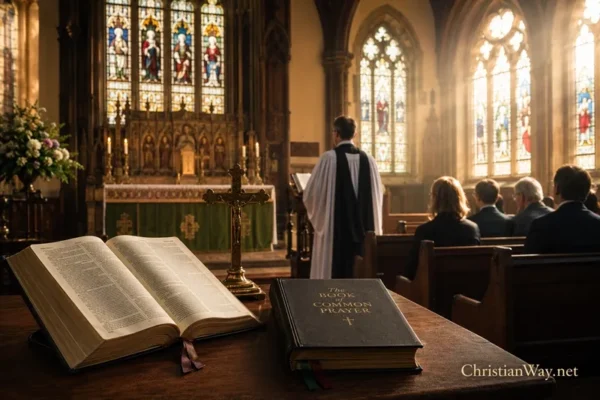
Perhaps no feature of Anglican life is more recognizable than common prayer. The Book of Common Prayer, in its historic forms and later expressions, has helped shape generations of believers through Scripture, confession, thanksgiving, intercession, creeds, Holy Communion, and the rhythms of the Christian year.
Common prayer is not simply a collection of words repeated by habit. It is a shared way of standing before God.
Prayer That Carries the Whole Life
There are moments when people do not know how to pray.
A person may stand beside a hospital bed and feel that words have disappeared.
A family may gather after the death of someone they love and feel too overwhelmed to speak.
A parent may carry fear for a child.
A person may feel ashamed of a past mistake.
A believer may be exhausted by work, grief, uncertainty, or loneliness.
In such moments, the prayers of the Church can become a shelter.
They give language to confession: “We have erred and strayed from thy ways like lost sheep.”
They give language to hope: “The peace of God, which passeth all understanding.”
They give language to grief: “Earth to earth, ashes to ashes, dust to dust.”
They give language to trust: “Our Father, which art in heaven.”
These words have carried generations through life’s greatest joys and deepest sorrows. They have been prayed in village churches, city parishes, hospitals, schools, homes, chapels, prisons, and gravesides. They remind believers that no one stands alone before God.
Worship Forms the Heart
What we pray slowly shapes what we believe.
When we confess sin, we remember our need for mercy.
When we hear Scripture, we remember that God has spoken.
When we pray for the sick, the poor, and the world, our hearts become larger.
When we receive Holy Communion, we remember that Christ gives Himself for us.
When we speak the creed, we remember that we belong to a faith larger than our own private thoughts.
The Anglican tradition has often understood worship as formation. It is not only an event we attend. It is a school of the heart.
A person who prays regularly may not always feel spiritual excitement. But over time, prayer changes the way they see life. It teaches patience. It teaches gratitude. It teaches forgiveness. It teaches the soul to return to God again and again.
This is why common prayer remains such a precious gift. It gives the Church a shared language of faith when personal feelings rise and fall.
Scripture at the Center
The Anglican tradition has always given a central place to Holy Scripture. The Bible is read publicly in worship, prayed through the Psalms, preached from the pulpit, taught in homes, and used to shape the conscience of the Church.
Scripture is not merely a source of information. It is the living witness to God’s saving work in Christ.
The Bible Leads Us to Jesus
The Old Testament tells the story of God’s creation, covenant, promises, mercy, and faithfulness. It reveals the human struggle with sin, injustice, fear, idolatry, and unbelief. It also points toward the hope of redemption.
The New Testament reveals Jesus Christ as the fulfillment of God’s promises. In Him, the Word becomes flesh. In Him, the sick are touched, sinners are forgiven, the poor hear good news, the dead are raised, and the cross becomes the doorway to resurrection.
Jesus Himself taught His disciples to see the Scriptures as pointing toward Him. The Bible is not simply a collection of isolated verses. It is a story. It tells us who God is, who we are, what sin has done, and what Christ has accomplished.
To read Scripture faithfully is to read with humility.
We ask: What does this passage reveal about God?
How does it lead us to Christ?
What does it expose within my own heart?
How does it call me to love more faithfully?
How does it speak to the suffering of the world?
The Bible comforts us, but it also corrects us. It gives hope to the weary, but it also confronts pride. It teaches forgiveness, but it also calls us to seek justice. It reveals mercy, but it never tells us that sin is harmless.
Scripture Read Within the Church
Anglican Christians often emphasize that Scripture should be read both personally and communally. A believer may read the Bible alone and be deeply blessed. Yet the Bible is also meant to be heard among the people of God.
The Church reads Scripture with the saints who have gone before, with the wisdom of Christian tradition, with the guidance of prayer, and with a willingness to learn from others.
This protects us from the temptation to make every personal opinion equal to God’s Word. We all have blind spots. We all bring our fears, preferences, and assumptions to Scripture. We need the Church to help us listen more faithfully.
The Anglican tradition therefore values preaching, study, prayer, and the regular public reading of the Bible. It seeks to make Scripture accessible without making it shallow.
Tradition: A Living Memory of Grace
Tradition is sometimes misunderstood as mere attachment to old ways. But in its healthiest sense, tradition is the Church’s living memory of grace.
It includes the creeds, the sacraments, the worshiping life of the Church, the wisdom of faithful teachers, the witness of saints, the decisions of councils, the prayers of generations, and the shared practices through which Christians have learned to follow Christ.
Roots That Help Us Stand
A tree without roots cannot stand through storms. In the same way, Christians need roots.
We need the Scriptures.
We need the creeds.
We need the worshiping community.
We need the memory of those who have followed Christ before us.
We need wisdom larger than our own generation.
The Anglican tradition values this rootedness. It does not ask Christians to imagine that faith began when they first opened a Bible or entered a church. It reminds us that we belong to a communion that stretches across nations, languages, centuries, and cultures.
This does not mean that every old custom is beyond question. Tradition must always be tested by the Gospel. The Church can preserve familiar practices while still losing sight of Christ. A beautiful service can become empty if it no longer leads people toward mercy. A historic institution can become cold if it does not care for the poor.
But healthy tradition does not imprison the Church. It helps the Church remember who she is.
The Saints and the Great Communion
The Anglican tradition honors the communion of saints. Christians are not the first people to struggle with doubt, pain, fear, grief, temptation, or hope. Those who have gone before us have walked through many of the same valleys.
The saints remind us that holiness is possible, not because human beings are naturally strong, but because God is merciful.
Some saints were teachers. Some were missionaries. Some were poets. Some were pastors. Some were martyrs. Some were parents, workers, caregivers, and hidden servants.
Their lives teach us that faith can take root in every place.
A person caring for a sick family member can become a witness to Christ.
A worker choosing honesty over profit can become a witness to Christ.
A young person resisting cruelty can become a witness to Christ.
A believer praying quietly through grief can become a witness to Christ.
The saints do not stand above us to make us feel small. They stand beside us as signs that grace can transform ordinary lives.
Reason: A Gift Offered Back to God
The Anglican tradition has often encouraged Christians to use reason with humility. God has given human beings minds capable of wonder, learning, creativity, moral reflection, and careful thought. Faith does not demand that the mind be switched off. It calls the mind to serve truth.
Many people associate Anglican theology with Scripture, tradition, and reason. This should not be understood as a mechanical formula or as three equal authorities competing with one another. Scripture remains the primary witness to God’s saving revelation. Tradition helps the Church receive and live that revelation. Reason helps believers think carefully, discern faithfully, and apply the Gospel wisely.
Questions Are Not the Enemy of Faith
Some Christians fear questions because they worry that questions will lead people away from God. But honest questions can become part of the path toward deeper faith.
Mary asked, “How shall this be?” when the angel brought news beyond her understanding.
Thomas struggled to believe the resurrection until Christ met him in mercy.
The Psalms ask difficult questions in the presence of God.
Job wrestled with suffering and did not hide his pain.
The disciples often misunderstood Jesus, yet He continued to teach them.
Faith is not the absence of questions. Faith is the willingness to bring questions to God rather than turning away from Him.
Reason helps Christians study history, examine language, understand difficult passages, engage with science, consider moral questions, and respond wisely to the challenges of the modern world.
But reason must remain humble. Human beings can understand much, but we cannot contain God. We can study the world, but we cannot reduce mystery to a formula. We can think deeply about the Trinity, the incarnation, the cross, and the resurrection, but we will never exhaust their depth.
Reason is a gift, but it must kneel before God.
Faith Beyond Mere Opinion
The modern world often encourages people to treat every belief as a private opinion. But Christian faith is more than personal preference.
The truth of Christ does not depend upon whether it is fashionable.
The dignity of every human being does not depend upon public approval.
The call to love the poor does not disappear when generosity becomes inconvenient.
The command to forgive does not change because resentment feels justified.
Reason helps believers discern how to live faithfully in changing circumstances, but it cannot simply make truth conform to whatever the world wants at a given moment.
The Anglican tradition seeks a faith that is thoughtful without becoming captive to passing ideas, and rooted without becoming afraid of honest questions.
Sacraments: Grace Received in Ordinary Things
The Anglican tradition recognizes baptism and Holy Communion as the two sacraments instituted directly by Christ. These sacred gifts stand at the center of Christian life because they remind believers that God works through ordinary things.
Water becomes a sign of new life.
Bread and wine become signs of Christ’s self-giving love.
A gathered community becomes the visible Body of Christ.
A spoken promise becomes a doorway into covenant faithfulness.
Baptism and Belonging
In baptism, Christians are marked as belonging to Christ. Baptism speaks of cleansing, new life, forgiveness, and participation in the death and resurrection of Jesus.
It reminds us that faith begins with grace.
Before we can prove anything, God comes toward us.
Before we can earn anything, Christ gives Himself for us.
Before we can build a spiritual identity from success or reputation, God calls us beloved.
This is especially important in a world where people often build identity upon fragile things. We may define ourselves through work, wealth, appearance, status, achievement, failure, or the opinions of others. But baptism speaks a deeper word: you belong to Christ.
That identity remains true in joy and sorrow, in strength and weakness, in youth and old age.
Holy Communion and the Gift of Christ
At the Lord’s Table, Christians hear again the words of Jesus: “This is my body which is given for you” and “This cup is the new testament in my blood” (Luke 22:19–20).
The Eucharist, or Holy Communion, is a meal of thanksgiving. It reminds believers that Christ gives Himself for the life of the world.
Anglicans have expressed the mystery of Christ’s presence in Communion in different ways. Some emphasize Christ’s real presence in a strongly sacramental sense. Others speak of believers receiving Christ spiritually through faith and the work of the Holy Spirit.
Yet all faithful approaches should lead toward reverence. The Lord’s Supper is not an empty ritual. It is a holy gift through which Christians remember the cross, receive grace, give thanks, and are called into deeper communion with Christ and one another.
The table also calls the Church toward justice and mercy.
We cannot receive Christ while refusing to care for the hungry.
We cannot ask for forgiveness while refusing to forgive.
We cannot speak of peace while feeding division.
We cannot celebrate Christ’s self-giving love while treating others as disposable.
The Eucharist teaches the Church that love must become visible.
The Via Media: Wholeness Rather Than Evasion
Anglicanism is sometimes described as a via media, a “middle way.” This phrase can be helpful, but only when understood rightly.
It does not mean that Anglican Christians avoid conviction in order to make everyone comfortable. It does not mean that truth is found by choosing the easiest position between two disagreements. It does not mean that doctrine becomes vague or unimportant.
At its best, the Anglican middle way is a desire for Christian wholeness.
Holding Together What Is Often Separated
The Anglican tradition seeks to hold together Scripture and tradition.
It seeks to hold together grace and holiness.
It seeks to hold together personal faith and shared worship.
It seeks to hold together reverence and accessibility.
It seeks to hold together serious thinking and humble prayer.
It seeks to hold together the ancient Church and the present mission of the Gospel.
This can be difficult. Human beings often prefer simple sides. We like to divide everything into either-or choices. But Christian life is often more demanding than that.
Truth without love becomes harsh.
Love without truth becomes shallow.
Tradition without renewal becomes rigid.
Renewal without roots becomes unstable.
Reason without prayer becomes proud.
Prayer without thought can become ungrounded.
The Anglican tradition seeks to live within these tensions under the lordship of Christ. It does not always do this perfectly. But the desire itself remains beautiful: to receive the fullness of Christian faith without reducing it to one narrow emphasis.
Unity as a Christian Calling
The Anglican tradition carries a strong concern for Christian unity. This concern grows naturally from its own history. Anglicanism stands within both ancient catholic Christianity and the Reformation heritage. It shares much with Roman Catholic, Orthodox, Lutheran, Reformed, Methodist, Baptist, Pentecostal, Evangelical, and other Christian communities.
Yet Christians remain divided in serious ways. Questions of authority, sacraments, ministry, worship, moral teaching, and church structure continue to matter.
Unity cannot be built by pretending those differences do not exist.
But division should never become a reason for pride.
Christ’s Prayer for His People
Jesus prayed that His followers “may all be one” (John 17:21). This prayer remains before the Church in every generation.
Christian unity does not mean that every culture must worship in the same way or that every church must erase its particular gifts. Unity is not sameness. It is communion in Christ.
The Church has always been made up of many peoples, languages, and histories. The Gospel was proclaimed in Jerusalem, Antioch, Alexandria, Rome, Constantinople, Africa, Asia, Europe, and beyond. It has taken root in countless cultures and languages.
The unity of the Church is not created by human uniformity. It is given by the Holy Spirit.
Yet Christians are called to guard that unity with humility. We must learn to speak truth without contempt. We must listen carefully. We must repent of the wounds Christians have caused one another. We must serve together where possible. We must remember that Christ is greater than the divisions of history.
The Anglican tradition can offer a modest but important witness here. It reminds the wider Church that prayer may sometimes draw people nearer before every theological question is resolved. It calls Christians to remain serious about doctrine while refusing to make hostility a virtue.
A Global Communion of Many Peoples
Although Anglicanism began in England, it is now a worldwide Christian family. Anglican communities worship across Africa, Asia, the Americas, Europe, Oceania, and many other regions. Their languages, music, local customs, and pastoral situations may be very different, yet they remain connected by a shared inheritance of Scripture, prayer, sacramental life, and episcopal ministry.
The Gospel Is Larger Than One Nation
The worldwide Anglican family reminds us that Christianity belongs to no single nation, ethnicity, or culture.
Christ was born among the people of Israel, yet He came for the life of the world.
The Gospel entered the Roman world, but it was never meant to remain Roman.
It took root in Greece, Egypt, Ethiopia, Syria, Armenia, Ireland, India, China, Africa, the Americas, and beyond.
Every people can receive Christ.
Every language can proclaim His praise.
Every culture can offer what is good, beautiful, and true to the glory of God.
This global reality is a gift, but it also brings challenges. Different Anglican churches do not always agree on every theological, pastoral, or social question. Tensions can arise. Cultural assumptions can be mistaken for eternal truth. Local concerns can become so strong that the wider communion is forgotten.
Yet diversity does not have to become division. When Christians remain rooted in Christ, cultural variety can become a sign of the richness of God’s Kingdom.
Faith for Ordinary Life
The Anglican tradition is not meant to remain in theological books, cathedrals, or formal worship alone. Its deepest purpose is to form Christians who live faithfully in ordinary life.
The Gospel belongs in homes, schools, workplaces, streets, hospitals, care homes, markets, and quiet rooms where people pray alone.
Holiness in Hidden Places
Many people imagine holiness as something reserved for famous saints, clergy, missionaries, or people who do extraordinary things. But much of Christian holiness grows quietly.
It grows in a parent who wakes in the night to care for a child.
It grows in a worker who refuses dishonest gain.
It grows in a friend who remains present during grief.
It grows in a teacher who treats every child with dignity.
It grows in a person who apologizes after speaking harshly.
It grows in someone who chooses mercy when bitterness would be easier.
It grows in a believer who continues to pray when answers have not yet come.
The Anglican tradition teaches that worship should shape daily life. After confessing sin, Christians are called to forgive. After hearing Scripture, they are called to obey. After receiving grace, they are called to show grace. After praying for the poor, they are called to care for the poor.
Faith becomes real when it has hands and feet.
The Parish as a Place of Mercy
Parish life has long been central to Anglican Christianity. A parish church may stand in a village, a town, a crowded city neighborhood, or near a school, hospital, or workplace. It may be large or small, ancient or modern, quiet or busy.
But its true purpose is not simply to exist as a building. It is called to become a place of mercy.
A parish can be a place where children learn to pray.
A place where families find support.
A place where the grieving are not left alone.
A place where the sick are remembered.
A place where strangers are welcomed.
A place where the poor are served.
A place where people with questions are not treated as enemies.
A place where Christ is proclaimed in word and action.
The Church is faithful when it reflects the mercy of Jesus. He welcomed those who were ignored, touched those others avoided, spoke with the lonely, wept with the grieving, and called people not to shame but to new life.
The Anglican Tradition in a Restless World
The modern world is often noisy, hurried, distracted, and tired. People are surrounded by information, but many feel spiritually empty. They are connected to thousands of voices, but often feel lonely. They are encouraged to build identity through achievement, appearance, success, or public approval, yet still struggle to know their worth.
The Anglican tradition offers a slower and gentler rhythm.
It offers Scripture read aloud.
It offers Psalms that give words to joy and sorrow.
It offers confession for those carrying guilt.
It offers silence for those exhausted by noise.
It offers Communion for those hungry for grace.
It offers a community where people can become more than consumers, competitors, or isolated individuals.
A Faith That Makes Room for Silence
Not every question needs an immediate answer.
Not every pain can be healed by explanation.
Not every fear should be allowed to rule the heart.
Sometimes the soul needs to become still before God.
The rhythm of Morning Prayer, Evening Prayer, the Psalms, the church year, and Holy Communion can help believers recover this stillness. It teaches us that faith is not driven by the urgency of every news cycle or every anxious thought.
God is present in the quiet.
Christ is near in the waiting.
The Holy Spirit is at work even when we cannot yet see the way forward.
This does not remove suffering. It gives suffering a place to be carried.
A Tradition Always in Need of Renewal
No Christian tradition can live only on the faithfulness of earlier generations. The Anglican tradition has been blessed with a rich heritage, but heritage alone cannot save the Church.
Ancient prayers must become living prayer.
Historic buildings must become places of welcome.
Theology must become love.
Worship must become service.
Tradition must lead people toward Christ.
Returning Again to the Gospel
Every church must ask difficult questions.
Are we still listening to Scripture?
Are we still making room for the poor?
Are we still protecting the vulnerable?
Are we still teaching children to know the love of God?
Are we still willing to repent when we have failed?
Are we still speaking truth with compassion?
Are we still praying for those with whom we disagree?
Are we still centered on Christ?
These questions do not belong only to Anglicans. They belong to every Christian community.
The Church is renewed whenever believers return to the Gospel with humble hearts. Renewal begins when we stop defending ourselves and begin seeking God. It begins when we allow Christ to expose our pride, heal our wounds, and lead us back to love.
The Anglican tradition remains a living heritage when it continues to be a tradition of repentance, prayer, Scripture, sacramental grace, mercy, and mission.
Reflect and Pray
Dear friends, the Anglican tradition is a living heritage of faith and unity because it seeks to receive the Gospel as a gift, pray it with the Church, and live it in the world.
It carries the memory of the ancient Church, the renewing call of the Reformation, the beauty of common prayer, the centrality of Scripture, the wisdom of tradition, the gift of reason, and the hope that Christians may grow in unity through Christ.
Its deepest gift is not a perfect system. No human tradition is perfect. Its deepest gift is an invitation to remain rooted in Christ while living faithfully in the world as it is.
May we learn to love Scripture without using it as a weapon. May we receive tradition without becoming cold or proud. May we use our minds with gratitude while remembering that God is greater than all we can understand. May our worship lead us toward service. May our convictions be joined to compassion. And may the Church become a place where the weary find rest, the wounded find mercy, and the world sees the love of Christ.
Let us pray.
Lord Jesus Christ, You are the true foundation of Your Church and the source of every faithful tradition. Teach us to receive Your Word with humility, worship You with reverence, and serve one another with love. Bless all Anglican communities throughout the world, and renew Your whole Church in truth, mercy, courage, and peace. Heal the wounds of division among Christians. Help us to remember that we belong not to ourselves, but to You. May our prayers, our work, our homes, and our daily lives become signs of Your grace in the world. Amen.
May the peace of Christ dwell richly in your heart, and may His love guide every step you take toward Him.
— Fr. John Matthew