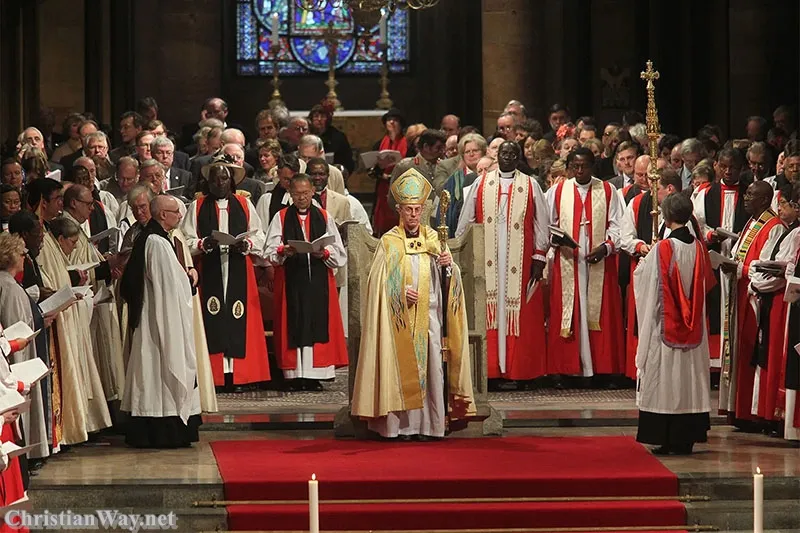
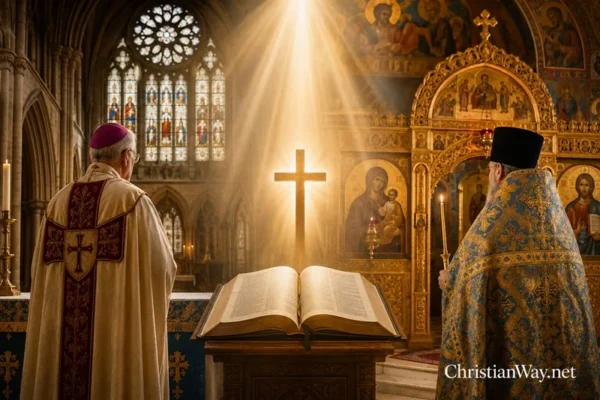
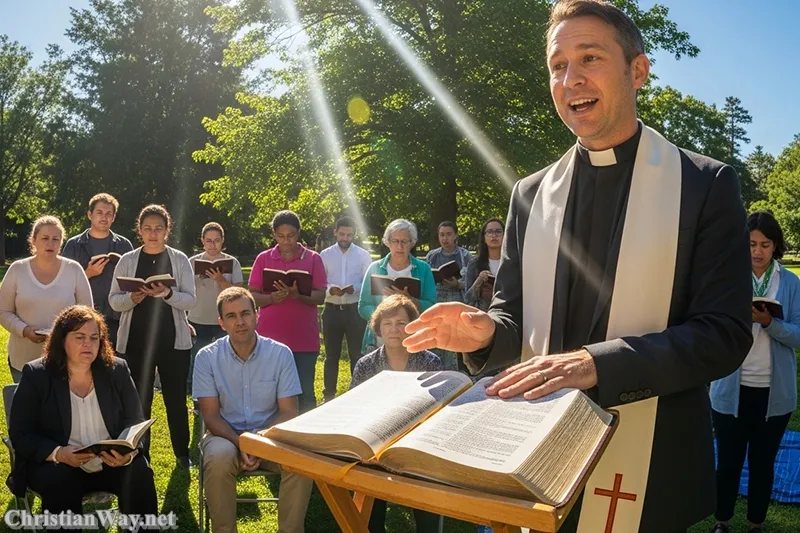
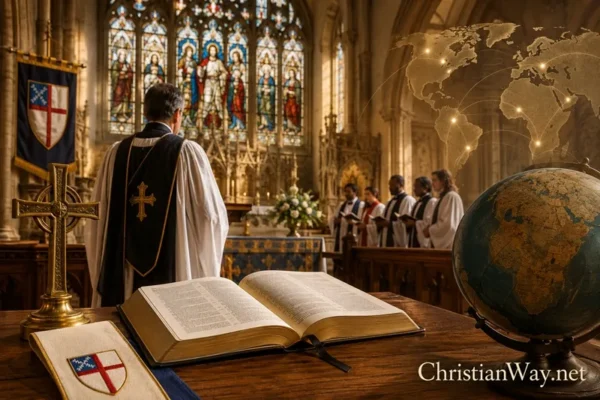
Dear friends in Christ,
Every Christian tradition seeks, in its own way, to answer a question that belongs to every generation: How do we remain faithful to Jesus Christ in a changing world? How do we hear the Word of God clearly while living amid new fears, new discoveries, new cultures, and new wounds? How do we honor the faith handed down by those who came before us without treating faith as something frozen in the past? And how do we use the mind God has given us without allowing pride to become greater than prayer?
Anglican theology has often tried to walk through these questions with reverence, patience, and humility. It has sought to hold together Scripture, tradition, and reason, not as three competing masters, but as gifts that help Christians receive and live the faith of Christ. Scripture gives the Church the authoritative witness to God’s saving work. Tradition carries the memory, worship, wisdom, and shared faith of generations. Reason helps believers think carefully, discern faithfully, and apply the Gospel wisely in the realities of life.
Yet none of these gifts is meant to become the center. Christ is the center.
The Church does not exist merely to preserve ancient customs, defend arguments, or produce thoughtful ideas. She exists to proclaim Jesus Christ: crucified for sinners, risen from the grave, present with His people, and coming again in glory. Anglican theology is at its best when it does not draw attention to itself, but leads the heart toward the living Lord.
This is why Anglican Theology: The Harmony of Scripture, Tradition, and Reason is not only a subject for scholars, clergy, or people who enjoy church history. It is a reflection on how ordinary believers can live faithfully. It is about the parent who wants to teach a child to pray, the student with honest questions, the worker trying to live with integrity, the grieving person who needs words when prayer feels difficult, and the seeker who wonders whether Christian faith can be both deeply rooted and intellectually honest.
The Anglican way does not promise that every question will be easy. It does not ask believers to pretend that mystery has disappeared. It does not reduce faith to emotion, custom, or argument. Instead, it invites us to stand before God with the whole person: heart, mind, body, memory, conscience, and hope.
The Christian faith is not a burden placed upon us from a distant God. It is the good news that God has come near in Jesus Christ. He has spoken through Scripture. He has gathered a people through the Church. He has given us minds capable of wonder and discernment. And He calls us, in every age, to love Him with all our heart, soul, mind, and strength.
A Faith Received, Not Invented
Anglican theology begins with a simple but humbling truth: Christianity is not invented anew by each generation. It is received.
The Gospel comes to us before we understand it fully. The story of creation, covenant, incarnation, cross, resurrection, forgiveness, and eternal life does not begin with our ideas. It begins with the God who reveals Himself. We are not asked to create our own savior, shape God according to our preferences, or build a faith that changes whenever culture changes. We are invited to receive the gift of Christ.
The Faith of the Apostles
The Anglican tradition understands itself as standing within the historic Christian faith. It confesses the Holy Trinity: Father, Son, and Holy Spirit. It proclaims that Jesus Christ is truly God and truly human. It declares that He was born of the Virgin Mary, suffered under Pontius Pilate, was crucified, died, and was buried, rose again on the third day, ascended into heaven, and will come again in glory.
These truths are not merely old sentences repeated from habit. They are the foundation of Christian hope.
If Jesus were only a wise teacher, He could inspire us but could not save us. If He were only divine and not truly human, He could not enter the full depth of our suffering. But the Gospel proclaims that the eternal Son of God took flesh and came near. He knew hunger, fatigue, friendship, grief, temptation, betrayal, pain, and death. He entered the darkness of human life so that no darkness would remain untouched by His love.
The faith of the apostles is therefore not a museum piece. It is living truth. It tells us that God has not abandoned the world. He has entered it.
Anglican theology receives this faith through Scripture, worship, creeds, sacraments, preaching, prayer, and the shared life of the Church. It does not imagine that Christians begin alone with a Bible in one hand and their private opinions in the other. We are taught. We are formed. We are corrected. We are encouraged. We are gathered into a people.
Theology Must Lead to Worship
Theology can become dry when it is separated from prayer. It can become proud when it is separated from humility. It can become harsh when it is separated from mercy.
But theology becomes beautiful when it leads a person to worship.
To know that God is holy should make us reverent.
To know that God is merciful should make us hopeful.
To know that Christ died for sinners should make us humble.
To know that Christ rose again should make us courageous.
To know that the Holy Spirit is at work should make us patient.
The Anglican tradition has often understood theology not merely as a system of ideas, but as a way of helping believers pray more truthfully and live more faithfully. The Church’s worship teaches the heart to confess sin, receive forgiveness, give thanks, intercede for the world, and rest in the promises of God.
A person may not remember every theological term they have heard. Yet they may remember the words prayed at a hospital bedside, the Psalms spoken during grief, the creed confessed with a congregation, or the blessing offered at the end of worship. These prayers can remain in the soul long after many arguments have faded.
Scripture: The Living Word That Leads Us to Christ
Scripture holds a central place in Anglican theology. The Bible is received as the primary witness to God’s saving work and the sure guide by which the Church is called to test her teaching.
The Old Testament tells the story of creation, covenant, promise, failure, judgment, mercy, and longing for redemption. The New Testament reveals Jesus Christ as the fulfillment of God’s promises: the Word made flesh, the Lamb of God, the crucified Savior, the risen Lord, and the One through whom all things are being made new.
Scripture Is More Than a Collection of Quotations
The Bible is not given merely to provide verses for arguments. It is not a box of religious sayings that we open only when we want to prove a point. It is the story through which God teaches us who He is, who we are, what sin has done, and what grace has accomplished in Jesus Christ.
To read Scripture faithfully is to read it with reverence, patience, and a desire to be changed.
The Bible comforts the grieving, but it also corrects the proud.
It gives hope to the weary, but it also calls the comfortable toward repentance.
It tells us of God’s love, but it does not hide the seriousness of sin.
It reveals mercy, but it also teaches justice.
It offers forgiveness, but it also calls believers to forgive.
This is why Scripture must be read as a whole. A single verse can be precious, yet no single verse should be torn away from the larger story of God’s revelation. Christians are called to read carefully, prayerfully, and in communion with the Church.
Jesus Himself taught His disciples to see the Scriptures as pointing toward Him. After His resurrection, He opened the Scriptures and showed how the Law, the Prophets, and the Psalms bore witness to His saving work. The Bible is not an end in itself. It leads us to Christ.
Scripture in the Life of Worship
One of the great gifts of Anglican worship is the prominence given to Scripture. The Bible is not kept at the edge of the service. It is read aloud, sung in the Psalms, proclaimed in the Gospel, echoed in prayers, and opened through preaching.
This matters because faith grows through hearing.
A person may enter worship carrying anxiety, grief, guilt, or confusion. Then a passage from Isaiah is read, and they hear that God gives strength to the weary. A Psalm gives words to sorrow. A Gospel story reveals Christ touching someone others have avoided. A letter of Saint Paul reminds believers that nothing can separate them from the love of God.
Scripture becomes not merely information, but encounter.
The regular reading of the Bible also protects the Church from becoming captive to the mood of the moment. Human opinions change quickly. Political movements rise and fall. Public values shift. But the Word of God continues to call the Church back to truth.
This does not mean that every passage is easy to interpret. Some passages are difficult. Some require historical understanding, careful study, prayer, and humility. But difficulty is not a reason to turn away. It is an invitation to listen more deeply.
Scripture and the Humility of Interpretation
Anglican theology has often encouraged Christians to read Scripture seriously while resisting the temptation to assume that every personal interpretation is automatically the final word.
A faithful reader asks:
What does this passage reveal about God?
How does it point toward Christ?
How has the Church understood this text through the centuries?
What is the context of these words?
How should this truth shape my life?
This posture is important because Scripture is holy. We should not use it to humiliate others, justify cruelty, or protect our own pride. The Bible is a sword, but it is first meant to cut through the falsehood within our own hearts.
When we read Scripture honestly, we discover that we too need mercy. We too have failed. We too need Christ to forgive, heal, and renew us.
Tradition: The Church’s Memory of Grace
Tradition is sometimes misunderstood as nothing more than old habits. But in Anglican theology, tradition is more than nostalgia. It is the living memory of the Church.
Tradition includes the ancient creeds, the worship of the Church, the witness of the early fathers, the decisions of councils, the prayers of generations, the lives of saints, the wisdom of pastors, and the shared practices through which Christians have learned to follow Christ.
Tradition Does Not Replace Scripture
Tradition is not meant to stand above Scripture as though the Church could create truth apart from God’s Word. Rather, tradition helps Christians receive Scripture faithfully.
The Church did not invent the Gospel. She received it.
The Church did not create Christ. She proclaimed Him.
The Church did not write the story of salvation. She was gathered into it.
Tradition becomes healthy when it keeps leading believers back to Jesus. It becomes unhealthy when it begins to protect itself more than it protects the Gospel.
This is why Anglican theology values continuity while also affirming the need for reform. The Church honors the faith of those who came before, but she must always ask whether her life remains faithful to Christ.
A tradition may be ancient and still need correction.
A practice may be familiar and still need renewal.
A church may be beautiful and still need repentance.
The Gospel is not a weapon against tradition, but it is the light by which every tradition must be examined.
The Creeds as a Shared Confession
The Apostles’ Creed and the Nicene Creed have long held an important place in Anglican worship. These creeds gather the central truths of Christian faith into words that can be confessed together.
“I believe in God the Father Almighty.”
“I believe in Jesus Christ His only Son our Lord.”
“I believe in the Holy Spirit.”
These words remind believers that Christianity is not based on vague spirituality. It is rooted in the living God revealed through the Father, the Son, and the Holy Spirit.
The creeds also remind us that we are not alone. Christians across centuries and cultures have confessed these truths. A believer in a small village, a cathedral congregation, a hospital room, a school chapel, or a quiet home can speak the same faith that has strengthened generations.
The creed does not remove every mystery. It gives us a place to stand within mystery.
Common Prayer as Living Tradition
The Book of Common Prayer is one of the clearest expressions of Anglican tradition. Its purpose is not merely to preserve beautiful language. Its deeper purpose is to teach the Church how to pray.
It gives words for confession when we are ashamed.
It gives words for thanksgiving when joy overwhelms us.
It gives words for intercession when the world’s suffering feels too large.
It gives words for grief when someone we love has died.
It gives words for hope when the future is uncertain.
The beauty of common prayer is that it forms Christians slowly. It teaches us to pray not only for ourselves, but for the Church, the world, those in authority, the poor, the sick, the lonely, and the departed.
Prayer enlarges the heart.
A person who prays only for personal comfort may remain trapped within their own fears. But a person who learns to pray for strangers, enemies, nations, suffering people, and future generations begins to see the world differently.
The Church’s tradition of prayer reminds us that faith is not meant to become private escape. It is meant to make us more available to love.
Reason: A Gift That Kneels Before God
Reason is also important in Anglican theology. God has given human beings minds capable of learning, questioning, imagining, observing, and discerning. To use the mind honestly is not a betrayal of faith. It can be an act of gratitude.
The God who created the stars, the human body, the natural world, language, music, beauty, and conscience does not ask believers to stop thinking. He calls the mind to serve truth.
Reason Is Not the Enemy of Faith
Some people fear that questions are dangerous. They may think that faith requires silence, certainty without struggle, or the refusal to examine difficult issues. But the Gospels do not present faith as the rejection of thought.
Mary asked, “How shall this be?” when the angel announced the birth of Jesus.
Thomas asked to see the wounds of the risen Christ.
The Psalms are full of questions, cries, and honest sorrow.
Job wrestled with suffering before God.
The disciples often failed to understand what Jesus was teaching.
Faith is not the absence of questions. It is the willingness to bring questions to God rather than turning away from Him.
Reason can help Christians study Scripture carefully, understand history, learn from science, discern ethical questions, examine social problems, and communicate the faith in ways that speak clearly to the world.
But reason must remain humble.
Human beings are intelligent, but we are not all-knowing.
We can study creation, but we cannot contain God.
We can understand some truths, but we cannot master every mystery.
We can form arguments, but we cannot save ourselves through intellect.
Reason is a gift, but it must kneel before the holiness of God.
Faith Is More Than What Can Be Measured
Reason is valuable, but Christian faith is not limited to what can be measured, tested, or controlled.
Love cannot be reduced to numbers.
Beauty cannot be fully explained by analysis.
Forgiveness cannot be calculated like a machine.
Prayer cannot be proven in the same way as a mathematical formula.
The resurrection is not a conclusion reached by human effort alone. It is God’s victory over death, received in faith through the witness of the apostles and the life of the Church.
This does not mean faith is irrational. It means faith is larger than rationalism.
Rationalism says that only what human reason can fully control is real.
Christian faith says that reason is real and good, but God is greater than the human mind.
The Christian does not throw away thought. The Christian offers thought to God.
Reason and Moral Discernment
The world changes, and Christians must often face questions that earlier generations could not have imagined in the same form. Technology, medicine, economics, family life, war, environmental responsibility, migration, social media, and public ethics all raise serious questions.
Scripture gives the Church foundational truth. Tradition gives wisdom from generations who have walked with God. Reason helps believers discern how to live faithfully in new circumstances.
But discernment must never become an excuse for making truth conform to whatever is fashionable.
Reason must be guided by love.
Love must be shaped by truth.
Truth must remain rooted in Christ.
The question is not, “What is easiest for us to accept?” The question is, “What helps us remain faithful to the God who has revealed Himself in Jesus?”
Scripture, Tradition, and Reason Belong Together
Anglican theology is often described through the harmony of Scripture, tradition, and reason. This description is useful when understood carefully.
It does not mean that Scripture, tradition, and reason are three equal authorities standing beside one another like three judges with equal power. Scripture remains the primary and authoritative witness to God’s saving revelation. Tradition helps the Church receive and live that revelation. Reason helps believers understand, apply, and communicate the faith wisely.
A Lamp, a Memory, and a Mind
We might imagine Scripture as a lamp given by God to light the path.
Tradition is the memory of those who have walked that path before us.
Reason is the mind that helps us see where we are walking and how the light should guide us in the present moment.
But the lamp remains essential.
Without Scripture, tradition can become only custom.
Without Scripture, reason can become only opinion.
Without tradition, Scripture can be treated as though no one before us has ever prayed, struggled, interpreted, or worshiped.
Without reason, believers may confuse faithfulness with fear of honest questions.
The harmony of these gifts can help Christians avoid extremes.
It guards against a religion that treats every old practice as sacred simply because it is old.
It guards against a religion that treats personal preference as truth.
It guards against a religion that rejects the mind God has given.
It guards against a religion that reads Scripture without humility or love.
A Faith Both Rooted and Living
The Anglican vision seeks a faith that is rooted but not lifeless.
A tree needs roots. Without them, it cannot remain standing when storms come. Yet a healthy tree is not a dead object buried in the ground. It grows. It bears fruit. It responds to seasons. It gives shade. It becomes a sign of life.
In the same way, the Church must remain rooted in the apostolic faith, but she must also bear fruit in every generation.
The Gospel does not change, but the world to which the Gospel is preached is always changing.
A faithful Church must speak eternal truth in language people can understand.
A faithful Church must preserve worship while also making room for those who are searching.
A faithful Church must honor the past while refusing to hide from present suffering.
A faithful Church must love the world enough to serve it, but not love the world so much that she forgets the Kingdom of God.
This is not an easy balance. It requires prayer, humility, courage, and patience.
Christ at the Center of Anglican Theology
The harmony of Scripture, tradition, and reason has value only when it leads to Christ.
Jesus is not merely one topic among many topics in theology. He is the center.
The Scriptures point toward Him.
The creeds proclaim Him.
The sacraments reveal His grace.
The Church belongs to Him.
The saints bear witness to Him.
The Christian life is lived in Him.
The Incarnation: God Comes Near
The heart of the Christian faith is the incarnation. The Word became flesh and dwelt among us.
This truth changes everything.
God is not distant from human sorrow.
He has entered our weakness.
He has known hunger, fatigue, grief, temptation, betrayal, and death.
He has walked among ordinary people.
He has touched the sick.
He has welcomed children.
He has spoken with the lonely.
He has wept at the tomb of a friend.
He has carried the cross.
Because Christ became human, no part of human life is beneath His concern.
The home matters.
The workplace matters.
The body matters.
The poor matter.
The grieving matter.
The forgotten matter.
The questions of the mind matter.
The wounds of the heart matter.
Anglican theology is faithful when it remembers that the God revealed in Christ is not an abstract idea. He is the Savior who comes near.
The Cross and Resurrection
At the cross, Christians see both the seriousness of sin and the depth of divine mercy.
Sin is not a small matter. It wounds people. It breaks relationships. It produces injustice, pride, cruelty, selfishness, violence, and fear. The cross reveals what human sin can do.
Yet the cross also reveals what God’s love will do.
Christ does not answer hatred with hatred.
He does not abandon the world in its rebellion.
He gives Himself.
He forgives.
He carries the burden.
He opens the way to reconciliation.
The resurrection then declares that death does not have the final word. The risen Christ gives hope to the grieving, courage to the fearful, and new life to those who believe.
A theology that does not lead us toward the cross becomes too comfortable with human pride.
A theology that does not lead us toward resurrection becomes too hopeless about human suffering.
Anglican faith must keep both before the Church: the cross that humbles us and the resurrection that gives us hope.
Grace Before Human Achievement
The Anglican tradition, shaped by the Reformation, has strongly emphasized that salvation is received through the grace of God.
Human beings cannot save themselves through intelligence, morality, religious effort, social position, money, education, family background, or reputation. We are saved because God comes toward us in Christ.
Saint Paul writes, “By grace are ye saved through faith; and that not of yourselves: it is the gift of God” (Ephesians 2:8).
This truth is deeply pastoral.
Many people live with a hidden fear that they are never enough. They feel they must constantly prove their value. They carry shame about past mistakes. They fear that God may love other people but not them.
The Gospel says otherwise.
Christ comes for sinners.
He comes for the weary.
He comes for the ashamed.
He comes for people who have failed.
He comes for those who do not know how to begin again.
Grace Produces a Changed Life
Grace does not mean that sin no longer matters. It does not mean that Christians are free to live selfishly without repentance. Grace is not permission to remain unchanged.
Grace changes the heart.
A person who has received mercy begins to show mercy.
A person who has been forgiven learns to forgive.
A person who has been loved begins to love.
A person who has been freed from fear begins to serve more courageously.
Good works do not purchase salvation. They are the fruit of salvation.
This is important because Christianity can become distorted in two directions. One person may try to earn God’s love through endless religious effort. Another person may speak about grace while treating holiness as unimportant.
The Gospel calls us beyond both errors.
We do not serve God to make Him love us.
We serve because He has loved us first.
Sacraments: Grace Received in Ordinary Things
Anglican theology gives an important place to baptism and Holy Communion, the two sacraments instituted directly by Christ.
These sacraments remind us that God works through ordinary things. Water, bread, wine, words, touch, gathered worship, and shared prayer become signs of divine grace.
Baptism and Belonging
Baptism speaks of new life in Christ. It reminds believers that they are not saved by their own achievement. They are received into the life of God through grace.
In baptism, Christians are joined to the Body of Christ. They are no longer meant to live only for themselves. They belong to a people.
This is especially meaningful in a world where many people feel isolated. The Gospel tells us that we are not created to carry life alone. We are called into communion: with God and with one another.
Holy Communion and the Gift of Christ
At the Lord’s Table, Christians remember the night when Jesus took bread and wine and gave Himself for the life of the world.
“This is my body which is given for you.”
“This cup is the new testament in my blood.”
These words reveal the heart of Christian faith. Christ gives Himself.
Anglicans have expressed the mystery of Christ’s presence in Holy Communion in different ways. Some emphasize a strong sacramental understanding of Christ’s real presence. Others speak more in the language of spiritual nourishment through faith and the Holy Spirit.
Yet the deeper truth remains: Holy Communion is not merely an empty ritual. It is a sacred encounter with the grace of Christ.
The Eucharist calls believers to remember the cross, receive mercy, give thanks, and become one body in love.
It also calls the Church toward justice and compassion. We cannot gather around Christ’s table while ignoring those who are hungry, lonely, poor, wounded, or forgotten. The bread we receive must shape the lives we live.
Worship That Forms the Soul
Anglican theology understands worship as more than a gathering for information or inspiration. Worship forms the heart.
The rhythm of confession, Scripture, praise, intercession, creed, sacrament, silence, and blessing slowly teaches believers how to live before God.
The Gift of Daily Prayer
Morning Prayer and Evening Prayer have held a special place in Anglican devotion. These services remind believers that prayer is not only for emergencies. It is the rhythm of a life offered to God.
Morning Prayer teaches the heart to begin the day with thanksgiving and trust.
Evening Prayer teaches the heart to release the day into God’s mercy.
The Psalms give words for every season: joy, fear, anger, repentance, gratitude, confusion, hope, and praise.
A person may not always know what to say to God. But the Church gives them words.
This is one of the great pastoral gifts of liturgical prayer. It carries us when our own strength is weak.
Worship and the Ordinary World
True worship does not remove us from the world. It sends us back into the world more ready to love.
After confessing sin, we are called to forgive.
After hearing Scripture, we are called to obey.
After receiving grace, we are called to show grace.
After praying for the poor, we are called to care for the poor.
After receiving Christ’s peace, we are called to become peacemakers.
Worship becomes empty when it does not shape daily life. But when worship forms the heart, the workplace, home, street, classroom, hospital, and marketplace can become places where Christ is made visible.
The Anglican “Middle Way”
Anglicanism is sometimes described as a via media, or “middle way.” This phrase can be helpful, but it can also be misunderstood.
It does not mean that Anglican theology simply chooses the safest position between every disagreement. It does not mean avoiding truth in order to avoid conflict. It does not mean that faith becomes vague enough for everyone to agree.
At its best, the Anglican middle way is a desire to hold together truths that Christians sometimes separate.
Not Compromise, but Wholeness
Anglican theology seeks to hold together Scripture and tradition.
It seeks to hold together grace and holiness.
It seeks to hold together personal faith and the shared life of the Church.
It seeks to hold together reverence and accessibility.
It seeks to hold together intellect and prayer.
It seeks to hold together ancient worship and present mission.
This is not compromise for the sake of comfort. It is an attempt at Christian wholeness.
The Church can become distorted when she chooses only one truth and forgets another.
Truth without love becomes harsh.
Love without truth becomes shallow.
Tradition without reform becomes rigid.
Reform without tradition becomes rootless.
Reason without worship becomes proud.
Worship without understanding can become empty habit.
The Anglican vision seeks to keep these gifts in conversation beneath the lordship of Christ.
Anglican Theology in a Restless World
The modern world often feels hurried, divided, distracted, and tired. People carry constant pressure to achieve, compare, consume, react, and prove themselves. Many are surrounded by information but still feel spiritually empty.
Anglican theology can offer a quiet and needed wisdom in such a world.
A Faith That Makes Room for Silence
The Church’s prayers, Psalms, liturgical seasons, and sacred rhythms remind us that the soul needs silence.
Not every question must be answered immediately.
Not every fear must control the day.
Not every opinion deserves our attention.
Not every wound can be healed by noise.
Sometimes we need to sit before God and simply say, “Lord, have mercy.”
Sometimes we need to let the Psalms speak when our own words fail.
Sometimes we need to hear again that Christ is near.
The Anglican tradition’s rhythm of common prayer can become a refuge for people who are tired of performing. It tells us that we do not need to impress God. We need only come honestly.
A Faith That Takes Questions Seriously
Many people today carry questions about faith, science, suffering, justice, Scripture, sexuality, work, doubt, death, and the future of the Church. Some fear that asking questions means they are weak in faith.
But honest questions can become part of the journey toward deeper trust.
The Church should not be afraid of thoughtful believers. She should be a place where people can wrestle with difficult things without being humiliated. This does not mean every answer will be easy or that every teaching will change according to public pressure. It means that Christians should listen carefully, study faithfully, pray deeply, and speak truth with compassion.
Christ did not turn away those who came with questions. He met Nicodemus in the night. He listened to the rich young ruler. He spoke patiently with the Samaritan woman. He received Thomas in his doubt and showed him His wounds.
The Church should reflect this same patience.
The Call to Justice, Mercy, and Service
Anglican theology is not meant to remain in worship services or theological books. It must touch the soil of daily life.
The God revealed in Scripture cares for the poor, the stranger, the oppressed, the sick, the hungry, the imprisoned, and the forgotten. Jesus said that what is done for the least of His brothers and sisters is done for Him.
Faith Has Hands and Feet
A church may have beautiful worship, thoughtful preaching, strong music, and ancient prayers. These can be precious gifts. But if the Church does not care for those who suffer, she has not yet received the full meaning of the Gospel.
The Christian life must become visible in mercy.
It appears when someone visits a lonely person.
It appears when a family shares food with a neighbor in need.
It appears when a worker refuses dishonest profit.
It appears when a church protects children and vulnerable people.
It appears when a person speaks against cruelty even when it is unpopular.
It appears when someone forgives without pretending that injustice is acceptable.
It appears when believers care for creation, communities, and future generations.
Justice is not opposed to worship. Justice is one of worship’s fruits.
Mercy is not an optional extra. Mercy is the shape of the cross in daily life.
Anglican Theology and Christian Unity
The Anglican tradition stands in conversation with many branches of Christianity. It shares much with Roman Catholicism through its liturgical worship, historic episcopacy, sacramental life, and reverence for the ancient Church. It shares much with Protestant traditions through its emphasis on Scripture, grace, reform, and the Gospel preached in the language of the people.
It has also been enriched through engagement with Orthodox Christianity, Lutheranism, Reformed churches, Methodism, Baptist communities, Pentecostal movements, Evangelical churches, and many others.
Unity Without Pretending Differences Do Not Matter
Christian unity does not mean pretending that every doctrine is identical. Differences about authority, sacraments, ministry, worship, salvation, and moral teaching remain serious.
But division should never become a reason for pride.
Jesus prayed that His followers “may all be one” (John 17:21). This prayer should remain before every Christian community.
The Church must seek unity with honesty. We do not honor one another by hiding real disagreements. But we also do not honor Christ by speaking contemptuously about other believers.
The path toward unity requires patience.
It requires repentance for the wounds Christians have caused one another.
It requires the courage to listen.
It requires shared service where possible.
It requires prayer.
The Anglican desire to hold together Scripture, tradition, and reason can offer a humble contribution to this work. It reminds Christians that no one tradition has the right to become proud. Every community needs the Scriptures. Every community needs the memory of the Church. Every community needs humble discernment. Every community needs Christ.
Living Anglican Theology in Daily Life
Theology becomes real when it enters ordinary life.
A parent lives Anglican theology when Scripture is read at home, prayers are spoken honestly, and children are taught that God’s mercy is greater than their mistakes.
A teacher lives Anglican theology when truth is taught with patience and students are treated with dignity.
A worker lives Anglican theology when honesty is chosen over convenience.
A friend lives Anglican theology when another person’s sorrow is carried with compassion.
A church member lives Anglican theology when worship leads them to forgive, serve, and care for those who are overlooked.
A believer lives Anglican theology when they bring both faith and questions before God.
The Whole Life Before God
The Christian life is not divided into sacred moments and ordinary moments. Every part of life belongs to God.
The meal prepared for a family.
The apology offered after anger.
The call made to a lonely friend.
The work done honestly when no one is watching.
The prayer whispered before sleep.
The patience shown to a difficult person.
The decision to begin again after failure.
These things may seem small. But in the Kingdom of God, hidden faithfulness matters.
Christ sees what the world overlooks.
He sees the exhausted parent.
He sees the person carrying grief quietly.
He sees the worker trying to remain upright in a difficult environment.
He sees the young person resisting pressure.
He sees the older believer who continues to pray when strength is fading.
The harmony of Scripture, tradition, and reason should lead us toward this kind of faithful life: a life rooted in truth, shaped by worship, open to wisdom, and poured out in love.
Reflect and Pray
Dear friends, Anglican Theology: The Harmony of Scripture, Tradition, and Reason is finally a reflection on how Christians may receive the whole life of faith with gratitude.
Scripture gives us the living witness of God’s saving love.
Tradition gives us the memory of the Church that has prayed, suffered, worshiped, and proclaimed Christ across generations.
Reason gives us the gift of thoughtful discernment, helping us seek truth with humility in the world where God has placed us.
But all three must lead us to Jesus Christ.
Without Christ, Scripture can become only a book of arguments.
Without Christ, tradition can become only the memory of old customs.
Without Christ, reason can become only the pride of the human mind.
But in Christ, the Scriptures become a living word of hope. Tradition becomes a communion of faith. Reason becomes a humble servant of truth. Worship becomes an encounter with grace. Daily life becomes an offering of love.
May we remain rooted in the Gospel without becoming hard-hearted. May we honor the wisdom of the past without losing compassion for the present. May we use our minds with gratitude without forgetting that God is greater than all we can understand. And may every part of our lives become a quiet answer to the love of Christ.
Let us pray.
Lord Jesus Christ, You are the living Word through whom the Father has spoken to the world. Teach us to love Holy Scripture, receive the wisdom of Your Church, and use the minds You have given us with humility and faith. Protect us from pride, confusion, fear, and division. Form us through worship, strengthen us through grace, and send us into the world as people of truth, mercy, and peace. May Your Church remain rooted in You, faithful in prayer, generous in service, and radiant with the hope of Your resurrection. Amen.
May the peace of Christ dwell richly in your heart, and may His love guide every step you take toward Him.
— Fr. John Matthew