Dear friends in Christ,
There are moments when a human life seems to be moving confidently in one direction, only for God to permit a wound, a loss, or a silence that changes everything. A door closes. A dream collapses. A body becomes weak. The applause of the world grows quiet. And in that unexpected stillness, the soul begins to hear a voice it had long ignored.
Such was the story of Saint Ignatius of Loyola.
Before he became known as a spiritual guide, a founder of a religious order, and a saint whose wisdom still helps Christians discern the will of God, Ignatius was a man of ambition. He dreamed of honor, courage, influence, and the admiration that often surrounds a soldier. He wanted to achieve great things, but at first he did not yet understand what true greatness was. He sought a name for himself before he learned to live for the name of Jesus Christ.
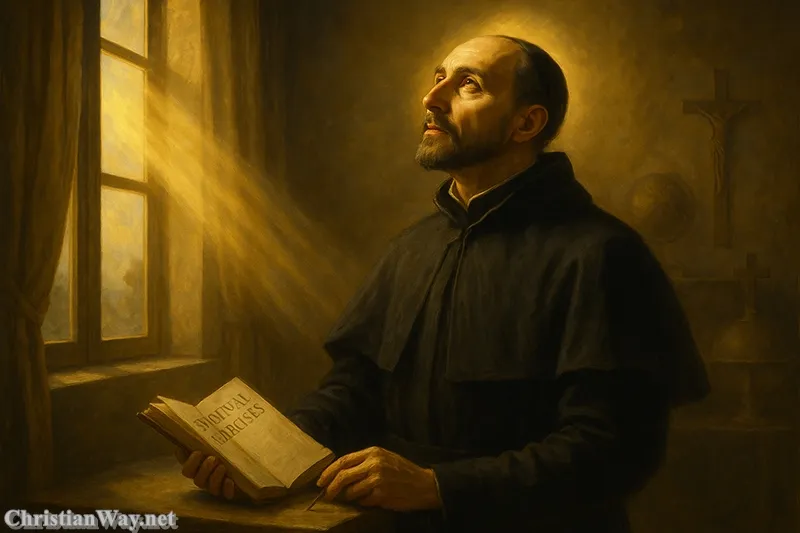
Yet God did not reject the fire in his heart. God transformed it.
The strength that once desired glory on the battlefield became strength for the Gospel. The discipline that once shaped a soldier became discipline for prayer. The courage that once defended a fortress became courage to surrender everything to Christ. Ignatius did not become a saint because he lost his personality, his energy, or his desire to do something meaningful. He became a saint because those desires were purified, healed, and placed in the hands of God.
His life speaks tenderly to every person who feels restless, ambitious, wounded, confused, or uncertain about the road ahead. It speaks to those who have spent years chasing success but still feel empty. It speaks to those who stand at a crossroads and quietly ask, “Lord, what do You want from me?” It speaks to those who are learning that faith is not only about believing certain truths, but about allowing Christ to shape every decision, every desire, every relationship, and every dream.
Saint Ignatius of Loyola teaches us that the Christian life is not a retreat from the world. It is a journey of seeing the world with new eyes. It is learning to recognize the movements of the heart, to distinguish what leads us closer to God from what slowly turns us away from Him, and to become available for the mission Christ places before us.
A Soldier With a Restless Heart
Ignatius of Loyola was born in 1491 in the Basque region of northern Spain. His early years were marked by the ideals of nobility, courage, courtly honor, and military ambition. He desired the kind of life that would make him admired by others. He wanted distinction, influence, and a story that people would remember. In many ways, he resembled the ambitious hearts of every generation: people who long to matter, who fear being unnoticed, and who believe that success will finally make them feel secure.
In 1521, while defending the fortress of Pamplona, Ignatius was seriously wounded in battle. His injury left him unable to continue the life he had imagined for himself. During a long and painful recovery, he asked for books about knights and heroic romances. But none were available. Instead, he was given books about the life of Christ and the lives of the saints. What seemed like a small accident became the beginning of a deep conversion.
At first, Ignatius read these books simply because he had little else to do. Yet slowly, the stories of Christ, Saint Francis of Assisi, Saint Dominic, and other saints began to awaken something within him. He started to imagine himself living as they had lived. He imagined leaving behind his former ambitions and giving his life entirely to God.
But he also continued to imagine the life he had once desired: military honor, romance, reputation, and worldly achievement. He noticed that these two kinds of thoughts affected him differently. When he dreamed of worldly success, the pleasure was real for a while, but it eventually left him restless and empty. When he imagined living for Christ, the thought might at first seem difficult or demanding, but it left behind a deeper peace.
This discovery became one of the foundations of Ignatian spirituality. God was teaching him to listen to his heart.
The Difference Between Passing Excitement and Lasting Peace
Many people confuse happiness with excitement. We often assume that whatever feels pleasurable in the moment must be good for us. We can become drawn to praise, comfort, entertainment, possessions, attention, or approval. Yet after the excitement passes, the heart can feel more tired than before.
Saint Ignatius learned that not every strong feeling comes from God. Some thoughts promise freedom but leave us enslaved. Some relationships seem attractive but slowly draw us away from truth. Some ambitions appear noble but are secretly rooted in pride, fear, or the need to prove ourselves.
At the same time, the call of God is not always immediately easy. Sometimes the path of faith asks us to forgive when we would rather hold onto anger. It asks us to remain faithful when we are tired. It asks us to speak truth when silence would be safer. It asks us to serve people who may never thank us. Yet when we follow Christ in these difficult ways, something deeper grows within us: peace, freedom, courage, and a quiet sense that our lives are becoming more real.
Pope Francis has reflected on this part of Ignatius’ story, noting that the saint discovered how certain attractive thoughts eventually left him dissatisfied, while thoughts of God and holiness gave him a deeper and more enduring peace.
This is the beginning of discernment.
Discernment is not simply asking, “What do I want?” It is asking, “What is happening within me when I desire this?” Does this thought make me more loving? Does it bring me closer to Christ? Does it lead me toward generosity, humility, and courage? Or does it feed fear, vanity, resentment, selfishness, and spiritual confusion?
Saint Paul writes, “Do not be conformed to this world, but be transformed by the renewal of your mind” (Romans 12:2). Ignatius understood that this renewal also involves the heart. God does not only want to change what we think. He wants to purify what we love.
The Wound That Became a Doorway to Grace
It is tempting to see suffering only as interruption. We often look at illness, disappointment, rejection, failure, or loss and ask, “Why is this happening to me?” Sometimes there is no easy answer. The mystery of suffering is deep, and Christians should never offer shallow explanations to those who are in pain.
Yet the life of Saint Ignatius reminds us that God can meet us in the places where our plans have broken apart.
Ignatius’ injury at Pamplona did not make him holy by itself. Pain does not automatically transform a person. Some people become bitter through suffering. Others close their hearts. Others spend their lives trying to return to the dreams they had before they were wounded.
What changed Ignatius was that he allowed his wound to become a place of listening.
He did not merely endure pain. He began to ask what God might be saying through it. He allowed a season of weakness to reveal the deeper weakness of his soul. He began to see that he had built much of his identity on the admiration of others. He had wanted to become great in the eyes of the world, but he had not yet learned what it meant to become small before God.
This is a difficult grace. Most of us do not welcome the moments that expose our weakness. We do not enjoy discovering that we are not as strong, independent, or secure as we imagined. Yet these moments can become holy if they lead us toward humility.
The Lord often begins His deepest work in the place where our self-sufficiency ends.
Jesus said, “Whoever loses his life for my sake and for the gospel’s will save it” (Mark 8:35). These words do not mean that Christian faith despises life. Rather, they reveal that life becomes most fully alive when it is given away in love. Ignatius had to lose the life he imagined before he could receive the life God had prepared for him.
When God Interrupts Our Plans
Perhaps you have experienced such an interruption. Maybe you hoped for a certain career, but the opportunity disappeared. Maybe you trusted someone and were deeply hurt. Maybe your family life did not unfold as you imagined. Maybe you have prayed for healing, direction, or financial stability, and the answer has not come in the way you expected.
In those moments, it is natural to feel sorrow. Faith does not require us to pretend that pain is pleasant. Jesus Himself wept at the tomb of Lazarus. He prayed in the garden of Gethsemane with deep anguish. The Christian life is not denial. It is trust in the One who enters our suffering and remains with us.
Saint Ignatius teaches us to bring our questions before God honestly. We can say, “Lord, I do not understand this. I am afraid. I am disappointed. I do not know what comes next.” Prayer does not become less holy because it is honest. In fact, honest prayer is often the beginning of healing.
God may not always remove the wound immediately. But He can transform it. He can make the place of pain become a place of compassion. He can use a disappointment to free us from false ambition. He can use a failure to lead us toward humility. He can use loneliness to teach us that our deepest home is in Him.
The wound of Ignatius became a doorway. Through it, he entered a life he never could have imagined.
Manresa: The School of the Inner Life
After his conversion began, Ignatius left behind many of the symbols of his former life. He spent time at Montserrat, where he laid aside his weapons in a symbolic act of surrender. He then spent many months in Manresa, a small town in Spain, where he prayed deeply, practiced penance, served the poor, and struggled with spiritual darkness as well as moments of great consolation.
Manresa became the school of his soul.
There, Ignatius learned that following God does not mean that every day will feel bright or easy. He experienced joy, but he also experienced fear, confusion, temptation, and scrupulosity. At times, he became trapped in anxious thoughts about his sins and his worthiness before God. He had to learn that God’s mercy is greater than the soul’s constant self-accusation.
This is an important lesson for many Christians today.
Some people believe that holiness means never feeling doubt, never feeling sadness, and never struggling with weakness. But saints are not people who never struggle. Saints are people who keep turning toward God in the midst of struggle. They learn not to build their spiritual life on moods alone. They learn to trust God even when prayer feels dry.
At Manresa, Ignatius began to write reflections and spiritual notes that later developed into the Spiritual Exercises. These exercises became one of the most influential guides to prayer and discernment in Christian history. They were not written as a book of abstract ideas. They were born from a man who had wrestled with his own heart and learned, slowly and humbly, to surrender it to Christ.
Consolation and Desolation
One of Saint Ignatius’ most helpful teachings concerns spiritual consolation and spiritual desolation.
Consolation does not simply mean feeling happy. It is the movement of the heart toward God. It may include peace, hope, gratitude, love, courage, tears of repentance, or a renewed desire to serve others. Sometimes consolation is joyful. Sometimes it is quiet. Sometimes it comes as a deep sense of being held by God even in the middle of sorrow.
Desolation, on the other hand, is not simply sadness. A person may feel sadness and still be close to God. Desolation is more like a spiritual heaviness that pulls the soul away from faith, hope, and love. It can include discouragement, confusion, bitterness, despair, self-centeredness, or the feeling that prayer no longer matters.
Ignatius did not teach that every emotion should be followed blindly. Instead, he encouraged Christians to examine where their thoughts and desires are leading them.
A thought may begin with something harmless but slowly lead toward pride, resentment, impurity, hopelessness, or isolation. Another thought may begin with sacrifice but lead toward generosity, courage, humility, and love. Discernment means paying attention to the direction of the soul.
This is especially important in a distracted age. We live surrounded by noise. Messages arrive constantly. We are encouraged to react quickly, compare ourselves endlessly, and make decisions before we have prayed. The world often tells us to follow our feelings without asking whether those feelings are leading us toward life.
Saint Ignatius gently asks a deeper question: “Where is this movement taking you?”
Does it lead you toward Christ?
Does it make you more capable of loving?
Does it help you become more free?
Does it open your heart to truth?
The Spiritual Exercises: A Path Toward Freedom
The Spiritual Exercises are often associated with silent retreats, prayer, and spiritual direction. Yet their deeper purpose is not merely to make a person more reflective. Their purpose is to help the soul become free for God.
Freedom is one of the great themes of Ignatian spirituality.
The world often thinks of freedom as the ability to do whatever we want. But anyone who has struggled with addiction, anger, pride, jealousy, or fear knows that desire alone does not make us free. Sometimes we want things that harm us. Sometimes we become slaves to the approval of others. Sometimes we cannot say no to habits that weaken our minds and hearts.
True freedom is the ability to choose what leads us closer to God.
Ignatius wanted Christians to become less controlled by fear, greed, comfort, status, and self-interest. He wanted the heart to become available to God. He taught that we should hold created things with gratitude, but without allowing them to possess us.
This does not mean that family, work, health, money, friendship, beauty, or success are bad. All good things come from God. But they become dangerous when they take the place of God. A person may have wealth and remain humble. Another may have little wealth yet be consumed by envy. A person may be admired by others and remain grateful. Another may receive praise and become spiritually proud.
The question is not always, “Do I have this thing?” The deeper question is, “Does this thing have me?”
Seeking God in Ordinary Life
Saint Ignatius is sometimes remembered as a saint of great discipline, but his spirituality is not cold or distant from daily life. It invites us to seek God in all things.
God can be found in the quiet prayer before sunrise. He can be found in the tired mother who prepares food for her children. He can be found in the worker who chooses honesty when dishonesty would be easier. He can be found in the student who studies faithfully. He can be found in the person who visits an elderly parent, comforts a grieving friend, or forgives an insult.
The Christian life is not divided into “holy moments” and “ordinary moments.” Christ is Lord of every moment.
Saint Paul writes, “Whatever you do, do all to the glory of God” (1 Corinthians 10:31). This verse carries the heart of Ignatius’ mission. Every action, even the smallest one, can become an offering when it is done with love.
A simple meal can become prayer when it is received with gratitude.
A difficult conversation can become holy when it is marked by truth and mercy.
A workplace can become a place of mission when we treat people with dignity.
A season of uncertainty can become sacred when we ask God to guide our next step.
This is not dramatic spirituality. It is faithful spirituality. It is the spirituality of a person who wakes each morning and quietly says, “Lord, let my life belong to You today.”
From Personal Conversion to Mission
Ignatius did not remain alone in his spiritual journey. God gradually led him toward companionship and mission.
After years of prayer, travel, study, and spiritual growth, Ignatius went to Paris, where he met men who would become his closest companions. Among them were Saint Francis Xavier and Saint Peter Faber. Together with several others, they formed a community united by prayer, friendship, poverty, and a desire to serve Christ wherever the Church needed them. In 1534, they made vows that would become the beginning of the Society of Jesus, formally recognized by Pope Paul III in 1540.
This is a beautiful reminder that God often forms His work through friendship.
The Christian life is personal, but it is never meant to be isolated. We need people who help us pray when we are weak. We need friends who tell us the truth with love. We need spiritual companions who remind us that our lives are part of something larger than our private concerns.
Ignatius knew that mission requires community. A person who seeks only personal holiness can become self-focused. But a person who grows close to Christ is always drawn outward. Love becomes mission.
The Society of Jesus became known for education, missionary work, preaching, spiritual direction, scholarship, service to the poor, and a willingness to go wherever the Church most needed them. Ignatius himself remained largely in Rome during the later years of his life, guiding the growing community through letters, prayer, counsel, and the development of its spiritual vision.
He did not need to be everywhere physically in order to serve the mission of Christ. His prayers, wisdom, and leadership helped send others into the world.
“Here Am I; Send Me”
Mission is not only for priests, religious sisters, missionaries, or people who travel to distant countries. Every baptized Christian is called to participate in the mission of Christ.
For one person, mission may mean raising children in faith and love.
For another, it may mean teaching with patience.
For another, it may mean serving the poor.
For another, it may mean offering professional skills with honesty and compassion.
For another, it may mean quietly praying for someone who has lost hope.
The prophet Isaiah heard the voice of God saying, “Whom shall I send?” And Isaiah answered, “Here am I; send me” (Isaiah 6:8).
This is the heart of mission.
It is not always knowing every detail of the future. It is making ourselves available to God.
Saint Ignatius teaches us to pray with open hands. We may have plans, hopes, gifts, and responsibilities. These are good. But we place them before the Lord and say, “Use them for Your greater glory.”
Sometimes God sends us far away. Sometimes He sends us back into our own homes with renewed love. Sometimes He sends us to speak. Sometimes He sends us to listen. Sometimes He sends us into visible service. Sometimes He sends us into the hidden work of prayer, patience, and faithfulness.
The important thing is not where we are sent. The important thing is whether we are willing.
Discernment in a Confused and Busy World
The wisdom of Saint Ignatius is especially needed today because modern life often makes discernment difficult.
We live in a world of endless options. We can change jobs, move cities, begin relationships, end relationships, purchase almost anything, and receive opinions from thousands of people within minutes. Yet more choices do not always create more peace.
Sometimes they create confusion.
Many people are tired not because they are doing too much work, but because they are carrying too many unanswered questions. They wonder whether they are making the right decisions. They compare their lives to others. They fear missing opportunities. They struggle to know whether a desire comes from God, from fear, from wounded pride, or from the pressure to keep up with everyone else.
Saint Ignatius does not give us a quick formula for every decision. Instead, he teaches us to become people of prayerful attention.
Before making an important decision, we need silence.
We need to ask God for light.
We need to look honestly at our motives.
We need to notice whether the path before us leads toward greater faith, hope, love, and service.
We need wise counsel from mature Christians.
We need patience.
Many poor decisions are made in haste. We make them because we are lonely, angry, afraid, jealous, or desperate for approval. Discernment asks us to pause before reacting.
This does not mean we must become indecisive. Ignatius was not a passive man. He was capable of bold action. But his action grew from prayer. He desired to move when God opened the way, not merely when his ego demanded movement.
The Daily Examen
One simple practice associated with Ignatian spirituality is the daily examen. It is a brief prayerful review of the day.
At the end of the day, we can ask:
Where did I notice God’s goodness today?
When did I feel grateful?
Where did I respond to love?
Where did I resist grace?
What thought, word, or action needs healing?
What do I want to place before God tomorrow?
This practice does not require many words. It can be done quietly before sleep. It helps us become more aware of God’s presence in ordinary life. It also teaches humility, because we begin to recognize both the gifts we have received and the ways we still need mercy.
The examen is not meant to make us anxious or overly focused on ourselves. It is meant to help us see our lives through the eyes of grace.
God is already present in our days. The question is whether we are paying attention.
Humility, Obedience, and the Love of the Church
Saint Ignatius was a man of strong conviction, but his strength was joined to humility. He understood that discernment is not simply doing whatever seems personally meaningful. Christian discernment must remain rooted in Christ, Scripture, prayer, the life of the Church, and love for others.
This is important because people can sometimes use the language of “God’s will” to justify their own desires. We may say, “I feel called,” when what we really mean is, “I want this.” We may claim spiritual freedom while avoiding responsibility. We may seek a private spirituality that does not challenge our pride.
Ignatius teaches that authentic freedom is not rebellion against God’s order. It is joyful cooperation with God’s grace.
For Catholics, his spirituality is deeply connected to love for the Church and faithfulness to her mission. Yet Christians from many traditions can also recognize the wisdom of his call to prayer, self-examination, spiritual maturity, and service. His life reminds all believers that following Jesus requires both a personal relationship with Christ and a willingness to belong to the wider Body of Christ.
Jesus prayed that His followers would be one (John 17:21). Our differences as Christians are real, and they should be approached honestly. Yet the desire for unity, humility, prayer, and mission belongs to every disciple of Jesus.
Saint Ignatius calls us away from spiritual pride. He reminds us that holiness is not proving that we are better than others. It is becoming more available to God and more loving toward our neighbor.
The Greater Glory of God
The phrase often associated with Saint Ignatius is “for the greater glory of God.” It is a simple phrase, but it carries a demanding question.
What would bring greater glory to God in this situation?
Would it bring greater glory to God for me to hold onto resentment, or to forgive?
Would it bring greater glory to God for me to live only for comfort, or to serve someone in need?
Would it bring greater glory to God for me to seek applause, or to do good quietly?
Would it bring greater glory to God for me to hide my faith, or to live it with gentle courage?
This question does not mean we must always choose the hardest path merely because it is hard. God is not pleased by misery for its own sake. Rather, it means that our lives are no longer centered on self. We begin to ask what will reveal the goodness, mercy, beauty, and truth of Christ.
Sometimes the answer will be hidden service.
Sometimes it will be bold witness.
Sometimes it will be rest, because our bodies and minds need healing.
Sometimes it will be sacrifice.
Sometimes it will be saying no to something attractive because it is not truly good.
The glory of God is not found only in grand achievements. It is found whenever a heart chooses love over selfishness, truth over deception, mercy over revenge, and faith over fear.
Saint Irenaeus famously wrote that the glory of God is the human person fully alive. Saint Ignatius helps us understand that we become fully alive when we belong completely to Christ.
A Saint for Those Still Becoming
One of the most comforting things about Saint Ignatius is that he did not begin as a saintly child who always knew what God wanted. He was proud. He was ambitious. He was wounded. He was confused. He made mistakes. He struggled with fear and spiritual darkness.
But he kept responding to grace.
This is why his life gives hope.
You may not yet know your vocation clearly.
You may still be healing from old wounds.
You may feel far from the person you want to become.
You may be carrying regrets about choices you have made.
You may be afraid that you have wasted too much time.
But God is not finished with you.
The Lord who met Ignatius in a season of weakness can meet you in your own unfinished story. Christ does not wait for us to become perfect before calling us. He calls us while we are still learning. He calls us while we are still wounded. He calls us while we are still becoming.
When Jesus invited the first disciples, He did not give them a detailed map of every future step. He simply said, “Come and see” (John 1:39).
That invitation remains.
Come and see what God can do with a surrendered heart.
Come and see how grace can transform ambition into mission.
Come and see how wounds can become places of compassion.
Come and see how prayer can bring light to confusion.
Come and see how a life offered to Christ can become more meaningful than any life built only for self.
Reflect and Pray
Dear friends, Saint Ignatius of Loyola reminds us that no part of our story is beyond the reach of God’s mercy. The dreams that once ruled us, the wounds that humbled us, the fears that weakened us, and the questions that still trouble us can all become places where Christ meets us.
Perhaps today the Lord is asking you to slow down and listen to your heart. Perhaps He is inviting you to notice what brings you lasting peace and what leaves you empty. Perhaps He is asking you to release an ambition that no longer serves your soul. Perhaps He is calling you toward a mission you have been afraid to accept.
Do not be afraid to place your life before Him.
Lord Jesus Christ,
You called Saint Ignatius from the dreams of worldly glory
into the deeper joy of serving You.
Teach us to recognize Your voice amid the noise of our lives.
Give us freedom from fear, pride, and false ambition.
Heal the wounds we carry, guide the decisions before us,
and make our hearts ready to go wherever You send us.
May every part of our lives give glory to You. Amen.
May the peace of Christ dwell richly in your heart, and may He lead you with wisdom, courage, and gentle love on the path prepared for you.
— Fr. John Matthew