Dear friends in Christ,
There are moments in the history of the Church when the Gospel seems to be asked a question not in a library or in a quiet chapel, but in the streets of a troubled world: Will you remain faithful when faithfulness costs you peace, influence, security, and even the affection of those around you? Saint Gregory VII lived in such a moment. He did not set out to become a symbol of conflict, nor did he seek the loneliness that came with opposition. Yet he understood that a shepherd cannot remain silent when the things of God are treated as possessions to be bought, traded, or controlled. He understood that the Church, though carried through history by fragile human hands, belongs first and always to Jesus Christ.
His life may feel distant from us. The names of emperors, princes, bishops, councils, and medieval cities can seem to belong to another world. But the great struggle within Gregory’s heart is not distant at all. It appears whenever a Christian is tempted to exchange truth for comfort, whenever a pastor must choose fidelity over approval, whenever a family refuses to let success become an idol, whenever a wounded believer wonders whether the failures of Christian leaders have made holiness impossible. Gregory speaks to us because he teaches that reform begins with the willingness to let God judge, cleanse, and free us.
To call him a doctor of justice is to recognize that he taught not merely through arguments or decrees, but through a life that insisted that justice is inseparable from the holiness of God. Biblical justice is not cold severity. It is the right ordering of love. It is the courage to give God what belongs to God, the neighbor what belongs to the neighbor, and the human soul the truth by which it can live. Gregory’s witness calls us toward that justice. It leads us from a faith that is convenient to a faith that is consecrated, from concern for appearances to a reverence for Christ, who is the true Lord of His Church.
A Church That Needed the Mercy of Reform
The eleventh century was a time of genuine faith, beautiful worship, missionary energy, monastic renewal, and profound Christian learning. Yet it was also a time in which the Church suffered from grievous wounds. Church offices could be treated as prizes for the powerful. The sin called simony—the buying and selling of spiritual offices or favors—darkened consciences and distorted the meaning of ministry. In many places, secular rulers claimed decisive control over the appointment of bishops and abbots. The sacred task of shepherding souls could be entangled with wealth, family alliances, and political ambition. The Gregorian Reform arose in response to these wounds, seeking to confront simony, failures of clerical discipline, and lay investiture, so that the Church’s ministers might serve God with greater freedom and integrity.
We should not read this history as though the Church had ceased to be the Church, or as though every priest, bishop, monk, ruler, and layperson had fallen into corruption. God never abandons His people. In every age, He preserves saints whose hidden fidelity keeps the lamps burning. But holiness does not require us to deny sin. The Church is holy because Christ is holy, because His Word is true, because His sacraments are gifts of grace, and because the Holy Spirit never stops calling sinners to conversion. At the same time, the members of the Church must continually allow themselves to be purified. The bride is beloved, yet her children must still wash their garments in the mercy of the Lamb.
This is why reform in the deepest Christian sense can never be merely administrative. Rules may be necessary. Structures may need correction. Authority may need to be exercised with clarity. Yet no outward renewal will endure if the heart remains divided. Our Lord spoke plainly: “Out of the heart come evil thoughts, murder, adultery, sexual immorality, theft, false witness, slander” (Matthew 15:19). The roots of corruption are never only outside us. They grow wherever fear, greed, vanity, resentment, and the hunger for control are allowed to take the place of trust in God. Saint Gregory VII understood that the battle for the Church would finally be a battle for the human conscience.
The Wound of Treating Holy Things as Possessions
Simony was not simply a technical abuse. It was a spiritual contradiction. The gifts of God are not merchandise. The ministry of the Church is not a path toward prestige. The Lord said to the apostles, “Freely you have received; freely give” (Matthew 10:8). When a sacred office becomes a tool for status, influence, or gain, people are not only harmed by bad leadership; they are taught, even without words, that holiness can be purchased. This is a lie against the Gospel.
The temptation has not vanished because the forms of life have changed. Few Christians today would imagine buying a bishop’s office, but many other bargains threaten the soul. We may soften the truth so that we will be admired. We may use religious language to hide ambition. We may want our service to be noticed more than we want Christ to be loved. We may measure a community by its outward success and overlook whether it is becoming more humble, more merciful, more prayerful, and more faithful. The ancient sin returns whenever we try to possess what ought to be received as gift.
Gregory’s reform therefore asks each of us a question that cannot be answered for us by another: What holy thing in my life have I begun to treat casually? Perhaps it is the Eucharist, received without a prepared heart. Perhaps it is marriage, reduced to a contract rather than received as a covenant of self-giving love. Perhaps it is the calling to raise children, to serve the poor, to teach the young, or to bear witness at work. The saint’s severity is not meant to crush us. It is meant to awaken reverence. God’s gifts are not burdens to manage; they are mysteries through which He draws us into communion with Himself.
Hildebrand: The Servant Formed Before He Led
Before he became Pope Gregory VII, he was Hildebrand of Soana, a man formed in prayer, discipline, and service to the Church. He did not suddenly appear upon the world’s stage with a program of reform. For years he worked closely with popes and with fellow servants of renewal, including Saint Peter Damian. Later Christian memory would associate his name so closely with the movement for reform that it became known as the Gregorian Reform. Pope Benedict XVI described Peter Damian as a soul of this reform and noted his close collaboration with Hildebrand even before Hildebrand became Bishop of Rome.
There is something quietly consoling in this. God often prepares His servants long before their most visible task begins. The years that seem hidden are not wasted. The prayer that no one sees, the honest work that receives no applause, the long effort to grow in patience, the repeated return to confession, the humble acceptance of small duties—these may be the very places where God is forming a soul for a responsibility it cannot yet imagine. In a culture that urges us to be noticed quickly, Hildebrand reminds us that spiritual authority grows first in the soil of obedience.
When Gregory was elected pope in 1073, he brought to the office not only intelligence and resolve, but a deep conviction that the Church must be free to serve Christ. His pontificate would last until 1085 and would become one of the decisive chapters in the long struggle over the relationship between spiritual authority and secular power. The office he accepted was not a throne for personal glory. It was a cross placed on the shoulders of a man who knew that the freedom of the Church could not be surrendered without harming the freedom of souls.
A Lesson for Those Who Lead
The world often thinks that leadership means the ability to make others obey. The Gospel gives us another image. Jesus says, “You know that the rulers of the Gentiles lord it over them… It shall not be so among you. But whoever would be great among you must be your servant” (Matthew 20:25–26). Gregory’s life cannot be understood apart from this difficult truth. His firmness mattered only because he believed that authority is accountable to God and must be used for the good of the people entrusted to it.
This is true for the pope, for bishops, priests, pastors, parents, teachers, employers, public servants, and every person who carries some responsibility. Authority becomes beautiful when it protects what is weak, tells the truth when falsehood would be easier, and makes room for the flourishing of others. It becomes destructive when it demands loyalty to itself rather than directing hearts toward God. Saint Gregory’s struggle against the control of ecclesial offices by political powers was, at its deepest level, a struggle against the confusion of service with possession.
Perhaps this is where we must be especially honest today. Christians rightly grieve whenever leaders betray trust, conceal wrongdoing, or treat the vulnerable as if they were obstacles to be managed. Gregory’s example should never be used to defend an institution from accountability. Rather, it should lead us to seek a more searching accountability before God. The Church is never purified by denial. She is purified by truth, repentance, justice for those who have been harmed, and a renewed commitment to serve as Christ served.
Justice Is More Than Winning a Conflict
The word justice can sound hard to modern ears. We may imagine a courtroom, a punishment, a sharp verdict delivered without tenderness. But in Scripture, justice is closely related to righteousness, fidelity, mercy, and the restoration of what has been broken. The just person is not merely someone who follows rules; the just person is one whose life is being aligned with the will of God. “What does the Lord require of you,” asks the prophet Micah, “but to do justice, and to love kindness, and to walk humbly with your God?” (Micah 6:8).
Saint Gregory VII carried a fierce love for justice because he believed that injustice in the Church wounds real people. When ministry is manipulated by worldly power, the poor are neglected, the faithful are confused, the sacraments can be treated as instruments of influence, and the voice of the Gospel is weakened. He saw that the Church cannot proclaim the freedom of the children of God while her own ministers are bound by the favors of those who expect spiritual obedience in return for political protection.
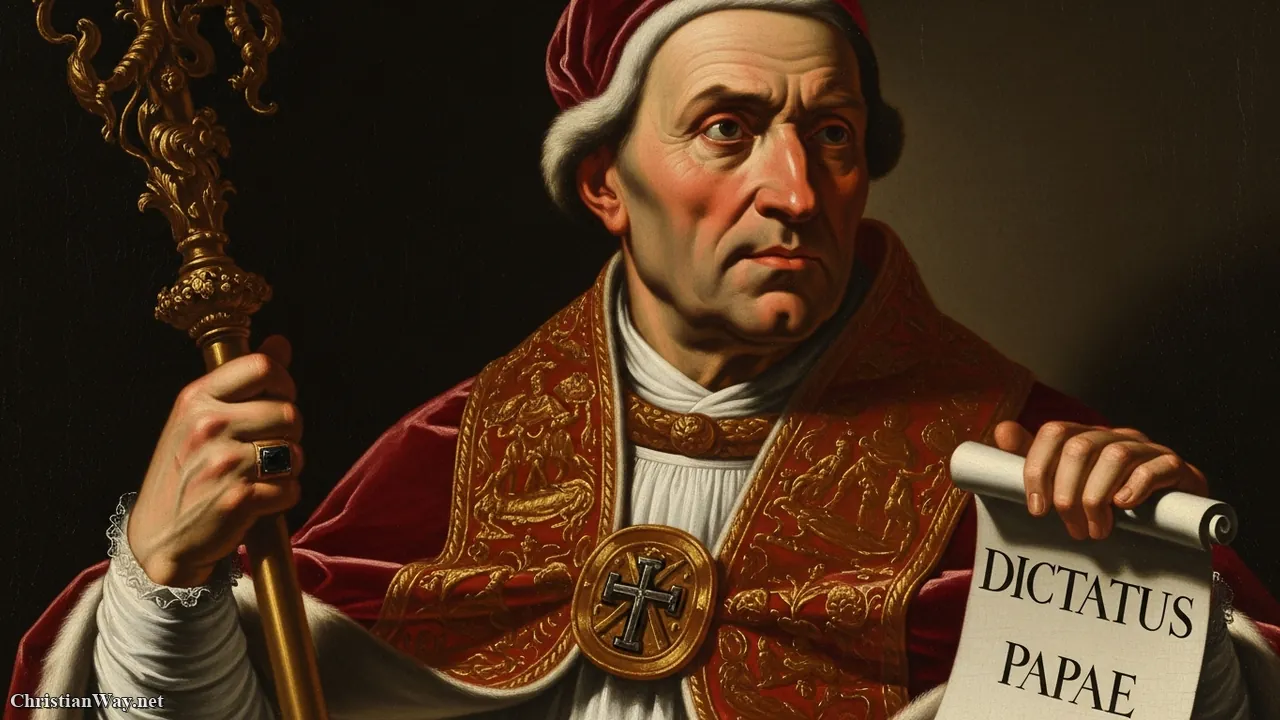
A document preserved in the papal register of 1075, commonly known as the Dictatus Papae, is associated with Gregory’s reforming vision. Its propositions express a bold understanding of the Church’s authority and freedom in the face of secular interference. Its exact historical interpretation has been debated, and Christians may assess its later implications differently, but its central concern is clear: the things that belong to God cannot finally be placed under the ownership of temporal rulers.
We must be careful here. Christian freedom does not mean contempt for civil society, nor does it mean that believers are called to withdraw from public responsibility. Scripture teaches us to pray for rulers and to seek the good of the places where we live (1 Timothy 2:1–2; Jeremiah 29:7). The Church has always needed wise cooperation between spiritual and civil communities. But cooperation is not captivity. When the state, wealth, popularity, or ideology tries to command the conscience in matters that belong to God, the Christian must remember the apostolic confession: “We must obey God rather than men” (Acts 5:29).
The Justice of a Clean Heart
Gregory’s justice was not perfect in the manner of Christ, for no saint is Christ. Saints are not given to us as flawless idols; they are given as witnesses to the grace of God working through human weakness. Their courage can inspire us even as history reminds us that every human exercise of authority requires humility, discernment, and constant conversion. The Church does not need admirers of power. She needs servants who tremble before the holiness of the Lord.
This is why the prayer of Psalm 51 belongs so deeply to the spirit of reform: “Create in me a clean heart, O God, and renew a right spirit within me.” We may ask for justice in the world, in our nation, in our workplace, in our parish, and in our family. Yet we must also allow the prayer to become personal. Create in me a clean heart. Remove from me the desire to dominate. Free me from the pleasure of being right without being loving. Teach me to speak truth without cruelty and to show mercy without surrendering truth.
A clean heart is not a weak heart. It is a heart undivided. It can say no when no is necessary. It can resist pressure. It can bear misunderstanding. It can forgive without pretending that evil is good. It can protect those entrusted to its care. In this sense, the justice of Saint Gregory VII reaches far beyond medieval debates. It becomes a summons to every Christian who longs to live with integrity in a complicated world.
The Freedom of Holy Church
One of the great phrases associated with Gregory’s age is libertas ecclesiae—the freedom of the Church. This freedom was not a claim that Christians should escape the demands of love, nor a desire for the Church to become a worldly empire. At its best, it meant that the Church must be free to worship God, proclaim the Gospel, appoint those called to pastoral care, and correct sin without being turned into an instrument of rulers or factions.
Why does this matter so much? Because the Church is not created by the state, by a political party, by a cultural trend, or by the preferences of powerful people. Jesus says to Peter, “You are Peter, and on this rock I will build my church, and the gates of hell shall not prevail against it” (Matthew 16:18). The Church belongs to Christ. Her ministers are accountable to Him. Her mission is to announce His kingdom, to celebrate His mercy, and to gather a people who belong to no earthly master in an ultimate sense.
This truth must be received with both gratitude and fear. Gratitude, because it means that the Church’s deepest life does not depend upon the approval of the world. Fear, because no Christian leader may claim ownership over what belongs to Christ. A parish is not a personal kingdom. A ministry is not a brand. A Christian community is not a platform for ambition. The moment we forget this, we begin again to repeat the old temptation against which Gregory labored.
For Catholic Christians, Gregory’s witness is closely bound to the ministry of the Bishop of Rome and the responsibility of the successor of Peter to guard communion and uphold the freedom of the Church’s mission. Orthodox and Protestant brothers and sisters approach the historical development and exercise of papal authority differently, and those differences should not be brushed aside. Yet Christians across traditions can recognize the spiritual danger Gregory confronted: the danger that the Gospel will be reshaped by whatever earthly power seeks to use it. The call to keep Christ—not wealth, not nationalism, not ideology, not personal status—at the center of the Church is a call that belongs to us all.
Canossa, Exile, and the Cost of Conscience
Gregory’s conflict with Emperor Henry IV became one of the most famous episodes in medieval Christian history. When Henry continued to involve himself in the appointment of bishops, Gregory acted with dramatic spiritual and political consequences. The conflict led to Henry’s excommunication and, in 1077, to the emperor’s journey to Canossa, where he sought reconciliation with the pope. The episode has often been reduced to an image of humiliation or victory, but its deeper meaning is more sober: conscience, authority, repentance, and power had become painfully entangled before the eyes of Christendom.
We should resist the temptation to turn Canossa into a simple story of one man defeating another. There was no easy triumph in Gregory’s life. The conflict continued. Alliances shifted. Rome itself became unsafe for him. He would eventually be driven from the city and die in exile at Salerno in 1085. A Vatican historical text recalls the traditional words linked to his death: “I have loved righteousness and hated iniquity; therefore I die in exile,” an adaptation of the psalmist’s words.
There is a special kind of loneliness known to those who choose conscience over convenience. It is the loneliness of the employee who refuses to falsify a report. It is the loneliness of the teenager who will not join cruelty simply to belong. It is the loneliness of the parent who sets a difficult boundary because love requires it. It is the loneliness of the pastor who speaks a needed truth and discovers that people would have preferred silence. Gregory knew this loneliness. He teaches us that faithfulness may not bring immediate vindication. Sometimes it brings misunderstanding, loss, and exile of the heart.
But exile is not the end of the Christian story. Jesus Himself was rejected outside the city. He suffered “outside the gate in order to sanctify the people through his own blood” (Hebrews 13:12). The Christian does not seek suffering as though pain were holy in itself. We seek Christ, and we trust that when faithfulness costs us, He is already present in the cost. Gregory’s last witness was not that justice always wins quickly in history. It was that justice remains worthy of love even when it leads through darkness.
Reform Begins Where No One Applauds
The most important lesson of Saint Gregory VII is not that every Christian must confront an emperor. It is that every Christian must let the Lord reform the inner life. We may speak passionately about what is wrong in the Church, the culture, the nation, or the family. Yet Christ asks each of us to begin at the place where we have real responsibility: our speech, our habits, our hidden choices, our use of money, our willingness to forgive, our integrity when no one is watching.
Pope Benedict XVI, reflecting on the reforming saints of Gregory’s era, emphasized that authentic reform must be spiritual and moral, born within the conscience. That insight is remarkably simple and eternally necessary. A reform that changes language but not hearts will not last. A reform that rearranges roles but does not lead people to prayer will become another form of restlessness. A reform that speaks of justice but refuses humility will eventually become harsh. The renewal God desires is not a performance. It is conversion.
For some of us, the beginning of reform may be very quiet. It may be an overdue apology. It may be the decision to stop speaking about another person with contempt. It may be a return to Sunday worship after months of drifting. It may be the courage to seek help for a hidden sin or destructive habit. It may be the choice to give time to prayer before giving time to criticism. These acts may seem small beside the drama of history, yet heaven rejoices over a single sinner who repents.
Think of the home as a small church, a place where the freedom of Christ should be protected. When parents pray together, when spouses repent quickly, when children are taught that truth and mercy belong together, when resentment is refused a permanent room in the house, the reform of the Church has begun there. Think of the workplace as a field of witness. When a Christian is fair in payment, honest in speech, diligent in duty, and gentle toward those who cannot advance his interests, justice is being lived. Think of the hidden room of prayer. When a weary heart says, “Lord, create in me a clean heart,” the Holy Spirit is already making all things new.
The Courage to Defend What Is Holy
Some people hear words such as reform, discipline, and justice and fear that Christianity will become severe, joyless, and impatient. That fear is understandable, especially when authority has been misused. But true holiness is never opposed to tenderness. The holiness Gregory defended was the holiness of a Church meant to offer the world the mercy of Christ. It was meant to protect the poor from exploitation, the faithful from deception, the sacred ministry from corruption, and the freedom of conscience from the demands of the powerful.
Jesus was tender with sinners, but He was never casual about sin. He forgave the woman caught in adultery, and He also said, “Go, and from now on sin no more” (John 8:11). He welcomed children, touched lepers, wept at Lazarus’s tomb, and gave Himself for His enemies. Yet He also cleansed the temple when worship was being corrupted by greed. Love is not the refusal to confront evil. Love is the refusal to let evil have the final word.
This is a difficult balance for every Christian. We need to be gentle enough to hear the wounded and courageous enough to name the wound. We need to defend truth without losing compassion. We need to expose corruption without feeding on outrage. We need to resist manipulation without becoming manipulative ourselves. Saint Gregory VII does not give us a simple formula for these tasks, but he does give us a holy urgency: what belongs to God must be treated as holy.
In our present age, this urgency is especially needed. Many hearts are exhausted by scandal, division, and endless public argument. Some have been hurt by the very people who should have reflected Christ’s care. To those who carry such wounds, the Church must never offer empty phrases. She must listen, repent where she has failed, seek justice, and make protection of the vulnerable a real and visible priority. Gregory’s reforming zeal can only be faithful today when it strengthens this work of truth and healing, never when it is used to silence those who have suffered.
A Saint for a Divided and Weary Age
Saint Gregory VII belongs to the eleventh century, yet his questions are ours. Who has the right to shape the conscience? Can the Church remain faithful when the world rewards compromise? What should a Christian do when leadership becomes entangled with self-interest? How do we seek justice without losing mercy? How can we love the Church honestly, neither idealizing her human failures nor abandoning her because of them?
The first answer is to look again at Christ. He alone is the perfect Shepherd. He alone is the King whose authority is pure service. He alone can cleanse the temple of the heart without destroying the broken person who comes to Him. Gregory’s life is valuable precisely because it directs us beyond Gregory. The saint does not ask us to build our faith on his personality or his political victories. He asks us, through his witness, to belong more completely to the Lord.
The second answer is to remain close to the ordinary means of grace. Pray the Psalms. Read the Gospels slowly. Receive the sacraments with reverence. Worship faithfully with the community of believers. Seek reconciliation when sin has made the heart heavy. Serve someone who cannot repay you. Give thanks before you criticize. These are not small things. They are the daily ways in which God keeps His people free.
The third answer is to live with hope. The Church has passed through storms before. She will pass through storms again. Her outward strength may seem great in one century and fragile in another, but her life is hidden with Christ in God. The gates of hell do not prevail because Christians are always wise or because leaders are always strong. They do not prevail because Jesus Christ is risen, faithful, and present with His people until the end of the age.
In the Light of Christ
Dear friends, Saint Gregory VII invites us to love justice, but to love it as disciples of Jesus. He invites us to resist corruption, but first to let God uncover the corruption within us. He invites us to honor the freedom of the Church, but to remember that this freedom exists for worship, for truth, for mercy, for the proclamation of the Gospel, and for the salvation of souls. He invites us to understand that no earthly power, no personal ambition, and no fear of rejection may take the place that belongs to Christ alone.
When you feel discouraged by the weakness of the Church’s human members, do not turn your eyes away from the Lord who remains faithful. When you are tempted to speak harshly, ask for a clean heart. When you are pressured to compromise what is right, ask for courage. When you see something holy treated carelessly, defend it with humility and love. And when your own path of faithfulness feels lonely, remember the saint who died far from Rome yet close to the justice of God.
Let us pray:
Lord Jesus Christ, You are the true Shepherd and the holy Head of Your Church. Purify us from every love that competes with You. Give us the courage of Saint Gregory VII to honor what is sacred, the humility to repent where we have failed, and the tenderness to serve Your people with mercy. Keep Your Church free for the work of Your Gospel, and make our hearts places where Your justice and peace may dwell. Amen.
May the peace of Christ guard your conscience, strengthen your courage, and lead you ever more deeply into the freedom of His holy love.
— Fr. John Matthew