A pastoral reflection on Anglican and Orthodox faith, their shared inheritance, and the convictions that still divide them.
Dear friends in Christ,
When Christians encounter traditions different from their own, the first temptation is often to ask which side is right and which side is wrong. Yet a more faithful beginning is to ask another question: Where is Christ already present, confessed, worshiped, and loved? This question does not erase serious theological differences, nor does it suggest that all Christian traditions are interchangeable. It simply teaches us to approach one another with humility, remembering that truth is not served by caricature and that Christian unity cannot be built upon contempt.
The relationship between Anglicanism and Eastern Orthodoxy is especially fascinating because the two traditions can appear both remarkably close and unmistakably different. Both value ancient liturgy, episcopal leadership, the historic creeds, sacramental worship, and the continuity of the Church through the centuries. Both resist the idea that Christianity can be reduced to private belief or spontaneous religious feeling. Both understand worship as something received from the Church rather than invented by each generation.
Yet beneath these shared features are significant differences concerning the nature of the Church, the authority of tradition, the interpretation of doctrine, the sacraments, the procession of the Holy Spirit, the ordination of clergy, and the boundaries of legitimate theological diversity.
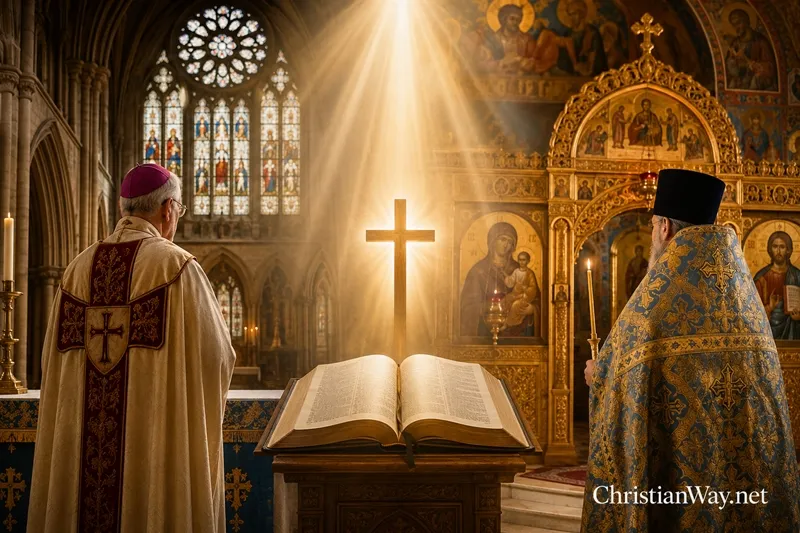
To understand Anglicanism vs Eastern Orthodoxy, we must therefore do more than compare ceremonies or list doctrines. We must listen to the spiritual instincts of each tradition. We must ask how each understands the apostolic faith, how each preserves the memory of the early Church, and how each believes Christians should remain faithful to the Gospel in a changing world.
This is not merely an academic comparison. It touches the deeper longing expressed in the prayer of Jesus: “That they all may be one” (John 17:21). The differences are real, but so too is the shared confession of the crucified and risen Lord. By considering both honestly, we may learn not only about Anglicanism and Eastern Orthodoxy, but also about the patience, humility, and truthfulness required on the path toward Christian unity.
A Brief Comparison of Anglicanism and Eastern Orthodoxy
| Area | Anglicanism | Eastern Orthodoxy |
|---|---|---|
| Historical formation | Developed from the English Reformation while retaining many Catholic structures | Sees itself as the continuous apostolic Church of the Christian East |
| Authority | Scripture as supreme, interpreted with tradition, reason, and the Church’s worship | Scripture within Holy Tradition, interpreted through the Church and the Ecumenical Councils |
| Church structure | Communion of autonomous provinces united historically around Canterbury | Communion of autocephalous churches united in doctrine, sacraments, and episcopal fellowship |
| Ecumenical councils | Early councils highly honored, but their authority is received differently across Anglican traditions | The first seven Ecumenical Councils are authoritative expressions of the apostolic faith |
| Sacraments | Baptism and Eucharist are the two dominical sacraments; other sacramental rites are also practiced | The whole life of the Church is sacramental; seven Holy Mysteries are commonly identified |
| Eucharist | Belief ranges from spiritual real presence to strongly Catholic interpretations | The bread and wine truly become the Body and Blood of Christ as a sacred mystery |
| Salvation | Strong emphasis on grace, justification, sanctification, and union with Christ | Strong emphasis on healing, participation in divine life, and theosis |
| Saints and icons | Honored differently across Anglican traditions | Central to worship and spirituality, with formal veneration of icons and saints |
| Clergy | Bishops, priests, and deacons; practices differ among provinces | Bishops, priests, and deacons within an ancient and highly regulated canonical tradition |
| Doctrinal diversity | Considerable diversity exists within one communion | Greater emphasis on visible doctrinal and liturgical uniformity |
Their Shared Roots in the Ancient Church
Before considering their differences, it is important to recognize that Anglicanism and Eastern Orthodoxy share a deep inheritance. Neither tradition believes that Christianity began in the modern era. Both look back to the apostles, the early bishops, the martyrs, the creeds, and the great theological struggles through which the Church defended the truth about Christ.
The Faith of the Apostles and the Early Creeds
Both Anglicans and Eastern Orthodox Christians confess faith in the Holy Trinity: one God in three Persons, Father, Son, and Holy Spirit. Both proclaim Jesus Christ as fully divine and fully human. Both confess His incarnation, crucifixion, bodily resurrection, ascension, and coming again in glory.
The Nicene Creed occupies an important place in both traditions. When Anglicans and Orthodox Christians recite the Creed, they confess many of the same foundational truths:
God is the Creator of heaven and earth. Jesus Christ is the eternal Son of God. He became incarnate for our salvation. He was crucified, rose from the dead, and will judge the living and the dead. The Holy Spirit is the Lord and giver of life. The Church is one, holy, catholic, and apostolic. Baptism is for the forgiveness of sins, and the faithful await the resurrection of the dead and the life of the world to come.
These are not small areas of agreement. They are the heart of historic Christianity.
Both traditions also receive the Christological teaching associated with the Council of Chalcedon in 451: Jesus Christ is one Person in two natures, divine and human, without confusion, change, division, or separation. The child born of the Virgin Mary is not a human person later joined to God. He is the eternal Word of God who truly assumed our humanity.
This shared confession means that Anglicans and Orthodox Christians worship the same Lord Jesus Christ and proclaim the same central mystery of salvation.
Bishops, Priests, and Deacons
Both traditions preserve the threefold ministry of bishops, priests, and deacons. They understand ordained ministry not merely as a practical arrangement but as part of the Church’s historical and sacramental life.
The bishop is a shepherd, teacher, guardian of doctrine, and focus of visible unity. Priests serve in communion with their bishop, preaching the Word, celebrating the sacraments, and caring for the faithful. Deacons assist in worship and serve the needs of the Church and the world.
Anglicanism retained the historic episcopate through the upheavals of the Reformation. Eastern Orthodoxy likewise understands episcopal succession as essential to the visible continuity of the Church.
This shared episcopal structure distinguishes both traditions from forms of Christianity governed primarily through independent congregations or non-episcopal assemblies.
Yet the existence of bishops in both churches does not by itself resolve the question of mutual recognition. Eastern Orthodox churches have not generally accepted Anglican ordinations as fully equivalent to Orthodox ordinations. The issue involves not only the historical succession of bishops but also doctrine, sacramental intention, ecclesial communion, and the meaning of apostolic continuity.
Still, the shared commitment to episcopal Christianity has provided an important foundation for dialogue.
Liturgical and Sacramental Worship
Anglican and Orthodox worship are both shaped by the conviction that the Church does not gather merely to hear a lecture or express religious emotion. The Church gathers to enter the mystery of Christ through Scripture, prayer, sacrament, praise, repentance, and thanksgiving.
In both traditions, the Eucharist stands at the heart of Christian worship. The congregation hears the Word of God, confesses the faith, offers prayer, gives thanks, and receives Holy Communion.
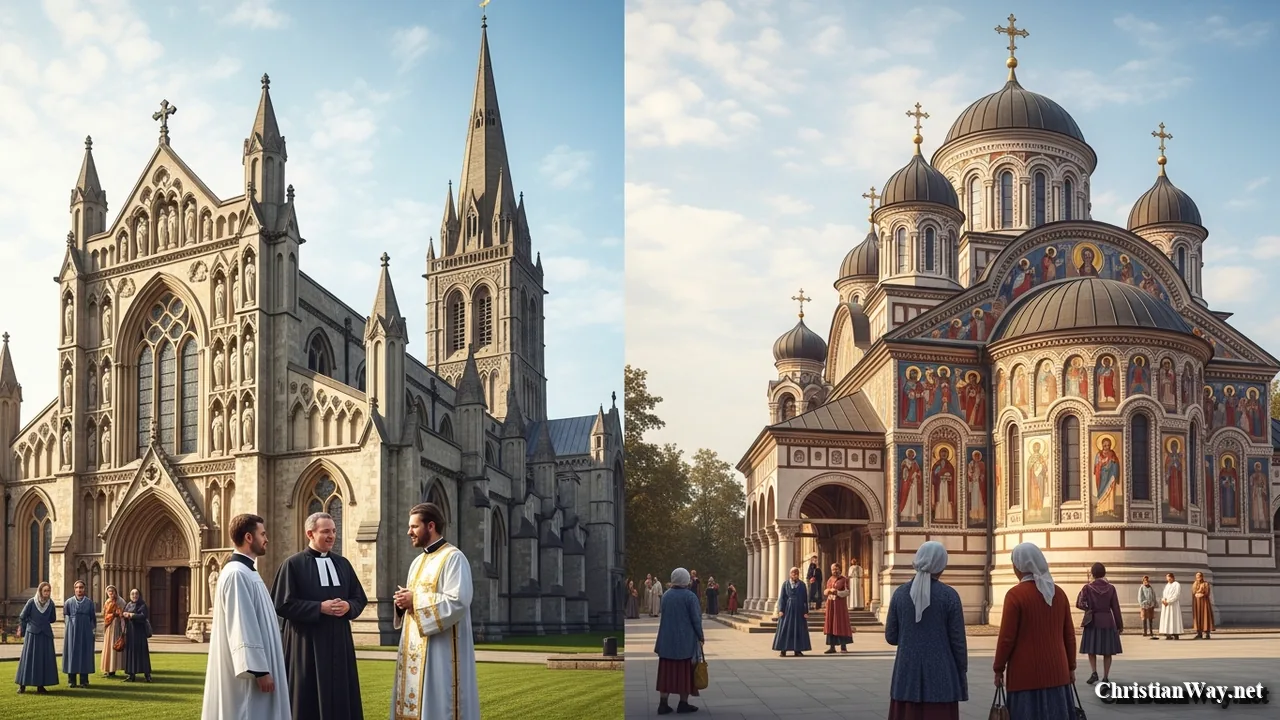
Both traditions also follow the Christian calendar. They celebrate seasons such as Advent, Christmas, Lent, Holy Week, Easter, and Pentecost, although the details and dates may differ. Both remember the saints and martyrs, proclaim the saving events of Christ’s life, and allow sacred time to shape the spiritual lives of the faithful.
Anglican liturgy has historically been formed by the Book of Common Prayer and its descendants. Orthodox worship is shaped above all by the Divine Liturgies associated with Saint John Chrysostom and Saint Basil the Great, together with the daily offices, sacramental services, and cycles of feasts and fasts.
The outward forms differ considerably, but the underlying instinct is shared: worship belongs to the whole Church and connects the local congregation with Christians across generations.
Different Historical Paths
The clearest way to understand the differences between Anglicanism and Eastern Orthodoxy is to recognize that they emerged through very different historical experiences.
Eastern Orthodoxy and the Christian East
Eastern Orthodoxy understands itself not as a denomination founded by a particular reformer but as the continuation of the ancient Church in the Christian East.
Its historical centers included Jerusalem, Antioch, Alexandria, Constantinople, and later the Slavic churches and other national or regional churches. Its theology developed through the Greek-speaking Fathers, the monastic tradition, the Ecumenical Councils, and centuries of liturgical life.
The division between Eastern and Western Christianity developed gradually. Cultural differences, political tensions, questions of papal authority, liturgical customs, and theological disputes accumulated over time. The rupture conventionally associated with the year 1054 was not a single moment in which two neatly organized institutions suddenly separated. It was part of a much longer process of estrangement.
The sack of Constantinople by Western crusaders in 1204 deepened the wound profoundly. For many Orthodox Christians, this event became a painful symbol of betrayal by fellow Christians.
Eastern Orthodoxy therefore developed outside the later theological and institutional developments of the medieval Latin West. It did not experience the Protestant Reformation as an internal movement in the same way Western Europe did. Its theological language remained strongly shaped by the Greek Fathers, the liturgy, monastic spirituality, and the vision of salvation as participation in the divine life.
Anglicanism and the English Reformation
Anglicanism emerged from the English Reformation of the sixteenth century. Its origins cannot be reduced either to the marital and political decisions of King Henry VIII or to a purely theological reform movement. Political, personal, ecclesiastical, and doctrinal forces all played a role.
The Church of England broke from papal jurisdiction under Henry VIII, but many traditional beliefs and practices initially remained. Under Edward VI, Protestant reforms moved much further. Under Mary I, communion with Rome was restored. Under Elizabeth I, a settlement emerged that attempted to establish a reformed national church while retaining bishops, liturgical worship, and significant elements of the ancient catholic inheritance.
The Book of Common Prayer gave English-speaking Christianity a distinctive spiritual and liturgical voice. The Thirty-Nine Articles expressed a Reformation understanding of Scripture, grace, justification, the sacraments, and the Church, while rejecting several doctrines and practices associated with medieval Roman Catholicism.
Over time, Anglicanism developed into a broad tradition containing evangelical, Reformed, catholic, charismatic, and liberal expressions. This breadth has sometimes been regarded as a gift, allowing Christians of different theological emphases to remain in communion. At other times, it has created deep tensions regarding doctrine, worship, and moral teaching.
Eastern Orthodoxy has generally regarded this Anglican comprehensiveness with caution. Orthodoxy values theological depth and legitimate differences in expression, but it does not believe that contradictory teachings can indefinitely coexist as equally valid interpretations of the apostolic faith.
Scripture, Tradition, and Authority
One of the most important differences in any discussion of Anglicanism vs Eastern Orthodoxy concerns authority.
Both traditions honor Scripture. Both read the Bible in worship. Both believe that the Scriptures bear inspired witness to God’s saving work. The disagreement is not about whether the Bible matters, but about how Scripture relates to the living authority and tradition of the Church.
The Anglican Understanding of Authority
Classical Anglicanism teaches that Holy Scripture contains all things necessary to salvation. No doctrine should be required as an article of faith if it cannot be established from Scripture.
This principle reflects the Reformation concern that the Church must remain accountable to the Word of God. Tradition, church leadership, and theological reasoning are valuable, but they cannot establish teachings contrary to Scripture.
Anglicans often speak of Scripture, tradition, and reason. This does not necessarily mean that the three possess equal authority. In classical Anglican thought, Scripture holds a unique and primary place. Tradition bears witness to how the Church has interpreted Scripture, while reason helps believers understand and apply revealed truth faithfully.
In practice, however, Anglican provinces and theological movements differ considerably in how they balance these authorities. Evangelical Anglicans tend to emphasize biblical authority strongly. Anglo-Catholic Anglicans often place greater weight on the early Church, sacramental tradition, and the historic episcopate. More liberal Anglicans may emphasize historical criticism, human experience, and the development of doctrine.
This variety is one of Anglicanism’s most recognizable characteristics.
The Orthodox Understanding of Holy Tradition
Eastern Orthodoxy does not place Scripture and Tradition in opposition. Scripture is understood as the inspired heart of Holy Tradition.
The Bible was received, preserved, proclaimed, and interpreted within the worshiping community of the Church. The same Holy Spirit who inspired the biblical authors guides the Church into truth. Therefore, Scripture cannot be separated from the apostolic faith, the Ecumenical Councils, the liturgy, the writings of the Fathers, the lives of the saints, and the spiritual experience of the Church.
Holy Tradition is not simply a collection of old customs. Nor does it mean that every historical practice is unchangeable. It is the living transmission of the apostolic faith in the life of the Church.
Orthodox Christians therefore read Scripture ecclesially. The interpretation of the Bible must remain consistent with the rule of faith confessed by the Church through the centuries.
From an Orthodox perspective, Anglicanism’s internal diversity raises a serious question: Who has the final authority to determine whether a new interpretation is faithful to the apostolic tradition? Anglicanism answers this differently in different provinces, while Orthodoxy looks to the common mind of the Church expressed through councils, bishops, liturgy, and continuous tradition.
The Nature and Unity of the Church
Both Anglicans and Orthodox Christians confess belief in “one, holy, catholic, and apostolic Church.” Yet they do not always mean the same thing when they describe the visible identity of that Church.
The Anglican Communion
The Anglican Communion is a worldwide family of autonomous churches historically connected with the Church of England and the See of Canterbury.
The Archbishop of Canterbury is regarded as a focus of unity, but he does not exercise universal jurisdiction over Anglican provinces. Each province governs itself through its own bishops, synods, and canonical structures.
Anglican identity has often been described through shared worship, the historic episcopate, the creeds, the sacraments, and communion with Canterbury. Yet there is no single worldwide Anglican authority capable of imposing doctrine or discipline upon every province.
Some Anglo-Catholics have embraced a form of “branch theory,” according to which the one Catholic Church continues in several historic branches, especially Roman Catholicism, Eastern Orthodoxy, and Anglicanism. This theory allows Anglicanism to see itself as both reformed and catholic.
Not all Anglicans accept this view, and Eastern Orthodoxy generally does not accept it. Orthodoxy does not understand the Church as a tree divided into institutionally separated but equally complete branches.
The Orthodox Communion
Eastern Orthodoxy consists of self-governing, or autocephalous, churches. These include ancient patriarchates and national or regional churches.
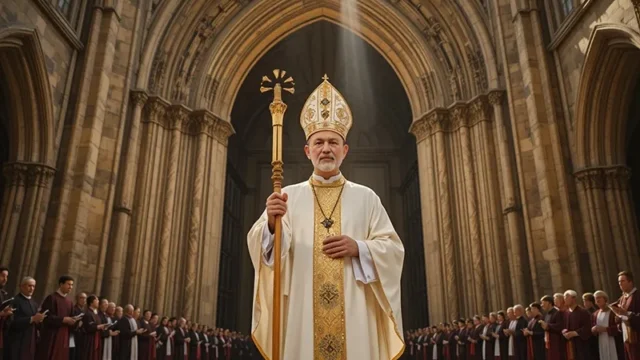
The Ecumenical Patriarch of Constantinople is traditionally honored as first among equals among Orthodox bishops. He possesses a primacy of honor and certain coordinating responsibilities, but he is not an Orthodox pope and does not govern all Orthodox churches through universal ordinary jurisdiction.
Orthodox unity is expressed through a common faith, common sacraments, apostolic succession, canonical communion, and shared liturgical tradition. Each local church is fully the Church when gathered around its bishop in the Eucharist, yet no local church exists independently from the universal communion of Orthodoxy.
Orthodoxy understands itself as the visible continuation of the one apostolic Church. This claim is not intended merely as institutional pride. It reflects the conviction that the fullness of Christian truth and sacramental life has been preserved within Orthodox communion.
For this reason, Orthodoxy cannot simply recognize Anglicanism as another equally complete form of the same visible Church while serious doctrinal and sacramental differences remain.
The Filioque and the Holy Spirit
One of the oldest doctrinal differences between Eastern and Western Christianity concerns the phrase known as the Filioque, meaning “and the Son.”
The original Greek form of the Nicene-Constantinopolitan Creed confessed that the Holy Spirit proceeds from the Father. In the Latin West, the phrase “and the Son” was gradually added, so that the Creed declared that the Spirit proceeds from the Father and the Son.
Anglicanism inherited the Western form of the Creed and traditionally included the Filioque. Eastern Orthodoxy rejects the unilateral addition of the phrase to an ecumenical creed and also raises theological concerns about the language itself.
Orthodox theology insists that the Father is the single source, cause, or principle within the Trinity. The Son is eternally begotten of the Father, and the Holy Spirit eternally proceeds from the Father. The Spirit is sent into the world through the Son and eternally rests upon the Son, but the Father remains the one personal source of both the Son and the Spirit.
Western theology generally intends the Filioque to protect the intimate communion of the Son and the Spirit, not to teach that the Spirit has two separate sources. Careful theological dialogue has shown that some historical disagreements may have been intensified by differences in language and conceptual framework.
Nevertheless, the issue remains important because it concerns both Trinitarian theology and the authority to alter the wording of a creed received by the universal Church.
Some Anglican liturgical texts have returned to the original form of the Creed without the Filioque, especially in ecumenical contexts. This has been welcomed by Orthodox Christians, but it does not by itself resolve the broader question of doctrinal authority.
Salvation: Justification and Theosis
Both traditions proclaim that salvation is the work of God’s grace. Neither teaches that human beings can save themselves through moral achievement. Both affirm that Christ conquered sin and death through His incarnation, cross, and resurrection.
Yet they often describe salvation with different theological emphases.
The Anglican Emphasis on Grace and Justification
The Anglican Reformation placed strong emphasis on justification by faith. Human beings are sinners who cannot make themselves righteous before God. We are justified because of the saving work of Christ, received through faith.
This teaching was intended to comfort troubled consciences. Salvation is not purchased through human merit. It is the gift of God.
Classical Anglicanism does not teach that good works are unnecessary. Good works are the fruit of living faith and the work of grace within the believer. The Christian is called not only to be forgiven but also to be sanctified, renewed, and made holy.
Within Anglican spirituality, salvation may be described through several biblical images: forgiveness, adoption, reconciliation, new birth, sanctification, participation in Christ, and growth in holiness.
Anglo-Catholic Anglicanism has often drawn more explicitly upon the language of sacramental transformation and union with God, while evangelical Anglicanism tends to emphasize conversion, justification, and biblical discipleship.
The Orthodox Vision of Theosis
Eastern Orthodoxy often describes salvation as healing and deification, or theosis. This does not mean that human beings become divine by nature or cease to be creatures. It means that, by grace, they participate in the life of God.
Saint Peter writes that believers become “partakers of the divine nature” (2 Peter 1:4). The eternal Son became truly human so that humanity might be healed, restored, and brought into communion with God.
Sin is understood not only as guilt but also as sickness, corruption, bondage, and alienation. Christ comes as physician, liberator, and conqueror of death.
Theosis includes forgiveness, but it extends toward the transformation of the entire person. Through baptism, Eucharist, prayer, repentance, love, and the work of the Holy Spirit, the believer is gradually conformed to the image of Christ.
Orthodoxy sometimes speaks of cooperation, or synergy, between divine grace and human freedom. This does not mean that salvation is partly accomplished by God and partly earned by human effort. Grace always comes first. Yet grace does not destroy human freedom. God heals the will so that the person may freely respond in faith, repentance, and love.
The Anglican and Orthodox accounts are not entirely opposed. Anglican theologians also speak of union with Christ and sanctification, while Orthodox theology affirms forgiveness and the necessity of faith. The difference lies partly in emphasis, theological vocabulary, and the larger framework through which salvation is understood.
Original Sin and Ancestral Sin
The Western Christian tradition often speaks of original sin, while Eastern Orthodoxy commonly uses the term ancestral sin.
Anglicanism, following the Western tradition, teaches that humanity is deeply wounded by the fall. Human beings are not born morally neutral. Our desires, reason, and will are disordered, and we are unable to turn to God without grace.
Eastern Orthodoxy likewise teaches that the fall has affected the entire human race. We inherit mortality, corruption, and an environment shaped by sin. No one escapes the brokenness of Adam’s world.
Orthodoxy is generally cautious, however, about language suggesting that each person inherits Adam’s personal guilt in a strictly legal sense. We inherit the consequences and corruption of the fall, and we inevitably participate in sin, but Adam’s personal act remains his own.
This difference reflects broader tendencies. Western theology has often used legal categories such as guilt, justification, and satisfaction. Eastern theology has more often emphasized illness, corruption, healing, and victory over death.
Both sets of images are found in Scripture. The danger arises when one is used to exclude all others. Sin is guilt, but it is also sickness. Salvation is acquittal, but it is also healing. Christ is judge and advocate, but He is also physician and conqueror.
The Sacraments and Holy Mysteries
Sacramental life stands near the center of both traditions, yet Anglicanism and Eastern Orthodoxy describe the sacraments differently.
Anglican Sacramental Teaching
Classical Anglican formularies identify Baptism and the Lord’s Supper as the two great sacraments ordained by Christ in the Gospel.
Other rites—including confirmation, confession, ordination, marriage, and anointing of the sick—are also practiced and may be described as sacramental. Anglo-Catholic Anglicans commonly speak of seven sacraments, while other Anglicans maintain a stronger distinction between the two dominical sacraments and the five other rites.
This difference within Anglicanism illustrates its theological breadth.
Baptism is understood as incorporation into Christ and His Church. The Eucharist is a means of grace in which believers truly participate in Christ, although Anglican explanations of Christ’s presence vary.
Orthodox Holy Mysteries
Eastern Orthodoxy commonly identifies seven Holy Mysteries: Baptism, Chrismation, Eucharist, Confession, Marriage, Ordination, and Anointing of the Sick.
Yet Orthodoxy does not normally restrict sacramental reality to a precise number. The whole life of the Church is sacramental because creation itself can become a means of communion with God.
Water, oil, bread, wine, touch, words, gestures, incense, and human relationships may all be taken into the life of grace. The material world is not an obstacle to salvation. It is capable of being sanctified because the Word truly became flesh.
Orthodox initiation ordinarily unites Baptism, Chrismation, and Eucharist. Infants are baptized, immediately chrismated, and admitted to Holy Communion. Anglican practice varies, with confirmation often occurring later and admission to Communion governed differently among provinces and parishes.
The Eucharist and the Presence of Christ
Both traditions take the Eucharist seriously, but the range of Anglican belief is wider than the Orthodox position.
Eastern Orthodoxy teaches that the bread and wine truly become the Body and Blood of Christ. This transformation is real, sacred, and mysterious. Orthodoxy does not normally attempt to define the mystery through one mandatory philosophical explanation.
The Divine Liturgy invokes the Holy Spirit upon the gifts and the worshiping people. The Eucharist is sacrifice, thanksgiving, communion, remembrance, and participation in the heavenly banquet.
Anglicanism also rejects the idea that the Eucharist is merely an empty memorial in many of its classical and catholic expressions. The faithful truly receive Christ. Yet Anglicans have differed over how His presence should be understood.
Some emphasize a real spiritual presence received by faith. Anglo-Catholics may speak of an objective sacramental presence in language close to Roman Catholic or Orthodox belief. Others interpret the Eucharist more symbolically, though usually within a rich biblical understanding of remembrance and covenant.
The Thirty-Nine Articles reject transubstantiation as it was understood in the Reformation controversies, yet they affirm that the Body of Christ is received in the Supper in a heavenly and spiritual manner.
For Orthodoxy, the breadth of Anglican Eucharistic interpretation creates difficulty. Eucharistic communion expresses full unity in faith. It cannot normally precede agreement regarding what the Eucharist is and what the Church believes.
Mary, the Saints, and Sacred Images
Both Anglicans and Orthodox Christians honor the Virgin Mary, but the extent and form of that honor differ greatly.
Mary in Eastern Orthodoxy
Orthodoxy calls Mary the Theotokos, the God-bearer or Mother of God. This title protects the truth about Christ: the one born of Mary is truly God incarnate.
Mary is praised as the foremost among the saints, the new Eve, the obedient servant of the Lord, and the living temple who bore the eternal Word.
Orthodox worship frequently asks for the prayers of Mary and the saints. This is not understood as worshiping them. Worship belongs to God alone. Veneration is offered to the saints because the grace of God has been revealed in their lives.
The saints are alive in Christ. The Church on earth and the Church in heaven are not two separate bodies but one communion.
Icons also occupy a central place in Orthodox life. They are not merely religious decoration. They bear witness to the incarnation. Because the Son of God truly became visible in human flesh, He may be depicted.
Orthodox Christians venerate icons through gestures such as bowing and kissing. The honor shown to the image passes to the person represented. The wood and paint are not treated as gods.
Mary and the Saints in Anglicanism
Anglican attitudes range widely.
Evangelical Anglicans may honor Mary as the mother of Jesus and model of faithful discipleship while avoiding prayers to saints and the veneration of images. They may worry that such practices obscure the unique mediation of Christ.
Anglo-Catholic Anglicans may celebrate Marian feasts, use icons, ask for the intercession of saints, pray the rosary, and practice devotions similar to those found in Roman Catholicism.
Between these positions are many Anglicans who honor the saints as witnesses and examples without invoking them directly.
This diversity means that an Orthodox Christian may encounter one Anglican parish that feels surprisingly familiar and another that feels strongly Protestant.
Orthodoxy, by contrast, regards the veneration of icons and the communion of saints as integral to the apostolic faith rather than optional expressions of spirituality.
Worship and Spiritual Life
The spiritual beauty of both traditions is perhaps most clearly encountered in worship.
Orthodox Spirituality
Orthodox worship is deeply sensory. The faithful see icons, hear chanting, smell incense, make the sign of the cross, bow, light candles, and receive the sacrament.
The Divine Liturgy does not seek primarily to imitate ordinary speech or daily life. It draws the faithful into the worship of heaven.
Orthodox spirituality also emphasizes fasting, repentance, monastic wisdom, silence, and the prayer of the heart. The Jesus Prayer—“Lord Jesus Christ, Son of God, have mercy on me”—has formed generations of Christians.
Hesychasm, the tradition of inner stillness, teaches that the mind and heart may be gathered in attentive prayer through grace. The goal is not an altered psychological state but communion with the living God.
Anglican Spirituality
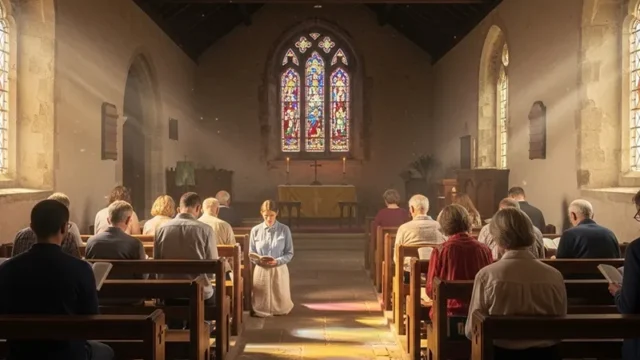
Anglican spirituality has been deeply shaped by the Book of Common Prayer. Its language of confession, thanksgiving, intercession, and praise has formed Christian hearts for centuries.
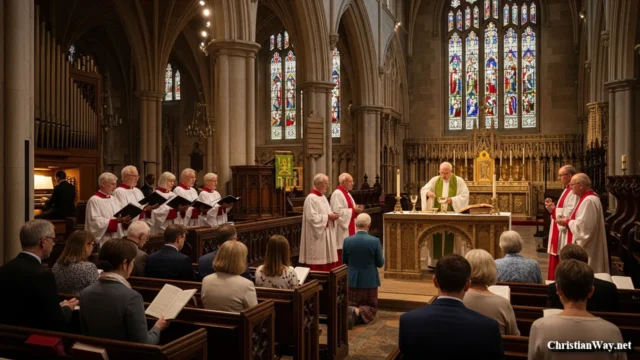
The Daily Office of Morning and Evening Prayer places the Psalms and Scripture at the center of daily devotion. Choral Evensong expresses the Anglican union of biblical prayer, sacred music, beauty, and reverence.
Anglican spirituality also has a strong pastoral and intellectual character. It values ordered prayer, careful preaching, theological reflection, and the sanctification of ordinary life.
Evangelical Anglicans emphasize personal conversion, Bible reading, mission, and preaching. Anglo-Catholic Anglicans emphasize Eucharistic devotion, confession, retreats, religious communities, and the liturgical year. Charismatic Anglicans emphasize the gifts and renewing work of the Holy Spirit.
The strength of Anglicanism is its ability to gather these expressions into one historic tradition. Its weakness is the possibility that breadth may become uncertainty about what the Church actually teaches.
Ordained Ministry and Apostolic Succession
Both traditions value apostolic succession, but they understand its requirements differently.
Anglicanism maintains that its bishops stand in historical succession from the apostles. Anglican ordinations use prayer and the laying on of hands, and ordained ministry remains central to the Church’s sacramental life.
Eastern Orthodoxy teaches that apostolic succession is not merely a chain of valid ordinations. It is succession in apostolic faith, sacramental communion, and canonical life. A bishop cannot be understood apart from the Church’s doctrine and Eucharistic fellowship.
For this reason, Orthodox churches have not generally recognized Anglican orders in a universal or definitive way. Historical discussions sometimes produced hopeful statements, particularly when Anglican doctrine appeared closer to Catholic tradition. Yet the growing diversity of Anglican teaching and practice has made agreement more difficult.
Another significant difference concerns eligibility for ordination. Eastern Orthodoxy reserves priestly and episcopal ordination to men. Married men may be ordained to the priesthood, while bishops are chosen from celibate clergy, normally monks. A priest may not marry after ordination.
Within Anglicanism, practices differ among provinces. Many Anglican churches ordain women as deacons, priests, and bishops, while some provinces or dioceses retain an all-male priesthood.
For Orthodoxy, ordained ministry belongs to the received sacramental order of the Church and cannot be altered by a local church acting independently. For Anglicans who support women’s ordination, the development is understood as a faithful recognition of baptismal equality and the gifts of the Holy Spirit.
This disagreement concerns more than church policy. It reflects different understandings of tradition, authority, sacramental symbolism, and doctrinal development.
Unity, Diversity, and Doctrinal Development
Anglicanism often seeks unity through comprehensiveness. It allows different schools of thought to coexist within a common liturgical and episcopal framework.
At its best, this can cultivate humility. Christians recognize that not every question requires separation and that the mystery of God is greater than any one theological system.
At its worst, comprehensiveness can permit contradictory teachings to remain unresolved. The result may be uncertainty among the faithful and conflict between provinces.
Eastern Orthodoxy allows diversity in customs, theological styles, local traditions, and spiritual practices. Greek, Russian, Serbian, Romanian, Arab, Georgian, African, Western-rite, and other Orthodox communities may express the same faith in distinct cultural forms.
Yet Orthodoxy places narrower boundaries around dogmatic teaching and sacramental practice. Doctrine is not understood as something each generation may revise according to cultural pressure.
At its best, this protects continuity and gives the faithful a stable spiritual home. At its worst, attachment to inherited forms may become confused with resistance to legitimate pastoral adaptation, and cultural identity may obscure the universal mission of the Church.
Both traditions therefore face spiritual temptations. Anglicans may confuse openness with doctrinal uncertainty. Orthodox Christians may confuse fidelity with immobility. Anglicans may adapt too quickly; Orthodox Christians may sometimes respond too slowly. Each tradition can learn from the strengths of the other without surrendering the truth it has received.
Can Anglicans and Orthodox Christians Receive Communion Together?
Ordinarily, they cannot.
In Eastern Orthodoxy, Eucharistic communion is the expression of full unity in doctrine, sacraments, episcopal order, and church life. It is not generally used as a means for creating unity before that agreement exists.
Because Anglicanism and Eastern Orthodoxy are not in full ecclesial communion, Orthodox Christians normally receive the Eucharist only in Orthodox churches. Anglican discipline may sometimes appear more open, but an Orthodox Christian remains bound by the discipline of the Orthodox Church.
This separation can be painful, especially for families or friends who share a sincere love for Christ. Yet the pain should not be dismissed. It reveals that Christian division is not merely administrative. It reaches the altar itself.
The proper response is neither indifference nor hostility. It is prayer, repentance, patient dialogue, and a renewed desire for the unity that Christ wills.
What Anglicans May Learn from Eastern Orthodoxy
Eastern Orthodoxy reminds Anglicanism that Christianity is more than a national tradition, a theological method, or a flexible institutional arrangement. It is participation in the life of the Triune God.
Orthodox worship witnesses to the holiness and transcendence of God. Its icons proclaim that the incarnation sanctifies matter. Its fasting teaches that the body belongs to spiritual life. Its monastic tradition reminds the Church that silence, repentance, and prayer are not optional luxuries.
Orthodoxy also challenges Anglicans to ask whether doctrinal unity can survive without a clearer shared authority. Can a communion remain visibly united when its provinces reach opposing conclusions on matters believed to touch faith and sacramental order? At what point does diversity cease to be comprehensiveness and become contradiction?
These questions should not be asked triumphantly but humbly. Orthodoxy itself experiences internal disputes and jurisdictional tensions. Yet its insistence that doctrine is received rather than continually reconstructed remains a powerful witness.
What Orthodox Christians May Learn from Anglicanism
Anglicanism reminds Orthodox Christians of the importance of making ancient faith intelligible within contemporary societies.
The best of Anglican pastoral life demonstrates that reverent liturgy can coexist with accessible language, serious preaching, intellectual engagement, social concern, and missionary flexibility.
Anglicanism has produced a rich tradition of poetry, hymnody, biblical scholarship, pastoral theology, and public Christian witness. Its daily offices have brought structured prayer into homes as well as churches. Its willingness to engage science, philosophy, literature, and culture reflects confidence that all truth belongs to God.
Anglicanism may also challenge Orthodox communities to distinguish Holy Tradition from ethnic custom. Orthodoxy is not the possession of one nation, language, or culture. It is called to proclaim the Gospel to every people.
When Orthodoxy becomes closely identified with immigrant identity or national history, newcomers may feel that they must adopt a foreign culture in order to enter the Church. Anglican experience in inculturation, vernacular worship, and local pastoral ministry may offer helpful lessons, even where the two traditions disagree doctrinally.
Shared Christian Witness in a Fragmented World
Despite their divisions, Anglicans and Orthodox Christians face many of the same spiritual challenges.
Modern people often experience loneliness, distraction, anxiety, and loss of meaning. Technology connects individuals while leaving many hearts isolated. Consumer culture teaches that human worth is measured by possession, success, attractiveness, or influence. Political loyalties frequently become more powerful than Christian fellowship.
In such a world, both traditions bear witness to truths that society desperately needs.
Human beings are created in the image of God. The body possesses sacred dignity. Marriage, family, community, prayer, and worship cannot be reduced to private preference. The poor are not problems to be managed but neighbors to be loved. Creation is not disposable property but a gift entrusted to human care.
Above all, both traditions proclaim that Jesus Christ is Lord.
He is not merely a teacher from the past. He is the risen Son of God who forgives sins, conquers death, and draws humanity into communion with the Father through the Holy Spirit.
Anglicans and Orthodox Christians can often work together in defending human dignity, serving the poor, caring for creation, supporting persecuted Christians, translating Scripture, responding to war and displacement, and offering a faithful Christian presence in public life.
Cooperation does not erase doctrinal disagreement. Rather, it allows separated Christians to obey Christ together wherever conscience and faith permit.
Is Anglicanism Closer to Orthodoxy or Protestantism?
The answer depends partly upon which form of Anglicanism one encounters.
Historically, Anglicanism is a Reformation tradition. Its classical formularies reflect Protestant convictions concerning Scripture, justification, and the rejection of certain medieval doctrines.
At the same time, Anglicanism retained bishops, liturgical worship, creeds, sacraments, cathedrals, vestments, and a strong sense of continuity with the ancient Church.
Evangelical Anglicanism may resemble other Protestant traditions in its preaching, theology, and emphasis on personal conversion. Anglo-Catholic Anglicanism may resemble Roman Catholicism or, outwardly, Eastern Orthodoxy in its liturgy and sacramental devotion.
Yet resemblance should not be confused with full theological agreement. An Anglican parish may use incense, icons, chanting, and ancient prayers while still belonging to an ecclesial structure and doctrinal tradition fundamentally different from Eastern Orthodoxy.
Anglicanism is therefore best understood as a distinct Western Christian tradition shaped by both catholic inheritance and Reformation theology. It cannot be reduced neatly either to Roman Catholicism without the pope or to Protestantism with elaborate ceremonies.
Are Anglicanism and Eastern Orthodoxy Moving Toward Unity?
Anglican-Orthodox dialogue has produced sincere friendship and significant theological discussion. The two traditions have explored questions of Scripture, tradition, the Trinity, the Church, ministry, sacraments, and Christian anthropology.
There have been moments when fuller unity appeared possible, particularly between Orthodox representatives and Anglicans committed to classical creedal and sacramental teaching.
Yet Anglican diversity has complicated the dialogue. When Anglican provinces make different decisions about doctrine, ordination, or moral teaching, Orthodox churches may struggle to determine what Anglicanism as a whole believes.
Orthodoxy also faces its own internal challenges. Disagreements among Orthodox jurisdictions can hinder common witness and make pan-Orthodox decision-making difficult.
Visible unity therefore remains distant. It cannot be achieved through diplomatic politeness alone. True unity requires agreement in faith, sacramental life, and ecclesial order.
But dialogue is not wasted simply because immediate reunion is unlikely. Honest conversation can remove misunderstandings, heal memories, deepen mutual respect, and reveal areas where Christians may already stand together.
The work of unity belongs ultimately to the Holy Spirit. Christians are called to pray, speak truthfully, repent of pride, and refuse to allow inherited division to become inherited hatred.
Reflect and Pray
The comparison of Anglicanism vs Eastern Orthodoxy reveals two traditions carrying precious treasures from the Christian past.
Anglicanism offers the beauty of common prayer, the richness of biblical worship, the historic episcopate, pastoral breadth, and a desire to unite catholic order with Reformation conviction.
Eastern Orthodoxy offers the splendor of the Divine Liturgy, the spiritual wisdom of the Fathers, the communion of saints, the theology of theosis, and an unwavering commitment to the continuity of apostolic tradition.
Their differences are not superficial. They concern authority, the Church, sacramental recognition, the Holy Spirit, ordained ministry, and the boundaries of doctrine. Love does not require us to pretend that such differences are unimportant.
Yet truth without love becomes a weapon, and love without truth becomes sentimentality.
The path of Christ asks more of us. It asks us to speak honestly without cruelty, to preserve conviction without pride, and to recognize grace wherever the name of Jesus is confessed in faith.
Perhaps the first step toward unity is not the solving of every theological question, but the purification of the heart. Before Christians can be reconciled institutionally, they must learn to look upon one another without suspicion and contempt.
We may pray for unity while admitting that we do not yet know how it will come. We may honor the good in another tradition without pretending that all differences have disappeared. We may remain faithful to conscience while allowing the Holy Spirit to correct our prejudices.
Let us therefore pray:
Lord Jesus Christ, Shepherd of Your people and Head of Your Church, look with mercy upon all who confess Your holy name. Forgive the pride, fear, ambition, and bitterness that have wounded the unity of Christians. Preserve us from false peace that ignores truth, and from harshness that forgets love. Guide Anglicans and Orthodox Christians into deeper faithfulness, honest dialogue, and humble service. By the power of the Holy Spirit, heal what has been divided and lead all Your people into the unity for which You prayed. May the Father be glorified, the Son adored, and the Holy Spirit received in hearts made new by grace.
May the peace of Christ dwell richly in your heart, and may His truth teach you to love every member of His Body with patience, courage, and hope.
— Fr. John Matthew