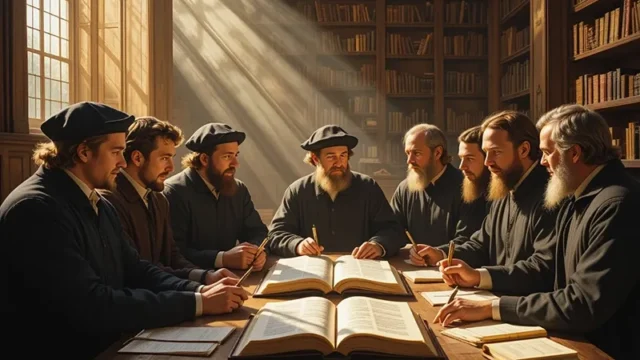
A pastoral guide to Protestant beliefs about Scripture, grace, salvation, worship, the Church, and life in Christ.
Dear friends in Christ,
When people ask, “What do Protestants believe?” they are often hoping for a simple answer. Yet Protestant Christianity is not a single denomination with one worldwide hierarchy, one liturgical form, or one detailed confession shared by every congregation. It is a broad family of Christian traditions that includes Lutherans, Reformed and Presbyterian Christians, Anglicans, Baptists, Methodists, Pentecostals, Evangelicals, Anabaptists, Congregationalists, and many other communities.
These traditions differ from one another in important ways. They may disagree about baptism, the Lord’s Supper, church government, spiritual gifts, predestination, worship, and the relationship between faith and culture. A quiet Lutheran service, a solemn Anglican liturgy, a Reformed congregation centered on expository preaching, and a joyful Pentecostal gathering may look very different. Yet beneath these differences lies a deep and recognizable center.
Protestants believe in the Triune God: Father, Son, and Holy Spirit. They confess Jesus Christ as the eternal Son of God who became truly human, died for our sins, rose bodily from the grave, reigns as Lord, and will come again. They receive the Bible as the inspired Word of God. They proclaim that salvation is God’s gift of grace, received through faith in Christ rather than earned by human merit. They believe that the Holy Spirit brings sinners to repentance, gives new life, forms the Church, and enables believers to grow in holiness and love.
At its best, Protestant faith is not merely a protest against certain Catholic teachings or practices. It is a positive confession of the Gospel: that sinful human beings are reconciled to God through Jesus Christ, that the Word of God must be heard and obeyed, and that every believer is called to live in grateful response to divine grace.
To understand Protestantism, therefore, we must look beyond labels. We must listen to its central spiritual concern: How can a sinner be made right with God? How does Christ save us? How does God speak to His people? What is the Church called to be? And how should those who have received grace live in the world?
Protestant Christianity Begins With Jesus Christ
The heart of Protestant belief is not Martin Luther, John Calvin, the Reformation, or any particular denomination. The heart is Jesus Christ.
Historic Protestant churches confess the ancient Christian faith expressed in the Apostles’ Creed and the Nicene Creed. They believe that there is one God in three divine Persons: the Father, the Son, and the Holy Spirit. They affirm that Jesus Christ is fully God and fully human, conceived by the Holy Spirit, born of the Virgin Mary, crucified under Pontius Pilate, raised from the dead, and exalted at the right hand of the Father.
This places historic Protestantism within the great stream of orthodox Christianity. Protestants do not generally believe that Christianity began in the sixteenth century. They understand themselves as heirs of the prophets, apostles, martyrs, Church Fathers, and Christian witnesses who came before the Reformation.
The Reformers believed that the Church of their time had obscured certain central truths of the Gospel. Their intention, as they understood it, was not to create a new religion but to call the Church back to Scripture and to the message of salvation through Christ.
This is why Protestant preaching so often returns to the life, death, and resurrection of Jesus. Christ is not merely a moral teacher who shows humanity how to live. He is the Savior who does for us what we cannot do for ourselves.
The Apostle Peter proclaimed:
“Neither is there salvation in any other: for there is none other name under heaven given among men, whereby we must be saved.”
— Acts 4:12
For Protestants, every doctrine must ultimately lead back to Christ. Scripture bears witness to Christ. Faith rests in Christ. Grace comes through Christ. The Church belongs to Christ. Christian holiness is conformity to Christ. Christian hope is the promise of eternal life with Christ.
The Cross Is Central to Protestant Faith
Protestants place particular emphasis on the saving meaning of the cross. Jesus did not die merely as an example of courage or as a tragic victim of political and religious injustice. He gave His life for sinners.
The New Testament speaks of the cross in several rich ways. Christ bears our sins, reconciles us to God, defeats the powers of evil, fulfills the covenant, reveals divine love, and opens the way to new life. Different Protestant traditions may emphasize these dimensions differently, but they agree that the death of Jesus is the decisive act through which God saves His people.
Many Protestants strongly emphasize substitutionary atonement: Christ stood in the place of sinners and bore the judgment sin deserved. As Isaiah had foretold, “he was wounded for our transgressions” and “the Lord hath laid on him the iniquity of us all” (Isaiah 53:5–6).
This teaching is not meant to portray the Father as unwilling to forgive while the Son persuades Him to become merciful. Rather, Protestants confess that the Father, Son, and Holy Spirit act together in salvation. The cross is the work of God’s own love.
As Saint Paul writes:
“God was in Christ, reconciling the world unto himself.”
— 2 Corinthians 5:19
At the cross, divine holiness and divine mercy are not enemies. God does not ignore sin, yet neither does He abandon sinners. In Christ, God takes upon Himself the cost of reconciliation.
For a burdened conscience, this is not an abstract theory. It is good news. The believer does not have to wonder whether enough good deeds have been performed to cancel past failures. The Christian looks to Christ and hears the promise that His sacrifice is sufficient.
Protestants Believe the Bible Is the Authoritative Word of God
One of the clearest marks of Protestant Christianity is its emphasis on Holy Scripture.
Protestants believe that the Bible is inspired by God and carries supreme authority for Christian faith and life. The Scriptures are not merely a collection of ancient religious reflections. Through the words of human authors, God has faithfully made known His saving truth.
Saint Paul writes:
“All scripture is given by inspiration of God, and is profitable for doctrine, for reproof, for correction, for instruction in righteousness.”
— 2 Timothy 3:16
The Protestant principle commonly called sola Scriptura, meaning “Scripture alone,” is sometimes misunderstood. It does not necessarily mean that every Christian should ignore history, creeds, pastors, theologians, or the wisdom of the wider Church. The Reformers themselves quoted the early Church Fathers, composed catechisms, defended the ancient creeds, and valued careful theological study.
Rather, sola Scriptura means that Scripture is the highest and final infallible authority by which all teachings, traditions, and church practices must be tested. Church councils may err. Pastors may err. Theologians may err. Christian customs may become distorted. Scripture, rightly understood, remains the decisive norm.
Scripture Is Read Within the Community of Faith
Although Protestants emphasize personal Bible reading, responsible Protestant theology does not teach that interpretation should be merely private or individualistic.
The Bible was given to the people of God. It is read in worship, preached from the pulpit, taught in families, studied in communities, and interpreted in conversation with Christians across generations. Historic confessions and creeds help guard believers from interpretations that separate a verse from the whole witness of Scripture.
The emphasis on personal access to the Bible arose partly from the conviction that ordinary Christians should hear God’s Word in a language they understand. The translation and distribution of Scripture became one of the great passions of Protestant Christianity.
This conviction has borne remarkable fruit. Christians have learned to read so they could study the Bible. Missionaries have helped develop written forms of languages. Bible societies have carried Scripture across national and cultural boundaries. Families have gathered around the Word of God in homes, churches, schools, hospitals, prisons, and places of persecution.
Yet personal Bible reading carries responsibility. Scripture should not become a collection of isolated sentences used to justify personal opinions. It must be read prayerfully, humbly, and in context. The reader must allow the Word to correct the heart rather than using the Word merely to correct others.
Salvation Is by Grace Alone
At the center of Protestant belief is the conviction that salvation begins, continues, and is completed by the grace of God.
Grace is God’s undeserved favor toward sinners. It is not a reward given to those who have first made themselves worthy. It is the free and merciful action of God toward those who cannot save themselves.
Saint Paul declares:
“For by grace are ye saved through faith; and that not of yourselves: it is the gift of God: not of works, lest any man should boast.”
— Ephesians 2:8–9
The phrase sola gratia, “grace alone,” expresses this conviction. Human beings are not spiritually neutral people who simply need better information. Sin has affected the mind, will, desires, relationships, and worship of humanity. We need forgiveness, but we also need renewal. We need not merely advice but resurrection.
God takes the initiative. The Father sends the Son. Christ accomplishes redemption. The Holy Spirit awakens faith. The sinner repents because grace has opened the heart. The believer perseveres because God remains faithful.
Different Protestant traditions explain the relationship between grace and human response in different ways. Reformed Christians tend to emphasize God’s sovereign election and the effectiveness of divine grace. Wesleyan and Arminian Christians emphasize grace that enables a genuine human response without destroying freedom. Lutherans insist that salvation is entirely God’s work while warning believers not to resist grace through unbelief.
These differences are substantial, but the traditions share a foundational confession: no person can stand before God and say, “I saved myself.”
Grace Humbles the Proud and Comforts the Broken
The doctrine of grace speaks differently to different hearts.
To the proud, grace says: You cannot boast. Your intelligence, discipline, religious background, moral record, or spiritual experiences do not place God in your debt.
To the ashamed, grace says: Your failures are not greater than the mercy of Christ. You do not need to repair yourself before coming to Him.
To the weary, grace says: You are not held by God because your faith is always strong. You are held because Christ is faithful.
To the fearful, grace says: Salvation rests not on the perfection of your feelings but on the promise of God.
True grace does not encourage indifference. It produces gratitude. The person who knows that forgiveness was freely given begins to desire a life that honors the Giver.
Justification Is Received Through Faith
A defining Protestant teaching is justification by faith alone, traditionally expressed as sola fide.
Justification refers to God’s declaration that a sinner is righteous in His sight because of Jesus Christ. The believer is accepted not because personal righteousness has become perfect, but because Christ’s righteousness is received through faith.
Faith is not a good work that earns salvation. It is the empty hand that receives the gift. It is trusting Christ, resting in His promise, and turning away from every false hope of self-salvation.
Saint Paul writes:
“Therefore being justified by faith, we have peace with God through our Lord Jesus Christ.”
— Romans 5:1
This teaching became central during the Protestant Reformation because many Christians were burdened by uncertainty. They feared that they had not confessed enough, repented enough, suffered enough, or performed enough works to be accepted by God.
The Reformers answered that peace with God rests on Christ’s completed work. The believer’s confidence is not based on the question, “Have I become good enough?” but on the declaration, “Christ is sufficient.”
Faith Is Living, Not Empty
Protestants do not generally teach that a person may claim intellectual belief in Jesus while deliberately rejecting repentance, love, and obedience.
The faith that justifies is living faith. It unites the believer to Christ and therefore produces fruit. Good works do not create salvation, but salvation creates good works.
Martin Luther expressed this by teaching that faith is active and powerful. John Calvin said that although justification and sanctification must be distinguished, they cannot be separated. The Methodist tradition strongly emphasizes holiness as the necessary fruit of grace. Baptists commonly stress that genuine conversion produces a changed life.
Ephesians 2 does not end with the statement that salvation is not by works. It continues:
“For we are his workmanship, created in Christ Jesus unto good works.”
— Ephesians 2:10
Good works are therefore not the root of salvation but its fruit. Christians serve the poor, forgive enemies, resist sin, practice generosity, pursue justice, care for families, and proclaim the Gospel not in order to purchase God’s love, but because God has already loved them in Christ.
Protestants Believe in Conversion and New Birth
Protestant spirituality often places strong emphasis on personal conversion.
Conversion includes repentance and faith. Repentance is not merely feeling guilty. It is a turning of the heart away from sin and toward God. Faith is trusting Jesus Christ as Savior and Lord.
Jesus said to Nicodemus:
“Except a man be born again, he cannot see the kingdom of God.”
— John 3:3
The new birth is the work of the Holy Spirit. It does not simply make a person more religious. It gives new spiritual life. The believer receives a new relationship with God, a new identity in Christ, and a new desire for holiness.
Some Protestants can name the precise day or moment when they came to faith. Others were raised in Christian homes and gradually grew into a conscious trust in Christ. Some experienced dramatic deliverance from destructive lives. Others encountered grace quietly through Scripture, worship, family prayer, or years of patient discipleship.
Protestant traditions differ in how they describe conversion, especially in relation to baptism and childhood faith. Yet they agree that Christianity cannot remain merely external. No one is saved simply by belonging to a Christian culture, attending a church, or inheriting a denominational identity. The Gospel calls for a living response of the heart.
Assurance of Salvation
Many Protestants teach that believers may possess genuine assurance of salvation.
This assurance does not mean careless presumption. It does not mean that every person who once repeated a prayer may live without repentance and still assume eternal security. Assurance rests upon the promise of God, the finished work of Christ, the witness of the Holy Spirit, and the growing fruit of grace.
Some Protestant traditions, especially Reformed and many Baptist churches, teach the perseverance or eternal security of true believers. Others, including many Methodists, Pentecostals, and Arminians, teach that believers must continue in faith and may fall away through persistent unbelief.
Despite these differences, Protestants generally encourage believers to look away from anxious self-reliance and toward Christ.
Jesus promises:
“Him that cometh to me I will in no wise cast out.”
— John 6:37
The Christian’s hope is not that personal faith will never tremble. Hope rests in the One to whom faith clings.
The Five Solas Summarize Reformation Convictions
The beliefs of the Protestant Reformation are often summarized through five Latin phrases known as the five solas.
Scripture Alone
Sola Scriptura teaches that Scripture is the supreme authority for faith and life. Traditions, councils, and teachers have value, but they remain accountable to the Word of God.
Grace Alone
Sola gratia teaches that salvation is entirely a gift of divine grace. No one can earn reconciliation with God.
Faith Alone
Sola fide teaches that sinners are justified through faith in Christ, apart from works as the basis of acceptance before God.
Christ Alone
Solus Christus teaches that Jesus Christ is the only mediator and Savior. His life, death, resurrection, and continuing intercession are sufficient for salvation.
Glory to God Alone
Soli Deo gloria teaches that all glory belongs to God. Salvation, worship, ministry, vocation, and daily life should magnify divine grace rather than human achievement.
These phrases are not five unrelated doctrines. They form a single vision. God reveals salvation in Scripture. Salvation comes by grace. It is received through faith. It is accomplished by Christ. Therefore, all glory belongs to God.
Protestants Believe in the Priesthood of All Believers
Another important Protestant teaching is the priesthood of all believers.
This does not mean that every Christian has the same role or that trained pastors are unnecessary. Protestant churches appoint ministers, elders, bishops, deacons, teachers, and other leaders according to their understanding of the New Testament.
The priesthood of all believers means that every Christian has direct access to God through Jesus Christ. No additional human mediator is required in order to approach the Father.
Saint Peter describes the Church as “a royal priesthood” and “an holy nation” (1 Peter 2:9). Through Christ, believers offer spiritual sacrifices of praise, prayer, service, generosity, and obedience.
Every Christian is therefore called to ministry. A parent teaching a child to pray, a worker acting with integrity, a believer comforting the grieving, a young person sharing the Gospel, and a congregation caring for its neighborhood are all participating in the mission of God.
Protestant Ministry and Pastoral Leadership
Although all believers share a spiritual priesthood, Protestant churches recognize ordained or appointed leadership.
Lutherans, Anglicans, Methodists, Presbyterians, Baptists, and Pentecostals structure this leadership differently. Some retain bishops. Others are governed by elders. Some emphasize the authority of the local congregation. Some belong to regional or national church bodies.
Most Protestants understand pastors primarily as ministers of the Word. They preach Scripture, administer baptism and the Lord’s Supper, provide pastoral care, guide the congregation, and equip believers for service.
Healthy Protestant leadership is not meant to create spiritual celebrities. Pastors are servants of Christ and shepherds of His flock. Their authority is ministerial, not absolute. They are accountable to Scripture and to the Church.
Where this accountability is forgotten, abuse can occur. Protestant communities, like all Christian communities, must remain vigilant against manipulation, financial exploitation, authoritarian leadership, and the misuse of spiritual authority.
Protestants Believe in the Church
Protestants are sometimes portrayed as believing only in an individual relationship with Jesus. Yet historic Protestantism teaches that Christians are saved into a people, not merely into private spirituality.
The Church is the body of Christ, the communion of believers, and the dwelling place of the Holy Spirit. Christ loves the Church and gave Himself for her.
Protestants commonly distinguish between the visible and invisible Church. The visible Church consists of those who gather in Christian congregations, hear the Word, receive the sacraments or ordinances, and profess the faith. The invisible Church refers to all true believers known perfectly to God.
This distinction recognizes that not everyone who outwardly belongs to a church possesses living faith, while some genuine believers may be found in imperfect or divided Christian communities.
Why Are There So Many Protestant Denominations?
The existence of many Protestant denominations is one of the most difficult questions for Protestants themselves.
Some divisions arose from serious theological disagreements. Others developed through geography, language, missionary history, political conflict, worship preferences, racial injustice, or disputes over leadership. Some denominations emerged from movements of spiritual renewal. Others resulted from human pride and failures of charity.
Not all Protestant differences are equally important. A disagreement about the style of music in worship is not the same as a disagreement about the identity of Christ. Historic Protestants generally distinguish essential Christian doctrines from secondary matters.
Yet denominational division should not be treated casually. Jesus prayed that His followers would be one. Christian separation weakens witness and can cause confusion, especially for those seeking faith.
Many Protestants participate in ecumenical cooperation, shared prayer, Bible translation, humanitarian service, theological dialogue, and joint Christian witness. Such cooperation does not erase genuine differences, but it can express the deeper unity believers possess in Christ.
Baptism and the Lord’s Supper
Most Protestants recognize two central rites instituted by Jesus: baptism and the Lord’s Supper. Many call them sacraments, while others prefer the word ordinances.
The difference in terminology often reflects a deeper difference in understanding. Sacramental traditions emphasize that God actively gives grace through visible signs joined to His promise. Ordinance traditions emphasize that believers obey Christ by publicly expressing the faith they have received.
What Protestants Believe About Baptism
All historic Protestant traditions practice baptism with water in the name of the Father, Son, and Holy Spirit. Yet they disagree about who should be baptized and what baptism accomplishes.
Lutherans, Anglicans, Presbyterians, Reformed Christians, Methodists, and some other groups baptize infants as well as adult converts. They see baptism as a sign and seal of God’s covenant, an act through which the person is received into the visible Christian community. Lutherans strongly affirm baptism as a means through which God offers forgiveness and new life.
Baptists, many Pentecostals, Anabaptists, and numerous Evangelical churches practice believer’s baptism. They teach that baptism should follow a personal profession of faith. For them, baptism publicly identifies the believer with the death, burial, and resurrection of Christ.
Some baptize by pouring or sprinkling, while others insist upon full immersion. Despite these differences, baptism remains a sign of cleansing, new life, union with Christ, and entrance into the Christian community.
What Protestants Believe About the Lord’s Supper
Protestants also differ regarding the Lord’s Supper, Holy Communion, or Eucharist.
Lutherans confess that Christ’s body and blood are truly present in the sacramental meal, though they reject the Catholic explanation of transubstantiation. Reformed Christians teach a real spiritual participation in Christ through the Holy Spirit. Anglicans hold a range of views, often affirming real sacramental communion while avoiding overly precise explanations of the mystery.
Many Baptists, Pentecostals, and Evangelicals understand the Lord’s Supper primarily as a memorial meal. The bread and cup proclaim Christ’s death, strengthen fellowship, and call believers to gratitude and self-examination.
Even where Protestants disagree about how Christ is present, the Supper remains centered on His command:
“This do in remembrance of me.”
— Luke 22:19
At the table, the Church remembers that its life comes from the broken body and shed blood of Jesus.
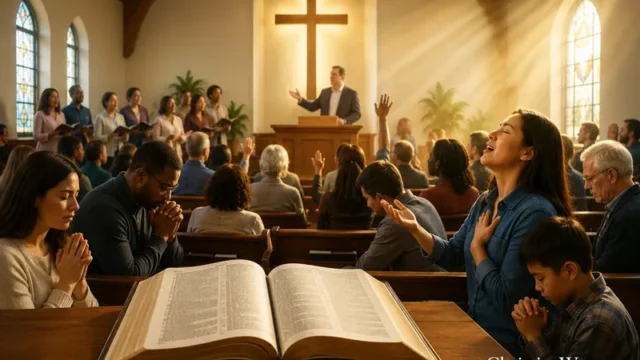
Protestant Worship Centers on Word and Response
Protestant worship varies greatly, but the proclamation of Scripture holds a central place.
In many Protestant churches, the sermon is one of the most prominent parts of worship. The pastor explains a biblical text, proclaims the Gospel, addresses the conscience, and applies God’s truth to daily life.
Yet Protestant worship is more than preaching. It includes prayer, singing, confession, thanksgiving, Scripture reading, baptism, Communion, offerings, testimony, silence, and acts of blessing.
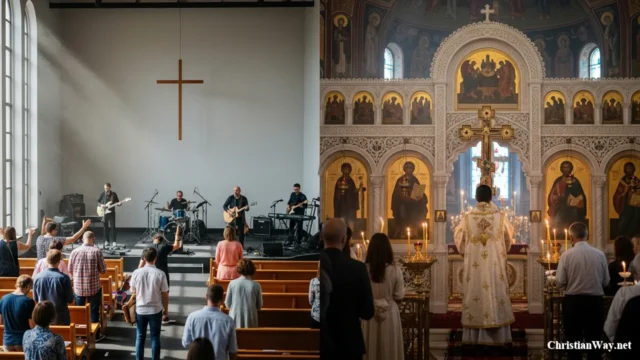
Lutheran and Anglican worship may follow ancient liturgical patterns. Reformed services often emphasize reverence, theological hymns, and careful exposition of Scripture. Methodist worship may unite structured prayer with warm evangelical devotion. Baptist worship often centers on congregational singing, preaching, and personal response. Pentecostal worship may include spontaneous prayer, expressive praise, testimony, prophecy, and expectation of the Spirit’s active presence.
These differences reveal distinct spiritual instincts. Some traditions protect continuity with ancient worship. Others seek simplicity modeled on the New Testament. Some emphasize order and reverence. Others emphasize freedom and immediacy.
The deepest question, however, is not whether worship is traditional or contemporary. The question is whether God is truly honored, Christ is proclaimed, Scripture is heard, the Holy Spirit is obeyed, and the people are formed in faith and love.
Protestants Believe in the Work of the Holy Spirit
Protestant Christianity is Trinitarian. The Holy Spirit is not merely a religious feeling or impersonal force. He is the divine Person who gives life, reveals Christ, inspired Scripture, convicts the world of sin, gathers the Church, and makes believers holy.
The Spirit awakens faith. Without His work, the Gospel may be heard outwardly but not received inwardly. The Spirit assures believers that they are children of God, helps them pray, produces spiritual fruit, and gives gifts for service.
Saint Paul describes the fruit of the Spirit as:
“Love, joy, peace, longsuffering, gentleness, goodness, faith, meekness, temperance.”
— Galatians 5:22–23
Protestants differ over spiritual gifts such as prophecy, tongues, and healing. Pentecostal and Charismatic Christians generally believe these gifts continue and should be practiced under biblical discernment. Many Reformed and conservative Evangelical Christians believe certain miraculous gifts were especially connected to the apostolic age. Others hold a cautious position between these views.
Yet all historic Protestants believe that Christian life is impossible without the Holy Spirit. Holiness is not produced by human determination alone. The Spirit changes desires, strengthens obedience, gives courage in suffering, and conforms believers to Christ.
The Christian Life Is a Life of Sanctification
Justification describes the believer’s acceptance before God. Sanctification describes the continuing work by which the Holy Spirit makes the believer holy.
Protestants insist that these truths must be distinguished but never separated. Christians are not accepted because they have reached moral perfection. Yet those who are accepted in Christ are called to become more like Him.
Sanctification includes putting sin to death, renewing the mind, practicing spiritual disciplines, loving one’s neighbor, seeking justice, showing mercy, and growing in humility.
This growth is often slow. Believers may experience seasons of spiritual joy and seasons of dryness. Old temptations may return. Wounds may take years to heal. Some sins are overcome quickly; others require long repentance, accountability, prayer, and patient dependence on grace.
Protestant spirituality should never reduce sanctification to self-improvement. The Christian does not merely become a more disciplined version of the old self. In union with Christ, a new life is being formed.
Prayer and Daily Devotion
Protestants encourage direct prayer to God through Jesus Christ.
Prayer includes praise, confession, thanksgiving, intercession, lament, and silent trust. Believers are taught to pray in Christ’s name, not as a formula attached to every sentence, but in dependence upon His mediation and in submission to His will.
Many Protestants practice daily Bible reading and personal prayer, sometimes called a quiet time or daily devotion. Families may pray together and read Scripture in the home. Small groups often gather for study, fellowship, and mutual encouragement.
These practices are not meant to earn divine approval. They are ways of remaining attentive to grace.
A Bible left unopened cannot nourish the mind. Prayer neglected cannot deepen communion. Worship abandoned cannot strengthen the believer through the gifts of the body of Christ. Spiritual disciplines are not payment to God; they are habits through which the heart learns to receive and respond.
Protestants, Mary, and the Saints
Protestants honor Mary as the mother of Jesus and a faithful servant of God. Historic Protestantism affirms the virgin birth and recognizes Mary as “blessed among women.”
The early Reformers often spoke respectfully of her faith and obedience. Protestants may meditate upon her response to the angel:
“Behold the handmaid of the Lord; be it unto me according to thy word.”
— Luke 1:38
However, most Protestants do not pray to Mary or ask for her intercession. They believe prayer should be directed to God through Jesus Christ, the one Mediator.
In the same way, Protestants may honor the memory of saints, martyrs, missionaries, pastors, reformers, and faithful Christians of the past. They may give thanks for their witness and imitate their virtues. Yet they generally do not invoke the saints in prayer.
The word saint is commonly used in the New Testament for all believers who belong to Christ. Protestants therefore speak of the communion of saints as the fellowship of the whole redeemed people of God, both on earth and in heaven.
This difference remains an important point of division between Protestants, Catholics, and Orthodox Christians. It should be discussed honestly but without caricature. Catholics and Orthodox Christians do not believe that saints replace Christ, while Protestants do not reject Christian history simply because they refuse invocation of the saints.
Christian dialogue is helped when each tradition describes the other accurately.
Protestants Believe in Mission and Evangelism
The command of Jesus to make disciples of all nations has deeply shaped Protestant history.
Protestants believe the Gospel should be proclaimed to every person. Evangelism is the announcement that God offers forgiveness and new life through Jesus Christ. It calls people to repentance, faith, baptism, and discipleship.
Mission is not limited to preaching. It includes translating Scripture, planting churches, educating children, caring for the sick, defending human dignity, feeding the hungry, serving refugees, opposing injustice, and strengthening families and communities.
Protestant missionary movements have contributed to global Christianity, education, literacy, medicine, and humanitarian service. They have also sometimes been entangled with colonial power, cultural superiority, and political ambition. Honest reflection requires gratitude for sacrificial service and repentance for failures.
Authentic mission does not treat people as projects. It bears witness to Christ with humility. It listens as well as speaks. It serves without manipulation. It remembers that conversion is the work of the Holy Spirit, not the result of pressure or human technique.
Protestants Believe Faith Must Shape Daily Life
Protestant faith is not meant to remain inside a church building.
The Reformers recovered a strong theology of vocation. They taught that ordinary work can become an arena of service to God. A farmer, teacher, parent, carpenter, physician, merchant, artist, civil servant, or laborer may glorify God through faithful work.
Christian vocation is not limited to ordained ministry. Every honest calling can become a place where love of neighbor is practiced.
This has profound spiritual meaning. The parent changing a child’s clothes, the employee refusing corruption, the nurse caring for a difficult patient, the business owner paying workers fairly, and the neighbor visiting someone who is lonely are not performing spiritually meaningless tasks. When done in faith and love, such actions become part of Christian discipleship.
Justice, Mercy, and Social Responsibility
Protestants have differed over how the Church should address social and political questions. Some emphasize individual conversion, believing transformed hearts will transform society. Others emphasize structural injustice and the Church’s public responsibility. Many seek to hold both together.
Protestant Christians have participated in movements for abolition, civil rights, education, religious freedom, prison reform, care for the poor, protection of unborn life, peacemaking, and humanitarian relief. They have also sometimes defended unjust systems or remained silent when courage was needed.
The Gospel calls believers beyond partisan loyalty. No political party fully represents the kingdom of God. Christians must test every ideology by Scripture and remember that the dignity of the human person does not depend on usefulness, wealth, ethnicity, nationality, age, health, or social status.
Faithfulness requires both personal virtue and concern for the neighbor. Christians are called to speak truth, protect the vulnerable, forgive enemies, seek peace, and refuse hatred.
Protestant Views of Death, Judgment, and Eternal Life
Protestants believe that human history is moving toward the return of Jesus Christ.
Christ will come again in glory. The dead will be raised. God will judge humanity in righteousness. Evil will not have the final word. Those who belong to Christ will share eternal life in the renewed creation.
Protestants differ in their understanding of events surrounding the end times. Some hold premillennial, amillennial, or postmillennial views. Some expect a distinct rapture before a period of tribulation. Others interpret such passages differently and emphasize the final resurrection and return of Christ as one great hope.
These debates can become complex, but the central confession is simple:
“He shall come to judge the quick and the dead.”
Christian hope is not escape into a vague spiritual realm. The resurrection of Jesus is the promise of renewed creation. God will wipe away tears, defeat death, expose injustice, and dwell with His people.
Most Protestants reject the doctrine of purgatory. They generally believe that believers who die are with Christ while awaiting the resurrection, and that their salvation rests entirely upon His grace.
The final judgment reveals the truth of every life. Good works do not purchase salvation, but they bear witness to the reality of faith. The person united to Christ need not face judgment with despair. The Judge is also the Savior who gave His life for His people.
What Protestants Share With Catholics and Orthodox Christians
Despite real divisions, Protestants share much with Catholic and Orthodox Christians.
They confess one God in three Persons. They believe that Jesus Christ is truly divine and truly human. They receive the Old and New Testaments as Holy Scripture. They affirm the virgin birth, crucifixion, resurrection, ascension, and future return of Christ. They practice baptism, celebrate the Lord’s Supper, pray the Lord’s Prayer, and seek to obey the commandments of God.
They read many of the same early Christian writers, honor the courage of the martyrs, and confess the faith of the ancient creeds.
The differences should not be minimized. Questions about authority, justification, sacraments, apostolic succession, the papacy, Mary, the saints, and the nature of the Church remain significant. Yet disagreement should not become contempt.
A Protestant should not assume that every Catholic believes salvation is simply earned by good deeds. A Catholic should not assume that every Protestant rejects tradition or believes that obedience is unnecessary. An Orthodox Christian should not reduce Protestant spirituality to individualism, and a Protestant should not dismiss Orthodox worship as empty ritual.
Charity begins with truthful understanding.
The Strengths and Dangers of Protestant Christianity
Every Christian tradition carries gifts that can bless the wider Church, and every tradition faces temptations that can distort its witness.
Protestantism’s love for Scripture has helped millions encounter the Word of God personally. Its emphasis on grace has comforted burdened consciences. Its missionary energy has carried the Gospel across cultures. Its theology of vocation has dignified ordinary work. Its insistence on reform reminds the Church that every human institution must remain accountable to Christ.
Yet Protestantism also faces dangers.
The emphasis on personal interpretation can become individualism. Congregational freedom can become fragmentation. Confidence in preaching can turn pastors into celebrities. Simplicity in worship can lose the sense of sacred mystery. The language of grace can be misused to excuse shallow discipleship. Entrepreneurial energy can turn churches into religious businesses. Political engagement can replace the Gospel with ideology.
There is also a temptation to behave as though Christian history disappeared after the apostles and reappeared during the Reformation. This impoverishes faith. Protestants benefit when they read the early Church Fathers, learn from ancient Christian worship, listen to believers from other traditions, and remember that the Holy Spirit has been at work throughout the centuries.
The answer to Protestant weakness is not abandonment of the Gospel convictions that gave Protestantism life. It is deeper faithfulness to those convictions: more Scripture, read humbly; more grace, producing holiness; more faith, centered on Christ; more worship, offered for God’s glory.
What It Means to Live as a Protestant Christian
To live as a Protestant Christian is not merely to reject the authority of the pope, prefer a particular worship style, or belong to a congregation with the word Lutheran, Baptist, Methodist, Presbyterian, Pentecostal, Anglican, Evangelical, or Reformed on its sign.
It is to hear the Gospel and place one’s trust in Jesus Christ.
It is to receive Scripture as God’s Word and allow that Word to judge, comfort, and reshape the heart.
It is to confess that salvation is a gift rather than an achievement.
It is to live in gratitude, knowing that good works flow from grace.
It is to belong to the Church, receive Christian teaching, worship with other believers, and participate in the mission of God.
It is to pray, repent, forgive, serve, suffer with hope, and seek holiness through the power of the Holy Spirit.
It is to say with the Apostle Paul:
“I live; yet not I, but Christ liveth in me.”
— Galatians 2:20
A mature Protestant faith should produce neither spiritual arrogance nor hostility toward other Christians. The doctrine of grace leaves no room for boasting. Those who believe that salvation is entirely God’s gift should be among the most humble of people.
The true test of Protestant conviction is not how forcefully one argues about denominational differences. It is whether Christ is loved, the Gospel is trusted, Scripture is obeyed, neighbors are served, enemies are forgiven, and God receives the glory.
Reflect and Pray
Dear friends, the question “What do Protestants believe?” finally leads us beyond history, denominations, and theological formulas. It leads us to the living Christ.
Protestants believe that humanity cannot climb its way to God, so God came down to us. The eternal Son took flesh, entered our suffering, carried our sin, died upon the cross, and rose in victory. He offers forgiveness not as a wage for the deserving but as grace for the repentant. He calls us not merely to admire Him but to trust Him, follow Him, and receive new life in His Spirit.
The heart of Protestant faith can therefore be expressed in a simple confession: Scripture directs us to Christ; grace brings us to Christ; faith receives Christ; the Spirit unites us to Christ; and the Christian life bears witness to Christ.
No Protestant church embodies this faith perfectly. Every congregation needs repentance. Every denomination must remain under the searching light of the Word of God. Every believer must resist the temptation to confuse a human tradition with the fullness of the kingdom.
Yet the promise of the Gospel remains greater than the failures of Christians.
Christ still speaks through His Word. Grace still reaches the undeserving. The Holy Spirit still awakens faith. Sinners are still forgiven. Broken lives are still renewed. Churches are still called into mission. Ordinary believers are still sent into homes, workplaces, neighborhoods, and nations as witnesses to the mercy of God.
Let us pray:
Lord Jesus Christ, eternal Son of the Father,
teach us to rest in Your grace and to trust in Your finished work.
Give us humble hearts before Your Holy Word.
Guard us from pride, division, and empty religion.
Fill us with the Holy Spirit, that our faith may bear the fruit of love,
our worship may glorify God,
and our lives may proclaim the beauty of the Gospel.
Draw all who seek You into the truth, peace, and freedom of Your saving presence.
May Your Church be renewed in holiness, united in charity, and faithful in mission,
until the day when every knee shall bow and every tongue confess that Jesus Christ is Lord.
May the grace of Christ steady your heart, the Word of God light your path, and the Holy Spirit lead you into a life of faithful love.
— Fr. John Matthew