A gentle reflection on Anglican belief, worship, Scripture, sacraments, and the shared Christian hope found in Jesus Christ.
Dear friends in Christ,
When someone asks, “What do Anglicans believe?” the question may appear simple, yet the answer opens into a rich and sometimes complex Christian tradition. Anglicanism includes ancient liturgy and Reformation theology, solemn cathedrals and small village parishes, evangelical preaching and sacramental devotion, contemplative prayer and energetic missionary service. Its churches may look and sound different from one country or parish to another, yet beneath that diversity lies a shared confession centered on Jesus Christ.
Anglicans believe in the Triune God: Father, Son, and Holy Spirit. They confess that Jesus Christ is fully God and fully human, that He died for the sins of the world, rose bodily from the grave, and reigns as Lord. They receive the Holy Scriptures as God’s written Word, proclaim the ancient creeds, administer Baptism and Holy Communion, and seek to live as members of the one, holy, catholic, and apostolic Church.
At the same time, Anglicanism has often resisted reducing the Christian faith to a brief list of propositions. Anglican belief is expressed not only in theological statements but also in prayer, worship, Scripture reading, preaching, sacramental life, pastoral care, and the rhythm of the Christian year. A well-known Anglican principle is lex orandi, lex credendi: the law of prayer shapes the law of belief. In other words, one of the best ways to understand what Anglicans believe is to listen to how they pray.
The Anglican tradition is sometimes described as a bridge between Catholicism and Protestantism. There is some truth in this, but the description can also be misleading. Anglicanism is not simply an attempt to stand halfway between two opposing traditions. It is a distinct expression of historic Christianity, shaped by the English Reformation while retaining many elements of the ancient Church’s worship, ministry, and sacramental life.
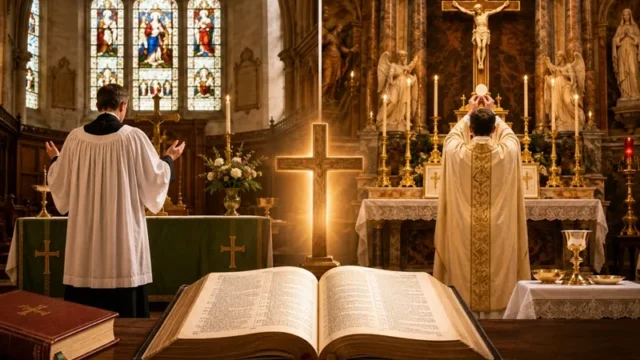
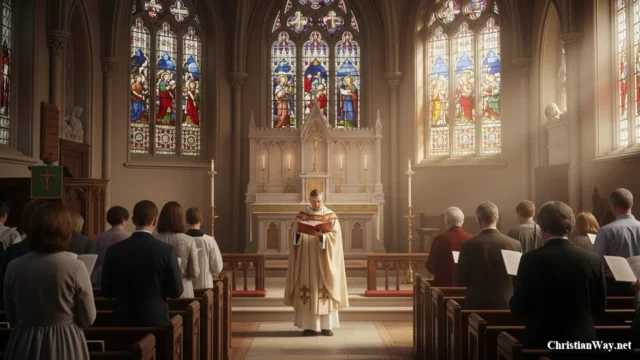
To understand Anglican belief, therefore, we must look beyond stereotypes. We must enter the sanctuary, listen to the Scriptures being proclaimed, hear the ancient creeds, approach the baptismal font and the Lord’s Table, and observe how Anglican Christians seek to follow Christ in the world. There we begin to see a tradition that longs to hold together truths that are sometimes separated: Scripture and tradition, Word and sacrament, personal faith and common worship, spiritual freedom and ecclesial order, reverence for the past and responsibility in the present.
Anglicans Believe in the Triune God
At the heart of Anglican faith is the Christian confession that there is one God in three Persons: the Father, the Son, and the Holy Spirit. This is not a secondary doctrine reserved for theologians. It is the living center of Christian worship, prayer, salvation, and hope.
Anglican services commonly begin and end in the name of the Father, the Son, and the Holy Spirit. Christians are baptized in this threefold name, following the command of Jesus:
“Go ye therefore, and teach all nations, baptizing them in the name of the Father, and of the Son, and of the Holy Ghost.”
— Matthew 28:19
Anglicans worship the Father as the Creator of heaven and earth, the source of all life and goodness. They confess the Son as the eternal Word of God who became flesh for the salvation of humanity. They believe in the Holy Spirit, the Lord and giver of life, who awakens faith, sanctifies the Church, distributes spiritual gifts, and draws believers into communion with God.
The doctrine of the Trinity teaches that God is not solitary or distant. Within the life of God there is eternal communion, self-giving, and love. The Father loves the Son, the Son offers Himself to the Father, and the Spirit is the living breath of divine communion. Human beings, created in the image of this God, are therefore made for relationship: relationship with God, with one another, and with the whole creation.
Anglican spirituality often reflects this Trinitarian pattern. Prayer is offered to the Father, through the Son, in the power of the Holy Spirit. Salvation is understood as being brought home to the Father through Christ and transformed by the Spirit. The Church is seen not merely as an organization but as a people drawn into the life and love of the Triune God.
Anglicans Believe That Jesus Christ Is Lord and Savior
The center of Anglican belief is not an institution, a national history, a style of worship, or even a particular theological method. The center is Jesus Christ.
Anglicans confess with the wider Christian Church that Jesus is the eternal Son of God, “God of God, Light of Light, very God of very God,” as the Nicene Creed declares. He was conceived by the Holy Spirit, born of the Virgin Mary, lived among us, suffered under Pontius Pilate, was crucified, died, was buried, rose again, ascended into heaven, and will come again in glory.
The mystery of the Incarnation is especially important in Anglican theology. In Jesus Christ, God truly entered human history. He did not merely appear human or speak to us from a distance. He took flesh, shared our weakness, knew hunger and weariness, wept at the grave of a friend, welcomed the rejected, touched the sick, forgave sinners, and offered Himself upon the cross.
Because the Son of God became truly human, every dimension of human life can be touched by grace. Work, family, friendship, art, reason, bodily life, suffering, and even death itself may become places of encounter with God. Anglican Christianity has often possessed a deeply incarnational character, seeing the material world not as something to be despised but as God’s creation, capable of bearing signs of His presence.
The Cross and the Forgiveness of Sins
Anglicans believe that Christ died for the sins of the world. On the cross, Jesus bore the weight of human rebellion and revealed the immeasurable love of God. Anglican theologians have described the saving work of the cross in several complementary ways.
Christ is the sacrificial Lamb who takes away the sin of the world. He is the victorious King who conquers sin, death, and the powers of evil. He is the representative of humanity whose perfect obedience restores what human disobedience had broken. He is the loving Savior whose self-giving awakens repentance and draws the heart back to God.
Anglicanism has not usually demanded that every Christian explain the atonement through only one theological model. The cross is too rich to be contained within a single image. Yet the central confession remains clear: humanity cannot save itself, and salvation is given through the gracious work of Jesus Christ.
The Book of Common Prayer repeatedly directs worshippers toward this mercy. In confession, Anglicans acknowledge that they have sinned in thought, word, and deed. In the words of absolution, they hear that God forgives those who truly repent and turn to Him. At the Holy Communion, they remember Christ’s offering of Himself and receive the signs of His redeeming love.
The Christian does not come before God boasting of moral achievement. We come empty-handed, trusting in mercy.
The Resurrection and Christian Hope
Anglicans believe that Jesus Christ truly rose from the dead. The Resurrection is not treated merely as a symbol of hope or a poetic way of saying that the teaching of Jesus continued after His death. It is the decisive victory of God over death.
Saint Paul wrote:
“But now is Christ risen from the dead, and become the firstfruits of them that slept.”
— 1 Corinthians 15:20
Because Christ has risen, sin does not have the final word. The grave does not have the final word. Violence, injustice, sickness, failure, and grief do not have the final word. God has acted in Jesus Christ, and the new creation has already begun.
This resurrection faith shapes Anglican funerals, which are marked by both sorrow and hope. Christians are not forbidden to grieve. Jesus Himself wept. Yet grief is carried within the promise that those who die in Christ are held in His love and will share in the resurrection of the body.
The Christian hope is not simply that an immaterial soul escapes from the world. Anglicans confess, in the words of the Apostles’ Creed, “the resurrection of the body, and the life everlasting.” God intends to renew His creation, heal what has been wounded, and bring His children into the fullness of life.
Anglicans Receive the Holy Scriptures as God’s Word
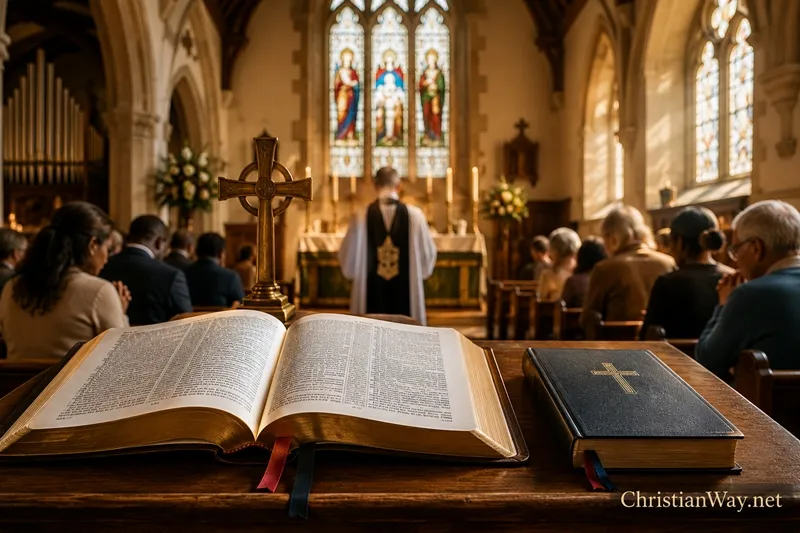
Holy Scripture holds a central and authoritative place in Anglican faith. The Bible is read in public worship, preached from the pulpit, prayed in the Daily Office, and studied in both personal devotion and Christian community.
The Thirty-Nine Articles, one of Anglicanism’s historic doctrinal texts, teaches that Holy Scripture contains all things necessary to salvation. This means that no doctrine can be required as essential to salvation unless it is grounded in Scripture.
The Bible is not merely a religious archive. Through the words of Scripture, God continues to address His people. The Holy Spirit uses the biblical text to reveal Christ, convict the conscience, comfort the suffering, guide the Church, and nourish faith.
Anglican worship traditionally includes readings from the Old Testament, the Psalms, the New Testament letters, and the Gospels. Over time, a congregation hears a broad range of Scripture rather than only the favorite passages of an individual preacher. This ordered reading protects the Church from becoming too narrow and allows difficult, comforting, familiar, and surprising texts to speak together.
Scripture Read Within the Church
Although Anglicans hold Scripture as the supreme written authority for Christian faith, most do not believe the Bible should be interpreted in isolation from the worshipping Church. Scripture was received, preserved, prayed, proclaimed, and interpreted within the Christian community.
Anglicans therefore read the Bible in conversation with the ancient creeds, the Church Fathers, the historic liturgy, Christian scholarship, and the witness of believers throughout the centuries. Tradition does not stand above Scripture as a rival revelation. Rather, healthy tradition helps the Church hear Scripture with humility and guards against interpretations that are novel, self-serving, or disconnected from the wider body of Christ.
Reason also has an important role. God does not ask human beings to abandon the mind. Anglicans have historically valued theological reflection, historical study, scientific inquiry, literary understanding, and careful moral reasoning. Reason is not treated as an independent judge standing over God, but as a gift that assists the faithful interpretation and application of revealed truth.
Scripture, tradition, and reason are therefore often mentioned together in discussions of Anglican theology. However, they are not always regarded as three equal sources. Scripture remains foundational, while tradition and reason serve the Church’s faithful hearing of the biblical witness.
The Bible Leads Us to Christ
Anglicans believe that the Scriptures ultimately bear witness to Jesus Christ. The Old Testament prepares for His coming. The Gospels proclaim His life, teaching, death, and Resurrection. The apostolic writings reveal the meaning of His saving work and the life of the Church formed in His name.
Jesus told His listeners:
“Search the scriptures; for in them ye think ye have eternal life: and they are they which testify of me.”
— John 5:39
Biblical knowledge is valuable, but the purpose of Scripture is not merely to make us informed. It is to bring us into communion with the living God. A person may know many biblical facts and still resist grace. The Scriptures must be received with faith, repentance, prayer, and obedience.
In Anglican spirituality, the reading of Scripture is often surrounded by prayer because understanding is not only an intellectual achievement. We ask the Holy Spirit to open our hearts so that the written Word may lead us to Christ, the eternal Word.
Anglicans Confess the Ancient Christian Creeds
Anglicans regularly confess the Apostles’ Creed and the Nicene Creed. These creeds summarize the foundational faith of the early Church and unite Anglicans with Christians across nations, centuries, and denominations.
The creeds affirm belief in God the Father Almighty, in Jesus Christ His only Son, and in the Holy Spirit. They proclaim the Incarnation, Crucifixion, Resurrection, Ascension, final judgment, forgiveness of sins, resurrection of the body, and everlasting life.
For Anglicans, saying the creed is not simply reciting an old document. It is joining the voice of the Church across time. The worshipper does not say only, “This is what I personally feel today.” The worshipper says, “This is the faith into which I have been baptized. This is the faith received from the apostles. This is the faith of the Church.”
There may be days when a believer feels spiritually strong and days when faith seems fragile. The creed gives the Christian words to stand within even when emotions are uncertain. We are carried by a confession larger than ourselves.
The ancient creeds also place boundaries around Christian teaching. Anglicanism allows a wide range of theological opinion, but this diversity is not intended to become limitless. Teachings that deny the Trinity, the true divinity and humanity of Christ, or the bodily Resurrection depart from the historic faith confessed by the Church.
Anglicans Belong to the One, Holy, Catholic, and Apostolic Church
The word catholic in the creed does not refer exclusively to the Roman Catholic Church. It comes from a word meaning universal or according to the whole. When Anglicans confess belief in the catholic Church, they are affirming their belonging to the universal body of Christ.
Anglicans generally understand themselves as both catholic and reformed. They are catholic because they retain the ancient creeds, episcopal ministry, sacramental worship, and continuity with the historic Church. They are reformed because their tradition was deeply shaped by the sixteenth-century Reformation, with its renewed emphasis on biblical authority, justification by grace, congregational participation, and worship in the language of the people.
These identities are not always held in the same balance. Some Anglican churches and individuals emphasize the catholic dimension, while others emphasize the Reformation inheritance. Still others describe themselves as broad church, charismatic, contemplative, or liberal. This diversity can be fruitful, although it can also create tension.
The unity of Anglicanism is therefore not based on identical opinions about every theological question. It rests more deeply in shared worship, episcopal communion, the Scriptures, the creeds, Baptism, Holy Communion, and the historic structures of the Church.
The Anglican Communion
The Anglican Communion is a worldwide family of churches that grew historically from the Church of England and related missionary movements. Its member churches are usually organized as self-governing provinces. They share a common heritage but are not governed by a single worldwide authority.
The Archbishop of Canterbury has a position of honor and pastoral leadership within the Communion, but he does not function as a pope with universal jurisdiction over every Anglican province. Anglican churches govern themselves through bishops, synods, clergy, and lay representatives according to their own constitutions.
This structure reflects both communion and local responsibility. It allows churches in different cultures to develop forms of worship, pastoral practice, and mission suited to their circumstances. At the same time, it can make global unity difficult when provinces disagree over doctrine, ethics, or ecclesial authority.
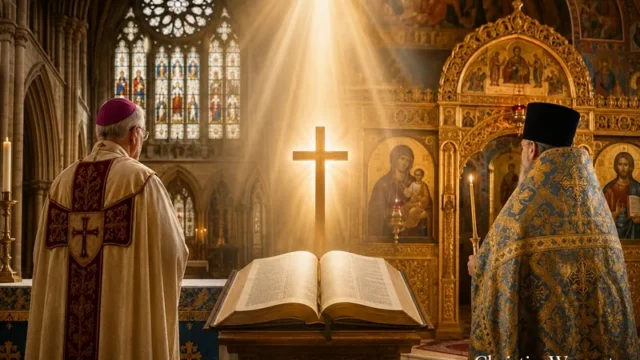
Anglicans believe that Christian unity is a gift to be received and a calling to be pursued. The divisions among Christians are not to be celebrated as though they were harmless. Anglican churches have long participated in ecumenical dialogue with Roman Catholic, Eastern Orthodox, Oriental Orthodox, Lutheran, Methodist, Reformed, Baptist, Pentecostal, and other Christian communities.
The prayer of Jesus remains before the Church:
“That they all may be one.”
— John 17:21
Anglicans Believe in Salvation by the Grace of God
Anglican teaching affirms that salvation is the gift of God’s grace. Human beings cannot earn reconciliation with God through good works, religious performance, or personal virtue. Salvation begins in God’s mercy and is accomplished through Jesus Christ.
The Reformation strongly shaped Anglican language concerning justification. Sinners are justified by faith because of the merits of Christ, not because they have accumulated enough moral merit to place God in their debt.
Yet authentic faith is never barren. The grace that forgives also transforms. Good works do not purchase salvation, but they are the fruit of living faith. A person united to Christ is called to grow in love, holiness, justice, humility, patience, and mercy.
Saint Paul wrote:
“For by grace are ye saved through faith; and that not of yourselves: it is the gift of God.”
— Ephesians 2:8
He immediately continued by teaching that believers are created in Christ Jesus for good works. Anglican theology therefore resists both self-righteousness and moral indifference. We are not saved because we are good enough, but the saving grace of Christ does not leave us unchanged.
Conversion as a Lifelong Turning Toward God
Some Anglicans speak of a clearly remembered conversion experience in which they consciously entrusted their lives to Christ. Others were baptized as infants, raised within the Church, and came gradually to a mature faith. Anglicanism can honor both patterns.
What matters is not whether every Christian has the same spiritual story. What matters is that each person turns toward Christ, trusts His mercy, receives His grace, and continues in the life of discipleship.
Repentance is not merely a one-time emotional moment. It is a lifelong reorientation of the heart. Again and again, Christians turn away from sin and return to God. The liturgy gives language to this continuing conversion. Anglicans confess their sins, hear the promise of forgiveness, receive spiritual nourishment, and are sent back into the world to walk in newness of life.
Sanctification, the process of being made holy, is the work of the Holy Spirit. It requires human cooperation, but even that cooperation is awakened and sustained by grace. Prayer, Scripture, sacramental worship, acts of mercy, fellowship, and self-discipline are not methods of earning God’s love. They are ways of opening our lives to the love already given in Christ.
Anglicans Recognize Baptism and Holy Communion as the Two Great Sacraments of the Gospel
Anglicans give a central place to the sacraments. A sacrament is commonly understood as an outward and visible sign of an inward and spiritual grace. Through physical signs such as water, bread, and wine, God communicates His promises and draws His people into the life of Christ.
Anglicans particularly recognize Baptism and Holy Communion as the two great sacraments instituted by Christ and commanded for the whole Church.
Holy Baptism
In Baptism, water is used in the name of the Father, the Son, and the Holy Spirit. Through this sacrament, a person is incorporated into the visible Church and marked as belonging to Christ.
Anglican churches commonly baptize both adults and infants. Adult candidates profess repentance and faith for themselves. When infants are baptized, parents and godparents make promises on their behalf, and the congregation commits itself to nurturing them in the Christian faith.
Infant Baptism expresses the priority of grace. A child does not earn God’s welcome or comprehend every mystery before being embraced by the covenant community. God’s mercy comes first. Yet Baptism is not treated as permission for spiritual passivity. The baptized person must grow into the promises made, personally embracing the faith and living as a disciple of Christ.
Confirmation often becomes a significant moment in this journey. Through prayer and the laying on of hands by a bishop, baptized Christians affirm their faith and seek the strengthening of the Holy Spirit. Confirmation does not replace Baptism but deepens and publicly confirms the baptismal calling.
Holy Communion
Holy Communion, also called the Eucharist, the Lord’s Supper, or the Mass in some Anglican settings, stands at the heart of Anglican worship.
At the Eucharist, the Church remembers the Last Supper, gives thanks for the saving work of Christ, offers praise to the Father, invokes the Holy Spirit, and receives consecrated bread and wine according to Christ’s command:
“This do in remembrance of me.”
— Luke 22:19
Anglicans believe that Holy Communion is more than an ordinary meal or a bare mental recollection. Christ truly gives Himself to His people. However, Anglicans have historically used different theological language to explain the manner of Christ’s presence.
Some Anglicans speak strongly of the real presence of Christ in the consecrated elements. Others emphasize that believers receive Christ spiritually by faith. Some use language close to Catholic sacramental theology, while others are more influenced by Reformed interpretations.
The historic formularies reject crude or overly materialistic explanations, yet they also speak of the bread and cup as a participation in the body and blood of Christ. The mystery is often approached with reverence rather than excessive definition.
The Eucharist gathers the Church around the one table of the Lord. Social status, wealth, education, ethnicity, and personal achievement do not determine who is most worthy. All come as sinners in need of grace. All stretch out empty hands. All receive the same gift.
The Lord’s Table teaches the Church how to live: with thanksgiving, humility, reconciliation, generosity, and communion.
Other Sacramental Ministries
Anglicans also practice confirmation, ordination, Christian marriage, reconciliation or confession, and the anointing of the sick. These are often called sacramental rites or ministries, though terminology may vary.
Private confession to a priest is available in many Anglican churches but is not usually required for every believer. A traditional Anglican approach may be summarized pastorally: all may, some should, none must. Corporate confession within public worship remains a regular part of Anglican spiritual life.
Anointing and prayers for healing express the Church’s care for the whole person. Anglicans pray for physical healing while also entrusting the sick to God’s wisdom and mercy. Healing may come through medicine, emotional restoration, reconciliation, spiritual strength, or, at times, extraordinary divine intervention. The Church prays boldly but does not manipulate the suffering with false promises.
Anglicans Worship Through Word and Sacrament
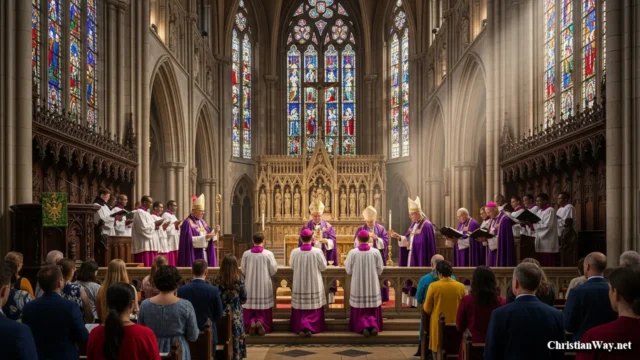
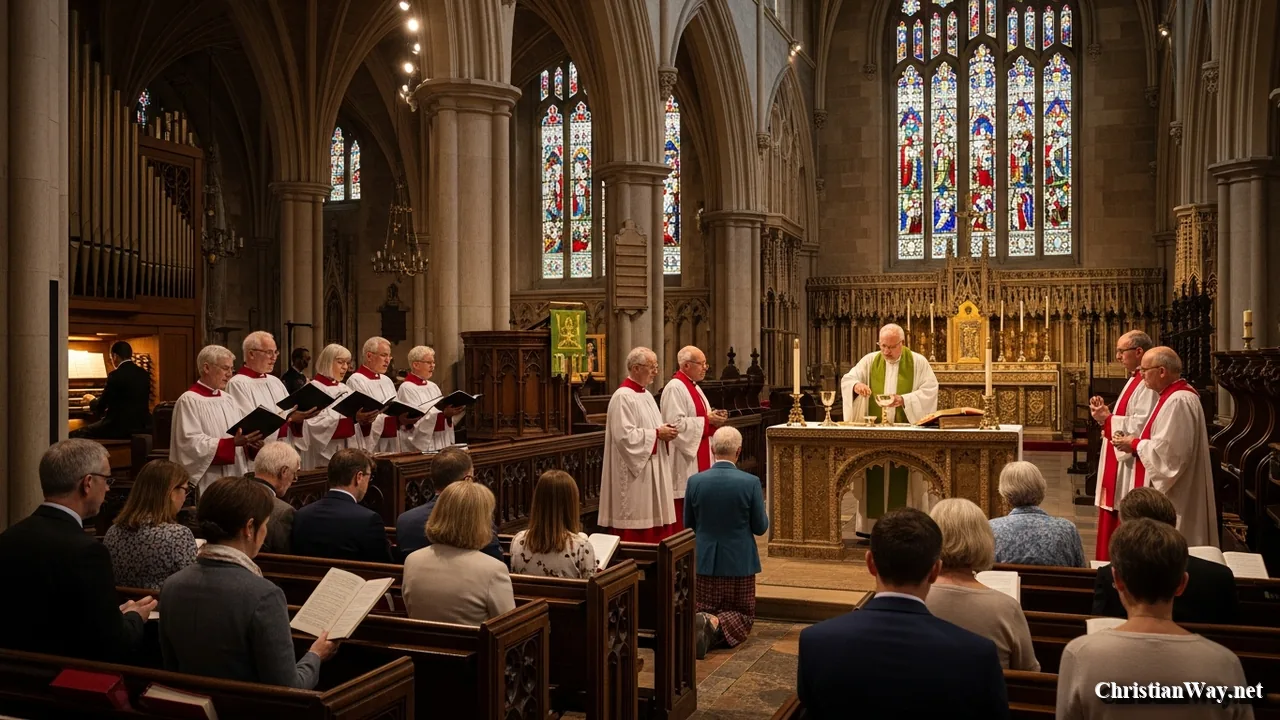
Anglican worship is shaped by a rhythm of gathering, listening, praying, receiving, and being sent. Though styles vary widely, traditional Anglican liturgy is usually marked by ordered prayer, biblical readings, congregational responses, confession, intercession, preaching, and sacramental celebration.
The Book of Common Prayer has played a foundational role in Anglican identity. Its language has formed generations of Christians in repentance, gratitude, reverence, and hope. Different Anglican provinces now use various authorized prayer books and liturgical texts, but the underlying pattern remains recognizable.
Morning Prayer and Evening Prayer, sometimes called the Daily Office, provide a disciplined rhythm of psalms, Scripture readings, canticles, and intercession. These services remind believers that prayer is not sustained by emotion alone. There are days when the heart is full of joy and days when it feels dry. The ordered prayers of the Church carry us through both.
The Christian Year
Anglicans commonly follow the liturgical year. Advent prepares for the coming of Christ. Christmas celebrates the Incarnation. Epiphany reveals Christ to the nations. Lent calls the Church to repentance. Holy Week enters the mystery of the Passion. Easter proclaims the Resurrection. Pentecost celebrates the outpouring of the Holy Spirit.
The liturgical year places human time within the story of Christ. The Church does not merely move from deadline to deadline, holiday to holiday, and crisis to crisis. It learns to inhabit sacred time.
In Advent, Christians learn to wait. In Christmas, they receive the wonder of God made flesh. In Lent, they confront sin and mortality. At the cross, they behold the love that suffers for the world. At Easter, they hear that death has been defeated. At Pentecost, they are renewed for mission.
This pattern forms the soul slowly. It reminds believers that discipleship is not a collection of isolated religious experiences but a life continually shaped by the mysteries of Christ.
Anglicans Value the Historic Ministry of Bishops, Priests, and Deacons
Anglican churches preserve the threefold ordained ministry of bishops, priests, and deacons.
Bishops serve as chief pastors, guardians of faith, and signs of unity. They ordain clergy, confirm baptized believers, provide oversight, and represent the continuity of the Church’s apostolic ministry.
Priests preach the Word, preside at the Eucharist, baptize, pronounce absolution, bless marriages, care for the sick, bury the dead, and shepherd local congregations.
Deacons are especially associated with service, proclamation, and the Church’s care for those in need. They remind the whole body of Christ that ministry is never about status but about service.
Jesus said:
“Whosoever will be chief among you, let him be your servant.”
— Matthew 20:27
Ordination does not create a spiritually superior class. Clergy remain sinners in need of grace. Their authority is meant to reflect the self-giving authority of Christ, who washed His disciples’ feet.
Anglicanism also strongly affirms the ministry of the laity. Every baptized Christian has a vocation. The Church’s mission does not belong only to bishops and priests. Parents, teachers, workers, artists, caregivers, business owners, students, public servants, and neighbors are called to bear witness to Christ in daily life.
Practices concerning ordination, including the ordination of women, differ among Anglican provinces. This is one of several areas in which the Communion contains significant theological disagreement. Such differences reveal both Anglicanism’s broadness and the difficulty of maintaining unity amid competing interpretations of Scripture and tradition.
Anglicans Honor Mary and the Saints Without Worshipping Them
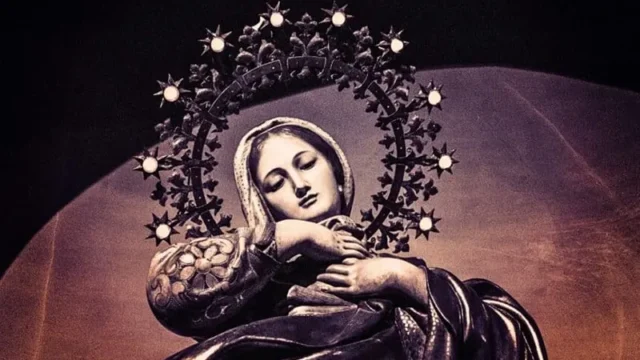
Anglicans honor the Virgin Mary as the mother of Jesus Christ and as a faithful servant of God. The ancient title Theotokos, meaning God-bearer or Mother of God, is accepted because it protects the truth that the child born of Mary is truly God incarnate.
Mary’s song, the Magnificat, is prayed regularly in Anglican Evening Prayer:
“My soul doth magnify the Lord, and my spirit hath rejoiced in God my Saviour.”
— Luke 1:46–47
Anglicans do not worship Mary. Worship belongs to God alone. However, attitudes toward Marian devotion vary. Anglo-Catholic Anglicans may observe Marian feasts, pray devotional prayers associated with Mary, and ask for her intercession. Evangelical Anglicans are often more cautious, emphasizing Mary’s biblical example without invoking her in prayer.
Anglican calendars also commemorate apostles, martyrs, pastors, missionaries, reformers, and other faithful Christians. The saints are remembered as witnesses to grace, not as replacements for Christ.
Some Anglicans ask the saints to pray for them, while others believe prayer should be directed only to God. The Anglican tradition has not maintained complete uniformity on this question.
What unites Anglicans is the belief that all Christian holiness comes from God. The saints are not self-made spiritual heroes. They are sinners transformed by grace. Their lives encourage the Church because they show what Christ can do in human beings who surrender themselves to Him.
Anglicans Believe That Prayer Is the Life of Communion With God
Prayer is central to Anglican life. It includes praise, thanksgiving, confession, lament, petition, intercession, contemplation, and silence.
Anglican prayer is both personal and communal. Christians are encouraged to pray privately, but they are also formed through the common prayer of the Church. This protects spirituality from becoming entirely individualistic.
When believers pray the Psalms, they receive a language broad enough for the whole human experience. There are psalms of joy, fear, anger, repentance, grief, trust, and praise. The Psalter teaches that we do not need to hide our true condition from God. We may come honestly, yet we allow God to reshape our emotions within the larger story of faith.
Anglicans also value extemporaneous prayer, especially within evangelical and charismatic communities. Some congregations pray for healing, exercise spiritual gifts, raise hands in worship, or use contemporary music. Others are marked by silence, chanting, incense, vestments, and ancient ceremonial.
These outward differences need not imply different gods or different Gospels. The Holy Spirit can meet His people in a cathedral choir, a simple spoken service, a lively worship gathering, a hospital room, or a quiet kitchen before dawn.
The true measure of prayer is not its style but its orientation toward God. Does it lead us to adore the Father, trust the Son, receive the Spirit, repent of sin, love our neighbors, and surrender our will?
Anglicans Believe That Faith Must Be Lived in Love and Service
Anglicanism teaches that worship and daily life cannot be separated. The person who receives Holy Communion is sent out to love and serve the Lord. The person who hears the Gospel must become a doer of the Word.
Christian discipleship includes personal holiness: honesty, chastity, humility, forgiveness, generosity, self-control, patience, and care for the vulnerable. It also includes concern for the common good, justice, peace, education, health, poverty, reconciliation, and the dignity of every human being.
Anglican churches have historically founded schools, hospitals, charities, relief organizations, and missionary societies. Their record, like the record of all human institutions, includes both faithful service and serious failure. Mission has sometimes been entangled with colonial power, cultural pride, and political ambition. Honest repentance requires acknowledging these wounds.
Yet the heart of Christian mission remains the love of Christ. The Church is sent not to dominate but to serve, not to glorify itself but to proclaim the Kingdom of God.
Jesus identified Himself with the hungry, the stranger, the sick, the poor, and the imprisoned. Therefore, service to those who suffer is not an optional addition to Christian faith. It is one of the places where love for Christ becomes visible.
The Gospel in Ordinary Life
Most Christians are not called to dramatic public ministry. They are called to quiet faithfulness.
An Anglican parent may live the Gospel through patience with a tired child. A nurse may show Christ’s compassion to a frightened patient. A business owner may refuse dishonesty even when deception would be profitable. A student may defend someone who is mocked. A grieving person may continue to pray when God feels silent.
These acts may seem small, but the Kingdom of God often grows through hidden obedience.
The Anglican emphasis on vocation teaches that ordinary life can become an offering to God. The altar is not the only holy place. A desk, workshop, classroom, kitchen, field, hospital, or family home can become a place of faithful service.
This does not mean that every action is automatically holy. Human work must be examined in the light of the Gospel. Yet when ordinary duties are performed with love, integrity, prayer, and concern for others, they may become part of the believer’s worship.
Anglicanism Contains Real Diversity and Real Tension
Any honest explanation of what Anglicans believe must acknowledge the diversity within Anglicanism. There is no single Anglican culture, worship style, or theological emphasis.
Some Anglicans identify strongly with the Protestant Reformation and emphasize personal conversion, biblical preaching, justification by faith, and evangelism. Some identify with the catholic heritage of the Church and emphasize apostolic succession, sacramental grace, liturgical worship, and continuity with the ancient tradition.
Some are influenced by charismatic renewal and emphasize the gifts and immediate work of the Holy Spirit. Others are shaped by contemplative spirituality, social theology, academic biblical scholarship, or broad-church pastoral practice.
This diversity can be a gift when it teaches humility and allows different aspects of Christian truth to enrich one another. The evangelical reminds the Church to proclaim the Gospel clearly. The catholic reminds the Church that Christianity is historical, sacramental, and communal. The charismatic reminds the Church that the Holy Spirit is living and active. The contemplative reminds the Church to be silent before God. The socially engaged Christian reminds the Church that faith must seek justice and mercy.
Diversity becomes destructive, however, when common faith is replaced by contradiction, when love becomes an excuse for doctrinal indifference, or when truth is used without humility and compassion. Anglicanism’s breadth requires continual discernment. Not every disagreement can be resolved by simply allowing everyone to hold a different opinion.
The Church must continually return to Scripture, the creeds, prayer, repentance, and the person of Jesus Christ. Unity cannot be created merely by institutional loyalty. It must arise from communion in truth and love.
What Anglicans Believe About Christian Unity
Anglicans believe that the Church of Jesus Christ is ultimately one, even though Christians are visibly divided. This unity is not created by human negotiation alone. It is rooted in one Lord, one faith, one Baptism, and one Holy Spirit.
Nevertheless, visible division wounds the Church’s witness. When Christians treat one another as enemies, the world struggles to see the reconciling power of the Gospel.
Anglicanism has often sought a middle or mediating role in ecumenical relations. It shares significant features with Protestant traditions, including the centrality of Scripture, Reformation history, and emphasis on grace. It also shares significant features with Catholic and Orthodox traditions, including bishops, creeds, liturgy, sacraments, and continuity with the ancient Church.
This position creates opportunities for dialogue but does not mean that all differences are superficial. Serious questions remain concerning authority, ordained ministry, the Eucharist, the papacy, Marian doctrine, moral theology, and the structure of the universal Church.
Authentic ecumenism does not pretend these differences do not exist. Nor does it begin with hostility. It begins by recognizing the work of Christ in other Christians, speaking truthfully about disagreement, repenting of prejudice, and praying for the unity God desires.
Anglicans can rejoice whenever Christ is faithfully proclaimed, Scripture is honored, the sacraments are celebrated, the poor are served, and lives are transformed by grace. At the same time, they continue to seek deeper unity in faith, worship, and mission.
What It Means to Live as an Anglican Christian
To live as an Anglican is not merely to belong to a particular denomination. It is to enter a way of Christian discipleship.
An Anglican Christian is called to worship faithfully, receive the Scriptures, confess the creeds, participate in the sacramental life of the Church, pray regularly, serve neighbors, forgive enemies, resist sin, seek justice, and bear witness to the hope of Christ.
This life is sustained by grace. No Anglican fulfills the baptismal calling perfectly. Every congregation contains weakness, disappointment, and contradiction. The Church is holy because Christ is holy, yet its members remain people being healed.
The liturgy acknowledges this reality. Anglicans do not begin worship by pretending to be righteous. They confess that they have wandered. They receive pardon. They listen to the Word. They exchange peace. They come to the Lord’s Table. They are blessed and sent.
This pattern reflects the whole Christian life. We wander, Christ calls. We confess, Christ forgives. We hunger, Christ feeds. We grow weary, Christ strengthens. We become divided, Christ gathers. We fear death, Christ reveals the empty tomb.
The beauty of Anglican worship is not meant to hide human brokenness. At its best, it brings broken human lives into the presence of the beautiful and merciful God.
Reflect and Pray
What do Anglicans believe? They believe in the God who created the world and did not abandon it. They believe in Jesus Christ, the eternal Son who became flesh, died for sinners, rose from the grave, and will come again. They believe in the Holy Spirit, who gives life to the Church and transforms human hearts.
They receive the Scriptures as the authoritative witness to God’s saving work. They confess the ancient creeds. They baptize in the name of the Trinity. They gather around the Lord’s Table. They pray with words both ancient and new. They seek to hold together the Word of God and the sacramental life, personal faith and common worship, historic continuity and continual reformation.
Anglicanism is a broad and complex tradition. It contains genuine beauty and genuine tension, faithful witness and human failure. It cannot be understood only by observing robes, cathedrals, prayer books, or denominational structures. Its deepest identity is found wherever people gather to hear the Gospel, receive the grace of Christ, and offer themselves to God in worship and service.
Perhaps the most important question is not only, “What do Anglicans believe?” but also, “What does this faith ask of the human heart?”
It asks us to trust Christ rather than ourselves. It asks us to receive grace with empty hands. It asks us to listen to Scripture with humility. It asks us to forgive because we have been forgiven. It asks us to recognize Christ in the poor, the lonely, the stranger, and the wounded. It asks us to pray not only with our lips but with our lives.
The Christian faith is not given merely to satisfy curiosity. It is given so that we may know God, be reconciled to Him, become like Christ, and participate in His healing of the world.
Let us pray.
Gracious Father,
You have called Your people from every nation
into the fellowship of Your Son.
Ground us firmly in the truth of Holy Scripture,
nourish us through the grace of the sacraments,
and fill us with the life of Your Holy Spirit.
Where Your Church is divided, make us humble.
Where we have wandered, lead us home.
Where we have grown cold, kindle love within us.
Where we are afraid, fix our eyes upon the risen Christ.
Teach us to worship You in spirit and in truth,
to serve our neighbors with compassion,
and to walk faithfully in the way of the cross.
May the peace of Christ dwell richly in your heart, and may His light guide you into truth, unity, and everlasting life.
— Fr. John Matthew