A gentle reflection on Catholic faith, worship, sacraments, and the hope of Christ faithfully handed on through the Church.
Dear friends in Christ,
Every human heart longs for a love that will not abandon it, a truth that will not deceive it, and a hope strong enough to endure suffering, failure, and death. Catholicism begins within this deep human longing, but it does not remain there. It proclaims that the love we seek has come near to us in Jesus Christ, the eternal Son of God who became truly human, entered the brokenness of our world, died for our sins, rose from the dead, and now draws humanity into communion with the Father through the Holy Spirit.
To ask, “What is Catholicism?” is therefore to ask much more than what Catholics believe about the pope, Mary, the saints, the Mass, or the sacraments. These are important, but they belong within a much greater reality. At its heart, Catholicism is a way of receiving and living the Gospel of Jesus Christ within the visible, worshiping, sacramental community of the Church. It is a faith rooted in Scripture, handed on through apostolic tradition, celebrated in the sacraments, expressed in works of mercy, and directed toward eternal communion with God.
For Catholics, Christianity is not merely a private relationship between an individual and God, though it certainly includes a personal relationship with Christ. It is also incorporation into a people, a body, and a family. Saint Paul writes, “Now ye are the body of Christ, and members in particular” (1 Corinthians 12:27). Faith joins believers not only to Jesus but also to one another. The Church is therefore understood not simply as an organization created by religious people, but as a community called into being by Christ, filled with the Holy Spirit, and sent into the world to proclaim the Gospel.
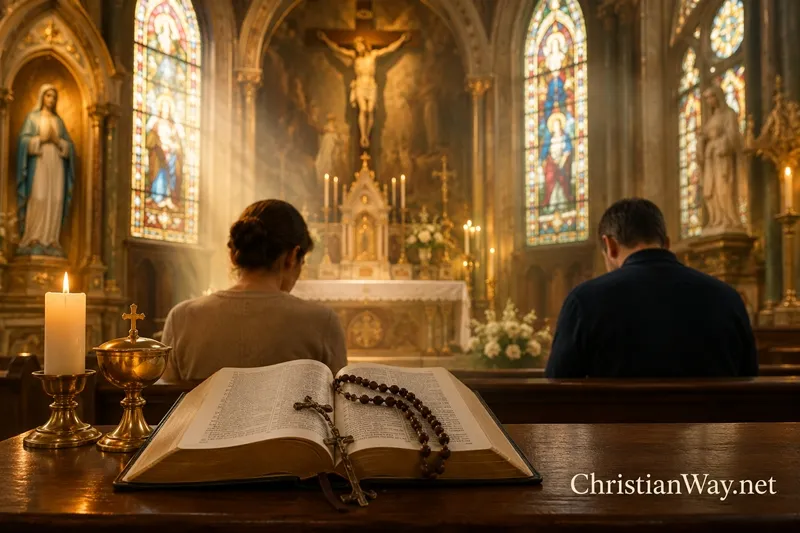
Catholicism carries within it nearly two thousand years of prayer, theological reflection, missionary witness, artistic beauty, human struggle, reform, sacrifice, and holiness. It has been lived in deserts and cities, monasteries and family homes, royal courts and prison cells. It has been proclaimed by scholars and embraced by children. It has inspired cathedrals, hospitals, schools, works of charity, contemplative communities, and movements for human dignity. It has also passed through periods of scandal, corruption, division, and failure, reminding Catholics that the holiness of Christ does not erase human weakness but continually calls the Church to repentance.
To understand Catholicism, then, we must approach it neither as an idealized institution untouched by sin nor as a collection of controversies. We must enter its central mystery: Jesus Christ continues to gather, teach, forgive, nourish, and sanctify His people. Everything truly Catholic must ultimately lead back to Him.
Catholicism Is Centered on Jesus Christ
The center of Catholic faith is not the pope, the Virgin Mary, the saints, Rome, canon law, religious ritual, or institutional authority. The center is Jesus Christ.
Catholics confess with other historic Christians that Jesus is truly God and truly man. He is not merely a prophet, moral teacher, spiritual guide, or religious reformer. He is the eternal Word through whom all things were made. As the Gospel of John declares, “The Word was made flesh, and dwelt among us” (John 1:14).
In Jesus, God does not simply send information about Himself. He comes personally. Christ reveals the Father, bears the burden of sin, conquers death, and opens the way to eternal life. His crucifixion is not understood as an accidental tragedy or the defeat of a good man. It is the self-offering of divine love. His resurrection is not merely a symbol that goodness survives. It is the real victory of God over sin and death.
Catholicism teaches that salvation is entirely rooted in the grace of God revealed in Christ. Humanity cannot save itself through moral effort, religious achievement, intelligence, wealth, or social status. God takes the initiative. Grace comes first. Even the human ability to respond to God is itself assisted and awakened by grace.
At the same time, Catholic teaching emphasizes that grace does not destroy human freedom. God does not save us as though we were lifeless objects. He heals and transforms our freedom so that we may genuinely respond to Him in faith, hope, love, repentance, and obedience.
This is why Catholic spirituality speaks so often about cooperation with grace. Such cooperation does not mean that human beings earn salvation independently of Christ. It means that God’s love makes a real response possible. A person who is forgiven is called to forgive. A person who has received mercy is called to practice mercy. A person joined to Christ is called to become more like Christ.
Saint Paul expresses this mystery when he writes, “It is God which worketh in you both to will and to do of his good pleasure” (Philippians 2:13). God acts within us, yet our response remains meaningful. Grace is not opposed to human action; grace restores human action to its proper purpose.
The Paschal Mystery
Catholic theology often describes the suffering, death, resurrection, and glorification of Jesus as the Paschal Mystery. This mystery stands at the heart of Catholic worship and life.
The word “mystery” does not mean something irrational or completely unknowable. It means a divine reality so rich that it can be truly known without ever being exhausted. The death and resurrection of Christ are historical events, but they also possess an eternal depth. Through them, Christ enters the darkest realities of human existence and transforms them from within.
Every Mass, every baptism, every act of repentance, every work of mercy, and every faithful endurance of suffering participates in some way in the Paschal Mystery. The Christian life takes the shape of the cross and resurrection. We die to sin and rise to new life. We surrender pride and receive humility. We pass through sorrow without surrendering hope.
Catholicism does not promise a life free from suffering. It proclaims that suffering need not be meaningless when united with Christ. The cross does not make pain good in itself, but it reveals that divine love can enter pain and bring forth redemption.
The Meaning of the Word “Catholic”
The word “Catholic” comes from a Greek term meaning “universal” or “according to the whole.” Early Christians used the word to describe the Church spread throughout the world, united in the apostolic faith, the sacraments, and communion among local churches.
The term expresses both breadth and wholeness. The Catholic Church is called to proclaim the Gospel to every nation, culture, class, and generation. No people belongs outside the concern of Christ. At the same time, Catholicism seeks to preserve the fullness of the Christian faith rather than reducing Christianity to one favored teaching, spiritual experience, cultural expression, or biblical passage.
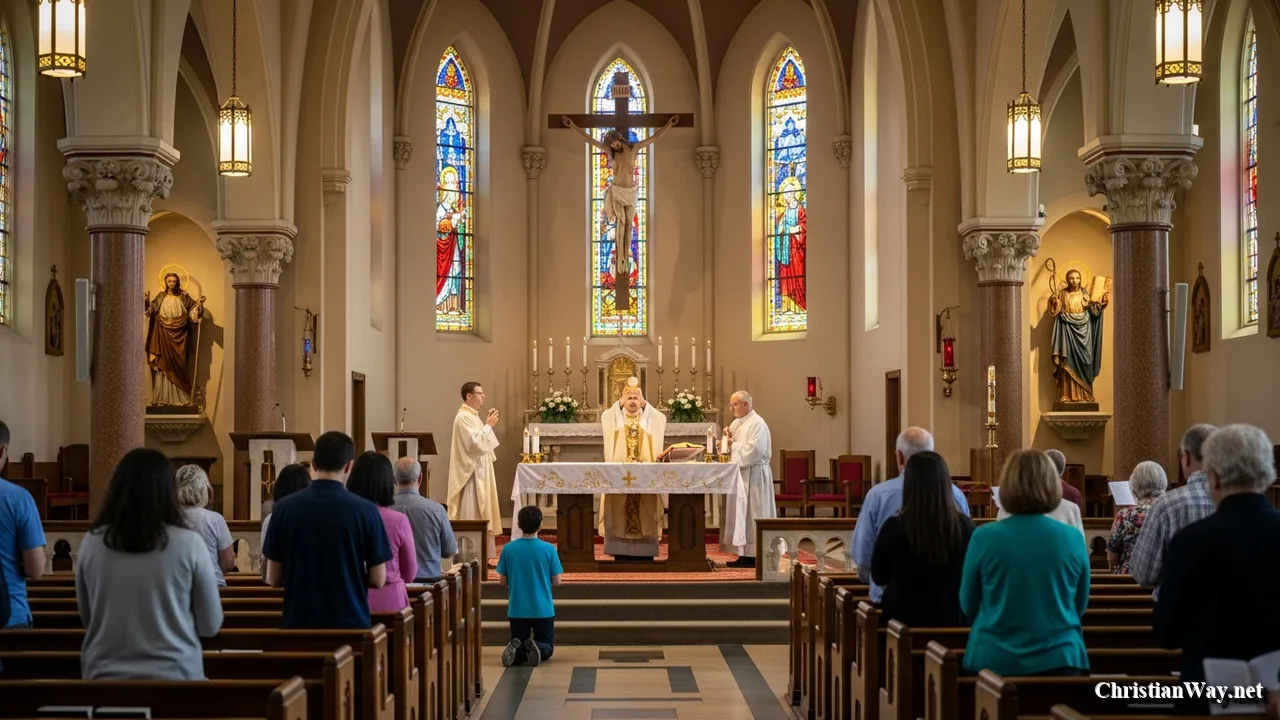
The word “universal” does not mean uniform. Catholic life appears in many cultural forms. A Mass celebrated in a village in Africa may look and sound different from one celebrated in Poland, India, Brazil, Vietnam, France, or the Philippines. Eastern Catholic churches possess liturgical, theological, and spiritual traditions distinct from those of the Latin Church while remaining in communion with the bishop of Rome.
This unity within diversity reflects the vision of Pentecost. The Holy Spirit did not erase the languages of the peoples gathered in Jerusalem. Instead, He enabled them to hear the mighty works of God in their own tongues. Catholic unity, at its best, does not destroy legitimate cultural difference. It gathers diverse peoples into one confession of Christ.
The Church as the People and Body of God
Catholics believe that Jesus intended to form a visible community of disciples. During His earthly ministry, He gathered the Twelve Apostles, taught them, sent them to preach, gave them authority, and promised to remain with His people.
After His resurrection, Jesus commanded His disciples:
“Go ye therefore, and teach all nations, baptizing them in the name of the Father, and of the Son, and of the Holy Ghost.”
— Matthew 28:19
At Pentecost, the Holy Spirit descended upon the disciples, empowering them to bear witness to Christ. Catholic tradition therefore sees Pentecost as the public manifestation of the Church and the beginning of its worldwide mission.
The Church is described in Catholic theology through several biblical images. It is the body of Christ, the people of God, the bride of Christ, the temple of the Holy Spirit, the flock of the Good Shepherd, and a pilgrim people journeying toward the kingdom of God.
Each image protects an important truth. The Church is not identical to Christ, yet it is inseparably joined to Him. It is made holy by God, yet its human members remain capable of sin. It possesses visible structures, yet it also contains a spiritual mystery that cannot be reduced to administration.
Catholics therefore distinguish between the holiness of the Church as the body joined to Christ and the personal holiness of its members. The failures of Christians are real and must never be hidden or excused. Clergy and laypeople alike can betray the Gospel. The Church continually requires purification, reform, accountability, and repentance.
Yet Catholics believe that human sin does not cancel the faithfulness of Christ. He remains the true head and shepherd of the Church. The treasure of the Gospel is carried, as Saint Paul says, “in earthen vessels” (2 Corinthians 4:7). The weakness of the vessel makes the treasure no less divine, though it should make every Christian humble.
Apostolic Succession
A central Catholic belief is that the mission entrusted by Christ to the apostles did not end when they died. The apostles appointed successors to continue teaching, governing, and sanctifying the Christian community. This continuing ministry is known as apostolic succession.
Catholic bishops are understood to stand within this historic succession. They do not become new apostles in precisely the same foundational sense as the Twelve, but they continue the apostolic ministry within the Church. Priests cooperate with bishops, while deacons serve through ministries of the Word, liturgy, and charity.
Apostolic succession is not merely a chain of official appointments. It also includes continuity in apostolic teaching, sacramental life, and communion. Authority in the Church is meant to protect the Gospel and serve the people of God, not elevate leaders above Christ.
Jesus taught His disciples that Christian authority must differ from worldly domination. “Whosoever will be chief among you, let him be your servant” (Matthew 20:27). Whenever Church authority becomes self-protective, proud, abusive, or detached from service, it contradicts the Lord whose authority it claims to represent.
Scripture and Sacred Tradition
Catholics receive the Bible as the inspired Word of God. Scripture is proclaimed at every Mass, prayed in the Liturgy of the Hours, studied by theologians, meditated upon by families and individuals, and woven throughout Catholic worship.
The Church teaches that the human authors of Scripture wrote under the inspiration of the Holy Spirit. Their personalities, cultures, literary styles, and historical settings were genuinely involved, yet God worked through them so that Scripture teaches the truth He intended for our salvation.
Catholicism does not place Sacred Tradition above Scripture as though the two were competing sources. Rather, Catholics understand Scripture and Tradition as closely united ways in which the apostolic faith is handed on.
Sacred Tradition does not simply mean customs that accumulated over time. Some customs may change, develop, or disappear. Sacred Tradition, in its deeper theological sense, is the living transmission of the Gospel entrusted by Christ to the apostles and passed on in the life, worship, teaching, and witness of the Church.
Before the New Testament books were gathered into a completed biblical canon, Christians already preached the Gospel, baptized believers, celebrated the Eucharist, appointed ministers, and handed on the teachings of the apostles. The Scriptures emerged within this worshiping apostolic community.
Catholics therefore read the Bible within the living faith of the Church. The teaching office of the bishops in communion with the pope, called the Magisterium, serves the Word of God by guarding and faithfully interpreting the apostolic deposit of faith.
The Magisterium is not understood as receiving new public revelation beyond Christ. Catholic teaching holds that God’s definitive revelation has been given in Jesus Christ and transmitted through the apostles. The Church may grow in its understanding of that revelation, clarify doctrines, address new questions, and express ancient truths in new language, but it cannot replace the Gospel with another message.
Reading Scripture With the Church
Catholic biblical interpretation pays attention to the literal meaning of a text: what the inspired authors intended to communicate through their language, culture, and literary form. It also recognizes the spiritual unity of Scripture, especially the way the Old and New Testaments illuminate one another.
For example, the crossing of the Red Sea is a real event in Israel’s story, but Christians have also seen in it an image of baptism: liberation from slavery, passage through water, and entrance into a new life with God. The Passover lamb prepares the reader to understand Christ, “the Lamb of God” (John 1:29). The manna in the wilderness prepares the way for Christ’s teaching about the bread of life.
This way of reading does not discard history. It sees history as part of the larger divine plan fulfilled in Christ.
Catholics are encouraged to read Scripture prayerfully through practices such as lectio divina, a slow and attentive form of sacred reading. In this practice, one listens to the biblical text, meditates on its meaning, responds to God in prayer, and rests in His presence.
The purpose is not simply to collect religious information. It is to allow the Word of God to enter the conscience, heal the memory, correct the will, and awaken love.
The Seven Sacraments
One of the most distinctive features of Catholicism is its sacramental understanding of the Christian life. A sacrament is a visible sign instituted by Christ that communicates divine grace.
Catholicism teaches that God often reaches human beings through material realities. This pattern flows from the Incarnation. The eternal Son of God took a human body. He spoke with a human voice, touched the sick, ate with sinners, washed His disciples’ feet, suffered in the flesh, and rose bodily from the grave.
Because God created the material world and entered it in Christ, physical things can serve His saving purpose. Water, oil, bread, wine, spoken words, human touch, and the gathered community become signs through which Christ acts.
The Catholic Church recognizes seven sacraments: Baptism, Confirmation, the Eucharist, Penance or Reconciliation, the Anointing of the Sick, Holy Orders, and Matrimony.
Baptism
Baptism is the sacrament of new birth in Christ. Through water and the invocation of the Father, Son, and Holy Spirit, a person is freed from sin, united with Christ, and incorporated into the Church.
Catholics baptize both adults and infants. Infant baptism expresses the conviction that grace is a gift before it is an achievement. A child cannot earn adoption into God’s family. The child receives grace, while parents and the Christian community promise to nurture the child in faith.
Baptism is not a guarantee that a person will live faithfully. Grace invites a lifelong response. The baptized must continually learn to die to sin and live as disciples of Christ.
Confirmation
Confirmation strengthens the grace of baptism through a special outpouring of the Holy Spirit. It deepens the believer’s bond with the Church and equips the person to witness courageously to Christ.
The sacrament recalls Pentecost, when fearful disciples were transformed into bold proclaimers of the Gospel. Confirmation is not a spiritual graduation after which religious formation ends. It is a commissioning for mature Christian discipleship.
The Eucharist
The Eucharist is the center of Catholic worship. Catholics believe that, through the consecration at Mass, the bread and wine truly become the Body and Blood of Christ while retaining their outward appearances.
This belief is rooted in the words of Jesus at the Last Supper: “This is my body” and “This is my blood.” It is also connected to His teaching in John 6: “I am the living bread which came down from heaven.”
The Catholic term transubstantiation seeks to express this mystery. It does not explain the Eucharist through chemistry or physical appearance. It means that the deepest reality of the bread and wine is changed by the power of Christ.
The Eucharist is simultaneously a sacred meal, the memorial of Christ’s Passover, the sacramental presence of His once-for-all sacrifice, and communion with His risen life. Catholics do not believe that Christ is crucified again at every Mass. Rather, the one sacrifice of Calvary is made sacramentally present so that believers may participate in its grace.
Receiving Communion therefore carries a profound meaning. The believer receives Christ and is also called to become what he or she receives: a member of Christ’s body, broken open in love for the life of the world.
Reconciliation
In the sacrament of Reconciliation, Catholics confess their sins to a priest, express contrition, receive spiritual counsel and penance, and hear the words of absolution.
Catholics confess to a priest not because the priest replaces God, but because Christ entrusted a ministry of reconciliation to His Church. After the resurrection, Jesus breathed on the apostles and said, “Whose soever sins ye remit, they are remitted unto them” (John 20:23).
The priest acts as a servant of Christ’s mercy. The power to forgive belongs to God. Sacramental confession gives the penitent a concrete encounter with that forgiveness while also acknowledging that sin wounds not only one’s private relationship with God but also the wider community.
Confession is not meant to produce humiliation or fear. Properly celebrated, it is a place of truth, healing, liberation, and renewed dignity. The Christian does not confess because God is reluctant to forgive, but because God desires to free the heart from what it has hidden.
Anointing of the Sick
The Anointing of the Sick offers grace, strength, peace, and sometimes physical healing to those who are seriously ill, weakened by age, or facing grave medical circumstances.
It is not reserved only for the final moments before death. The sacrament joins the suffering person more deeply to Christ and surrounds illness with the prayer of the Church.
Catholicism does not pretend that every faithful prayer results in physical recovery. Sometimes healing comes through restored health; sometimes through reconciliation, courage, acceptance, or preparation for eternal life. In every case, the sick person is reminded that he or she has not been abandoned.
Holy Orders
Through Holy Orders, bishops, priests, and deacons are ordained for service within the Church.
Bishops receive the fullness of ordained ministry and serve as successors of the apostles. Priests preach, celebrate the sacraments, shepherd communities, and cooperate with their bishops. Deacons proclaim the Gospel, assist in worship, and exercise ministries of charity and service.
Ordination does not make a person morally superior. It places him under a serious obligation to imitate Christ the servant. The credibility of ordained ministry depends not only upon sacramental office but also upon humility, integrity, accountability, and pastoral love.
Matrimony
Catholicism understands marriage between a baptized man and woman as a sacrament: a covenant in which the spouses become signs of Christ’s faithful love for the Church.
The spouses themselves confer the sacrament upon one another through their free consent. Their ordinary life together—their sacrifices, forgiveness, fidelity, affection, work, suffering, and care for children—becomes a path of holiness.
Catholic marriage is intended to be faithful, lifelong, and open to life. This teaching can be demanding, especially in a culture where relationships are often treated as temporary arrangements. Yet its deeper purpose is not to impose an abstract burden. It is to witness that love is capable of covenant, endurance, fruitfulness, and self-gift.
The Church also recognizes that family life may include painful situations: infertility, illness, betrayal, abandonment, economic hardship, and separation. Such wounds require truth, justice, protection for the vulnerable, and compassionate pastoral care.
The Mass and Catholic Worship
The word “Mass” refers to the principal act of worship in the Latin Catholic tradition. Its basic structure contains two major parts: the Liturgy of the Word and the Liturgy of the Eucharist.
In the Liturgy of the Word, passages from Scripture are proclaimed, usually from the Old Testament, the Psalms, the New Testament letters, and one of the Gospels. A homily explains and applies the Word. The community professes the faith and offers prayers for the Church and the world.
In the Liturgy of the Eucharist, bread and wine are brought forward, the Church gives thanks to the Father, the words of Christ are proclaimed, and the Holy Spirit is invoked. The faithful then receive Holy Communion if properly prepared.
Catholic worship is both communal and deeply personal. The prayers do not depend entirely upon the creativity or emotional condition of the minister. They belong to the whole Church. This can be comforting when a person feels spiritually dry. The liturgy carries the believer when private words fail.
At the same time, external participation is not enough. A person may stand, kneel, respond, sing, and receive Communion while the heart remains distracted or closed. Catholic worship calls for both bodily participation and interior conversion.
The gestures of the Mass express Catholic theology. Standing signifies reverence and readiness. Sitting allows attentive listening. Kneeling expresses humility and adoration. The sign of the cross recalls baptism and the Holy Trinity. Silence creates space for the soul to receive what words cannot fully express.
The Pope and the Ministry of Unity
The pope is the bishop of Rome and the successor of Saint Peter. Catholics believe that Christ gave Peter a distinctive pastoral responsibility among the apostles.
Jesus said to Peter, “Thou art Peter, and upon this rock I will build my church” (Matthew 16:18). He also prayed that Peter’s faith would not fail and commanded him to strengthen his brethren. After the resurrection, Christ entrusted Peter with the threefold command, “Feed my sheep.”
Catholics understand the papal ministry as a service of visible unity, doctrinal fidelity, and pastoral care for the universal Church. The pope does not replace Christ, receive new revelation, or possess unlimited authority. He is bound to the Gospel and the apostolic faith.
The doctrine of papal infallibility is often misunderstood. It does not mean that the pope is sinless, always wise, always correct in personal opinions, or incapable of administrative mistakes. It refers to carefully defined circumstances in which the pope solemnly teaches a doctrine concerning faith or morals for the whole Church.
Such definitions are rare. Most papal statements do not carry this highest level of authority, though Catholics are still called to receive the pope’s ordinary teaching with serious attention appropriate to its nature.
The papacy remains one of the major points of disagreement between Catholics, Eastern Orthodox Christians, and Protestants. These disagreements involve history, biblical interpretation, the extent of Roman authority, and the relationship between the pope and other bishops.
Catholics should speak about these differences with humility. The desire for Christian unity must never become an excuse for caricature. Genuine ecumenism requires both honesty about disagreement and gratitude for the faith Christians already share in the Triune God, the divinity of Christ, His death and resurrection, Scripture, baptism, prayer, and the call to holiness.
Mary, the Mother of Jesus
Catholic devotion to Mary can be confusing to Christians who fear that she is being placed alongside God. Catholic teaching, however, makes a clear distinction between the worship owed to God alone and the honor given to Mary and the saints.
Catholics do not believe that Mary is divine. She is a human being, created and redeemed by God. Everything she possesses comes from grace. Her greatness lies in the work of God within her and in her faithful response.
Mary is honored above all because she is the mother of Jesus Christ. The title “Mother of God” does not mean that she existed before God or gave origin to Christ’s divine nature. It protects the truth that the one she bore is a single divine Person who is truly God and truly man.
At the Annunciation, Mary responds to God’s call: “Behold the handmaid of the Lord; be it unto me according to thy word” (Luke 1:38). Her faith becomes an image of Christian discipleship. She receives the Word, carries Christ within her, and gives Him to the world.
Catholics ask Mary to pray for them in much the same way Christians ask one another for prayer, while recognizing that her relationship with Christ and the Church is unique. This practice depends upon belief in the communion of saints: those who have died in Christ remain alive in Him and are not separated from His body.
Mary’s words at the wedding feast of Cana summarize authentic Marian spirituality: “Whatsoever he saith unto you, do it” (John 2:5). True devotion to Mary must lead toward obedience to Jesus, not away from Him.
The Communion of Saints
In Catholic language, the word “saints” can refer broadly to all who belong to Christ, but it is also used for men and women whose lives of holiness have been formally recognized by the Church.
Catholics do not worship the saints. Worship belongs to God alone. Saints are honored as witnesses to the transforming power of grace and as members of Christ’s body who pray for the Church.
The saints are not presented as people who never struggled. Many passed through doubt, temptation, grief, conflict, weakness, or serious sin. Saint Peter denied Christ. Saint Augustine lived far from the faith before his conversion. Saint Thérèse of Lisieux endured spiritual darkness. Saint Josephine Bakhita survived enslavement and cruelty. Saint Maximilian Kolbe offered his life for another prisoner in Auschwitz.
Their lives show that holiness is not a single personality type. Some saints were contemplatives, others missionaries, scholars, parents, physicians, laborers, rulers, servants, martyrs, or advocates for the poor. Their diversity reveals that grace does not erase individuality. It purifies and fulfills it.
Canonization does not mean that every opinion or action of a saint was perfect. It means that the Church recognizes the person as having lived heroic Christian virtue and now shares in the life of heaven.
Relics, feast days, sacred art, and pilgrimage help Catholics remember that Christianity is embodied and historical. The Gospel has been lived by real people in particular places and circumstances.
Sin, Grace, and Salvation
Catholicism takes sin seriously because it takes love seriously. Sin is not merely the violation of an arbitrary rule. It is a rejection or distortion of the good, a wound in our relationship with God and others, and a misuse of human freedom.
Catholic teaching distinguishes between mortal and venial sin. Mortal sin involves grave matter, sufficient knowledge, and deliberate consent. It destroys charity in the heart by turning the person away from God in a serious way. Venial sin wounds the relationship with God without completely breaking it.
This distinction is not meant to encourage anxious calculation. It recognizes that not all wrong actions possess equal seriousness and that personal responsibility may be affected by ignorance, fear, coercion, immaturity, habit, psychological factors, and other circumstances.
Salvation is not merely acquittal from guilt. It includes forgiveness, adoption, healing, sanctification, and participation in divine life. Catholics often use the word theosis or divinization, especially in the Eastern traditions, to describe how grace makes human beings “partakers of the divine nature” (2 Peter 1:4).
This does not mean that human beings become God by nature. It means that they are drawn by grace into communion with God, as iron placed in fire begins to glow with the fire’s heat without ceasing to be iron.
Faith is essential to salvation. Yet Catholicism understands saving faith as living faith, a trust in Christ that bears fruit in love. Good works do not purchase grace. They are the fruit of grace and the living expression of faith.
Saint James writes, “Faith without works is dead” (James 2:26). Saint Paul teaches that salvation is by grace and that believers are “created in Christ Jesus unto good works” (Ephesians 2:10). Catholic theology seeks to hold these truths together: we are not saved by works performed apart from grace, but the grace that saves us transforms the way we live.
Catholic Moral Teaching
Catholic moral teaching begins with the dignity of the human person created in the image of God. Human beings must never be treated merely as objects, instruments, commodities, or obstacles.
This dignity belongs to every person, including the unborn child, the elderly, the disabled, the prisoner, the refugee, the poor, the sick, the stranger, and even the enemy. It does not depend upon health, usefulness, intelligence, social approval, wealth, nationality, or moral perfection.
Catholic morality is often presented only as a list of prohibitions, especially concerning sexuality and family life. Yet its deeper purpose is to guide human freedom toward authentic love. The commandments protect goods such as life, truth, fidelity, justice, family, worship, and the dignity of the body.
Freedom, in Catholic thought, is not simply the ability to choose anything whatsoever. True freedom is the capacity to choose the good. A musician becomes free to play beautifully not by rejecting discipline but by being formed through it. In a similar way, virtue trains human desires so that a person can love wisely and consistently.
Catholic social teaching applies the Gospel to economic, political, and social life. It affirms the dignity of work, the rights of workers, concern for the poor, responsible use of property, solidarity among peoples, care for creation, the pursuit of peace, and the principle that decisions should be made at the most appropriate local level while still serving the common good.
Charity and justice belong together. Giving food to a hungry person is an act of mercy. Asking why people remain hungry, and working to correct unjust conditions, is also an act of love.
The Church does not offer a single technical solution to every political question. Catholics may disagree prudently about policies. Yet they may not treat politics as morally neutral. The Gospel must shape how Christians view power, wealth, violence, truth, human life, and responsibility toward the vulnerable.
Prayer and Catholic Spirituality
Catholic spirituality contains many forms of prayer because human relationships require many forms of communication. Prayer includes praise, thanksgiving, repentance, petition, intercession, meditation, contemplation, silence, and lament.
The highest prayer of the Church is the Eucharist, but Catholics are also encouraged to develop daily personal prayer. The Our Father holds a privileged place because Jesus Himself taught it.
The Psalms give believers words for nearly every human condition: joy, fear, anger, wonder, guilt, loneliness, gratitude, and hope. The Rosary meditates upon the life of Christ with Mary. The Stations of the Cross accompany Jesus through His Passion. Eucharistic adoration places the believer in prayer before Christ present in the sacrament.
Catholic spirituality also includes the Liturgy of the Hours, a cycle of psalms, readings, and prayers offered throughout the day by clergy, religious communities, and many laypeople. Through it, the Church seeks to sanctify the hours of human life.
Devotions are helpful when they lead toward Christ, the sacraments, charity, and conversion. They become unhealthy when treated as magical techniques, guarantees of earthly success, or substitutes for moral responsibility.
Prayer is not a way to control God. It is the opening of the heart to His presence. Sometimes prayer brings consolation; at other times, it feels dry or silent. Catholic spiritual teachers repeatedly warn that feelings alone do not measure faithfulness. Love may become deepest when a person continues to pray without emotional reward.
Religious Life and the Universal Call to Holiness
Catholicism includes many forms of vocation. Some are called to marriage, some to priesthood, some to consecrated religious life, and some to dedicated forms of single life and service.
Religious sisters, brothers, monks, nuns, and friars make vows that commonly include poverty, chastity, and obedience. Their lives are meant to point toward the kingdom of God, where human fulfillment rests ultimately in communion with Him.
Contemplative communities serve the Church through hidden lives of prayer. Active communities may serve in education, healthcare, missions, care for the poor, or other ministries. Some religious orders emphasize preaching, others silence, study, hospitality, manual labor, or service among the marginalized.
Yet holiness is not reserved for priests and religious. The Second Vatican Council strongly emphasized the universal call to holiness. Every baptized person is called to become a saint.
For most people, holiness unfolds through ordinary responsibilities. It appears in the parent who rises during the night to care for a sick child, the employee who refuses dishonesty, the student who befriends someone excluded, the caregiver who remains patient, the wounded person who struggles toward forgiveness, and the elderly believer who offers loneliness as prayer.
Holiness is not spiritual fame. It is love becoming faithful in real circumstances.
Catholicism in the Midst of Human Weakness
Any honest explanation of Catholicism must acknowledge the grave failures committed by Catholics and Catholic institutions. History includes examples of political compromise, intolerance, corruption, coercion, neglect, and abuse. In modern times, the sexual abuse of minors and vulnerable adults by clergy, together with institutional concealment, has caused immeasurable suffering.
These sins must not be minimized by pointing to the good works of the Church or the failures of other institutions. Victims deserve truth, justice, care, and protection. Repentance requires more than words. It demands accountability, safeguarding, transparency, and lasting reform.
Such failures create a painful question: How can the Church claim holiness when its members commit terrible sins?
Catholic theology answers that the Church is holy because Christ is holy, because the Holy Spirit dwells within her, and because she possesses the means of grace. Yet the Church is also composed of sinners who may resist and betray that grace. Her holiness is a gift and a calling, not a reason for self-congratulation.
The sins of Christians do not disprove the Gospel, but they can obscure it terribly. They place upon the Church a responsibility to listen, repent, repair harm where possible, and become more faithful to the Lord she proclaims.
Catholicism and Other Christians
Catholics share a profound spiritual inheritance with Eastern Orthodox, Oriental Orthodox, Anglican, Protestant, and other Christian communities. All who confess Christ as Lord and receive valid Christian baptism possess a real, though sometimes imperfect, communion.
Catholicism differs from other Christian traditions concerning the authority of the pope, the relationship between Scripture and Tradition, the number and nature of the sacraments, the Eucharist, justification, purgatory, Marian doctrines, the invocation of saints, ordained ministry, and other matters.
These differences should not be hidden. Unity cannot be built upon vagueness or indifference to truth. Yet disagreement should not lead to contempt. Christians must not speak of one another as though centuries of prayer, sacrifice, theological reflection, and faithful witness were meaningless.
Catholics can receive gifts from other Christians: a deep love of Scripture, vigorous preaching, congregational participation, missionary courage, sacred music, contemplative wisdom, and strong communal life. Other Christians may likewise encounter within Catholicism the richness of sacramental worship, historic continuity, monastic spirituality, global communion, and the witness of the saints.
Ecumenism does not ask Christians to pretend that all differences are insignificant. It asks them to seek truth together, repent of hostility, cooperate in works of mercy, and pray for the unity Christ desires.
Common Misunderstandings About Catholicism
Some believe Catholics worship Mary, but Catholic doctrine reserves worship for God alone. Mary is honored because of her relationship with Christ and her exemplary discipleship.
Some believe Catholics think they can earn heaven through good deeds. Catholic teaching instead holds that salvation begins and remains rooted in grace, while insisting that saving faith must become active in love.
Some believe papal infallibility means every papal statement is perfect. In reality, the doctrine applies only under specific and limited conditions involving definitive teaching on faith or morals.
Some believe Catholics are discouraged from reading the Bible. While access to Scripture was historically shaped by questions of literacy, language, printing, and ecclesial regulation, contemporary Catholic teaching strongly encourages biblical reading and study.
Some imagine Catholic worship as empty ritual. Ritual can indeed become empty when the heart is absent, but ritual itself is not the enemy of sincerity. Human beings express love through repeated embodied actions: meals, vows, embraces, songs, anniversaries, and shared remembrance. The liturgy seeks to order such human expression toward God.
Some suppose that Catholicism teaches blind obedience. Authentic Catholic obedience is directed toward truth and must never be used to justify abuse, manipulation, illegality, or the violation of conscience. Conscience must be carefully formed, but a person must not act against a certain judgment of conscience.
Living as a Catholic Today
To live as a Catholic is not merely to identify with a cultural heritage or attend Mass occasionally. It is to enter a lifelong path of conversion.
A Catholic seeks to participate faithfully in Sunday Mass, receive the sacraments, pray regularly, study Scripture and the faith, examine the conscience, practice mercy, support the Church’s mission, and serve neighbors in need.
Yet discipleship is not measured only by visible religious activity. A person may know Catholic terminology, defend Church teaching, and participate in devotions while remaining harsh, proud, dishonest, or indifferent to suffering.
Jesus identifies love of God and love of neighbor as the greatest commandments. Catholic practice must therefore produce patience, truthfulness, humility, chastity, generosity, courage, justice, and mercy.
Modern life makes this difficult. Constant digital stimulation scatters attention. Consumer culture teaches people to seek identity through possessions. Political conflict tempts believers to treat opponents as enemies. Sexual confusion separates intimacy from covenant. Ambition turns work into a measure of personal worth. Loneliness hides beneath endless communication.
Catholic spirituality responds not by fleeing the world but by learning to live within it differently. Silence resists distraction. Sabbath worship resists the tyranny of productivity. Fasting challenges consumer desire. Confession breaks the habit of self-justification. The Eucharist teaches gratitude and self-gift. Service to the poor reveals Christ in those society overlooks.
The Catholic life is therefore not an escape from reality. It is an attempt to see reality in the light of Christ.
What Is Catholicism at Its Deepest Level?
Catholicism is the confession that God has entered human history and continues to communicate His grace through the body of Christ, the Word of Scripture, the apostolic faith, the sacraments, and the communion of believers.
It is the conviction that matter can carry grace because the Word became flesh.
It is the belief that salvation is personal but never merely private.
It is the hope that sinners can be forgiven, wounded lives can be healed, ordinary work can become holy, suffering can be united with love, and death does not have the final word.
It is a faith that gathers at an altar and is sent outward into the world.
At the end of Mass, the people are dismissed to live what they have received. The Latin word connected with this sending gives the Mass its name. Worship becomes mission. Those who receive the Body of Christ are sent to recognize and serve Christ in the hungry, the lonely, the forgotten, the imprisoned, the unborn, the elderly, the refugee, the grieving, and the person who has become difficult to love.
Catholicism fails whenever it turns inward and protects its own comfort. It becomes faithful when it allows Christ to break open its life for the salvation and healing of the world.
In the Light of Christ
Dear friends, Catholicism is vast. It contains ancient creeds, philosophical traditions, canon law, councils, monasteries, religious orders, liturgical rites, theological schools, popular devotions, missionary movements, and cultural expressions from every part of the world. Yet all of these must be judged by one simple question: Do they reveal Jesus Christ and help His people follow Him?
The Church does not exist for herself. She exists to receive Christ, proclaim Christ, worship Christ, and carry His mercy into the world.
For the practicing Catholic, this truth is a call to renewal. Faith cannot remain a label inherited from family or culture. It must become a living surrender to God.
For the Christian from another tradition, Catholicism should be approached with both honesty and charity. Serious disagreements remain, but so does a shared confession of Jesus Christ as Lord.
For the person who is uncertain, wounded, or simply curious, there is no need to understand everything at once. The journey of faith often begins quietly—with a question, a moment of prayer, the reading of a Gospel, an encounter with unexpected kindness, or a longing that ordinary success cannot satisfy.
The Catholic Church points beyond herself to the One who says, “Come unto me, all ye that labour and are heavy laden, and I will give you rest” (Matthew 11:28).
Christ is the beginning and end of Catholicism. He is the Word proclaimed in Scripture, the mercy offered in confession, the bread received at the altar, the Lord honored in prayer, and the suffering neighbor waiting to be loved.
May we never allow religious familiarity to hide His face from us. May our worship become love, our doctrine become wisdom, our repentance become freedom, and our faith become a light for those who walk in darkness.
Let us pray:
Lord Jesus Christ,
You called Your disciples to remain in Your love
and sent them to carry the Gospel to every nation.
Draw us beyond pride, fear, and division.
Forgive the sins by which we have obscured Your face.
Teach us to receive Your grace with humility,
to worship the Father in spirit and truth,
and to recognize Your presence in every person we meet.
Strengthen Your Church in holiness, courage, and mercy,
so that all her words and works may lead the world toward You.
May the Holy Spirit guide us into truth,
and may the peace of God rest upon every searching heart.
Amen.
May the peace of Christ dwell richly within you, and may His grace lead you ever more deeply into truth, holiness, and love.
— Fr. John Matthew