A gentle explanation of how Catholicism belongs within Christianity, with shared faith, real differences, and hope for unity.
Dear friends in Christ,
The question “What is the difference between Catholicism and Christianity?” is asked more often than many people realize. Sometimes it comes from sincere curiosity. Sometimes it arises from a person’s first encounter with a Catholic church, a Protestant congregation, or an Orthodox liturgy. At other times, it reflects language commonly heard in families or communities: one person says, “I am Catholic,” while another says, “I am Christian,” as though these were two entirely separate religions.
Yet the relationship between Catholicism and Christianity cannot be described accurately as a simple opposition. Catholicism is not outside Christianity, nor is Christianity a denomination competing with Catholicism. Christianity is the broad faith centered on Jesus Christ, while Catholicism is one of the principal historic traditions within that faith.
A Catholic is therefore a Christian. At the same time, not every Christian is Catholic.
That simple sentence provides the foundation, but it does not answer every question. Catholics, Eastern Orthodox Christians, Anglicans, Lutherans, Baptists, Methodists, Pentecostals, Reformed Christians, Evangelicals, and members of many other communities all confess Jesus Christ, read the Scriptures, practice baptism, gather for worship, and seek to live according to the Gospel. Nevertheless, they differ on important questions concerning authority, the Church, the sacraments, salvation, Mary, the saints, ordained ministry, and Christian tradition.
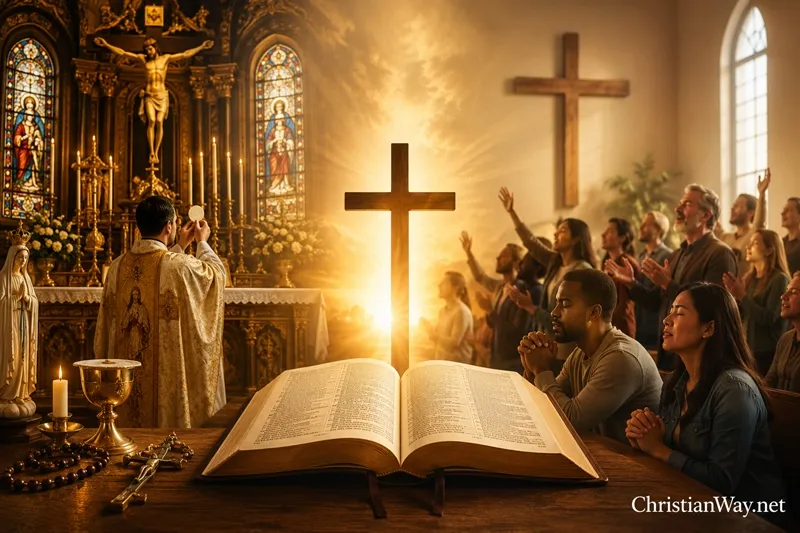
These differences should neither be ignored nor exaggerated. Truth does not require us to pretend that all Christians believe exactly the same things. Love, however, requires us to speak about one another honestly, respectfully, and without caricature.
The purpose of this reflection is not to decide which Christians are more sincere, nor to deepen old divisions. It is to understand what the words Catholicism and Christianity actually mean, what Catholics share with other Christians, where genuine differences remain, and how all who bear the name of Christ may seek greater faithfulness to Him.
Christianity Is the Faith Centered on Jesus Christ
Christianity begins not with a denomination, an institution, a nation, or a cultural identity, but with Jesus Christ.
Christians believe that Jesus of Nazareth is the promised Messiah, the Son of God, the Word made flesh, the Savior of the world, crucified and risen for the redemption of humanity. Christianity is the life of faith that flows from encountering Him, receiving His grace, entering His covenant, and learning to follow Him.
Jesus did not merely offer moral advice. He announced the kingdom of God, forgave sins, healed the sick, welcomed the rejected, confronted hypocrisy, revealed the Father, laid down His life upon the Cross, and rose from the dead. After His resurrection, He sent His disciples into the world, saying:
“Go ye therefore, and teach all nations, baptizing them in the name of the Father, and of the Son, and of the Holy Ghost.”
— Matthew 28:19
The first Christians were united by faith in the risen Lord. They listened to the teaching of the apostles, shared fellowship, broke bread, prayed together, cared for the poor, and proclaimed the Gospel. The book of Acts describes this early Christian life:
“And they continued stedfastly in the apostles’ doctrine and fellowship, and in breaking of bread, and in prayers.”
— Acts 2:42
Christianity therefore includes a shared core of faith. Historic Christians confess one God who is Father, Son, and Holy Spirit. They believe that God created the world, that humanity has been wounded by sin, that Christ came for our salvation, that He truly died and rose again, that the Holy Spirit gives life to the Church, and that Christ will come again.
These central convictions are expressed in ancient creeds, especially the Apostles’ Creed and the Nicene Creed. Catholics, Orthodox Christians, Anglicans, Lutherans, Methodists, and many other Protestants regularly profess these creeds in worship. Even Christian communities that do not recite formal creeds often affirm the essential truths contained within them.
Christianity is therefore the larger spiritual family. Catholicism belongs within that family, alongside Eastern Orthodoxy and the many traditions that emerged from the Protestant Reformation.
Catholicism Is a Historic Tradition Within Christianity
The word Catholic comes from the Greek word katholikos, meaning “universal” or “according to the whole.” Early Christians used the term to describe the universal Church spread throughout the world and united in the apostolic faith.
Catholicism today ordinarily refers to the worldwide Christian communion led by the bishop of Rome, who is commonly called the pope. The Catholic Church includes the Latin Church, often called the Roman Catholic Church, as well as more than twenty Eastern Catholic Churches with their own liturgical, spiritual, and theological traditions.
Catholics believe that their Church stands in historical and sacramental continuity with the community founded by Christ and entrusted to the apostles. They understand the bishops as successors of the apostles and the pope as the successor of Saint Peter, called to serve the unity of the universal Church.
This does not mean that Catholics believe the pope replaces Christ. Christ alone is the head of the Church in the fullest and ultimate sense. The pope is understood as a servant and visible sign of ecclesial unity under Christ.
The Catholic Church is the largest Christian communion in the world, but size alone does not define it. Catholic identity is shaped by its understanding of Scripture and Tradition, sacramental worship, apostolic succession, communion with the bishop of Rome, devotion to the Eucharist, and a spiritual heritage formed by saints, theologians, religious communities, missionaries, martyrs, and ordinary believers across many centuries.
Thus, when someone asks about Catholicism vs Christianity, the first clarification is essential: Catholicism is a form of Christianity. It is not a separate faith centered on someone other than Jesus.
Why Do Some People Speak of “Catholics and Christians”?
The phrase “Catholics and Christians” is usually based on a misunderstanding of categories.
It is similar to saying “Europeans and Italians,” as though Italians were not European. Italy is a country within Europe. In the same way, Catholicism is a tradition within Christianity.
More precise comparisons would be:
- Catholicism and Protestantism
- Catholicism and Eastern Orthodoxy
- Catholics and Evangelical Christians
- Catholic Christians and non-Catholic Christians
The misunderstanding often develops because many Protestants, especially in Evangelical communities, commonly identify themselves simply as “Christians.” They may rarely use denominational labels, even when their beliefs and worship reflect Baptist, Pentecostal, Reformed, Wesleyan, or independent Evangelical traditions.
Catholics, by contrast, often answer the question “What religion are you?” by saying, “I am Catholic.” A Protestant may answer, “I am Christian.” Over time, ordinary speech can create the impression that “Catholic” and “Christian” describe opposing identities.
There are also communities in which people have been taught that Catholics are not truly Christian because of Catholic teachings about Mary, the saints, the pope, the sacraments, or salvation. Likewise, some Catholics have spoken as though Protestant believers were simply outside the Christian faith. These judgments are often based on incomplete knowledge, inherited suspicion, or painful memories of religious conflict.
A more truthful beginning is to recognize that Catholics confess Jesus Christ as Lord and affirm the historic doctrines at the heart of Christianity. One may disagree with particular Catholic teachings without denying that Catholicism is Christian.
The same generosity should be extended in the other direction. Catholics should recognize the sincere faith, biblical devotion, missionary zeal, sacrificial service, and love of Christ found among many Protestant and Orthodox Christians.
What Catholics Share With Other Christians
The shared ground among Christians is deeper than many divisions suggest. This common faith should not be treated as insignificant.
Faith in the Holy Trinity
Catholics believe in one God in three divine Persons: Father, Son, and Holy Spirit. This is the same Trinitarian faith professed by Orthodox Christians and the overwhelming majority of Protestants.
The Father is not the Son, the Son is not the Holy Spirit, and the Holy Spirit is not the Father. Yet God is not three gods, but one God. This mystery is not a mathematical puzzle but the revelation that the eternal life of God is communion and love.
Christians are baptized in the name of the Trinity. They pray to the Father, through the Son, in the Holy Spirit. The Christian life is a participation in the life of the triune God.
Faith in Jesus Christ
Catholics believe that Jesus Christ is fully divine and fully human. He is not merely a prophet, teacher, saint, or spiritual guide. He is the eternal Son of God who took human nature for our salvation.
Catholics affirm His virginal conception, His public ministry, His miracles, His suffering under Pontius Pilate, His crucifixion, His bodily resurrection, His ascension, and His future return.
At the heart of Catholic worship is the proclamation:
“Christ has died. Christ is risen. Christ will come again.”
This is not a different Gospel from the Christian Gospel. It is the Gospel.
The Authority and Inspiration of Scripture
Catholics receive the Bible as the inspired Word of God. Scripture is read at every Mass, prayed in the Liturgy of the Hours, studied in seminaries and universities, proclaimed in preaching, and meditated upon in personal prayer.
Catholic teaching holds that the books of Scripture were written under the inspiration of the Holy Spirit and communicate faithfully the truth God desired for our salvation.
Catholics and Protestants differ concerning the precise relationship between Scripture, Tradition, and the teaching authority of the Church. They also differ concerning the number of books in the Old Testament. Yet Catholics do not reject the Bible. The Bible is essential to Catholic faith, doctrine, worship, and spiritual life.
The Death and Resurrection of Christ
Catholics believe that Jesus died for the sins of humanity and rose victorious over death. Salvation is possible because of the grace of God revealed and accomplished in Christ.
The Cross is everywhere in Catholic life: above altars, in homes, in schools, around the necks of believers, and at the beginning and end of prayer. The crucifix is not meant to suggest that Christ remains dead. It displays the depth of the love by which He conquered sin.
Saint Paul wrote:
“But we preach Christ crucified.”
— 1 Corinthians 1:23
Catholics, Orthodox Christians, and Protestants may explain aspects of the atonement with different theological emphases, but all historic Christian traditions look to the death and resurrection of Jesus as the decisive act of God’s saving love.
Baptism and the Call to Discipleship
Catholics practice baptism because Christ commanded it. Through baptism, a person is joined to Christ and welcomed into the life of the Church.
Catholics baptize infants as well as adult converts, believing that baptism is first the gift of God rather than a reward for mature understanding. Many Protestants also baptize infants, including Anglicans, Lutherans, Methodists, Presbyterians, and members of Reformed churches. Baptists, Pentecostals, and many Evangelicals ordinarily baptize those able to make a personal profession of faith.
Despite differences concerning the timing and precise meaning of baptism, Christians generally recognize it as deeply connected to faith, conversion, new life, and belonging to Christ.
Prayer, Worship, and Moral Life
Catholics pray in the name of Jesus, worship the triune God, confess their sins, seek holiness, care for those in need, and hope for eternal life.
Catholic moral teaching calls believers to love God and neighbor, protect human dignity, forgive enemies, honor marriage and family life, defend the vulnerable, practice justice, resist greed, serve the poor, and grow in virtue.
Catholics do not always live up to these teachings. Neither do members of any Christian tradition. The failures of Christians should grieve us, but human failure does not erase the Gospel to which the Church is called.
Where Catholicism Differs From Many Protestant Traditions
Although Catholics and Protestants share the central confession of Christ, their differences are not merely cultural. They concern serious theological questions that developed through centuries of history, especially during and after the Protestant Reformation of the sixteenth century.
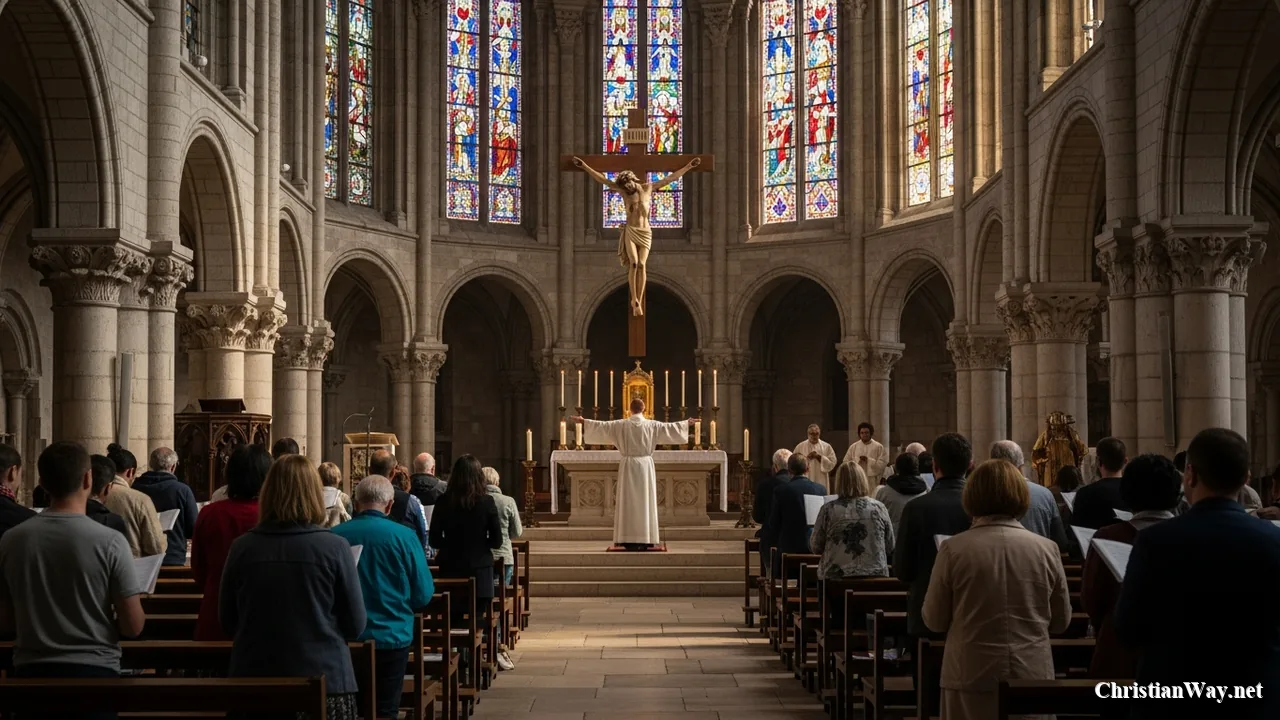
Not every Protestant believes the same thing, so comparisons must be made carefully. Anglicanism, Lutheranism, Methodism, Reformed Christianity, Baptist Christianity, Pentecostalism, and independent Evangelicalism each have distinctive teachings. Nevertheless, several broad areas of difference can be identified.
Scripture, Tradition, and Church Authority
One of the most important differences concerns authority.
Catholics believe that divine revelation has been entrusted to the Church through Sacred Scripture and Sacred Tradition. Here, Tradition does not simply mean customs created by human beings. It refers to the apostolic faith handed on in the life, teaching, worship, and witness of the Church.
The Catholic Church teaches that Scripture and Tradition belong together and are authentically interpreted by the Church’s teaching office, called the Magisterium. The bishops, in communion with the pope, are entrusted with guarding and explaining the apostolic faith. Catholics do not believe that bishops may invent new revelation. Their responsibility is to preserve, clarify, and faithfully teach what has been received.
Many Protestants emphasize sola Scriptura, meaning that Scripture alone is the final infallible authority for Christian doctrine. This does not always mean that Protestants reject all tradition. Most value the ancient creeds, the early councils, historic confessions, and the wisdom of past teachers. However, they hold that every tradition and church teaching must be tested by the written Word of God.
The disagreement is therefore not simply about whether the Bible matters. Both Catholics and Protestants affirm Scripture. The deeper question is how Christ intended the Church to receive, preserve, and interpret divine revelation.
Catholics ask whether the Bible was ever meant to function apart from the apostolic Church that recognized its books, proclaimed its message, and handed down the faith. Protestants ask how the Church can be protected from elevating human traditions to the level of God’s Word.
These are important questions, and they deserve more than slogans.
The Pope and the Leadership of the Church
Catholics believe that Jesus gave Saint Peter a distinctive pastoral role among the apostles. They often point to Christ’s words:
“Thou art Peter, and upon this rock I will build my church.”
— Matthew 16:18
Catholic teaching holds that Peter’s ministry of strengthening his brethren and shepherding Christ’s flock continues in the ministry of the bishops of Rome.
The pope is therefore regarded as the visible center of unity for the Catholic Church. Under specific and carefully defined conditions, Catholics also believe that the pope may teach infallibly on matters of faith or morals. Papal infallibility does not mean that the pope is sinless, inspired in every statement, politically correct, or incapable of personal error. It applies narrowly to solemn teachings intended to bind the whole Church in matters of faith and morals.
Most Protestants reject papal authority. They may respect the pope as an influential Christian leader, but they do not believe that Christ established a universal office with jurisdiction over the entire Church.
Eastern Orthodox Christians honor the ancient importance of the bishop of Rome but reject the later Catholic understanding of universal papal jurisdiction and infallibility. They generally view the bishop of Rome, in the undivided Church, as having held a primacy of honor rather than supreme authority over all other bishops.
Thus, the Catholic understanding of the papacy is one of the central distinctions between Catholicism and other major Christian traditions.
The Sacraments
Catholics recognize seven sacraments: Baptism, Confirmation, the Eucharist, Reconciliation, Anointing of the Sick, Holy Orders, and Matrimony.
A sacrament is understood as an effective sign of grace instituted by Christ and entrusted to the Church. The sacraments do not compete with personal faith. They are encounters in which Christ acts through visible signs such as water, oil, bread, wine, spoken words, and the laying on of hands.
Most Protestant communities recognize Baptism and the Lord’s Supper as the two ordinances or sacraments explicitly instituted by Christ. Some Anglican and Lutheran traditions use sacramental language more broadly, while other Evangelical communities prefer the term ordinances and understand them primarily as acts of obedience and public testimony.
The difference concerns whether sacraments merely symbolize divine grace or truly communicate the grace they signify. Catholicism strongly affirms that Christ works through them.
The Eucharist
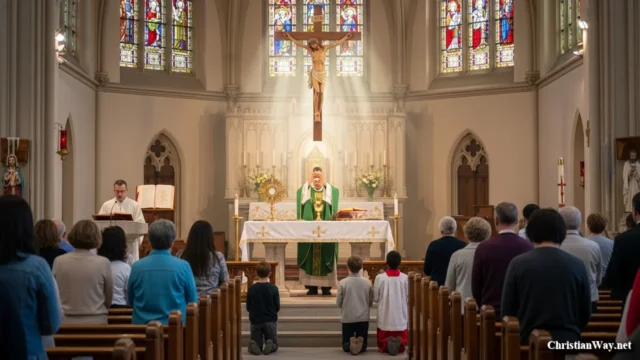
The Eucharist stands at the center of Catholic worship.
Catholics believe that, through the words of Christ and the power of the Holy Spirit, the bread and wine become the Body and Blood of Jesus Christ. The outward appearances of bread and wine remain, but their deepest reality is changed. This teaching is commonly called transubstantiation.
Catholics understand the Eucharist not as a repetition of Christ’s sacrifice but as the sacramental making-present of the one sacrifice of Calvary. Christ died once for all. At Mass, the Church is united to that one saving offering.
Many Protestants interpret the Lord’s Supper differently. Lutherans affirm Christ’s real presence in a strong sacramental sense, though they do not ordinarily use the Catholic explanation of transubstantiation. Reformed Christians often speak of a genuine spiritual participation in Christ. Many Baptists and Evangelicals understand Communion primarily as a memorial of Christ’s death.
These differences affect worship profoundly. For Catholics, the Eucharist is not merely one devotion among others. It is the source and summit of the Christian life because Catholics believe the risen Lord gives Himself to His people.
Salvation, Faith, Grace, and Good Works
This is one of the most frequently misunderstood areas in conversations about Catholicism vs Christianity.
Catholics do not teach that human beings can save themselves by performing enough good works. Catholic doctrine teaches that salvation begins with God’s grace. No person can earn the grace of conversion, forgiveness, or eternal life through unaided human effort.
The initiative belongs to God. Christ saves. The Holy Spirit awakens faith. Grace heals and transforms the human person.
Catholic theology, however, understands saving faith as a living faith expressed through love, obedience, hope, repentance, and perseverance. Good works do not purchase salvation; they are the fruit of grace and the believer’s real cooperation with God.
Saint Paul teaches that we are saved by grace:
“For by grace are ye saved through faith; and that not of yourselves: it is the gift of God.”
— Ephesians 2:8
Yet the following verse says that believers are created in Christ for good works. Saint James likewise writes:
“Faith without works is dead.”
— James 2:26
Many Protestants, particularly those shaped by Lutheran and Reformed theology, emphasize justification by faith alone. They teach that sinners are declared righteous before God solely because of Christ, received through faith rather than merited by works.
Serious Catholic and Protestant theologians today often recognize that part of the historical conflict arose from different definitions and emphases. Both traditions condemn the idea that salvation can be purchased by moral achievement. Both affirm that genuine faith should bear fruit in a transformed life.
The remaining differences concern how justification, sanctification, grace, human freedom, merit, perseverance, and assurance of salvation are related. These differences matter, but they should be discussed accurately. It is misleading to say simply that Protestants believe in grace while Catholics believe in earning heaven.
Catholics believe that even our good response to God is possible only because grace has come first.
Mary, the Mother of Jesus
Catholic devotion to Mary is perhaps the most visible source of confusion for non-Catholic Christians.
Catholics honor Mary because she is the mother of Jesus Christ, the incarnate Son of God. The title Mother of God does not mean that Mary created the divine nature or existed before God. It protects the truth that the one she bore is truly God the Son in human flesh.
Catholics believe that Mary is a creature redeemed by Christ. She is not a goddess, not part of the Trinity, and not equal to God. Authentic Catholic teaching forbids the worship of Mary.
The honor given to Mary differs essentially from the worship offered to God alone. Catholics ask Mary to pray for them in the same spiritual family in which Christians ask one another for prayer.
Catholic doctrine also includes beliefs not accepted by most Protestants, such as the Immaculate Conception and the Assumption of Mary. The Immaculate Conception refers to Mary’s preservation from original sin by the grace of Christ from the first moment of her existence. The Assumption refers to her being taken body and soul into heavenly glory at the end of her earthly life.
Protestants generally honor Mary as the mother of Jesus and a model of faith but reject doctrines or devotions they do not see clearly established in Scripture. Many worry that Marian practices may distract believers from Christ.
Catholics respond that properly understood Marian devotion always leads to Christ. Mary’s own words provide the pattern:
“Whatsoever he saith unto you, do it.”
— John 2:5
Where Marian devotion becomes sentimental, superstitious, or detached from Jesus, it needs purification. Where Mary is ignored or treated merely as an incidental figure, an important part of the Gospel story may be lost.
The Saints and Prayer for Their Intercession
Catholics believe that those who die in friendship with Christ remain alive in Him. The Church in heaven and the Church on earth are not two unrelated families but one communion in Christ.
For this reason, Catholics ask saints to pray for them. They do not believe the saints possess divine power independently of God. Any help associated with a saint is understood as the work of God through the prayer of a member of Christ’s body.
Many Protestants object that prayer should be directed only to God and that Scripture identifies Christ as the one mediator between God and humanity.
Catholics fully affirm that Jesus is the one Mediator of salvation. No saint adds to the Cross or replaces Christ. Catholics understand the intercession of saints as participation in Christ’s unique mediation, just as Christians on earth participate when they pray for one another.
The disagreement concerns whether believers should address requests for prayer to those already in heaven and whether the practice is sufficiently grounded in apostolic revelation.
This difference should be discussed without accusation. Catholics should avoid language that makes saints seem like alternative sources of divine power. Protestants should avoid assuming that informed Catholics worship the saints as gods.
Confession to a Priest
Catholics confess serious sins to a priest in the sacrament of Reconciliation because they believe Christ entrusted the ministry of forgiveness to His apostles.
After His resurrection, Jesus said:
“Receive ye the Holy Ghost: Whose soever sins ye remit, they are remitted unto them.”
— John 20:22–23
The priest does not forgive by personal authority or moral superiority. He acts as a minister of Christ and the Church. The absolution is understood to come from Christ.
Catholics may and should confess sins directly to God in prayer. Sacramental confession does not prevent this. Rather, it provides a visible encounter with Christ’s mercy, pastoral counsel, accountability, and the spoken assurance of forgiveness.
Most Protestants teach that believers should confess sins directly to God and may confess to trusted Christians for prayer and accountability, but they do not ordinarily regard priestly absolution as a sacrament necessary for the reconciliation of serious post-baptismal sin.
Both traditions proclaim that forgiveness comes through Christ. The difference concerns how Christ has chosen to minister that forgiveness within the Church.
Priests, Bishops, and Apostolic Succession
Catholicism has a threefold ordained ministry of bishops, priests, and deacons. Catholics believe that bishops stand in apostolic succession through the laying on of hands, preserving continuity with the apostles.
Priests preside at the Eucharist, proclaim the Gospel, celebrate the sacraments, and shepherd local communities under the bishop. In the Latin Church, priests are ordinarily celibate, though there are exceptions. Many Eastern Catholic priests are married, provided the marriage occurs before ordination.
Some Protestant traditions, especially Anglicanism and certain Lutheran bodies, retain bishops, priests or pastors, and deacons. Others organize their ministry through elders, pastors, congregational leaders, or denominational structures.
The disagreement concerns whether ordained ministry carries a sacramental character handed down through apostolic succession or whether the Church may establish various forms of leadership according to biblical principles and pastoral need.
Purgatory and Prayer for the Dead
Catholics believe that some who die in God’s grace still need purification before entering the fullness of heavenly glory. This purification is called purgatory.
Purgatory is not a second chance after rejecting God, nor is it a place where people earn salvation apart from Christ. Those undergoing purification are already destined for heaven. The doctrine expresses the conviction that God’s grace completes the healing and holiness begun in this life.
Catholics also pray for the dead, trusting them to God’s mercy.
Most Protestants reject purgatory, believing that the faithful enter the presence of God through the complete righteousness of Christ and that Scripture does not establish a post-death process of purification for the saved.
Eastern Orthodox Christians pray for the dead but do not define the intermediate state in precisely the same way as Catholic theology.
Here again, Christians share faith in judgment, resurrection, heaven, and the mercy of God, while differing on how the soul is prepared for the unveiled presence of divine holiness.
Catholicism and Eastern Orthodoxy
The comparison between Catholicism and Christianity should not be reduced to Catholicism and Protestantism alone. Eastern Orthodox Christianity is another ancient and major expression of the Christian faith.
Catholics and Orthodox Christians share much: apostolic succession, bishops and priests, seven sacraments or holy mysteries, belief in the real presence of Christ in the Eucharist, devotion to Mary and the saints, liturgical worship, prayer for the dead, and continuity with the early Church.
The separation between the Catholic West and Orthodox East developed gradually and became formalized in the schism traditionally associated with the year 1054.
The principal continuing disagreements concern the authority of the pope, certain formulations about the procession of the Holy Spirit, and some theological and disciplinary developments in the West.
Catholics recognize Orthodox sacraments and apostolic succession as valid. The Catholic Church regards Orthodox Christians as very closely united to Catholics, though full ecclesial communion has not yet been restored.
This wider perspective reminds us that Christianity cannot be understood as merely “Catholics on one side and Bible Christians on the other.” The Christian family is historically and theologically more complex.
Is Catholicism Biblical?
The answer depends partly on what is meant by biblical.
Catholics believe that their faith is biblical because it arises from the revelation fulfilled in Christ and witnessed in Scripture. Catholic worship is filled with biblical language, readings, prayers, images, and themes.
However, Catholicism does not claim that every Christian doctrine must appear in Scripture as an isolated sentence with a modern theological label. Catholics believe that the biblical faith was lived, preached, worshiped, and handed on in the Church before the New Testament canon was formally recognized.
Protestants often argue that certain Catholic doctrines lack sufficient scriptural support or conflict with the plain meaning of biblical texts. Catholics respond by interpreting those doctrines within the whole witness of Scripture, apostolic Tradition, liturgical life, and the teaching of the early Church.
A fruitful conversation therefore asks more than, “Where is that exact phrase in the Bible?” It also asks: How did the first Christians worship? How was doctrine preserved before the New Testament was compiled? What authority did Christ give to the apostles? How should Scripture be interpreted when sincere readers disagree?
Catholics should be willing to test popular practices by the Gospel and the official teaching of the Church. Protestants should be willing to examine whether their own interpretations are also shaped by traditions, historical movements, and inherited assumptions.
No Christian reads the Bible from nowhere. We all read within communities, languages, histories, and patterns of belief.
Are Catholics Saved?
Only God knows the heart of each person, and no human being should casually declare the eternal destiny of an entire group.
According to historic Christian faith, salvation is through Jesus Christ. A denominational label cannot save anyone. Being listed as Catholic, Protestant, Orthodox, Anglican, Baptist, or Pentecostal is not a substitute for repentance, faith, grace, and communion with Christ.
Catholics are saved in the same fundamental way every Christian is saved: by the grace of God through the saving work of Jesus Christ.
A Catholic may possess the sacraments, hear Scripture, recite the Creed, and still resist the transforming love of God. A Protestant may know the language of personal conversion and still live without mercy, humility, or obedience. Religious identity can become external in any tradition.
At the same time, we should not imagine that imperfect understanding or incomplete theology automatically places a sincere believer outside God’s mercy. Christ judges with perfect truth and perfect love.
Our task is not to pronounce final judgment upon others but to respond to the grace given to us. Saint Paul writes:
“Examine yourselves, whether ye be in the faith.”
— 2 Corinthians 13:5
The better question may not be, “Are those people saved?” but, “Am I trusting Christ, turning from sin, receiving His grace, loving my neighbor, and remaining faithful to the Gospel?”
Can a Person Be Christian Without Belonging to a Church?
Modern culture often encourages people to say, “I follow Jesus, but I do not need the Church.”
This desire may arise from painful experiences. Some have encountered hypocrisy, manipulation, abuse, political hostility, coldness, or division within Christian communities. Their wounds should be taken seriously.
Yet the New Testament does not present Christianity as an entirely private relationship between an isolated individual and Jesus. Christ calls a people. Believers are described as members of one body, stones in a spiritual house, branches of one vine, and brothers and sisters in one household.
Saint Paul writes:
“For by one Spirit are we all baptized into one body.”
— 1 Corinthians 12:13
Catholics understand this belonging in a visible and sacramental way. Other Christians may define the visible Church differently, but historic Christianity has always included communal worship, baptism, teaching, fellowship, service, and accountability.
The Church is imperfect because it contains imperfect people. Yet Christ continues to meet His people through the life of His body.
We should seek a faithful Christian community not because its members are flawless, but because discipleship was never meant to be lived alone.
How Should Catholics and Other Christians Relate to One Another?
Christian division is a tragedy, especially when it leads to contempt, hostility, or false witness.
On the night before His crucifixion, Jesus prayed for His disciples:
“That they all may be one.”
— John 17:21
Christian unity does not require pretending that doctrine is unimportant. Love without truth becomes shallow sentiment. Truth without love becomes a weapon.
Catholics and other Christians can begin by listening carefully to what each tradition actually teaches. We should avoid describing another community only by its worst representatives or most distorted popular practices.
Catholics should not assume that Protestants reject history, good works, reverence, or the Church. Many Protestants possess deep knowledge of Scripture, serious theology, disciplined prayer, strong community life, and sacrificial commitment to mission.
Protestants should not assume that Catholics worship Mary, believe the pope is divine, ignore the Bible, or think heaven can be earned by religious rituals. These statements misrepresent official Catholic teaching.
Christians can pray together where conscience permits, serve the poor, defend human dignity, support families, comfort the suffering, proclaim Christ, and work for peace. They can also engage in honest theological dialogue without anger.
Unity is not achieved by reducing Christianity to the smallest possible collection of beliefs. It grows through conversion to Christ, humility before the truth, repentance for past sins, and patient love.
Choosing Between Catholicism and Other Christian Traditions
Some readers may be asking this question because they are considering becoming Catholic, leaving Catholicism, returning to church, or entering Christianity for the first time.
Such a decision should not be made merely according to personality, convenience, music style, social pressure, or disappointment with individual Christians.
Ask deeper questions.
Who is Jesus Christ? What did He intend the Church to be? Did He establish a visible teaching and sacramental community? What authority did He give the apostles? How was the Christian faith understood in the earliest centuries? What is the Eucharist? How are Scripture and apostolic Tradition related? What does salvation by grace mean? Where is Christ calling you to obedience, not merely comfort?
Read the Gospels slowly. Pray for humility. Study the early Church. Speak with faithful and well-informed Christians from different traditions. Attend worship respectfully. Do not base your judgment only on internet debates, hostile apologetics, or brief social-media clips.
Above all, seek truth with a heart willing to be changed.
Faith is not choosing a religious product that best matches our preferences. It is surrendering ourselves to Jesus Christ.
Catholicism vs Christianity: The Clearest Answer
We may now return to the original question.
Catholicism and Christianity are not two separate religions.
Christianity is the worldwide faith of those who confess Jesus Christ as Lord and Savior. Catholicism is one of the oldest and largest historic expressions of Christianity.
All Catholics are Christians, though not all Christians are Catholics.
Catholics share with other historic Christians faith in the Trinity, the divinity and humanity of Jesus, His death and resurrection, the inspiration of Scripture, the necessity of grace, baptism, prayer, worship, moral discipleship, the resurrection of the dead, and eternal life.
Catholics differ from many Protestants in their understanding of Scripture and Tradition, the authority of the pope and bishops, the number and nature of the sacraments, the Eucharist, justification, confession, Mary, the saints, purgatory, prayer for the dead, and apostolic succession.
These differences are real. Some touch the very structure of Christian life and worship. Yet they exist within a larger confession of Jesus Christ, and they should be approached with truth, reverence, patience, and love.
The final center of Christianity is not Catholic identity, Protestant identity, Orthodox identity, or denominational loyalty. The center is Christ Himself.
Every tradition must stand beneath His Word. Every church must be purified by His grace. Every disciple must learn to say with Saint Paul:
“For we preach not ourselves, but Christ Jesus the Lord.”
— 2 Corinthians 4:5
Reflect and Pray
Dear friends, perhaps the most important fruit of understanding Catholicism vs Christianity is not the ability to win an argument. It is the grace to see more clearly where Christ is present, where division has wounded His people, and where each of us is called to deeper conversion.
We live in a world already burdened by suspicion, loneliness, anger, and fragmentation. Christians should not add carelessly to that burden. We must be able to name differences without hatred, defend convictions without pride, and seek unity without sacrificing truth.
A Catholic should be able to rejoice when a Protestant leads someone to love the Scriptures. A Protestant should be able to rejoice when a Catholic serves Christ faithfully in the poor. An Orthodox Christian should be able to recognize the work of grace beyond the visible boundaries of Orthodoxy. Each of us should be more eager to see Christ glorified than to see our own community praised.
This does not erase the longing for full unity. On the contrary, genuine love makes division more painful. We pray for the day when all Christians may be fully one in faith, sacramental life, and visible communion.
Until that day, let us refuse easy contempt. Let us study patiently, speak honestly, repent humbly, and love generously.
Let us pray:
Lord Jesus Christ, Son of the living God,
You called Your disciples to be one as You and the Father are one.
Forgive us for the pride, bitterness, ignorance, and fear
that have deepened the divisions among Your people.
Lead Catholics, Orthodox Christians, Protestants,
and all who confess Your holy name
into greater fidelity to Your Gospel.
Purify Your Church.
Heal the wounds of history.
Give us courage to seek truth,
humility to receive correction,
and love that does not fail when agreement is difficult.
Keep our eyes fixed upon You,
for You alone are the way, the truth, and the life.
May every Christian community proclaim not itself,
but Jesus Christ as Lord.
May the peace of Christ dwell richly in your heart, and may His truth lead you ever more deeply into the life of His grace.
— Fr. John Matthew