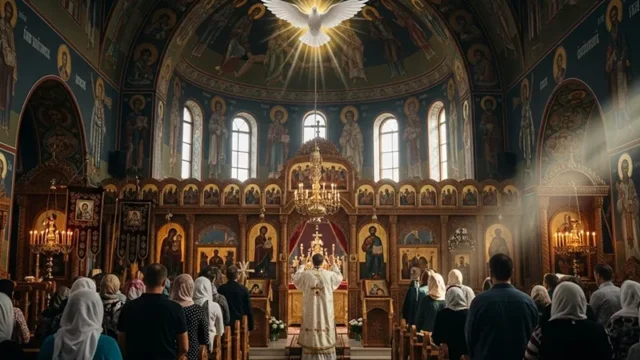
A gentle reflection on shared faith, historic division, and the enduring hope uniting Eastern and Oriental Orthodox Christians.
Dear friends in Christ,
To someone encountering the Christian East for the first time, the names Eastern Orthodoxy and Oriental Orthodoxy can sound almost identical. Both traditions call themselves Orthodox. Both trace their spiritual life to the apostles and the early Church. Both worship through ancient liturgies filled with Scripture, incense, icons, fasting, chanting, and sacramental prayer. Both honor the Virgin Mary as the Theotokos, the Mother of God, and both cherish the witness of martyrs, monks, bishops, and saints.
Yet Eastern Orthodox and Oriental Orthodox Christians do not presently belong to the same ecclesial communion. Their separation reaches back primarily to the controversies surrounding the Council of Chalcedon in AD 451, when Christians struggled to express faithfully the mystery of Jesus Christ as truly God and truly human. The disagreement involved theology, but it was intensified by differences of language, culture, ecclesiastical authority, imperial politics, and the wounds created by mutual condemnation.
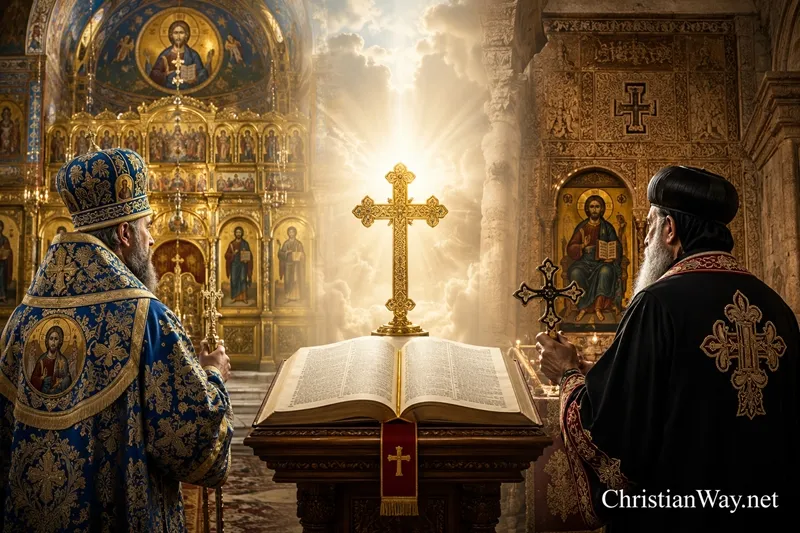
It is easy to reduce this history to a slogan: Eastern Orthodox Christians believe in “two natures,” while Oriental Orthodox Christians believe in “one nature.” Such a sentence is not entirely false, but without careful explanation it can become deeply misleading. Oriental Orthodox Christians do not believe that Christ’s humanity disappeared into His divinity. Eastern Orthodox Christians do not believe that Christ is divided into two persons. Both confess one Lord Jesus Christ, fully divine and fully human, the eternal Son of God who truly became man for our salvation.
The real story is therefore more sorrowful, more complex, and also more hopeful than a simple comparison chart can express. It is the story of Christians who inherited the same apostolic faith, became separated while defending what each believed to be the truth about Christ, and now increasingly recognize that centuries of polemical language have sometimes concealed a profound measure of shared belief.
To understand Eastern Orthodoxy vs. Oriental Orthodoxy, we must enter this history with humility. We are not examining two abstract religious systems. We are approaching living communities of prayer whose faithful have suffered persecution, preserved ancient Christian cultures, raised children in the faith, celebrated the Eucharist, cared for the poor, and confessed Christ through centuries of political upheaval.
Two Ancient Families Within Eastern Christianity
The word Orthodox comes from Greek roots commonly understood as meaning “right belief” or “right worship.” Both Eastern Orthodox and Oriental Orthodox Christians use the name because each believes it has faithfully preserved the apostolic faith of the early Church.
The term Eastern Orthodox Church usually refers to the communion of churches shaped primarily by the Byzantine Christian tradition. This family includes churches commonly described as Greek, Russian, Serbian, Romanian, Bulgarian, Georgian, Antiochian, and others. These churches recognize the first seven Ecumenical Councils, beginning with the Council of Nicaea in 325 and ending with the Second Council of Nicaea in 787.
The term Oriental Orthodox Churches refers to another ancient family consisting principally of the Coptic Orthodox Church, Syriac Orthodox Church, Armenian Apostolic Church, Ethiopian Orthodox Tewahedo Church, Eritrean Orthodox Tewahedo Church, and Malankara Orthodox Syrian Church of India. These churches are united with one another sacramentally and doctrinally and traditionally recognize the first three Ecumenical Councils: Nicaea, Constantinople, and Ephesus.
In this context, the word Oriental is an established historical and ecclesiastical title meaning eastern. It does not refer specifically to East Asian culture. “Oriental Orthodox” is the name used for churches whose historical centers include Egypt, Syria, Armenia, Ethiopia, Eritrea, and India.
The Church of the East, sometimes associated with the name “Assyrian Church of the East,” is a separate ancient Christian tradition. It is not part of either the Eastern Orthodox communion or the Oriental Orthodox communion. This distinction matters because discussions of ancient Eastern Christianity sometimes place all non-Western churches into one category, obscuring their different histories and theological inheritances.
Neither Family Is Simply “Older”
It is sometimes asked, “Which is older, Eastern Orthodoxy or Oriental Orthodoxy?” The most responsible answer is that both descend from Christian communities that existed before their separation.
The churches of Alexandria, Antioch, Jerusalem, Armenia, and other ancient Christian lands did not suddenly appear after AD 451. Their roots reach into the apostolic and patristic centuries. The division at Chalcedon did not create Christianity in these regions; rather, it divided Christians who had previously shared the life of the ancient Church.
It is therefore misleading to imagine one tradition as the original Church and the other as a later denomination founded by an individual. Neither Eastern Orthodoxy nor Oriental Orthodoxy began as a modern movement. Both understand themselves as continuations of the one, holy, catholic, and apostolic Church confessed in the Nicene Creed.
Their disagreement concerns which ecclesial body most faithfully continued that undivided inheritance after the fifth-century rupture. That question cannot be settled merely by comparing dates. It requires serious engagement with theology, councils, apostolic succession, liturgy, and the historical reception of doctrine.
The Faith They Continue to Share
Before examining their differences, we should recognize the immense inheritance that Eastern and Oriental Orthodox Christians hold in common.
Both confess the Holy Trinity: one God in three divine Persons, Father, Son, and Holy Spirit. Both confess that the eternal Son and Word of God became incarnate from the Virgin Mary. Both proclaim His real birth, His sinless life, His saving death on the Cross, His bodily Resurrection, His Ascension, and His glorious return.
Both receive the Nicene-Constantinopolitan Creed as a foundational confession of Christian faith. Both baptize in the name of the Father, the Son, and the Holy Spirit. Both possess an episcopal ministry of bishops, priests, and deacons that they understand as standing in historical continuity with the apostles.
Their worship is sacramental rather than merely symbolic. The Eucharist stands at the center of ecclesial life. Baptism is understood as participation in Christ’s death and Resurrection. Chrismation or confirmation bestows the seal of the Holy Spirit. Confession is a ministry of healing and reconciliation. Marriage is blessed within the worship of the Church, while ordination sets apart ministers for sacramental service.
Both honor the Virgin Mary as Theotokos, meaning “God-bearer” or “Mother of God.” This title does not mean that Mary is the origin of Christ’s divinity. It protects the truth that the child born of her is one divine Person, the eternal Son of God made flesh.
Both traditions honor saints, preserve relics, ask for the prayers of the faithful departed, practice monasticism, fast throughout the Christian year, and surround worship with sacred art. Both see salvation not merely as the cancellation of guilt but as healing, communion with God, and transformation by divine grace.
The spiritual atmosphere of the two traditions is therefore often strikingly familiar. A Coptic Christian visiting an Eastern Orthodox monastery may recognize the rhythm of fasting, prostrations, psalmody, incense, reverence for the altar, and love for the saints. A Greek or Serbian Orthodox Christian entering an Armenian, Syriac, or Ethiopian church may encounter different music and ceremonial customs while still sensing the ancient sacramental world of Christian Orthodoxy.
These similarities are not superficial. They arise from a common inheritance formed before the fifth-century division.
The Council of Chalcedon and the Historical Separation
The central historical turning point in Eastern Orthodoxy vs. Oriental Orthodoxy is the Council of Chalcedon, held in AD 451 near Constantinople.
To understand Chalcedon, we must first remember the theological question confronting the Church: How should Christians speak about the divinity and humanity of Jesus Christ?
The New Testament reveals Jesus as truly human. He is born, grows, hungers, thirsts, weeps, suffers, and dies. Yet the same Scriptures reveal Him as the eternal Word who was with God and was God, through whom all things were made. Saint John writes:
“And the Word was made flesh, and dwelt among us.”
— John 1:14
Christians therefore had to reject explanations that denied either side of the mystery. If Christ were not truly God, He could not reveal the Father perfectly or unite humanity with God. If He were not truly human, then human nature would not truly have been assumed, healed, and redeemed.
The Council of Ephesus and Saint Cyril of Alexandria
Before Chalcedon, the Council of Ephesus in 431 defended the unity of Christ’s person. It rejected teachings associated with Nestorius that appeared to divide Christ too sharply, as though the divine Word and the human Jesus were two distinct subjects joined only morally or relationally.
Saint Cyril of Alexandria became one of the great defenders of Christ’s unity. He emphasized that the eternal Word Himself was born according to the flesh, suffered according to the flesh, and acted through the humanity He had made His own. Cyril used the famous expression often translated as “one incarnate nature of God the Word.”
Both Eastern and Oriental Orthodox Christians honor Saint Cyril and regard his Christology as fundamental. The later conflict did not arise because one side accepted Cyril and the other rejected him. It arose partly because Christians interpreted later terminology through different understandings of Cyril’s teaching.
What Chalcedon Declared
The Council of Chalcedon confessed one and the same Jesus Christ as perfect in divinity and perfect in humanity, consubstantial with the Father according to His divinity and consubstantial with us according to His humanity. It spoke of Christ as existing in two natures, without confusion, change, division, or separation.
For those who accepted Chalcedon, this formula protected both essential truths. “Without confusion” and “without change” protected the full reality of Christ’s humanity and divinity. “Without division” and “without separation” protected the unity of His one Person.
The churches now called Eastern Orthodox received Chalcedon as the Fourth Ecumenical Council. They also received the three later councils of Constantinople II, Constantinople III, and Nicaea II, bringing their commonly recognized number of Ecumenical Councils to seven.
A substantial body of Christians in Egypt, Syria, Armenia, and elsewhere did not receive Chalcedon. They feared that the council’s language could weaken Cyril’s insistence on the unity of the incarnate Christ or open the door to a Christology that divided Him.
The rejection of Chalcedon became the principal historical marker separating the churches now called Oriental Orthodox from those now called Eastern Orthodox. The two families are still not in full ecclesial communion.
What Eastern Orthodoxy Means by “Two Natures”
Eastern Orthodox Christians confess that Jesus Christ is one divine Person or hypostasis, the eternal Son of God, in two natures, divine and human.
This does not mean that there are two persons within Christ. The divine nature does not speak as one subject while the human nature speaks as another. The one who speaks, acts, suffers, dies, rises, and reigns is always the one Lord Jesus Christ.
Nature answers the question, “What is He?” He is truly divine and truly human. Person answers the question, “Who is He?” He is the eternal Son and Word of God.
The two natures remain real within the union. Christ’s humanity does not become divinity, and His divinity does not become humanity. He possesses a real human body, a rational human soul, a human mind, and a human will. Yet this complete humanity belongs personally to the eternal Word.
This is why Eastern Orthodox theology can say that God suffered and died in the flesh. It does not teach that the divine nature ceased to be immortal. It teaches that the one who experienced suffering through His human nature is truly the divine Son.
When Chalcedonian Christians say “two natures,” they are not intending to divide Christ. They are guarding the completeness of what has been united.
Saint Gregory of Nazianzus famously expressed the principle that what is not assumed is not healed. If the Son of God did not assume the fullness of human nature, then the fullness of human nature would not be redeemed. Eastern Orthodox Christology therefore insists that Christ is completely human without ceasing to be completely divine.
What Oriental Orthodoxy Means by “One Incarnate Nature”
Oriental Orthodox Christians commonly express their Christology through Saint Cyril’s language of one incarnate nature of God the Word. This position is often called miaphysitism, from Greek words suggesting one united or composite nature.
The word one in this expression does not mean that Christ’s humanity was swallowed, dissolved, or changed into divinity. Oriental Orthodox Christians confess that Christ is fully God and fully man. His humanity is real, complete, and consubstantial with ours, except for sin.
They emphasize that after the incarnation, the divine and human are united in the one incarnate reality of the Word. The union is without mixture, confusion, alteration, or separation. Christ’s divinity and humanity can be distinguished in contemplation, but they are never separated into two personal subjects.
A helpful analogy, though every analogy remains imperfect, is the unity of a human being. A person has both body and soul, yet we do not ordinarily speak of two persons standing beside one another. The body and soul remain distinguishable, but they belong to one living human reality. Oriental Orthodox theology uses its own careful language to insist that everything divine and human in Christ belongs to the one incarnate Word.
The official theological dialogues between Eastern and Oriental Orthodox representatives have recognized that both families reject the errors associated with Nestorius and Eutyches. The 1990 Agreed Statement acknowledged that Oriental Orthodox Christians may continue using the Cyrillian phrase “one nature of the incarnate Logos,” while Eastern Orthodox Christians may continue using the “two natures” formula, because both intend to confess the complete divinity, complete humanity, and undivided personal unity of Christ.
This does not mean that every theological question has been resolved or that the churches have already restored communion. It does mean that the old assumption—one side believes in a divided Christ and the other in an incomplete Christ—cannot fairly describe the official teaching of either communion.
Why “Monophysite” Is Often an Inaccurate Label
Oriental Orthodox Christians have frequently been called Monophysites. They generally reject this description.
Historically, monophysitism is associated with a view in which Christ’s humanity is absorbed into or overwhelmed by His divinity, leaving only one divine nature in a manner that compromises His real humanity. The teaching of Eutyches is often cited as an example of this error.
Oriental Orthodox churches reject Eutychianism. They do not believe that Christ’s humanity became unreal after the incarnation. The Armenian Apostolic Church, for example, rejects both Nestorian and Eutychian interpretations while also declining to receive Chalcedon.
The term miaphysite is therefore usually more accurate when describing Oriental Orthodox Christology. It indicates a united incarnate nature composed from full divinity and full humanity, without confusing or abolishing either.
Even this term must be used carefully. Christians do not place their faith in vocabulary alone. Words such as nature, person, hypostasis, and physis developed shades of meaning in Greek, Coptic, Syriac, Armenian, and Latin theological contexts. A formula that sounded protective and orthodox in one linguistic tradition could sound dangerous in another.
This is one reason the historical division cannot be attributed solely to stubbornness. Christians on both sides were attempting to guard the mystery of salvation, but they did so amid linguistic ambiguity, political pressure, ecclesiastical rivalry, and growing mistrust.
The Division Was About More Than One Sentence
It would be comforting to imagine that the separation resulted only from a translation problem and could therefore be erased by finding a better dictionary. The reality is more difficult.
Theological language was central, but the dispute also concerned the authority and reception of Chalcedon, the deposition and condemnation of particular bishops, the recognition of saints, and the legitimacy of competing ecclesiastical hierarchies.
The Council of Chalcedon deposed Dioscorus of Alexandria. Chalcedonian churches came to regard his actions and theology with grave suspicion, while the Coptic and other Oriental Orthodox traditions honored him as a defender of Saint Cyril’s faith. Later figures such as Severus of Antioch likewise became revered saints in Oriental Orthodoxy but remained condemned in Chalcedonian tradition.
At the same time, Oriental Orthodox Christians could not accept the veneration of certain Chalcedonian figures whom they believed had contributed to doctrinal error or persecution. The division therefore entered the calendars, liturgies, historical memories, and ecclesial identities of both families.
Imperial attempts to impose unity often increased resentment. Communities suffered displacement, imprisonment, or political pressure. Parallel patriarchal lines emerged in some ancient sees. Even today, one may encounter both an Eastern Orthodox Patriarchate of Alexandria and the Coptic Orthodox Patriarchate of Alexandria, or both an Eastern Orthodox Patriarchate of Antioch and a Syriac Orthodox Patriarchate of Antioch. These parallel structures are living reminders of the ancient separation.
When wounds become embodied in communities, they cannot be healed merely by declaring that the original argument was misunderstood. Truth must be clarified, but memory must also be purified, condemnations addressed, trust rebuilt, and ecclesial reception patiently sought.
The Difference in Ecumenical Councils
One of the clearest formal differences concerns the number of councils each communion recognizes as ecumenical.
Eastern Orthodoxy traditionally recognizes seven:
- Nicaea I in 325
- Constantinople I in 381
- Ephesus in 431
- Chalcedon in 451
- Constantinople II in 553
- Constantinople III in 680–681
- Nicaea II in 787
Oriental Orthodoxy traditionally recognizes the first three: Nicaea, Constantinople, and Ephesus. It does not recognize Chalcedon as an ecumenical and authoritative council, and therefore does not enumerate the later councils in the same way.
This difference should not be interpreted to mean that Oriental Orthodox Christians reject every theological truth taught at later councils. For example, they have practiced the veneration of icons since ancient times. In the modern dialogue, Oriental Orthodox representatives affirmed that the theology and practice of icon veneration associated with the Seventh Ecumenical Council are substantially consistent with their own tradition.
The difficulty lies not only in whether a particular statement is true, but in whether a disputed council possesses ecumenical authority for the whole Church.
Different Families of Self-Governing Churches
Neither Eastern Orthodoxy nor Oriental Orthodoxy is governed by one worldwide bishop exercising authority in the same manner as the pope in Roman Catholicism.
Eastern Orthodoxy is a communion of self-governing or autocephalous churches. Each is led by its own patriarch, archbishop, or metropolitan and governed through a synod of bishops. The Ecumenical Patriarch of Constantinople holds a place of honor often described as “first among equals,” but Eastern Orthodox Christians do not regard him as possessing universal jurisdiction over every Orthodox church.
Oriental Orthodoxy is likewise composed of self-governing churches. The Coptic Pope of Alexandria, the Syriac Patriarch of Antioch, the Armenian catholicoi, and the heads of the Ethiopian, Eritrean, and Indian churches govern their respective ecclesial communities. No one of these hierarchs functions as a universal pope over the entire Oriental Orthodox communion.
The two families therefore share a broadly synodal understanding of ecclesial leadership, though their canonical structures, titles, and procedures have developed differently.
Worship: Shared Sacramental Life, Different Liturgical Families
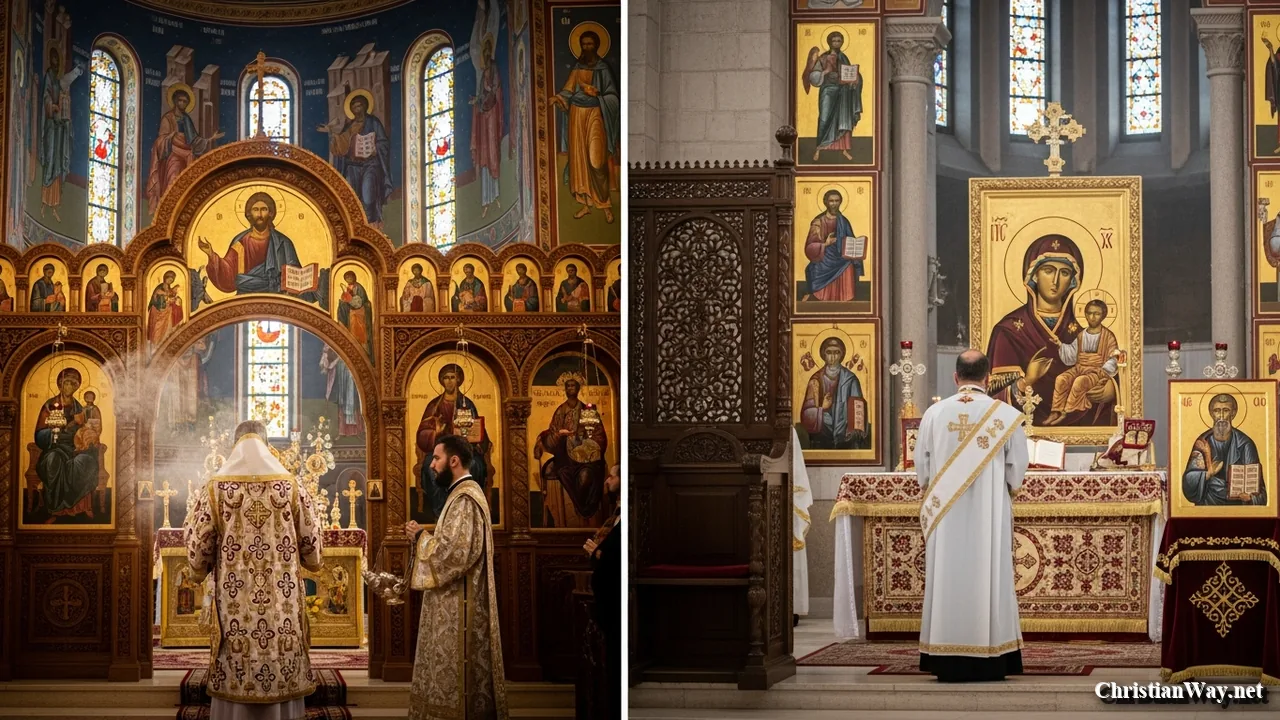
Visitors sometimes assume that Eastern Orthodox and Oriental Orthodox worship should look almost identical. Certain features are indeed shared: the prominence of the Eucharist, chanting, incense, vestments, fasting, sacred art, processions, and reverence before the altar.
Yet the liturgical traditions are not the same.
Most Eastern Orthodox churches worship according to the Byzantine rite. The Divine Liturgy of Saint John Chrysostom is celebrated most frequently, while the Liturgy of Saint Basil is used on designated occasions. Greek, Church Slavonic, Arabic, Romanian, Georgian, English, and many other languages may be heard depending on the local church.
Oriental Orthodoxy includes several distinctive liturgical families. The Coptic Church preserves the Alexandrian tradition. The Syriac Orthodox Church worships through the West Syriac heritage. The Armenian Apostolic Church has its own ancient rite. Ethiopian and Eritrean Christians preserve the Ge’ez tradition, while the Malankara Orthodox Syrian Church in India has been deeply shaped by the West Syriac rite.
An Eastern Orthodox liturgy may therefore look and sound quite different from an Ethiopian or Armenian celebration. These differences do not necessarily indicate conflicting doctrines. They often reflect the diverse languages, music, history, and cultures through which the Gospel took root.
The Christian faith was never meant to erase every human culture. At Pentecost, the apostles did not proclaim the works of God in only one language. The Spirit enabled many peoples to hear the one Gospel.
Liturgical diversity can become a sign of catholicity when it serves the same Lord. It becomes a wound when Christians treat cultural familiarity as the measure of truth or dismiss another ancient tradition merely because its prayers sound unfamiliar.
Icons and Sacred Images
Both Eastern and Oriental Orthodox Christians use sacred images, but their artistic traditions can be visually distinct.
Byzantine icons commonly associated with Eastern Orthodoxy developed particular conventions of color, perspective, gesture, and theological symbolism. Russian, Greek, Serbian, Romanian, Georgian, and Arab iconographic schools possess recognizable variations within that broader tradition.
Oriental Orthodox sacred art is equally diverse. Coptic icons often possess a warm simplicity and distinctive facial style. Armenian illuminated manuscripts developed remarkable artistic forms. Ethiopian churches preserve vivid images shaped by their own ancient Christian culture. Syriac manuscripts and church decorations reflect another venerable expression of sacred art.
Both families reject the worship of wood, paint, stone, or created material. Honor shown to a sacred image is directed toward the person represented. The use of icons rests upon the incarnation: because the invisible Son of God truly became visible in human flesh, He may be portrayed according to His humanity.
The common reverence for icons is one of many signs that the two families inhabit the same broad sacramental understanding of creation. Matter is not an enemy of grace. Water can become the means of baptism, oil can be used for anointing, bread and wine become the Eucharistic gift, and color can bear witness to the face of Christ.
Saints and the Memory of the Church
Eastern and Oriental Orthodox Christians share many saints from the centuries before Chalcedon. They honor the apostles, the martyrs of the early persecutions, Saint Athanasius, Saint Cyril of Alexandria, Saint Basil the Great, Saint Gregory of Nazianzus, Saint Gregory of Nyssa, and many other ancient witnesses.
After the division, their calendars developed separately. Each communion canonized saints who lived within its own ecclesial life. Some figures honored by one family remain controversial in the other because of the Chalcedonian conflict.
This presents more than an administrative problem. Saints embody a church’s understanding of holiness, doctrine, and historical faithfulness. Restoring communion would therefore require the churches to address inherited condemnations and conflicting memories with honesty.
Modern dialogue has recommended examining and, where agreement permits, lifting historical anathemas. Yet such steps require reception by the appropriate synods and by the faithful. Unity cannot be created merely by a committee document, even an excellent one. It must be received as truth within the worship and life of the whole Church.
Are Eastern and Oriental Orthodox Christians in Communion?
At present, the two families are not in full sacramental communion. Their bishops and priests do not ordinarily concelebrate the Eucharist, and a member of one communion should not presume that he or she may receive Holy Communion in the other.
This can be painful, especially in places where Eastern and Oriental Orthodox Christians live near one another, marry one another, or face persecution together.
Pastoral agreements have been developed in certain regions concerning mixed marriages or the recognition of particular sacraments. Such arrangements, however, do not amount to universal restoration of communion between the two families. The Coptic Orthodox Church itself distinguishes Christological agreements and local pastoral cooperation from the establishment of full ecclesial communion.
A person facing a practical question about Communion, marriage, baptism, or reception into either church should speak directly with the local priest. Practices may depend on the decisions of particular bishops and synods.
This caution is not intended to create coldness. Christians may attend one another’s services respectfully, cultivate friendship, cooperate in works of mercy, study together, and pray for reconciliation. But love does not require us to pretend that communion exists before the churches themselves have restored it.
A Clear Comparison
| Question | Eastern Orthodoxy | Oriental Orthodoxy |
|---|---|---|
| Historical family | Primarily Byzantine or Chalcedonian Orthodox churches | Coptic, Syriac, Armenian, Ethiopian, Eritrean, and Malankara Orthodox churches |
| Ecumenical Councils | Traditionally recognizes seven | Traditionally recognizes the first three |
| Chalcedon, AD 451 | Receives it as the Fourth Ecumenical Council | Does not receive it as ecumenical |
| Christological language | One Person in two natures, divine and human | One incarnate, united nature of the Word, fully divine and fully human |
| Error explicitly rejected | Division of Christ into two persons and confusion of His natures | Division of Christ and absorption or destruction of His humanity |
| Church government | Communion of self-governing synodal churches | Communion of self-governing synodal churches |
| Liturgical heritage | Primarily Byzantine | Alexandrian, West Syriac, Armenian, Ethiopian-Eritrean, and Indian traditions |
| Sacramental communion | Communion within the Eastern Orthodox family | Communion within the Oriental Orthodox family |
| Communion with each other | Not yet fully restored | Not yet fully restored |
The table identifies genuine differences, but the heart of the matter remains Christological and ecclesial. The two families do not worship different Christs. They use different historical formulations to guard the mystery of the one Christ, and they differ over the authority of Chalcedon and the ecclesial consequences that followed it.
What Modern Dialogue Has Achieved
Beginning in the twentieth century, Eastern and Oriental Orthodox theologians met for sustained conversations. Unofficial consultations were held during the 1960s and 1970s, followed by official dialogue and important agreed statements in 1989 and 1990.
These discussions reached a remarkable conclusion: both families have preserved the authentic confession that Jesus Christ is fully divine and fully human, united without confusion or separation in the one Person of the incarnate Word. The representatives acknowledged that the language of “two natures” and the Cyrillian language of “one incarnate nature” can express a common apostolic faith when properly understood.
This was not merely diplomatic politeness. It represented decades of historical and theological study. Scholars examined the original languages, the writings of the Fathers, the intentions of disputed formulas, and the ways polemics had distorted each side’s beliefs.
The dialogue also recognized common ground in the wider faith of the early Church, including the sacraments, apostolic tradition, and veneration of icons. Eastern and Oriental Orthodox leaders have continued meeting to seek practical steps toward deeper unity, while acknowledging that official reception by the churches remains necessary.
Recent encounters have continued to describe the relationship between the two Orthodox families as uniquely close within the wider Christian ecumenical landscape. Yet closeness is not the same as restored communion. Significant canonical, historical, and pastoral work remains.
The proper Christian response is neither impatient triumphalism nor resigned indifference. It is hopeful patience: praying, studying, speaking truthfully, repenting of caricatures, and allowing the Holy Spirit to heal what human sin and historical fear have deepened.
Common Questions About Eastern and Oriental Orthodoxy
Do Both Believe That Jesus Is God?
Yes. Both confess Jesus Christ as the eternal Son and Word of God, of one divine essence with the Father. Both also confess that He became truly human without ceasing to be divine.
The disagreement is not between belief and unbelief in Christ’s divinity. It concerns the best theological language for expressing the union of His divinity and humanity, the authority of Chalcedon, and the ecclesial consequences of the fifth-century conflict.
Do Oriental Orthodox Christians Deny Christ’s Human Nature?
No. Official Oriental Orthodox teaching affirms Christ’s complete humanity, including a real human body, soul, mind, and will. It rejects the idea that His humanity was dissolved into His divinity.
Calling Oriental Orthodox Christians “Monophysites” without explanation can therefore misrepresent their faith.
Do Eastern Orthodox Christians Divide Christ Into Two Persons?
No. Eastern Orthodox teaching confesses one Person, the divine Son, in two complete natures. The distinction of natures does not create two Christs or two personal subjects.
The Chalcedonian phrase “without division and without separation” is intended precisely to exclude such a misunderstanding.
Are Coptic Orthodox Christians Eastern Orthodox?
In ordinary modern usage, no. The Coptic Orthodox Church belongs to the Oriental Orthodox communion.
The similarity of names can be confusing because both families are geographically eastern and the Coptic Church is certainly an Eastern Christian church in the broad sense. But the formal title Eastern Orthodox usually identifies the Chalcedonian Byzantine communion, while Oriental Orthodox identifies the non-Chalcedonian family.
Are Armenian Orthodox Christians Oriental Orthodox?
The Armenian Apostolic Church belongs to the Oriental Orthodox family. It shares communion with the Coptic, Syriac, Ethiopian, Eritrean, and Malankara Orthodox churches.
Can Members Attend Each Other’s Worship?
Visitors are generally able to attend respectfully, but local guidance should be followed. Attendance at a service is not the same as receiving the Eucharist.
Because full communion has not been restored, a visitor should not approach the chalice without speaking to the priest and receiving appropriate ecclesial permission.
Can Eastern and Oriental Orthodox Christians Marry?
Mixed marriages may be permitted under particular pastoral conditions, but the requirements vary by jurisdiction. Questions may arise concerning where the wedding will be celebrated, how children will be baptized and raised, and which bishop has authority over the arrangement.
Couples should therefore consult their priests before making sacramental plans. Local pastoral agreements exist in some places, but they should not be assumed to apply universally.
Are They Closer to Each Other Than to Catholicism or Protestantism?
In many areas of doctrine, worship, spirituality, and church order, Eastern and Oriental Orthodox Christians are extraordinarily close. Both preserve ancient liturgical worship, apostolic succession, sacramental theology, monastic spirituality, veneration of saints, and a patristic understanding of salvation.
Yet ecclesial closeness cannot be measured only by counting shared practices. Full communion requires a common confession of faith, mutual recognition of councils and saints, reconciliation of historical condemnations, and a shared sacramental life.
What This Division Teaches the Whole Church
The separation between Eastern and Oriental Orthodoxy offers a solemn lesson about the power of words.
The Church must speak carefully about Christ. Doctrine matters because Christ matters. The faithful cannot be indifferent when His divinity, humanity, or personal unity is endangered.
Yet theological precision must be joined to humility. Human language stands before a divine mystery greater than every formula. Dogmatic definitions protect the mystery from falsehood; they do not imprison God within sentences.
The history also teaches us that correct words can be spoken without sufficient charity. Political ambition can attach itself to doctrinal controversy. Cultural pride can masquerade as zeal for truth. A community may defend a legitimate concern while failing to hear the legitimate concern of another.
Saint Paul wrote:
“There is one body, and one Spirit, even as ye are called in one hope of your calling.”
— Ephesians 4:4
Christian unity is not optional sentiment. It flows from the identity of the Church as the Body of Christ. At the same time, unity cannot be built on vagueness or the concealment of real disagreements. Christ prayed not merely that His disciples would appear friendly, but that they would be one in truth and love.
The patient dialogue between Eastern and Oriental Orthodox Christians shows that ancient disputes can be reconsidered without betraying the Fathers. Indeed, sometimes fidelity to the Fathers requires returning to their actual writings rather than repeating inherited accusations.
It also reminds us that reconciliation is more than proving that our ancestors were right. The deepest question is whether we are willing to let Christ purify our memory, language, and pride.
Seeing Christ in One Another
For many centuries, Christians on each side knew the other mainly through polemical descriptions. Eastern Orthodox believers were told that Oriental Orthodox Christians confused Christ’s natures. Oriental Orthodox believers were told that Chalcedonian Christians divided Christ.
Modern encounters have allowed believers to hear one another pray, explain their own theology, and confess Christ in their own words. Such encounters do not instantly solve every ecclesiological problem, but they make caricature more difficult.
When a Greek Orthodox Christian hears a Coptic congregation proclaim the divinity and humanity of Christ, an old stereotype begins to weaken. When an Armenian Christian reads Chalcedon’s insistence that the two natures are united without division or separation, another inherited fear may begin to soften.
This is the work of truth joined to charity.
We do not honor our own tradition by bearing false witness against another. Nor do we serve unity by pretending that history, doctrine, and ecclesial authority no longer matter. Christian love seeks to understand before judging. It allows the other person to describe his own faith rather than forcing him into a category he rejects.
The Apostle James teaches that every person should be “swift to hear, slow to speak, slow to wrath” (James 1:19). This is good counsel not only for private relationships but also for theological reconciliation.
In the Light of Christ
The difference between Eastern Orthodoxy and Oriental Orthodoxy is real. Eastern Orthodoxy receives Chalcedon and the first seven Ecumenical Councils. Oriental Orthodoxy receives the first three councils and preserves the Cyrillian miaphysite confession. The two families possess different ecclesiastical communions, liturgical histories, calendars of saints, and canonical structures. They do not yet share full Eucharistic communion.
Yet their separation should never be described as though one worships the divine Christ and the other worships a merely human or distorted Christ. Both confess one Lord Jesus Christ, perfect in divinity and perfect in humanity. Both seek to preserve the mystery announced by Saint John: the eternal Word truly became flesh.
The modern theological dialogue has shown that much of the old Christological opposition can be understood as a difference of terminology rather than a contradiction concerning the substance of faith. Nevertheless, restoring full communion requires more than theological agreement among specialists. Councils must receive that agreement, historical condemnations must be addressed, practical questions must be resolved, and the faithful must be prepared to recognize one another without suspicion.
Until that day, Christians can pray for unity without denying truth. They can honor one another’s courage, learn from one another’s spiritual inheritance, cooperate in works of mercy, and resist the temptation to repeat accusations that responsible dialogue has shown to be misleading.
The Lord Jesus prayed on the night before His Passion:
“That they all may be one; as thou, Father, art in me, and I in thee.”
— John 17:21
This prayer remains before the Church as both promise and judgment. Our divisions cannot be treated lightly, because Christ gave Himself to gather the scattered children of God into one. Yet we need not surrender to despair, because the unity of the Church rests finally not upon human diplomacy but upon the faithfulness of the Lord who died and rose for His people.
Let us pray:
Lord Jesus Christ, eternal Word of the Father, You became truly human for our salvation without ceasing to be truly God. Preserve Your Church in the truth of the Gospel. Heal the memories wounded by division, purify our words of pride and accusation, and teach us to recognize Your grace in all who faithfully confess Your holy name. Guide the Eastern and Oriental Orthodox churches along the path of truth, repentance, and reconciliation, so that the world may see more clearly the light of Your undivided love. May all Your disciples be drawn into the unity for which You prayed, to the glory of the Father, the Son, and the Holy Spirit. Amen.
May the peace of Christ dwell richly in your heart, and may His truth always be held with humility, patience, and love.
— Fr. John Matthew