A compassionate guide to Catholic and Protestant faith, their shared hope in Christ, and differences shaping Christian life.
Dear friends in Christ,
The words Catholic and Protestant are familiar to millions of Christians, yet they often carry memories, assumptions, and emotions that reach far beyond theology. For some, these words describe the churches in which they were raised, the prayers spoken by their parents, and the sacred rhythms that shaped their childhood. For others, they recall painful disagreements, divided families, historical conflicts, or questions that have never been answered with patience and charity.
A discussion of Catholicism vs Protestantism can easily become a contest in which each side tries to prove that the other is mistaken. But Christians are called to seek truth in a different spirit. Truth must never be separated from love, and love must never become an excuse for avoiding truth. Saint Paul urges believers to speak “the truth in love” so that the whole body may grow toward maturity in Christ. The goal, therefore, is neither to erase real differences nor to enlarge them unnecessarily. It is to understand them honestly while remembering that every authentic Christian confession must ultimately point beyond itself to Jesus Christ.
Catholicism and Protestantism share the central proclamation of the Gospel: God created humanity in love; sin wounded our communion with Him; the eternal Son of God became man in Jesus Christ; Christ died for our sins, rose bodily from the dead, and offers eternal life to all who turn to Him in faith. Catholics and Protestants worship the Father, the Son, and the Holy Spirit. They read the Holy Scriptures, confess Christ as Lord, baptize in His name, gather for worship, pray for grace, and await His return.
At the same time, the two traditions differ significantly in their understanding of authority, salvation, the Church, the sacraments, ordained ministry, the Eucharist, Mary, the saints, and several other teachings. Some of these differences arise from distinct theological emphases. Others involve claims that cannot simply be harmonized. To understand them well, we must listen carefully to what each tradition actually teaches rather than relying on stereotypes.
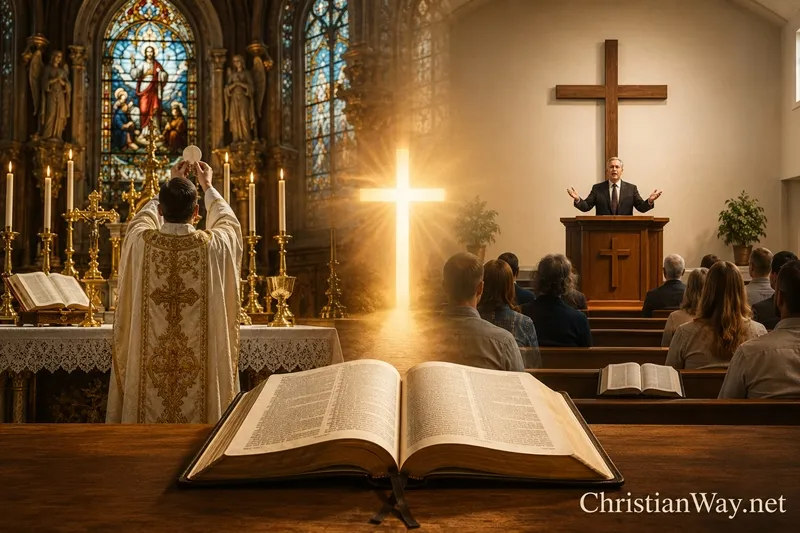
This reflection is offered in the hope that knowledge may lead not to pride, but to humility; not to suspicion, but to honest conversation; and not merely to religious information, but to a deeper desire to follow Christ faithfully.
The Historical Roots of Catholicism and Protestantism
The Catholic Church and the Continuity of the Ancient Church
Catholics understand the Catholic Church as the visible, historical Church founded by Jesus Christ and entrusted to the apostles. They believe that Christ gave the apostles a continuing ministry of teaching, sanctifying, and shepherding His people, and that this ministry has been handed on through the bishops by apostolic succession.
Catholic Christians see a particular role for the apostle Peter. They often point to the words of Jesus:
“You are Peter, and on this rock I will build my church, and the gates of hell shall not prevail against it.”
— Matthew 16:18
Catholic teaching holds that the Bishop of Rome, known as the pope, succeeds Peter in a ministry of visible unity and pastoral leadership. This does not mean that Catholics believe every action or private opinion of a pope is perfect. Popes are human beings who can sin, make poor judgments, and fail in many ways. The Catholic claim is more specific: Christ preserves His Church in the truth necessary for salvation and gives the pope, together with the bishops, a particular responsibility to guard and authentically interpret the apostolic faith.
Catholic worship, theology, and structure developed through many centuries. The Church’s life was shaped by the early councils, the writings of the Church Fathers, monastic communities, missionary expansion, theological controversies, and the spiritual witness of countless saints. Catholics therefore see their tradition not as an addition to biblical Christianity, but as the historical life of the Church unfolding under the guidance of the Holy Spirit.
The Protestant Reformation and the Call for Renewal
Protestantism arose in Western Europe during the sixteenth century, although its roots can be traced to earlier reform movements. Many Christians believed that serious abuses and theological errors had entered the life of the Western Church. Concerns included corruption among some clergy, the misuse of indulgences, inadequate pastoral care, confusion about salvation, and the concentration of ecclesial power.
Martin Luther, an Augustinian friar and professor of Scripture, became a central figure in the Reformation after publicly challenging the abuse of indulgences in 1517. His concerns eventually developed into a wider dispute about authority, justification, the sacraments, and the nature of the Church.
Other reformers, including Huldrych Zwingli, John Calvin, Thomas Cranmer, and later leaders in various countries, developed distinct Protestant traditions. The result was not one unified Protestant church but a family of churches and movements, including Lutheran, Reformed, Anglican, Baptist, Methodist, Presbyterian, Pentecostal, evangelical, and many independent communities.
This diversity is important. There is no single Protestant position on every theological subject. Lutherans, Baptists, Anglicans, Pentecostals, and Reformed Christians may differ considerably in worship, sacramental theology, church government, and spiritual practice. Any comparison between Catholicism and Protestantism must therefore avoid speaking as though all Protestants believe exactly the same things.
The Reformation was not only a political or cultural rebellion. At its heart was a spiritual question: How does a sinful human being become righteous before God? Protestants emphasized the sufficiency of Christ’s saving work, the authority of Scripture, and the reception of salvation through faith. Catholics responded that authentic reform was necessary but maintained that the unity, sacramental life, and apostolic authority of the historic Church could not be abandoned.
The division that followed caused profound suffering. Christians who confessed the same Lord sometimes persecuted one another, fought wars, destroyed sacred places, and treated fellow believers as enemies. We should remember this history with repentance rather than triumphalism. No Christian tradition should look upon the sins of the past merely to condemn others. Every community must ask how fear, pride, political ambition, and hardness of heart have obscured the face of Christ.
Catholicism vs Protestantism at a Glance
Catholicism vs Protestantism at a Glance
The following table offers a concise overview of the main similarities and differences between Catholicism and Protestantism. Because Protestantism includes many denominations, individual churches may hold views that differ from this general summary.
| Area of Belief | Catholicism | Protestantism |
|---|---|---|
| Historical origin | Understands itself as the historic Church founded by Christ and continued through the apostles and their successors. | Emerged from the sixteenth-century Reformation as movements seeking to reform Western Christianity according to Scripture. |
| Primary authority | Sacred Scripture and Sacred Tradition, authentically interpreted by the Church’s Magisterium. | Scripture is the highest and only infallible authority for Christian faith and practice. |
| Church leadership | Led by bishops in apostolic succession, in communion with the pope, the Bishop of Rome. | Leadership varies by denomination and may include bishops, elders, pastors, councils, or local congregations. |
| The pope | Regarded as the successor of Saint Peter and the visible pastor of the universal Church. | Papal supremacy and papal infallibility are generally rejected. |
| Salvation | Entirely initiated by God’s grace and received through faith, which must become active in love and cooperation with grace. | Received by grace through faith in Christ; good works are the fruit and evidence of genuine faith, not the basis of justification. |
| Justification | Includes both the forgiveness of sins and an inner transformation by God’s grace. | Commonly understood as God declaring the believer righteous because of Christ’s righteousness. |
| Sacraments | Recognizes seven sacraments as effective signs through which Christ communicates grace. | Most recognize Baptism and the Lord’s Supper; their meaning and effect vary among denominations. |
| Baptism | Practices infant baptism and regards Baptism as a means of regeneration and entrance into the Church. | Some baptize infants, while Baptists, Pentecostals, and many evangelicals baptize professing believers. |
| The Eucharist or Lord’s Supper | Believes the bread and wine become the true Body and Blood of Christ through transubstantiation. | Views range from the real presence of Christ to a spiritual presence or a symbolic memorial. |
| Confession of sins | Sins are confessed to God, with sacramental confession to a priest for reconciliation and absolution. | Sins are ordinarily confessed directly to God, though confession to pastors or other believers may be encouraged. |
| Mary | Honors Mary as the Mother of God and asks for her intercession; affirms doctrines such as the Immaculate Conception and Assumption. | Honors Mary as the mother of Jesus and an example of faith but generally rejects later Marian dogmas and prayers for her intercession. |
| The saints | Honors the saints and asks for their prayers as living members of the communion of Christ. | Respects faithful Christians of the past but generally does not ask departed saints for intercession. |
| Purgatory | Teaches a final purification for those who die in God’s grace but still need cleansing before entering heaven. | Generally rejects purgatory and teaches that believers enter the presence of Christ after death. |
| The Bible | Includes 73 books, including the deuterocanonical books of the Old Testament. | Usually includes 66 books, excluding the deuterocanonical books from the biblical canon. |
| Worship | Usually liturgical and centered on the celebration of the Eucharist in the Mass. | Ranges from highly liturgical services to informal worship centered on preaching, prayer, and music. |
| Shared Christian faith | Confesses the Trinity, the divinity of Christ, His death and resurrection, the authority of Scripture, and salvation through God’s grace. | Confesses the Trinity, the divinity of Christ, His death and resurrection, the authority of Scripture, and salvation through God’s grace. |
This comparison shows that Catholicism and Protestantism differ significantly in their understanding of authority, the Church, salvation, and the sacraments. At the same time, both traditions stand within the wider Christian confession that Jesus Christ is Lord, that He died and rose for the salvation of humanity, and that every believer is called to live by faith, grace, and love.
Scripture, Tradition, and Christian Authority
The Catholic Understanding of Scripture and Sacred Tradition
Catholics believe that divine revelation has been handed on through both Sacred Scripture and Sacred Tradition. These are not understood as two unrelated sources competing with each other. Rather, they form one sacred deposit of faith entrusted to the Church.
Sacred Scripture is the inspired written Word of God. Sacred Tradition refers to the living transmission of the apostolic faith through the worship, teaching, and life of the Church. Catholics believe that the apostles taught more than they personally wrote and that the Church existed, preached, baptized, and celebrated the Eucharist before the New Testament was fully written and formally recognized.
The Catholic Church therefore teaches that Scripture should be interpreted within the faith of the Church and in continuity with the apostolic tradition. The bishops, in communion with the pope, exercise what is called the Magisterium, or the Church’s teaching office. The Magisterium is not considered superior to the Word of God. Its duty is to serve the Word by guarding, explaining, and faithfully transmitting it.
Catholics may point to Saint Paul’s instruction:
“Stand firm and hold to the traditions that you were taught by us, either by our spoken word or by our letter.”
— 2 Thessalonians 2:15
For Catholics, this passage reflects the reality that apostolic teaching was transmitted both orally and in writing.
The Protestant Principle of Scripture Alone
Most Protestants affirm sola Scriptura, a Latin expression meaning “Scripture alone.” This principle does not necessarily mean that history, tradition, creeds, teachers, and church councils are worthless. Classical Protestants often value the early creeds and consult the writings of earlier Christians. The principle means that Scripture is the only infallible rule of Christian faith and practice.
From a Protestant perspective, church traditions and authorities must always be tested by the written Word of God. Because human institutions can err, no pope, council, bishop, pastor, or denomination possesses authority equal to Scripture.
Protestants often appeal to the example of the Bereans, who received the apostolic preaching eagerly but examined the Scriptures daily to see whether what they heard was true. They also emphasize Christ’s criticism of human traditions that obscure or contradict God’s commands.
The disagreement is therefore not about whether Scripture is authoritative. Catholics and Protestants both confess that the Bible is inspired by God. The deeper question concerns how Christ intended the Scriptures to function within the Church and who possesses authority to give a binding interpretation when serious disagreements arise.
Catholics worry that Scripture separated from an authoritative teaching Church can lead to endless division and contradictory interpretations. Protestants worry that an institution claiming final authority can elevate later doctrines or customs beyond what Scripture teaches.
These concerns should be heard fairly. Catholics are called to ensure that tradition always serves the Gospel rather than becoming mere custom or institutional self-protection. Protestants are called to recognize that every reader interprets Scripture within some community, language, history, and theological tradition, even when that tradition remains unnamed.
Salvation: Grace, Faith, and the Work of Christ
A Shared Confession of Divine Grace
Both Catholics and historic Protestants confess that salvation begins with God’s grace. Human beings cannot redeem themselves by moral effort, religious achievement, intelligence, or social respectability. Salvation is possible only because God acts first.
The Gospel declares that while humanity was still estranged from God, Christ died for sinners. The cross is not a reward for the worthy; it is mercy given to the unworthy. Every Christian, whether Catholic or Protestant, must stand before the cross with empty hands.
Saint Paul writes:
“For by grace you have been saved through faith. And this is not your own doing; it is the gift of God.”
— Ephesians 2:8
Catholics affirm this verse. Protestants affirm it. No authentic Christian teaching permits a person to boast that he has earned the love of God.
The disagreement concerns how grace justifies and transforms the believer, how faith relates to love and good works, and whether justification should be understood primarily as a declaration, an inner renewal, or both.
The Protestant Teaching on Justification by Faith Alone
A central Reformation principle is sola fide, meaning “faith alone.” Protestants teach that sinners are justified before God through faith in Jesus Christ apart from the merit of their works.
To be justified is to be declared righteous in God’s sight because the righteousness of Christ is credited to the believer. Christ has fulfilled the law, borne the judgment of sin, and accomplished everything necessary for salvation. Faith receives this gift; it does not earn it.
Classical Protestant theology distinguishes justification from sanctification. Justification refers to God’s once-for-all declaration that the believer is righteous in Christ. Sanctification is the continuing work of the Holy Spirit by which the believer grows in holiness.
Good works are therefore necessary as the fruit and evidence of true faith, but they are not the basis upon which God accepts the sinner. As the Reformers often insisted, faith alone justifies, but the faith that justifies is never alone. Living faith produces love, obedience, mercy, repentance, and a transformed life.
Protestants frequently appeal to Paul’s teaching that a person is justified by faith apart from works of the law. They fear that including human works in justification could weaken confidence in Christ’s completed sacrifice and lead people to trust their own religious performance.
The Catholic Teaching on Justification and Transforming Grace
Catholic teaching likewise rejects the idea that human beings can earn the initial grace of salvation. Justification begins entirely through God’s mercy and is made possible by the death and resurrection of Christ.
Catholics understand justification not only as the forgiveness of sins but also as an interior renewal by the Holy Spirit. God does not merely regard the sinner as righteous while leaving the person unchanged. Grace truly heals, renews, and enables the believer to participate in the life of Christ.
Faith is indispensable, but Catholic theology does not ordinarily use “faith alone” without qualification because the New Testament speaks of faith working through love. A merely intellectual belief that does not lead to obedience is considered dead.
The Letter of James states:
“Faith by itself, if it does not have works, is dead.”
— James 2:17
Catholics understand good works performed in grace as genuine cooperation with God. These works do not originate independently from the believer and do not place God in humanity’s debt. They are made possible by grace and have value because the believer is united to Christ.
Catholic theology therefore emphasizes that salvation is a living relationship. A person is called to remain in Christ, grow in love, repent after serious sin, and persevere to the end.
Moving Beyond Misunderstanding
Catholics sometimes misunderstand Protestants as teaching that moral conduct does not matter once a person professes faith. Historic Protestantism does not teach this. A faith that produces no repentance or love is considered false or barren.
Protestants sometimes misunderstand Catholics as teaching that heaven can be purchased through good deeds. The Catholic Church explicitly rejects the idea that human beings save themselves apart from grace.
The real differences remain important, especially concerning the nature of justification, merit, perseverance, and the relationship between justification and sanctification. Yet Catholics and Protestants can confess together that salvation is possible only through Jesus Christ and that authentic faith must bear fruit in love.
A Christian life is neither self-salvation nor passive indifference. It is a life in which grace awakens faith, faith clings to Christ, and union with Christ produces obedience.
The Nature and Authority of the Church
The Catholic Church as a Visible and Sacramental Communion
Catholics believe that Jesus founded one visible Church with a recognizable structure, apostolic ministry, sacramental life, and teaching authority. The Church is both a spiritual mystery and a historical community. It is the Body of Christ, the people of God, and the temple of the Holy Spirit.
Catholic ecclesiology places great importance on communion with the bishops and the pope. The unity of the Church is meant to be visible in shared faith, sacraments, and pastoral leadership.
Catholics do not claim that everyone visibly belonging to the Church is holy. The Church contains sinners in need of conversion, and her members have often failed grievously. Yet Catholic teaching distinguishes between the holiness of Christ’s gift to His Church and the sinfulness of those who receive that gift imperfectly.
The Church is also called the sacrament of salvation because Christ continues His ministry through her proclamation, worship, and service. Catholics ordinarily believe that the fullness of the means of grace entrusted by Christ subsists in the Catholic Church, while also recognizing that genuine elements of sanctification and truth exist outside her visible boundaries.
Protestant Understandings of the Church
Protestants agree that the Church is the Body of Christ and the community of believers, but they often define its visible structure differently.
Many Protestants distinguish between the invisible Church, consisting of all true believers known perfectly to God, and visible churches, which are local or denominational communities containing both sincere and nominal Christians.
The true Church is commonly identified wherever the Gospel is faithfully preached, the sacraments or ordinances are properly administered, and Christian discipline is practiced. No single worldwide institution is necessarily regarded as identical with the whole Church of Christ.
Forms of Protestant church government vary. Anglican and some Lutheran churches have bishops. Presbyterian churches are governed through elders and representative councils. Baptist and many evangelical congregations emphasize the authority of the local congregation. Pentecostal communities may combine pastoral leadership with denominational oversight.
Protestants often view denominational diversity as regrettable but not necessarily a destruction of the spiritual unity believers possess in Christ. Catholics, however, tend to see visible institutional and sacramental unity as an essential part of Christ’s intention for His Church.
This difference raises a searching question for all Christians: What kind of unity did Jesus desire when He prayed that His disciples might be one? Spiritual unity is real and precious, but Christ’s prayer also challenges believers to resist complacency about visible division.
The Pope and Apostolic Succession
The Catholic Understanding of the Papacy
Catholics believe that Peter received a distinctive pastoral role among the apostles. The pope, as Bishop of Rome and successor of Peter, serves as a visible principle of unity for the universal Church.
The pope does not replace Christ, who alone is the head of the Church. Nor is the pope believed to receive new public revelation. His ministry is to preserve the apostolic faith and strengthen the brethren.
Papal infallibility is one of the most misunderstood Catholic doctrines. It does not mean that the pope is sinless, all-knowing, inspired in every statement, or incapable of poor decisions. It applies only under particular conditions when the pope definitively teaches a doctrine concerning faith or morals to be held by the whole Church.
Catholics also believe that bishops stand in historical succession from the apostles through ordination. This succession is not merely a chain of officeholders. It is intended to preserve communion with the apostolic mission, teaching, and sacramental ministry.
Protestant Objections and Alternative Models
Most Protestants reject universal papal jurisdiction and papal infallibility because they do not believe these doctrines are clearly established in Scripture. They may honor Peter as an important apostle while interpreting the “rock” of Matthew 16 as Peter’s confession of faith, Christ Himself, or Peter in a role that was not transmitted uniquely to later bishops of Rome.
Protestants also point to moments in the New Testament when Peter was corrected, particularly when Paul confronted him over behavior that compromised the truth of the Gospel.
Some Protestant traditions retain a form of apostolic succession, especially Anglican and certain Lutheran churches. Others understand apostolic succession primarily as fidelity to apostolic teaching rather than an unbroken line of episcopal ordination.
The central question is whether Christ gave the Church a permanent, divinely protected office centered in the Bishop of Rome. Catholics answer yes; most Protestants answer no.
This is not a secondary difference, because it affects how disputes about doctrine are resolved. Yet even amid disagreement, Christians can remember that all authority in the Church must imitate Christ, who washed His disciples’ feet. Authority that ceases to be service becomes a distortion of the Gospel.
The Sacraments and the Means of Grace
Seven Sacraments in Catholicism
The Catholic Church recognizes seven sacraments: Baptism, Confirmation, the Eucharist, Penance or Reconciliation, Anointing of the Sick, Holy Orders, and Matrimony.
Catholics understand the sacraments as effective signs instituted by Christ and entrusted to the Church. Through them, Christ truly communicates grace. Their fruitfulness in a person’s life requires faith and proper disposition, but their reality does not depend upon the personal holiness of the minister.
The sacraments accompany the Christian through the whole journey of life. Baptism gives new birth. Confirmation strengthens the baptized through the Holy Spirit. The Eucharist nourishes believers with Christ Himself. Reconciliation restores those wounded by sin. Anointing brings healing and strength in illness. Matrimony consecrates the covenant of husband and wife. Holy Orders serves the Church through ordained ministry.
Protestant Views of Baptism and the Lord’s Supper
Most Protestants recognize Baptism and the Lord’s Supper as the two rites explicitly instituted by Christ for the whole Church. Many call them sacraments, while others prefer the word ordinances.
Protestant beliefs about their effect differ widely. Lutherans teach that Baptism and the Lord’s Supper are genuine means through which God gives grace. Reformed Christians often describe them as signs and seals of God’s covenant that the Holy Spirit uses to strengthen faith. Baptists generally emphasize them as acts of obedience and public testimony, though some Baptist theologians speak of a rich spiritual participation in Christ through them.
Protestants also disagree about baptism. Lutherans, Anglicans, Presbyterians, Methodists, and many Reformed Christians baptize infants. Baptists, many Pentecostals, and numerous evangelical churches baptize those who personally profess faith.
These differences reveal that Protestantism cannot be reduced to the idea that sacraments are merely symbolic. Some Protestants hold a strongly sacramental theology, while others place greater emphasis on remembrance, testimony, and personal faith.
The Eucharist and the Presence of Christ
The Catholic Doctrine of the Real Presence
The Eucharist stands at the heart of Catholic worship. Catholics believe that during the Mass, through the words of consecration and the power of the Holy Spirit, the bread and wine become the Body and Blood of Christ.
The term transubstantiation describes this change. The appearances of bread and wine remain, but their deepest reality becomes Christ Himself. Catholics therefore adore Christ present in the Eucharist and receive Holy Communion as the true Body and Blood of the Lord.
This belief is connected to the words of Jesus at the Last Supper: “This is my body” and “This is my blood.” Catholics also understand John 6, where Jesus speaks of eating His flesh and drinking His blood, in a strongly Eucharistic sense.
The Mass is not believed to crucify Christ again. The sacrifice of Calvary occurred once and for all. Rather, the one sacrifice of Christ becomes sacramentally present so that the Church may participate in it across time and place.
The Variety of Protestant Eucharistic Beliefs
Protestant teaching about the Lord’s Supper ranges across a wide spectrum.
Lutherans strongly affirm the real presence of Christ’s Body and Blood in the sacrament, although they reject the Catholic explanation of transubstantiation. Reformed Christians often teach a real spiritual presence: believers truly commune with Christ by the Holy Spirit, though His physical body remains in heaven.
Many Anglicans affirm the real presence while allowing mystery to remain around the manner of that presence. Methodists often describe Holy Communion as a means of grace. Baptists and many evangelical churches emphasize the meal as a memorial of Christ’s sacrifice and a proclamation of His death until He returns.
Therefore, it is inaccurate to say that Catholics believe in the real presence while all Protestants believe the Eucharist is only a symbol. The actual divide is more complex. Nevertheless, Catholics uniquely hold transubstantiation and the sacrificial character of the Mass as defined by Catholic doctrine.
At the altar or communion table, all Christians are confronted with the love of Christ who gives Himself for the life of the world. The divisions surrounding the Eucharist are especially painful because the meal intended to express unity also reveals separation. This should awaken not contempt, but prayer for reconciliation in truth.
Confession, Repentance, and Forgiveness
Catholics confess sins directly to God, but they also receive the Sacrament of Reconciliation by confessing serious sins to a priest. They believe Christ gave the apostles authority to forgive sins when He breathed the Holy Spirit upon them and said that the sins they forgave would be forgiven.
The priest does not replace God. He acts as a minister of Christ and the Church. Catholics value sacramental confession as a personal encounter with divine mercy, an opportunity for counsel, and an objective assurance of absolution.
Most Protestants confess sins directly to God, trusting that Christ alone is the mediator between God and humanity. Many encourage confession to another believer, pastor, or spiritual mentor for accountability and healing, but they do not ordinarily regard priestly absolution as a sacrament necessary after grave sin.
Both traditions agree that repentance is essential. Confession must never become an empty formula. True repentance involves sorrow for sin, trust in God’s mercy, and a willingness to turn toward a renewed life.
The Christian does not confess because God delights in humiliation, but because grace brings hidden wounds into the light. Whether kneeling in a confessional or praying privately beside a bed, the sinner must learn to say: “Lord, have mercy on me.”
Mary and the Saints
Catholic Devotion to Mary
Catholics honor Mary as the Mother of Jesus and therefore as the Mother of God, a title that protects the truth that the one she bore is truly divine as well as truly human.
Catholic teaching holds that Mary was uniquely graced by God. Catholics believe in her Immaculate Conception, meaning that she was preserved from original sin from the first moment of her existence, and in her Assumption, meaning that she was taken body and soul into heavenly glory.
Catholics do not worship Mary. Worship belongs to God alone. They venerate her as the foremost disciple of Christ and ask for her intercession, much as Christians ask one another to pray for them.
Marian devotion is intended to lead believers toward Jesus. Mary’s words at Cana express the heart of authentic devotion: “Do whatever he tells you.”
Protestant Concerns About Marian Doctrine
Protestants honor Mary as the mother of Jesus, a woman of faith, and a blessed servant of God. Many gladly confess the ancient title Theotokos, or God-bearer, because it safeguards the divinity of Christ.
However, most Protestants reject the Immaculate Conception and the Assumption because they do not believe these teachings are sufficiently supported by Scripture. They also do not ordinarily pray for Mary’s intercession, fearing that such practices may obscure the unique mediation of Christ.
Protestants often emphasize that every believer has direct access to the Father through Jesus. Catholics agree that Christ is the one mediator of salvation but understand the prayers of Mary and the saints as participation in Christ’s mediation rather than competition with it.
The Communion of Saints
Catholics believe that Christians in heaven remain living members of Christ’s Body and can pray for believers on earth. Asking a saint for prayer is therefore understood as asking a fellow member of the Church to intercede.
Most Protestants honor faithful Christians of the past and may study their lives as examples, but they generally do not address prayers to them. They maintain that Scripture does not clearly instruct believers to seek the intercession of departed saints.
Beneath this disagreement lies a shared hope: those who die in Christ are alive with Him. Death does not defeat the communion created by Jesus. Catholics and Protestants alike can give thanks for the cloud of witnesses whose faith encourages the Church to persevere.
Purgatory, Heaven, and Final Judgment
Catholics believe in purgatory, a final purification of those who die in God’s grace but are not yet perfectly purified. Purgatory is not a second chance for those who definitively reject God, nor is it an alternative destination between heaven and hell. Everyone in purgatory is destined for heaven.
Catholics connect this teaching with the holiness required to enter God’s presence, biblical passages about purification, and the ancient Christian practice of praying for the dead.
Most Protestants reject purgatory because they do not believe it is clearly taught in Scripture and because they see Christ’s righteousness as fully sufficient for the believer’s acceptance before God. They generally teach that believers enter the presence of Christ after death and await the resurrection of the body.
Both traditions affirm the resurrection of the dead, the final judgment, eternal life with God, and the tragic possibility of final separation from Him. Both proclaim that Christian hope rests not in speculation about the afterlife but in the risen Christ, who has conquered death.
Worship, Liturgy, and Christian Practice
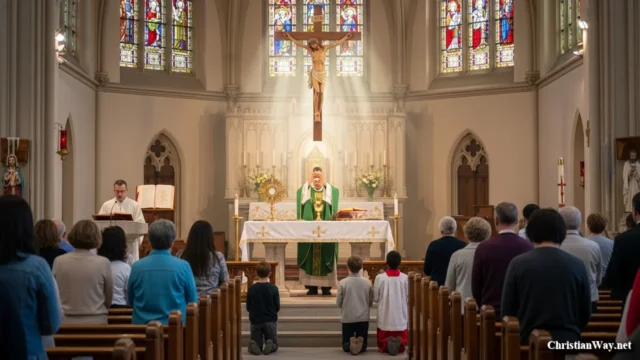
Catholic worship is centered on the Mass, with a structured liturgy of Scripture, prayer, creed, Eucharistic offering, and Holy Communion. The liturgical year guides believers through Advent, Christmas, Lent, Easter, Pentecost, and the memorials of saints.
Catholic churches often include sacred images, statues, candles, vestments, incense, and gestures such as kneeling and making the sign of the cross. These physical elements reflect the Catholic conviction that the material world can serve as a bearer of grace because the Word became flesh.
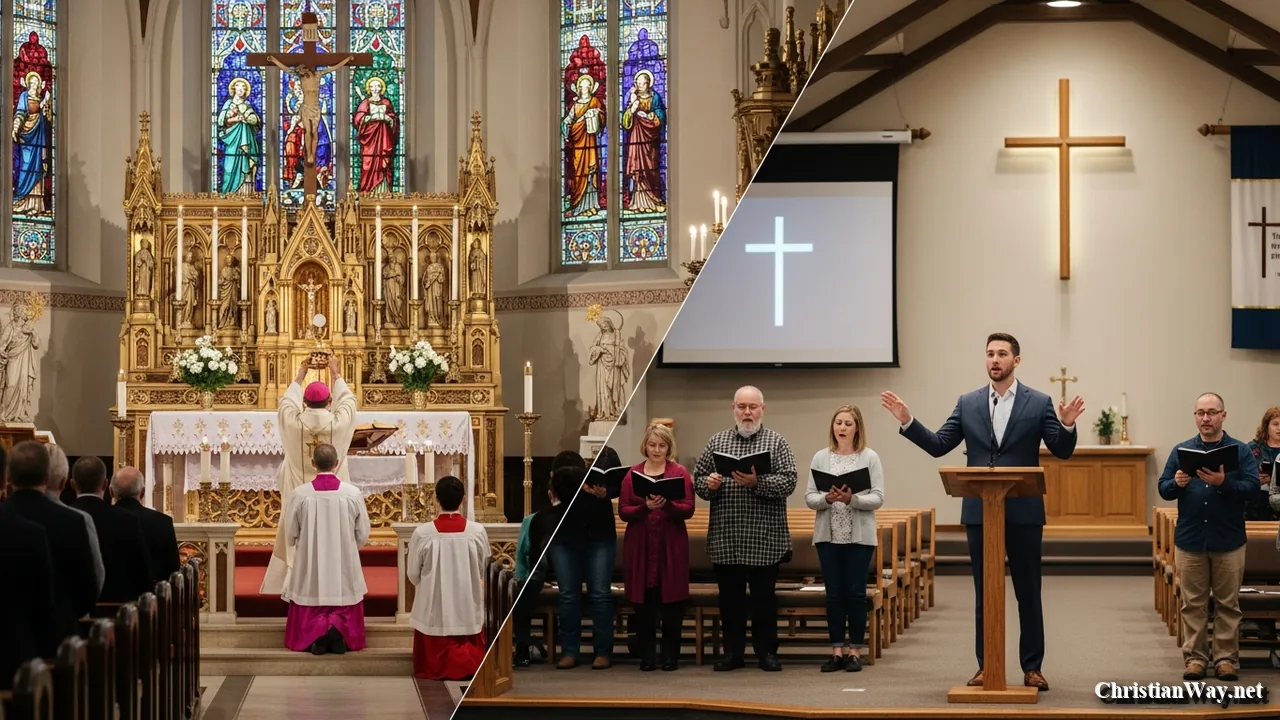
Protestant worship varies greatly. Anglican and Lutheran services may resemble the Catholic liturgy. Reformed worship may center on preaching, psalmody, prayer, and the sacraments. Baptist and evangelical services often include contemporary or traditional songs, extended sermons, spontaneous prayer, and personal testimony. Pentecostal worship may emphasize spiritual gifts, expressive praise, healing prayer, and an immediate experience of the Holy Spirit.
The sermon generally occupies a more prominent place in Protestant worship, reflecting the Reformation emphasis on the proclamation of Scripture. Catholic worship also includes preaching, but the Eucharist remains the summit of the Mass.
Each tradition can learn from the other. Catholics may be reminded by Protestants to cultivate deep personal knowledge of Scripture and an attentive response to preaching. Protestants may be reminded by Catholics that worship is not only intellectual instruction or emotional expression but participation in the prayer of the whole Church across generations.
True worship is not measured by whether the music is ancient or modern, whether the congregation kneels or raises its hands, or whether the service follows a book or a spontaneous order. True worship turns the heart toward the Father through the Son in the Holy Spirit and sends believers into the world to love their neighbors.
Shared Beliefs at the Heart of Christianity
Faith in the Holy Trinity
Catholics and the overwhelming majority of Protestants confess one God in three divine Persons: Father, Son, and Holy Spirit. God is not three gods but one eternal communion of love.
This belief is central, not optional. Christian baptism is given in the name of the Father, the Son, and the Holy Spirit. Christian prayer rises to the Father, through the Son, in the Spirit.
Jesus Christ, True God and True Man
Catholics and Protestants confess that Jesus Christ is the eternal Son of God who became truly human without ceasing to be divine. He was conceived by the Holy Spirit, born of the Virgin Mary, lived without sin, proclaimed the kingdom, healed the sick, welcomed sinners, died under Pontius Pilate, and rose bodily from the dead.
Christ is not merely a prophet, moral teacher, or religious founder. He is Lord and Savior.
The Saving Death and Resurrection of Christ
At the center of both traditions stands the cross. Jesus gave His life for sinners, bore the consequences of evil, reconciled humanity to God, and defeated the powers of sin and death.
Catholic and Protestant theologians may emphasize different aspects of the atonement, but they agree that salvation is accomplished through Christ, not through human wisdom or virtue.
They also confess the bodily resurrection. Christianity does not rest merely on the survival of Jesus’ teachings. It rests on the proclamation that the crucified Lord is alive.
The Inspiration of Holy Scripture
Catholics and Protestants believe that Scripture is inspired by God and authoritative for faith. They read the same four Gospels, the same apostolic letters, and the same central story of creation, covenant, redemption, and new creation.
They differ over the Old Testament canon. Catholic Bibles include books commonly called deuterocanonical, while Protestant Bibles place these writings outside the canon or omit them. Yet the vast majority of biblical books are shared, and the same Christ speaks through the Gospel.
The Need for Conversion and Holiness
Both traditions teach that Christians must repent, believe, and be transformed. Grace is not permission to remain indifferent to sin.
Jesus calls His disciples to love God, forgive enemies, care for the poor, remain faithful in marriage, speak truth, resist injustice, practice mercy, and take up the cross.
Holiness does not belong only to priests, pastors, monks, missionaries, or famous saints. Every Christian is called to become more like Christ in family life, work, suffering, friendship, and service.
Prayer, Mission, and the Hope of Christ’s Return
Catholics and Protestants pray in the name of Jesus. They proclaim the Gospel, translate the Bible, educate children, serve the sick, assist the poor, defend human dignity, and carry the message of Christ across cultures.
They also await the return of Christ, the resurrection of the body, and the renewal of creation. The final hope of Christianity is not that souls escape the world forever, but that God will make all things new.
How Catholics and Protestants Can Speak With One Another
Begin With Listening Rather Than Labels
Many conversations fail because Christians respond to a caricature rather than a person. A Catholic may assume that Protestants have abandoned history and created a faith based only on personal opinion. A Protestant may assume that Catholics worship Mary, trust in their own works, and never read the Bible.
These assumptions prevent understanding.
A better question is: “What does your church actually teach, and what does this belief mean in your relationship with Christ?” Listening does not require agreement. It does require enough humility to allow another person to define his own faith.
Recognize Both Unity and Division
It is unhelpful to say that Catholic and Protestant differences do not matter. Truth matters, and some doctrines lead to substantially different forms of Christian life.
It is equally unhelpful to behave as though Catholics and Protestants have nothing in common. They share the ancient creeds, the Scriptures, faith in the Trinity, and the confession of Jesus Christ as crucified and risen Lord.
Christian charity neither minimizes differences nor turns them into weapons.
Repent of Pride and Hostility
The history of Christian division includes sincere conviction, but it also includes pride, political manipulation, prejudice, and violence. Catholics and Protestants have both failed to reflect the mercy of Christ.
Repentance does not require pretending that every theological claim is equally true. It means refusing hatred, dishonesty, mockery, coercion, and self-righteousness.
Before Christians ask why others cannot see the truth, they should ask whether their own lives make the truth beautiful.
Cooperate in Works of Mercy
Catholics and Protestants can often serve together even while doctrinal dialogue continues. They can feed the hungry, defend the vulnerable, care for refugees, support families, oppose human trafficking, visit prisoners, comfort the grieving, and bear witness to the dignity of every human life.
Such cooperation does not replace theological truth. It shows that shared faith in Christ can already bear visible fruit.
When Christians stand together beside the suffering, old hostilities often appear smaller. At the bedside of a dying person, in a home devastated by poverty, or among children who need protection, the question becomes not which community can claim greater prestige, but whether the love of Jesus is present.
What the Comparison Means for the Searching Heart
For someone exploring Christianity, the many denominations can feel overwhelming. One church points to ancient continuity and sacramental authority. Another emphasizes biblical preaching and personal conversion. One speaks of saints, liturgy, and apostolic succession. Another speaks of faith alone, the authority of Scripture, and direct access to God through Christ.
The searching person may fear making the wrong choice or offending God through imperfect understanding. Yet the first step is not to master every historical controversy. The first step is to turn toward Jesus Christ.
Read the Gospels. Pray honestly. Ask God for wisdom. Visit Christian communities with reverence and discernment. Observe whether their teaching is centered on Christ, faithful to Scripture, rooted in holiness, and expressed through love.
Do not choose a church merely because its music is attractive, its people are socially similar to you, or its message never challenges you. Neither should you choose a tradition simply because it appears ancient or modern. Seek truth with humility, and remember that Christ does not despise the sincere seeker.
For those already rooted in a church, the comparison should invite deeper faithfulness rather than curiosity alone. Catholics should ask whether they truly know the Scriptures, receive the sacraments with living faith, and embody the mercy their Church proclaims. Protestants should ask whether their devotion to Scripture produces unity, holiness, reverence, and love rather than individualism or constant division.
Every tradition can be professed superficially. A Catholic may attend Mass without surrendering the heart. A Protestant may speak of personal faith while refusing repentance. Religious labels cannot replace discipleship.
The question Christ places before every person is not merely, “Which side of a historical debate do you occupy?” It is also, “Do you love me? Will you follow me? Will you forgive as you have been forgiven? Will you take up your cross?”
In the Light of Christ
The discussion of Catholicism vs Protestantism reveals real and enduring differences. Catholics and Protestants disagree about the relationship between Scripture and Tradition, the authority of the pope, the nature of justification, the structure of the Church, the number and effect of the sacraments, the Eucharist, confession, Mary, the saints, and purgatory.
These questions deserve careful study. They cannot be resolved through slogans, social media arguments, or inherited suspicion. They require prayer, historical honesty, theological patience, and a willingness to be corrected.
Yet the comparison also reveals a vast field of shared faith. Catholics and Protestants confess the Trinity, the divinity and humanity of Christ, His saving death, His bodily resurrection, the authority of Scripture, the need for grace, the call to holiness, the power of prayer, and the hope of eternal life.
This shared inheritance should never become an excuse for theological indifference, but neither should theological difference become an excuse for hostility.
At the foot of the cross, Catholic and Protestant pride must both fall silent. No church can boast before the wounds of Christ. No believer comes to Calvary as the owner of grace. We come as sinners who need mercy.
Perhaps Christian unity begins there—not by pretending that all disagreements have disappeared, but by kneeling together before the One who loved us while we were still sinners. The closer Christians draw to Christ, the more deeply they will long for truth, holiness, and reconciliation.
Let us pray:
Lord Jesus Christ,
You prayed that Your disciples might be one.
Forgive us for the ways pride, fear, and bitterness have wounded Your Body.
Give Catholics and Protestants the courage to seek truth without hostility,
to speak with honesty without cruelty,
and to love one another without surrendering faithfulness.
Lead every searching heart into the fullness of Your light.
Purify Your Church, renew Your people, and make us witnesses of Your mercy.
Teach us to build our lives not upon human pride,
but upon Your cross, Your resurrection, and Your unfailing grace.
May the peace of Christ dwell richly in your heart, and may His love guide every step you take toward truth and unity.
— Fr. John Matthew