Dear friends in Christ,
There are moments in history when the anguish of one soul becomes a question placed before the whole Church. Martin Luther was such a soul. He was not born with the intention of dividing Christendom, nor did he begin his life as a man seeking a throne, a following, or a new name for himself. He began as a frightened and earnest seeker of God: a son, a student, a monk, a priest, a teacher of Scripture, and a man whose conscience would not let him rest until he knew whether the mercy of God was truly stronger than human sin. His life unfolded amid the late medieval Church, a world of deep faith, sacramental beauty, learning, devotion, corruption, fear, and sincere longing. In that complicated world, his question was painfully simple: How can a sinner stand before a holy God?
That question does not belong only to the sixteenth century. It rises quietly in every human heart. It appears when we wake in the night burdened by regret, when we realize that our achievements cannot heal our wounds, when death comes close, when prayer feels empty, when we recognize that we cannot save ourselves by trying harder. Many people today are not troubled by the same religious language that troubled Luther, yet they still carry the same hunger. They ask, “Can I be forgiven? Does God receive me? Is His love something I must earn, or is it a gift I may finally receive?” In the story of Martin Luther, we encounter not merely the beginning of the Protestant Reformation, but a searching human heart standing before the mystery of grace.
To remember him faithfully, however, requires more than admiration and more than accusation. Luther was a man of profound courage, spiritual insight, intensity, and learning. He was also a man of his time, marked by anger, limitation, and words that caused real harm. His life helped awaken necessary reform, but it also unfolded within a tragic separation among Christians that still grieves the Body of Christ. Therefore, we approach his story neither as a weapon in old arguments nor as a polished legend. We approach it prayerfully, asking what the Lord may teach us through the struggles, gifts, failures, and witness of this monk who changed the course of Christian history.
A Restless Heart Before God
Martin Luther was born in 1483 in Eisleben, in what is now Germany. His parents hoped that he would rise through education and become a lawyer, a secure profession that could bring honor to the family. He was intelligent, disciplined, and capable, and he entered the University of Erfurt with a future that seemed carefully prepared. Yet God often meets us where our plans are strongest and gently reveals that the deepest path cannot be chosen by calculation alone.
The Storm That Turned Him Toward the Monastery
According to the well-known account of his life, Luther was caught in a violent thunderstorm in 1505 as he traveled near Stotternheim. Terrified by the lightning and fearing for his life, he cried out to Saint Anne and promised that he would become a monk if he survived. Whether we hear in that moment the trembling of youth, the intensity of medieval piety, or the providence of God, the result was decisive. Soon afterward, Luther entered the Augustinian monastery at Erfurt.
He did not enter religious life casually. He gave himself to fasting, prayer, confession, study, and the demanding discipline of the community. Yet the more seriously he sought righteousness, the more sharply he felt his own weakness. He feared not merely punishment, but the holiness of God itself. In later years, he spoke of how the phrase “the righteousness of God” once troubled him, because he heard it mainly as a declaration of divine judgment. How could a sinful person rejoice in the righteousness of God if that righteousness exposed every hidden fault? Luther knew the commands of God were good; what tormented him was the realization that he could not fulfill them by sheer effort.
This was not a shallow anxiety. It was the spiritual pain of someone who believed that God mattered more than comfort, success, or public approval. In an age that often tells us to soothe every discomfort quickly, Luther’s restlessness can teach us something. There is a false peace that comes from refusing to look at the truth, and there is a deeper peace that comes only after the truth has brought us to our knees. The psalmist prayed, “Search me, O God, and know my heart” (Psalm 139:23). Luther, in his own fierce and imperfect way, allowed that searching to reach the depths of his soul.
His superiors and mentors did not simply leave him imprisoned in fear. Johann von Staupitz, the vicar general of the Augustinian order, encouraged him to look not endlessly at himself but to Christ. He directed Luther toward study, preaching, and the Scriptures. This pastoral counsel matters. A soul caught in scrupulosity does not need more self-accusation; it needs to be led toward the crucified and risen Lord. The Christian life is serious about sin precisely because it is even more serious about mercy. The wound must be named, but it must be named in the presence of the Physician.
The Gospel of Grace Opened Before Him
Luther’s spiritual journey was transformed above all through his work as a teacher of Scripture at the University of Wittenberg. He lectured on the Psalms, Romans, Galatians, and Hebrews, returning again and again to the apostolic proclamation that salvation is God’s gift in Jesus Christ. He did not discover a new God. Rather, he came to see more clearly the mercy of the God revealed in the Gospel: a mercy that does not wait for human beings to climb toward heaven, but comes down to us in the Son.
“The Righteous Shall Live by Faith”
Romans 1:17 became especially important to Luther: “The righteous shall live by faith.” He gradually came to understand that the righteousness of God is not only the righteousness by which God judges evil. It is also the righteousness God gives to those who trust in Christ. In other words, the sinner is not saved by presenting God with a perfect record. The sinner is saved because Jesus Christ, in His death and resurrection, has done what we could never do for ourselves. Grace is not a prize handed to the spiritually successful; it is the undeserved love of God reaching the helpless.
This insight is close to the heart of the whole Christian proclamation. Saint Paul writes, “By grace you have been saved through faith; and this is not your own doing, it is the gift of God” (Ephesians 2:8). Christians have long reflected on how faith, grace, love, obedience, sacramental life, and human freedom belong together. Different traditions have expressed these mysteries in different ways. Yet no faithful Christian can say that salvation is a human achievement. We are saved because Christ loved us first. We repent because His goodness calls us home. We do good works not to purchase His love, but because His love is already at work within us.
Luther’s preaching placed Christ at the center with extraordinary force. He warned against any religion that turned the Gospel into a ladder of anxious self-improvement. He knew that even holy practices can become spiritually dangerous when we use them to avoid receiving mercy. Prayer, fasting, almsgiving, confession, worship, service, and the sacraments are precious gifts. But they are not charms that place God in our debt. Their deepest purpose is to draw us into communion with the One who says, “Come to me, all you who labor and are heavy laden, and I will give you rest” (Matthew 11:28).
This is why Martin Luther remains spiritually important even for Christians who do not belong to Lutheran churches. He asks each of us a searching question: What do you rely upon when you stand before God? Do you rely on your morality, your religious activity, your family heritage, your intellect, your suffering, or the good opinion of others? Or do you rest, with humility and trust, in Jesus Christ alone? The grace of God does not make our lives careless. It makes them free. It frees us from the exhausting attempt to prove that we deserve to be loved.
The Ninety-Five Theses and a Call to Reform
In 1517, Luther’s concerns became public. The immediate issue was the preaching and sale of indulgences, practices connected to repentance and the Church’s penitential discipline that were being presented in ways many believers found troubling. Luther was especially alarmed when ordinary people seemed to be given the impression that financial payment could secure forgiveness or lessen the need for genuine conversion. Such a message wounded the conscience, distorted the Gospel, and risked treating grace as if it were a commercial transaction.
A Door, a Debate, and a Church in Need of Renewal
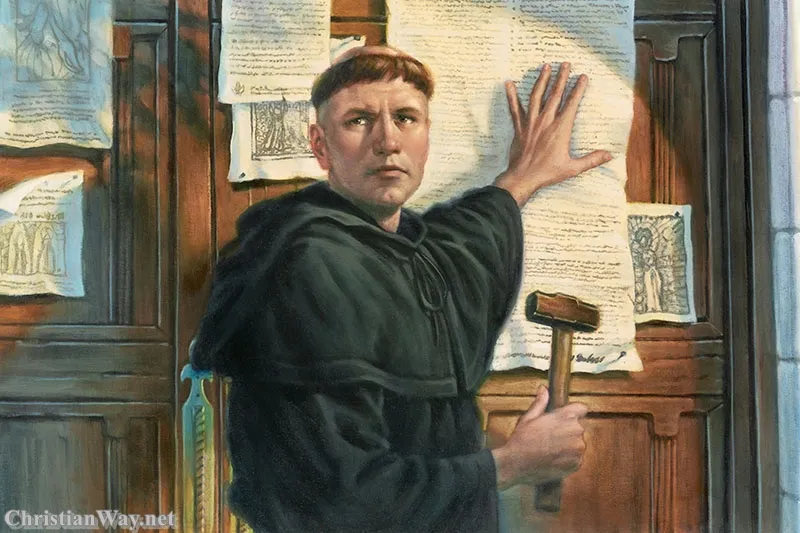
On October 31, 1517, Luther sent his Ninety-Five Theses for academic discussion, and tradition associates the event with the church door in Wittenberg. Whether we imagine the dramatic image of a hammer striking wood or the quieter reality of scholarly correspondence, the central point remains: Luther wanted the Church to recover a more truthful vision of repentance. His first thesis was striking in its simplicity. When the Lord Jesus said, “Repent,” He intended the whole life of believers to be one of repentance.
That is not a call to despair. Christian repentance is not self-hatred; it is the turning of the heart toward the Father who runs to meet the prodigal son. It is a lifelong conversion, a continual return to the fountain of mercy. In this sense, Luther was calling the Church back to a truth that belongs to all Christian traditions. We never graduate from the need for grace. The holiest person is not the one who believes he has no sin, but the one who continues to receive forgiveness with gratitude and to offer that forgiveness to others.
The theses spread quickly because the printing press carried them far beyond the university setting in which they began. They touched a nerve already present across Europe. Many people were concerned about abuses, the financial burdens connected to church life, the moral failures of some clergy, and the distance between the Gospel preached by Christ and the experience of ordinary believers. It is important to say plainly that the Church of that period was not simply corrupt or empty. It contained saints, missionaries, scholars, monasteries, works of mercy, vibrant parish life, and profound devotion. Yet it also contained failures that demanded repentance and reform. The need for reform was real, even though Christians would later differ painfully about the path it should take.
Here we should be cautious in judging the past too easily. Every generation has its blind spots. We may be shocked by the abuses of another century while ignoring the ways money, power, image, and ideology can still corrupt Christian witness today. Whenever the Church forgets that she belongs to Christ, she is tempted to protect herself instead of serving the world. Whenever ministers of the Gospel seek privilege without holiness, or whenever believers confuse outward religion with inward conversion, the old call to reform becomes newly urgent. The Church is holy because Christ is holy; her members are always in need of purification.
Conscience, Scripture, and the Cost of Witness
As the controversy grew, Luther’s ideas developed beyond the original dispute over indulgences. He questioned the authority of the papacy, challenged certain theological formulations, emphasized the authority of Scripture, and called for reforms that many church leaders regarded as dangerous. In 1521, he was summoned before the Diet of Worms, an imperial assembly where he was asked to recant his writings. The gathering placed him before political power, ecclesial authority, and the expectation that he would submit.
Standing Before Powers Greater Than Himself
Luther’s response at Worms became one of the defining images of the Reformation. He appealed to Scripture and to a conscience bound before God. The exact wording preserved in later memory has been debated, but the heart of his position is clear: he believed that he could not deny what he had come to see in the Word of God unless he were shown from Scripture and sound reason that he was mistaken. This conviction was not merely private stubbornness. It was a claim that even the conscience must answer finally to God.
There is something profoundly Christian in this seriousness about conscience. The Church has always taught that conscience is not a place where we invent our own truth. Rather, it is the inner sanctuary where we are called to hear and obey God’s truth. A conscience must be formed by Scripture, prayer, wisdom, tradition, and humble accountability. Yet once a person is honestly convinced that obedience to God requires a certain path, no threat, ridicule, or worldly advantage can rightly replace that obedience. The apostles said before the authorities, “We must obey God rather than men” (Acts 5:29). Luther’s stand belongs to that long and costly tradition of Christian witness.
At the same time, conscience can become isolated. We all need the correction of the Church, the counsel of wise believers, and the humility to admit that we may have misunderstood. Luther’s story is not an invitation to make every personal opinion absolute. It is an invitation to take truth seriously enough that we are willing to be corrected by Christ. The Christian conscience is free, but it is never free from love. It is bound to the Word of God and therefore called to speak truth without cruelty, conviction without contempt, and courage without pride.
Luther was eventually excommunicated, and the political protection he received allowed him to continue his work. During a period of seclusion at the Wartburg Castle, he translated the New Testament into German. This labor was one of his lasting gifts. By placing Scripture in the language of the people, he helped ordinary believers hear the biblical story more directly. The desire that Christians should know the Scriptures deeply belongs to the inheritance of the whole Church. The Bible is not the possession of scholars alone. It is bread for the hungry, light for the confused, comfort for the grieving, and a living word that continually directs us toward Jesus Christ.
A Reformation That Brought Renewal and Wounds
The movement associated with Luther did not remain a narrow academic disagreement. It became a vast religious, social, political, and cultural transformation. New churches formed. Worship changed. Clergy married. Confessional identities hardened. Nations and rulers became entangled in conflicts that were both theological and political. The unity of Western Christianity, already strained by many historical forces, was broken in a visible and lasting way.
The Grief of a Divided Body
We must speak of this division with sorrow. Jesus prayed that His followers “may all be one” so that the world may believe (John 17:21). When Christians wound one another, the world sees not only our disagreements but also our failure to love as Christ loves. The divisions of the Reformation cannot be reduced to one man’s ambition or one institution’s weakness. They grew out of deep disputes about authority, sacraments, salvation, ministry, worship, and the very nature of the Church. They were also intensified by political fears, economic interests, national loyalties, and the passions of human hearts.
For Roman Catholics, Luther’s break with the Church involved grave errors and a rupture in communion. For Lutherans and many other Protestants, his witness represented a necessary recovery of the Gospel and a resistance to teachings and practices that obscured Christ’s saving grace. These convictions should not be treated lightly, because they concern matters believers hold sacred. Yet in the presence of Christ, we can speak truthfully without treating one another as enemies. Many Christians today have inherited divisions they did not create. We are called not to erase history, but to remember it honestly and to seek healing wherever healing is possible.
The Catholic Church’s reform at the Council of Trent, which unfolded in the decades after Luther’s initial protest, addressed abuses, clarified teaching, strengthened clerical formation, and renewed many aspects of church life. Reform did not begin or end with Luther; the Holy Spirit has continually called the Church to purification throughout her history. In this way, even conflict can become a painful instrument through which God summons His people back to fidelity. That does not make division good. It means that the Lord is able to bring light even from the shadows cast by human sin.
The modern movement toward Christian unity has also allowed Catholics, Lutherans, Orthodox Christians, Anglicans, and many Protestant communities to listen to one another with greater patience. In 1999, the Lutheran World Federation and the Roman Catholic Church signed the Joint Declaration on the Doctrine of Justification, expressing significant shared convictions about salvation as God’s gift of grace in Christ. Differences remain, and unity cannot be built by pretending they do not. But this shared witness is a sign of hope. It reminds us that the deepest center of Christian faith is not a human system, but the crucified and risen Lord.
The Gifts Martin Luther Gave to Christian Life
Martin Luther’s influence cannot be measured only by the churches that bear his name. His thought helped shape preaching, worship, education, language, music, family life, public debate, and the reading of Scripture across the world. He wrote catechisms for ordinary households, seeking to help parents teach the faith in the home. He composed hymns that carried theology into the hearts of congregations. He encouraged believers to see ordinary work as a vocation through which God may be served.
Scripture, Song, and the Everyday Calling of God
Luther believed that the Gospel should be heard not only in universities and monasteries, but also around the dinner table, in the workshop, in the field, and in the songs of the people. His Small Catechism was written in a direct and practical style because he understood that faith must be lived in ordinary life. A Christian parent teaching a child to pray, a laborer doing honest work, a neighbor caring for someone who is ill, or a believer singing praise in a small church: these are not lesser forms of holiness. They are places where the love of Christ becomes visible.
His teaching on vocation remains especially helpful. Many people imagine that God is present only in moments that appear obviously religious. Yet the Lord meets us in the patient responsibilities of life. A mother preparing food, a father working faithfully, a student studying with integrity, a nurse caring for the weak, a teacher encouraging a struggling child, a friend listening without judgment—each can become a servant of Christ in the world. As Saint Paul writes, “Whatever you do, do it heartily, as to the Lord” (Colossians 3:23). Luther’s emphasis on ordinary vocation can help rescue us from the false idea that holiness belongs only to extraordinary people.
He also gave renewed attention to congregational song. When the people of God sing, theology enters memory in a way that arguments alone cannot accomplish. Hymns can teach courage, confession, lament, and hope. Luther understood that music could carry the Gospel into places that sermons could not always reach. In every Christian tradition, sacred song remains a gift: it gathers the lonely, strengthens the weary, and gives voice to faith when our own words are too small.
Yet Luther’s legacy must be received with discernment. He was capable of sharp polemic, and some of his later writings against Jewish people were cruel and grievously wrong. Those words have caused harm and have been misused in tragic ways. No Christian may defend hatred by appealing to theological conviction. The Jesus whom Luther preached is the Jewish Messiah, the Son of Mary, who commanded His disciples to love their neighbors and their enemies. To remember Luther truthfully means honoring his witness to grace while rejecting every word or attitude that contradicts the mercy of Christ.
What His Life Asks of the Church Today
The story of Martin Luther is not merely a chapter in a textbook. It remains a mirror held before the Church and before every believer. It asks whether we have allowed the Gospel to become unclear beneath habits, fears, religious performance, or the desire for control. It asks whether our preaching gives people Christ or merely gives them burdens. It asks whether our traditions lead us toward the living God or become walls against the very renewal the Spirit desires to bring.
Reform Begins With Repentance and Love
Every true reform begins in repentance. It begins when we stop speaking only about the failures of others and let the light of Christ search our own hearts. It begins when clergy ask whether they serve with humility, when teachers ask whether they communicate truth with charity, when families ask whether they forgive, and when churches ask whether they make room for the poor, the wounded, and the spiritually exhausted. Reform is not first a program, a slogan, or a struggle for influence. It is the return of the heart to God.
This does not mean that doctrine is unimportant. On the contrary, doctrine matters because it protects the truth of who God is and who we are before Him. Luther cared passionately about doctrine because he believed souls were at stake. But doctrine separated from love becomes a weapon, and love separated from truth becomes sentiment without strength. The Church needs both: the clear confession that Jesus Christ is Lord and the gentle hands that wash the feet of those who suffer.
Our present age has its own indulgences, even if they do not look like the ones Luther confronted. We are tempted to believe that money can secure us, that online approval can justify us, that productivity can redeem us, that political victory can save us, or that spiritual experiences can be consumed like products. But none of these can give the heart peace. The Gospel still says what it said in Luther’s day: our hope is not in ourselves. “While we were still sinners, Christ died for us” (Romans 5:8). This is the ground beneath our feet.
When we truly receive this grace, we become freer to repent, freer to serve, freer to forgive, and freer to seek unity. We no longer need to protect our ego because Christ has received us. We no longer need to win every argument because the truth is not ours to possess; it is God’s gift to obey. We no longer need to despise those who differ from us, because at the foot of the cross every Christian stands as a sinner loved by mercy.
Martin Luther and the Hope of Christian Unity
It may seem strange to speak of unity in an article about the man most closely associated with a historic division. Yet perhaps this is precisely where the Gospel leads us. Christian unity does not mean sameness. It does not mean forgetting doctrines, customs, wounds, or convictions. It means allowing Christ to be greater than our fear and greater than the stories we tell about one another. It means remembering that the Church is not our possession. She belongs to the Lord who gave Himself for her.
Remembering Without Repeating the Old Hostilities
There is a difference between conviction and hostility. We may remain committed to the teachings of our own churches while refusing contempt. We may speak honestly about the differences between Catholic, Lutheran, Orthodox, Anglican, and Protestant understandings while also recognizing the grace of God at work beyond our own familiar boundaries. The first Christians were not united because they had no disagreements; they were united because they learned to bring their disagreements under the lordship of Jesus.
Luther himself could be fierce, and the age in which he lived was not gentle. But we are not required to imitate the harshness of the past in order to honor the seriousness of faith. In a fractured world, Christians can bear a different witness. We can pray for one another. We can read Scripture together. We can serve the poor together. We can acknowledge sins committed in the name of Christ. We can ask the Holy Spirit to heal what human pride has wounded.
The prayer of Jesus in John 17 should remain before us: “That they may all be one.” This is not a vague wish. It is the longing of the Savior for His people. Full visible unity may still seem far away, and real theological questions remain. But every act of repentance, every honest conversation, every shared work of mercy, and every prayer offered across old boundaries becomes a small answer to Christ’s desire. The memory of Martin Luther can therefore lead us not only into history, but into the humility required for reconciliation.
Reflect and Pray
Dear friends, Martin Luther: The Monk Who Changed the Course of Christian History is ultimately a story about a human being who could not escape the question of grace. In his fear, study, courage, and conflict, we see both the greatness and the fragility of the human heart. We see how deeply the Church needs reform, how costly truth can be, how dangerous anger may become, and how faithful God remains even when His people wound one another.
Perhaps the most enduring lesson is this: do not run from the mercy of Christ. Bring Him the sin you cannot hide, the fear you cannot master, the questions you cannot answer, and the divisions you do not know how to heal. He is not surprised by your weakness. He is the Savior who meets sinners with grace, gathers the scattered, and calls His Church again and again to repentance, holiness, and love.
Let us pray.
Lord Jesus Christ, You are the righteousness and peace of all who trust in You. Deliver us from the pride that divides, the fear that enslaves, and the false confidence that turns our eyes away from Your mercy. Give Your Church the courage to repent, the wisdom to seek truth, and the tenderness to love every person You have made. Heal the wounds among Your people, and make us faithful witnesses to Your grace in a weary world. Amen.
May the peace of Christ dwell richly in your heart, and may His love guide every step you take toward Him.
— Fr. John Matthew