Dear friends in Christ,
The origins of Protestantism cannot be understood as a simple story of one man, one disagreement, or one moment in history. It is the story of a Church longing for renewal, of consciences burdened by fear, of men and women searching the Scriptures, of political powers entering religious conflict, and of ordinary believers asking how they could know the mercy of God. It is also a story of deep sorrow, because the movement that began as a call for reform eventually led to visible divisions among Christians that remain with us today.
Yet before we speak of conflict, doctrines, or historical names, we should remember the deepest question beneath the Protestant Reformation. It was not merely, “Who has authority?” It was not only, “How should the Church be governed?” It was, in the hearts of many people, “How can a sinner stand before a holy God?” This question belonged to Martin Luther, John Calvin, Ulrich Zwingli, Thomas Cranmer, the Anabaptists, and many others. But it also belongs to every human heart that has ever carried guilt, fear, regret, or the longing to be received by God.
The Reformation began in a Christian world already rich with prayer, worship, Scripture, saints, learning, monasteries, pilgrimage, music, charity, and deep devotion. It would be unfair to imagine that the medieval Church was empty of grace or untouched by holiness. Across Europe, countless believers loved Christ sincerely. They prayed the Psalms, cared for the poor, built churches, copied manuscripts, taught children, served the sick, and sought to live faithfully before God.
But the Church was also marked by human weakness. Some clergy were poorly trained. Some leaders became too entangled with wealth and political power. Some religious practices were misunderstood or misused. Some ordinary Christians carried a heavy fear that they could never do enough to please God. In this setting, the cry for reform became increasingly urgent.
The origins of Protestantism remind us that the Church always needs renewal. Every generation must ask whether its worship still points people to Christ, whether its leaders remain servants, whether its teaching gives hope to the wounded, and whether its communities reflect the mercy they proclaim. Reform is not first about changing structures. It begins when the heart returns to God.
For Christians today, the Reformation should not be remembered only as an old argument between Catholics and Protestants. It should also be remembered as a call to humility. It invites us to look honestly at our traditions, our habits, our assumptions, and our own hearts. It asks whether we are trusting in Christ or merely trusting in religious familiarity. It asks whether we love truth enough to seek it humbly, and whether we love one another enough to speak about our differences without contempt.
The Church Before the Reformation: A World of Faith, Beauty, and Need
Before Protestantism emerged, Western Christianity was centered around the Roman Catholic Church. Europe was filled with parish churches, monasteries, cathedrals, schools, charitable institutions, and places of pilgrimage. The Christian faith shaped the rhythm of life from birth to burial. Bells called people to worship. Feast days marked the calendar. Scripture was proclaimed in churches. Art, architecture, music, and prayer sought to lift the human heart toward God.
A Church Rich in Devotion
The centuries before the Reformation were not spiritually barren. Many saints, mystics, scholars, reformers, missionaries, and ordinary believers lived lives of deep devotion. Figures such as Francis of Assisi, Catherine of Siena, Thomas Aquinas, Julian of Norwich, and many others bear witness to the beauty of Christian faith during the medieval period.
Monasteries preserved learning, served the poor, welcomed travelers, copied biblical texts, and became places of prayer. Universities grew, and Christian theology developed with great intellectual depth. Parish life brought the sacraments into the ordinary lives of people. Families prayed. Workers attended Mass. The dying were comforted with the hope of eternal life.
It is important to remember this because the Reformation did not arise from a complete absence of faith. It arose within a deeply Christian culture, one in which people cared intensely about salvation, holiness, the Church, and the presence of God.
Yet sincere faith does not remove every human weakness. The Church is holy because Christ is holy, but her members remain in need of repentance. Across the centuries, believers had repeatedly called for reform. Monastic movements, preaching orders, spiritual revivals, and reforming popes had all sought to renew the Church before the sixteenth century.
The Reformation was therefore not the first call for renewal. But it became one of the most far-reaching and painful.
When Spiritual Life Becomes Burdened by Fear
Many Christians in late medieval Europe carried a strong awareness of sin, judgment, death, and the need for repentance. This awareness was not wrong. Scripture speaks clearly about sin, the holiness of God, and the need to turn from evil. But for some believers, faith became overshadowed by anxiety.
They wondered whether they had confessed enough. They feared dying with sins still unforgiven. They worried about punishment after death. They sought assurance through prayers, pilgrimages, charitable acts, relics, devotions, and other religious practices.
These practices could be meaningful when rooted in faith, but they could also become distorted when people began to believe that salvation depended mainly on their ability to perform religious acts. The Gospel of grace can become obscured when human beings begin to think that God’s love must be purchased, earned, or negotiated.
This was the burden that troubled Martin Luther. He was not a man who took sin lightly. He took it so seriously that he struggled to believe he could ever stand before God. His spiritual crisis would become one of the sparks that ignited the Protestant Reformation.
Martin Luther and the Cry for Reform
Martin Luther was born in 1483 in Germany. He became an Augustinian monk, priest, professor, preacher, and student of Scripture. He was intelligent, disciplined, and deeply serious about faith. Yet beneath his learning and religious devotion, he carried a troubled conscience.
Luther feared the righteousness of God because he understood it mainly as the standard by which God judges sinners. The more he examined his own heart, the more he felt his inability to become righteous by effort alone. He prayed, fasted, confessed, studied, and sought peace, but he remained restless.
The Discovery of Grace
As Luther lectured on the Psalms, Romans, Galatians, and Hebrews, he began to see the Gospel differently. He reflected deeply on the words of Saint Paul: “The righteous shall live by faith” (Romans 1:17).
Gradually, Luther came to understand that the righteousness of God was not only the righteousness by which God judges sin. It was also the righteousness God gives to those who trust in Christ. Salvation was not a reward for those who had achieved spiritual success. It was the gift of divine mercy.
This insight became central to Luther’s preaching. Christ had done what sinners could never do for themselves. Through His death and resurrection, Jesus had opened the way to forgiveness, reconciliation, and peace with God. The believer did not need to climb toward heaven by endless fear. God had come down to humanity in Christ.
This was not a rejection of repentance, prayer, good works, or holy living. Luther believed that genuine faith should bear fruit. But he insisted that good works flow from salvation; they do not purchase salvation. Christians serve God because they are loved, not in order to make God love them.
The Question of Indulgences
The immediate public controversy began around the preaching of indulgences. In Catholic teaching, indulgences were connected to the Church’s pastoral practice of penance and the remission of temporal consequences associated with sin. Yet in the popular preaching of Luther’s day, they were sometimes presented in ways that confused ordinary people.
Many believers were left with the impression that money could secure spiritual benefits, reduce punishment, or free loved ones from suffering after death. This deeply troubled Luther. He feared that people were being encouraged to rely on a financial transaction rather than true repentance and faith.
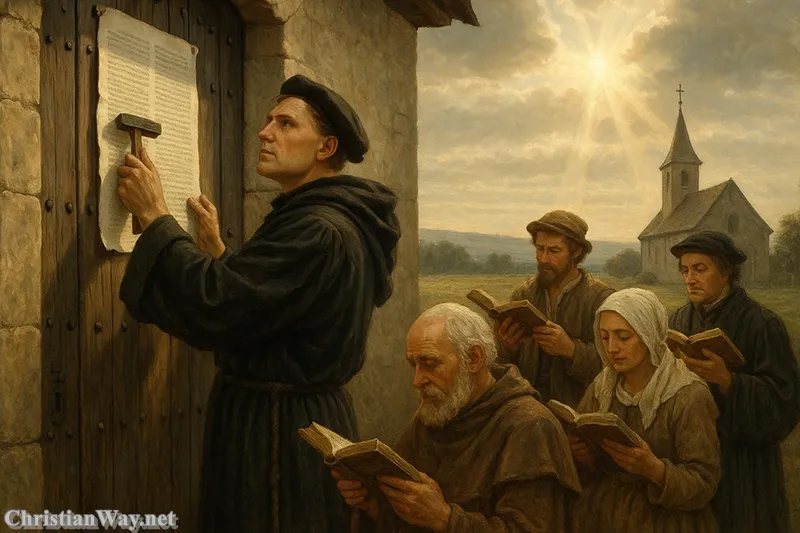
In 1517, Luther wrote his Ninety-Five Theses, inviting academic debate about indulgences, repentance, and the nature of spiritual authority. The traditional image of him nailing the theses to the church door in Wittenberg remains powerful, though the more certain historical point is that his theses circulated quickly and provoked widespread discussion.
Luther’s first thesis captured the heart of his concern: when Jesus called His followers to repent, He intended the whole life of believers to be one of repentance.
This was not meant to crush the soul. It was meant to free it. Christian repentance is not endless self-hatred. It is the return of the heart to the Father who receives the prodigal child. It is the recognition that we need grace every day.
From Local Debate to a Movement Across Europe
What began as a debate over indulgences soon became something far greater. Luther’s writings spread rapidly through the newly developing power of print. Pamphlets, sermons, translations, and theological arguments moved from town to town. Ordinary people, students, princes, clergy, merchants, and scholars began discussing questions that had once remained mostly within universities and church courts.
Scripture, Conscience, and Authority
Luther’s concerns expanded beyond indulgences. He began to question the authority of the Pope, the role of Church tradition, the nature of the sacraments, and the relationship between grace, faith, and works. He argued that Scripture held the highest authority for Christian teaching and that every human authority must be judged in the light of God’s Word.
In 1521, Luther appeared before the Diet of Worms, an imperial assembly where he was asked to recant his writings. His stand became one of the defining moments of the Reformation. He appealed to Scripture and to conscience, declaring that he could not deny what he believed unless he were convinced by biblical witness and sound reason.
His position was not merely private rebellion. Luther believed that conscience must ultimately answer to God. Yet the Christian conscience is never meant to become self-centered stubbornness. It must be formed through Scripture, prayer, humility, wisdom, and the willingness to be corrected.
Luther’s challenge to authority was powerful because many people already felt that Church structures had become distant from the Gospel. His writings gave language to frustrations that had been building for generations.
The Birth of the Name “Protestant”
The word Protestant came into wider use after a protest in 1529 at the Diet of Speyer. Certain rulers and cities objected when an earlier measure of tolerance toward reforming movements was restricted. Their protest was not simply an act of anger. It was a declaration that they believed the Gospel and conscience must not be controlled merely by political pressure.
Over time, the word Protestant came to describe the many Christian communities that separated from Roman Catholic authority during the Reformation and its aftermath. Yet Protestantism was never a single church with one leader, one worship style, or one theological system.
The origins of Protestantism were diverse from the beginning. Lutherans, Reformed Christians, Anabaptists, Anglicans, Presbyterians, later Baptists, Methodists, and many other communities would develop their own spiritual identities, church structures, and theological convictions.
Many Reformers, Many Paths
The Protestant Reformation was not the work of Martin Luther alone. Many figures, often disagreeing deeply with one another, shaped the movement. Some shared common convictions about Scripture and grace, yet differed over the sacraments, church authority, worship, baptism, and the relationship between Christians and civil government.
Ulrich Zwingli and the Swiss Reformation
Ulrich Zwingli was a priest and reformer in Zurich, Switzerland. Like Luther, he believed that the Church needed to return to Scripture. He challenged practices he believed were not rooted clearly in the Bible and sought to simplify worship.
Zwingli emphasized the authority of Scripture and rejected practices that he believed distracted from Christ. His understanding of the Lord’s Supper differed from Luther’s, however. Luther held strongly that Christ was truly present in the sacrament, while Zwingli emphasized the memorial and communal character of the meal.
Their disagreement revealed something important: Protestantism was not a single uniform movement. Even those who agreed that reform was needed could still differ profoundly about how to understand worship and the sacraments.
The Anabaptist Witness
Another stream of the Reformation came through groups often called Anabaptists. They believed that baptism should follow a personal confession of faith, rather than being administered to infants. Many also emphasized voluntary church membership, discipleship, simplicity, peace, and separation from political power.
Some Anabaptist communities faced persecution not only from Roman Catholic authorities, but also from other Protestants. Their history reminds us how quickly Christians can fail to love one another when theological disagreement becomes tied to fear and power.
The Anabaptist tradition would influence later Mennonite, Amish, Brethren, Baptist, and Free Church movements. Their emphasis on a church of committed disciples continues to shape Christian life around the world.
John Calvin and the Reformed Tradition
John Calvin, a French reformer who became closely associated with Geneva, developed one of the most influential Protestant theological traditions. He emphasized the sovereignty of God, the authority of Scripture, salvation by grace, the centrality of Christ, and the calling of believers to live before the face of God.
Calvin’s writings, especially Institutes of the Christian Religion, shaped Reformed and Presbyterian churches across Europe and beyond. His influence reached Scotland through John Knox, affected churches in the Netherlands and France, and later shaped many communities in North America, Africa, Asia, and other parts of the world.
Calvin’s theology is often associated with predestination, but his vision was broader than one doctrine. He wanted believers to know that their hope rested in God’s mercy rather than in their own strength. He taught that every part of life belonged to God: work, family, worship, education, public responsibility, and service to neighbor.
The English Reformation
The English Reformation followed a distinct path. It involved questions of royal authority, papal jurisdiction, political conflict, worship, doctrine, and the identity of the Church in England. Over time, the Church of England developed a tradition that carried both Catholic and Reformed elements.
Anglicanism would later become a worldwide communion, shaped by the Book of Common Prayer, episcopal leadership, sacramental worship, biblical preaching, and a broad range of theological perspectives.
The English story reminds us again that the Reformation was not only a matter of theology. Politics, national identity, royal power, economic interests, and social change were deeply involved. This does not mean that faith was unimportant. It means that human history is often complicated, and spiritual movements can become entangled with worldly struggles.
The Central Beliefs of Protestantism
Although Protestant churches are diverse, several convictions became especially important across many Protestant traditions. These are often summarized through phrases known as the “solas.” These phrases are helpful, but they should not be treated as if every Protestant community uses them in exactly the same way or gives them identical meaning.
Scripture as the Highest Authority
Many Protestants emphasize sola Scriptura, often translated as “Scripture alone.” This does not always mean that history, tradition, teachers, councils, or Christian wisdom are worthless. Rather, it means that Scripture is regarded as the final and highest authority for faith and practice.
Protestants believe the Bible is not merely a collection of ancient texts. It is the living witness through which God reveals His character, His saving work, and His will for His people. The Old Testament tells the story of creation, covenant, promise, failure, mercy, and longing for redemption. The New Testament reveals Jesus Christ as the fulfillment of God’s promises.
This emphasis on Scripture led many Reformers to translate the Bible into the languages of ordinary people. They wanted farmers, workers, parents, merchants, and children to hear the Word of God directly. Bible reading became a central feature of Protestant devotion, education, preaching, and family life.
Salvation by Grace Through Faith
Another central Protestant conviction is that salvation comes through grace, received by faith. Saint Paul writes, “For by grace are ye saved through faith; and that not of yourselves: it is the gift of God” (Ephesians 2:8).
Protestants often emphasize that no human being can earn salvation. We cannot rescue ourselves through good behavior, religious performance, wealth, knowledge, family background, or social status. We are saved because God loves us in Christ.
Faith is not merely agreeing with religious ideas. It is trusting in Jesus Christ. It is resting in His mercy. It is receiving the forgiveness and new life He offers.
This does not mean that works are unimportant. A living faith bears fruit in love, obedience, generosity, forgiveness, prayer, and service. But good works are the response to grace, not the price of grace.
Christ Alone
Protestantism also strongly emphasizes Christ as the only Savior and mediator between God and humanity. Jesus Christ is not merely a teacher pointing toward God. He is the incarnate Son of God, the Lamb who takes away the sin of the world, the crucified Savior, and the risen Lord.
The Reformers feared that Christians could become distracted by religious customs, human achievements, or spiritual intermediaries in ways that obscured the direct saving work of Christ. They wanted to return attention to Jesus Himself.
This remains a needed reminder for every Christian tradition. No institution, leader, tradition, preacher, theologian, saint, or spiritual practice can replace Christ. The Church exists to point people toward Him.
Glory to God Alone
The phrase Soli Deo Gloria means “to God alone be the glory.” This conviction teaches that the purpose of salvation and the whole Christian life is the glory of God.
At its best, this does not make human life small or joyless. It gives life its deepest meaning. A person glorifies God not only through worship, but through honesty, work, care for family, service to the poor, courage in suffering, forgiveness, and love.
The Christian life becomes less about building a personal reputation and more about living in gratitude before the One who has given us life.
Protestant Worship and the Life of the Church
The Reformation changed worship in many parts of Europe. Protestant communities often placed strong emphasis on preaching, congregational singing, prayer, Scripture reading, and the use of local languages.
Worship in the Language of the People
For many Reformers, worship needed to be understandable to ordinary believers. They wanted people to hear Scripture in their own language, pray with understanding, sing together, and participate actively in the life of the Church.
Luther wrote hymns and encouraged congregational singing. Reformed communities sang psalms. Anglican worship was shaped by prayers in English through the Book of Common Prayer. Other Protestant communities developed their own patterns of preaching, prayer, music, testimony, and fellowship.
These changes helped form the devotional life of millions of Christians. Scripture was no longer heard only through formal liturgical settings. It also became part of family prayer, education, personal reading, and ordinary conversation.
Sacraments and Differences
Protestant churches generally recognize baptism and the Lord’s Supper as central acts instituted by Christ. Yet they differ in how they understand these gifts.
Lutherans emphasize Christ’s true presence in the Lord’s Supper. Reformed Christians speak of believers being nourished spiritually by Christ through the Holy Spirit. Anglicans hold a range of sacramental understandings. Baptists and many Free Church traditions often emphasize the memorial and communal nature of Communion. Pentecostal and Evangelical churches may celebrate the Lord’s Supper in different ways, while still remembering Christ’s sacrifice.
These differences matter, because worship shapes how Christians understand the nearness of Christ, the life of the Church, and the meaning of grace. Yet all Christians who gather around the table of the Lord are called to remember the One who gave His body and shed His blood for the life of the world.
The Catholic Response and the Sorrow of Division
The Protestant Reformation did not occur without response. The Roman Catholic Church also entered a period of serious renewal. The Council of Trent, which met in stages between 1545 and 1563, addressed abuses, clarified Catholic teaching, strengthened the formation of clergy, renewed pastoral structures, and affirmed the importance of the sacraments, tradition, and the Church’s teaching authority.
Reform Was Needed on Every Side
It is too simple to say that Protestants wanted reform and Catholics opposed reform. Many Catholics also recognized the need for renewal. New religious orders, missionary movements, seminaries, charitable institutions, and spiritual communities arose during this time.
The Catholic Reformation, sometimes called the Counter-Reformation, sought to strengthen the Church from within. It produced saints, missionaries, teachers, mystics, and servants of the poor. Figures such as Ignatius of Loyola, Teresa of Ávila, Francis de Sales, Charles Borromeo, and Vincent de Paul became signs of spiritual renewal.
The tragedy is that reform unfolded amid separation rather than reconciliation. Christians who shared belief in the Trinity, the incarnation, the cross, the resurrection, Scripture, prayer, and the call to holiness became divided over questions of authority, sacraments, justification, ministry, worship, and Church life.
The Violence of Christian Conflict
The Reformation era was marked not only by theological debate, but also by persecution, war, executions, political struggle, and suffering. Catholics persecuted Protestants in some places. Protestants persecuted Catholics in others. Some Protestant groups persecuted other Protestants. The name of Christ was sometimes used to justify actions that contradicted the mercy of Christ.
This should grieve every Christian.
Jesus prayed that His followers “may all be one” (John 17:21). The divisions of the Reformation are not merely historical events. They are wounds in the Body of Christ. We should remember them with honesty, repentance, and prayer.
No Christian should use the history of the Reformation as a weapon. We may hold convictions firmly, but we must never take pleasure in another believer’s suffering. Truth and love belong together in the heart of God.
The Reformation and Ordinary Christian Life
The origins of Protestantism shaped much more than theological debate. The Reformation changed family life, education, worship, music, language, work, politics, and the way many Christians understood their daily calling.
The Bible in the Home
One of the most lasting effects of the Reformation was the increased emphasis on Scripture in the languages of ordinary people. Families were encouraged to read the Bible, teach children, memorize passages, pray together, and shape their lives around God’s Word.
For many Protestants, the home became an important place of discipleship. Parents were encouraged to speak about faith with children. Hymns were sung. Catechisms were taught. Bible reading became part of daily life.
This emphasis remains spiritually valuable. The Christian faith is not meant to remain only in church buildings. It belongs at the family table, in difficult conversations, in work, in grief, in joy, and in ordinary acts of love.
Vocation and Everyday Work
The Reformers also gave renewed emphasis to the dignity of ordinary work. A farmer, parent, teacher, craftsperson, worker, merchant, or servant could live faithfully before God. Holiness did not belong only to monks, clergy, or scholars.
Martin Luther and later Calvin taught that ordinary responsibilities could become acts of service to God. A mother caring for children, a worker acting honestly, a teacher shaping young minds, or a neighbor helping someone in need could all live as part of God’s calling.
This was a beautiful reminder that every honest task can become an offering. Yet it should never be used to justify exploitation, exhaustion, or injustice. Work is holy when it respects human dignity, serves others, and is carried out with integrity.
What Protestantism Means Today
Today, Protestantism includes a vast family of churches around the world. Some are Lutheran, Reformed, Anglican, Presbyterian, Baptist, Methodist, Pentecostal, Evangelical, Mennonite, Congregational, Holiness, Charismatic, or non-denominational. Their worship styles vary greatly. Their theological emphases differ. Their church structures are not the same.
Yet many Protestants continue to share a love for Scripture, a focus on personal faith in Christ, the conviction that salvation is by grace, the importance of preaching, and the calling of every believer to serve God in daily life.
A Family Marked by Diversity
No single description can fully contain Protestantism. Some Protestant churches have formal liturgies, bishops, sacraments, historic prayers, robes, and ancient hymns. Others worship in simpler settings with spontaneous prayer, contemporary music, testimony, and Bible teaching.
Some emphasize predestination and covenant. Others emphasize free will and personal conversion. Some baptize infants. Others baptize only believers. Some celebrate Communion weekly. Others observe it monthly or less often. Some are strongly connected to historic confessions of faith. Others focus more on local church independence.
This diversity can be a strength when it reflects the richness of the Body of Christ. But it can also become a weakness when Christians divide too easily, forget humility, or treat their own tradition as the whole of Christianity.
The origins of Protestantism should remind believers that reform must never become pride. Every church, every tradition, and every Christian needs the mercy of God.
The Call to Unity in Christ
Christians today cannot undo the divisions of the sixteenth century by pretending that differences do not exist. Catholics, Orthodox Christians, Anglicans, Lutherans, Reformed Christians, Baptists, Pentecostals, Evangelicals, and other communities still hold distinct convictions about Scripture, authority, sacraments, ministry, salvation, and worship.
These differences matter. Honest theological conversation remains necessary. Unity cannot be built upon confusion or by ignoring truth.
But neither can unity be built through hostility.
Conviction Without Contempt
The Gospel calls Christians to speak truth with love. Saint Paul writes that believers are to grow by “speaking the truth in love” (Ephesians 4:15). This is not weakness. It is Christian maturity.
We can remain faithful to our convictions while refusing to despise others. We can study the history of the Reformation honestly while refusing to repeat its cruelties. We can recognize the gifts present in other Christian traditions without surrendering the truths we believe God has entrusted to us.
Perhaps this is one of the most important lessons of the Reformation for our own time. The world is already divided by anger, politics, race, class, nationalism, fear, and suspicion. Christians are called to bear a different witness.
We are called to pray for one another. We are called to serve the poor together where possible. We are called to defend human dignity. We are called to remember that Jesus Christ is greater than our old hostility.
The path toward visible Christian unity may be long. But every act of humility, every honest conversation, every shared prayer, and every act of mercy becomes a small response to the prayer of Jesus.
What the Origins of Protestantism Ask of Us
The Protestant Reformation asks us to return to the questions that troubled its earliest voices. Do we trust in the grace of God, or do we secretly believe we must earn our worth? Do we read Scripture as the living Word that leads us to Christ? Do we take repentance seriously without falling into despair? Do we seek reform in our churches with humility and love?
The Church Must Always Return to Christ
Every Christian community can become distracted. We may become attached to habits, personalities, institutions, arguments, or cultural traditions. These things may have value, but they cannot become the center.
Christ must remain the center.
The Church is renewed whenever believers return to the Gospels, pray honestly, confess sin, care for the poor, protect the vulnerable, forgive one another, and seek the guidance of the Holy Spirit. Reform begins when we allow Christ to search our hearts.
The great danger is not only that churches may become outdated. The deeper danger is that churches may become cold. We may preserve correct words while losing compassionate hearts. We may defend truth while forgetting mercy. We may speak about grace while refusing to forgive.
The origins of Protestantism remind us that God continues to call His people back to Himself. This call is not only for one tradition. It is for all of us.
Reflect and Pray
Dear friends, Origins of Protestantism: The Reformation Explained is not simply a story about the past. It is a story about the human longing for grace, truth, Scripture, renewal, and peace with God.
The Reformation brought many important gifts: renewed attention to Scripture, a strong proclamation of grace, worship in the language of the people, the dignity of ordinary vocation, and a deep desire to place Christ at the center of faith. Yet it also brought division, conflict, and wounds that Christians must remember with sorrow.
We honor the Reformation best when we do not turn it into a reason for pride. Instead, let it lead us back to Jesus Christ. Let it remind us that we are saved by grace. Let it teach us to read Scripture with humble hearts. Let it call us to serve faithfully in ordinary life. And let it move us to pray that all who confess Christ may grow in truth, charity, and unity.
Let us pray.
Lord Jesus Christ, You are the foundation of Your Church and the source of every true renewal. Forgive us for the ways Christians have wounded one another through pride, fear, and division. Teach us to love Your Word, trust Your grace, and seek Your truth with humble hearts. Renew Your Church in holiness, courage, mercy, and peace. Make us faithful witnesses to Your Gospel, that the world may see Your love through the lives of Your people. Amen.
May the peace of Christ dwell richly in your heart, and may His love guide every step you take toward Him.
— Fr. John Matthew