Dear friends in Christ,
There are times when the human heart becomes weary of choosing between things that were never meant to be enemies. We may feel that faith belongs only to prayer, while reason belongs only to study. We may imagine that love for God requires us to close our minds, or that serious thinking requires us to leave behind the quiet trust of the soul. We may be surrounded by information, arguments, scientific discoveries, opinions, and endless voices, yet still feel uncertain about where truth can be found.
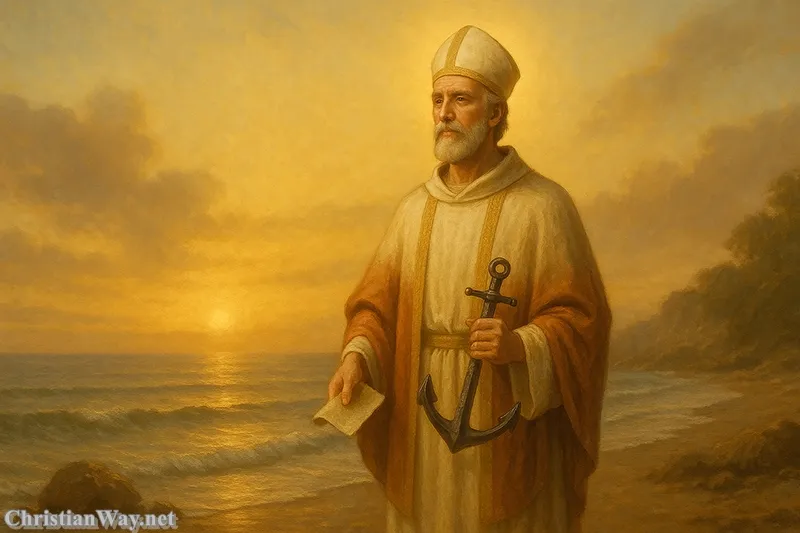
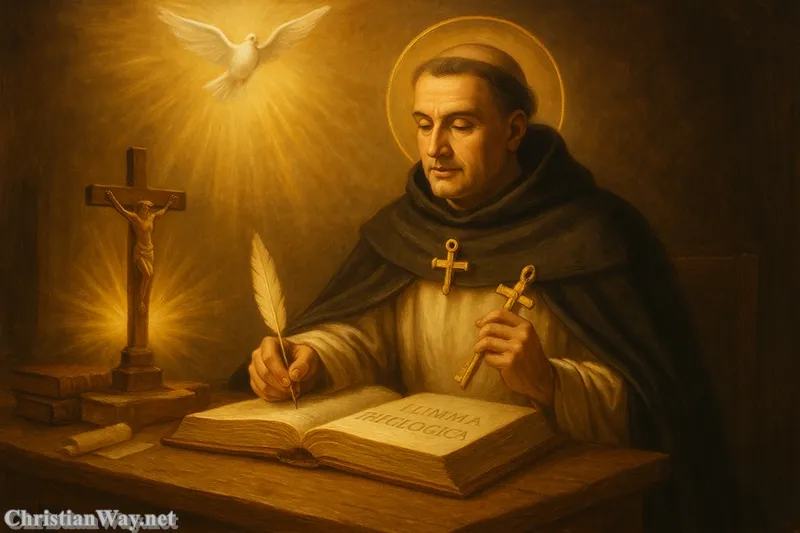
Saint Thomas Aquinas comes to us in such a moment as a gentle guide. He was one of the Church’s greatest theologians and philosophers, but he was not a man who loved ideas merely for the pleasure of winning arguments. He loved truth because he loved God. His study was not separate from prayer. His questions were not separate from worship. His brilliant mind did not lead him away from Christ; it led him more deeply toward the mystery of Christ.
The Church has long called Saint Thomas Aquinas the Angelic Doctor, a title connected with the purity of his life and the height of his thought. Yet behind this title was not an unreachable man who lived only among books and theological debates. Thomas was a Dominican friar, a teacher, a preacher, a friend, a man of prayer, and a servant of the Church. He knew that every human person longs for truth, but he also knew that truth is not finally an idea to be possessed. Truth has a face. Truth is Jesus Christ.
When Jesus says, “I am the way and the truth and the life” (John 14:6), He does not invite us into a cold system of ideas. He invites us into communion with Himself. Saint Thomas Aquinas spent his life helping the Church understand this more clearly. He showed that the mind is a gift from God, that reason can lead us toward wonder, and that faith does not crush the intellect but lifts it toward a light beyond its own strength.
His witness remains deeply needed. In a world where some people dismiss faith as irrational and others fear that questions will weaken belief, Saint Thomas reminds us that God is not threatened by honest inquiry. The Creator of the stars, the human mind, the moral law, and the beauty of creation does not ask us to abandon reason at the door of faith. He asks us to bring our whole selves to Him: heart, mind, imagination, weakness, questions, and hope.
Saint Thomas Aquinas teaches us that a Christian does not have to choose between loving God deeply and thinking carefully. The same God who gives faith also gives reason. The same God who speaks in Scripture has written signs of His wisdom into creation. The same Lord who calls us to humble prayer also commands us to love Him “with all your heart, with all your soul, and with all your mind” (Matthew 22:37).
A Young Man Who Chose God Above Comfort
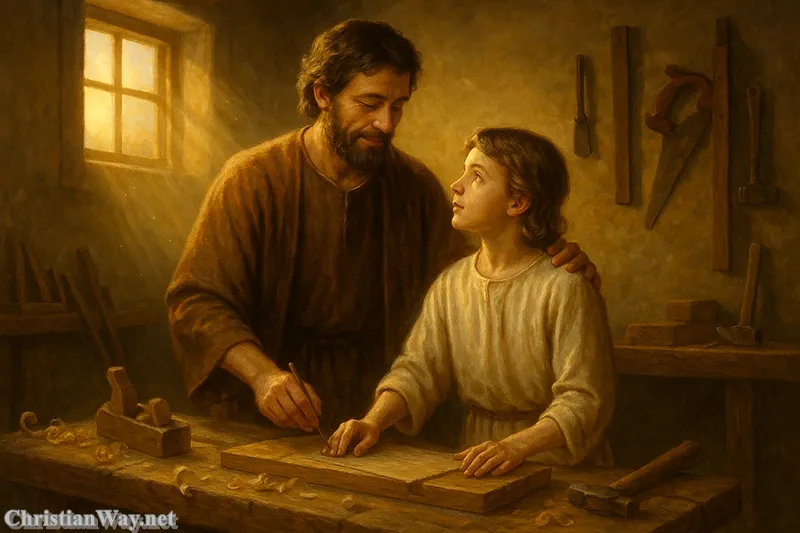
Saint Thomas Aquinas was born around 1224 or 1225 in Roccasecca, near Aquino in Italy, into a wealthy noble family. His parents hoped that he would enter the influential Benedictine abbey of Montecassino and eventually hold an important position in the Church. Yet as a young man studying in Naples, Thomas encountered the newly founded Dominican Order and felt drawn to its life of poverty, preaching, study, and service. His family strongly opposed this choice, but Thomas remained faithful to what he believed God was asking of him.
This decision already reveals something important about the saint. Thomas was not simply a gifted student who drifted into theology because he enjoyed books. He chose a path that cost him something. He turned away from the security, prestige, and expectations that surrounded his birth. He desired to belong fully to Christ.
The Dominican Order had been founded by Saint Dominic to preach the Gospel with clarity, poverty, and deep knowledge of Scripture. The friars were called to study not so that they might appear superior to others, but so that they could serve the Church more faithfully. They were to bring the light of truth into a world where many people had become confused, divided, or spiritually hungry.
Thomas entered this life with a quiet determination. Tradition remembers him as a man of few unnecessary words, a person whose silence was not emptiness but attentiveness. He listened carefully. He studied patiently. He prayed deeply. He allowed truth to grow within him before he attempted to speak about it.
This is a lesson for us in an age that often rewards speed. We are tempted to answer before we understand, react before we pray, and speak before we have listened. Saint Thomas Aquinas reminds us that wisdom requires patience. A person does not become wise merely by gathering information. Wisdom grows when knowledge is joined to humility, prayer, love, and a willingness to let God correct the heart.
There is a difference between being clever and being wise. Cleverness can impress others. Wisdom helps people live well. Cleverness may know how to win a debate. Wisdom knows how to bring truth into a wounded heart without crushing it. Cleverness can make a person proud. Wisdom makes a person humble because it recognizes that all truth belongs to God.
Thomas knew this deeply. His intellectual gifts were extraordinary, yet he never treated the mind as an idol. He did not believe that human reason could explain every mystery of God. He understood that the human mind can discover many real things about the world, about morality, about the beauty and order of creation, and even about the existence of God. But he also knew that the deepest mysteries of God’s love are received through revelation.
The Trinity, the Incarnation, the grace of the sacraments, the saving power of the Cross, and the promise of eternal life are not simply conclusions that human beings can reach by their own efforts. They are gifts God reveals to us. Reason can prepare the heart to receive them. Reason can help explain them. Reason can defend faith from misunderstanding. But reason cannot replace grace.
The Courage to Follow a Hidden Call
Many people know what it is to feel pulled between the expectations of others and the quiet call of God. A young person may feel pressure to choose a career only for money or status. A parent may fear the future of a child who takes an unexpected path. A worker may feel trapped in a life that does not reflect the deepest desires of the heart. Someone may sense that God is calling them to serve, forgive, change, study, pray, or begin again, but the road ahead feels uncertain.
Saint Thomas Aquinas shows us that obedience to God is not always dramatic at first. Sometimes it begins with a simple but costly “yes.” It begins when we stop measuring our life only by what will make us admired, comfortable, or secure. It begins when we ask: “Lord, what do You desire from me?”
Thomas did not know every detail of his future when he entered the Dominican Order. He could not have imagined all the books he would write, the students he would teach, the prayers he would compose, or the generations of Christians who would be strengthened by his thought. He simply chose to follow Christ where Christ was leading him.
This is often how God works in our lives. He does not always show us the whole path. He gives us light for the next faithful step.
Faith and Reason Come From the Same God
The central gift of Saint Thomas Aquinas to Christian thought is his deep confidence that faith and reason are not enemies. He lived in a time when newly available writings of Aristotle were stirring intense debate in European universities. Some Christians feared that the rediscovery of ancient philosophy would weaken the faith. Others were tempted to accept every philosophical idea without examining whether it was truly compatible with the Gospel.
Thomas chose neither fear nor blind enthusiasm. He studied carefully. He learned from Aristotle, but he did not treat Aristotle as infallible. He welcomed what was true, corrected what was incomplete, and placed human philosophy within the wider light of divine revelation. His work helped show that Christian faith and authentic reason belong together because both ultimately come from God, who is the source of all truth.
This is not merely a historical lesson. It speaks directly into the struggles of modern life.
Many people today feel forced into false choices. They are told that they must either believe in science or believe in God. They are told that faith is only emotion, while reason is only calculation. They are told that religion belongs to private feeling, while public life should be shaped by power, wealth, technology, or personal desire.
Saint Thomas would gently challenge these divisions.
He would remind us that science is a beautiful gift when it studies the created world honestly. Medicine, mathematics, astronomy, engineering, psychology, technology, and countless other fields can reveal something of the order and richness of creation. Christians need not fear genuine knowledge. Truth does not threaten God. Every true discovery, properly understood, can become another reason for wonder.
But Thomas would also remind us that science alone cannot answer every question a human heart must ask.
Science can explain many things about how the body works, but it cannot finally tell us why human life has dignity. It can measure brain activity, but it cannot fully explain why love, sacrifice, forgiveness, beauty, and conscience matter. It can describe the movements of stars, but it cannot tell us why the human soul longs for eternity. It can help us build powerful tools, but it cannot tell us whether we should use them wisely.
These questions belong to a deeper search for meaning.
This is where faith and reason meet. Reason asks questions about truth, goodness, beauty, justice, and the meaning of existence. Faith receives the revelation of God in Christ and shows that the deepest answer to human longing is not found in possessions, power, or self-sufficiency, but in communion with the living God.
Pope John Paul II once described faith and reason as “two wings” by which the human spirit rises toward truth. This image reflects much of the vision found in Saint Thomas Aquinas: faith does not humiliate reason, and reason does not destroy faith. Both are gifts that can lead the person toward God when they are received with humility.
Reason Without Faith Can Become Cold
When reason is separated from faith, it can become narrow. It may begin to believe that only what can be measured is real. It may reduce the human person to biology, productivity, desire, or usefulness. It may become powerful without becoming wise.
We see this danger when technology advances faster than moral reflection. We see it when people are treated as numbers, consumers, data, workers, or obstacles instead of beloved children of God. We see it when success becomes more important than conscience, and efficiency becomes more important than mercy.
Reason is a gift, but it needs a moral horizon. It needs love. It needs truth that is larger than human convenience.
Saint Thomas understood that human intelligence is not meant merely to help us control the world. It is meant to help us recognize the goodness of God and order our lives toward what is truly good. The purpose of knowledge is not domination. It is wisdom.
A person may know many facts and still not know how to live. A person may have education, influence, talent, and wealth, yet remain restless and unhappy. Knowledge becomes life-giving only when it leads us toward goodness, humility, compassion, and love.
Faith Without Reason Can Become Fragile
There is also another danger: faith that refuses to think. A person may inherit religious words without ever allowing them to enter the mind and heart. They may repeat beliefs but become afraid of questions. They may confuse superstition with faith, or personal opinion with the Gospel. They may become suspicious of learning, conversation, or honest reflection.
But true faith does not fear questions.
The God who made the human mind does not ask us to destroy it. Faith is not the refusal to think. Faith is the courage to trust God beyond what we can fully understand, while still using our minds faithfully and responsibly.
Saint Thomas did not believe that every mystery of God could be solved. He knew that God is greater than every human concept. But he also believed that because God has revealed Himself, Christians are called to seek understanding. We do not study in order to reduce God to a formula. We study because love desires to know more deeply the One who is loved.
A child asks questions because the world is full of wonder. A believer asks questions because God is worthy of being known more fully. The question “Why?” can become a prayer when it is asked with humility.
The Theology of a Man Who Prayed
It would be easy to think of Saint Thomas Aquinas only as a scholar surrounded by manuscripts, students, and theological debates. But this would miss the heart of his life. Thomas was not simply a thinker who happened to be religious. He was a man of prayer whose thought flowed from worship.
His writings grew out of Scripture, the liturgy, the Eucharist, the teaching of the Church, and the desire to help others know Christ more clearly. He was not interested in theology as a game of intellectual skill. He wanted theology to lead people toward holiness.
Thomas taught that sacred theology is ultimately concerned with God and with all things in relation to God. This is a simple idea, but it changes everything. It means that our work, family, suffering, decisions, relationships, learning, hopes, and fears are not isolated pieces of life. They find their deepest meaning when they are placed before God.
This is why Saint Thomas Aquinas can speak to people far beyond universities or seminaries. He speaks to the parent exhausted by responsibility. He speaks to the student struggling to understand a difficult subject. He speaks to the worker trying to remain honest. He speaks to the person carrying grief. He speaks to the believer who wants to know how faith touches ordinary life.
For Thomas, truth was never cold. Truth was ordered toward love.
He wrote that charity is friendship with God. This means that the Christian life is not simply obeying rules from a distance. It is entering into communion with God through grace. It is learning to love what God loves. It is allowing God to form the heart until our desires become more like His desires.
This is why Thomas’s theology is never only about the mind. It is also about the transformation of the person.
To know God is not merely to gather correct ideas about Him. It is to allow the truth of God to make us more humble, more honest, more patient, more merciful, and more free. If our learning does not make us love more deeply, then we have misunderstood what true knowledge is for.
The Eucharistic Heart of Saint Thomas
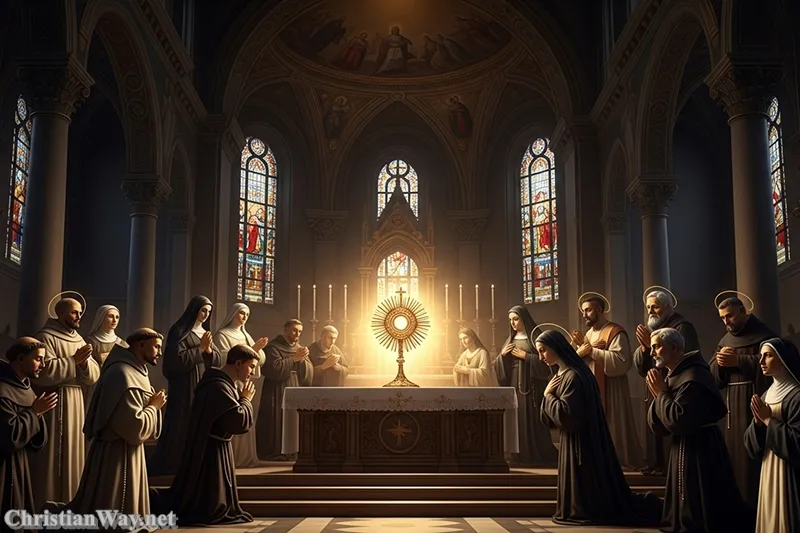
Saint Thomas Aquinas is especially loved for the prayers and hymns traditionally associated with the Feast of Corpus Christi, including Adoro Te Devote, Pange Lingua, and Tantum Ergo. These texts reveal a theologian whose mind bowed in adoration before the mystery of Christ’s presence in the Eucharist.
This is important because it shows the balance of his life. Thomas could write with great precision about the Eucharist, explaining the Church’s belief with philosophical care. Yet his final response to the mystery was not pride but worship.
The Eucharist reminds us that God is not an abstract idea. He comes near. Christ gives Himself. He feeds His people. He remains with those who seek Him.
In every Christian tradition that honors the Lord’s Supper, the breaking of bread draws believers back to the heart of the Gospel: Christ gave Himself for us. Catholics and Orthodox Christians especially confess the profound mystery of Christ’s sacramental presence in the Eucharist, while many Protestant Christians emphasize the Lord’s Supper as a holy remembrance, communion, and proclamation of Christ’s saving work. Though Christians differ in their theological language, all who come faithfully to the table of the Lord are invited to remember the self-giving love of Jesus.
Saint Thomas teaches us that the deeper we enter the mystery of Christ, the more humble we become. The mystery does not make us less thoughtful. It makes us more reverent.
The Summa Theologiae: A Path Toward God
Saint Thomas Aquinas is especially known for the Summa Theologiae, one of the great works of Christian theology. It was written as a guide for students, not as a display of personal brilliance. Thomas wanted to help those preparing for ministry understand the central truths of the Christian faith in a clear, ordered, and spiritually meaningful way.
The Summa begins with God. This is already a message for our time.
Modern life often begins with the self. What do I want? What will make me successful? What will make me comfortable? What image do I want to present to others? What can I gain? What can I control?
Thomas begins somewhere else. He begins with God because God is the source of all being, all goodness, all truth, and all beauty. Human beings understand themselves rightly only when they understand that they are creatures, loved into existence by God and called toward communion with Him.
This does not make the human person small. It gives the human person dignity.
We are not accidents without meaning. We are not machines made only to produce and consume. We are not merely collections of impulses, fears, and desires. We are persons created in the image of God, capable of truth, love, friendship, virtue, worship, and eternal life.
Thomas’s thought can seem difficult at first because he asks large questions. What is God? What is the human person? What is happiness? What is virtue? What is sin? What is grace? What is law? What is love? What is justice? What is the meaning of Christ’s incarnation? What is the purpose of the sacraments?
Yet these are not distant questions. They are the questions every human life eventually asks.
What will make me truly happy? How should I live? Why do I keep choosing things that hurt me? What does freedom mean? How do I become a good person? Can I be forgiven? What does love ask of me? Why did Christ come? How can I live with hope in a world marked by suffering and death?
The Summa Theologiae is not simply a book for specialists. It is a map of the human journey toward God.
Happiness Is More Than Pleasure or Success
One of Saint Thomas Aquinas’s most important teachings concerns happiness. He understood that every person seeks happiness. This desire is not selfish in itself. It has been placed within us by God.
But we often look for happiness in things that cannot finally satisfy the soul.
We may seek it in money, but money cannot heal loneliness. We may seek it in recognition, but praise fades quickly. We may seek it in pleasure, but pleasure passes. We may seek it in power, but power cannot save us from death. We may seek it in controlling everything around us, but life remains full of uncertainty.
Thomas teaches that finite things can be good gifts, but they cannot become our final good. Created things are not meant to carry the weight of our entire soul. Only God can do that.
This does not mean we should reject the good things of life. Friendship, family, work, beauty, food, music, learning, rest, and creation are all gifts. But they become distorted when we ask them to become gods.
A person who receives these things gratefully can enjoy them more deeply. A person who clings to them desperately will eventually be disappointed.
Saint Thomas reminds us that our hearts are made for something greater. We are made for God.
Grace Does Not Destroy Nature; It Heals and Elevates It
One of the most beautiful ideas associated with Saint Thomas Aquinas is that grace does not destroy nature but perfects it. This does not mean that human nature is already complete without God. It means that God does not despise the world He has created. He heals what sin has wounded and lifts the human person toward a life beyond what we could achieve by our own strength.
This is deeply hopeful.
Sometimes people think that becoming Christian means losing their personality, abandoning their gifts, or becoming less human. But Christ does not make us less human. He makes us more fully alive.
Grace does not destroy intelligence; it makes intelligence more humble and open to truth.
Grace does not destroy work; it turns work into service.
Grace does not destroy friendship; it deepens friendship through charity.
Grace does not destroy desire; it purifies desire.
Grace does not destroy freedom; it frees us from the slavery of sin.
Grace does not destroy the body; it teaches us to honor the body as part of God’s good creation.
This vision is especially important for people who feel ashamed of their humanity. We may believe that God loves only the spiritual part of us, while ignoring our emotions, weaknesses, bodies, relationships, and daily struggles. But the Incarnation tells us something different. The Son of God took flesh. Jesus entered human life fully. He knew hunger, fatigue, friendship, sorrow, temptation, pain, and death.
Nothing genuinely human is beyond the reach of God’s grace.
Saint Thomas Aquinas helps us see that holiness is not escaping reality. Holiness is allowing God to enter reality and transform it from within.
The Humility of the Angelic Doctor
One of the most moving parts of Saint Thomas’s life comes near its end. In December 1273, after a profound spiritual experience connected with the celebration of Mass, he stopped writing. Later accounts describe his deep awareness that even his greatest theological work was small before the infinite beauty of God. He died a few months afterward, while traveling to the Council of Lyons.
This should not be misunderstood. Thomas was not saying that truth does not matter, that theology is useless, or that the mind should stop seeking God. He had spent his life teaching the Church to think carefully and love truth deeply.
But he knew that every human word about God remains limited.
Theology can guide us, but it cannot contain God.
Scripture reveals the truth of salvation, but even Scripture leads us toward a mystery greater than our understanding.
Prayer gives us communion with God, but God is always more beautiful than the images we form in our minds.
This is the humility of a true theologian. The more Thomas knew, the more he understood that God is beyond all human possession.
In a world where knowledge can become pride, this humility is a great gift.
We do not study in order to become superior to others. We study in order to serve. We do not learn theology to win arguments. We learn theology to know Christ more deeply and help others encounter Him. We do not seek truth to control people. We seek truth so that we may be free.
Jesus says, “You will know the truth, and the truth will make you free” (John 8:32). Saint Thomas Aquinas spent his life showing that this freedom is not the freedom to do whatever we desire. It is the freedom to become the person God created us to be.
“Nothing but Yourself, Lord”
Ancient accounts of Thomas’s life preserve a prayerful image of him before the crucifix. When asked what reward he desired from Christ, tradition remembers him answering, “Nothing but Yourself, Lord.” This short prayer captures the heart of his entire life.
It is a prayer worth carrying into our own lives.
We often ask God for many things: healing, provision, protection, success, guidance, reconciliation, peace, and strength. These prayers are good. God invites us to bring every need before Him.
But beneath every request is a deeper longing: the longing for God Himself.
We may receive what we ask for and still remain restless if we do not have God. We may lose many things and still find peace if we remain close to Christ. The saints show us that the deepest gift is not always a change in circumstances. The deepest gift is communion with the Lord.
Saint Thomas Aquinas did not seek knowledge for its own sake. He sought God. This is why his work still carries light.
Saint Thomas Aquinas for Students, Teachers, and Seekers
Saint Thomas is often honored as a patron of students, teachers, universities, philosophers, and theologians. Yet his intercession is meaningful for anyone who wants to grow in wisdom.
Students can ask his prayers when they feel overwhelmed by learning, exams, uncertainty, or the pressure to succeed. He reminds them that education is not only about marks or achievements. It is about learning to see the world more truthfully and use one’s gifts responsibly.
Teachers can ask his prayers for patience, clarity, humility, and love for those they teach. A teacher does more than pass on information. A teacher helps another person discover that truth is worth seeking.
Parents can ask his prayers for children growing up in a confusing world. Young people need more than answers. They need adults who will show them that faith is not afraid of thought and that truth is not opposed to love.
Those who struggle with doubt can ask his prayers too. Doubt is not always the opposite of faith. Sometimes doubt is the pain of a heart that wants to believe but does not yet understand. Saint Thomas teaches us not to panic when questions arise. Bring them to God. Study honestly. Pray patiently. Seek wise guidance. Let the search for truth become a path toward deeper faith.
The Church needs Christians who are both faithful and thoughtful. It needs believers who can speak about Christ with humility and clarity. It needs people who can engage the world without fear, who can respect learning without worshiping human pride, and who can hold together compassion and conviction.
Saint Thomas Aquinas remains a guide for this mission. His legacy is not simply a collection of difficult ideas. It is the witness of a man whose mind, heart, prayer, study, and service belonged to God.
Reflect and Pray
Dear friends, Saint Thomas Aquinas invites us to ask a quiet question: What am I seeking with my mind, my work, and my life?
Perhaps you are searching for answers. Perhaps you are carrying doubts you have never spoken aloud. Perhaps you are studying, teaching, working, or making decisions that feel difficult. Perhaps the noise of the world has made it hard to hear the voice of God.
Do not be afraid to seek truth. Do not be afraid to bring your questions before Christ. The One who made your mind also knows your heart. He does not ask you to choose between honest thinking and faithful prayer. He calls you to bring both to Him.
Saint Thomas Aquinas reminds us that every true search for truth can become a path toward God when it is guided by humility, love, and grace.
Let us pray:
Lord Jesus Christ,
You are the eternal Word of the Father,
the source of all truth, wisdom, and light.
Through the prayers of Saint Thomas Aquinas,
give us minds that seek what is true,
hearts that love what is good,
and lives that reflect Your mercy.
Protect us from pride in knowledge,
from fear of honest questions,
and from every false wisdom
that leads us away from You.
Teach us to unite faith and reason,
prayer and study,
truth and love,
so that all we learn may lead us closer to Your heart.
May Saint Thomas Aquinas pray for students, teachers, families, and all who seek wisdom.
May he help us to desire above every earthly gift
the joy of knowing and loving You.
Amen.
May the light of Christ guide your mind, strengthen your faith, and lead your heart ever more deeply into the truth that sets us free.
— Fr. John Matthew