Dear friends in Christ,
There are places in the human heart where words become small. A person may stand beside the bed of someone who is ill, sit alone after a painful betrayal, carry regret for a choice that cannot be undone, or watch a beloved dream quietly fade. In such moments, easy answers often feel empty. We do not need someone to tell us that pain is simple, that grief should pass quickly, or that faith means never asking why. We need to know whether God is near when life hurts. We need to know whether love can remain when so much seems broken.
The Cross of Jesus Christ stands in the very place where those questions become most urgent. It does not turn away from suffering or cover it with shallow comfort. It does not tell us that evil is unimportant, that sin leaves no wound, or that tears are signs of weak faith. Instead, it reveals a love willing to enter the deepest darkness of human life and remain there until darkness is overcome from within.

At Calvary, Christians do not see a distant God watching human pain from beyond reach. They see Jesus Christ, the beloved Son, giving Himself in love. They see the Innocent One standing beside the guilty, the wounded, the fearful, and the dying. They see mercy refusing to abandon those who have wandered far from God. They see a love that does not demand to be loved before it gives itself.
This is why the Cross cannot be reduced to an ornament, a familiar image, or a memory revisited only during Holy Week. It is the Gospel written in the language of self-giving love. It tells us who God is, what sin has done to the world, how far mercy is willing to go, and where hope begins when every human strength has failed.
To gaze upon the Cross is to enter a mystery that cannot be exhausted. It humbles the proud, consoles the wounded, calls the sinner home, steadies the fearful, and teaches every disciple that love is stronger than hatred, faithfulness is stronger than despair, and life is stronger than death.
The Cross Is Not a Sign That Love Failed
When the World Sees Defeat, God Reveals Faithfulness
At first glance, the Cross appears to be a place of defeat. Jesus is mocked, rejected, betrayed, condemned, and crucified. Those who had hoped in Him see their expectations shattered. The disciples who imagined a kingdom of visible triumph are left confused and afraid. His mother and the faithful women stand near the suffering they cannot prevent. The world seems to say that cruelty has won, that power has silenced truth, and that love has been overcome.
Yet the Christian faith looks upon the Cross and sees something deeper. It sees not the failure of love, but love carried to its fullest measure. Jesus does not leave the path of mercy when it becomes costly. He does not answer violence with violence, deception with deception, or hatred with hatred. He remains faithful to the Father and faithful to the people He came to save.
The Gospel of John says of Jesus, “Having loved his own which were in the world, he loved them unto the end” (John 13:1). These words give us a key to the Cross. Christ’s love does not stop at the point where human love often stops. It does not end when gratitude disappears. It does not retreat when misunderstanding grows. It does not become cold when the beloved has become unfaithful.
There are times when we know only a small part of such costly love. A parent remains beside a sick child through a long night. A husband or wife keeps serving when the other is weak. A friend stays present in grief when there are no words to say. A person chooses truth and integrity even though dishonesty would bring easier gain. These acts do not save the world as Christ saves the world, yet they echo the pattern of His love: love that remains.
The Cross tells us that faithfulness is not always loud. Sometimes it looks like staying at the foot of the cross when one cannot change the outcome. Sometimes it looks like refusing to become cruel because cruelty has been shown to us. Sometimes it looks like carrying sorrow without allowing sorrow to become hatred.
A Love That Does Not Coerce
God’s love does not force itself upon the human heart. Jesus heals, teaches, forgives, invites, warns, and calls. Yet He does not coerce people into loving Him. He allows people the terrible freedom to reject Him, misunderstand Him, betray Him, or leave Him.
The Cross reveals this mystery with painful clarity. God’s love is not weak because it does not dominate. It is strong enough to remain love even when it is refused.
This is difficult for us because we often want love to guarantee an easy outcome. We want faithfulness to be rewarded immediately, goodness to be recognized, and kindness to protect us from sorrow. But the Cross shows that love can be rejected without ceasing to be love.
Jesus does not become less loving because Judas betrays Him. He does not become less true because Peter denies Him. He does not become less compassionate because the crowd misunderstands Him. His love remains rooted in the Father, not in the changing response of those around Him.
This gives hope to every person who has tried to love faithfully and has not received the response they desired. Your love may be misunderstood. Your quiet service may go unnoticed. Your mercy may be met with suspicion. But no act of love offered in Christ is wasted. The Cross teaches us that love has meaning even before it receives recognition.
The Cross Reveals the Heart of God
The Father Does Not Stand Apart From Mercy
Some people carry an image of God in which the Father seems distant and severe, while Jesus appears gentle and merciful. But the Cross does not reveal a divided God. The Father is not against the Son, and the Son is not persuading an unwilling Father to show compassion.
Jesus says, “For God so loved the world, that he gave his only begotten Son” (John 3:16). The Cross begins in the love of God. The Father sends the Son in love; the Son freely gives Himself in love; the Holy Spirit brings the life of Christ into wounded human hearts. The saving work of God is not an argument within God. It is the overflowing mercy of the Holy Trinity toward a world that cannot heal itself.
This does not make the Cross easy to understand. It remains a holy mystery. But it protects us from a cruel picture of God. The Father does not delight in suffering. The Son is not a helpless victim trapped in a plan He did not choose. Jesus says, “No man taketh it from me, but I lay it down of myself” (John 10:18). He gives Himself freely, not because pain is good, but because love refuses to abandon the beloved.
When we stand before the Cross, we are invited to release the idea that God loves only the strong, the successful, or the morally impressive. Christ dies for sinners. He gives Himself for those who have run away, hidden in shame, grown cold in heart, or forgotten how to pray.
The Cross is God’s answer to the fear that we are too broken to be loved.
Jesus Shows Us What Divine Love Looks Like
The love revealed in Christ is not vague sentiment. It has hands that touch the leper, eyes that see the forgotten, feet that walk toward the wounded, and a heart that remains open even when pierced.
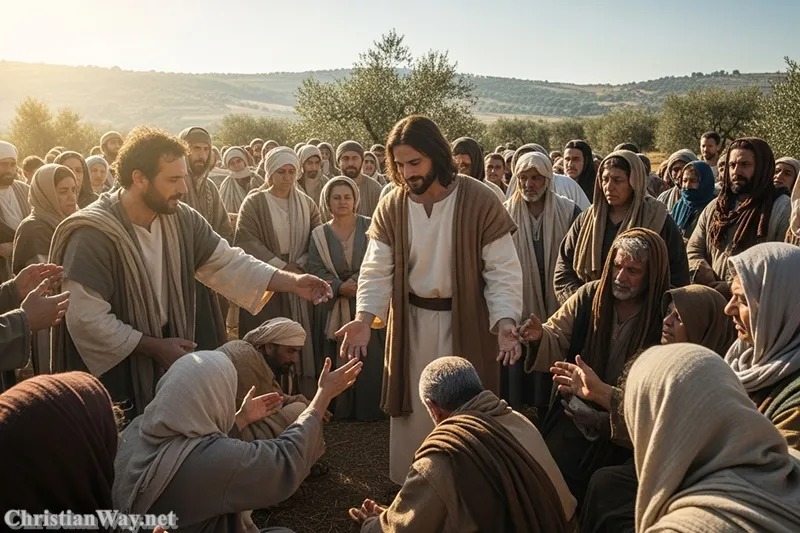
Jesus shows us divine love in the way He receives people. He speaks with the woman at the well. He calls Zacchaeus down from the tree. He welcomes children whom others consider unimportant. He weeps at the grave of Lazarus. He forgives the one who comes to Him with tears. He feeds hungry crowds. He washes the feet of those who will soon abandon Him.
All of this reaches its fullness at the Cross. The life of Jesus and the death of Jesus belong together. The One who forgives in Galilee is the same One who prays for His enemies at Calvary. The One who touches the untouchable is the same One who allows Himself to be wounded for the sake of the world.
The Cross of Jesus Christ tells us that God’s love is not only a feeling toward humanity. It is a gift of Himself. Love gives. Love serves. Love bears. Love remains. Love opens a way where human beings can no longer find one for themselves.
For the person who has been hurt by false love, this message can be especially tender. Many have been told they were loved by people who controlled, manipulated, ignored, humiliated, or used them. Christ reveals another kind of love. His love does not take dignity away. It restores dignity. It does not trap the heart. It frees the heart. It does not demand that we become useful before we are welcomed. It meets us with mercy and calls us into truth.
The Cross Names the Wound of Sin
Sin Is More Than a List of Failures
To understand why the Cross matters, we must be honest about sin. Sin is not only a list of individual mistakes. It is the deep turning of the human heart away from God’s love. It is the refusal to trust that God is good. It is the desire to build life around the self, even when that self-centeredness wounds others.
Sin appears in obvious acts of cruelty, violence, dishonesty, and betrayal. But it also appears in quieter forms: the pride that refuses to apologize, the resentment we feed in secret, the greed that ignores another person’s need, the envy that makes us unable to rejoice in another’s good, and the indifference that sees suffering and looks away.
Sin divides. It divides the human heart from God. It divides families. It divides communities. It divides us from the truth about ourselves. It makes us hide, blame, defend, and fear.
The Cross does not hide this wound. It shows the seriousness of sin because it reveals what human fear, violence, envy, and self-protection can do when they are left unchecked. On the Cross, we see the Innocent One suffering the consequence of a world that has forgotten how to love.
But the Cross does not leave us in accusation. It does not say that we are beyond hope. It speaks the truth about sin so that healing can begin.
A doctor who refuses to name a wound cannot help it heal. In the same way, God’s mercy does not pretend that sin is harmless. Mercy brings the truth into the light because love desires restoration.
Christ Enters Our Estrangement
The Apostle Paul writes, “God was in Christ, reconciling the world unto himself” (2 Corinthians 5:19). Reconciliation is the movement from separation toward communion. In Christ, God enters the place where humanity has become estranged, fearful, and lost.
Jesus knows abandonment. He knows betrayal. He knows the silence of friends who cannot remain awake with Him. He knows the loneliness of being misunderstood. He knows the terror of death. He enters the farthest place of human brokenness so that no one can say, “God does not know what this feels like.”
This does not mean that every personal sorrow is caused by someone’s individual sin. The world is complex, and suffering is not always a direct punishment. Jesus Himself rejects easy explanations that blame the suffering person. But the Cross tells us that every form of human pain can be brought into the presence of Christ.
When a person feels ashamed, Christ knows what it is to be mocked.
When a person feels abandoned, Christ knows what it is to be left alone.
When a person feels betrayed, Christ knows what it is to be wounded by a friend.
When a person feels afraid, Christ knows the night of Gethsemane.
When a person feels that life has become too heavy, Christ knows the weight of the cross.
The Cross is not a promise that Christians will never suffer. It is the promise that suffering is never beyond the reach of God’s compassion.
The Cross Opens the Way of Forgiveness
“Father, Forgive Them”
Among the most astonishing words ever spoken are the words Jesus speaks from the Cross: “Father, forgive them; for they know not what they do” (Luke 23:34).
These words do not make violence acceptable. They do not suggest that betrayal, injustice, and cruelty do not matter. The Cross itself reveals how grave such sins are. Yet Jesus refuses to let hatred have the final word.
Forgiveness is not pretending that nothing happened. It is not surrendering wisdom, abandoning necessary boundaries, or allowing harm to continue. It is not a demand that wounded people silence their pain. Rather, forgiveness is the costly release of vengeance into the hands of God.
Christ shows that mercy can remain alive even where pain is deepest.
This is one of the most difficult calls of the Gospel. Most of us know how easily anger grows. A harsh word can live in memory for years. A betrayal can affect the way we trust everyone who comes afterward. We may replay an injury again and again, not because we enjoy pain, but because the heart does not know where else to put it.
The Cross invites us to bring the wound to Jesus.
We may not be ready to say, “I feel no anger.” But we can begin with, “Lord, do not let this pain make me hard.” We may not be ready for reconciliation. But we can ask, “Lord, free me from the desire to destroy the one who hurt me.” We may still need protection, counsel, truth, and time. But we can place justice in the hands of the God who sees all things.
Forgiveness is often a journey, not one dramatic moment. Christ walks patiently with those who are learning to let mercy heal what resentment has held captive.
The Cross Creates a New Future
At the Cross, Jesus does not merely forgive the past. He opens a future.
The thief beside Him asks, “Lord, remember me when thou comest into thy kingdom” (Luke 23:42). The man has no time left to repair his past, prove his worth, or build a new reputation. Yet he turns toward Christ in faith, and Jesus answers with mercy.
This scene is a tender reminder that no human life is beyond the reach of grace. Even at the edge of death, the door of mercy remains open.
For many people, the past feels like a sentence that cannot be escaped. They remember sins they regret, words they cannot take back, relationships they have damaged, or years they feel they have wasted. The Cross does not tell them that their choices were insignificant. It tells them that Christ’s mercy is greater than the power of shame.
Repentance matters. Where repair is possible, Christians are called to seek it honestly. An apology may be needed. Restitution may be needed. A harmful habit may need to be confronted. But none of these things are performed to purchase God’s love. They are responses to mercy already offered.
The Cross gives the repentant heart courage to begin again.
The Cross Does Not End at the Tomb
Good Friday Is Not the Last Word
The Cross cannot be understood apart from the Resurrection. Good Friday and Easter are not two unrelated events. The Resurrection does not erase the Cross; it reveals that the Cross is not the end.
The risen Christ still bears the wounds of His passion. The scars remain, but they are no longer signs of defeat. They become signs of love that has passed through death and emerged victorious.
This is a word of hope for everyone carrying wounds that do not disappear quickly. Some scars remain in memory. Some losses remain part of our story. Some questions may never receive a full answer in this life. But the Resurrection tells us that wounds need not be the final definition of who we are.
Christ’s wounds become radiant with the truth that death could not hold Him.
The Apostle Paul cries, “O death, where is thy sting? O grave, where is thy victory?” (1 Corinthians 15:55). These words are not a denial of grief. Christians still mourn. Jesus Himself weeps. But grief is held within a larger hope: Christ is risen, and death does not have the final word.
The Cross of Jesus Christ therefore teaches us how to hope honestly. We do not hope by pretending the world is less broken than it is. We hope because God has entered the brokenness and opened a way through it.
Resurrection Life Begins Even Now
Resurrection life is not only a promise for the end of time. It begins to appear wherever Christ brings new life into places that seemed closed.
It appears when a hardened heart learns to forgive.
It appears when someone who has carried shame receives mercy.
It appears when a family finds the courage to speak truthfully after years of silence.
It appears when a person who has been crushed by fear begins to pray again.
It appears when a community chooses compassion instead of contempt.
It appears when someone who has suffered becomes a source of comfort for another.
These are not small things. They are signs that the risen Christ is at work.
A person may not see a great miracle today. But perhaps they can make one faithful choice. They can apologize. They can refuse revenge. They can sit with someone who is grieving. They can speak a gentle word. They can pray when the heart feels empty. They can take the next step rather than surrendering to despair.
The Cross and Resurrection teach us that God often begins new life in places the world has given up on.
Carrying the Cross in Daily Life
Christ Does Not Ask Us to Seek Pain
Jesus says, “If any man will come after me, let him deny himself, and take up his cross daily, and follow me” (Luke 9:23). These words are often misunderstood.
To take up the cross does not mean seeking suffering for its own sake. It does not mean accepting abuse, remaining in danger, ignoring illness, or refusing help when help is needed. It does not mean calling every burden “God’s will” without discernment or compassion.
The God who heals the sick, comforts the grieving, and defends the vulnerable does not ask us to glorify pain.
To take up the cross means choosing faithfulness when selfishness would be easier. It means telling the truth when dishonesty appears more profitable. It means forgiving when resentment feels safer. It means serving when no one is likely to applaud. It means remaining patient in ordinary responsibilities. It means refusing to let fear, pride, or anger rule the heart.
Sometimes the cross is visible: illness, loss, persecution, or a hard responsibility that cannot be avoided. Sometimes it is hidden: the daily decision to be kind, the effort to remain honest, the discipline of prayer, the courage to ask forgiveness, and the willingness to love a difficult family member without becoming trapped in unhealthy patterns.
Christ never asks us to carry these things alone. He says, “Lo, I am with you alway” (Matthew 28:20). The cross becomes bearable not because it is light in itself, but because the Crucified and Risen Lord walks with us.
The Small Crosses of Ordinary Faithfulness
Most people do not live in dramatic moments. They live in kitchens, workplaces, classrooms, hospitals, markets, buses, offices, and homes. They make meals, answer messages, care for children, face deadlines, earn a living, visit relatives, and try to be faithful in small responsibilities.
This is where much of Christian discipleship takes place.
The cross may be a parent who chooses tenderness after a sleepless night.
It may be a worker who refuses to cheat, even when dishonesty would bring advantage.
It may be a young person who refuses to join in cruelty toward someone who is different.
It may be an adult child who cares patiently for an aging parent.
It may be a spouse who chooses to listen instead of adding another harsh word to an already difficult day.
It may be a person who quietly returns to prayer after a long season of doubt.
These acts are often unseen. Yet they matter deeply. They become offerings of love.
The Cross teaches us that nothing given in love is insignificant in the Kingdom of God.
The Cross Calls the Church to Humble Love
A Community Formed by Mercy
The Church exists because of the Cross and Resurrection of Jesus Christ. It is called to be a community where mercy becomes visible.
This means the Church must never become merely a place of religious appearance. It must be a home for people who know they need grace: the grieving, the questioning, the burdened, the poor, the repentant, the lonely, the wounded, and the hopeful.
The Church is faithful when it protects the vulnerable, tells the truth, cares for those in need, and refuses to use holy words to cover cruelty. It is faithful when it remembers that every person standing within its walls is someone for whom Christ gave Himself.
The Cross leaves no room for spiritual pride. No Christian approaches God as though he has earned a place above another person. We come as people in need of mercy.
This humility can heal divisions. Christians may differ in history, worship, language, and theological emphasis, but all are called to kneel before the Crucified Lord. At the foot of the Cross, every false measure of superiority loses its power.
Love That Becomes Service
Jesus washes the feet of His disciples before His Passion. This act helps us understand the Cross. The One who gives His life also takes the place of a servant.
Christian love becomes credible when it becomes service.
It becomes credible when a church notices the family that cannot afford food.
It becomes credible when a believer sits with someone in grief rather than offering quick advice.
It becomes credible when Christians speak against exploitation and protect those who cannot protect themselves.
It becomes credible when people choose reconciliation where it is possible and wise boundaries where it is necessary.
The Cross does not call Christians to seek control over others. It calls them to lay down selfish power and become servants of mercy.
The Cross in the Night of the Heart
There are seasons when the Cross becomes especially personal.
A person may be praying for healing and still feel weak.
A parent may be watching a child struggle.
A family may be carrying grief after a death.
A person may have done everything they know to do and still face uncertainty.
In these moments, the Cross does not offer a quick explanation. It offers the presence of Christ.
Jesus knows the prayer of Gethsemane: “Father, if thou be willing, remove this cup from me” (Luke 22:42). He knows what it is to ask for another way. He knows what it is to bring fear honestly before the Father.
This gives permission for our own honest prayer. We do not have to say that pain is easy. We can ask for relief. We can seek help. We can cry. We can say, “Lord, I do not understand.” Faith is not pretending that the cup is sweet. Faith is placing the cup in God’s hands.
Sometimes the answer we receive is not immediate change but strength for the next step. Sometimes it is a person sent to help. Sometimes it is peace that arrives quietly after many tears. Sometimes it is the grace to endure what cannot yet be changed.
The Cross assures us that Christ is not absent in the night of the heart. He is there before we can feel Him, and He remains when every other comfort seems far away.
Reflect and Pray
The Cross of Jesus Christ is the mystery of love that redeems the world because it reveals a God who does not abandon humanity in sin, sorrow, or death.
At the Cross, Jesus shows us the heart of the Father. He freely gives Himself. He names sin without leaving sinners in shame. He forgives without calling evil good. He enters suffering without allowing suffering to have the final word. He opens a future where the past seemed closed.
The Cross is not an invitation to become fascinated with pain. It is an invitation to trust that love can remain faithful in pain, that mercy can overcome hatred, and that the risen Christ can bring life from places that seem like tombs.
Whatever cross you carry today, Christ sees it.
He does not ask you to pretend it is light.
He does not shame you for being tired.
He does not turn away from your questions.
He invites you to bring your whole life into His wounded and risen hands.
May you find courage beneath His Cross.
May you find forgiveness in His mercy.
May you find strength in His faithfulness.
And may you discover, even in the night, that the love of Christ is still leading you toward life.
Let us pray:
Lord Jesus Christ,
You gave Yourself in love for the life of the world.
Meet us in every place where we are afraid,
wounded, ashamed, or weary.
Teach us to receive Your mercy
and to offer mercy without denying the truth.
Give us courage to carry the responsibilities
that love places before us,
and wisdom to seek protection and help
when burdens become too heavy.
Heal what sin has wounded within us.
Comfort those who mourn.
Strengthen those who suffer.
Free our hearts from bitterness and despair.
May Your Cross become for us
not a sign of defeat,
but the sure promise
that love is stronger than death
and that Your resurrection light
will never be overcome.
Amen.
— Fr. John Matthew