Dear friends in Christ,
There are moments when the world changes so quickly that people begin to fear they are losing their footing. Old certainties seem to weaken. New inventions promise progress, yet leave many hearts anxious. Wealth grows in some places while poverty deepens in others. Work becomes more demanding, families feel pressure, public life grows noisy, and faith can appear to some as a voice from another age. At such moments, God often raises up servants who can look honestly at the wounds of their time without surrendering to fear.
Pope Leo XIII was such a man. He lived at the threshold of a new age: an age of industrial power, political upheaval, social inequality, scientific confidence, urban growth, and new ideologies competing for the human heart. Yet he refused to treat the modern world as a place beyond the reach of Christ. He believed that the Gospel had not grown old. He believed that truth and charity could still renew society. He believed that the dignity of the worker, the family, the poor, the scholar, and the child all mattered before God.
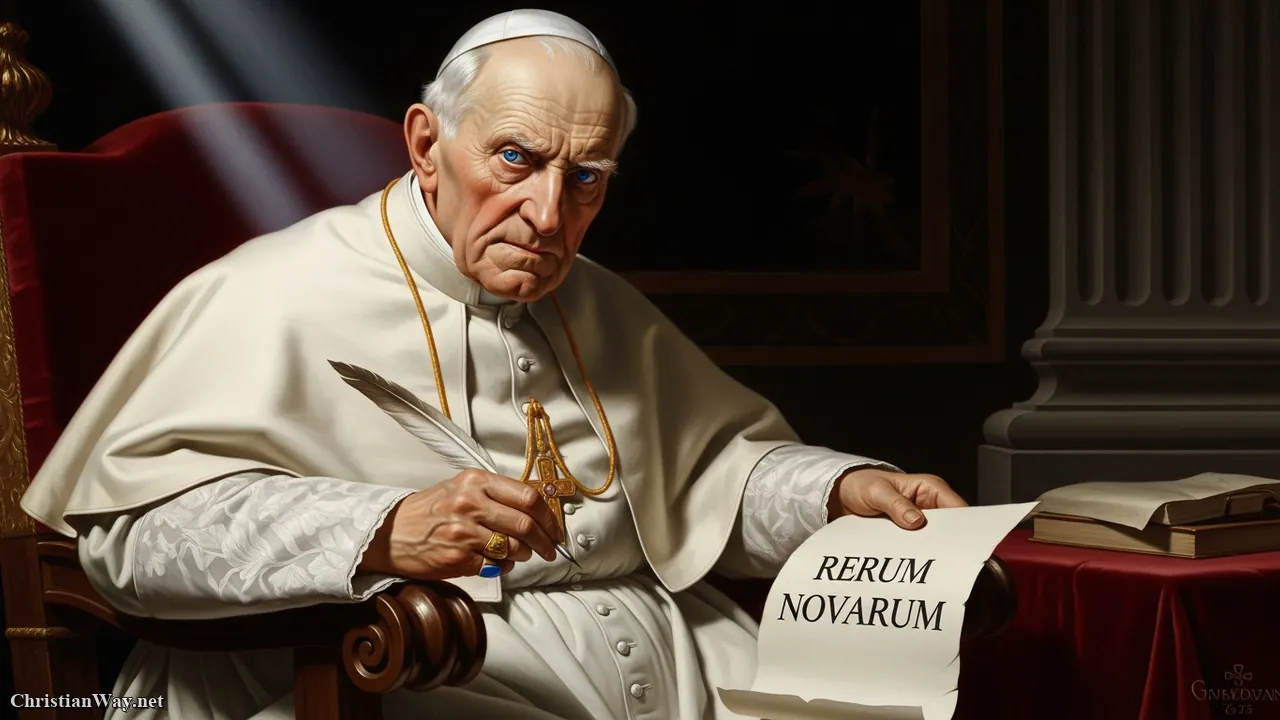
His long pontificate, from 1878 until 1903, carried the Church from the wounds of the nineteenth century toward the great questions of the twentieth. Born Vincenzo Gioacchino Pecci, he became the 256th Bishop of Rome at an age when many people imagine their most fruitful work has already ended. Yet God gave him a remarkable mission: to help the Church speak with courage, intelligence, and compassion to a changing world.
Some popular traditions call Pope Leo XIII Lumen in Caelo, meaning “Light in Heaven” or “Light in the Sky.” The phrase comes from a list of cryptic papal mottos attributed to Saint Malachy. It is important to approach this carefully. The list was first published in 1595, has never been recognized by the Church as a binding prophecy, and is widely regarded by historians as unreliable or forged. It should never become a source of fear, speculation, or obsession about the future.
Still, there is a deeper and more beautiful sense in which Pope Leo XIII truly became a light for his age. Not because he predicted every event to come, but because he saw the spiritual questions beneath the events. He saw that machines, wealth, politics, and education could never save the human person if they were separated from truth, conscience, family, faith, and love. He understood that society could become more advanced while becoming less humane. He knew that the Church must not flee from the world, but neither could she surrender herself to the spirit of the world.
Pope Leo XIII remains a prophet of the modern age because his message reaches beyond his own century. He calls us to remember that Christ is not only Lord of our private prayer, but Lord of work, family, education, society, conscience, and the hidden struggles of the human heart.
The Light That Comes From Christ
The world often looks for light in power. We imagine that if we had more money, more influence, more education, more control, or more public recognition, our lives would become secure. Yet history repeatedly teaches us that human power can become cruel when it is separated from humility. Knowledge can become pride. Wealth can become greed. Freedom can become selfishness. Politics can become an idol. Progress can become a new name for indifference toward the weak.
The deepest light does not come from human achievement. It comes from Christ.
Jesus says, “I am the light of the world: he that followeth me shall not walk in darkness, but shall have the light of life” (John 8:12). These words are not merely poetic. They reveal something essential about the Christian life. Christ does not simply give us advice from a distance. He enters the darkness of human history. He walks among the poor, the sick, the lonely, the misunderstood, the sinner, and the grieving. He brings light not by pretending darkness does not exist, but by overcoming it through love.
Pope Leo XIII understood this deeply. He did not believe that Christians should hide from the difficult questions of their time. He believed they should bring those questions before Christ. What does the Gospel say about labor? What does it say about justice? What does it say about wealth and poverty? What does it say about human dignity? What does it say about the responsibilities of governments, employers, workers, parents, teachers, and citizens?
These were not distant questions for him. They were pastoral questions. They were questions about whether families could live with dignity, whether workers could feed their children, whether the poor would be forgotten, and whether society would remember that every human person bears the image of God.
A Light That Does Not Blind
There is a kind of light that blinds. It is the light of pride, self-certainty, and the belief that we do not need God. It shines brightly for a while, but it does not warm the heart. It leaves people lonely, competitive, and restless.
But the light of Christ is different. It reveals without humiliating. It corrects without crushing. It shows us our sin, yet also shows us mercy. It calls us to repent, yet never abandons us. It asks much of us because it knows that we were created for more than selfishness.
Pope Leo XIII’s life teaches us that Christian truth must never become cold or abstract. Truth is meant to lead us toward love. Theology is meant to help us adore God. Philosophy is meant to help us seek wisdom. Social teaching is meant to protect the dignity of real people: workers, parents, children, the elderly, the poor, and those who feel forgotten by society.
The light of Christ becomes real in the ordinary places of life. It shines when a father works honestly. It shines when a mother prays with her children. It shines when an employer treats workers fairly. It shines when a young person refuses to cheat, lie, or use another person. It shines when someone chooses forgiveness instead of bitterness.
A Pope Formed by Prayer, Study, and Service
Before he became Pope Leo XIII, Vincenzo Gioacchino Pecci was a man of learning, discipline, and deep faith. He served as a priest, bishop, nuncio, and cardinal before being elected pope. He had a thoughtful mind and a serious love for philosophy, theology, history, and the intellectual life of the Church.
Yet he was not merely a scholar sitting far away from the struggles of ordinary people. His life brought him into contact with political tension, social unrest, the changing realities of Europe, and the challenges facing Catholics in public life. He understood that ideas are never only ideas. Ideas shape laws, families, schools, workplaces, and the moral atmosphere in which children grow.
Pope Benedict XVI later described Leo XIII as a wise and farsighted pope who brought the Church into the twentieth century with a renewed ability to face the new questions of modern society. He emphasized that Leo’s strength came from what he called “Christian wisdom”: a wisdom that joined faith and practical life, truth and charity, doctrine and the real burdens carried by ordinary people.
This is an important lesson for us. We sometimes separate the spiritual life from the intellectual life. We imagine that prayer belongs to the heart while thinking belongs to the mind. But in Christ, the whole person is called to God. We are called to love the Lord with all our heart, all our soul, all our strength, and all our mind.
A mind that seeks truth can become a prayer. A person studying honestly, teaching patiently, reading Scripture carefully, or trying to understand the suffering of the world can offer that work to God. Faith does not ask us to stop thinking. It asks us to think with humility, reverence, and love.
The Mind Must Learn Humility
Knowledge is a gift. But knowledge alone cannot save us.
A person can know many facts and still be unkind. A person can have a university education and still be dishonest. A person can understand economics, history, medicine, or technology and still fail to recognize the tears of someone sitting beside them.
The human mind becomes most beautiful when it learns humility. Humility does not mean refusing to think. It means recognizing that truth is greater than us. It means admitting that we are creatures, not gods. It means allowing God to correct us, teach us, and lead us beyond the narrow limits of our own opinions.
“The fear of the Lord is the beginning of wisdom,” Scripture says (Proverbs 9:10). This does not mean we should fear God as though He were cruel. It means that wisdom begins when we stand before God with reverence. We begin to see clearly when we remember that life is not centered on us.
Pope Leo XIII knew that the Church needed thinkers, teachers, philosophers, scientists, and scholars. But he also knew that their work had to remain rooted in truth. The greatest education is not merely the education that makes us successful. It is the education that teaches us how to love what is good.
Faith and Reason in Harmony
One of Pope Leo XIII’s great contributions was his encouragement of Christian philosophy, especially the thought of Saint Thomas Aquinas. In his 1879 encyclical Aeterni Patris, he called for a renewed appreciation of philosophy grounded in truth, reason, and faith. He did not want Catholics to retreat from intellectual life. He wanted them to enter it with courage, clarity, and a Christian vision of the human person.
This was deeply significant. In his time, many people believed that faith and reason were enemies. Some imagined that science would eventually make religion unnecessary. Others feared that serious intellectual inquiry would destroy belief. Pope Leo XIII rejected both fears.
Truth cannot contradict truth.
The God who reveals Himself in Scripture is also the Creator of the universe. The God who speaks through the prophets is also the God who formed the human mind. The God who gives grace is also the God who gives us the ability to reason, question, explore, and learn.
This does not mean that every question has an easy answer. It does not mean that Christians never struggle with doubt. But it means that we need not be afraid of honest searching. A question honestly placed before God can become a doorway to deeper faith.
The Restless Mind and the Resting Heart
Many people today feel mentally exhausted. We receive endless messages, opinions, videos, headlines, warnings, arguments, and demands for attention. It is possible to know more information than any generation before us and yet feel less peaceful.
Pope Leo XIII reminds us that information is not the same as wisdom.
Wisdom asks different questions. It asks: What is true? What is good? What is worthy of love? What kind of person am I becoming? Am I using knowledge to serve others, or merely to make myself feel important?
Saint Augustine wrote, “Thou hast made us for thyself, and our heart is restless until it rests in thee.” The modern mind remains restless not because it knows too little, but because it often tries to live without God.
The answer is not ignorance. The answer is a mind joined to prayer.
A Christian student can study with devotion. A teacher can teach with patience. A parent can answer a child’s questions with honesty. A worker can seek to understand their craft more deeply. All of this can become part of the journey toward God.
The Word of God in a Changing World
Pope Leo XIII also encouraged a deeper love for Sacred Scripture. In Providentissimus Deus, published in 1893, he reflected on the study of the Bible and encouraged Catholics to approach the Scriptures with reverence, seriousness, and trust.
This matters because the Bible is not merely an ancient collection of religious texts. It is the living word of God speaking into the human heart. In Scripture, we meet the faithfulness of God through the joys, failures, sorrows, prayers, sins, and hopes of real people.
The Bible speaks to those who are afraid. It speaks to those who are grieving. It speaks to those who feel forgotten. It speaks to those who have failed and do not know how to begin again.
When we open the Scriptures, we do not simply learn about the past. We allow God to speak into the present.
The Psalms teach us how to pray when we are overwhelmed. The Gospels show us the face of Christ. The letters of Saint Paul teach us how to live in a broken world without losing hope. The Old Testament reveals the long patience of God with His people.
A Bible Open on the Table
There is a simple practice that can change the spirit of a home: keep a Bible open.
It does not need to be dramatic. It may rest quietly on a table, near a prayer corner, or beside a family photograph. The presence of Scripture reminds us that our home is not built only on work, money, schedules, and worries. It is built on the word of God.
Perhaps each morning, before looking at the phone, read a few verses from the Gospel. Perhaps before sleep, read one Psalm. Perhaps when a family member is ill, read the story of Jesus healing the sick. Perhaps when you are anxious, return to the words: “Be still, and know that I am God” (Psalm 46:10).
Pope Leo XIII knew that a society could not be renewed only by political speeches or social reform. It also needed hearts formed by the word of God.
Rerum Novarum and the Dignity of Work
Pope Leo XIII is especially remembered for his encyclical Rerum Novarum, published in 1891. The title means “Of New Things,” and it addressed the social problems created by industrialization: the suffering of workers, unjust conditions, poverty, economic inequality, and conflict between labor and capital.
In many places, the Industrial Revolution had brought great wealth. Factories expanded. Cities grew. Machines increased production. But many workers endured dangerous conditions, low wages, long hours, overcrowded housing, and deep insecurity. Families were often treated as though they existed only to serve the needs of the economy.
Pope Leo XIII looked at this suffering and refused to remain silent.
He taught that work is not merely a commodity. A worker is not a machine. A human being is not valuable only because of what they can produce. Every person has dignity because every person is created by God.
This simple truth has enormous consequences.
It means that a worker deserves fair treatment. It means that employers have moral responsibilities. It means that society must care about wages, family life, safety, rest, education, and the ability of people to live with dignity. It means that the poor cannot be treated as invisible.
Pope Leo XIII defended private property, but he also insisted that property carries responsibility. Wealth is not given to us so that we can ignore the needs of others. The goods of the earth are meant to serve the common good.
The Human Person Is Never a Tool
The most important message of Rerum Novarum is not political. It is spiritual.
The human person must never become a tool.
A worker is not simply labor. A customer is not simply profit. A poor person is not simply a burden. An elderly person is not simply an expense. A child is not simply a future worker. Every person is a child of God.
This is especially important today. Many people feel pressure to prove their worth through productivity. They may work long hours, answer messages late into the night, worry constantly about money, and feel guilty whenever they rest.
But your worth is not measured by how busy you are.
Your dignity does not disappear when you are sick, unemployed, elderly, tired, or unable to achieve what others expect. God does not love you because you are useful. He loves you because you are His.
Jesus did not ask people first what they could produce. He asked them, “What do you want me to do for you?” He saw the blind man, the woman who had been suffering for years, the child, the widow, the leper, the sinner, and the poor.
The Church’s social teaching begins here: with the face of Christ in the person before us.
Work, Family, and the Common Good
Pope Leo XIII saw that the problems of work could never be separated from the health of the family. When workers are paid unjustly, families suffer. When parents are forced into impossible conditions, children suffer. When people are treated as disposable, communities become unstable.
A society cannot call itself successful if many families are unable to live with dignity.
This does not mean that every social problem has one simple solution. Human life is complicated. Economies are complex. Governments, businesses, workers, and communities all have responsibilities. But the Gospel gives us a moral foundation: every decision must respect the dignity of the person and the good of the family.
Pope Leo XIII encouraged cooperation rather than class hatred. He rejected the idea that society could be healed through envy, violence, or the destruction of human freedom. At the same time, he rejected the selfishness that says the wealthy owe nothing to the poor.
He called for justice shaped by charity.
This is not weak or sentimental. Charity without justice can become empty kindness that changes nothing. Justice without charity can become harsh and cold. Christ calls us to both.
The Economy Needs a Conscience
We often speak about the economy as though it were a machine with no soul. We talk about wages, prices, markets, growth, productivity, and investment. These things matter. But behind every number there is a person.
There is a father trying to provide for his children. There is a mother worrying about food, school fees, housing, or medicine. There is a young person wondering whether they will ever find stable work. There is an elderly worker who fears being forgotten.
Pope Leo XIII reminds us that economics must have a conscience.
A Christian business owner should ask not only, “How much can I earn?” but also, “Am I treating people fairly?” A worker should ask not only, “What can I get?” but also, “Am I doing my work honestly?” A consumer should ask, “Do my choices ignore the suffering of others?” A citizen should ask, “Do I care about the dignity of people whose struggles are different from mine?”
These are not easy questions. But they are holy questions.
The Church and the Modern World
Some people imagine that Pope Leo XIII opposed everything modern. That is not true. He was not afraid of the modern world. He was concerned about the modern world losing its soul.
He understood that political freedom, scientific progress, education, technology, and social development could become genuine goods. But he also knew that they could become dangerous when separated from moral truth.
Freedom without truth can become selfishness. Progress without conscience can become exploitation. Politics without humility can become tyranny. Education without wisdom can become arrogance.
Pope Leo XIII did not want the Church to retreat into nostalgia. He wanted the Church to bring Christ into the questions of the modern age.
This is why he remains important. We too live in a world of rapid changes. Technology changes the way people work, communicate, learn, spend money, and form relationships. Artificial intelligence, automation, digital media, and economic uncertainty raise questions that many people do not know how to answer.
Yet the human heart has not changed as much as we think.
People still need love. They still need family. They still need dignity. They still need purpose. They still need forgiveness. They still need God.
A recent reflection from Vatican News noted that Pope Leo XIII’s response to the first Industrial Revolution continues to speak to the new technological and social challenges of our own time, especially those involving work, human dignity, and the rapid growth of artificial intelligence.
A Prophet Is Not a Fortune-Teller
When we call Pope Leo XIII a prophet, we do not mean that he predicted every event of the future. A prophet is not primarily someone who tells people what will happen tomorrow.
A prophet is someone who sees the present through the eyes of God.
The prophets of Scripture looked at injustice, idolatry, oppression, violence, and spiritual forgetfulness. They called people back to God. They warned that a society cannot reject truth forever without suffering the consequences. They also offered hope: God has not abandoned His people.
Pope Leo XIII was prophetic because he saw the danger of a world that worships money, power, ideology, or progress. He saw the suffering of workers before many leaders were ready to take it seriously. He saw the importance of faith and reason before many people imagined they could live without either one. He saw that the Church needed to engage the world with courage rather than fear.
His prophecy was not fear. It was hope rooted in Christ.
A Heart Devoted to Christ
Behind Pope Leo XIII’s social teaching, intellectual work, and public leadership was a deep spiritual center: Christ.
He wrote about the Sacred Heart of Jesus, the Holy Spirit, the Eucharist, the Rosary, Saint Joseph, and the need for Christians to remain close to prayer. He understood that society can only be renewed when hearts are renewed.
In 1899, through Annum Sacrum, he called for the consecration of the human race to the Sacred Heart of Jesus. This was not merely a devotional gesture. It was a proclamation that the world needs the love of Christ.
The Sacred Heart reminds us that God is not distant from human suffering. Christ sees the tears no one else sees. He knows the burden of the worker, the loneliness of the elderly, the anxiety of parents, the questions of young people, and the hidden sorrow of those who feel forgotten.
The heart of Christ is not weak. It is strong enough to carry the sins of the world.
The World Is Healed One Heart at a Time
We may look at the world and feel overwhelmed. There are wars, divisions, injustice, fear, economic worries, broken families, loneliness, and public anger. We may wonder what one person can do.
Pope Leo XIII would remind us that the renewal of the world begins with the renewal of the heart.
A world changes when someone chooses honesty instead of corruption. It changes when a family begins to pray again. It changes when a person refuses to spread hatred. It changes when an employer treats workers fairly. It changes when a young person protects their dignity instead of following destructive pressure.
We may not be able to solve every great problem. But we can allow Christ to reign in the places He has given us.
The kingdom of God begins quietly. Jesus compares it to a mustard seed: small, hidden, almost unnoticed, yet capable of becoming a great tree (Matthew 13:31–32).
Your prayer may feel small. Your kindness may feel small. Your effort to forgive may feel small. But in the hands of God, small acts of faith can become light for others.
The Church as a Mother to the World
Pope Leo XIII did not see the Church as a fortress built to keep the world away. He saw her as a mother called to serve the world with truth and love.
A mother does not abandon her children when they are confused. She teaches them. She corrects them. She comforts them. She remains present.
The Church must do the same.
She must speak the truth, even when the truth is difficult. She must defend the dignity of life, the sacredness of marriage, the importance of family, the rights of workers, and the needs of the poor. But she must also speak with the tenderness of Christ.
The Church cannot become harsh simply because the world is harsh. She cannot become frightened simply because the world is changing. She cannot become silent simply because truth is unpopular.
Pope Leo XIII teaches us that faithfulness is not stubbornness. Faithfulness is love that remains rooted in Christ.
Living Pope Leo XIII’s Message Today
The teachings of Pope Leo XIII can feel large: faith and reason, work and justice, society and human dignity, Christ and the modern world. But his message becomes most powerful when it enters daily life.
For parents, his teaching means forming children not only for success, but for goodness. Teach them to pray. Teach them to respect workers. Teach them that people are more important than possessions. Teach them that intelligence without kindness is incomplete.
For workers, his teaching means remembering that your labor has dignity. Work honestly, but do not believe that your job defines your entire worth. You are more than your income, your title, your productivity, or your success.
For employers and business owners, his teaching means remembering that people are never merely numbers. A just wage, a safe environment, respect, honesty, and compassion are not optional decorations. They belong to Christian responsibility.
For young people, his teaching means do not be afraid to think deeply. Ask questions. Study seriously. Seek truth. But do not allow the noise of the world to take away your ability to pray.
For every Christian, his teaching means let Christ reign in your heart. Let Him reign in your words, your decisions, your work, your family, your use of money, your treatment of others, and your response to those who are weak.
Reflect and Pray
Dear friends, Pope Leo XIII teaches us that the Gospel is never outdated. The world changes. Machines change. Governments change. Economies change. Technologies change. But the human heart still longs for the same things: truth, dignity, love, mercy, justice, and peace.
The Lumen in Caelo associated with Pope Leo XIII should not lead us into speculation about mysterious prophecies. Instead, it can remind us of the true light that shines in every age: Jesus Christ.
Pope Leo XIII saw a world entering a new era, and he did not respond with fear. He responded with faith. He called Christians to think deeply, pray faithfully, defend the poor, honor work, strengthen families, and bring Christ into the questions of public life.
May his witness help us become people of courage in our own time. May we never be afraid of truth. May we never forget the poor. May we never allow progress to make us less human. And may we always remember that Christ remains the true light of the world.
Let us pray.
Lord Jesus Christ, Light of the world and King of every heart, through the example of Pope Leo XIII, teach us to seek wisdom without pride, justice without hatred, and progress without forgetting the dignity of every person. Bless workers, families, teachers, students, the poor, and all who carry hidden burdens. Give us courage to bring Your truth into the world with humility and love. May Your Sacred Heart heal what is wounded in us, and may Your light guide every step we take toward You. Amen.
— Fr. John Matthew