Dear friends in Christ,
There are times in history when the world seems to possess great power and yet lose its soul. Nations may build impressive cities, develop new machines, grow rich through industry, and speak confidently of progress, while human hearts become more restless, divided, and afraid. The twentieth century brought many such contradictions. It offered astonishing scientific achievement, but it also witnessed war, oppression, economic suffering, ideologies of hatred, and the frightening temptation to place the State, race, wealth, or political power where God alone should stand.
Into this troubled age came Pope Pius XI, known to many as the Scholar-Pope. Before he became Bishop of Rome, Achille Ratti was a priest, teacher, librarian, scholar, diplomat, and man of prayer. He knew the world of books, archives, universities, and careful thought. Yet he also knew that knowledge without wisdom can become dangerous, and that civilization cannot survive merely by becoming more educated, wealthier, or technically advanced. A civilization must also ask whether it honors the dignity of the human person, protects the weak, defends truth, and remembers that every life is accountable before God.
Pius XI did not lead the Church during a peaceful or simple era. He became pope in 1922, after the devastation of the First World War and during a period of deep political uncertainty across Europe. His pontificate continued through the Great Depression, the rise of totalitarian movements, social unrest, and growing hostility toward the Church in several nations. He saw the danger of systems that treated the person as a tool of the State, a number within an ideology, or a disposable part of some larger political dream.
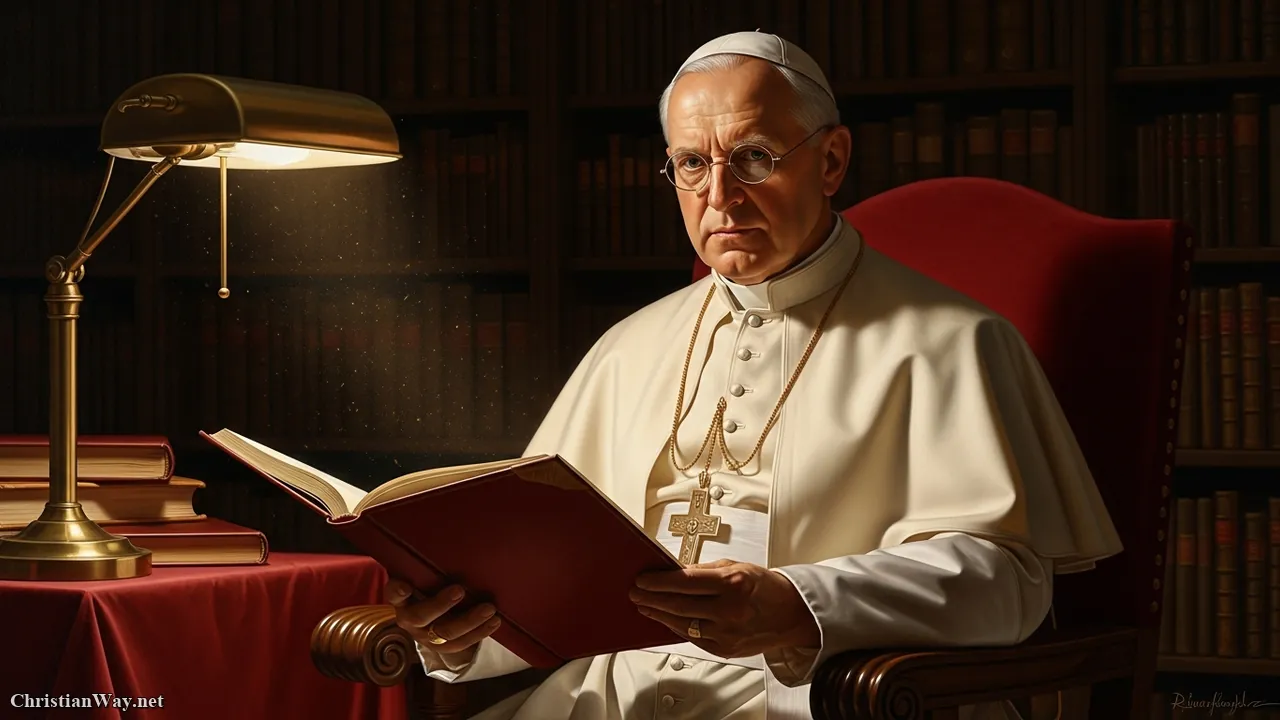
Yet Pope Pius XI was not a man of despair. He believed that Christ remained Lord even when the world seemed to forget Him. He believed that the Gospel could renew families, economies, education, public life, and the conscience of nations. His great pastoral cry was expressed in the phrase Pax Christi in regno Christi—the peace of Christ in the Kingdom of Christ. Peace, he believed, could not be built upon fear, violence, greed, or domination. It had to begin where every true renewal begins: in the human heart turned again toward God.
The life and teaching of Pope Pius XI remain deeply meaningful today. We too live in a world crowded with information, distraction, ambition, anxiety, and conflicting voices. We may feel overwhelmed by global problems, economic pressure, family burdens, moral confusion, and the fear that truth itself is slipping away. The Scholar-Pope reminds us that renewal is never merely political or cultural. It is spiritual. It begins when we allow Christ to reign in our conscience, our homes, our work, our relationships, and our daily decisions.
A Scholar Formed by Faith, Prayer, and the Love of Truth
Achille Ratti was born in Desio, near Milan, in 1857. He was ordained a priest in 1879 and pursued serious theological, philosophical, and canonical studies. His early life was shaped not only by academic discipline but also by pastoral devotion. He taught in seminaries, served as a chaplain, worked with religious communities, and gave himself to the patient work of learning. His mind was wide, curious, and carefully trained, yet it remained joined to the heart of a priest.
For many years, he worked in the famous Ambrosian Library in Milan, eventually becoming its prefect. He spent long hours among manuscripts, historical documents, theological texts, and treasures of Christian memory. Later, he served in the Vatican Library, helping to organize collections and preserve the intellectual inheritance of the Church. He was also known for his love of the mountains, undertaking difficult climbs in the Alps during his younger years. His life held together study, prayer, courage, discipline, and a deep appreciation for the beauty of creation.
There is something important here for every Christian who values the life of the mind. Faith does not ask us to despise learning. The God who created the stars, formed the human mind, and gave us Scripture is not threatened by honest questions. The Church has never needed Christians who are afraid to think. She needs men and women whose minds are humble enough to seek truth and whose hearts are pure enough to receive it.
Saint Paul urges believers to be transformed by the renewing of their minds (Romans 12:2). This renewal is more than gaining knowledge. It is learning to see the world as God sees it. It is recognizing that intelligence becomes dangerous when it is separated from conscience. A person may become highly skilled, highly educated, and greatly admired, yet still use their gifts selfishly. Knowledge can build hospitals, schools, bridges, and works of beauty. But knowledge can also be used to manipulate, exploit, dominate, and destroy when it is no longer guided by moral truth.
Knowledge Must Learn to Kneel
Pope Pius XI understood that the human mind is a gift, but not a god. He had spent years among books and scholars, yet he knew that the greatest wisdom is not found merely in libraries. It is found when the mind learns to kneel before the truth of God.
This is a lesson our age desperately needs. We live surrounded by opinions. Every day, people are invited to react quickly, speak loudly, judge easily, and assume they understand everything. Yet wisdom requires patience. Wisdom listens before it speaks. Wisdom recognizes that facts alone do not teach us how to love. Wisdom remembers that the person standing before us is never simply an argument to defeat, a category to dismiss, or a problem to solve.
The Book of Proverbs says, “The fear of the Lord is the beginning of knowledge” (Proverbs 1:7). This does not mean that Christians should fear God as though He were cruel. It means that we must approach God with reverence. We must remember that we are not the center of the universe. We are creatures, loved by the Creator, called to receive truth rather than invent it according to our preferences.
The Scholar-Pope teaches us that education becomes holy when it serves human dignity. A teacher who helps a child discover confidence, a parent who patiently answers questions, a student who studies honestly, a worker who seeks truth rather than shortcuts—each can participate in this sacred work. The mind becomes an instrument of grace when it seeks not merely to impress others, but to serve God and neighbor.
A Pope for a Wounded World
When Achille Ratti was elected pope in 1922, the world was still carrying the wounds of the First World War. Millions had died. Families had been shattered. Nations were struggling with grief, poverty, bitterness, and uncertainty. Across Europe, many people were losing confidence in democratic institutions, religious life, and moral order. Political movements promised strength, unity, prosperity, or national rebirth, but many of these promises were built upon fear, hatred, violence, or the destruction of human freedom.

Pius XI entered the papacy at a moment when the Church needed both courage and clarity. His first great concern was peace—not a shallow peace built upon silence or surrender, but peace rooted in justice and truth. He believed that societies could not truly heal if Christ and His moral law were pushed out of private and public life. In Quas Primas, he wrote that lasting peace could not be secure where individuals and nations refused the rule of Christ.
This does not mean that Pius XI wished to create a worldly empire ruled by force. The kingship of Christ is not like the power of earthly rulers. Jesus Himself said, “My kingdom is not of this world” (John 18:36). Christ does not conquer by armies, propaganda, or fear. He reigns through truth, mercy, sacrifice, forgiveness, and love.
The world often mistakes power for greatness. A person may have money, influence, followers, titles, or authority, yet remain inwardly empty. Christ reveals another kind of power. He washes the feet of His disciples. He touches lepers. He forgives sinners. He carries the cross. He enters death itself and rises again, not by crushing others but by giving Himself for them.
Civilization Is More Than Progress
Pope Pius XI saw clearly that a civilization may become materially advanced while spiritually impoverished. A society may have better technology and still become less humane. It may speak proudly about freedom while ignoring the poor. It may defend order while tolerating cruelty. It may celebrate national greatness while forgetting the sacredness of the stranger, the disabled person, the worker, the child, the elderly, or the persecuted.
A true civilization is not measured only by its wealth or inventions. It is measured by the way it treats the vulnerable. It is revealed in whether the strong use their strength to protect or exploit. It appears in the way a family speaks to its weakest member, in the way an employer treats workers, in the way a community remembers the poor, and in the way a nation responds to those who have little power.
This is why the crisis of civilization is never only “out there” in governments or institutions. It also lives within the human heart. Every time we treat another person as useful only when they benefit us, we take a step away from Christ. Every time we mock the weak, justify dishonesty, ignore suffering, or allow resentment to rule us, we participate in the same spiritual sickness that wounds societies.
Pius XI’s message is therefore deeply personal. He calls us to ask: Who reigns in my heart? Is it Christ? Or is it fear, pride, anger, money, approval, ambition, or the desire to control? The renewal of civilization begins when ordinary people allow the Lord to renew their conscience.
Christ the King and the Freedom of the Human Person
One of the most enduring contributions of Pope Pius XI was the establishment of the Feast of Christ the King through the encyclical Quas Primas in 1925. He gave this feast to the Church in a time when many ideologies were demanding absolute loyalty from citizens. He saw governments, movements, and political leaders claiming more and more power over the human person. In such a climate, the Church needed to proclaim again that no earthly authority can take the place of God.
Christ is King not because He takes away human freedom, but because He restores it. Sin makes us slaves. Fear makes us slaves. Hatred makes us slaves. Addiction, greed, resentment, and selfishness can rule us more harshly than any visible tyrant. Christ comes to free us from these hidden masters. He calls us to live as sons and daughters of the Father.
When Christians say that Jesus is Lord, they are not making a political slogan. They are confessing that every power on earth is limited. No State, party, nation, leader, economy, or ideology can claim the absolute loyalty that belongs to God alone. Human beings are not created to become servants of political dreams. They are created for truth, love, communion, and eternal life.
Pius XI saw the danger of a world in which the State becomes an idol. When the State claims authority over conscience, family life, education, worship, or the dignity of the person, it begins to demand what belongs to God. The Christian response is not hatred of society or contempt for public life. Christians are called to serve their country, work for peace, obey just laws, and seek the common good. But they must never forget that their first allegiance belongs to Christ.
Let Christ Reign in the Ordinary Places
The kingship of Christ may sound grand and distant, but it becomes real in small, daily choices. Christ reigns when a husband chooses patience instead of harshness. Christ reigns when a wife speaks truth without contempt. Christ reigns when parents teach children to pray, forgive, and respect others. Christ reigns when a business owner refuses to cheat customers, when an employee works honestly, and when a student refuses to lie.
Christ reigns when we choose mercy instead of revenge. He reigns when we defend someone being mocked. He reigns when we refuse to spread gossip. He reigns when we care for an elderly parent, speak kindly to a lonely neighbor, or help a person who cannot repay us.
The kingdom of Christ does not begin with crowds cheering. It begins quietly, like a seed in the soil. Jesus said that the kingdom of God is like a mustard seed, small at first but growing into something that gives shelter to many (Matthew 13:31–32). A Christian home where prayer, truth, forgiveness, and tenderness are practiced may seem small in the eyes of the world, but it becomes a sign of Christ’s kingdom.
The Social Question: Work, Wealth, and Human Dignity
Pope Pius XI was deeply concerned about the suffering caused by economic injustice. The industrial world had brought many advances, but it had also created painful divisions between wealth and poverty. Workers often lived in insecurity, while large concentrations of power and money were held by a small number of people. Families struggled to survive. Laborers were sometimes treated as tools for production rather than as persons with bodies, minds, souls, and responsibilities.
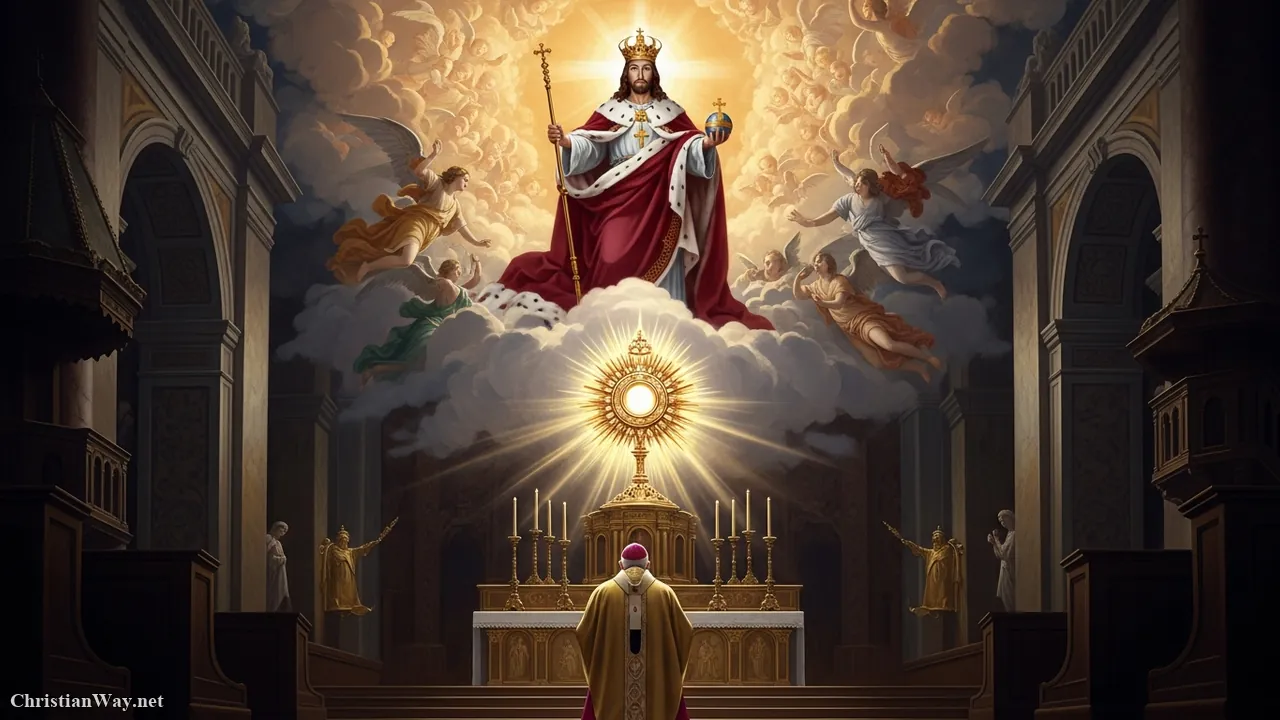
In 1931, Pius XI issued Quadragesimo Anno, an encyclical marking forty years since Pope Leo XIII’s landmark social teaching Rerum Novarum. In it, Pius XI spoke about the reconstruction of the social order. He insisted that economic life cannot be separated from moral responsibility. He rejected the idea that markets, wealth, or profit should function without concern for justice, the dignity of workers, the needs of families, and the common good.
This teaching remains deeply relevant. Work is not merely a way to earn money. Work is connected to human dignity. Through work, people support their families, develop their gifts, serve society, and participate in God’s creative care for the world. When work becomes exploitative, degrading, or unjust, the human person is wounded.
Pius XI did not offer a simplistic solution to every economic problem. He did not reduce the Gospel to an ideology. Instead, he insisted that Christian faith must speak to real life. It must care about wages, housing, working conditions, family stability, education, and the treatment of the poor. A faith that speaks only about heaven while ignoring the suffering of people on earth has not fully heard the compassion of Christ.
Jesus did not turn away from hunger. He fed the crowds. He did not ignore the sick. He healed them. He did not despise laborers, fishermen, widows, children, or the poor. He drew near to them. The Church, therefore, cannot remain indifferent when people are treated unfairly or when families are crushed beneath burdens they cannot bear.
Neither Greed nor Envy Can Heal the World
Pius XI warned against two opposite temptations. One is selfish individualism, which treats private gain as though it were the only good. The other is collectivism, which can erase the dignity and freedom of the person in the name of a larger social program. In Quadragesimo Anno, he argued that human beings are both individual and social by nature. We have personal rights, but we also have responsibilities toward one another.
This is a difficult balance, but it is a beautiful one. We are not meant to live only for ourselves. Nor are we meant to disappear into a crowd. God knows each of us by name, and yet He also calls us into communion. We belong to families, communities, parishes, workplaces, and nations. The good of one person is never completely separate from the good of others.
In daily life, this means that success should not make us forget the poor. It means that those with authority should not use it to humiliate others. It means that workers should be treated fairly, employers should act responsibly, and citizens should care about the common good. It means that charity cannot replace justice, but justice without charity becomes cold and hard.
The Gospel calls us to a love that is both personal and social. We are called to see the face of Christ in the person before us, especially in the poor, the weary, the unemployed, the forgotten, and the anxious. “Inasmuch as ye have done it unto one of the least of these my brethren,” Jesus says, “ye have done it unto me” (Matthew 25:40).
The Church Against the Idols of Race, State, and Ideology
The final years of Pope Pius XI’s pontificate unfolded under the growing shadow of totalitarianism. In different parts of Europe, ideologies were demanding absolute loyalty and treating religious faith as an obstacle to political power. Human beings were increasingly divided according to race, class, nationality, or political usefulness. The person was in danger of being swallowed by the machine of ideology.
Pius XI spoke firmly against these dangers. In 1937, he issued Mit Brennender Sorge, addressed to the Church in Germany. The encyclical protested the persecution of the Church and warned against attempts to reshape Christianity according to nationalist ideology. It rejected the idea that a national or racial ideology could take the place of the universal Gospel of Jesus Christ.
That same year, he issued Divini Redemptoris, condemning atheistic communism and warning against social systems that denied God, undermined religious faith, and sought to reshape society through revolutionary violence. He saw that any ideology which removes God from human life eventually risks diminishing the human person as well.
It is important to understand Pius XI’s witness carefully. He was not simply making political judgments about parties or nations. He was speaking about something deeper: the danger of turning temporary human systems into ultimate truths. Whenever a government, ideology, race, class, or leader claims the place that belongs to God alone, human dignity is threatened.
Every Idol Eventually Demands a Sacrifice
An idol always promises security. It tells people, “Give me your trust, your conscience, your loyalty, and your fear, and I will save you.” But every idol eventually demands sacrifice. It asks us to sacrifice truth for comfort, mercy for power, conscience for approval, and the dignity of others for our own sense of belonging.
The idols of our own age may not always look like the idols of the 1930s. They may appear as wealth, success, political tribalism, fame, technology, pleasure, or the need to be admired. Yet the spiritual danger is the same. When anything takes the place of God, it begins to rule us.
Pope Pius XI calls us back to the freedom of the Gospel. The Christian is not asked to hate the world. We are asked to love the world as God loves it. But we must not become enslaved by it. We may participate in society, work for justice, vote, serve, study, and build. Yet we must remain free enough to say no when the world demands that we betray conscience.
This is why holiness is never merely private. A holy person is someone who has become free. Free to tell the truth. Free to forgive. Free to resist injustice. Free to love without being ruled by fear. Free to remain faithful even when faithfulness is costly.
Education, Family, and the Formation of the Heart
Pius XI also cared deeply about education. He believed that the formation of children could not be treated merely as a political or economic matter. Education concerns the whole person: mind, body, conscience, imagination, relationships, moral character, and eternal destiny. In Divini Illius Magistri, he emphasized the important role of parents and the Church in the education of the young.
This concern remains urgent. Children are always being formed by something. They are formed by parents, teachers, friends, stories, music, screens, advertisements, fears, hopes, and examples. The question is not whether children will be shaped. The question is what will shape them.
A child who sees parents forgive one another learns something about mercy. A child who sees honesty practiced learns something about truth. A child who is treated with respect learns that they are loved by God. A child who hears prayer in the home begins to understand that God is not a distant idea but a living presence.
Education is not only about preparing a child for a career. It is about preparing a soul for life. It is about helping a young person become capable of loving, thinking, serving, praying, and choosing what is good even when it is difficult.
The First School of Civilization Is the Home
The home is often the first place where civilization either becomes real or begins to crumble. A society may have impressive laws and institutions, but if families are filled with contempt, violence, dishonesty, loneliness, or neglect, the deeper foundations of life are weakened.
The home does not need to be perfect to become holy. No family is without struggle. Parents become tired. Children make mistakes. Couples misunderstand one another. Financial pressures rise. Illness enters. Grief arrives. But a Christian home can become a place of renewal when it returns again and again to Christ.
A family may begin simply: a prayer before meals, a blessing before sleep, a sincere apology after anger, a few minutes of Scripture, a habit of speaking kindly, a willingness to forgive. These small acts may seem ordinary, but they build a culture of grace.
Pius XI understood that the crisis of civilization cannot be healed only through speeches or laws. It must be healed in the hearts of people. It must be healed at kitchen tables, in classrooms, in churches, in workplaces, and in the quiet decisions that no one else sees.
The Missionary Heart of the Church
Though Pius XI is often remembered for his social teaching and his confrontation with the crises of Europe, he also had a strong missionary vision. He believed that the Church must never become closed within one culture, nation, or race. The Gospel belongs to every people because Christ came for all.
He encouraged the growth of local churches and supported the ordination of native bishops in mission territories. In 1926, he consecrated six Chinese bishops in St. Peter’s Basilica, a significant sign that the Church’s mission could not be reduced to European influence or colonial ambition.
This vision is profoundly beautiful. The Church is universal because Christ is universal. He is not the possession of one country, language, social class, or culture. The Gospel is able to take root in every land without destroying what is good in the people who receive it. Christ does not erase the richness of human cultures. He purifies, heals, and fulfills them.
For Christians today, this is a call to humility. We must never imagine that our way of living faith is the only possible expression of holiness. The Church is filled with many peoples, languages, customs, saints, songs, and forms of prayer. The same Christ who is worshipped in a quiet village chapel is worshipped in a crowded city church, in a monastery, in a refugee camp, in a hospital room, and in the hidden prayer of someone who has no words left but the name of Jesus.
The Crisis of Civilization Begins in the Heart
When we hear the phrase “crisis of civilization,” we may imagine only great events: wars, revolutions, economic collapse, political corruption, and international conflict. These things matter, and Pope Pius XI faced them with seriousness. Yet the deepest crisis is always spiritual.
A civilization becomes sick when people stop seeing one another as brothers and sisters. It becomes sick when truth is treated as optional, when wealth is treated as salvation, when the weak are forgotten, and when power is admired more than holiness. It becomes sick when families lose the habit of prayer, when children are taught that life has no higher purpose, and when conscience is silenced for the sake of convenience.
But the same is true in reverse. Civilization begins to heal when one person chooses mercy. It begins to heal when a family begins to pray again. It begins to heal when an employer acts justly, when a young person refuses to lie, when a Christian reconciles with an enemy, and when a parish becomes a home for the poor and lonely.
Pope Pius XI would remind us that the Gospel is not an escape from the world. It is the light that helps us live faithfully within it. Christ does not call us to hide from human problems. He calls us to bring His love into them.
Perhaps the Lord is inviting you to renewal in one small area of life. Perhaps you need to return to prayer after a long silence. Perhaps you need to forgive someone. Perhaps you need to become more honest in your work, more patient with your family, more generous with the poor, or more careful with your words.
The renewal of society may feel beyond our reach. But the renewal of the heart is always possible through grace. God begins with what we place before Him.
Reflect and Pray
Dear friends, Pope Pius XI teaches us that faith must be strong enough to face the real wounds of the world. He reminds us that Christ is not a private comfort reserved for Sundays. Christ is Lord of every part of life: our work, our families, our education, our suffering, our conscience, our communities, and our hopes for the future.
The Scholar-Pope calls us to seek truth without pride, to defend human dignity without fear, and to build peace without surrendering conscience. He reminds us that the world does not need Christians who simply repeat religious words. It needs Christians whose lives reveal that Christ truly reigns.
May we learn from Pope Pius XI to love the truth, to serve the poor, to resist every idol that tries to take God’s place, and to build peace in the ordinary places where the Lord has planted us.
Let us pray.
Lord Jesus Christ, King of all creation and Prince of Peace, through the example of Pope Pius XI, give us minds that seek truth, hearts that love justice, and courage that remains faithful when the world grows dark. Heal the wounds of our families, our communities, and our nations. Protect us from the idols of pride, greed, fear, and power. Teach us to honor the dignity of every person and to build a civilization of love beneath Your merciful reign. May Your peace dwell richly within us, and may Your kingdom come in every part of our lives. Amen.
— Fr. John Matthew