A pastoral reflection on rival papal claimants, the Western Schism, and Christ’s call to unity, truth, and mercy in Hhere are moments in Church history that can unsettle the heart.
We may hear that there were times when two men, and even for a brief period three men, each claimed to be the Pope. We may wonder how such a thing could happen in the Church founded by Christ. If Jesus promised to remain with His people, if He prayed that His disciples might be one, how could Christians become divided over something as serious as the successor of Saint Peter?
The honest answer is that history has known such painful periods. There have indeed been rival claimants to the papacy at the same time. Yet this does not mean that the Catholic Church believes there were ever two legitimate Popes at once. It means that, in moments of crisis, confusion, politics, fear, human weakness, and incomplete knowledge made it difficult for Christians to recognize clearly who the rightful Bishop of Rome was. The most famous example is the Western Schism, which lasted from 1378 until 1417, when rival papal obediences divided Western Christendom and, for a time, produced three competing claimants. stion is not merely about old names, medieval cities, or conflicts among cardinals. It touches something much closer to every Christian heart: the mystery of how God works through fragile human beings. The Church belongs to Christ, yet she is carried through history by people who can be holy and sinful, courageous and afraid, wise and confused. The Church is divine in her origin and mission, but human in her members. She bears the treasure of the Gospel in what Saint Paul calls “clay jars” (2 Corinthians 4:7).
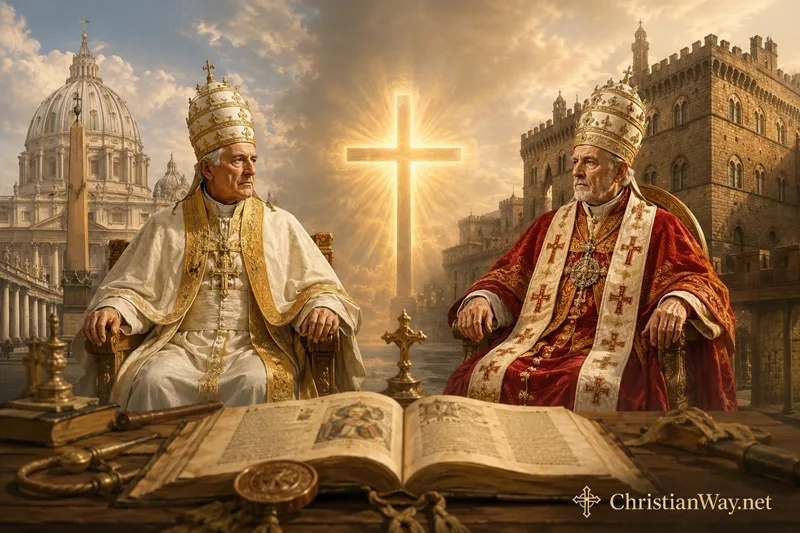
When we look at the history of rival Popes, then, we should not look with mockery or despair. We should look with humility. We should remember that unity is precious, that division wounds the Body of Christ, and that no human office can save the Church apart from the grace of Jesus. The history of the papacy does not ultimately tell us that Christ has failed His Church. It tells us how deeply the Church needs Him in every generation.
The Simple Answer: Rival Claimants, but Not Two Legitimate Popes
The simplest answer is this: yes, there have been times when more than one man claimed to be Pope at the same time. But according to Catholic understanding, there cannot truly be two legitimate Popes governing the universal Church at once. There is one Bishop of Rome, one successor of Saint Peter, and one visible pastoral office entrusted with serving the Church’s unity.
The difficulty comes when people living in a particular historical moment cannot easily determine who that rightful Pope is. Sometimes an election is disputed. Sometimes political powers interfere. Sometimes cardinals disagree about whether an election was free or valid. Sometimes a man is recognized as Pope by one group of Christians and rejected by another. In those moments, Christians may find themselves sincerely divided, not always because they love division, but because they are trying to follow what they believe to be the true successor of Peter.
The word often used for an illegitimate papal claimant is antipope. This does not necessarily mean that everyone who supported him was rebellious or dishonest. In many historical cases, faithful bishops, priests, religious, rulers, scholars, and ordinary Christians sincerely believed they were following the rightful Pope. Only later, after the crisis had passed and the Church had been able to judge the matter more clearly, did the line of legitimate succession become settled.
That is important for us to remember. History is sometimes clearer in retrospect than it was for those who lived through it. We can look back and identify who is recognized in the official line of Popes. But Christians who lived in the middle of a schism often faced real uncertainty. They did not have the advantage of seeing the ending while they were carrying the burden of the conflict.
A Human Crisis in a Church That Belongs to Christ
Some people imagine that faith means Christians will never face confusion, conflict, or failure. But Scripture gives us a more honest picture. The apostles themselves sometimes misunderstood Jesus. They argued about who was greatest. Peter confessed Christ with courage, then later denied Him in fear. Paul and Barnabas had a serious disagreement. The early Church had to confront disputes about how Gentile believers would be welcomed into the people of God.
The presence of conflict does not prove that Christ has abandoned His people. It proves that His people still need conversion. The Church is not a gathering of those who no longer struggle with sin. It is the family of those who have been called by Christ, forgiven by Christ, and invited to grow in holiness through Christ.
This does not make division unimportant. Division always wounds. When Christians are separated from one another, the world sees less clearly the unity of love that Jesus desired for His disciples. Yet even in moments of division, Christ continues to call His people back. He remains the Good Shepherd. He remains the Head of the Church. He remains faithful when His servants are weak.
Before the Western Schism: The Papacy and the Wounds of History
To understand why there were rival Popes in the late Middle Ages, we need to remember that the Church does not live outside history. The Church proclaims an eternal Gospel, but she does so among nations, rulers, wars, languages, customs, ambitions, and fears. At times, these earthly pressures have entered painfully into the life of the Church.
In the early fourteenth century, the Popes lived for a long period in Avignon rather than Rome. This period is often called the Avignon Papacy. For many people, especially in Italy, the Pope’s absence from Rome caused deep concern. Rome was not merely a political city. It was the city of Saint Peter and Saint Paul, the place closely connected with the martyrdom of the apostles and the historic center of the Church of the West.
When Pope Gregory XI returned from Avignon to Rome, many hoped that the papacy would regain stability. But when Gregory died in 1378, fear and tension surrounded the election of his successor. The people of Rome wanted an Italian Pope, worried that a French Pope might return the papal court to Avignon. The cardinals elected Bartolomeo Prignano, who took the name Urban VI.
At first, Urban VI was widely recognized. But his harsh manner and severe reforms soon caused serious conflict with many cardinals. Some of them later claimed that the election had taken place under pressure from the Roman crowd and therefore was invalid. They withdrew, gathered elsewhere, and elected another claimant, Robert of Geneva, who took the name Clement VII. Clement established his court in Avignon, while Urban remained in Rome.
Thus began the Western Schism. Two men claimed to be Pope. Two groups of cardinals supported different lines. Different kingdoms and regions gave allegiance to different claimants. What had begun as a disputed election became a long and painful division throughout Western Christendom. itics Made a Wound Even Deeper
The tragedy of the Western Schism was not only theological or canonical. It was also deeply political. Nations often supported the claimant who best served their political interests. France tended to support the Avignon line. England, in conflict with France, generally supported the Roman line. Other kingdoms and regions made decisions shaped by alliances, rivalries, geography, and power.
This does not mean that all political leaders acted without faith. Many believed sincerely that they were defending the Church’s rightful head. But politics can easily cloud the spiritual vision of believers. When earthly power becomes more important than truth, when national pride becomes stronger than Christian charity, when leaders seek influence rather than holiness, the Church suffers.
We see this temptation in every age. It is easy to criticize medieval Christians for allowing politics to shape religious life. Yet we must ask whether we do the same. Do we allow political loyalties to determine how we read the Gospel? Do we treat fellow Christians as enemies because they belong to another group, nation, culture, or movement? Do we seek Christ’s truth, or only the victory of our own side?
The Western Schism reminds us that the Church is always in danger when Christians forget that their first citizenship is in the Kingdom of God. Earthly nations matter. Cultures matter. Laws and leaders matter. But none of these can become greater than the Lord Jesus Christ.
Why the Schism Was So Painful for Ordinary Believers
For bishops, theologians, and rulers, the question of who was Pope involved councils, letters, legal arguments, and political negotiations. But for ordinary believers, the confusion was deeply personal. Imagine living in a parish and hearing that one part of Christendom recognized one Pope while another part recognized someone else. Imagine hearing that bishops, kings, and religious communities disagreed about the most visible office of unity in the Church.
The faithful could reasonably ask: Whom should we follow? Which authority is true? Where is the Church’s unity? How can we know what God desires? These questions were not abstract. They affected appointments of bishops, relationships between dioceses, religious communities, sacramental discipline, and the confidence of ordinary Christians.
One of the saddest facts about the Western Schism is that holy and sincere people could be found on different sides. People of prayer, learning, charity, and devotion did not always agree about which claimant was legitimate. This should make us humble. It reminds us that even sincere Christians can misunderstand complicated situations when the facts are unclear and human passions are strong. e was also grace in this painful reality. Many believers did not abandon the faith simply because the leaders of the Church were divided. They continued to pray. They celebrated the sacraments. They cared for the poor. They entered religious life. They preached the Gospel. They trusted that Christ had not stopped being Lord simply because human leaders were struggling to restore visible unity.
That is a lesson for every generation. When the Church disappoints us, when leaders fail, when disputes seem endless, we must not confuse the weakness of Christians with the weakness of Christ. The Church may pass through storms, but Christ remains in the boat. He may seem silent for a time, but He has not abandoned His people.
Faithfulness During Confusion
There are seasons in life when we do not receive immediate answers. A family may go through a conflict that seems impossible to heal. A parish may experience division. A Christian may feel wounded by the failures of a leader. A young person may struggle to understand why the Church carries both holiness and scandal within her visible life.
In those moments, faithfulness does not mean pretending that pain is not real. It means bringing the pain honestly to Christ. It means refusing to let disappointment become bitterness. It means continuing to pray even when prayer feels dry. It means remaining close to the sacraments, the Scriptures, and the people who are quietly living the Gospel.
The Christians who lived through the Western Schism could not see the end of the story. They could not know exactly how unity would be restored. Yet many remained faithful because they knew something deeper than the disputes around them: Jesus Christ is Lord.
When There Were Three Claimants
The Western Schism became even more complicated in 1409. Many Christians hoped that a council held at Pisa would resolve the division between the Roman and Avignon claimants. The council declared both existing claimants deposed and elected a new man, Alexander V.
But instead of ending the division, the decision created an even greater crisis. The two existing claimants did not simply disappear. Each continued to insist that he was the rightful Pope. Now there were three competing lines: one based in Rome, one connected with Avignon, and one associated with Pisa.
This is one of the most striking moments in papal history. For a time, Christians could look across Europe and see three men who each claimed the highest visible office in the Church. Yet again, Catholic teaching does not say that there were three legitimate Popes. Rather, there were three claimants, and the Church faced an extraordinary crisis in determining how unity could be restored. The Council of Pisa, intended to heal the wound, had unintentionally deepened the confusion. ation reveals something important about human solutions. Good intentions are not always enough. A plan can sound wise and still bring unforeseen consequences. The desire to resolve a crisis quickly can sometimes create a new crisis. This is true in families, parishes, workplaces, nations, and churches.
When people are divided, they often want an immediate solution. But healing sometimes requires patience, repentance, truthfulness, and the willingness to surrender personal ambition. Unity cannot be built merely by declaring that a problem is solved. It must be rebuilt through humility.
The Difference Between Unity and Mere Agreement
It is possible for people to agree outwardly while remaining divided inwardly. A family may stop arguing but continue to carry resentment. A parish may avoid open conflict while hidden distrust remains. A nation may sign an agreement while bitterness continues beneath the surface.
Christian unity is deeper than outward peace. It is rooted in truth, repentance, forgiveness, and shared life in Christ. Jesus does not merely ask His disciples to stop fighting. He prays “that they may all be one” (John 17:21). This unity is not the result of pressure or fear. It is a gift of grace.
The Western Schism could not truly end until the rival claims were addressed and the Church found a path back toward a single recognized Pope. The work required more than political negotiation. It required a willingness to put the good of the whole Church above the ambitions of individuals and factions.
The Council of Constance and the Restoration of Unity
The crisis was eventually addressed through the Council of Constance, which met from 1414 to 1418. Its purpose was not only to confront the papal schism but also to address wider questions of reform and doctrine. The restoration of unity, however, stood at the center of its work.
The path was difficult. The Roman claimant, Gregory XII, agreed to resign in a way that helped make a new election possible. The Pisan claimant, John XXIII, was removed from office. The Avignon claimant, Benedict XIII, refused to resign and continued to claim the papacy, but he gradually lost support.
In 1417, the council elected Martin V. His election was widely recognized and brought the Western Schism to its decisive end. The Church once again had one universally recognized Pope, and the long period of competing papal obediences began to close. ent should not be remembered as a simple victory of one political group over another. It was a moment of healing after nearly forty years of confusion. The Church had been wounded. The faithful had suffered. The visible unity of Western Christendom had been damaged. The election of Martin V became a sign that, even after human failure, unity could be restored.
There is something deeply moving about Gregory XII’s resignation. Whatever complexities surrounded the situation, his willingness to step aside helped open a path toward reconciliation. In the Christian life, humility often becomes the doorway through which healing enters. Sometimes the greatest act of leadership is not holding more tightly to power but letting go for the good of others.
A Lesson in Letting Go
We all know how difficult it can be to let go. We cling to arguments because we want to be proven right. We cling to resentment because forgiveness feels unfair. We cling to control because uncertainty frightens us. We cling to our own importance because we fear being forgotten.
But Christ teaches another way. He “emptied himself,” as Saint Paul says, taking the form of a servant (Philippians 2:7). The Cross is the deepest revelation that love is not self-protection. Love is self-gift.
The healing of the Western Schism required people to think beyond themselves. It required the Church to seek unity not as a political achievement but as a spiritual necessity. It reminds us that every Christian community is strengthened when people ask not, “How can I win?” but, “How can Christ be honored?”
What Does This Teach Us About the Papacy?
The history of rival papal claimants can make people ask whether the papacy is too fragile to serve as a sign of unity. But the deeper lesson is not that the office has failed. It is that every office in the Church depends on the grace of Christ.
Catholics believe that the Pope, as Bishop of Rome and successor of Saint Peter, has a particular ministry of serving the Church’s unity. This ministry is not meant to replace Christ. Jesus alone is the Head of the Church. Jesus alone is the Savior. Jesus alone is the Good Shepherd who lays down His life for the sheep.
The Pope’s role is one of service. He is called to strengthen his brothers and sisters in faith, safeguard the apostolic tradition, encourage communion among the Churches, and help the faithful remain close to Christ. The title “Vicar of Christ” does not mean that the Pope becomes another Christ or takes Christ’s place. It means that he is called to serve in Christ’s name and according to Christ’s mission.
The Western Schism shows why this ministry matters. Christians need visible signs of unity because we are not purely spiritual beings. We live in history. We belong to communities. We need shared worship, shared teaching, shared memory, and shared pastoral care. But the same history also reminds us that visible structures must always remain under the judgment of the Gospel.
No Pope is above Christ. No Pope can invent a new Gospel. No Pope can change sin into holiness or falsehood into truth. The Pope himself must be a disciple before he can be a shepherd. He must kneel before the Lord before he can speak to the Church.
Peter Was Chosen, but Peter Also Needed Mercy
Perhaps the most consoling thing about the papacy is that it is connected to Saint Peter. Peter was not chosen because he was flawless. He was chosen by grace. He loved Jesus deeply, but he also failed Him painfully.
Peter said, “You are the Messiah, the Son of the living God” (Matthew 16:16). Yet later, when fear took hold of him, he denied that he even knew Jesus. After the Resurrection, Christ did not cast Peter away. He asked him three times, “Do you love me?” and then entrusted him with the care of His sheep (John 21:15–17).
Peter’s story tells us that leadership in the Church is never about human perfection. It is about mercy received and mercy offered. The one who is called to strengthen others is first the one who has been forgiven.
The Popes, like Peter, are human beings in need of grace. Some have been saints. Some have been weak. Some have governed wisely. Some have caused pain. Yet Christ’s promise does not rest on the perfection of His servants. It rests on His own faithfulness.
The Church Is Holy, but Her Members Need Conversion
The Western Schism can also help us understand a difficult truth about the Church: the Church is holy because Christ is holy, because the Holy Spirit dwells within her, because the Gospel is true, and because the sacraments are gifts of grace. Yet the members of the Church remain sinners who need conversion.
This is not a contradiction. It is the mystery of the Church’s life in the world. She is the Bride of Christ, loved and sanctified by Him. Yet she carries within her members who can be selfish, fearful, proud, divided, and weak.
We see this in Scripture. The disciples are chosen by Jesus, but they still misunderstand Him. The Corinthian Christians receive the Gospel, but they quarrel among themselves. The early Church is filled with the Holy Spirit, but she still has to work through disagreements and growing pains.
The Western Schism belongs to this painful human side of Church history. It is not a reason to abandon hope. It is a call to deeper repentance. The Church must always be reformed according to the Gospel. Every Christian must ask: Where am I adding to division? Where am I allowing pride to rule me? Where do I need the mercy of Christ?
Christ Does Not Abandon His Bride
When we see failures in the Church, we may be tempted to say, “How can this still be the Church of Christ?” But we should remember the words of Jesus: “I am with you always, to the end of the age” (Matthew 28:20).
Christ did not promise that every Christian leader would be wise. He did not promise that every century would be free from scandal. He did not promise that the Church would never pass through suffering. He promised His presence.
The Church has survived persecution, division, corruption, war, misunderstanding, and exile not because her members have always been strong, but because Christ is faithful. He continues to call sinners. He continues to forgive. He continues to raise up saints. He continues to feed His people with His Word and His Body.
This is not an excuse for complacency. When sin appears in the Church, it must be named, confronted, and healed. But neither should we surrender to despair. The Church’s hope is not in human brilliance. Her hope is in the risen Christ.
A Word for Christians of Other Traditions
The question of the papacy is one that Christians understand differently. Catholics believe that the Bishop of Rome has a unique ministry of unity as successor of Saint Peter. Eastern Orthodox Christians, Anglicans, and Protestants do not all understand papal authority in the same way.
These differences are real and should not be ignored. But they should be discussed with charity. No Christian honors Jesus by misrepresenting another Christian tradition. No believer serves the Gospel by turning historical wounds into weapons.
The Western Schism itself teaches humility. If Catholics can look honestly at a period when Western Christians were deeply divided over papal legitimacy, then all Christians can recognize the need for repentance, patience, and prayer for unity.
Jesus prayed that His followers might be one. That prayer still stands before us. Christian unity will not be built through pride. It will not be built through pretending that real differences do not exist. It will be built through truth spoken with love, mutual repentance, serious dialogue, shared prayer, and renewed devotion to Christ.
The Pope’s ministry, when understood rightly, should never lead Catholics to boast. It should lead them to pray more deeply for the unity of all who bear the name of Jesus.
What the Western Schism Means for Us Today
It may seem that the Western Schism belongs only to the distant past. Yet its spiritual lessons remain close to us.
We live in a world full of division. Families are divided by old wounds. Communities are divided by politics. Christians are divided by theology, culture, and history. Even within parishes, people can become suspicious of one another. We can be tempted to think that unity means everyone must speak, vote, pray, and think exactly as we do.
But Christian unity is not uniformity. The Church has room for many cultures, languages, spiritual traditions, and expressions of faith. Unity means remaining rooted in Christ. It means receiving one another as brothers and sisters. It means refusing to let disagreement become hatred.
The Western Schism warns us about the danger of turning faith into a struggle for power. It warns us about allowing political loyalties to become stronger than the Gospel. It warns us that even good people can become divided when fear and pride take control.
But it also gives hope. The schism did not last forever. Healing was possible. Unity was restored. The Church passed through a dark valley, but Christ did not leave His people there.
Building Unity in Ordinary Life
Most of us will never be called to resolve a great historical crisis. But every one of us can become a servant of unity in the places where God has put us.
We can refuse to spread gossip. We can listen before speaking. We can apologize when we have caused hurt. We can pray for people with whom we disagree. We can avoid using religion as a weapon. We can welcome the lonely person at church. We can teach our children that Christian faith is not about winning arguments but about loving Christ and loving others.
Unity begins in small acts of humility. A family becomes more peaceful when someone chooses forgiveness. A parish becomes stronger when members stop competing for recognition. A friendship is healed when one person has the courage to say, “I was wrong.” A community becomes more Christlike when people learn to carry one another’s burdens.
The Church’s unity is not only something we discuss in history books. It is something we either strengthen or weaken through our daily choices.
Reflect and Pray
Dear friends, there have been times in history when two, and even three, men claimed to be Pope at the same time. The Western Schism was a painful wound in the life of the Church. It reminds us that human weakness can bring confusion even into sacred things.
Yet it also reminds us that Christ remains faithful. The Church is not held together by the strength of personalities, the skill of politicians, or the certainty of human plans. She is held together by the grace of the Lord who said, “I am with you always.”
May we never take unity for granted. May we pray for the Pope, for bishops, for priests, for all Christian communities, and for the healing of divisions among those who confess the name of Jesus. May we learn from the wounds of history to become more humble, more patient, and more willing to serve one another in love.
Lord Jesus Christ, You are the true Shepherd of Your people and the Head of Your Church. Heal every division that wounds Your Body. Give wisdom to those who lead, courage to those who serve, and humility to every Christian heart. Teach us to seek not our own victory, but Your truth; not our own power, but Your peace; not our own glory, but the glory of Your holy name.
May the peace of Christ dwell richly in your heart, and may His love guide every step you take toward Him.
— Fr. John Matthew