Dear friends in Christ,
Yes, there have been non-European popes.
The question may sound simple, but the answer invites us into a larger and more beautiful story. It reminds us that the Church of Jesus Christ was never meant to belong to one continent, one language, one culture, or one people alone. The Gospel was born in the lands of the eastern Mediterranean. It was preached across Africa, Asia, and Europe. It traveled by roads, ships, letters, prayers, and the courage of ordinary believers who carried the name of Christ far beyond the places where they first heard it.
When we speak about a “non-European pope,” however, we should do so carefully. Ancient people did not use modern national and continental identities in exactly the way we do today. The early Church belonged to the world of the Roman Empire, the Mediterranean, North Africa, the Near East, and many peoples whose identities cannot be neatly placed into modern categories.
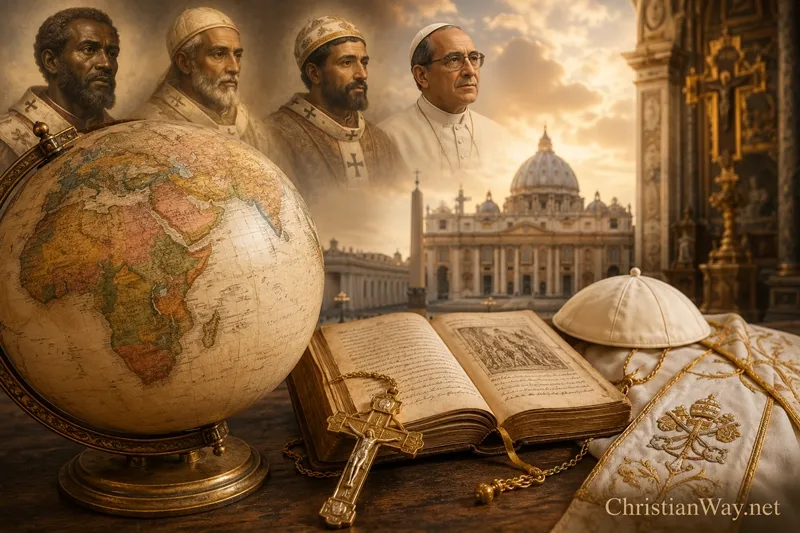
Yet the essential truth remains clear: the papacy has never been exclusively European in origin.
Saint Peter himself, whom Catholics recognize as the first Bishop of Rome, came from Galilee in the eastern Mediterranean. Several early popes were connected with Roman Africa, Syria, Jerusalem, and the wider Christian East. Pope Theodore I was born in Jerusalem, and Pope Gregory III was born in Syria.
In more recent history, Pope Francis became the first pope from the Americas when he was elected in 2013. After him, Pope Leo XIV became the first pope born in the United States.
But this question is about more than geography. It invites us to remember something central to the Gospel: Christ gathers His people from every nation. The Church is not a possession of one race, culture, or civilization. She belongs to Jesus Christ.
The Book of Revelation gives us a vision of heaven in which a great multitude stands before the throne of God, gathered “of all nations, and kindreds, and people, and tongues” (Revelation 7:9). This is not merely a distant dream. It is already the calling of the Church on earth.
The Church is called to become a home where every person may hear the name of Jesus.
It is called to welcome the poor and the wealthy, the educated and the simple, the strong and the wounded, the old and the young, the familiar and the stranger.
It is called to remember that Christ Himself crossed every boundary of human fear. He entered our world as a child. He lived among ordinary people. He spoke with Samaritans, Romans, fishermen, tax collectors, widows, the sick, the poor, and those whom society had forgotten.
To ask whether there have ever been non-European popes is therefore to ask a deeper question: Has the Church ever truly been universal?
The answer is yes.
And she is called to become more visibly what she has always been in the heart of Christ: a people gathered from every land into one family of faith.
The Church Began in the East, Not in Europe
Before we speak about the history of popes from Africa, Syria, Jerusalem, or the Americas, we should remember something very important: Christianity itself did not begin in Europe.
Jesus was born in Bethlehem.
He grew up in Nazareth.
He preached in Galilee and Judea.
He died and rose again in Jerusalem.
The apostles first proclaimed the Gospel in the lands of the eastern Mediterranean, where Jewish, Greek, Roman, Syrian, Egyptian, African, and Asian cultures met.
The first disciples were not Europeans in the modern sense. They were Jewish men and women who believed that Jesus of Nazareth was the promised Messiah, the Son of God, and the Savior of the world.
The Church was born at Pentecost in Jerusalem.
On that day, people from many regions heard the apostles speaking about “the wonderful works of God” in their own languages. The Gospel was not given in only one language. It was heard by people from many places.
This is one of the first great signs that Christianity was never meant to become the property of one nation.
The Holy Spirit did not come only for one people.
He came so that the nations might hear.
Jesus Himself gave this mission to His disciples when He said, “Go ye therefore, and teach all nations” (Matthew 28:19).
The Church would soon spread beyond Jerusalem into Samaria, Syria, Asia Minor, Greece, North Africa, Rome, and eventually far beyond the boundaries of the ancient world.
The Gospel moved outward because the love of Christ cannot remain locked inside one place.
It is too wide for one nation.
It is too merciful for one language.
It is too great for one culture.
This is why the question of non-European popes matters. It reminds us that even though Rome became the center of the Catholic Church, the faith itself was never Roman in the narrow sense. Rome received the Gospel. Rome preserved and proclaimed it. Rome became the place where Peter and Paul gave their lives in witness to Christ. But Rome did not own the Gospel.
Christ owns the Gospel.
Christ owns the Church.
Christ calls every people to Himself.
Saint Peter and the Universal Mission of the Church
For Catholics, Saint Peter is the first successor in the line of the bishops of Rome. Yet Peter did not come from Rome. He was a fisherman from Galilee, a region in the eastern Mediterranean.
He was not a scholar seeking a public title.
He was not a ruler surrounded by power.
He was a man who knew boats, nets, storms, hunger, fatigue, and the ordinary work of daily life.
Jesus called him beside the sea.
“Follow me,” the Lord said.
Peter would become the disciple who spoke boldly, failed painfully, wept bitterly, and was restored mercifully by Christ.
He would confess, “Thou art the Christ, the Son of the living God” (Matthew 16:16).
Yet Peter would also deny Jesus during the darkest night of the Passion.
This is one reason Peter is such a source of hope.
The Church is not built upon the perfection of human beings.
It is built upon Christ.
Peter was weak, but Christ strengthened him.
Peter was afraid, but Christ restored him.
Peter failed, but Christ entrusted him with the care of His flock.
After the Resurrection, Jesus asked Peter three times, “Lovest thou me?” Then He said, “Feed my sheep” (John 21:17).
This is the heart of Christian leadership.
Not power for its own sake.
Not status for its own sake.
Not influence for its own sake.
But love for Christ that becomes service to His people.
The pope, in Catholic understanding, is not meant to become the owner of the Church. He is called to be a servant of the Church, a shepherd who points believers back to Christ.
This is why the papacy cannot truly belong to a nation.
Peter himself came from outside Rome.
The first Christians came from many lands.
The Church began as a people on the move.
And the Gospel continues to travel wherever human hearts hunger for mercy, truth, forgiveness, and hope.
Pope Victor I and the African Roots of the Early Church
One of the earliest examples often mentioned in discussions of non-European popes is Pope Saint Victor I, who served as Bishop of Rome near the end of the second century.
Ancient tradition identifies Victor as a native of Roman Africa. The exact details of his birthplace, ethnicity, and family background cannot be reconstructed with certainty, and modern racial categories should not be forced onto an ancient African Christian. But the historical tradition is clear enough to show that the early papacy was already connected with the African world of the Roman Empire.
This should not surprise us.
North Africa was one of the great centers of early Christianity.
Long before Christianity became deeply rooted in northern Europe, Christian communities flourished in places such as Carthage, Alexandria, Hippo, and other cities across Africa.
Some of the most important voices in Christian history came from Africa.
Tertullian wrote with passion about Christian faith and moral life.
Saint Cyprian of Carthage spoke about unity, charity, and the courage of martyrs.
Saint Augustine of Hippo became one of the most influential theologians in Christian history.
Saint Monica prayed faithfully for the conversion of her son Augustine.
These were not distant figures outside the story of Christianity. They were part of its very heart.
Africa gave the Church theologians, bishops, martyrs, teachers, monks, missionaries, and saints.
The Christian faith has always been African.
It has always been Asian.
It has always been Middle Eastern.
It has always been European.
It has always been global because Christ is Lord of every people.
Pope Victor I also reminds us that the Church has always been challenged by questions of unity. During his pontificate, Christians debated the proper date for celebrating Easter. The discussion was not small. Easter stands at the center of Christian faith because it proclaims the Resurrection of Christ.
Yet even in disagreement, the Church was learning how to remain united around the mystery of Jesus.
This is still important today.
Christians continue to differ in worship, theology, church structure, and tradition. Catholics, Orthodox Christians, Anglicans, Lutherans, Reformed Christians, Baptists, Methodists, Pentecostals, and many others do not agree on every question.
But every Christian is called to remember that Christ is greater than our divisions.
Unity does not mean pretending differences do not matter.
Truth matters.
Doctrine matters.
History matters.
But love also matters.
Humility matters.
Prayer matters.
The Church grows when Christians stop treating one another as enemies and begin asking how they can witness more faithfully to the one Lord they proclaim.
Pope Theodore I: A Pope Born in Jerusalem
Pope Theodore I offers one of the clearest examples of a pope born outside Europe.
The official historical listing of the Holy See identifies Theodore I as having been born in Jerusalem. He served as pope from 642 to 649, during a time when the Christian world was deeply affected by political upheaval, theological controversy, and changing powers across the Mediterranean.
Jerusalem is not merely a place on a map.
For Christians, it is the city of the Passion, the Resurrection, Pentecost, and the birth of the Church.
It is the place where Jesus entered the city riding humbly upon a donkey.
It is the place where He shared the Last Supper with His disciples.
It is the place where He carried the Cross.
It is the place where He rose from the dead.
It is the place where the Holy Spirit descended upon the apostles.
To remember that a pope was born in Jerusalem is to remember that the heart of Christianity lies in the eastern Mediterranean, not in the courts of Europe.
Theodore I lived in a time when theological debates could become bitter and dangerous. Christians struggled to explain faithfully the mystery of Jesus Christ: fully God and fully human, united without confusion or division.
These debates may seem distant to many people today. Yet they matter because our understanding of Jesus matters.
If Jesus were only a good teacher, He could inspire us but not save us.
If Jesus were only God appearing to be human, He could not truly enter our suffering.
But Christians confess that Jesus Christ is truly God and truly man.
He knows the pain of hunger.
He knows fatigue.
He knows rejection.
He knows grief.
He knows betrayal.
He knows death.
And because He is God, His mercy is greater than sin, fear, and death.
This is why the Church has always defended the truth about Christ so carefully.
The debates of Theodore’s time were not merely arguments between scholars. They concerned the heart of the Gospel.
Can Christ truly save us?
Can He truly enter our suffering?
Can He truly unite humanity with God?
The answer of the Church has always been yes.
And this yes belongs to every people and every nation.
Pope Gregory III: A Syrian Bishop of Rome
Another important non-European pope was Pope Gregory III, who was born in Syria and served as pope from 731 to 741. The Holy See’s official listing identifies Syria as his birthplace.
Gregory III lived in a time when the Christian world was deeply divided by political conflict and disputes over sacred images.
The question of icons was not simply about art. It was connected to deeper questions about the Incarnation.
If Jesus Christ truly became human, then matter itself is not beneath God’s love.
Wood, paint, stone, bread, water, oil, and human hands can become signs that point us toward grace.
The Christian faith does not worship images as gods. It worships God alone.
But Christians have long understood that visual beauty can help turn the heart toward Christ.
A cross can remind us of His sacrifice.
An icon can remind us of His presence.
A painting of the Nativity can awaken gratitude.
A candle can remind us that Christ is the Light of the World.
A church building can help us remember that God is worthy of reverence.
Gregory III defended the use of sacred images during a period of iconoclasm, when many religious images were being destroyed.
Yet his importance reaches beyond that historical debate.
He is a reminder that the papacy has long been shaped by Christians from the eastern world.
The Church did not become universal only after missionaries traveled from Europe to other continents.
From the beginning, Christian faith was shared among people from Africa, Asia, the Middle East, and Europe.
The early Church was more diverse than many people realize.
It was Jewish and Greek.
Syrian and Latin.
African and Roman.
Egyptian and Armenian.
Coptic and Byzantine.
Eastern and Western.
The Church was never meant to erase these differences.
She was called to unite them in Christ.
This is the true meaning of catholicity.
Catholic does not mean uniform.
Catholic means universal.
It means that Christ is not the Savior of one nation only.
He is the Savior of the world.
The Meaning of “Catholic”: Universal, Not Uniform
The word “catholic” comes from a Greek word meaning universal.
It speaks of the Church’s calling to reach every people, every language, and every land.
But universal does not mean that every Christian must look the same, speak the same language, sing the same music, or express faith through the same cultural customs.
A Christian in Vietnam may pray with a different rhythm from a Christian in Ireland.
A Christian in Nigeria may sing differently from a Christian in Poland.
A Christian in Korea may worship differently from a Christian in Brazil.
A Christian in Lebanon may carry the memory of ancient Syriac traditions.
A Christian in Ethiopia may treasure a history of faith that reaches back many centuries.
A Christian in the Philippines may express devotion with songs, processions, and family customs shaped by local history.
These differences do not weaken the Church when they remain rooted in Christ.
They reveal the beauty of the Gospel entering real human lives.
God does not erase culture.
He purifies what is sinful.
He heals what is wounded.
He transforms what is broken.
He allows every people to offer their gifts in praise.
The Church is at her most beautiful when she reflects the many colors of God’s creation without losing sight of the one Savior who gathers her.
Saint Paul wrote, “There is neither Jew nor Greek, there is neither bond nor free, there is neither male nor female: for ye are all one in Christ Jesus” (Galatians 3:28).
This does not mean that cultural differences disappear.
It means that no difference is greater than our shared dignity in Christ.
No nation is closer to God because it is powerful.
No language is more holy because it is widely spoken.
No people can claim ownership over Jesus.
The Gospel belongs to all because Christ gave Himself for all.
Pope Francis and the First Pope From the Americas
In 2013, the election of Pope Francis became a moment of great significance for the modern Church.
Born Jorge Mario Bergoglio in Buenos Aires, Argentina, Pope Francis became the first pope from the Americas. He was also the first Jesuit pope and the first pope to take the name Francis.
For many Catholics, his election carried a powerful message.
The center of the Catholic Church remains in Rome, but the life of the Church is not confined to Europe.
Catholics live in Latin America, Africa, Asia, North America, the Middle East, Oceania, and every part of the world.
Many of the fastest-growing Christian communities are found outside Europe.
Many of the most vibrant expressions of Catholic faith are lived in countries where families pray together, communities support one another, and people carry the Gospel through hardship, poverty, persecution, migration, and struggle.
Pope Francis often spoke about the Church as a people that must go outward rather than remain closed within itself.
He called Christians to care for the poor.
He called them to remember migrants and refugees.
He called them to protect the vulnerable.
He called them to see Christ in those whom the world overlooks.
This message did not begin with Pope Francis. It belongs to the Gospel itself.
Jesus said, “I was a stranger, and ye took me in” (Matthew 25:35).
He did not say, “I was important, wealthy, admired, and secure.”
He said, “I was hungry.”
“I was thirsty.”
“I was a stranger.”
“I was sick.”
“I was in prison.”
The Church must always remember this.
A Church that forgets the poor forgets Christ.
A Christian who despises the weak forgets Christ.
A society that treats human beings as disposable forgets Christ.
The election of Pope Francis reminded many people that the Church’s future cannot be understood only by looking at old centers of influence. The Holy Spirit is at work wherever people hear the Gospel, receive the sacraments, pray, serve, forgive, and remain faithful to Christ.
Pope Leo XIV and the First Pope From the United States
In 2025, Pope Leo XIV became the first pope born in the United States. The Vatican identifies him as the 267th successor of Saint Peter and the first pope from the United States of America.
This moment added another chapter to the global story of the papacy.
The papacy has known popes born in Italy, France, Germany, Poland, Argentina, Syria, Jerusalem, and other parts of the Christian world.
The election of a pope from the United States does not mean that one nation has become spiritually greater than another.
It means something more humble.
It means the Church continues to reflect the worldwide nature of the Gospel.
It means that the successor of Peter can come from many places.
It means that Christ continues to call servants from unexpected backgrounds.
It means that the Church cannot be reduced to one culture or continent.
Every pope carries the same essential responsibility: to serve Christ and to strengthen the Church in faith.
Every pope must remember that he is not the center.
Christ is the center.
The pope is a shepherd, not the Savior.
The pope is a servant, not the owner of the Church.
The pope is called to point believers toward Jesus.
This is why titles such as “Servant of the Servants of God” carry such meaning.
The Church does not need leaders who seek admiration.
She needs leaders who pray.
She needs leaders who serve.
She needs leaders who defend the vulnerable.
She needs leaders who speak truth with humility.
She needs leaders who remember that Christ washed the feet of His disciples.
Why This History Matters Today
Some people may ask why any of this history matters.
Why should Christians care where a pope was born centuries ago?
Why does it matter that there were African, Syrian, Jerusalem-born, Argentine, or American popes?
It matters because history shapes imagination.
If we assume that the Church has always belonged mainly to Europe, we may begin to imagine that Christianity is foreign to Africa, Asia, the Middle East, or Latin America.
But this is not true.
Christianity has deep roots in every part of the world.
It has ancient roots in Africa.
It has ancient roots in the Middle East.
It has ancient roots in Asia.
It has ancient roots in Europe.
The Church has always crossed borders because Christ Himself crossed the greatest border of all: the distance between God and humanity.
He became flesh.
He entered our weakness.
He lived among us.
He died for us.
He rose again.
The Gospel is universal because the human heart is universal.
Every person knows something about fear.
Every person knows something about sorrow.
Every person knows something about failure.
Every person knows something about longing.
Every person needs mercy.
Every person needs hope.
Every person needs Christ.
This is why the Church cannot become a place of nationalism, cultural pride, or human superiority.
The Church must never say, “Christ belongs more to us than to them.”
He belongs to all.
The Church must never say, “Our people matter more than other people.”
Every person is made in the image of God.
The Church must never say, “We are closer to God because our culture is better.”
Holiness is not measured by nationality.
Holiness is measured by love.
The Danger of Turning Faith Into National Pride
It is natural to love our homeland.
It is good to love the language we speak, the food we eat, the songs we sing, the customs we inherit, and the places that formed us.
A person can thank God for family, history, culture, and nation.
But Christian faith must always be greater than nationalism.
When love of country becomes contempt for others, it has lost its way.
When faith becomes a tool for hatred, it has lost its way.
When Christians use the name of Jesus to divide people by race, language, wealth, or nationality, they have forgotten the Cross.
Christ died for all.
He died for the Roman soldier.
He died for the Samaritan woman.
He died for the thief beside Him.
He died for the poor.
He died for the rich.
He died for the sinner.
He died for the person we find difficult to love.
The Church becomes most faithful when she remembers that every human being stands beneath the mercy of God.
This does not mean that Christians cannot love their local culture.
It means they must love it without making it an idol.
It means they must love their homeland without despising other homelands.
It means they must remember that heaven is larger than every border.
Saint Peter himself wrote to Christians as “strangers and pilgrims” in the world (1 Peter 2:11).
This is true for all of us.
We may live in one country, speak one language, and belong to one culture. But our deepest citizenship is in the Kingdom of God.
Faith in Real Life: Welcoming the Stranger
The global history of the papacy should also change the way Christians see strangers.
Many people today live far from home.
Some travel to find work.
Some flee violence.
Some move for education.
Some leave their families because they have no other way to support them.
Some live in places where they do not know the language well.
Some fear being rejected because of their accent, appearance, religion, or culture.
The Gospel calls Christians to see these people not as problems, but as persons.
Jesus says, “I was a stranger, and ye took me in” (Matthew 25:35).
To welcome the stranger does not mean ignoring the real challenges faced by families, communities, and nations. Wisdom, law, safety, and responsibility matter.
But Christian love never permits contempt.
It never allows us to speak as though another human being has no dignity.
It never allows us to forget that Jesus Himself was carried into Egypt as a child when His family fled danger.
The Holy Family knew what it meant to travel under fear.
Mary knew what it meant to protect her child.
Joseph knew what it meant to leave home for safety.
Jesus knew what it meant to depend upon the care of others.
When Christians remember the global roots of the Church, they become more able to see Christ in the stranger.
The person from another land may be carrying grief we cannot see.
The worker far from family may be carrying loneliness.
The child in a new school may be frightened.
The neighbor with a different language may be searching for belonging.
The person who appears unfamiliar may become a blessing beyond measure.
A Church That Belongs to Every People
The history of non-European popes gives us a simple but profound lesson.
No people should feel that they are merely guests in the Church of Christ.
The poor are not guests.
The immigrant is not a guest.
The child is not a guest.
The elderly person is not a guest.
The person with disability is not a guest.
The believer from another continent is not a guest.
The Church belongs to all who belong to Christ.
Of course, every Christian tradition has its history, language, and customs. Catholics have the papacy. Orthodox Christians honor patriarchal traditions. Protestants have many forms of church governance, worship, and mission. Anglicans, Lutherans, Baptists, Pentecostals, Methodists, Reformed Christians, and others each carry particular histories.
Yet all Christians are called to remember that Christ is not divided by human pride.
The Church must become a place where people can kneel beside one another.
A place where the wealthy and poor pray together.
A place where the educated and uneducated hear the same Gospel.
A place where people of different races, languages, and cultures receive the same mercy.
A place where the world sees not perfect people, but forgiven people.
A place where love becomes visible.
Saint Paul wrote, “For by one Spirit are we all baptized into one body” (1 Corinthians 12:13).
This body is larger than any nation.
It is larger than any politics.
It is larger than any culture.
It is the Body of Christ.
The Final Gathering of the Nations
One day, the Church will no longer be divided by geography, language, history, or misunderstanding.
One day, the faithful from every people will stand before Christ.
The hidden prayers of mothers will be known.
The sacrifices of fathers will be remembered.
The tears of the poor will be wiped away.
The suffering of the persecuted will be healed.
The lonely will be welcomed.
The wounded will be restored.
The Church will no longer struggle with pride, division, fear, or sin.
She will stand before Christ as a people made new by grace.
This is the promise of Revelation.
It is the promise that the Church does not move toward darkness, but toward the Kingdom of God.
Until that day, Christians are called to live as signs of that coming Kingdom.
We are called to welcome.
We are called to forgive.
We are called to serve.
We are called to pray.
We are called to protect life.
We are called to speak truth with love.
We are called to remember that Christ has people in places we may never see.
The history of the papacy teaches us this clearly.
The successor of Peter has come from many places.
But Peter’s true successor must always point beyond himself.
He must point to Jesus.
And every Christian, whatever country, culture, or tradition they come from, is called to do the same.
Reflect and Pray
Dear friends, the answer to the question is yes: there have been non-European popes, and the history of the papacy has always been more global than many people realize.
But the deeper truth is even more beautiful.
Christ does not belong to one people.
He belongs to every people.
He calls children from every nation.
He gathers believers from every language.
He receives the poor and the powerful, the famous and forgotten, the strong and weak, the familiar and the stranger.
Perhaps you have felt out of place in your own life.
Perhaps you have felt that your background, language, culture, past, or weakness makes you less worthy of God’s love.
Do not believe that lie.
You are known by Christ.
You are seen by Christ.
You are loved by Christ.
The Church is not meant to be a home only for people who look alike, think alike, or come from the same place.
It is meant to become a home for all who seek the mercy of Jesus.
Lord Jesus Christ,
You called Your disciples from many places
and sent them to every nation under heaven.
Teach us to see Your Church as a family gathered from every people.
Free us from pride, prejudice, fear, and contempt.
Give us hearts that welcome the stranger, protect the vulnerable,
and rejoice in the gifts You have given to every culture and land.
Make us faithful witnesses of Your love,
until all Your people are gathered before You
in the peace of Your eternal kingdom. Amen.
May Christ widen your heart with His mercy, deepen your love for His Church, and help you see every person as a beloved child of God.
— Fr. John Matthew