Dear friends in Christ,
There are wounds that the world can see, and there are wounds that remain hidden deep within the soul. Some wounds come through illness, grief, rejection, fear, betrayal, or regret. Others are carried silently through long years: the sorrow of a parent worried for a child, the shame of an old mistake, the loneliness behind a busy life, the burden of caring for someone who is suffering, or the quiet question that rises in the heart at night: “Lord, do You still see me?”
Saint Padre Pio knew something about wounds.
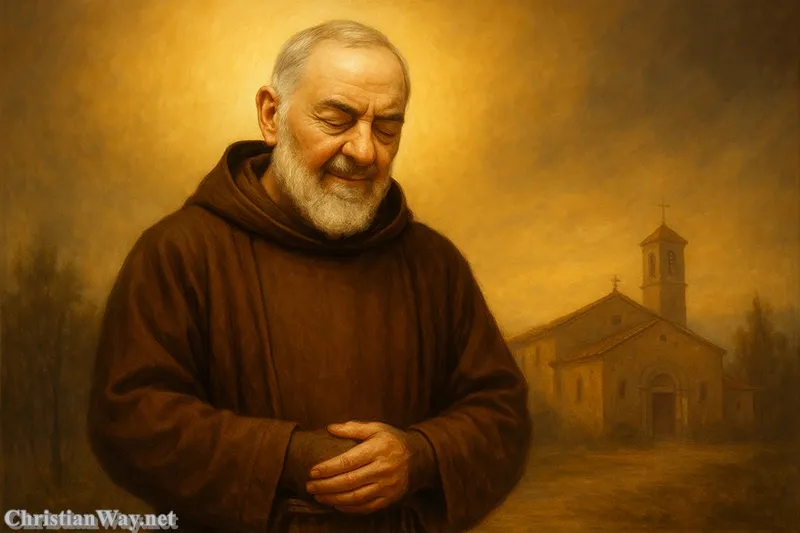
He is remembered throughout the Christian world as a Capuchin friar, a priest of prayer, a servant of the confessional, and a man marked in his body by the wounds of Christ. Yet the deepest meaning of his life is not found merely in extraordinary signs. His life points beyond himself. It directs us toward Jesus crucified and risen, toward the mercy that does not turn away from human pain, and toward the love of God that can transform suffering into a place of grace.
Saint Padre Pio: The Wounded Witness of God’s Mercy is not only the story of a saint who bore an unusual cross. It is also the story of a man who learned to place his whole life beneath the Cross of Christ. He prayed when prayer was costly. He heard confessions when people came burdened by sin. He accepted misunderstanding when defending himself may have seemed easier. He welcomed the sick, the poor, the wounded, and the lost. He showed that the heart of Christianity is not the search for spiritual excitement, but the humble surrender of oneself to the mercy of God.
His life speaks with special tenderness to those who feel weary. It speaks to the person who has prayed for healing and still waits. It speaks to the person who feels ashamed of past sin. It speaks to the one who has tried to remain faithful but is tired of carrying a cross. It speaks to those who long for God but do not know how to begin again.
Padre Pio reminds us that no wound, no failure, and no sorrow is beyond the reach of Christ.
A Child Who Belonged to God
Padre Pio was born Francesco Forgione on May 25, 1887, in Pietrelcina, a small town in southern Italy. He entered the Capuchin Franciscan friars as a teenager, took the name Pio, and was ordained a priest in 1910. Though his health was often fragile, he eventually lived for many years at the Capuchin friary in San Giovanni Rotondo, where his ministry would draw countless people seeking prayer, confession, counsel, and consolation.
From the beginning, his life was shaped by the Franciscan desire to follow Christ poor, humble, and crucified. Saint Francis of Assisi had taught generations of Christians to look upon the Cross not as a symbol of defeat, but as the deepest revelation of God’s love. The Son of God did not save the world from a distance. He entered our suffering. He took flesh. He wept. He was rejected. He carried the Cross. He gave Himself completely.
Padre Pio wanted to live close to that mystery.
This was not a fascination with pain for its own sake. Christian faith does not teach us to love suffering as though suffering itself were good. Illness is painful. Loss is painful. Sin wounds the human heart. Death is an enemy. But the Cross tells us that God can enter even the darkest places of human life and bring forth mercy, hope, and new life.
Saint Paul wrote, “God forbid that I should glory, save in the cross of our Lord Jesus Christ” (Galatians 6:14). These words stood at the center of Padre Pio’s spirituality. He did not seek applause. He did not wish to become a religious celebrity. He desired to belong to Christ, and he believed that the path of Christ was the path of humble love.
The Difference Between Being Religious and Belonging to Christ
It is possible to speak about religion while remaining distant from God. A person may know prayers, attend services, understand Christian teaching, and still carry a heart that is guarded by pride, resentment, fear, or self-reliance. The life of Padre Pio quietly asks us whether we have allowed Christ to enter the deeper places of our lives.
To belong to Christ is more than having a religious identity. It means allowing Him to meet us where we are weak. It means admitting that we cannot save ourselves. It means allowing His mercy to cleanse what is sinful, strengthen what is fragile, and heal what has been wounded.
Many people are afraid of bringing their real lives before God. They will bring Him polite prayers, but not their anger. They will bring Him public words, but not their hidden shame. They will bring Him Sunday faith, but not their Monday anxiety. Yet Jesus does not ask us to hide from Him.
He already knows.
The risen Christ still bears the marks of His wounds. When He appeared to Thomas, He did not erase the scars of the Cross. He showed them. “Reach hither thy finger, and behold my hands,” He said, “and reach hither thy hand, and thrust it into my side” (John 20:27). The wounds remained, but they no longer spoke of defeat. They had become signs of victorious love.
This is one of the deepest lessons of Saint Padre Pio. God does not always remove our wounds immediately. But when we surrender them to Christ, they need not define us by despair. In His hands, even the places that have hurt us can become places where compassion grows.
The Wounds of Christ and the Mystery of Suffering
The visible wounds associated with Padre Pio are known as the stigmata, marks resembling the wounds of Christ’s Passion. Catholic tradition holds that he received these wounds while praying after Mass on September 20, 1918, and that he bore them for many years. The Church’s attention to Padre Pio, however, was never meant to rest only on the extraordinary. His life was judged above all by the faith, humility, charity, obedience, and perseverance with which he followed Christ.
This is important to remember.
Faith is not built on curiosity about miracles. God may grant signs, but signs are meant to lead us toward Christ, not distract us from Him. When people came to Padre Pio, many may have been drawn by stories of unusual spiritual gifts. Yet what they encountered most deeply was a priest who called them back to prayer, confession, repentance, the Eucharist, charity, and trust in God.
The wounds of Christ are not decorations. They reveal the cost of love.
Jesus was wounded because He loved us to the end. He did not answer hatred with hatred. He did not save Himself by abandoning those who had rejected Him. He gave Himself for sinners, for the weak, for the broken, for those who would later deny Him, abandon Him, or fail to understand Him.
The Cross tells us that God’s love is not fragile.
It does not disappear when life becomes difficult.
It does not withdraw when we fall.
It does not grow tired of waiting for us to return.
Carrying a Cross Without Losing Hope
Every person carries some form of cross. For some, it is sickness in the body. For others, it is financial hardship, family conflict, loneliness, grief, or uncertainty about the future. Some carry wounds from childhood. Some carry the sorrow of a marriage that has become difficult. Some carry anxiety that others cannot see. Some carry the long burden of caring for a loved one whose health is failing.
There are days when the cross feels too heavy.
In such moments, it can be tempting to think that God has abandoned us. We may ask why prayer has not changed our circumstances. We may wonder why others seem to have easier lives. We may feel ashamed that our faith is weak.
Padre Pio does not offer easy answers to these questions. He does not tell us that pain is simple or that suffering should be ignored. Instead, his life points us toward the crucified Christ, who understands human sorrow from within.
Jesus did not stand outside the pain of the world. He entered it.
When we suffer, we are not praying to a distant God who cannot understand. We are praying to the One who wept at Lazarus’s tomb, who sweat blood in Gethsemane, who was betrayed by a friend, and who cried from the Cross.
This does not make every sorrow immediately understandable. But it means that no sorrow is carried alone.
The Confessional and the Mercy of God
One of the most powerful parts of Padre Pio’s ministry was his service as a confessor. People traveled long distances to confess their sins to him, seek spiritual direction, and receive the grace of reconciliation. The Vatican’s account of his life describes his ministry of confession, spiritual guidance, and the Eucharist as central to his apostolic work, while also noting his deep concern for those who were poor, sick, and burdened by suffering.
Why did so many people come?
Perhaps they came because they sensed that this priest took sin seriously without losing compassion. He did not reduce confession to a routine. He understood that sin harms the soul. It distorts love. It weakens trust. It turns us inward. It can make us feel distant from God, from others, and even from our own truest selves.
But he also believed deeply in mercy.
The confessional is not meant to be a courtroom where a person comes only to be condemned. It is a place where Christ receives the sinner who returns. It is where the wounded heart is brought into the light, not to be shamed, but to be healed.
The parable of the prodigal son reveals this mystery. The younger son leaves his father, wastes what he has been given, and returns in sorrow. He prepares a speech of repentance. He expects to be treated as a servant. But before he can finish speaking, the father runs to him, embraces him, clothes him, and welcomes him home.
This is the mercy of God.
God does not excuse sin. The son still had to return. He still had to admit that he had wandered. But mercy met him before shame could destroy him.
When Shame Keeps Us Away From God
Many people do not return to prayer because they feel unworthy. They think they must become better before they can come near to God. They wait until they are less angry, less tempted, less confused, or more spiritually disciplined.
But this is like refusing to visit a doctor until we are healthy.
Christ does not call the perfect. He calls sinners.
Jesus said, “They that are whole need not a physician; but they that are sick” (Luke 5:31). The Church has always understood this as a word of hope. We do not come to Christ because we have already healed ourselves. We come because we need healing.
Saint Padre Pio reminds us that repentance is not humiliation. It is a return to reality. It is the moment when we stop pretending we can live without God. It is the beginning of freedom.
Perhaps there is something in your life that you have carried for too long. Perhaps it is a sin you regret. Perhaps it is a habit that has slowly taken control of you. Perhaps it is anger toward someone who has hurt you. Perhaps it is a secret you cannot speak about easily.
Bring it to Christ.
Do not wait until you feel worthy.
His mercy is not given to those who have earned it. It is given to those who are willing to receive it.
The Holy Mass as the Center of His Life
For Padre Pio, the celebration of the Holy Mass stood at the center of his spiritual life. The Vatican describes the Eucharist as the summit of his apostolic activity, and the Capuchin tradition likewise remembers the Mass as the heart of his spirituality.
This tells us something essential about Christian life.
The Eucharist is not merely an obligation to complete or a familiar ritual to attend without attention. It is the memorial of Christ’s self-giving love. In the Mass, the Church remembers that Jesus offered His body and blood for the life of the world. We are invited not only to observe that sacrifice but to enter it with our own lives.
Every time we come to the altar, we bring more than bread and wine. We bring our worries, our grief, our joys, our failures, our hopes, our family burdens, our unanswered questions, and our need for mercy.
We place them before Christ.
Then, in the mystery of grace, He receives what we offer and gives us Himself.
This is why the Eucharist matters so deeply. We do not come only to remember Jesus from a distance. We come to receive the One who strengthens us for the road ahead.
Learning to Offer Ordinary Life to God
Not everyone can spend long hours in a church. Many people have demanding work, children to care for, elderly parents to help, illness to manage, or responsibilities that make life feel rushed. Yet Padre Pio’s love for the Mass can still teach us something very practical.
We can learn to offer ordinary life to God.
A mother may offer her fatigue while preparing breakfast for her family.
A worker may offer the day’s labor before leaving home.
A student may offer the stress of study and examination.
A person who is ill may offer the pain of the day in union with Christ.
A caregiver may offer each small act of patience.
A person facing uncertainty may offer the fear that cannot yet be solved.
This is not magic. It does not mean every difficulty disappears. But it transforms the heart. We begin to see that nothing given to God is wasted.
Saint Paul urges Christians to offer their bodies as “a living sacrifice, holy, acceptable unto God” (Romans 12:1). Padre Pio lived this not only in extraordinary suffering, but in daily prayer, faithful ministry, and humble obedience.
The Christian life becomes deeper when we stop asking only, “What can God do for me?” and begin asking, “Lord, how can I offer this day to You?”
Prayer That Does Not Flee From Reality
Padre Pio was known as a man of prayer. Yet his prayer did not make him distant from people. It made him more available to them.
This is the true fruit of prayer.
Prayer should not become an escape from responsibility. It should not make us less patient with our families, less honest in our work, or less attentive to the suffering around us. When prayer is genuine, it changes the way we see others. We begin to notice the lonely person, the poor person, the grieving person, the person who irritates us, and the person whom everyone else has forgotten.
The more deeply we encounter the love of God, the more we are called to become instruments of that love.
Pope Benedict XVI described Padre Pio as above all a “man of God” and connected his charitable work with the union of prayer and love for neighbor. In this vision, prayer and charity belong together: one who seeks the God of Jesus Christ is also called to serve brothers and sisters in need.
This is a needed lesson for our time.
Some people are active but spiritually exhausted. They work, serve, solve problems, and carry burdens, yet they have little silence left within them. Others pray often but remain closed to the needs of people around them. Both paths become incomplete.
Padre Pio teaches us that prayer should lead to charity, and charity should return us to prayer.
The Prayer of a Wounded Heart
Sometimes we imagine prayer must always be peaceful, beautiful, and full of clear thoughts. But much of real prayer is simple. It is the cry of the heart.
“Lord, help me.”
“Jesus, have mercy.”
“Give me strength.”
“I do not understand, but I trust You.”
“Stay with me.”
These prayers may be small, but they are not weak. They are often the most honest prayers we can offer.
The Psalms are filled with this kind of prayer. “Out of the depths have I cried unto thee, O Lord” (Psalm 130:1). The person praying does not pretend to be strong. He cries from the depths.
God hears.
Perhaps you have no long prayer to offer today. Perhaps your mind is tired. Perhaps sorrow has made words difficult. Do not be discouraged. Sit quietly before Christ. Speak His name. Give Him what you have.
A wounded heart can still pray.
In fact, a wounded heart may sometimes pray more truthfully than a heart that feels secure in itself.
Obedience in Seasons of Misunderstanding
The life of Padre Pio was not free from scrutiny, misunderstanding, and pain. The Church’s official account notes that he endured difficult interventions from his superiors, accusations, and years of suffering, yet sought to remain obedient and silent rather than turn his trials into self-defense or bitterness.
This part of his witness is especially challenging.
Most of us find it difficult to be misunderstood. When someone speaks unfairly about us, we want to correct the story immediately. When our motives are questioned, we want to prove ourselves. When others receive praise while we are overlooked, we may feel resentment quietly growing within us.
There are times when truth must be spoken. There are situations of abuse, injustice, or harm where silence is not the right response, and people need protection, counsel, and help. Christian humility does not mean allowing evil to continue without challenge.
But there are also many moments when our desire to defend ourselves comes from wounded pride rather than love for truth.
Padre Pio teaches us to ask a difficult question: “Am I seeking justice, or am I simply demanding that everyone see me as I wish to be seen?”
This question can humble us.
The Strength to Let God Defend Us
Jesus Himself was misunderstood. He was accused falsely. He was mocked, rejected, and condemned. Yet on the Cross He prayed, “Father, forgive them; for they know not what they do” (Luke 23:34).
This does not mean that injustice is unimportant. It means that hatred does not have to control the heart of the believer.
There are moments when we must speak clearly. There are moments when boundaries are necessary. There are moments when a person must seek help, protection, or justice. But even then, Christ calls us to guard our hearts from revenge.
Padre Pio’s silence was not emptiness. It was trust.
He knew that human praise is unstable. One day people admire us; another day they criticize us. One day we are welcomed; another day we are forgotten. If our peace depends completely on public opinion, we will never know rest.
But the person who belongs to Christ can slowly learn another kind of freedom. We can do what is right, speak when necessary, remain silent when wisdom calls for silence, and place our reputation in the hands of God.
This does not happen quickly. It is a grace learned through prayer.
Mercy for the Sick and the Poor
Padre Pio’s love for those who suffered was not only expressed in prayer. It also took visible form through the Casa Sollievo della Sofferenza, the House for the Relief of Suffering, which opened in San Giovanni Rotondo in 1956. The work was created to offer care and relief to the sick, joining practical medical help with a spirit of prayer and charity.
This is one of the most beautiful parts of his legacy.
He understood that Christian love must touch both soul and body.
A hungry person needs food.
A sick person needs care.
A lonely person needs companionship.
A grieving person needs someone willing to listen.
A struggling family may need practical help as much as encouraging words.
The Gospel never separates spiritual love from human compassion. Jesus preached the Kingdom of God, but He also touched lepers, fed the hungry, healed the sick, and stopped for those whom others ignored.
In Matthew 25, Jesus says, “I was sick, and ye visited me.” These words are simple, but they carry great weight. Christ identifies Himself with the vulnerable. To care for the suffering is, in a mysterious way, to care for Christ Himself.
Compassion That Becomes Concrete
It is easy to feel sympathy. It is harder to let sympathy become action.
We may hear that someone is struggling and think, “I hope things get better.” But perhaps God is inviting us to do something more. Perhaps we can call. Perhaps we can visit. Perhaps we can bring food. Perhaps we can help with a practical task. Perhaps we can offer a ride, a donation, a prayer, or simply our time.
Not everyone can found a hospital. But everyone can perform acts of mercy.
A child can show kindness to another child who is left out.
A neighbor can notice an elderly person who needs help.
A family can pray for someone who is ill.
A worker can treat a struggling colleague with patience.
A church community can become a place where the lonely are welcomed.
Padre Pio teaches us that mercy is not an idea. It is love made visible.
“Pray, Hope, and Do Not Worry”
One saying commonly associated with Padre Pio is: “Pray, hope, and do not worry.” It is remembered because it speaks directly to the human heart.
Worry can become a kind of prison.
We worry about money, health, children, work, the future, relationships, aging, decisions, and problems we cannot yet solve. Some worry is natural. It may even help us prepare responsibly. But when worry becomes constant, it begins to take the place of trust.
Jesus said, “Which of you by taking thought can add one cubit unto his stature?” (Matthew 6:27). He was not telling people to ignore their responsibilities. He was teaching that anxious fear cannot control the future.
Faith does not mean that we never plan. Faith does not mean that we refuse medical care, wise counsel, honest work, or practical preparation. Faith means that after we have done what we can, we place what we cannot control into the hands of God.
This is difficult because the human heart often wants guarantees.
We want to know that the illness will end.
We want to know that our children will be safe.
We want to know that our work will succeed.
We want to know that every decision will lead us exactly where we hope.
But God rarely gives us the whole future at once.
He gives us enough light for the next step.
Hope Is Not Denial
Christian hope is not pretending that everything is easy. Hope is not smiling falsely when the heart is breaking. Hope is not ignoring danger or refusing to acknowledge pain.
Hope is the conviction that God remains God even when life is difficult.
Hope is believing that Christ is with us in the storm.
Hope is trusting that suffering will not have the final word.
Hope is continuing to pray when answers do not come quickly.
Padre Pio’s life reminds us that prayer is not a way of escaping reality. It is the courage to face reality with Christ beside us.
When fear rises, do not be ashamed to pray simply: “Jesus, I place this in Your hands.”
Then take the next faithful step.
A Saint for Those Who Feel Unworthy
Many people are drawn to Saint Padre Pio because they sense that he understood weakness. He did not present himself as a man who had mastered life by his own strength. He saw himself as dependent on God’s grace.
This is why his witness is so comforting.
The world often rewards those who appear confident, successful, attractive, and strong. We may feel pressure to hide our failures and pretend that everything is under control. But the saints show us another path. They teach that holiness begins when we stop pretending to be self-sufficient.
Blessed are the poor in spirit, Jesus says, “for theirs is the kingdom of heaven” (Matthew 5:3).
To be poor in spirit is to know that we need God.
It is to recognize that our achievements cannot save us.
It is to understand that every good gift is received.
It is to come before God with open hands.
Padre Pio’s life invites us to stop measuring ourselves only by what we can accomplish. You may feel ordinary. You may feel weak. You may be carrying a past that still causes you shame. You may have failed in ways that no one else fully knows.
But Christ has not abandoned you.
The mercy of God is not reserved for people with impressive stories. It is given to all who turn toward Him.
Letting Christ Touch the Places We Hide
There are places in every heart that we try to hide.
We hide our jealousy.
We hide our anger.
We hide our grief.
We hide our fear of being abandoned.
We hide our disappointment with God.
We hide the ways we feel we have failed.
But healing often begins when we let Christ enter those places.
This may happen in confession. It may happen in quiet prayer. It may happen through speaking honestly with a trusted priest, pastor, counselor, friend, or spiritual guide. It may happen slowly over time.
God is patient.
He does not force His way into the heart. He waits at the door. He invites. He calls. He offers mercy again and again.
Saint Padre Pio reminds us that the wounds we hide are not too dark for the light of Christ.
The Cross and the Resurrection Belong Together
It is important not to speak of Padre Pio only as a saint of suffering. He was also a saint of hope.
The Cross was central to his life because he believed in the Resurrection. Without the Resurrection, suffering would remain only suffering. The Cross would be only tragedy. The wounds of Christ would have no final meaning.
But Jesus rose.
The stone was rolled away.
Death did not win.
Sin did not have the last word.
This is the foundation of Christian hope.
When we look at the Cross, we do not see a God who delights in human pain. We see a Savior who enters our pain and transforms it by love. The Resurrection does not erase the reality of Good Friday, but it reveals that Good Friday is not the end of the story.
This is why a Christian can weep and still hope.
We can grieve and still believe.
We can carry a cross and still know that Christ is near.
Padre Pio’s life invites us to hold these truths together. We do not deny the darkness. But we do not surrender to it either.
Faithfulness in Ordinary Life
Most of us will never be asked to live the unusual life of Padre Pio. We may never be known beyond our family, workplace, parish, or community. We may never receive public recognition. We may never perform anything that the world calls remarkable.
But we can still become holy.
We can pray before beginning the day.
We can forgive someone who has hurt us.
We can speak gently in a tense conversation.
We can visit someone who is ill.
We can work honestly.
We can care for our family.
We can return to confession.
We can receive the Eucharist with greater attention.
We can offer our suffering to Christ.
We can place our worries in God’s hands.
These are not small things.
They are the path of faithful love.
Saint Padre Pio: The Wounded Witness of God’s Mercy teaches us that holiness does not require us to become famous. It requires us to become available to grace. It asks us to let Christ shape our hearts little by little, until our lives begin to reflect His mercy to others.
Reflect and Pray
Dear friends, perhaps you are carrying a wound today that no one else can fully see. Perhaps you are tired of waiting for healing. Perhaps you feel burdened by sin, regret, fear, or uncertainty. Perhaps your faith feels weak.
Do not turn away from Christ.
Bring your wound to Him.
Bring your questions to Him.
Bring your shame to Him.
Bring your sorrow to Him.
The hands of Jesus still bear the marks of love. He is not frightened by your weakness. He is not disappointed by your need. He is the Savior who receives the wounded, forgives the sinner, strengthens the weary, and walks beside those who cannot see the road ahead.
Saint Padre Pio, wounded witness of God’s mercy, pray for us. Teach us to love the Cross without losing hope. Lead us to the mercy of Christ in confession, to His strength in the Eucharist, and to His peace in prayer. Help us to carry our burdens with faith, to serve those who suffer, and to trust that no wound offered to Jesus is ever wasted.
May the mercy of Christ touch every wounded place within you, and may Saint Padre Pio’s witness lead your heart into deeper prayer, stronger hope, and faithful love.
— Fr. John Matthew