Dear friends in Christ,
There are saints whose names are spoken with special affection in homes, churches, marketplaces, and quiet moments of personal prayer. Saint Anthony of Padua is one of them. Across many generations, people have turned to him when something precious has been lost: a document, a key, a job, a friendship, a direction in life, or simply a sense of peace in the heart. Yet before Saint Anthony became known as the beloved helper in lost causes, he was first a man who had found something far greater than anything the world could give. He had found Jesus Christ.
To know Saint Anthony only as the saint people call upon when they have misplaced something is to see only a small part of his radiant life. He was a Franciscan friar, a preacher of unusual grace, a teacher of sacred theology, a servant of the poor, and a soul deeply formed by the Gospel. His words were not cold lessons spoken from a distance. They came from a heart that had learned to love Christ in prayer, poverty, Scripture, and service. He spoke of God not as an abstract idea but as the living Father who draws near to His children with mercy.
Saint Anthony lived in a century marked by spiritual confusion, social division, poverty, and religious conflict. Yet he did not answer the darkness around him with bitterness. He answered it by preaching Christ. He did not try to impress people with clever arguments alone. He invited them to return to the tenderness of God. He reminded the proud to become humble, the comfortable to remember the poor, the distracted to seek God in silence, and the wounded to believe again that they were loved.
Perhaps this is why his life still touches so many hearts. We too live in an age of restlessness. We lose things easily. We lose time to distraction. We lose patience in difficult relationships. We lose confidence after failure. We lose hope when prayers seem unanswered. Sometimes, though we may appear successful on the outside, we lose the quiet center of the soul where God waits for us.
Saint Anthony of Padua gently leads us back to that center. He tells us, through the witness of his life, that what is lost can be sought again. What is wounded can be brought to Christ. What is broken can be placed in the hands of mercy. And the God who searches for the lost sheep still searches for every heart that has wandered far from home.
A Young Man Who Chose the Way of Christ
Saint Anthony was born in Lisbon, Portugal, near the end of the twelfth century, and was given the name Fernando. He first entered the Augustinian Canons, where he received a serious formation in prayer, Scripture, and the life of the Church. Later, after being moved by the witness of Franciscan martyrs, he joined the Order of Friars Minor and took the name Anthony. His journey led him eventually to Italy, where his life of preaching, teaching, and service became known throughout the Christian world.
It is easy to imagine that saints were born already certain of everything, already fearless, already free from the questions and struggles that trouble ordinary people. But Anthony’s life reminds us that holiness often grows through a journey. God leads the soul step by step. At times He gives clear direction. At other times He allows us to wait, to pray, to surrender our own plans, and to discover that His path is different from the one we had imagined.
Anthony had desired to become a missionary and to preach the Gospel in distant lands. He hoped to go to Morocco, following the path of Franciscan friars who had given their lives for Christ. Yet illness prevented his mission from unfolding as he expected. He was forced to turn back, and his plans seemed to come to nothing.
How many of us know that feeling? We pray for one path, but the door closes. We prepare for one dream, but circumstances change. We imagine a certain future, but illness, loss, family burdens, financial difficulty, or disappointment lead us somewhere else. At such moments, the heart may ask, “Lord, why have You stopped me? Why did You allow this hope to fade?”
Saint Anthony teaches us that a closed door is not always the end of God’s purpose. Sometimes it is the beginning of a deeper calling. The mission Anthony imagined did not happen in the way he expected. Yet God was preparing him to preach to countless souls, to defend the faith, to bring sinners back to reconciliation, and to become a spiritual father to people far beyond the place where he had first hoped to serve.
The Lord often works quietly in this way. He takes what appears to be failure and makes it a new beginning. He turns a delay into preparation. He turns a disappointment into a hidden grace. He does not waste the tears of those who trust Him.
Saint Paul writes, “We know that all things work together for good for those who love God” (Romans 8:28). This does not mean that every painful event is good in itself. Suffering is real. Loss is real. Human weakness is real. But God is greater than every painful chapter of our lives. He can draw grace even from what we do not understand.
The Holiness of Being Available to God
Anthony’s life calls us to become available to God. This is not always easy. We often want to know the entire plan before we take the next step. We want assurance that we will succeed, that we will be appreciated, that our sacrifices will make sense. But God usually asks for something simpler and more profound: trust.
To be available to God may mean accepting an unexpected responsibility in the family. It may mean caring for someone who is sick. It may mean forgiving a person who has deeply wounded us. It may mean staying faithful in work that feels unnoticed. It may mean beginning again after failure. It may mean praying when the heart feels dry and distant.
God does not always call us to great public deeds. Sometimes He calls us to quiet fidelity. A mother wakes in the night to care for her child. A father works honestly when no one is watching. A young person refuses to compromise faith merely to be accepted. An elderly person offers hidden prayers for a family that may not even know how much those prayers matter.
This is the way of saints. It is not always dramatic. But it is beautiful in the eyes of God.
The Hidden Friar Who Became a Great Preacher
For a time, Anthony lived quietly among the Franciscans. He was not immediately known as a great preacher. Tradition remembers that his gift became visible unexpectedly when he was asked to speak at an ordination gathering after no prepared preacher was available. What began as a simple act of obedience revealed a remarkable ability to explain the faith with clarity, beauty, and spiritual conviction.
Anthony’s preaching did not come from a desire to be admired. It came from love for the Word of God. He had spent years studying Scripture, praying over it, and allowing it to shape his heart. When he spoke, people heard more than knowledge. They heard a man who believed what he proclaimed.
This is an important lesson for every Christian. The Gospel is not given to us merely so that we may collect religious information. Scripture is given so that Christ may enter our lives. We do not read the Gospels simply to know what Jesus said long ago. We read them so that His voice may speak into our present fears, sins, hopes, and decisions.
Saint Anthony knew that truth without love can become harsh. But love without truth can become empty. He preached both. He spoke of conversion because sin wounds the soul. He spoke of mercy because God never stops calling sinners home. He spoke of humility because pride blinds the heart. He spoke of charity because faith must become visible in the way we treat one another.
His preaching was not meant to crush people. It was meant to awaken them. It was the kind of preaching that says: “You are loved too much by God to remain trapped in what destroys you.”
The Church remembers Anthony as one of the great preachers of his time, and his surviving sermons show a teacher deeply rooted in Scripture, prayer, moral conversion, and the mystery of Christ. Pope Benedict XVI especially highlighted Anthony’s understanding of prayer as a loving relationship with God, one that gradually brings the soul into an inner quiet beyond its anxieties.
The Word of God in an Age of Noise
We live in an age where words are everywhere. News, messages, advertisements, opinions, arguments, images, and endless streams of information fill our days. Yet many people feel that they no longer hear what truly matters. The heart becomes crowded, but not nourished. The mind becomes busy, but not peaceful.
Saint Anthony invites us to return to the Word of God. A few verses of the Gospel, prayed slowly and sincerely, can do more for the soul than many hours spent wandering through anxious thoughts. The Word of God does not merely inform us. It forms us. It teaches us how to forgive, how to endure, how to love, how to suffer, and how to hope.
Perhaps we can begin with something simple. Before starting the day, open the Gospel. Read a few lines. Do not rush. Ask, “Lord, what are You saying to me today?” Then carry one sentence in the heart.
It may be the words of Jesus: “Peace I leave with you; my peace I give to you” (John 14:27). It may be His promise: “Come to me, all you who are weary and burdened” (Matthew 11:28). It may be His command: “Love one another as I have loved you” (John 13:34).
The Word of God becomes a lamp in dark places. It does not always remove the darkness at once. But it gives enough light for the next step.
The Miracle Worker Who Pointed Beyond Himself
Saint Anthony is often called “the Miracle Worker.” Through the centuries, many stories of healing, protection, reconciliation, and answered prayers have been associated with his intercession. The Church recognized the extraordinary devotion surrounding his life soon after his death, and he was canonized less than a year later.
Yet it is important to understand what miracles mean in the Christian life. A miracle is not a religious trick. It is not a way of treating God as though He were a servant of our wishes. A miracle is a sign. It points beyond itself. It reminds us that God is near, that creation remains in His hands, and that His mercy can enter places where human strength has reached its limit.
The greatest miracle is not always the one we can see. Sometimes the greatest miracle is the forgiveness that becomes possible after years of anger. Sometimes it is the person who finds the courage to seek help instead of giving up. Sometimes it is a family reconciled after long division. Sometimes it is a hardened heart softened by grace. Sometimes it is the quiet strength of a person who continues to trust God in the midst of illness.
Jesus performed miracles throughout the Gospels. He healed the sick, restored sight to the blind, fed the hungry, calmed the storm, and raised the dead. But each miracle revealed something deeper: the Kingdom of God had drawn near. Christ was showing the world that God is not indifferent to human suffering.
When we ask Saint Anthony to pray for us, we are not asking him to replace Christ. We are asking a friend of God to intercede for us. We are asking someone who loved Jesus deeply to bring our need before the Lord. All grace comes from God. All healing comes from God. All mercy comes from God.
The saints do not draw attention away from Christ. They point toward Him. Saint Anthony’s life says to every troubled heart: “Bring your need to Jesus. Do not be ashamed. Do not lose hope. The Lord sees you.”
Miracles of Tenderness
God’s tenderness is sometimes overlooked because people imagine that holiness must always be severe. But the Gospel is full of tenderness. Jesus touches the leper. He speaks to the woman who has been suffering for years. He weeps at the tomb of Lazarus. He notices the widow who gives two small coins. He welcomes children. He forgives the thief dying beside Him.
Saint Anthony preached this tenderness. He knew that human beings need truth, but they also need to know that they are not abandoned. The sinner needs to hear the call to repentance, but also the promise of mercy. The poor need practical help, but also dignity and friendship. The grieving need words of hope, but also someone willing to sit beside them in silence.
There are many ways to become instruments of God’s tenderness. We can speak gently when anger would be easier. We can listen to a lonely person without constantly looking at a screen. We can visit someone who is ill. We can offer food to a family in need. We can stop repeating another person’s faults. We can pray for someone who has hurt us.
These acts may seem small. But heaven sees them. And sometimes the person receiving that kindness may experience it as a miracle.
The Saint of Lost Things and Lost Hearts
One of the most beloved traditions connected with Saint Anthony is that people ask for his intercession when something has been lost. This devotion has become known throughout the world. Some turn to him when they lose an object. Others pray when they have lost a job, a relationship, a sense of purpose, or a path forward in life.
There is something deeply human in this devotion. We are all searching for something. Some are searching for peace. Some are searching for forgiveness. Some are searching for faith after a long season of doubt. Some are searching for the courage to begin again. Some are searching for a child, a spouse, a parent, or a friend who has drifted away.
The Gospel tells us that God is the One who searches. Jesus speaks of the shepherd who leaves the ninety-nine sheep and goes after the one that is lost. He speaks of the woman who searches carefully for the lost coin. He speaks of the father who waits every day for his lost son to return home.
These parables reveal the heart of God. He is not a distant judge waiting for us to become worthy before He loves us. He is the Father who watches the road. He is the Shepherd who goes into the darkness. He is the One who does not give up on the lost.
Perhaps you feel lost today. You may not even know how to explain it. Life may look normal on the outside, but inside there is confusion. You may have made choices that now weigh heavily upon you. You may feel far from prayer. You may wonder whether God still listens. You may be tired of trying to be strong.
Saint Anthony would tell you: return to Christ. Begin with one honest prayer. You do not need impressive words. You can simply say, “Jesus, I am lost. Please lead me home.”
That prayer is enough to begin.
What the Heart Most Needs to Find
Many people spend years looking for happiness in places that cannot truly satisfy the soul. We look for approval, comfort, achievement, pleasure, control, money, or success. Some of these things may be good in their proper place, but none of them can carry the full weight of the human heart.
The heart was created for God. Saint Augustine expressed this beautifully when he wrote that our hearts are restless until they rest in God. Saint Anthony knew this restlessness well. He preached not merely to correct outward behavior but to lead people back to the source of peace.
What the heart most needs to find is not simply a better situation. It is communion with God. This does not mean that our practical needs do not matter. God cares about our work, our health, our families, and our daily burdens. But beneath every visible need lies a deeper hunger: the hunger to be loved, forgiven, known, and held by God.
When we find Christ, we do not suddenly become free from all difficulties. Yet we are no longer alone in them. Christ becomes the center that holds us together. He becomes the peace that remains even when circumstances are uncertain.
The Poor, the Forgotten, and the Face of Christ
Saint Anthony’s preaching was closely joined to concern for the poor and the vulnerable. He did not see charity as a small religious duty completed now and then. He understood that love for God must become love for neighbor.
This is the test of authentic faith. We cannot claim to love Christ while remaining indifferent to those who suffer. The person who is hungry, lonely, excluded, sick, or ashamed is not an interruption to our spiritual life. That person may be the very place where Christ comes to meet us.
Jesus says, “Whatever you did for one of the least of these brothers and sisters of mine, you did for me” (Matthew 25:40). These words are not meant to make us feel guilty. They are meant to open our eyes. Christ is present in the people we may be tempted to overlook.
Saint Anthony’s tender love for God became tender love for people. He understood that wealth can become dangerous when it closes the heart. Money itself is not evil, but it becomes spiritually dangerous when it teaches us to live only for ourselves. Possessions can give comfort, but they cannot give salvation. The poor remind us that human dignity is not measured by what a person owns.
In every city and every village, there are people who need the tenderness of Christ. There are elderly persons who receive no visitors. There are parents silently worried about how to provide for their children. There are young people who feel invisible. There are workers burdened by debt. There are people living with shame because of past mistakes. There are families carrying grief after the death of someone they loved.
We may not be able to solve every problem. But we can refuse to pass by without compassion. We can pray. We can give. We can serve. We can listen. We can make room at our table, in our time, and in our hearts.
The Teacher Who Kept Prayer at the Center
Saint Anthony was not only a preacher. He was also entrusted with teaching theology to Franciscan brothers. Saint Francis of Assisi welcomed this work, while carefully insisting that study should never extinguish the spirit of prayer and devotion. This balance between learning and love remains one of Anthony’s most important lessons.
Knowledge is a gift. The Church needs teachers, scholars, preachers, and students who seek the truth with humility. But knowledge can become dangerous when it makes the heart proud. We can know many things about God and still fail to know God personally. We can speak beautifully about prayer while rarely praying. We can debate doctrine while forgetting to love the person standing in front of us.
Saint Anthony did not separate truth from holiness. His theology was born from prayer. His preaching flowed from contemplation. His concern for moral conversion was joined to compassion for the sinner. He knew that the purpose of Christian teaching is not to make us feel superior. It is to lead us closer to Christ.
This is true in every part of life. Parents need wisdom, but they also need tenderness. Teachers need knowledge, but they also need patience. Church leaders need clarity, but they also need humility. Young people need answers, but they also need witnesses whose lives show that faith can be lived with joy.
The world does not only need people who can speak about God. It needs people whose lives make the love of God believable.
The Infant Jesus and the Humility of God
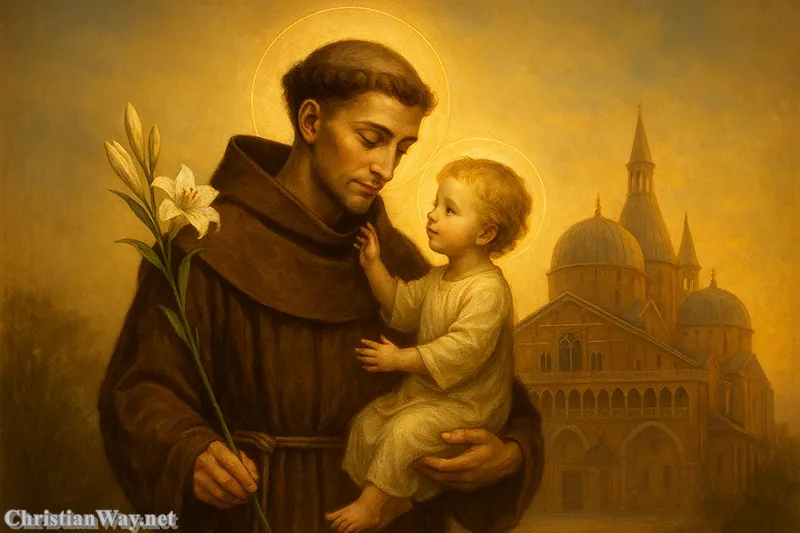
Saint Anthony is often portrayed holding the Child Jesus. This image has become one of the most beloved ways Christians remember him. It draws our hearts toward the mystery of the Incarnation: the eternal Son of God became small for our sake.
There is something astonishing in this truth. The God who created the stars chose to enter our world as a child. The One who holds all things in being allowed Himself to be held in the arms of Mary. The Lord of heaven came close enough to be seen, touched, loved, and rejected.
The Child Jesus reveals the humility of God. He does not force His way into the human heart. He comes gently. He waits for our welcome. He asks for our love.
Saint Anthony understood this tenderness. To contemplate Christ as a child is to remember that God is not only mighty; He is near. He is not only holy; He is compassionate. He is not only the Judge of the world; He is the Savior who enters our weakness.
Many people carry fear before God. They imagine that He is always disappointed, always distant, always waiting to punish. But Jesus shows us the face of the Father. He welcomes the weary. He forgives the repentant. He seeks the lost. He carries the wounded.
When you look at the Child Jesus in the arms of Saint Anthony, remember this: God has come close to you. He knows the fragility of your life. He knows your fears. He knows your needs before you can even name them.
A Saint for the Restless and Distracted Heart
Saint Anthony speaks powerfully to people today because he knew that the soul needs silence. Our lives are often filled with activity but empty of prayer. We can be constantly connected to others and still feel deeply alone. We may have access to more information than any previous generation, yet struggle to know what is true, good, and worth living for.
The answer is not to reject the world in fear. The answer is to give the heart a deeper center. We need places of silence. We need moments when the noise is turned off. We need to remember that God is not found only in great events but also in the quiet whisper of grace.
Saint Anthony teaches us to make room for God. This may mean praying before sleep instead of ending the day in endless distraction. It may mean sitting quietly in a church. It may mean speaking honestly to God while walking alone. It may mean reading one Psalm slowly and allowing it to become the prayer of the heart.
“Be still, and know that I am God” (Psalm 46:10). These words are difficult for restless people, but they are full of healing. In stillness, we begin to hear what the world cannot tell us: that we are loved, that God is near, and that our lives are held in His hands.
Saint Anthony’s life reminds us that the soul does not need to be loud to be strong. A person rooted in prayer can bring peace into a noisy room. A person shaped by the Gospel can speak truth without cruelty. A person who knows the tenderness of God can become tender toward others.
The Lasting Voice of Saint Anthony
Saint Anthony died in Padua in 1231 while still a young man. Yet his voice has not been silenced. His sermons continue to speak. His example continues to encourage. His name continues to be spoken by people who seek help, healing, guidance, and hope. He was later recognized as a Doctor of the Church, known especially as the “Evangelical Doctor,” because of the richness of his biblical teaching and his love for the Gospel.
His life tells us that the most powerful preaching is not merely spoken from a pulpit. It is lived. Every act of mercy preaches. Every quiet forgiveness preaches. Every honest prayer preaches. Every sacrifice offered in love preaches. Every person who remains faithful in suffering becomes a living witness to the Gospel.
You may feel that your life is small. You may wonder whether your prayer matters. You may think that your service goes unnoticed. But the saints remind us that nothing offered to Christ in love is ever wasted.
A kind word may save someone from despair. A prayer may strengthen a person you will never meet. A small act of generosity may become a doorway through which another person recognizes the goodness of God. A faithful life, even hidden from the world, can become a light for many souls.
Saint Anthony did not seek to become famous. He sought Christ. And because he sought Christ, his life became a gift to the world.
Reflect and Pray
Dear friends, Saint Anthony of Padua invites us to bring every loss, every worry, every hidden wound, and every unanswered question into the presence of Christ. He reminds us that God is not indifferent to the things that trouble us. The Lord knows what we have lost. He knows where our hearts are broken. He knows the path home, even when we cannot see it clearly.
Perhaps there is something you need to place before God today. Perhaps you have lost peace. Perhaps you have lost trust. Perhaps you are praying for someone who has wandered away from faith. Perhaps you are carrying a burden that feels too heavy to explain.
Do not be afraid to pray simply. Ask Saint Anthony to intercede for you. Then place your need in the hands of Jesus. The Lord may answer in ways you do not expect. He may not always change the circumstances immediately, but He will never refuse a heart that comes to Him with humility and trust.
May Saint Anthony of Padua pray for us, that we may become people of the Gospel: humble in spirit, faithful in prayer, tender toward the poor, courageous in truth, and confident in the mercy of Christ.
Lord Jesus Christ, You came to seek and save what was lost. Through the intercession of Saint Anthony of Padua, draw near to every weary heart. Help us to find again what sin, fear, sorrow, or distraction has taken from us. Give us the grace to love Your Word, serve the poor, forgive freely, and rest in the tenderness of Your mercy. Amen.
— Fr. John Matthew