Dear friends in Christ,
Many believers have quietly wondered whether Mary’s intercession is more powerful than the intercession of other saints. The question often comes from a sincere place. Perhaps someone has heard Christians ask Mary for help in moments of fear, illness, family sorrow, or spiritual struggle. Perhaps someone has seen a rosary held in the hands of a grieving mother, a weary father, or an elderly person whose faith has carried them through many storms. Perhaps the question comes from love for Jesus Himself: if Christ alone saves us, what place can Mary or any saint truly have in our prayers?
The answer must begin with Christ. Jesus Christ is the one Savior of the world. He alone is the eternal Son of God made flesh. He alone died for our sins. He alone conquered death through His Resurrection. He alone is the source of grace, mercy, forgiveness, and eternal life. No saint, not even Mary, ever stands beside Christ as though sharing His divine authority or replacing His saving work. Every prayer is heard because of the love of God revealed in Jesus Christ.
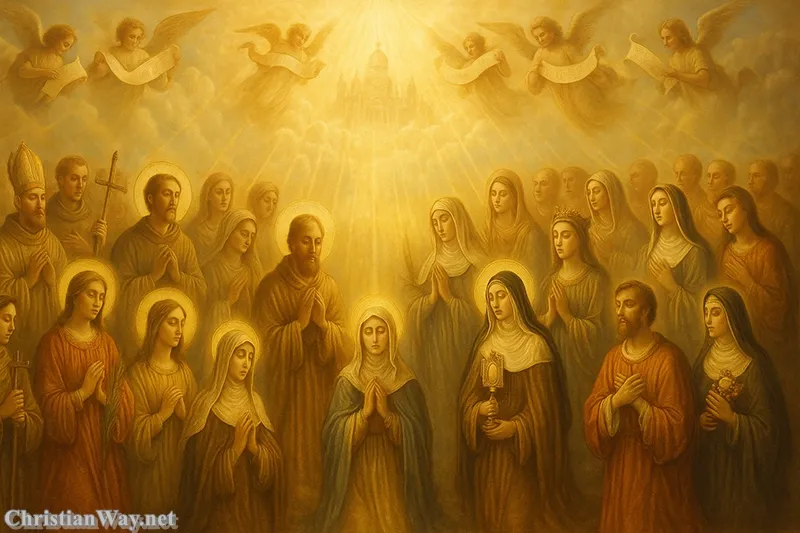
Yet Christians have always believed that the family of God is larger than what we can see. We do not walk toward heaven alone. We are surrounded by the communion of saints: believers who have finished their earthly journey and now live in the presence of God. Just as we may ask a friend, a parent, a pastor, or a fellow Christian to pray for us, many Catholic and Orthodox Christians ask the saints in heaven to pray for them as well. In this holy communion, Mary holds a unique and beloved place because she is the mother of Jesus, the one chosen by God to receive the Word made flesh into her womb.
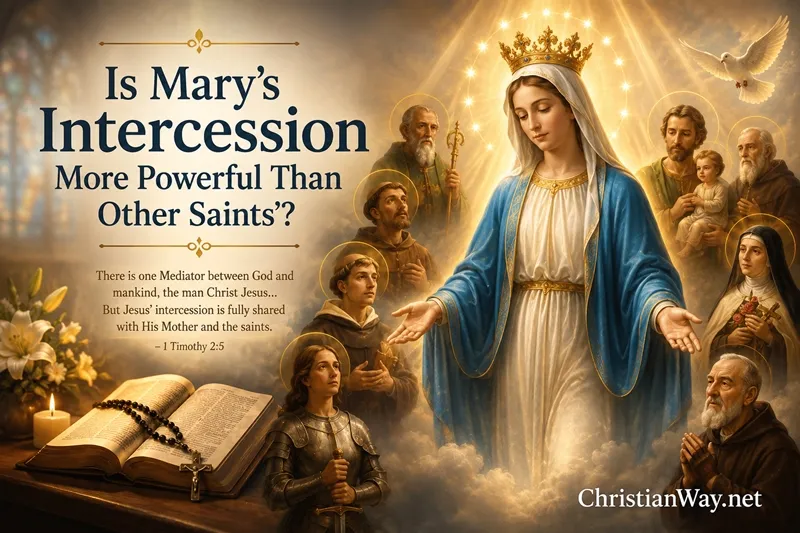
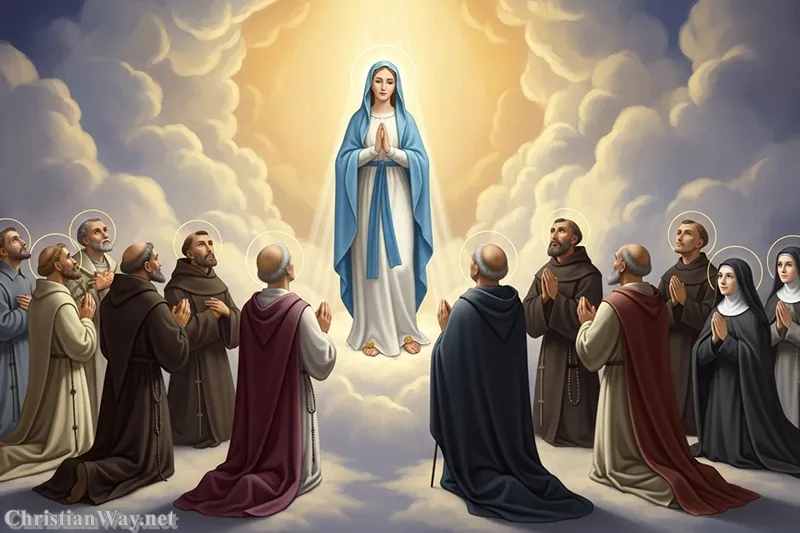
So, is Mary’s intercession more powerful than that of other saints? The question needs a gentle answer. Mary is not more powerful than Christ, for no creature can ever possess the power that belongs to God alone. But because of her unique closeness to Jesus, her faithful “yes” to God, and her maternal place in the story of salvation, Catholic and Orthodox Christians have long honored her as the foremost among the saints and have trusted her prayers with particular tenderness. Her intercession is not separate from Christ. It leads to Christ. It depends entirely on Christ. It is like the loving prayer of a mother who always brings her children to her Son.
This is not a competition among heaven’s holy ones. The saints do not seek to be greater than one another. They are not jealous, divided, or eager for attention. They rejoice in the glory of God and in the salvation of souls. Mary herself would never wish to draw a heart away from Jesus. Her whole life points toward Him. Her first words in the Gospel reveal a humble heart ready to serve God, and her last recorded words in Scripture are spoken at the wedding in Cana: “Whatsoever he saith unto you, do it” (John 2:5).
That is the deepest truth about Mary. She does not say, “Look at me.” She says, “Do whatever He tells you.”
Prayer Is Never Meant to Be a Lonely Journey
Human beings are made for communion. From the beginning, God did not create us to live as isolated souls carrying every burden alone. We need one another. We need the prayers of one another. We need encouragement when faith becomes difficult, wisdom when decisions are unclear, forgiveness when relationships are wounded, and hope when sorrow seems too heavy to bear.
The New Testament repeatedly shows Christians praying for one another. Saint Paul often asks the churches to remember him in prayer. He tells believers to carry one another’s burdens. Saint James writes, “Pray one for another, that ye may be healed” (James 5:16). There is something deeply beautiful in this simple command. When we ask another person to pray for us, we are admitting that we need help. We are allowing love to enter the places where pride might otherwise keep us alone.
No Christian would normally think that asking a friend to pray takes away from Jesus. In fact, it honors Jesus, because it trusts that He is present in the prayer of His people. When a mother prays for her child, when a husband prays for his wife, when a parish prays for someone who is sick, Christ is not pushed aside. Christ is the one who joins those prayers together and receives them in love.
This is the heart of the communion of saints. Christians who ask for the prayers of Mary or other saints do not believe that the saints are independent sources of grace. They believe that the saints are alive in Christ and that their prayers, like the prayers of all God’s faithful people, are offered through the love and mercy of the Lord.
The Book of Revelation gives us a glimpse of heaven as a place of worship and intercession. It speaks of the elders holding “golden vials full of odours, which are the prayers of saints” (Revelation 5:8). The image is gentle and mysterious. The prayers of God’s people are not lost. They rise before Him. They are precious in His sight.
For many Christians, asking Mary or a saint to pray is therefore not a departure from Christ. It is a way of saying: “I believe the love of Christ is stronger than death. I believe those who have gone before us in faith are not erased. I believe the Church is still one family, on earth and in heaven.”
Mary’s Unique Place in the Story of Salvation
Mary is honored above all other saints not because she is divine, but because of the unique place God gave her in the life of Jesus Christ. The Gospel does not introduce her as a distant or accidental figure. It introduces her at the moment when the eternal Son of God enters the world.
When the angel Gabriel comes to Mary, he greets her with words filled with grace: “Hail, thou that art highly favoured, the Lord is with thee” (Luke 1:28). Mary is troubled, not proud. She does not respond with self-importance or demand special honor. Instead, she listens. She asks how God’s promise will unfold. Then she gives the answer that changes history: “Behold the handmaid of the Lord; be it unto me according to thy word” (Luke 1:38).
In that humble “yes,” Mary receives Jesus into her life. She does not save the world by her own power. She does not create grace. She receives grace. She says yes to the God who saves.
This is why Christians call her blessed.
Elizabeth, filled with the Holy Spirit, cries out when Mary visits her: “Blessed art thou among women, and blessed is the fruit of thy womb” (Luke 1:42). Mary’s own response is not self-praise. She sings of God’s greatness: “My soul doth magnify the Lord, and my spirit hath rejoiced in God my Saviour” (Luke 1:46–47).
These words are essential. Mary calls God her Savior. She is not outside the need for redemption. She is not another redeemer beside Jesus. She is a redeemed creature, saved by God’s grace, loved by God, and chosen by God for a singular vocation: to be the mother of the incarnate Son.
For Catholics, Orthodox Christians, and many other Christians who honor Mary deeply, her motherhood is not merely biological. It is bound to the mystery of who Jesus is. She is called Theotokos, a Greek word meaning “God-bearer” or “Mother of God,” not because she existed before God or created the divine nature of Christ, but because the child born of her is truly God made flesh.
The One whom Mary held in her arms is the One through whom all things were made.
The One whose first cries she heard is the eternal Word of the Father.
The One she fed, protected, and raised is the Savior of the world.
This mystery does not make Mary less human. It makes her humanity shine with the beauty of grace. She shows us what a human life can become when it is open to God.
Christ Alone Is the Source of Every Grace
Whenever Christians speak about Mary’s intercession, they must speak clearly about Jesus. There is only one Savior. There is only one Lord. There is only one sacrifice that takes away the sins of the world.
Saint Paul writes, “For there is one God, and one mediator between God and men, the man Christ Jesus” (1 Timothy 2:5). These words are sacred and true. Jesus alone reconciles humanity with the Father because Jesus alone is both truly God and truly man. He alone stands at the center of salvation. He alone gave Himself upon the Cross. He alone rose from the dead in victory.
No prayer to Mary should ever weaken this truth.
No devotion to Mary should ever replace worship of Christ.
No love for Mary should ever become greater than love for Jesus.
Mary herself would be the first to turn our eyes back toward her Son.
There is a great difference between worship and veneration. Christians worship God alone: Father, Son, and Holy Spirit. Worship belongs to God because God alone is eternal, uncreated, all-powerful, and worthy of our complete surrender. Mary is not worshiped as God. The saints are not worshiped as gods. They are honored as faithful witnesses to God’s grace.
A person may honor a saint in the way one honors a beloved spiritual mother, father, teacher, or elder in the faith. Yet the adoration of the heart belongs only to the Lord.
This distinction matters because words can sometimes confuse people. A Catholic may say, “Pray to Mary,” meaning, “Ask Mary to pray for me.” But someone from another Christian tradition may hear those words and worry that Mary is being treated as though she were equal to Christ. Such concerns should be met with patience, not argument. Christians should explain their faith with humility and should never speak about Mary in a way that obscures the unique glory of Jesus.
Mary is not a shortcut around Christ.
She is not a way to avoid repentance.
She is not a heavenly power whom we must persuade because Jesus is too distant or too severe.
Jesus is not reluctant to hear us. He is full of mercy. He welcomes sinners. He invites the weary. He says, “Come unto me, all ye that labour and are heavy laden, and I will give you rest” (Matthew 11:28).
Mary’s maternal prayer, as Christians have understood it, does not compete with this invitation. It rests inside it.
The Wedding at Cana and the Heart of Mary’s Intercession
The Gospel story of the wedding at Cana has become especially precious for Christians who ask Mary to intercede. It is a quiet scene, almost domestic in its tenderness. A wedding is taking place. Families and friends have gathered. There is joy, food, conversation, music, and celebration. Then a problem arises: the wine has run out.
Mary notices.
She sees a need that others may not yet understand. She does not shame anyone. She does not make a public scene. She simply turns toward Jesus and says, “They have no wine” (John 2:3).
These few words reveal something beautiful about intercession. Mary does not command Jesus. She does not claim authority over Him. She does not demand a miracle. She places the need before Him.
Then she turns to the servants and says, “Whatsoever he saith unto you, do it” (John 2:5).
This is the heart of Marian devotion at its best. Mary sees the need. Mary brings the need to Jesus. Mary tells us to obey Jesus.
The miracle at Cana is performed by Christ alone. He is the one who transforms water into wine. He is the one whose glory is revealed. He is the one in whom the disciples begin to believe. Yet Mary’s presence in the story is full of maternal tenderness. She notices the embarrassment of a family. She carries their need quietly to her Son. She directs the servants to Him.
Many believers have found comfort in this image. When they do not know how to pray, they simply say, “Mary, bring this need to Jesus.” When a child is sick, when a marriage is strained, when a loved one has wandered from faith, when fear keeps the heart awake at night, they entrust these burdens to the one who first said, “They have no wine.”
But Mary never becomes the answer instead of Christ. At Cana, she does not become the giver of the wine. She points to the One who can transform what is empty.
This is why her intercession is often called maternal. A mother sees. A mother cares. A mother carries concerns that others may overlook. Yet a faithful mother does not keep her children for herself. She brings them toward what is good, true, and life-giving.
Mary brings us to Jesus.
Is Mary “More Powerful” Than Other Saints?
The language of “more powerful” can be difficult because it may sound as though the saints are competing for influence in heaven. But heaven is not like an earthly court where some people must fight for the attention of a ruler. God is not limited. His mercy is not scarce. His love is not divided among those who come to Him.
God hears every prayer.
God knows every wounded heart.
God is near to every person who calls upon Him.
When Catholics and Orthodox Christians speak of Mary’s intercession as especially powerful, they usually do not mean that Mary has a separate power apart from God. They mean that her closeness to Jesus is unique because she is His mother and His first disciple. She stood with Him from the beginning of His earthly life. She carried Him in her womb. She watched Him grow. She followed Him in His ministry. She stood beneath the Cross when many others had fled. She prayed with the disciples after His Ascension.
Mary’s life was completely shaped by Christ.
For this reason, many Christians speak of her as the “first among the saints,” the “Queen of Saints,” or the “foremost intercessor.” These titles are not meant to make her a goddess. They are meant to honor the grace of God at work in her and the unique role she has in salvation history.
It may be helpful to think of a family gathered around a beloved father. Every child is loved. Every child may speak freely. Every child may bring a need. Yet there may be a special tenderness in the voice of a mother who knows the family deeply, carries every sorrow, and draws everyone closer together. This does not make the mother greater than the father. It simply recognizes the beauty of her unique place within the family.
Mary’s intercession is like this. It is maternal, close, tender, and completely dependent upon the love of Christ.
Still, Christians should be careful not to turn this into a mathematical comparison. We cannot measure prayers in heaven as though one saint receives a certain number of favors and another receives fewer. God is not a machine. Prayer is not a transaction. Grace is not a reward earned by choosing the “right” heavenly person.
The saints are not rivals.
Saint Joseph does not compete with Mary.
Saint Peter does not compete with Saint Paul.
Saint Thérèse of Lisieux does not compete with Saint Francis of Assisi.
The saints do not compete with one another because all holiness comes from the same source: the love of God.
They rejoice when we come closer to Christ. They rejoice when we repent. They rejoice when we forgive. They rejoice when a broken family finds healing, when a lonely person finds hope, and when a sinner returns home.
The Saints Are Signs of God’s Many-Sided Grace
The communion of saints is one of the great consolations of Christian life. It reminds us that holiness does not have only one face.
Saint Francis teaches us joyful simplicity and love for the poor.
Saint Augustine teaches us that a restless heart can find its rest in God.
Saint Monica teaches us the perseverance of a mother who prays for her child.
Saint Joseph teaches quiet faithfulness and protection.
Saint Thérèse teaches that small acts of love can become a path to great holiness.
Saint Paul teaches that grace can transform even a life marked by violence, pride, and regret.
Saint Peter teaches that failure does not have to be the end of the story.
Mary holds a unique place among them all, but she does not diminish them. Her greatness does not make the other saints less beautiful. Rather, she helps us see the fullness of God’s grace in the whole family of faith.
In the same way, asking Mary to pray for us does not mean we should ignore other saints. A person may feel drawn to a saint whose life resembles their own struggle. Someone who is grieving may be comforted by Saint Monica. Someone who has failed deeply may find hope in Saint Peter. Someone facing illness may turn to Saint Raphael or Saint Peregrine. Someone who longs for courage may seek the prayers of Saint Joan of Arc, Saint Maximilian Kolbe, or Saint Óscar Romero.
The saints do not replace our relationship with Jesus. They help us see what a life surrendered to Jesus can become.
They are windows, not the sun.
They are witnesses, not the Savior.
They are brothers and sisters, not gods.
And Mary, more than any other saint, is the one who teaches us to receive Christ with humility, trust, and love.
Mary Beneath the Cross
Mary’s unique place in Christian devotion becomes even clearer at Calvary. The Gospels tell us that Mary stood near the Cross of Jesus. She did not run away from suffering. She did not understand every mystery unfolding before her. Yet she remained.
There are forms of love that do not solve pain but refuse to abandon the person who suffers. Mary’s presence beneath the Cross is this kind of love. She cannot take the Cross away from Jesus. She cannot save Him from the suffering He has chosen to bear for the salvation of the world. But she remains close.
In the Gospel of John, Jesus looks upon His mother and the beloved disciple. He says to Mary, “Woman, behold thy son.” Then He says to the disciple, “Behold thy mother” (John 19:26–27).
Christians have reflected deeply on these words. At the most immediate level, Jesus is caring for His mother and entrusting her to the beloved disciple. Yet many believers have also seen a wider spiritual meaning: Mary is given as a motherly presence to the disciples of Christ.
This does not mean that Mary replaces God as Father. It does not mean that Mary stands between us and Jesus as though He were inaccessible. It means that Jesus, even from the Cross, gives His people a sign of tender maternal care.
For Catholics and Orthodox Christians, this is one reason Mary is often called a spiritual mother. She is not merely a figure from the past. She is remembered as one who prays for the Church, carries the needs of God’s children before Christ, and teaches believers how to remain close to Him in suffering.
At the Cross, Mary does not offer easy explanations.
She does not say that pain is not painful.
She does not promise that every sorrow will immediately disappear.
She stands.
There are times when this is the greatest form of love. When someone is grieving, we cannot always fix the wound. When someone is ill, we cannot always take away their suffering. When a parent watches a child struggle, when a spouse walks through fear, when a friend faces loss, love sometimes means remaining near.
Mary teaches us this faithfulness.
Mary and Christians Who Do Not Ask Saints for Intercession
Not every Christian tradition asks Mary or the saints to pray. Many Protestant Christians deeply honor Mary as the mother of Jesus, blessed among women, and a model of faith, while believing that prayer should be addressed directly to God through Jesus Christ alone. This conviction often comes from a sincere desire to protect the unique mediation and saving work of Christ.
Catholics and Orthodox Christians should receive that concern with respect. The desire to keep Jesus at the center is good and holy. No Christian should ever treat Mary as though she were equal to Christ, independent of Christ, or necessary in the same way Christ is necessary.
At the same time, Catholic and Orthodox Christians would explain that asking Mary or a saint to pray is not meant to deny direct prayer to Jesus. They pray directly to Christ every day. They worship Christ. They receive forgiveness from Christ. They trust salvation in Christ. They ask Mary and the saints to pray in the same way they might ask fellow believers on earth to pray.
There is room here for humility.
Christians should not mock one another over this question.
Those who ask Mary’s intercession should not speak as though other Christians do not love Jesus.
Those who do not ask Mary’s intercession should not assume that every Catholic or Orthodox Christian worships Mary.
The mother of Jesus should never become a reason for bitterness among the children of Christ.
Mary herself would grieve at that. Her whole life is marked by obedience, humility, and peace. She does not gather disciples around herself. She gathers them around Jesus.
The deepest unity Christians share is not found in winning every argument. It is found in confessing Jesus Christ as Lord, receiving His mercy, and seeking to live according to His love.
How Mary’s Intercession Can Shape Daily Life
For those who feel called to ask Mary’s intercession, the prayer can be simple. It does not need to be complicated or filled with perfect words. A person may simply say:
“Mary, mother of Jesus, pray for me that I may trust your Son.”
Or:
“Holy Mary, bring this burden to Jesus.”
Or:
“Mother of the Lord, teach me to say yes to God.”
These prayers are not magic. They are not a way to control God. They are acts of trust. They place the heart into the care of Christ through the loving example of His mother.
Mary can also teach us how to pray even when we do not use formal Marian prayers. Her life gives us a pattern for discipleship.
Like Mary, we can listen before we speak.
Like Mary, we can bring our confusion honestly to God.
Like Mary, we can say yes when God asks something difficult of us.
Like Mary, we can carry Christ into the ordinary places of life.
Like Mary, we can stand near those who suffer.
Like Mary, we can point others toward Jesus.
The world often tells us that strength means control, independence, noise, and self-assertion. Mary shows another kind of strength. Her strength is not weakness. It is the courage to trust God when the road is unclear.
She receives an angelic message that changes her entire future.
She travels while carrying the Son of God.
She gives birth in poverty.
She flees with Joseph and Jesus into Egypt.
She watches her Son misunderstood.
She stands beneath the Cross.
She waits in prayer with the disciples.
Through all of this, she remains faithful.
Her intercession is precious because her life is precious. She knows what it is to trust without having every answer. She knows what it is to carry sorrow and hope together. She knows what it is to love Jesus completely.
When We Must Keep Our Eyes on Jesus
There is a final and important reminder. Devotion to Mary is healthy only when it brings us closer to Jesus.
If a person prays to Mary but neglects the Gospel, something has gone wrong.
If a person speaks constantly about Mary but does not forgive others, something has gone wrong.
If a person wears religious symbols but refuses to repent, something has gone wrong.
If a person treats Marian devotion as a charm for good luck rather than a call to discipleship, something has gone wrong.
Mary does not lead us away from the Cross, the Eucharist, Scripture, repentance, mercy, or prayer to Christ. She leads us toward them.
At Cana, her message remains the same: “Whatsoever he saith unto you, do it.”
This is the test of every devotion. Does it make us more obedient to Jesus? Does it make us more humble? Does it make us more merciful? Does it make us more willing to serve the poor, forgive those who hurt us, pray for our enemies, and carry our cross with faith?
If it does, then it is leading us in the right direction.
Mary’s greatest glory is not that people speak of her. Her greatest glory is that Jesus Christ came into the world through her willing faith.
Her greatest desire is not that people stop at her name. Her greatest desire is that every heart comes to know her Son.
Reflect and Pray
Dear friends, Mary’s intercession is not more powerful than Christ, because Christ alone is Lord and Savior. Yet among the saints, Mary holds a unique place because she is the mother of Jesus, the first disciple, the woman of faith who stood near the Cross and prayed with the Church.
Catholic and Orthodox Christians honor her as the foremost among the saints and entrust themselves to her maternal prayers. Other Christians may honor her differently, while still joining in the same confession that Jesus Christ alone saves.
The question is not whether Mary draws attention away from Christ. The deeper question is whether we allow her example to lead us closer to Him.
Mary’s life answers gently: trust God, receive Christ, remain faithful, and do whatever He tells you.
Let us pray:
Lord Jesus Christ,
You are the one Savior of the world,
the source of every grace,
the mercy that heals every wounded heart.
Thank You for giving us Mary, Your mother,
as a model of humble faith and faithful love.
Teach us to listen as she listened,
to trust as she trusted,
and to remain near You in every season of life.
May the prayers of Mary and all the saints
lead us always toward You,
that we may love You more deeply,
serve You more faithfully,
and rest forever in Your peace. Amen.
May the gentle faith of Mary lead your heart ever nearer to Jesus Christ, who hears every prayer and never turns away the soul that comes to Him.
— Fr. John Matthew