Welcome to Christian Way. In the long and storied history of the Papacy, few men have ascended the Throne of Peter with such a unique combination of intellectual brilliance and rugged tenacity as Achille Ratti, who became Pope Pius XI. He was not merely a shepherd; he was a mountaineer who had scaled the Alps, a librarian who had guarded the treasures of history, and a diplomat who stared down the 20th century’s most terrifying dictators. While he has not been raised to the altars of canonization like his successor Pius XII or his predecessor St. Pius X, his holiness was forged in the fire of moral courage. He stands as the “Doctor of the Social Reign of Christ,” the man who established the Feast of Christ the King as a defiant banner against the secular tyrannies of his age.
Profile of Holiness
| Attribute | Detail |
|---|---|
| Birth Name | Ambrogio Damiano Achille Ratti |
| Lifespan | May 31, 1857 – February 10, 1939 |
| Birthplace | Desio, Lombardy (Kingdom of Lombardy-Venetia) |
| Service Period | 1922 – 1939 (Pontificate) |
| Feast Day | N/A (Historical Pontiff) |
| Patronage | N/A (Often associated with Catholic Action, Librarians, and Alpinists) |
| Key Virtue | Fortitude (Courage in the face of Totalitarianism) |
The Cradle of Grace: Historical Context & Early Life
Achille Ratti was born on May 31, 1857, in Desio, a small town near Milan, into a world that was rapidly fracturing. The Italian peninsula was in the throes of the Risorgimento, the violent political unification that would eventually strip the Papacy of its earthly territories. He was the son of a silk factory manager, born into the industrious and pious middle class of Lombardy. This background instilled in him a distinctly Milanese temperament: practical, hardworking, and deeply intellectual.
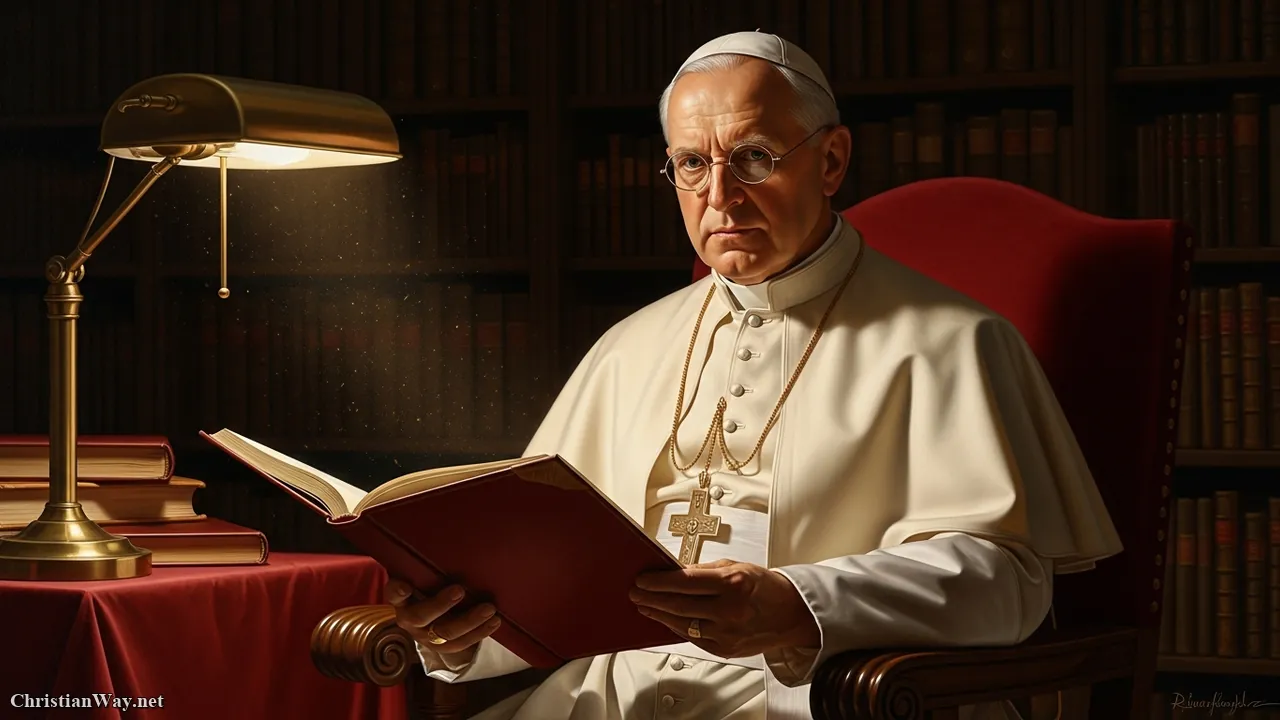
From his earliest days, Ratti displayed a dual vocation: a hunger for God and a hunger for knowledge. He entered the minor seminary at age ten, and his brilliance was immediately apparent. He was not, however, a cloistered recluse. Young Achille was a man of the outdoors, a passionate mountaineer who scaled the peaks of the Alps, including Monte Rosa and the Matterhorn. This was not a frivolous hobby; it was a spiritual discipline. In the silence of the high peaks, facing the sheer rock and the thin air, Ratti learned the endurance and steady nerve that would define his papacy. He famously remarked that mountaineering was a school of character, teaching “contempt for danger” and “endurance of fatigue”—virtues he would later need when facing the political avalanches of Europe.
Ordained a priest in 1879, his path did not initially lead to the parish, but to the library. For over thirty years, he served at the Ambrosian Library in Milan and later the Vatican Library. He was a “bookworm” in the most heroic sense, preserving the memory of the Church against the ravages of time. He lived among manuscripts and dust, a quiet scholar whose life seemed destined for academic obscurity. Yet, God often prepares His greatest warriors in the desert—or in this case, the stacks.
The Turning Point: Vocation and Conversion
The turning point of Ratti’s life came late, at the age of 60, when most men are looking toward retirement. In 1918, Pope Benedict XV pulled the scholar from his library and sent him into the chaos of World War I’s aftermath. He was appointed Apostolic Visitor (and later Nuncio) to Poland, a nation just reborn and fighting for its life.

This was Ratti’s “Damascus Road” from theory to practice. In Warsaw, he did not find dusty scrolls; he found the Red Army. During the Polish-Soviet War of 1920, as the Bolshevik forces bore down on Warsaw, the entire diplomatic corps fled—except for one man. Achille Ratti refused to leave. He stayed in the capital, praying with the people and demonstrating a physical courage that stunned the Polish leadership. He saw firsthand the face of Communism: the atheism, the violence, and the systematic attempt to erase God from society. This experience seared a deep anti-totalitarian resolve into his soul.
His rise from there was meteoric. In 1921, he was made Archbishop of Milan and a Cardinal. Less than a year later, on February 6, 1922, following the sudden death of Benedict XV, the scholar-diplomat emerged from the conclave as Pope Pius XI. He took the motto “Pax Christi in Regno Christi” (“The Peace of Christ in the Kingdom of Christ”). It was not a pious platitude; it was a battle cry.
The Great Labor: Ministry and Mission
Pius XI inherited a Church under siege. The old monarchies were gone, replaced by the terrifying new ideologies of Fascism in Italy, Nazism in Germany, and Communism in Russia. His pontificate was a ceaseless labor to secure the Church’s liberty in a closing world.
His most tangible historical achievement was the resolution of the “Roman Question.” Since 1870, the Popes had been “prisoners of the Vatican,” refusing to recognize the Italian state that had seized the Papal States. In 1929, displaying his pragmatic Milanese negotiation skills, Pius XI signed the Lateran Treaty with Benito Mussolini. This treaty established the Vatican City State as a sovereign nation, ensuring the Pope’s independence from any earthly power. While controversial for dealing with a dictator, Pius XI saw it as a necessary firewall to protect the spiritual governance of the Church.
But his labor was not just diplomatic; it was missionary. Pius XI is often called the “Pope of Missions.” He aggressively moved to de-colonize the Church, demanding that missionary orders train native clergy and consecrating the first Chinese and Japanese bishops personally. He understood that the Church must not be seen as “European” but as truly universal. “The Church has no country,” he famously declared, “except the Kingdom of Heaven.”
He also embraced the modern world to evangelize it. He established Vatican Radio, commissioning Guglielmo Marconi to build the station, becoming the first Pope to broadcast his voice to the world. He refounded the Pontifical Academy of Sciences, demonstrating that faith has nothing to fear from reason. He was a modernizer, but one who used modernity to defend ancient truths.
The Teacher of Souls: Theological & Spiritual Legacy
If Pius XI was a diplomat by necessity, he was a teacher by nature. His encyclicals were hefty, intellectual, and uncompromising. He did not traffic in ambiguity.
His theological masterstroke was the institution of the Feast of Christ the King in 1925 with the encyclical Quas Primas. In an era where dictators demanded absolute loyalty, Pius XI reminded the world that there is only one true Sovereign. He wrote:
“When once men recognize, both in private and in public life, that Christ is King, society will at last receive the great blessings of real liberty, well-ordered discipline, peace and harmony.”
This was a direct challenge to the secular state that sought to privatize religion.
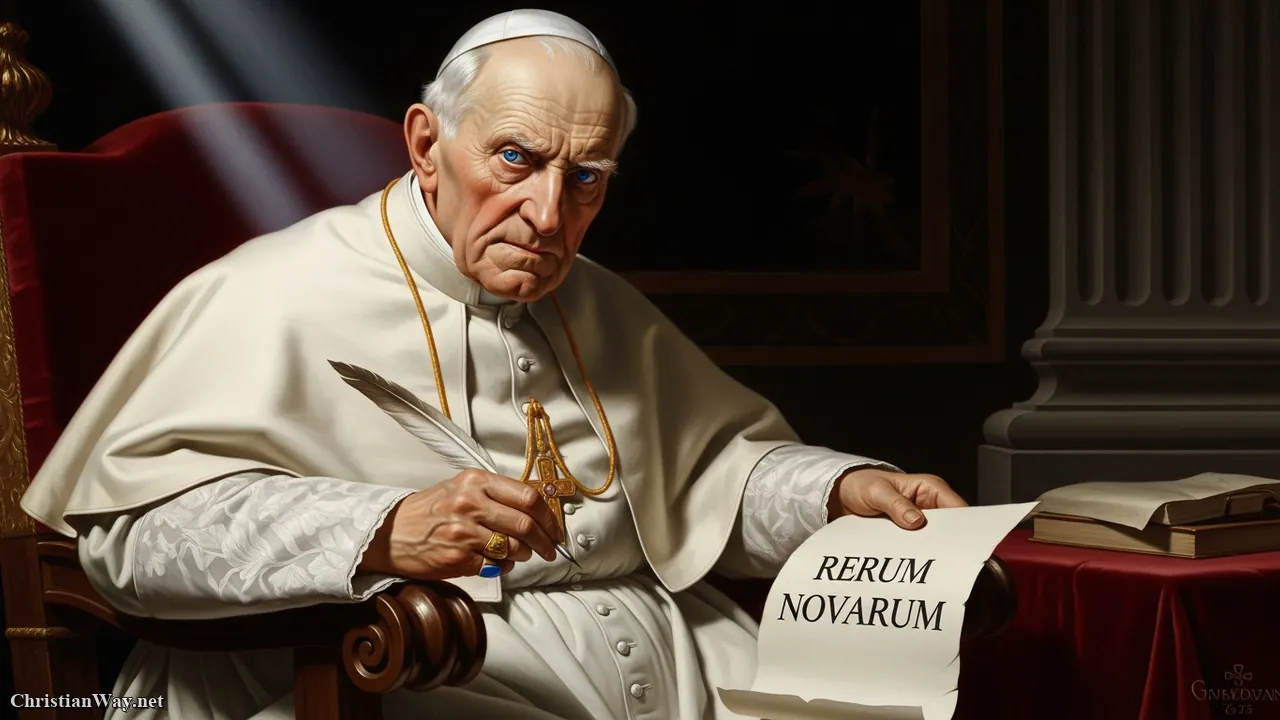
In 1931, forty years after Leo XIII’s Rerum Novarum, Pius XI issued Quadragesimo Anno (“In the Fortieth Year”). This document remains a pillar of Catholic Social Teaching. It introduced the principle of subsidiarity—the idea that social issues should be handled at the most local level possible, rather than by a centralized state. It was a scathing critique of both unbridled capitalism (“the international imperialism of money”) and socialism, offering a third way based on justice and charity.
Perhaps his most courageous teaching came in his defense of the family. In Casti Connubii (1930), he reaffirmed the sanctity of marriage and issued a prophetic warning against the rising tide of eugenics and contraception, defending the dignity of every human life against the state’s desire to engineer a “perfect” race.
The Via Dolorosa: Suffering, Death, and Sainthood
The final years of Pius XI were his Via Dolorosa. As the 1930s progressed, he watched with horror as the treaties he had signed were violated. In Germany, Adolf Hitler was dismantling the Church; in Italy, Mussolini was embracing anti-Semitic racial laws. The old mountaineer prepared for one last climb.
In 1937, he did something unprecedented. He smuggled an encyclical into Nazi Germany, titled Mit Brennender Sorge (“With Burning Anxiety”). Written in German rather than Latin, it was read from every Catholic pulpit on Palm Sunday, blindsiding the Nazi regime. In it, Pius XI decimated the Nazi ideology of race and blood:
“Whoever exalts race, or the people, or the State… above their standard value and divinizes them to an idolatrous level, distorts and perverts an order of the world planned and created by God.”
It was a roar of the lion.
Simultaneously, he issued Divini Redemptoris, condemning atheistic Communism as “intrinsically perverse.” He was fighting a two-front war. His health began to fail; he suffered from asthma and heart trouble, struggling to breathe as the “winds of war” gathered.
In early February 1939, Pius XI had prepared a speech for the tenth anniversary of the Lateran Treaty. Historians now know this speech was intended to be a final, blistering condemnation of Fascism and its racial laws. He prayed desperately to live long enough to deliver it. “I have so many things to say,” he whispered to his doctors. But on February 10, 1939, his heart gave out. He died working, a soldier at his post.
While his cause for canonization was introduced and he is recognized as a servant of the Church, the process stalled, perhaps overshadowed by the complex legacy of the war years and his successor. Yet, to the student of history, his holiness is evident in his refusal to bend the knee to the Caesars of his day.
Spiritual Highlights: Lessons for the Modern Christian
What can the life of this scholar-pope teach us today?
- The Courage of Intellect: Faith is not just a feeling; it requires study. Pius XI teaches us that we must love God with our minds, equipping ourselves to answer the errors of our age.
- The Kingship of Christ: We cannot leave our faith in the church building. Christ claims authority over our politics, our economics, and our public lives. We must live as citizens of His Kingdom first.
- Subsidiarity in Action: In a world of big government and big tech, we are called to build community at the local level—in our families, parishes, and neighborhoods.
- Resilience: Like the alpinist he was, we must endure the fatigue of the spiritual climb. When the air gets thin and the path steep, we do not turn back; we keep our eyes on the summit.
A Prayer for Intercession
(Though not a canonized saint, we may pray for his cause and ask God to grant us his spirit of fortitude.)
Almighty and Everlasting God, who in Your Providence chose Your servant Pius XI to steer the barque of Peter through the storms of war and tyranny; grant us, we beseech You, that same spirit of fortitude and wisdom. May we, like him, be unafraid to proclaim the Kingship of Your Son in the face of all worldly powers. Teach us to love Your Truth, to defend the weak, and to seek the peace of Christ in the Kingdom of Christ. We ask this through the same Christ our Lord. Amen.
— Fr. John Matthew, for Christian Way