Dear friends in Christ,
There are moments when the word death seems too heavy to carry. It may come through the loss of someone we love, through a frightening diagnosis, through the end of a relationship, through a dream that has quietly fallen apart, or through the inward exhaustion of a heart that no longer knows where to find hope. Death does not only stand at the end of earthly life. It sometimes appears in the middle of our days: in grief, disappointment, betrayal, loneliness, fear, and the sense that something precious has been taken from us.
The Christian faith does not ask us to pretend that death is not painful. It does not tell grieving people to smile too quickly or speak only bright words while their hearts are breaking. Jesus Himself stood at the tomb of Lazarus and wept. He knew sorrow. He knew the ache of loss. He knew what it meant to love someone and stand before the mystery of death.
Yet the Gospel gives us a hope greater than denial. It tells us that death, though real, does not have the final word.
The Resurrection of Jesus Christ stands at the center of Christian faith because it proclaims that God has entered the darkest place of human existence and brought forth life. The tomb was not the end of Christ’s story. Good Friday was not the last chapter. The stone was rolled away, the grave was empty, and the risen Lord came to His frightened disciples with words of peace.
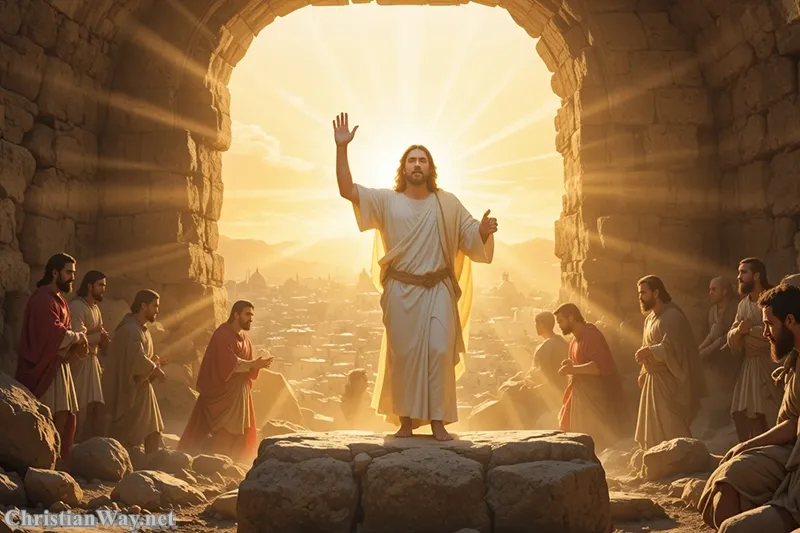
This is not merely a comforting symbol. It is the proclamation that Jesus Christ truly conquered death. He who was crucified rose again. He who carried the cross now lives in glory. He who was placed in a tomb now opens the way to eternal life for all who trust in Him.
The Resurrection is the triumph of life over death, but it is not a shallow promise that Christians will never suffer. It is a deeper promise: suffering is not final. Sin is not final. Grief is not final. Failure is not final. Even death itself is not final in the hands of God.
The resurrection tells every weary heart that the story God is writing is larger than the chapter we can presently see. It tells the person who has lost hope that Christ is still alive. It tells the grieving family that love is not destroyed by the grave. It tells the sinner that forgiveness is possible. It tells the brokenhearted that God can bring new life even from what seems beyond repair.
To believe in the risen Christ is to stand before the mystery of life with courage. It is to say, even through tears, that darkness will not reign forever. It is to trust that the God who raised Jesus from the dead is able to meet us in every place where we feel afraid, lost, wounded, or alone.
The Resurrection Is the Heart of the Christian Faith
Christianity is not built only upon the teachings of Jesus, beautiful and necessary though they are. It is not built only upon His compassion for the poor, His welcome to children, His forgiveness of sinners, or His call to love one another. Christianity is built upon the proclamation that Jesus Christ died and rose again.
Saint Paul wrote with great clarity, “And if Christ be not raised, your faith is vain” (1 Corinthians 15:17). These words show how central the resurrection is. Without it, Jesus might still be remembered as a holy teacher, a martyr, or a remarkable example of love. But with the resurrection, Christians confess something far greater: Jesus is the living Lord.
The risen Christ is not simply an inspiring memory from the past. He is present. He is active. He is the One who continues to call, forgive, heal, strengthen, and guide His people.
When the first disciples saw Jesus die, their hopes were crushed. They had followed Him, listened to Him, watched Him heal the sick and calm storms, heard Him speak of the Kingdom of God, and believed that He was the promised Messiah. Then came the cross.
Their teacher was arrested.
Their hopes seemed defeated.
Their courage failed.
Some fled.
Peter denied Him.
The women stood near the cross in sorrow.
The disciples hid behind locked doors.
From a human point of view, everything appeared finished.
But God was at work in the silence of the tomb.
This is one of the most important lessons of the resurrection. God often works in ways that human eyes cannot immediately see. The disciples saw only loss. God was preparing new life. They saw a sealed tomb. God was preparing the dawn of a new creation. They saw the end of hope. God was about to reveal that hope had not died.
There are times in our own lives when we stand before what looks like an ending. A marriage may be wounded. A family may be divided. Work may become uncertain. Health may fail. A beloved person may be taken from us. We may feel as though the stone has been rolled across the entrance of everything we loved.
The resurrection does not give us permission to ignore pain. But it teaches us not to call the tomb the final word.
God can still bring life.
The Empty Tomb and the Dawn of Hope
The Gospels tell us that early on the first day of the week, women came to the tomb where Jesus had been laid. They came not expecting a miracle, but carrying grief. They came with spices to honor the body of the One they loved. Their hearts were heavy. The future was unclear.
They had seen the cross.
They had seen the burial.
They knew the weight of the stone.
But when they arrived, they found that the tomb was empty.
The resurrection did not begin with noise, celebration, or public triumph. It began quietly, in the early morning, while grief was still present and the disciples still did not understand what had happened.
This quiet beginning is meaningful. God often enters our lives gently.
He may meet us in a prayer whispered when we have no strength left.
He may meet us through a Scripture verse that comes alive in a difficult season.
He may meet us in the kindness of someone who sits beside us without trying to explain our pain.
He may meet us in the courage to take one more step when we thought we could not continue.
The risen Christ often comes before we recognize Him.
Mary Magdalene stood outside the tomb weeping. She saw Jesus, but at first she did not know who He was. She thought He was the gardener. Then He spoke her name: “Mary” (John 20:16).
Everything changed in that moment.
The risen Lord did not begin with a lecture. He did not begin by asking why she had doubted. He called her by name.
This is how Christ meets the human heart.
He knows us personally.
He sees the tears we hide.
He sees the burdens we cannot explain.
He sees the parts of our story that others do not understand.
The resurrection is not only a doctrine to be accepted. It is the living promise that the risen Jesus knows His people by name.
Perhaps there are times when we feel unseen. We may work hard, care for others, carry responsibilities, and still wonder whether anyone truly understands what is happening inside us. The resurrection speaks into this loneliness. Christ is not distant from the human heart. He calls us by name.
The Risen Christ Meets the Fearful
After the resurrection, the disciples were gathered behind locked doors because they were afraid. Their fear was understandable. They had seen what happened to Jesus. They did not know what would happen next. They felt exposed, confused, and uncertain.
Then Jesus came and stood among them.
His first words were not words of accusation. He did not say, “Why did you abandon Me?” He did not begin by reminding Peter of his denial or the others of their fear.
He said, “Peace be unto you” (John 20:19).
These words are among the most tender in all the Gospels.
The risen Christ comes into a room filled with fear and speaks peace.
He does not wait for the disciples to become brave before He appears. He comes while they are still afraid.
This is good news for every person who feels weak.
Sometimes we imagine that faith means never being afraid. But the disciples show us otherwise. Faith is not the absence of fear. Faith is allowing Christ to meet us within our fear.
A mother may be afraid for her child.
A father may be afraid about the future of his family.
A student may be afraid of failure.
A person facing illness may be afraid of what lies ahead.
An elderly believer may be afraid of loneliness.
A grieving heart may be afraid that joy will never return.
The risen Christ does not stand outside these fears and demand that we solve them alone. He enters the locked room. He comes near. He speaks peace.
This peace is not merely a calm feeling. It is the assurance that Christ is present.
The disciples were still living in a difficult world. Rome still ruled. Danger still existed. The future was not simple. But they were no longer alone. The risen Christ had come among them.
The same is true for us. The resurrection does not promise that every circumstance will become easy. It promises that Christ is alive in the midst of every circumstance.
The Resurrection Does Not Erase the Cross
One of the most beautiful truths in the Gospel is that the risen Jesus still bears the marks of the cross.
When Thomas doubted, Jesus invited him to see His hands and His side. The wounds were still there. Resurrection did not erase the reality of suffering. It transformed it.
This matters deeply for those who have been wounded.
Many people carry scars that remain long after the painful event has passed. A betrayal may be forgiven, but its memory can remain. A loss may be carried with faith, but grief still visits. A person may heal from illness, yet remember the fear of those days. A child who grew up in a troubled home may become strong, but still carry the marks of what was endured.
The resurrection tells us that our wounds do not have to define us as defeated.
Christ’s wounds became signs of love.
The nails did not have the final word.
The cross did not have the final word.
The tomb did not have the final word.
The risen Christ carried His wounds, but they were no longer wounds of defeat. They became the marks of victory.
There is a mystery here. God does not always remove every scar from our lives. But He can give those scars a new meaning. The place where we were broken can become the place where we learn compassion. The sorrow we endured can make us more gentle toward someone else. The forgiveness we received can make us more ready to forgive.
This does not mean suffering is good. We should never glorify pain or excuse injustice. But it does mean that Christ is able to redeem what sin and sorrow have wounded.
The resurrection is not denial of the cross. It is God’s answer to the cross.
The Resurrection and the Forgiveness of Sins
The risen Christ did not come only to prove that death had been defeated. He came also to bring forgiveness.
After His resurrection, Jesus spoke to His disciples about repentance and the forgiveness of sins. The cross and resurrection belong together. Christ dies for the world, rises in victory, and sends His followers to proclaim mercy.
This is important because many people carry guilt that feels like a private tomb.
They remember words they wish they had never spoken.
They remember choices that wounded others.
They remember years wasted in anger, dishonesty, selfishness, addiction, betrayal, or spiritual neglect.
They may believe that they can never truly begin again.
But the resurrection declares that Christ has power over what seems impossible.
Peter is one of the clearest examples. Before the cross, Peter boldly promised that he would never deny Jesus. Yet when fear came, he denied Him three times.
Imagine the shame he carried after hearing the rooster crow.
Imagine the sorrow of knowing that he had failed the One he loved.
But the risen Jesus did not abandon Peter.
On the shore of Galilee, Jesus asked him three times, “Lovest thou me?” (John 21:15–17). This was not meant to humiliate Peter. It was healing. Where Peter had denied three times, Christ now gave him the opportunity to answer in love three times.
Then Jesus entrusted Peter with a calling: “Feed my sheep.”
The resurrection is not only about surviving failure. It is about being restored through grace.
Christ does not simply say, “Your past does not matter.” He enters the truth of what has happened. He brings it into the light. He forgives. He heals. He gives a new beginning.
There are people who feel that their worst mistake has become their identity. But the Gospel says that in Christ, no sin is stronger than mercy.
Repentance is not merely feeling bad about the past. It is turning toward Christ and allowing Him to lead us into a different future.
The risen Lord is still able to say to the ashamed heart: “Peace be unto you.”
The Resurrection and the Promise of New Creation
The resurrection of Jesus is not only about one person rising from the dead. It is the beginning of God’s new creation.
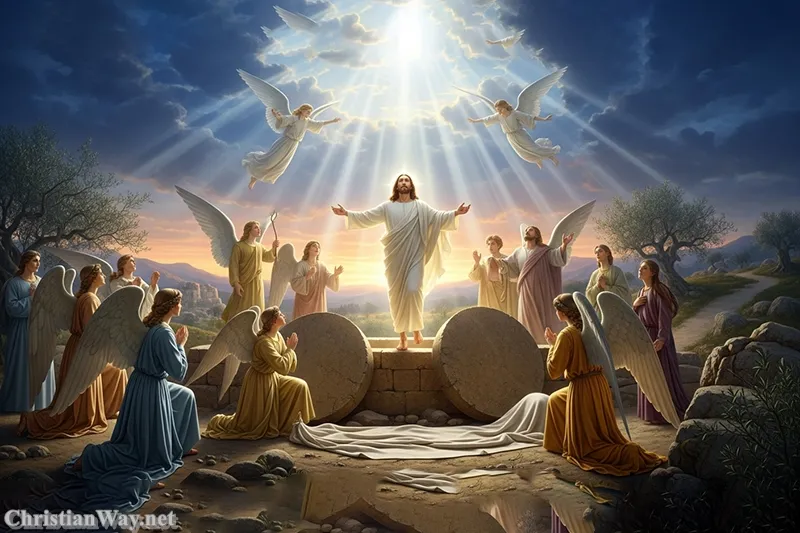
Saint Paul calls Christ “the firstfruits of them that slept” (1 Corinthians 15:20). This means that Christ’s resurrection is the beginning of a greater harvest. What happened to Him is a promise of what God intends for those who belong to Him.
Christian hope is not only that souls will escape the world. It is that God will renew what sin and death have wounded. The Bible speaks of a new heaven and a new earth, of God dwelling with His people, of tears being wiped away, and of death being no more.
This hope matters because the world is full of brokenness.
We see war and violence.
We see injustice and exploitation.
We see families divided by anger.
We see people crushed by poverty.
We see children carrying burdens they should never have to carry.
We see the elderly left lonely.
We see the sick waiting for comfort.
We see creation itself groaning under the weight of human carelessness.
The resurrection tells us that God has not abandoned His world.
Christ rose bodily from the dead. This means that creation matters to God. Human bodies matter. Human work matters. Food, water, homes, families, communities, and the earth itself matter.
The Christian hope is not escape from God’s world. It is the renewal of God’s world.
This should change the way Christians live.
If Christ is risen, then kindness matters.
If Christ is risen, then justice matters.
If Christ is risen, then caring for the poor matters.
If Christ is risen, then protecting the vulnerable matters.
If Christ is risen, then every act of mercy becomes a small sign of God’s coming Kingdom.
We may not be able to repair every broken thing in the world. But we can become witnesses to resurrection life wherever God has placed us.
The Resurrection in Everyday Life
The resurrection can sometimes sound like a truth reserved for Easter Sunday, church services, or theological reflection. But it is meant to enter ordinary life.
Resurrection life appears whenever grace creates a new beginning.
It appears when a person who has carried bitterness for years begins to forgive.
It appears when a family that has been divided finds the courage to speak honestly and seek peace.
It appears when someone who has made a serious mistake chooses repentance instead of hiding.
It appears when a person suffering from loneliness finds a community that receives them with love.
It appears when a weary parent finds strength to keep serving with patience.
It appears when a person in grief begins, slowly and gently, to feel gratitude again.
It appears when someone who once lived only for self begins to care for others.
These moments are not the final resurrection promised at the end of time. But they are signs of the risen Christ already at work in the world.
The Christian life is not a promise that we will avoid every cross. It is a promise that every cross can be carried with Christ.
There are mornings when faith feels strong and clear. There are also mornings when prayer feels dry, the heart feels tired, and hope seems far away. On those days, resurrection faith may look very simple.
It may look like getting out of bed and whispering, “Lord Jesus, help me.”
It may look like opening the Bible for a few moments.
It may look like forgiving one small offense.
It may look like calling someone who is lonely.
It may look like choosing honesty when dishonesty would be easier.
It may look like returning to worship even when you feel empty.
The risen Christ is present in these small acts of faithfulness.
The Resurrection Gives Courage to Love
Fear often makes people protect themselves. It can make us hard, suspicious, selfish, or unwilling to risk love. We may fear being hurt, rejected, embarrassed, disappointed, or taken for granted.
But the resurrection gives Christians courage to love.
If death does not have the final word, then love is never wasted.
If Christ is risen, then no act of mercy is insignificant.
If Christ is risen, then forgiveness is not foolishness.
If Christ is risen, then serving someone who cannot repay us is not a wasted life.
Jesus taught His disciples that the greatest commandment is to love God and love neighbor. The resurrection does not remove this command. It gives it new strength.
The risen Christ sends His people into the world not to win arguments, seek power, or build their own importance. He sends them to bear witness to His love.
This love is not weak.
It speaks truth.
It protects the vulnerable.
It resists evil.
It refuses to celebrate cruelty.
It carries burdens.
It serves quietly.
It forgives when forgiveness is costly.
It remains faithful when no one is applauding.
A resurrected life is not a life without struggle. It is a life that refuses to let sin, hatred, fear, or despair have the final word.
The Church as a People of Resurrection
The Church exists because Christ is risen.
The first disciples did not remain hidden forever. The fearful men and women who once stood behind locked doors became witnesses to the Gospel. They preached Christ, cared for the poor, prayed together, broke bread, and carried the message of resurrection into the world.
The Church is not simply a gathering of people who share religious opinions. It is a community formed by the risen Lord.
Saint Paul writes, “Now ye are the body of Christ, and members in particular” (1 Corinthians 12:27). This means that every believer has a place in the life of the Church.
The child learning to pray belongs.
The elderly person who feels forgotten belongs.
The grieving widow belongs.
The person who struggles with doubt belongs.
The young man trying to find direction belongs.
The mother exhausted by care belongs.
The person who has made mistakes and longs to begin again belongs.
The Church is called to be a place where resurrection hope becomes visible.
It should be a place where sinners can repent without being crushed.
It should be a place where the grieving can weep without being rushed.
It should be a place where the poor are welcomed, the lonely are noticed, and the wounded are treated with gentleness.
It should be a place where people are reminded that Christ is alive.
No church is perfect. Churches are made up of human beings who still need grace. They can fail, become distracted, or forget their calling. But Christ remains faithful.
The Church is strongest when it remembers that it does not exist for itself. It exists to proclaim the risen Jesus.
The Resurrection and Our Hope Beyond Death
Every Christian eventually faces the mystery of death personally.
We may stand beside the bed of someone we love.
We may attend a funeral.
We may look at a photograph and feel the ache of absence.
We may wonder what lies beyond the final breath.
The resurrection does not give us every detail we might wish to know. It does not remove the pain of goodbye. But it gives us a promise strong enough to carry us through sorrow.
Jesus says, “I am the resurrection, and the life: he that believeth in me, though he were dead, yet shall he live” (John 11:25).
These words were spoken near the tomb of Lazarus. They were spoken into grief. They were spoken not as an abstract idea, but as the promise of a living Savior.
For Christians, death is not the end of relationship with Christ. The One who conquered death holds His people even when they pass beyond what we can see.
This hope does not make us careless about life. It makes life more precious.
Every day becomes a gift.
Every conversation becomes meaningful.
Every act of love becomes important.
Every opportunity to forgive becomes urgent.
Every prayer becomes a way of placing our lives in the hands of God.
The resurrection teaches us to live with eternity in our hearts, not by escaping our responsibilities, but by loving more deeply within them.
In the Light of the Risen Christ
The Resurrection is the triumph of life over death because Jesus Christ is alive.
He is alive when the grieving heart cannot yet see beyond sorrow.
He is alive when a sinner returns home in repentance.
He is alive when a frightened disciple finds courage.
He is alive when a broken relationship begins to heal.
He is alive when a church serves the poor.
He is alive when a weary person whispers a prayer in the night.
He is alive when a family gathers around a table with gratitude.
He is alive when someone chooses mercy over revenge.
He is alive when hope rises again after a long season of darkness.
The empty tomb is God’s answer to despair.
The risen Christ is God’s answer to death.
The peace of Jesus is God’s answer to fear.
The forgiveness of Jesus is God’s answer to guilt.
The love of Jesus is God’s answer to the brokenness of the world.
Dear friends, whatever tomb you may be standing before today, do not lose heart. The stone may look heavy. The night may feel long. The future may seem hidden. But Christ is risen.
He is not distant from your sorrow.
He is not weary of your questions.
He is not finished with your story.
The God who raised Jesus from the dead is still able to bring life where we see only endings.
Let us pray:
Risen Lord Jesus Christ,
You have conquered death
and opened the way of everlasting life.
Come into every fearful heart,
comfort those who grieve,
forgive those who carry shame,
and strengthen those who feel weak.
Teach us to trust You
when the road is dark,
to love when love is costly,
and to hope when hope feels far away.
May Your resurrection light our path,
heal what is broken within us,
and make our lives a witness
to the victory of Your mercy and love.
Amen.
— Fr. John Matthew