Dear friends in Christ,
Among all the disciples who walked with Jesus, few feel as near to us as Saint Peter. He is brave, but sometimes speaks before he understands. He loves Jesus deeply, yet he is often afraid. He promises loyalty, then falls in weakness. He asks questions, makes mistakes, tries again, weeps bitterly, and finally becomes a courageous witness to the risen Lord.
For this reason, Saint Peter is not only a figure of history. He is a companion for every Christian who has ever loved God sincerely and still struggled to remain faithful. His life tells us that Christ does not choose only the strong, the polished, or the perfectly prepared. He calls ordinary people. He meets them in their weakness. He corrects them with patience. He forgives their failures. Then He sends them out to serve others in the power of grace.
Catholics honor Saint Peter as the first Pope, the Apostle entrusted by Christ with a unique ministry of strengthening the Church and caring for the flock. This belief is rooted in the words of Jesus and in the ancient memory of the Church. At the same time, other Christian traditions understand Peter’s role in different ways. Eastern Orthodox, Anglican, and Protestant Christians all honor Peter as a chief apostolic witness, a confessor of Christ, and a central figure in the early Church, while differing from Catholic teaching about papal authority and the succession of the Bishop of Rome.
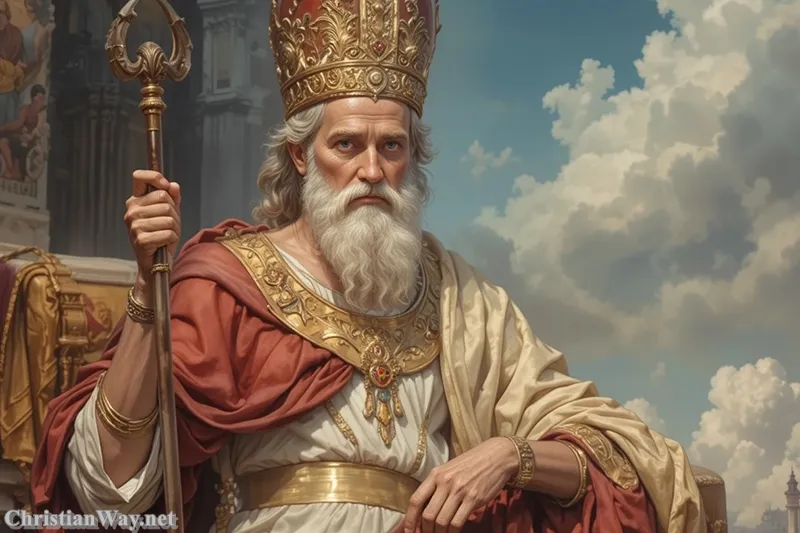
Yet before debates about titles, offices, or church structures, Saint Peter invites us to look toward Christ. Peter’s greatness does not come from personal perfection. It comes from the mercy of Jesus. His strength does not begin with confidence in himself. It begins when he learns to trust the Lord who calls him from the boat, lifts him from the waves, forgives him after failure, and gives him a mission beyond anything he could have imagined.
The story of Saint Peter is the story of a fisherman who became a shepherd. It is the story of a frightened disciple who became a bold preacher. It is the story of a man who denied Christ and was restored by Christ. It is the story of grace patiently shaping a human life.
To reflect on Saint Peter – The First Apostle and First Pope is therefore to reflect on the Church, on leadership, on repentance, on faith, and on the astonishing patience of God. It is to remember that Christ can take an imperfect heart, fill it with mercy, and make it a source of courage for others.
Simon the Fisherman: A Life Before the Call
Before he was known as Peter, he was Simon. Before he stood before crowds proclaiming the resurrection, he was a fisherman from Galilee. Before he became associated with Rome, apostolic witness, and the early life of the Church, he lived a working life beside the waters of a lake.
The Gospels present Simon as a man of the ordinary world. He knew physical work. He knew long nights. He knew the disappointment of returning from the water with empty nets. He likely knew the quiet responsibility of providing for a household, since the Gospels tell us that he had a wife and that Jesus healed his mother-in-law.
This matters because Jesus does not begin His ministry only among kings, scholars, or religious experts. He walks beside fishermen. He calls tax collectors. He notices the poor. He speaks to women and children. He receives people whose lives have been marked by illness, grief, shame, or exclusion.
God often begins His greatest works in ordinary places.
Simon’s life reminds us that a Christian calling does not always begin when a person becomes outwardly impressive. It may begin in the middle of a tired workday. It may begin after a disappointment. It may begin when we feel that our efforts have produced little. It may begin when we are simply trying to do what is in front of us.
The Gospel of Luke tells us that after a night of unsuccessful fishing, Jesus asks Simon to put out into deep water and let down the nets again. Simon responds with honesty: “Master, we have toiled all the night, and have taken nothing.” Yet he adds, “Nevertheless at thy word I will let down the net” (Luke 5:5).
That sentence contains the beginning of faith.
Simon does not claim to understand everything. He does not pretend that the situation makes sense. He simply chooses to trust the word of Jesus more than the discouragement of the night before.
When the nets fill beyond expectation, Simon falls before Jesus and says, “Depart from me; for I am a sinful man, O Lord” (Luke 5:8). He has seen something of Christ’s holiness, and suddenly he sees himself more clearly.
But Jesus does not turn away from him.
He says, “Fear not; from henceforth thou shalt catch men” (Luke 5:10).
Christ Calls People Where They Are
This moment is deeply comforting. Jesus does not wait for Simon to become spiritually polished before calling him. He calls him from the place of work, fatigue, and uncertainty.
Many people imagine that God only draws close once they have already become better, calmer, wiser, or more disciplined. But the Gospel shows something different. Christ comes first. He enters the boat before Simon has anything to offer Him. He speaks before Simon knows how to respond. He calls before Simon has proved himself worthy.
This does not mean that Christ leaves Simon unchanged. The call of Jesus always leads toward transformation. But grace begins with God’s initiative.
Perhaps this is where Saint Peter’s life meets us most personally. We may feel unready. We may feel too ordinary. We may carry failures that have made us afraid to hope again. We may believe that others are more suited for faith, ministry, service, or holiness.
Peter’s life tells us that Christ is not looking only for people who appear strong. He is looking for hearts willing to say, even tremblingly, “At thy word.”
“Thou Art Peter”: The Confession at Caesarea Philippi
One of the most important moments in Peter’s life takes place near Caesarea Philippi. Jesus asks His disciples, “Whom say ye that I am?” The question is not only for them. It reaches every generation. Who is Jesus to us? A teacher? A prophet? A moral example? A source of comfort? Or something far greater?
Peter answers, “Thou art the Christ, the Son of the living God” (Matthew 16:16).
This confession stands at the center of Christian faith. Jesus is not merely one religious voice among many. He is the Christ, the Messiah, the Son of the living God. He is the One through whom God comes near to humanity. He is the One who reveals the Father, carries the sin of the world, defeats death, and opens the way of life.
Jesus responds to Peter with words that have shaped Christian reflection for centuries: “Thou art Peter, and upon this rock I will build my church; and the gates of hell shall not prevail against it” (Matthew 16:18).
Catholics understand these words as Christ giving Peter a distinctive role in the Church: a ministry of unity, leadership, and pastoral care that continues in the Bishops of Rome. In this sense, Saint Peter is honored as the first Pope, not because he stood above Christ, but because Christ entrusted him with a particular responsibility in serving the Church.
Other Christians understand this passage differently. Some see the “rock” primarily as Peter’s confession of faith. Others see it as referring to Peter personally but not as establishing a continuing universal papal office. Eastern Orthodox Christians honor Peter’s primacy among the apostles while maintaining a conciliar understanding of church leadership. Many Protestants emphasize the confession that Jesus is the Christ as the foundation of the Church.
These differences are important and deserve honesty. Yet all Christians can recognize the heart of this moment: the Church is built upon the truth that Jesus Christ is Lord.
The Rock Is Not Human Perfection
It is striking that Jesus speaks these words to Peter, a man who will soon misunderstand Him, resist the meaning of the cross, and later deny Him.
This reveals something important about the Church.
The Church is not built upon flawless human beings. It is built upon Christ. Peter has a real role, but Peter is not the Savior. He is a servant. He is a witness. He is a man transformed by mercy.
When Christians speak about Peter’s importance, they must never forget his weakness. The same Peter who confesses Christ as the Son of God later rebukes Jesus when Jesus speaks about suffering and death. Peter wants a Messiah of visible triumph. He does not yet understand that the path of Christ leads through the cross.
Jesus corrects him strongly because Peter must learn that God’s victory does not follow the patterns of worldly power.
This lesson remains necessary for the Church today. Christians can be tempted to seek influence, comfort, recognition, or cultural control. But Jesus leads His people toward humility, sacrifice, mercy, and truth.
Saint Peter’s calling does not make him greater than the cross. It places him beneath the cross.
Peter Walks on Water and Learns to Trust
Another beloved moment in the Gospel shows Peter stepping out of the boat toward Jesus. The disciples are caught in a storm, and Jesus comes to them walking on the sea. Peter says, “Lord, if it be thou, bid me come unto thee on the water” (Matthew 14:28).
Jesus simply says, “Come.”
Peter steps out. For a brief moment, he walks toward Christ. Then he sees the wind, becomes afraid, and begins to sink. He cries out, “Lord, save me.”
Immediately Jesus reaches out His hand.
This scene contains the whole movement of faith. Peter sees Christ and responds with courage. Then fear overtakes him. Yet even in fear, he knows where to turn. “Lord, save me.”
Many people think faith means never being afraid. But Peter shows us that faith is often bringing fear directly to Christ.
We may begin with great confidence and then become overwhelmed by circumstances. Illness, financial pressure, conflict, grief, loneliness, uncertainty about the future, or disappointment in ourselves can make the waves feel too high. We may wonder whether the faith we once had was real.
Peter’s cry is a prayer for such moments.
“Lord, save me.”
It is not a complicated prayer. It does not require polished language. It does not depend on emotional strength. It is the prayer of a person who knows he cannot save himself.
The Hand of Christ Is Nearer Than Our Fear
The Gospel says that Jesus immediately stretched forth His hand and caught Peter.
This “immediately” is precious.
Christ does not stand at a distance, waiting for Peter to become calm before helping him. He reaches into the water. He catches the frightened disciple. He brings him back toward safety.
The Christian life often involves this pattern. We step out in faith. We become afraid. We sink into discouragement. We cry out. Christ reaches for us again.
This does not mean that life will always become easy. Peter still had to learn. He still had to grow. But he learned that failure did not place him beyond the reach of Jesus.
This is one of the great gifts of Saint Peter’s story. He teaches us that our weakness can become the place where we discover the faithfulness of God.
The Upper Room: Love, Fear, and the Promise of Loyalty
At the Last Supper, Peter speaks with deep emotion. When Jesus tells the disciples that they will be scattered, Peter insists that even if everyone else falls away, he will remain faithful.
His love is real. His courage is real. Yet he does not fully know himself.
Jesus tells him, “Before the cock crow, thou shalt deny me thrice” (Luke 22:34).
Peter cannot imagine it. He believes he is ready to die with Christ. But when danger comes, fear takes hold. In the courtyard, surrounded by uncertainty and risk, Peter denies that he knows Jesus.
The Gospels do not hide this failure. They do not protect Peter’s reputation by pretending he was always brave. They allow us to see him at his weakest.
This is one reason why his story is so powerful.
Peter’s failure is not the failure of a person who never loved Christ. It is the failure of a person who loved Christ but discovered that love must become deeper than emotion. It must be rooted in grace.
When Peter hears the rooster crow, he remembers the words of Jesus. The Gospel says that he went out and wept bitterly.
Those tears matter.
They are not the tears of despair. They are the tears of a heart broken open by truth. Peter sees what he has done. He can no longer rely on his own strength. He cannot pretend that he is braver than he is.
But this breaking becomes the beginning of a new kind of faith.
Repentance Is Not the End of the Story
Many people carry a failure that they believe has defined them forever. Perhaps they betrayed someone’s trust. Perhaps they spoke cruelly. Perhaps they abandoned a responsibility. Perhaps they turned away from God at the very moment they thought they would be strongest.
Peter knows this pain.
Yet the resurrection tells us that failure is not the final word.
The risen Christ does not return to Peter merely to accuse him. He returns to restore him.
This is the mystery of Christian repentance. Repentance is not self-hatred. It is not endless punishment. It is the turning of the heart back toward the One who still loves us.
To repent is to tell the truth about sin and then place that truth before the mercy of God.
Peter’s tears become holy because they lead him back to Christ.
“Feed My Sheep”: Peter Restored by the Risen Lord
After the resurrection, Jesus meets Peter beside the Sea of Galilee. It is a tender scene. The disciples have gone fishing. Once again, they have struggled through the night. Once again, Jesus comes to them near the water.
After breakfast, Jesus asks Peter, “Simon, son of Jonas, lovest thou me?” (John 21:15).
He asks him three times.
The three questions correspond to Peter’s three denials. But Jesus does not ask them to humiliate Peter. He asks them to heal him.
Each time Peter answers, Jesus gives him a mission: “Feed my lambs.” “Feed my sheep.”
This is one of the most beautiful scenes in the Gospel.
Peter had once relied on his own courage. Now he is called to care for others out of a love that has passed through failure and forgiveness. He is no longer being asked merely to prove himself. He is being entrusted with the people of Christ.
Catholics see in this passage a central foundation for Peter’s pastoral ministry and for the ministry of the Pope as successor of Peter. The Pope is called not to rule for personal glory, but to serve the flock of Christ, strengthen unity, guard the faith, and care especially for those who are weak, suffering, or far from hope.
The Pope’s traditional title, “Servant of the Servants of God,” reflects this calling. The ministry associated with Peter is not meant to become worldly domination. It is meant to become pastoral love.
Leadership After Failure Can Become More Humble
Peter’s restoration teaches a powerful truth about Christian leadership.
The best leaders are not always those who have never failed. Often, the most compassionate leaders are those who have learned what it means to receive mercy.
A person who has been forgiven may be less eager to humiliate others.
A person who has wept over personal weakness may become more patient with the weaknesses of those around them.
A person who has learned that Christ’s love is stronger than shame may become a more faithful shepherd.
Peter’s authority is not separated from his repentance. His mission is given after he has learned to say, “Lord, thou knowest all things; thou knowest that I love thee” (John 21:17).
This is a very different kind of leadership from the leadership of the world. It begins not with self-confidence, but with love for Christ.
Peter at Pentecost: From Fear to Courage
The transformation of Peter becomes visible at Pentecost.
Before the coming of the Holy Spirit, the disciples are often fearful, confused, and uncertain. After Pentecost, Peter stands before the crowds and proclaims the risen Christ with courage.
The man who once denied Jesus before a small group of people now speaks openly about the Lord before many.
This is not because Peter suddenly becomes naturally fearless. It is because the Holy Spirit gives him strength.
Peter’s sermon at Pentecost is one of the first great proclamations of the Church. He speaks of Jesus, His death, His resurrection, and the fulfillment of God’s promises. He calls people to repentance and baptism. The Church begins to grow as men and women receive the Gospel.
This is an important reminder that Christian courage does not come merely from personality. Some people are naturally bold. Others are quiet. Some speak easily. Others find words difficult. But the Holy Spirit can strengthen every kind of person for the work God gives them.
Peter becomes courageous not because he no longer remembers fear, but because he has encountered the risen Christ and received the Spirit’s power.
The Church Begins with Witness
The early Church does not begin with an attempt to build a religious empire. It begins with witness.
The apostles testify that Jesus is risen.
They pray.
They share what they have.
They care for one another.
They proclaim forgiveness in Christ.
They endure opposition.
Peter stands at the center of much of this early witness, but he does not stand alone. The Church is not built by one apostle only. John, James, Paul, Mary Magdalene, Barnabas, Stephen, Philip, Priscilla, Aquila, Lydia, and many others all serve the Gospel in different ways.
Peter’s role is important, but it is always part of the wider communion of the Church.
This too is a lesson for Christians today. No leader, however gifted, can carry the Church alone. The Body of Christ has many members. Every baptized person has a calling.
Saint Peter and the Early Church
The Acts of the Apostles shows Peter as a central figure in the earliest Christian community. He preaches, heals, encourages believers, faces persecution, and helps guide the Church through difficult moments.
He speaks on behalf of the apostles in Jerusalem. He participates in decisions that affect the growing community. He opens the door of the Gospel to Gentiles through the encounter with Cornelius. This moment is especially important because it reveals that the grace of Christ is not limited to one people, culture, or nation.
When Peter sees the Holy Spirit poured out upon Cornelius and his household, he recognizes that God is doing something larger than human expectation. The Church is being called outward.
This requires Peter to change. He must learn that God’s mercy is wider than the boundaries he once imagined.
Here again, Peter’s life teaches humility. Even an apostle must remain open to the surprising work of God.
The Gospel Is for Every Nation
The story of Cornelius reminds us that the Church cannot become a closed circle for people who look, speak, think, or live in one particular way.
The Gospel belongs to every nation.
It belongs to the poor and wealthy, the educated and uneducated, the confident and anxious, the young and elderly, the familiar and the stranger.
The Church must never confuse the Gospel with one culture alone. Every culture needs to be purified, healed, and transformed by Christ, but every people can receive the good news in the language of its own life.
Peter’s ministry helps the early Church learn this. The fisherman from Galilee becomes an apostle to a world much larger than the shores of his childhood.
Saint Peter and Rome
Ancient Christian tradition connects Saint Peter’s final ministry and martyrdom with Rome. Catholics believe that his ministry in Rome gives special significance to the Bishop of Rome as Peter’s successor.
The New Testament does not give a detailed account of Peter’s final years, and historians must speak carefully about the precise details of his journey and ministry. Yet from the earliest centuries, Christians remembered Peter as having borne witness to Christ in Rome and having died there as a martyr.
According to longstanding tradition, Peter was crucified during a period of persecution. A later tradition holds that he asked to be crucified upside down because he did not consider himself worthy to die in the same manner as his Lord. Whether every detail can be established with equal historical certainty, the spiritual meaning remains clear: Peter’s life ends not with self-protection, but with faithful witness to Christ.
For Catholics, this connection between Peter and Rome is central to the meaning of the papacy. The Pope is not understood as a replacement for Christ, but as the Bishop of Rome who serves in the succession of Peter. His role is to strengthen the Church in faith, preserve unity, guard the apostolic tradition, and call believers back to the Gospel.
The First Pope Must Be Understood as a Servant
The phrase “first Pope” can be misunderstood if it makes people imagine that Peter lived within a later medieval structure or held every form of authority exactly as it developed through history.
The title pope itself developed over time. The visible structures of the Catholic Church also developed through centuries of prayer, doctrine, pastoral practice, councils, and historical circumstances.
Yet Catholics believe that the seed of the papacy is present in Christ’s words to Peter: the giving of the keys, the call to strengthen his brothers, and the command to feed Christ’s sheep.
The Catholic understanding is not that Peter became a worldly ruler. It is that he received a unique pastoral responsibility within the apostolic Church.
This is why the papacy must always be judged by the Gospel. A Pope serves faithfully when he points beyond himself to Christ. He serves faithfully when he protects the weak, teaches truth with mercy, strengthens the Church in faith, and remembers that he too is a sinner in need of grace.
Peter’s own life keeps this ministry humble. The first Pope, in Catholic understanding, was not a flawless man. He was a forgiven disciple.
Peter and the Unity of the Church
The life of Saint Peter remains important not only because of Catholic teaching about the papacy, but because Peter represents the visible need for unity in the Church.
Christ prayed that His followers would be one.
Yet Christians have experienced painful divisions throughout history. Catholics, Orthodox Christians, Anglicans, Lutherans, Reformed Christians, Baptists, Pentecostals, and many others share faith in Jesus Christ, love the Scriptures, confess His death and resurrection, and seek to live as His disciples. At the same time, they differ in their understanding of authority, sacraments, apostolic succession, worship, and church order.
These differences should not be ignored. They are real. But they should never lead Christians to forget the prayer of Jesus.
Saint Peter’s ministry can remind all Christians that unity is not a luxury. It belongs to the witness of the Gospel.
Unity does not mean that every Christian tradition becomes identical overnight. It does not mean that difficult theological questions should be treated as unimportant. But it does mean that Christians must learn to speak with honesty, humility, patience, and love.
The Church Must Never Turn Authority into Pride
Whenever Christians speak about Peter, leadership, bishops, patriarchs, pastors, or Popes, they must remember the warning of Christ: “He that is greatest among you shall be your servant” (Matthew 23:11).
Authority in the Church exists for service.
It exists to teach, protect, encourage, reconcile, and guide.
It must never become a tool for domination, fear, secrecy, or personal glory.
Peter himself knew what it meant to be corrected by Christ. He knew what it meant to fall. He knew what it meant to receive forgiveness. This should make every Christian leader humble.
The Church is strongest not when leaders seek admiration, but when they serve like Christ.
The Lessons of Saint Peter for Daily Life
Saint Peter’s life may seem distant from the daily struggles of ordinary people, but in truth it speaks directly into them.
Peter teaches us that faith can begin in an ordinary place.
He teaches us that fear does not have to be the end of faith.
He teaches us that failure does not make us beyond mercy.
He teaches us that repentance is not humiliation, but return.
He teaches us that leadership begins with love for Christ.
He teaches us that courage comes from the Holy Spirit, not from human strength alone.
He teaches us that the Church is called to welcome those whom we once considered far away.
Most of all, he teaches us that Jesus does not give up on those who turn back to Him.
Perhaps you have denied Christ in some small way—not with words, but by silence when you should have spoken, by fear when you should have trusted, by selfishness when you should have loved, or by neglect when someone needed your care.
Peter understands.
Perhaps you have promised God something and then failed to live it out.
Peter understands.
Perhaps you are tired of beginning again.
Peter understands.
And Christ understands even more deeply.
Reflect and Pray
Dear friend, Saint Peter began as Simon the fisherman. He knew the work of ordinary life, the disappointment of empty nets, the fear of storms, the shame of failure, and the pain of tears.
Yet Christ called him.
Christ corrected him.
Christ forgave him.
Christ gave him a mission.
This is the hope of Peter’s life. We are not defined finally by our weakness. We are defined by the mercy of the Lord who calls us back.
For Catholics, Peter is honored as the first Pope and the first Bishop of Rome, entrusted with a ministry of strengthening the Church and caring for Christ’s flock. For all Christians, he remains a beloved apostle, a witness to the resurrection, and a living reminder that grace can transform even the most imperfect heart.
May we learn from Saint Peter to confess Christ with courage, to repent without despair, to receive mercy with humility, and to serve others with love.
Let us pray:
Lord Jesus Christ, You called Saint Peter from the waters of Galilee and made him a shepherd of Your people. Teach us to trust You when we are afraid, to return to You when we fall, and to receive Your mercy when shame weighs heavily upon our hearts. Give Your Church faithful leaders who serve with humility, protect the vulnerable, proclaim Your truth with love, and point every soul toward You. Strengthen all Christians in the desire for unity, and make us bold witnesses of Your resurrection in the ordinary places of our lives. Amen.
May the peace of Christ dwell richly in your heart, and may the faith of Saint Peter lead you always back to the mercy, courage, and love of the risen Lord.
— Fr. John Matthew