Grace and peace be with you, my dear brothers and sisters in Christ, as we embark on another profound journey into the spiritual archives of our faith here at Christian Way. Today, we turn our gaze not towards a canonized saint in the traditional sense, but towards a man whose spiritual authority, intellectual brilliance, and sheer fortitude profoundly shaped the entire course of the Church—and indeed, Western Civilization itself. We contemplate the life of Pope Innocent III.
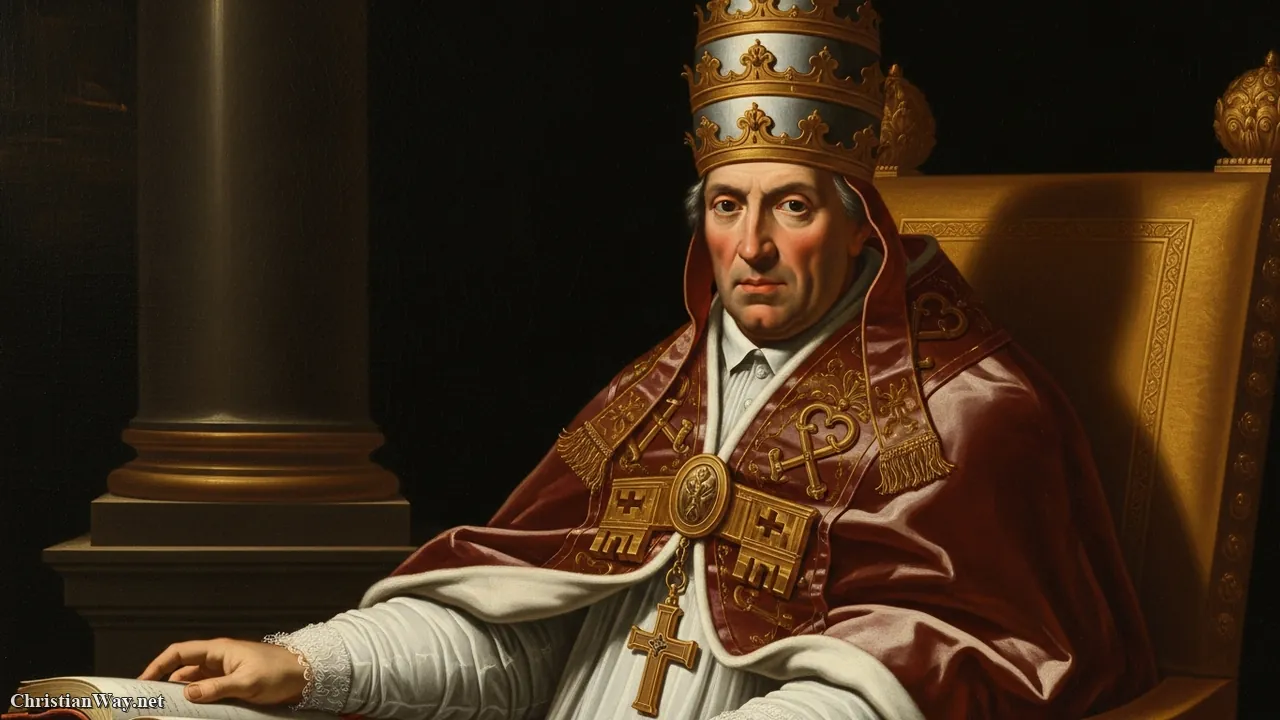
Born Lotario de’ Conti di Segni, he ascended to the Chair of Peter at the unprecedented age of thirty-seven, inheriting a Church beset by temporal chaos, internal corruption, and the burgeoning threat of heresy. In his eighteen-year pontificate (1198–1216), Innocent III did not merely manage the affairs of the Church; he redefined the very scope of the papal office. He claimed the title Vicar of Christ (Vicarius Christi) in the fullest possible sense, asserting that the Supreme Pontiff was not just the successor of Peter (Vicarius Petri), but the visible manifestation of Christ’s sovereignty on earth, overseeing both spiritual and, when necessary, temporal matters. His reign represents the high-water mark of medieval papal power—a period where the vision of a unified, God-centered Christendom seemed, for a brief and glorious moment, within the grasp of one determined soul. His legacy challenges us today to reflect on the nature of spiritual authority in a complex, secular world, and to understand the immense historical cost of leading the flock of Christ.
Profile of Holiness
The following data outlines the life and immense ecclesiastical contribution of this pivotal figure in Church history.
| Attribute | Detail |
|---|---|
| Birth Name | Lotario de’ Conti di Segni |
| Lifespan | February 22, 1161 – July 16, 1216 |
| Birthplace | Gavignano, Papal States (near Anagni, Italy) |
| Service Period | Papacy: January 8, 1198 – July 16, 1216 (18 Years) |
| Feast Day | Not Canonized (Commemorated July 16, Date of Death) |
| Patronage | Canon Lawyers, Ecclesiastical Reformers, Papal States Authority |
| Key Virtue | Prudence, Fortitude, and a Zeal for the House of God |
The Cradle of Grace: Historical Context & Early Life
Lotario de’ Conti was born into a world perpetually caught between the sacred and the temporal, a world that was, in the late 12th century, simultaneously vibrant with intellectual growth and fractured by political strife. The year 1161 saw a fragmented Italian peninsula, nominal territories of the Holy Roman Empire, yet fiercely guarded by powerful local Roman families and the emerging power of the nascent Papal States. The fundamental tension of the medieval era—the conflict between the Sacerdotium (the spiritual power of the Church, led by the Pope) and the Imperium (the temporal power of the Emperor and Kings)—was at a fever pitch.
Lotario was not born into humble surroundings; he was a child of privilege, a member of the powerful, aristocratic Conti family, Counts of Segni, whose lineage would later boast several other popes and cardinals. His father, Count Trasimondo de’ Conti di Segni, and his mother, Clarissa Scotti, ensured their son received the finest education money and influence could buy. This foundational privilege would later prove critical, for it gave Lotario access to a vision of power he sought to redirect toward God’s service. The young noble was not destined for the battlefield or the baronial court, but for the life of the mind and the heart of the Church.
His academic itinerary reads like a grand tour of medieval European scholarship. He received his early formation in Rome before moving to the intellectual hub of Paris, where he immersed himself in theology under luminaries like Peter of Corbeil. It was here, in the shadow of the great cathedral schools, that Lotario mastered the subtle art of disputation and the profound depth of Scripture. Crucially, he then journeyed to Bologna, the primary center for the study of Canon Law. This legal training was the most essential component of his formation. It imbued him with the systematic, administrative, and legal framework necessary to conceive of and implement his sweeping vision of papal authority. This combination—a Paris-trained theologian and a Bologna-trained jurist—made him uniquely qualified to assume the reins of the universal Church. He understood that faith required not only theological depth but also the strong sinews of good law to govern justly. Indeed, the Lord prepares those He calls, and the meticulous education of Lotario de’ Conti was a divine preparation for the monumental task ahead.
The Turning Point: Vocation and Conversion
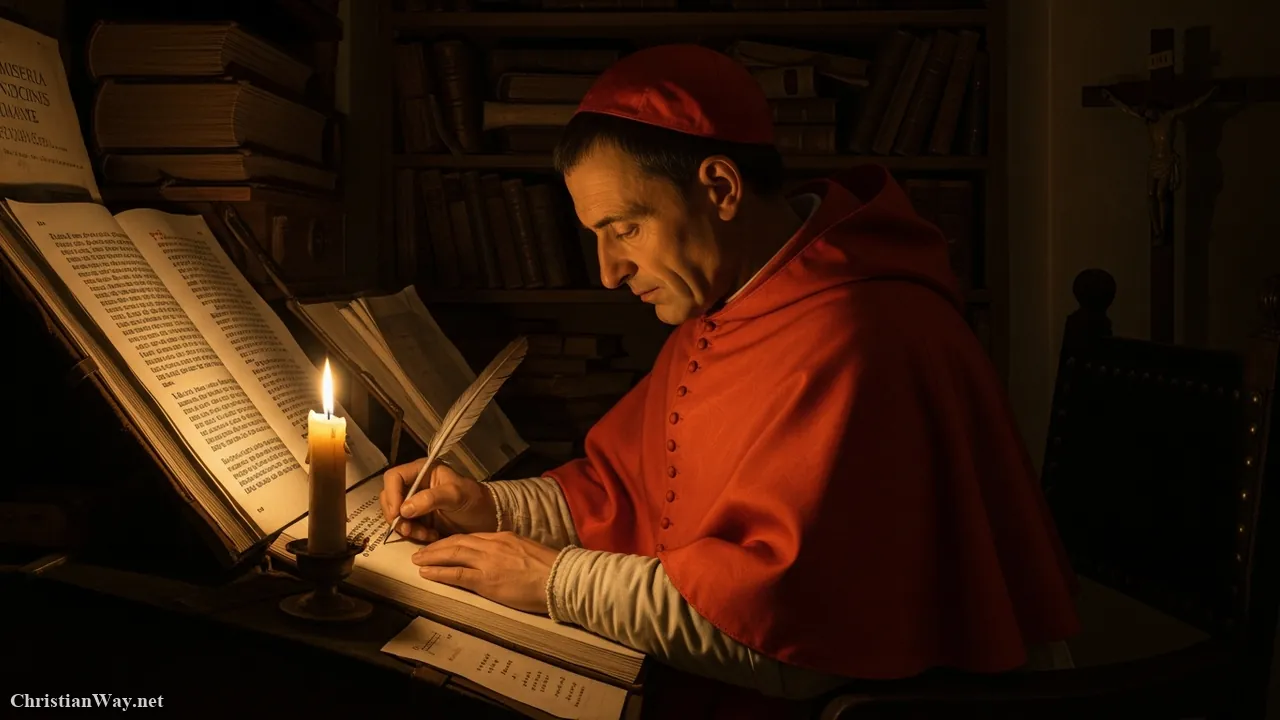
For Lotario, the call to vocation was less a sudden, dramatic conversion moment and more a profound, ongoing realization of his intellectual and spiritual obligations to the Lord. Unlike Saint Paul’s blinding light on the road to Damascus, Lotario’s journey was characterized by a deep, introspective wrestling with the human condition, evidenced most clearly in his seminal work written during his time as a Cardinal: De Miseria Condicionis Humanae (On the Misery of the Human Condition). This treatise, which became one of the most popular books of the Middle Ages, is an unflinching meditation on the physical decay, the fleeting vanity, and the moral corruption inherent in human life since the Fall.
It was during the pontificate of Celestine III (1191–1198), an era when his family was out of papal favor, that Lotario was forced into a period of deep contemplation and enforced retirement. This seemingly fallow period was, in fact, his spiritual crucible. The young cardinal, already steeped in the affairs of the world, turned inward, allowing his learning to be tempered by ascetical reflection. This interior turning gave him the moral compass he would need as Pope. His personal realization of the “misery” of fallen man became the theological engine for his political actions: if the world was so inherently flawed, so corruptible, and so prone to violence, it must be guided and corrected by a single, unwavering spiritual authority—the Papacy.
The obstacle that stood in his way was not external persecution, but the immense temptation of power itself. When he was elected Pope on January 8, 1198, mere hours after the death of Celestine III, the shock was twofold: his youth (only 37) and the magnitude of the responsibility. The greatest struggle for Innocent III was the internal battle to ensure that his enormous temporal power remained subservient to his spiritual duty. He had to embody the ideal he preached: that the Pope was “placed between God and man, lower than God but higher than man.” This concept demanded an almost superhuman degree of humility, which he articulated in his sermons, recalling the words of the Psalmist: “Unless the Lord builds the house, those who build it labor in vain.” – Psalm 127:1. His conversion was thus a daily, conscious choice to wield the Sword of Peter with wisdom and justice, always striving to be a faithful steward of the authority granted to him by Christ.
The Great Labor: Ministry and Mission
Pope Innocent III’s pontificate was an astonishing whirlwind of activity that spanned the whole of Europe, asserting the Church’s moral supremacy in every corner. His ministry was defined by three major undertakings: the restoration of papal temporal control, intervention in European monarchical affairs, and the calling of Crusades.
Upon his election, he immediately set about reclaiming the Papal States, which had fallen into the hands of petty Roman tyrants and imperial German officials. He successfully restored order in Rome and the surrounding territories, demonstrating that the Vicar of Christ could, in fact, be a capable temporal sovereign. He viewed this temporal control not as a luxury but as a vital necessity to ensure the Papacy’s spiritual independence, preventing it from becoming a mere puppet of the Holy Roman Emperor.
His greatest achievement in terms of asserting spiritual supremacy over temporal rulers was his relentless defense of the sanctity of marriage and canon law. He famously used the spiritual weapon of the Interdict (the suspension of public ecclesiastical services) against entire kingdoms. He compelled King Philip II Augustus of France to take back his lawfully wedded wife, Ingeborg of Denmark, after the King attempted an unlawful annulment. Even more dramatically, he humbled King John of England, placing the entire realm under Interdict and eventually excommunicating the King for refusing to accept Stephen Langton as the Archbishop of Canterbury. John was eventually forced to submit, acknowledging the Pope as his feudal overlord and paying him an annual tribute—an unprecedented victory for the Sacerdotium.
However, the greatest spiritual challenge of his age was the rise of heresies, particularly the Cathars (or Albigensians) in Southern France, who rejected the material world and the entire structure of the Church. Innocent first attempted peaceful conversion through Cistercian monks, and famously gave his blessing and support to the nascent mendicant orders of Saint Francis of Assisi and Saint Dominic, recognizing in their evangelical zeal the true antidote to heretical materialism. In a famous, yet possibly legendary, anecdote (which resonates with spiritual truth), Innocent III dreamt of the Lateran Basilica collapsing and a poor, ragged man—St. Francis—literally holding it up with his shoulders. Recognizing the prophetic nature of this vision, he gave his crucial approval to Francis’s primitive rule, thus unleashing a new force of evangelical charity upon the world. This discernment remains one of the greatest acts of Pastoral Prudence in his pontificate.
Sadly, his commitment to the recovery of the Holy Land led to the most tragic disaster of his reign: the Fourth Crusade (1202–1204). Intended to recapture Jerusalem, the expedition was cynically diverted by Venetian financial and political maneuvering, leading to the unthinkable—the siege and sack of the Christian city of Constantinople, the seat of the Byzantine Empire. Innocent III excommunicated the perpetrators immediately but was unable to undo the damage, which effectively shattered any hope of reconciliation between the Latin and Greek Churches, a division that remains today. He wept over this failure, recognizing that the lust for earthly treasure had tragically supplanted the spiritual goal of the cross, proving the truth of the Lord’s warning: “What profit is it for a man to gain the whole world, and forfeit his soul?” – Mark 8:36.
The Teacher of Souls: Theological & Spiritual Legacy
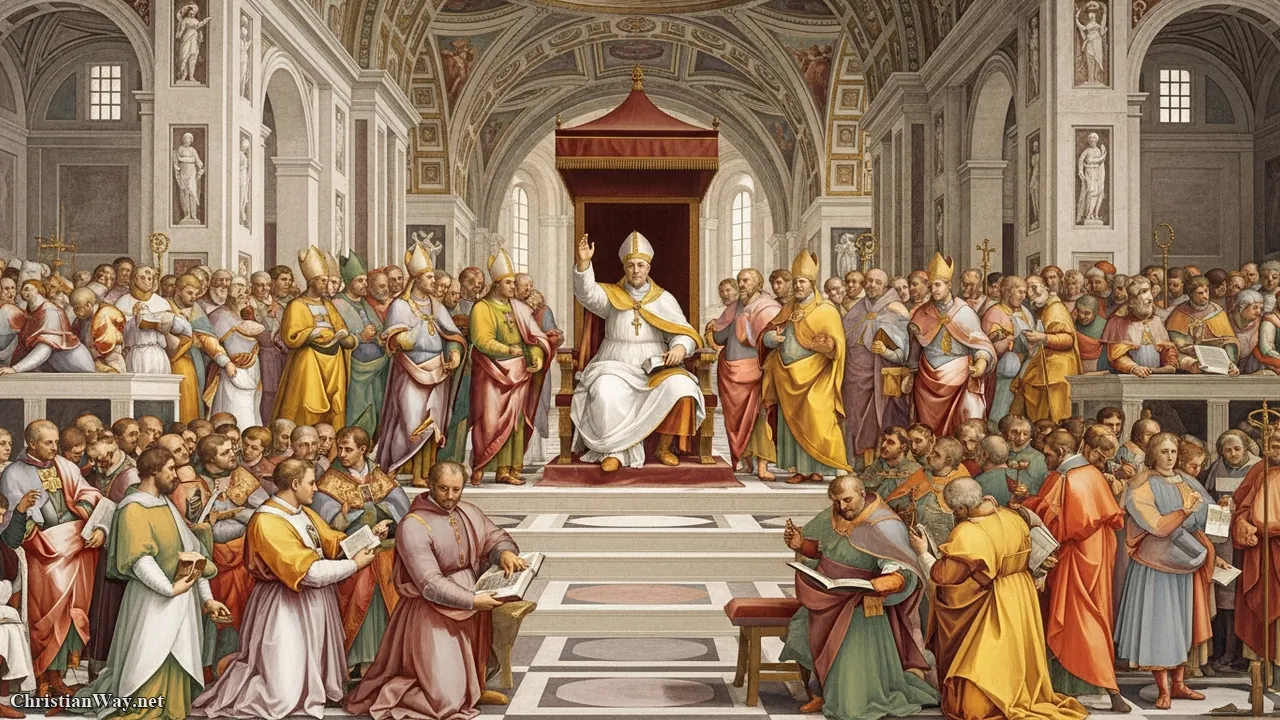
Pope Innocent III left an intellectual and spiritual legacy that continues to define Catholicism, primarily through his masterful legal and theological organization of the Fourth Lateran Council (1215), which he convoked and presided over. This council was arguably the most significant ecumenical gathering of the Middle Ages, attended by over 400 bishops and 800 abbots, solidifying the doctrines and practices of the Western Church for centuries.
### Intellectual Contribution and Canons
Innocent’s genius was in transforming sprawling legal and doctrinal needs into clear, concise canons. The seventy canons of Lateran IV addressed everything from clerical discipline to defining core dogmas. Two contributions stand out as monumental:
1. The Definition of Transubstantiation: Canon 1 definitively established the term Transubstantiation (transubstantiatio) to describe the change that takes place during the consecration of the Eucharist—the transformation of the entire substance of bread and wine into the substance of the Body and Blood of Christ, while the accidents (the appearances) remain. This precise theological language resolved centuries of theological dispute and remains the official teaching of the Catholic Church. It provided the basis for the profound Eucharistic piety that blossomed in the later Middle Ages.
2. The Paschal Precept (Canon 21): Known by its opening words, Omnis Utriusque Sexus (All of either sex), this canon mandated that every Catholic, once they have reached the age of discretion, must confess their sins at least once a year and receive Holy Communion during the Easter season. This ensured that the faithful participated in the sacramental life of the Church regularly and provided a necessary pastoral oversight that had been sorely lacking in many regions. It was a practical, disciplinary tool rooted in the deepest spiritual concern for the salvation of souls.
### Key Teachings and Papal Theory
Beyond the Council, Innocent III’s legacy is his sophisticated theology of the Papacy. He was the first Pope to consistently apply the title Vicarius Christi to himself, signifying his direct, immediate authority from God, rather than merely deriving his authority from St. Peter. In his view, the Pope was Christ’s authentic earthly representative, making the Papal office supreme. He used the famous analogy of the Sun and the Moon to describe the relationship between the spiritual power (Papacy) and the temporal power (Empire):
“God established two great luminaries in the firmament of heaven; the greater luminary to preside over the day, and the lesser luminary to preside over the night. In the firmament of the universal Church… He has established two great dignities, which are the pontifical authority and the royal power. However, the one which presides over the day, that is, over spiritual things, is the greater; and the one which presides over carnal things is the lesser.”
This teaching, while controversial in its political application, was a clear articulation of the priority of the spiritual realm over the material, a necessary corrective in a world where Kings often sought to control the Church. His writings compelled theologians and jurists for centuries to grapple with the proper balance of authority, a debate that fundamentally shapes our understanding of Church and State even today.
The Via Dolorosa: Suffering, Death, and Sainthood
Innocent III experienced the true Via Dolorosa not through martyrdom but through the profound weight of responsibility and the spiritual agony of failed enterprises. His greatest suffering was seeing his spiritual goals—the unity of Christians, the reclamation of the Holy Land, and the eradication of moral corruption—compromised and often thwarted by the avarice, pride, and shortsightedness of temporal leaders, including those in his own Curia and the Crusaders themselves. The sorrow over the sack of Constantinople was a spiritual cross he carried until his death.
### The Final Days
In 1216, having achieved the triumph of the Fourth Lateran Council and planning the long-desired Fifth Crusade, Innocent III began a tour of northern Italy. His goal was to reconcile the warring maritime cities of Pisa and Genoa, whose ships were essential for the upcoming military expedition to the East. It was an act of a true shepherd, traveling far from the comfort of Rome for the sake of unity and mission. While staying in the city of Perugia, this tireless champion of Christ’s authority was struck down by a sudden illness—likely a severe fever or stroke—in the summer heat. He died suddenly on July 16, 1216, at the age of fifty-five.
His death was as humbling as his life was grand. The chronicler Jacques de Vitry recorded a deeply unsettling post-mortem incident: just after his death, the body of the immensely powerful Pope was robbed of its vestments and left nearly naked in the cathedral. It was a stark, brutal reminder of the ultimate vanity of earthly splendor, confirming the very theme of his own youthful treatise, De Miseria Condicionis Humanae. This event, ironically, provided a final, powerful sermon on the transience of worldly glory.
### Post-Mortem and Canonization Status
While Innocent III was universally recognized as one of the greatest Popes in history, he was never formally canonized by the Catholic Church. The search confirms this fact, and no recent discoveries suggest a cause is currently active. Historically, Popes who wielded immense temporal and political power often have complex paths to canonization because their political actions, though motivated by spiritual concern, often involved the use of harsh disciplinary measures, wars, and interdicts, which left behind powerful enemies and mixed historical judgments. His focus was perhaps too intensely on the structural integrity of the Church and too involved in the “things of Caesar” for the immediate recognition of personal, ascetical holiness required for sainthood. Nevertheless, his legacy of administrative holiness, theological precision, and tireless dedication to the libertas ecclesiae (freedom of the Church) is undeniable. He may not be a Saint, but he remains an irreplaceable and monumental Servant of God.
Spiritual Highlights: Lessons for the Modern Christian
The life of Pope Innocent III, though lived in the distant 13th century, offers profound and actionable spiritual guidance for the modern disciple of Christ, reminding us that true authority is rooted in intellectual rigor and moral conviction.
1. Balance of Intellect and Piety: The fusion of his expertise in theology (Paris) and law (Bologna) teaches us that faith is not merely sentimental; it requires the discipline of the mind. Today’s believer must be both fervent in prayer and knowledgeable in the doctrines of the faith to resist the subtle errors of the age.
2. The Sovereignty of Christ: Innocent III’s insistence on the Papacy’s ultimate authority reminds us to keep Christ’s Kingship (the Vicarius Christi) paramount in our lives. The pursuit of wealth, comfort, and secular approval must always be subjected to the spiritual law of God. We must prioritize the eternal over the temporary.
3. Support True Reform: He recognized and empowered St. Francis and St. Dominic, two of the most disruptive and profound reformers of their era. We are called to discern and support the true, radical evangelical movements in the Church, even if they challenge the comfortable status quo, remembering that the Holy Spirit “blows where it wills.”
4. Confronting Sin and Worldliness: The requirement of annual confession and Communion (the Paschal Precept) is a powerful lesson in spiritual discipline. We must regularly submit ourselves to the Sacrament of Reconciliation and frequently receive the Eucharist, the “source and summit” of our faith, to guard against the insidious effects of spiritual complacency.
A Prayer for Intercession
O God, eternal Judge and Shepherd of Souls, Who raised up Pope Innocent III to the height of earthly power that he might champion the spiritual authority of Your Church, grant us the grace to follow his example of tireless labor and intellectual clarity. Help us to discern rightly between the claims of the world and the dictates of Your heavenly kingdom. By his example, may we hold the doctrines of our faith with precision and uphold the moral order with courage, that Your Church may remain free, strong, and centered always upon the Holy Eucharist. We ask this through Christ our Lord. Amen.
— Fr. John Matthew, for Christian Way