Dear friends in Christ, welcome. Today, we embark on a different kind of journey—a pilgrimage of the heart across the sweeping landscape of the United States. Often, when we think of ancient, majestic churches, our minds drift across the ocean to Europe. Yet, right here in our own land, God has raised up tremendous witnesses to the faith in stone and glass.
The term “basilica” is not merely an architectural description of a large building; it is a title of honor bestowed by the Pope. A minor basilica is recognized for its historical significance, its architectural beauty, and its vibrant liturgical life. They are special links to the See of Peter in Rome, serving as beacons of unity and peculiar places of grace. They are, in essence, the “royal houses” of our King in this land.
Why do we list them? Not to rank one house of God above another, for the humblest chapel where the Eucharist is celebrated is holier than the greatest secular palace. Rather, we explore these sacred spaces here at Christian Way to remember that our faith has deep roots in American soil. In a world that often feels transient and fleeting, these basilicas stand as enduring testaments to the permanence of God’s love and the generations of believers who poured their treasures—both financial and spiritual—into building a worthy dwelling place for the Lord.
Let us journey together, moving from the deserts of the Southwest to the bustling avenues of New York, beholding the beauty that points us inevitably to the Divine Architect.
A Summary of Sacred Treasures
| Rank | Basilica Name | Location | A Defining Spiritual Feature |
|---|---|---|---|
| 10 | Cathedral Basilica of St. Francis of Assisi | Santa Fe, NM | The harmonization of cultural traditions rooted in the Southwest. |
| 9 | Basilica of the National Shrine of St. Elizabeth Ann Seton | Emmitsburg, MD | A testament to homegrown American sanctity and service. |
| 8 | Cathedral Basilica of the Assumption | Covington, KY | Appalachian Gothic splendor and breathtaking stained glass. |
| 7 | Basilica of Saint Mary | Minneapolis, MN | The very first church in the U.S. designated a basilica. |
| 6 | Cathedral Basilica of Saint Louis (The New Cathedral) | St. Louis, MO | One of the world’s largest collections of mosaic art. |
| 5 | Mission Basilica San Diego de Alcalá | San Diego, CA | The foundational “Mother of the Missions” in California. |
| 4 | Basilica of the Sacred Heart | Notre Dame, IN | The intersection of rigorous intellect and ardent devotion. |
| 3 | Basilica of St. Louis, King of France (The Old Cathedral) | St. Louis, MO | A historical anchor on the banks of the Mississippi River. |
| 2 | St. Patrick’s Cathedral | New York, NY | A gothic sanctuary offering peace amidst a global metropolis. |
| 1 | Basilica of the National Shrine of the Immaculate Conception | Washington, D.C. | The preeminent Marian shrine and patronal church of the nation. |
Top 10. Cathedral Basilica of St. Francis of Assisi (Santa Fe, New Mexico)
Our journey begins under the vast, azure skies of the American Southwest. Standing firmly in the adobe heart of Santa Fe is the Cathedral Basilica of St. Francis of Assisi. While the current Romanesque Revival structure was built in the late 19th century under the direction of Archbishop Jean-Baptiste Lamy—famous from Willa Cather’s novel *Death Comes for the Archbishop*—this holy ground has held a church since nearly the founding of the city in 1610. Its distinct honey-colored stone contrasts beautifully with the surrounding Pueblo architecture, creating a visual dialogue between European roots and the ancient landscape.
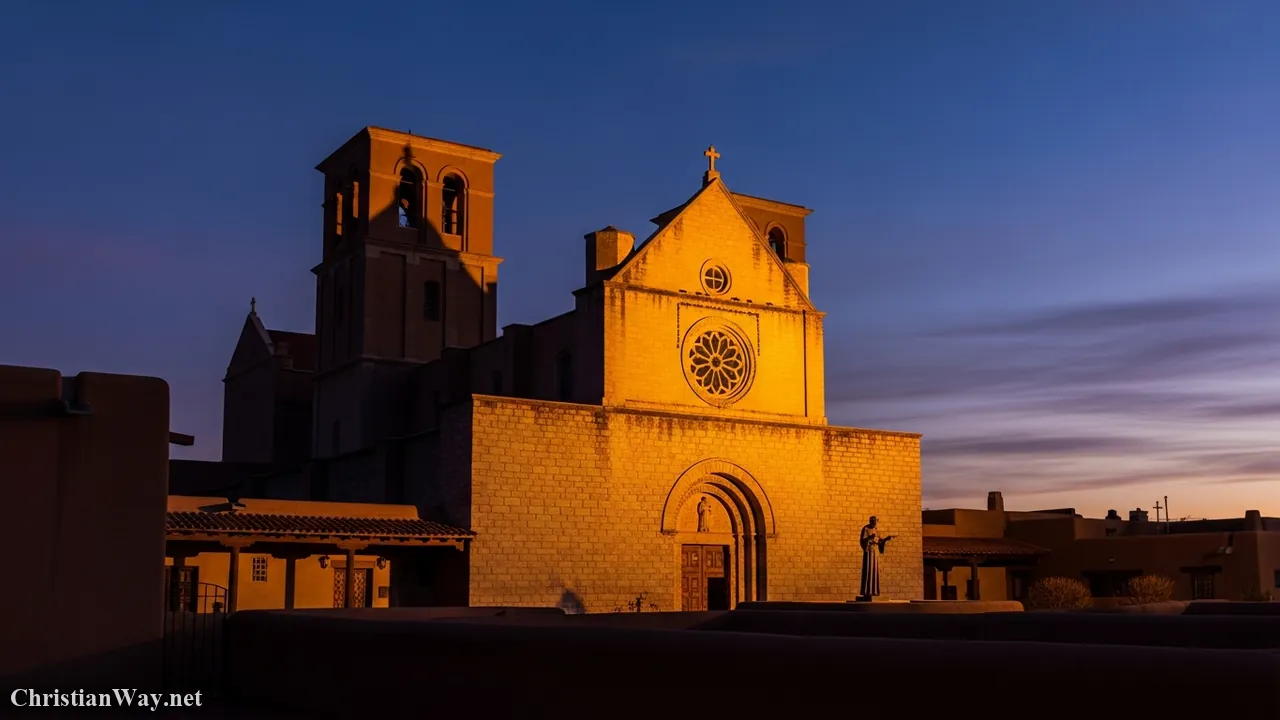
Theologically, this basilica reminds us of the complex, sometimes painful, yet enduring weaving together of cultures under the banner of Christ. Inside, the La Conquistadora chapel houses the oldest Madonna statue in the United States, a poignant symbol of continuity amidst centuries of change. The basilica stands as a testament to the Incarnation—that Christ enters into specific cultures, times, and places, sanctifying the soil and the history of a people.
For us today, the Santa Fe basilica is a call to recognize the diverse tapestry of the Church. It challenges us to see how faith can flourish in arid lands—both physically and spiritually. When we feel parched in our own walk, we might look to this enduring sentinel in the desert and remember Isaiah’s promise that the Lord will “make the wilderness glad” and the desert “blossom as the rose.”
Spiritual Highlights:
- Home to La Conquistadora, Our Lady of Peace, the oldest Madonna statue in the U.S.
- A striking example of French Romanesque architecture in the American Southwest.
- “The wilderness and the dry land shall be glad, the desert shall rejoice and blossom…” (Isaiah 35:1)
Top 9. Basilica of the National Shrine of St. Elizabeth Ann Seton (Emmitsburg, Maryland)
Moving eastward to the rolling hills of Maryland, we encounter a shrine dedicated to a truly American story of grace. This basilica is not just a church; it is the final resting place of St. Elizabeth Ann Seton, the first native-born citizen of the United States to be canonized a saint. A convert, a widow, a mother, and the foundress of the Sisters of Charity of St. Joseph’s, Mother Seton’s life was one of profound sorrow mingled with unconquerable faith. The basilica itself is a beautiful Italian Renaissance structure, vibrant with color, reflecting the joy that Elizabeth found in her Catholic faith despite her many trials.
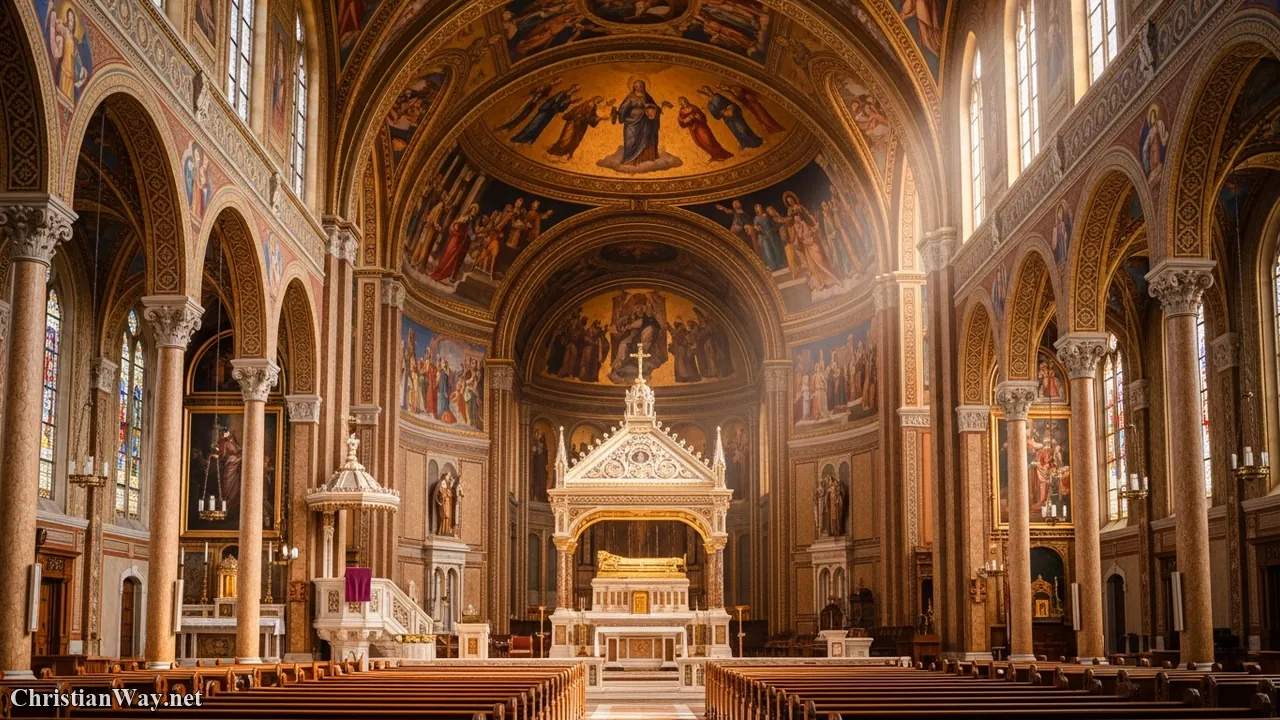
The theological weight of this holy site lies in the “universal call to holiness.” Mother Seton was not a cloistered mystic from a distant medieval past; she was a woman navigating the complexities of early American life, finances, and family, yet she found the path to total surrender to God. Her shrine is a physical manifestation of the truth that sanctity is possible right here, right now, in the midst of our daily duties.
Visually, the basilica is warm and inviting, much like the embrace of a mother. When we visit, or even when we reflect upon her life, we are comforted by the reality that God understands our human struggles. Mother Seton’s oft-quoted advice remains pastoral balm for the anxious modern soul: “Be children of the Church; be children of God.”
Spiritual Highlights:
- Houses the remains of the first native-born American saint.
- Built in a vibrant Italian Renaissance style, completed in the mid-20th century.
- A pilgrimage site dedicated to Catholic education and service to the poor.
Top 8. Cathedral Basilica of the Assumption (Covington, Kentucky)
Just across the Ohio River from Cincinnati sits a jewel of Gothic architecture that many might not expect to find in Kentucky. The Cathedral Basilica of the Assumption is a breathtaking testament to the immigrant faithful who sought to recreate the grandeur of Notre Dame de Paris in their new Appalachian home. Its exterior is imposing, featuring gargoyles and flying buttresses, but it is the interior that truly lifts the soul toward heaven. The space is defined by soaring ribbed vaults and an overwhelming sense of verticality, designed to draw the eye upward.
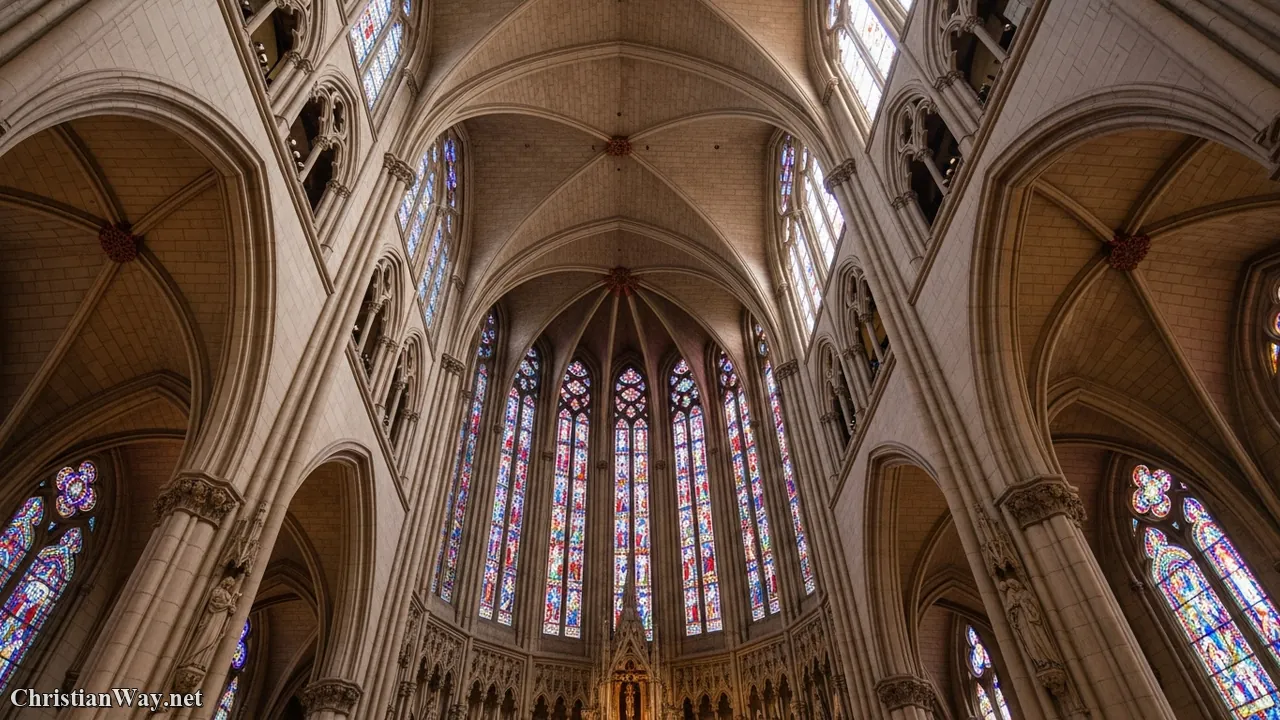
The true glory of Covington, however, is its glass. It boasts one of the largest handmade church stained-glass windows in the world, depicting the Council of Ephesus proclaiming Mary as the Mother of God. The theology here is one of light. Just as the sunlight is fractured into a kaleidoscope of brilliant colors by the windows, so too is the pure light of Christ refracted through the lives of the saints and the teachings of the Church, illuminating our darkened world with beauty.
In a world often obsessed with utility and function, this basilica is a necessary reminder of the value of “wasteful” beauty poured out for God. It challenges us: do we offer God only what is practical, or do we, like the woman with the alabaster jar, offer Him something beautiful simply because He is worthy?
Spiritual Highlights:
- Modeled after Notre Dame de Paris and the Abbey Church of St. Denis.
- Features the immense North Transept window, one of the world’s largest.
- “God is light; in him there is no darkness at all.” (1 John 1:5)
Top 7. Basilica of Saint Mary (Minneapolis, Minnesota)
As we journey north to the “Land of 10,000 Lakes,” we arrive at a pivotal landmark in American Catholic history. The Basilica of Saint Mary in Minneapolis holds the distinct honor of being the very first church in the United States to be designated a basilica by Pope Pius XI in 1926. This designation marked a turning point, a recognition by Rome that the Church in America had come of age. Architecturally, it is a stunning example of Beaux-Arts design, boasting a magnificent copper dome that has been a beacon on the city skyline for over a century.
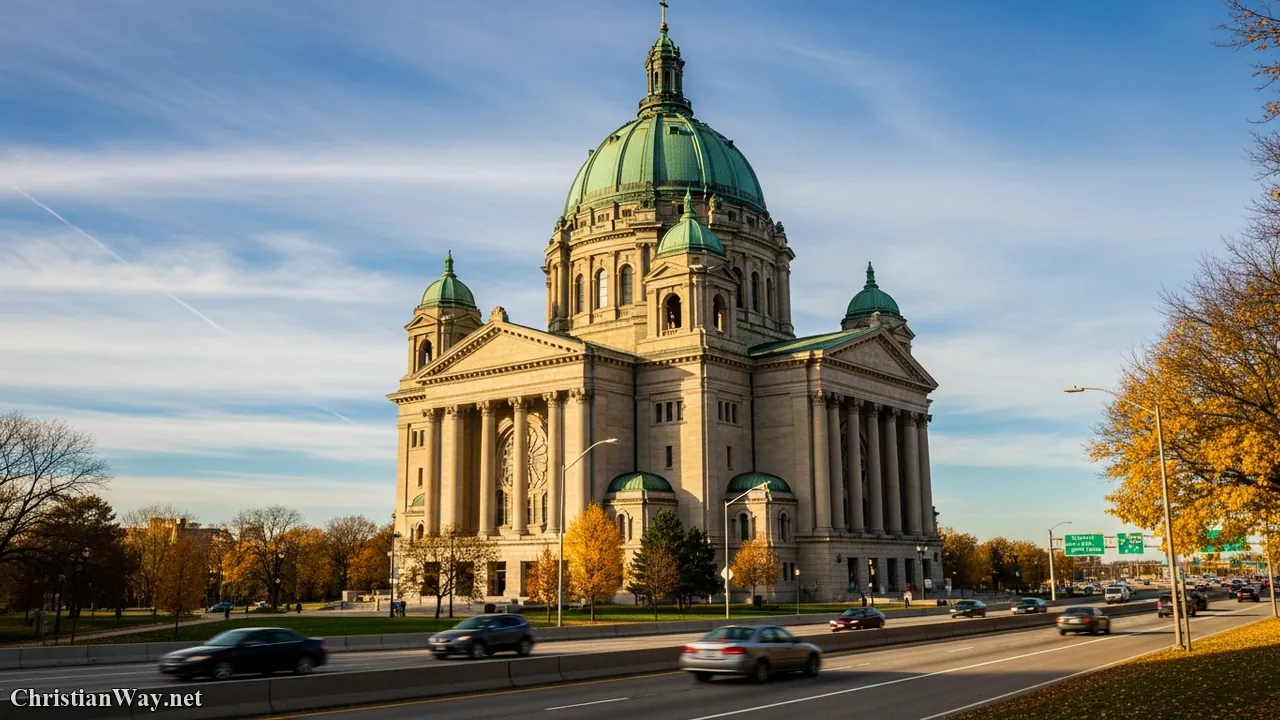
Theologically, Saint Mary’s serves as a powerful symbol of the Church as a “Shelter for Souls.” Built to accommodate the booming immigrant populations of the early 20th century, its vast, open nave with wide arches was designed so that every person, no matter how poor or marginalized, could clearly see the altar and feel included in the Eucharistic sacrifice. It is a structure that speaks of the universal welcome of Christ.
Today, situated next to a busy interstate highway, the basilica stands as a sanctuary of silence amidst the noise of modern life. It reminds us that the sacred is not far away, hidden in a remote monastery, but is present right alongside the rushing traffic of our daily routines, inviting us to pause and enter the stillness of God’s presence.
Spiritual Highlights:
- The first minor basilica established in the United States (1926).
- Famous for its grand Beaux-Arts architecture and massive copper dome.
- Known historically as a welcoming spiritual home for diverse immigrant communities.
Top 6. Cathedral Basilica of Saint Louis (The New Cathedral) (St. Louis, Missouri)
In the hearthouse of the nation, St. Louis, we find an architectural wonder that defies adequate description. The “New Cathedral,” as it is locally known to distinguish it from the older basilica down the road, looks impressive from the outside, featuring a blend of Romanesque and Byzantine styles. But stepping through the doors is akin to stepping into a jewelry box. The interior contains one of the largest mosaic collections in the world, covering nearly every surface of domes, ceilings, and arches—some 83,000 square feet of art made from tens of millions of glass tesserae.
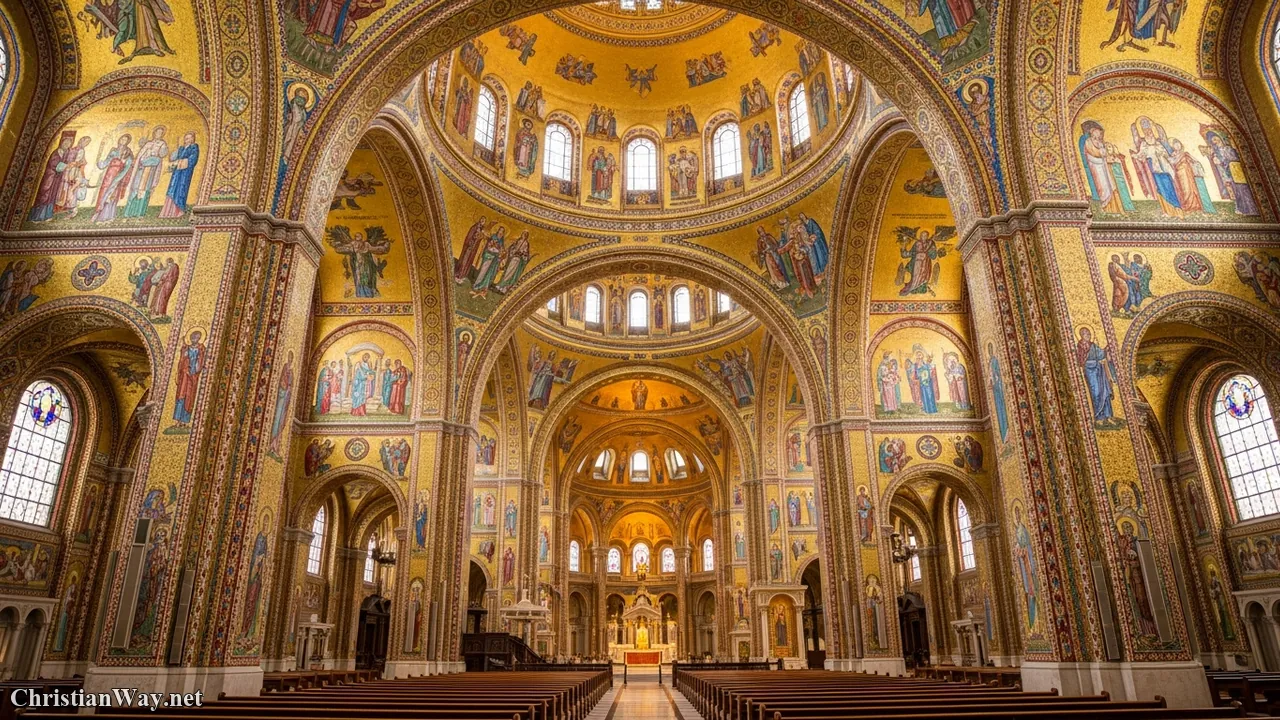
The theology of this basilica is profoundly communal. A mosaic is formed by millions of tiny, individual pieces, each perhaps insignificant on its own. Yet, when placed together by the hand of the master artist, they form a glorious, coherent image of Christ and His saints. This is a vivid image of the Body of Christ, the Church. We are the individual stones, different in color and shape, but essential to the grand design God is working out in history.
To visit this basilica is to be overwhelmed by splendor. It serves as a pastoral corrective to a sometimes overly casual approach to the divine. It reminds us of the transcendent majesty of God—that He is awe-inspiring, holy, and worthy of our very best efforts in art and architecture.
Spiritual Highlights:
- Contains one of the largest mosaic installations in the Western Hemisphere.
- Took nearly 80 years for the mosaic work to be fully completed.
- The mosaics depict the history of salvation and the life of St. Louis IX.
Top 5. Mission Basilica San Diego de Alcalá (San Diego, California)
We return to the West Coast, to the very cradle of Catholicism in the western United States. Mission San Diego de Alcalá is the first of the 21 California missions, founded by the tireless (and recently canonized) Saint Junípero Serra in 1769. Compared to the ornate cathedrals elsewhere on this list, the Mission Basilica is strikingly simple. Its whitewashed adobe walls and humble espadaña (bell wall) speak of a different kind of grandeur—the grandeur of missionary zeal in a rugged frontier.
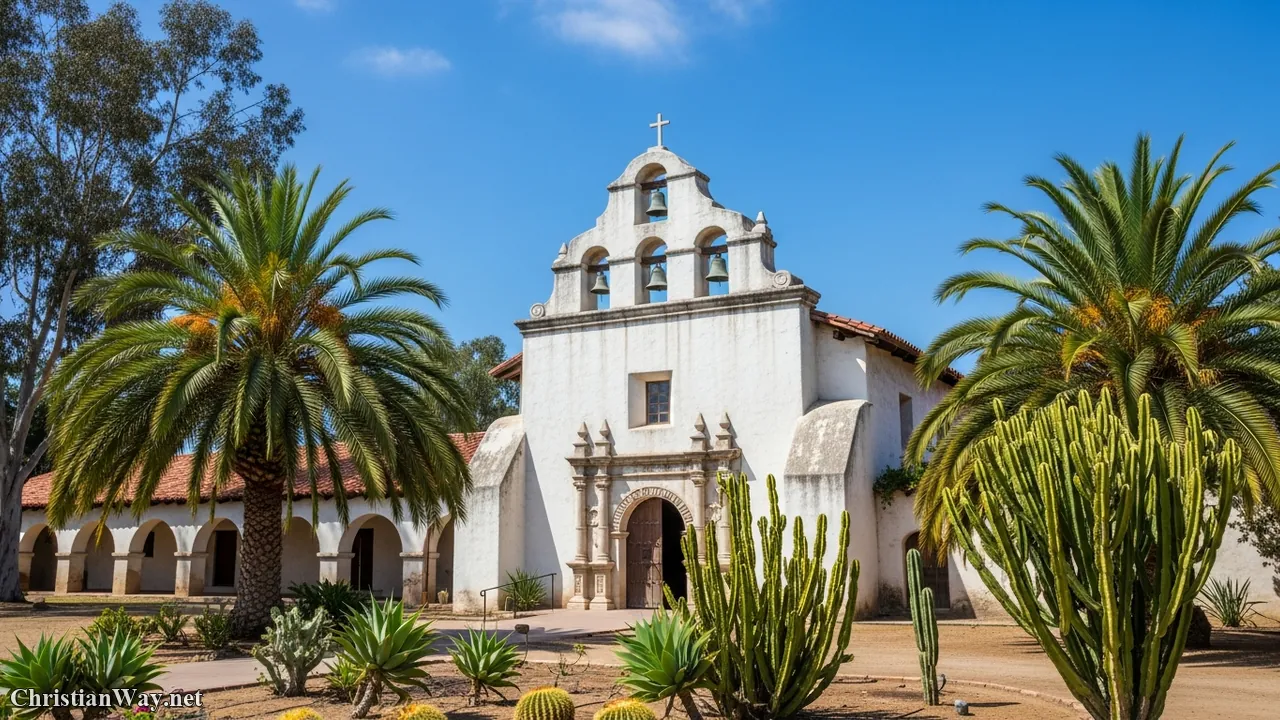
This site carries a weighty, sometimes difficult theological history. It is a place of martyrdom, where blood was shed in the initial encounters between European missionaries and the indigenous peoples. It stands as a complex monument to the mandate to “go and make disciples,” reminding us that the spread of the Gospel has often been fraught with suffering and misunderstanding. Yet, it is also the seed from which the massive vine of faith in the American West grew.
Pastoral reflection here focuses on resilience and roots. The mission has been destroyed by fire and rebuilt, secularized and returned to the Church. It endures. It encourages us to remember that even when our own faith feels simple or threadbare, provided it is rooted in Christ, it can withstand the fires of life and become the foundation for future growth.
Spiritual Highlights:
- The “Mother of the Missions,” the first founded in Alta California (1769).
- Designated a minor basilica in 1976 by Pope Paul VI.
- A site marking the complex beginning of Christianity in the American West.
Top 4. Basilica of the Sacred Heart (Notre Dame, Indiana)
Located on the campus of the University of Notre Dame, the Basilica of the Sacred Heart is the spiritual engine of one of the nation’s premier Catholic universities. This Neo-Gothic masterpiece, with its famous golden dome topped by Our Lady nearby, is a vibrant center of liturgical life. It is renowned for its 116 stained glass windows (among the finest collections of 19th-century French glass in the world) and its intricately painted murals. Yet, despite its academic setting, the basilica exudes a profound warmth dedicated to the Sacred Heart of Jesus.
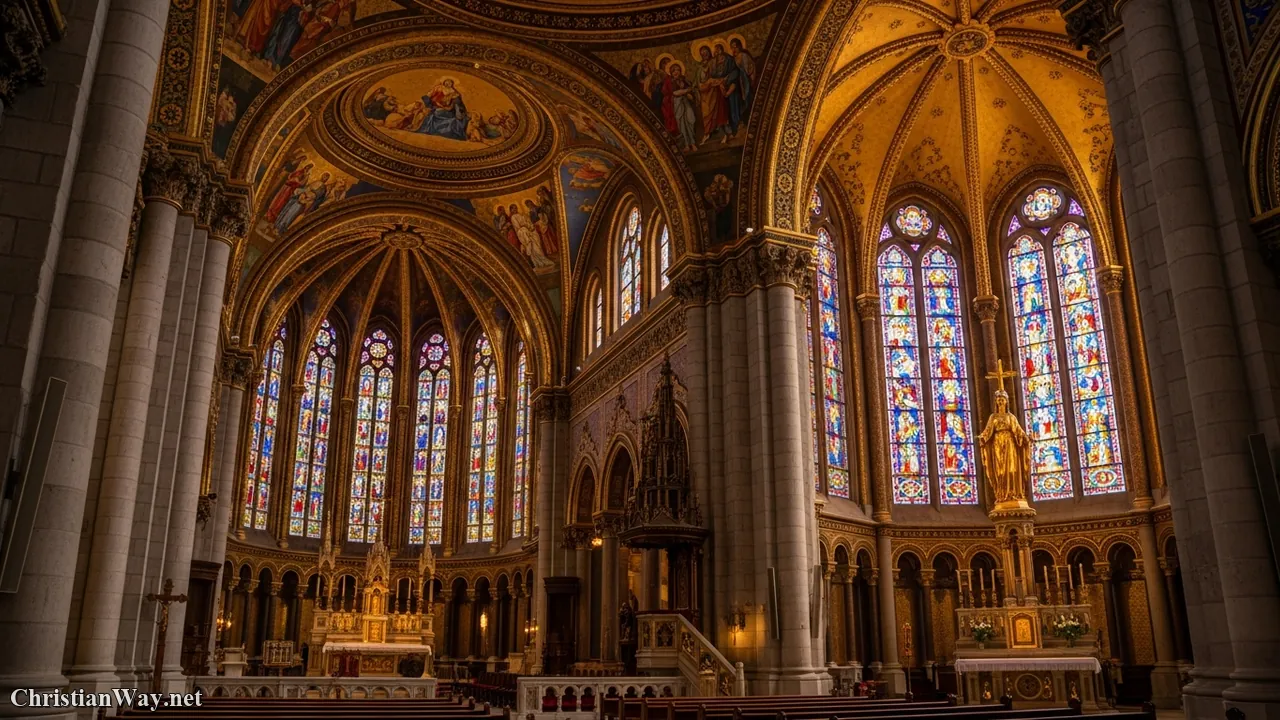
The theology embodied here is the beautiful, necessary synthesis of *fides et ratio*—faith and reason. Standing in the center of a great university, the basilica declares that intellectual pursuit and spiritual devotion are not enemies, but partners. The mind seeks truth, and the heart seeks love, and both find their ultimate fulfillment in Christ.
For the pilgrim, especially the student or the intellectual seeker, this basilica is a comforting reminder that we do not have to check our brains at the door of the church. God desires our whole being—our intellect included—to be engaged in worship. It is a place where the earnest questions of the mind can be laid to rest in the burning love of the Heart of Christ.
Spiritual Highlights:
- The primary place of worship for the University of Notre Dame du Lac.
- Features extensive murals by Vatican painter Luigi Gregori.
- Contains the Reliquary Chapel with hundreds of relics of the saints.
Top 3. Basilica of St. Louis, King of France (The Old Cathedral) (St. Louis, Missouri)
We return to St. Louis to visit the “Old Cathedral,” a site of immense historical gravity. While the current Greek Revival structure was finished in 1834, this patch of land near the banks of the Mississippi River has been dedicated to church use since 1770, before the founding of the United States. It was the first cathedral west of the Mississippi and the mother church for a vast territory of the American frontier. Its architecture is dignified and simple, reflecting the Republic’s early years, standing in stark contrast to the modern steel Arch that now looms over it.
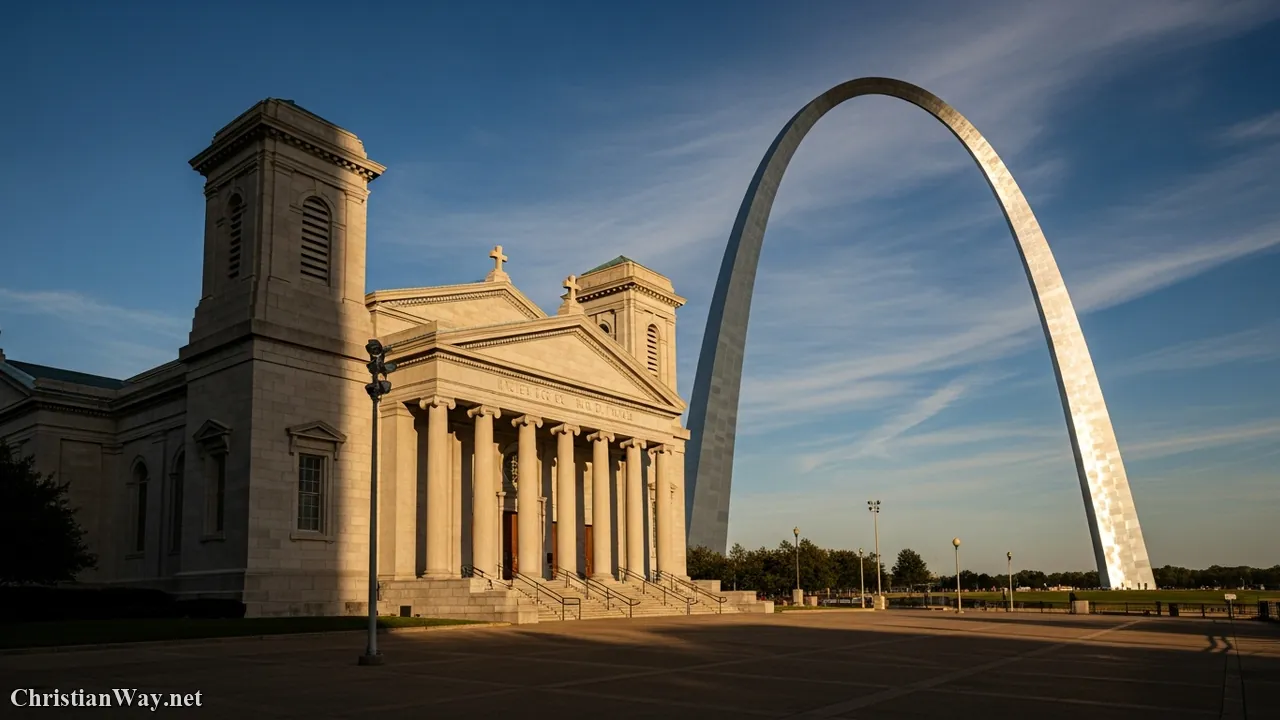
Theologically, the Old Cathedral speaks to us of “apostolic succession” and stability. For centuries, amidst changing flags (French, Spanish, American), booming populations, and westward expansion, this altar has remained. Masses have been offered here continuously through wars, depressions, and floods. It is a tangible anchor in the swiftly flowing river of time.
Pastorally, this basilica encourages us to value foundational things. In our own spiritual lives, we often chase the new and exciting, but there is profound grace in returning to the basics—the consistent prayer, the weekly Eucharist, the simple truths of the Creed. Like this old church standing firm by the mighty river, our lives need quiet, unchanging foundations in Christ.
Spiritual Highlights:
- The first cathedral built west of the Mississippi River.
- The site has been continuously occupied by a Catholic church since 1770.
- A beautiful example of Greek Revival architecture in a religious setting.
Top 2. St. Patrick’s Cathedral (New York, New York)
Perhaps the most famous Catholic church in the United States, St. Patrick’s Cathedral on Fifth Avenue in Manhattan is an icon of American Catholicism. When Archbishop John Hughes proposed building this massive Neo-Gothic cathedral in the 1850s, it was considered folly, located too far north of the city center. Today, it stands in the very heart of one of the world’s busiest metropolises, its twin spires soaring upwards, somehow holding their own against the surrounding skyscrapers of commerce.
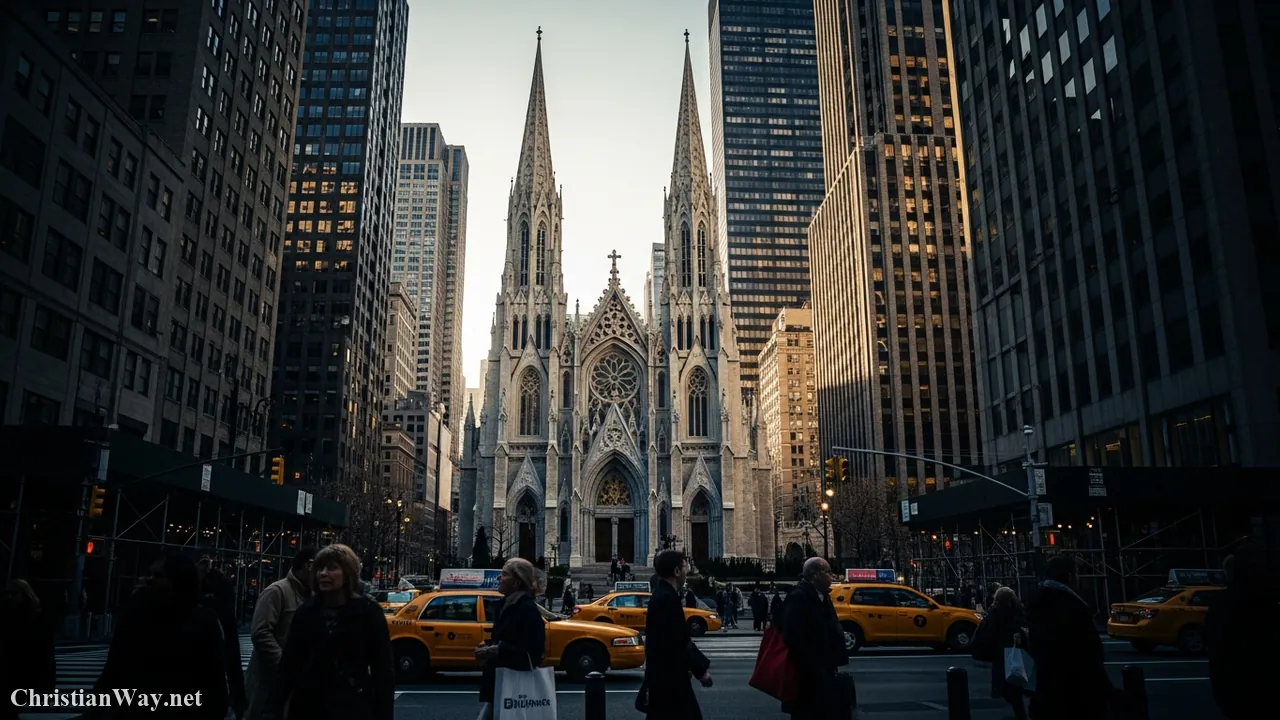
The theology of St. Patrick’s is one of incarnation and witness in the public square. It does not retreat from the world; it stands squarely in the middle of it. Its massive bronze doors open to millions of tourists, shoppers, and seekers every year, offering a sudden, shocking encounter with the transcendent amidst the rush of the secular city. It is a bold declaration that God is present in the city of man.
For the weary modern soul, St. Patrick’s offers a profound lesson in sanctuary. To step off the noisy avenue into its cavernous, quiet interior is to experience immediate relief. It reminds us that we all need a “cloister in the heart”—an interior space where we can retreat to be with God, even when the noise of the world is raging around us.
Spiritual Highlights:
- The largest Decorated Neo-Gothic-style Catholic cathedral in North America.
- The seat of the Archbishop of New York, welcoming millions of visitors annually.
- “My house shall be called a house of prayer for all peoples.” (Isaiah 56:7)
Top 1. Basilica of the National Shrine of the Immaculate Conception (Washington, D.C.)
Our journey concludes in the nation’s capital at the Basilica of the National Shrine of the Immaculate Conception. This is the preeminent Marian shrine of the United States, built by the collective effort of American Catholics to honor the Immaculate Conception as the Patroness of the nation. It is among the ten largest churches in the world, a massive structure blending Byzantine and Romanesque styles, dominated by its great dome adorned with vivid blue and gold mosaic tiling.
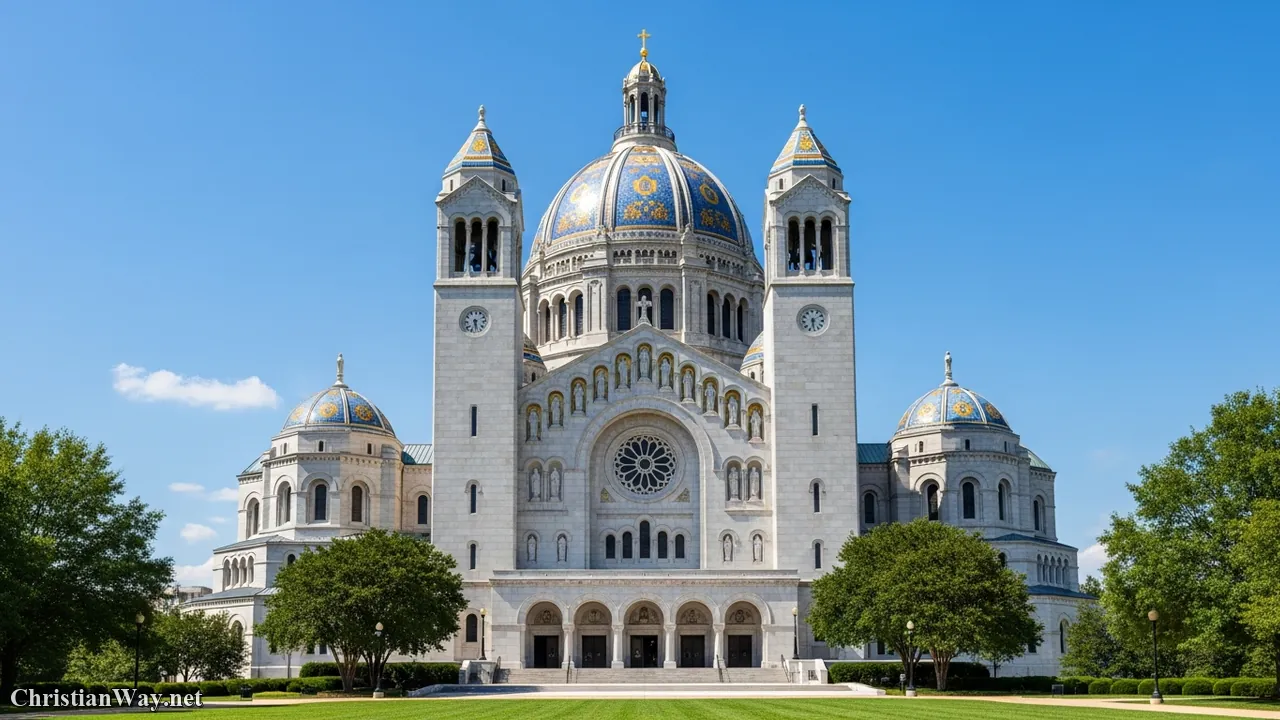
The theology of the National Shrine is intrinsically tied to Mary, the Mother of God, and her relationship to the Church in America. The upper church emphasizes her glorious role as Queen, while the vast crypt church below focuses on her humanity and motherhood. The shrine contains dozens of chapels dedicated to different cultural manifestations of Mary—from Our Lady of Guadalupe to Our Lady of La Vang—showing how the diverse tapestry of American Catholicism finds unity in her maternal embrace.
Pastorally, this is America’s “Catholic Home.” It is a place of immense pilgrimage, where the scale of the architecture matches the scale of the prayers offered there for the nation and the world. To visit here is to feel part of something much larger than oneself, to feel tucked under the mantle of the one who always points us to her Son, saying, “Do whatever He tells you.”
Spiritual Highlights:
- The largest Catholic church in the United States and North America.
- Dedicated to the Patroness of the United States, the Immaculate Conception.
- Features over 80 chapels and oratories honoring Mary from diverse cultures.
Reflecting on These Houses of God
My dear friends, as we conclude this pilgrimage in words, let us remember that these magnificent structures are made of dead stone, but they are brought to life by the “living stones”—you and me—who worship within them. They are foretastes of the heavenly Jerusalem, the eternal city where we will worship God face-to-face.
I encourage you, if the opportunity arises, to visit one of these basilicas not merely as a tourist, but as a pilgrim. Step inside, sit in the silence, look at the light filtering through the glass, and let the beauty raise your mind to the Source of all beauty. Let these spaces remind you that God desires to dwell with His people.
Let us pray. Almighty God, who desires to be adored in spirit and in truth, we thank you for the gift of these sacred places in our land. May they ever remain sanctuaries of peace, beacons of truth, and houses of prayer where weary souls find rest in You. Through Christ our Lord. Amen.
— Fr. John Matthew, for Christian Way