Welcome, beloved friends.
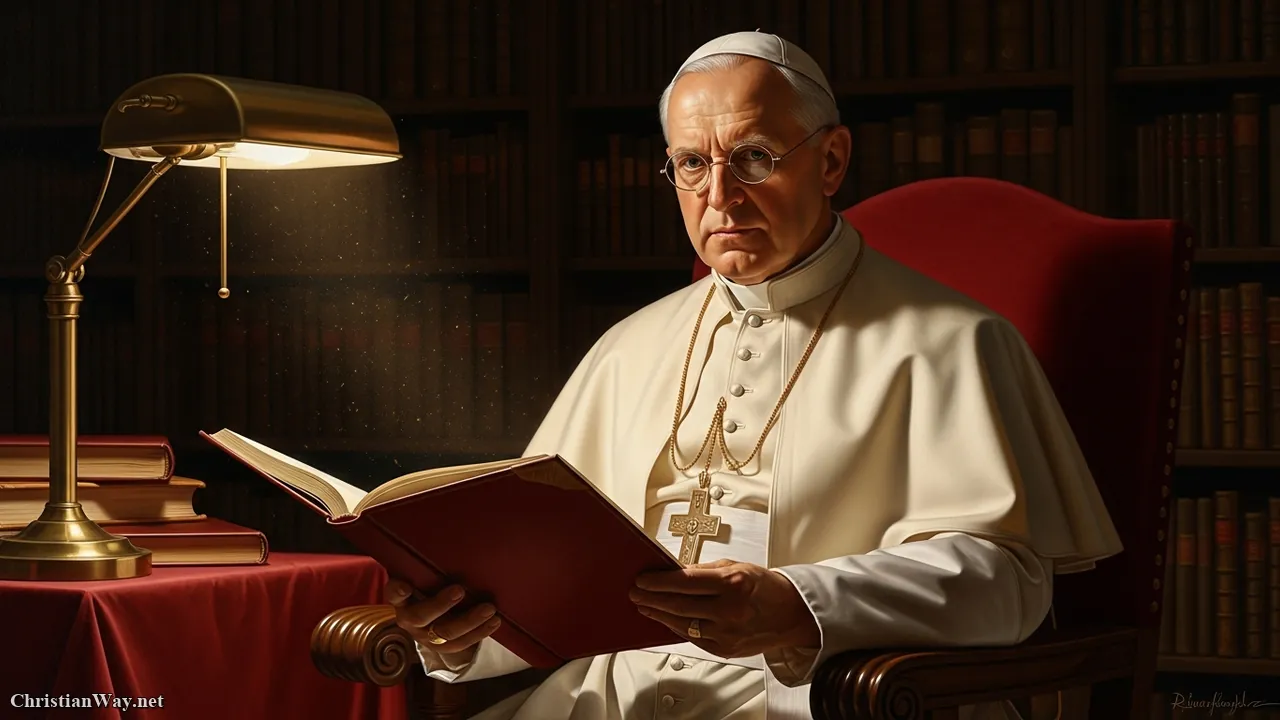
As we navigate the closing months of 2025, the Universal Church finds herself in a moment of profound reflection. With the Chair of Peter now occupied by Pope Leo XIV, the eyes of the faithful have naturally turned back to his namesake and inspiration: Pope Leo XIII. We often speak of “prophets” in the Old Testament sense, but history occasionally grants us a Pontiff whose vision pierces through the fog of centuries. Leo XIII was such a man. He was the “Lumen in Caelo” (Light in the Sky)—a fragile, brilliant intellectual who ascended the throne of Peter when the world declared the Papacy dead, only to reign for 25 years and birth the modern social doctrine of the Church. While he has not yet been raised to the altars as a canonized Saint, his holiness, intellect, and prophetic warnings regarding culture, labor, and spiritual warfare make him a giant upon whose shoulders we currently stand. Let us open the archives of this “Grand Old Man of the Vatican.”
Profile of Holiness
| Attribute | Detail |
|---|---|
| Birth Name | Vincenzo Gioacchino Raffaele Luigi Pecci |
| Lifespan | March 2, 1810 – July 20, 1903 |
| Birthplace | Carpineto Romano, Papal States (Italy) |
| Service Period | 1878 – 1903 (Papacy) |
| Feast Day | N/A (Not Canonized) |
| Patronage | (Unofficial) Christian Workers, Social Justice, Rosary Devotion |
| Key Virtue | Intellectual Prudence & Justice |
The Cradle of Grace: Historical Context & Early Life
To understand Vincenzo Pecci, one must first breathe the dusty, turbulent air of 19th-century Italy. Born on March 2, 1810, in the hill town of Carpineto Romano, Vincenzo entered a world in flux. Napoleon Bonaparte had ravaged Europe, dragging Popes into exile and shattering the old monarchies. The Pecci family were minor nobility—devout, somewhat austere, and deeply loyal to the Holy See. Young Vincenzo was a brilliant, fragile boy, displaying an aptitude for Latin verse and theology that would later define his papacy.
He was educated by the Jesuits in Viterbo and later at the Collegio Romano. These were not years of peace; they were years of revolution. The “Risorgimento” (Italian Unification) was bubbling, threatening to strip the Pope of his earthly territories. In this cauldron, God was forging a man who could fight not with a sword, but with a pen. Unlike the robust, outdoorsy saints like John Paul II, Pecci was a man of the library and the altar. He was ordained in 1837, and his early priesthood was marked not by parish picnics, but by grit. Sent to govern the lawless province of Benevento, the young priest-delegate dismantled rings of smugglers and brigands, proving that behind his gaunt, pale face lay a spine of steel.
The Turning Point: Vocation and Conversion
We often look for a “Damascus Road” moment in the lives of holy men, but for Leo XIII, his vocation was a “long obedience in the same direction.” His turning point was perhaps less spiritual and more geopolitical. In 1846, he was appointed Bishop of Perugia, a position he would hold for thirty-two years. It was here, in what he called his “exile” from Rome, that the future Pope confronted the modern world.
As Bishop, he watched as the Papal States were invaded and annexed. He saw the Church stripped of her temporal power, her monasteries confiscated, and her influence mocked by secularists. It was a dark night of the soul for the Church in Italy. Yet, Pecci did not retreat into bitterness. Instead, he began to write. He realized that if the Church could no longer command armies or collect taxes, she must command the intellect and the heart. He renovated the seminary, championed the philosophy of St. Thomas Aquinas to combat modern errors, and established savings banks for the poor farmers. He was learning that the Church’s true power was not in land, but in her ability to speak the truth about human dignity. The “Prisoner of Perugia” was preparing to become the “Prisoner of the Vatican.”
The Great Labor: Ministry and Mission
In 1878, Pope Pius IX died after the longest reign in history. The Cardinals gathered, looking for a transitional Pope—someone older, moderate, who wouldn’t rock the boat while the Church figured out how to survive without a kingdom. They chose the 68-year-old Cardinal Pecci. He took the name Leo XIII.
They expected a caretaker; they got a lion. Physically, he was almost transparently thin, his skin like parchment, but his eyes burned with life. He immediately set about engaging the world. He was the first Pope to be filmed (a clip from 1896 still exists, showing him blessing the camera), and he opened the Vatican Secret Archives to scholars, famously declaring, “The Church has nothing to fear from the truth.”
His ministry was defined by a refusal to let the Church be relegated to the sacristy. He engaged with the French Republic, with Bismarck in Germany (ending the Kulturkampf persecution), and even with the distant United States. But his greatest labor was his defense of the working class. In the 19th century, the Industrial Revolution was grinding men, women, and children into dust. Unbridled capitalism treated humans like cogs; reacting to this, socialism proposed stripping them of property and faith. Leo stepped into the breach.
The Teacher of Souls: Theological & Spiritual Legacy
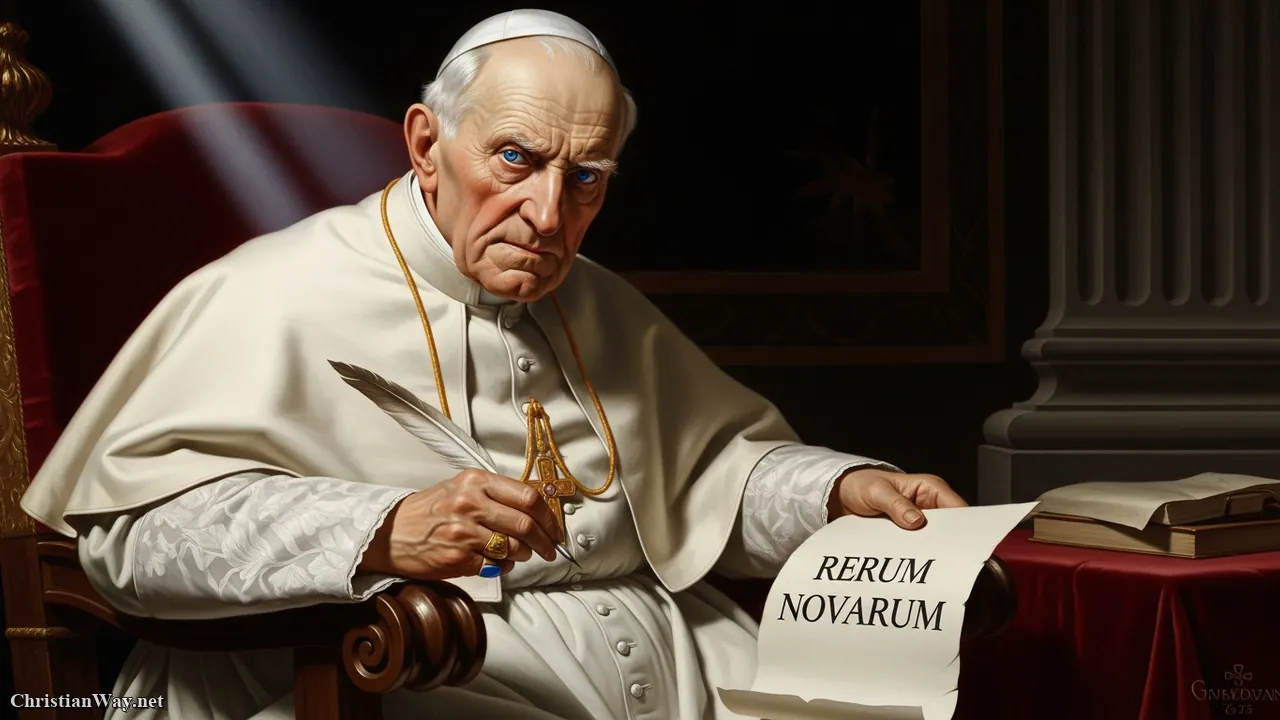
Leo XIII is the undisputed father of Catholic Social Teaching. His 1891 encyclical, Rerum Novarum (Of New Things), remains one of the most important documents in Church history. In it, he radically defended the rights of workers to form unions, to earn a living wage, and to own private property. He wrote:
“It is neither justice nor humanity so to grind men down with excessive labor as to stupefy their minds and wear out their bodies… No man may with impunity outrage that human dignity which God Himself treats with great reverence.”
This was revolutionary. He occupied the middle ground between the errors of socialism and the cruelty of liberalism. In our current year of 2025, Pope Leo XIV has frequently cited Rerum Novarum when discussing the “new industrial revolution” of Artificial Intelligence, proving the timelessness of Leo XIII’s intellect.
But he was also a mystic. Known as the “Rosary Pope,” he wrote a staggering eleven encyclicals on the Rosary. He saw the Rosary not just as a prayer, but as a “spiritual weapon” for the family. Furthermore, the famous Prayer to St. Michael the Archangel is his legacy. After a terrifying vision on October 13, 1884, where he allegedly heard Satan boast of his power to destroy the Church, Leo composed the prayer that we still recite today at the end of Mass in many dioceses. He taught us that the battle for the world is, effectively, a battle for the soul.
The Via Dolorosa: Suffering, Death, and Sainthood
Leo XIII’s suffering was largely hidden. He lived as a “prisoner” within the Vatican walls, never setting foot in Rome proper as a protest against the Italian state’s seizure of Church property. This confinement was a 25-year martyrdom of isolation. He missed his beloved Umbrian mountains, yet he never complained, channeling his energy into poetry (he was a master of Latin verse) and prayer.
As he surpassed the age of 90, he became a living icon of endurance. On his deathbed in July 1903, he dictated poetry until the very end. His last words were reported to be a whisper of the office he held: “To the Church… to the Church.” He died on July 20, 1903, at the age of 93.
Status of Canonization: It is a curiosity of history that Leo XIII is not yet canonized. While his successor Pius X was quickly raised to the altars, Leo remains a “Servant of God” in the broad sense, though no active miracle-based cause is currently dominating the headlines like that of the recently canonized millennials (Acutis and Frassati). However, with the election of his namesake, Pope Leo XIV, there is a renewed fervor and hope that the “Social Pope” might finally be recognized for his heroic virtue. He stands as a testament that one can be holy without being a mystic wonder-worker; one can be holy by engaging the intellect for the glory of God.
Spiritual Highlights: Lessons for the Modern Christian
What does a Pope from the 1890s have to say to us in 2025? Everything.
- The Dignity of Labor: Your work matters. Whether you are coding in a high-rise or caring for a home, Leo reminds us that work is a participation in God’s creation, not just a way to pay bills.
- Intellectual Courage: Do not fear science or history. Leo opened the archives and the observatories. He teaches us that “Truth cannot contradict truth.” Faith and reason are allies.
- The Weapon of the Rosary: When the culture seems hostile, do not despair—pray. Leo believed the Rosary was the chain that binds us to God and breaks the chains of sin.
- Steadfastness: Leo was a “prisoner” for 25 years. He teaches us that even when our physical circumstances are limited, our spiritual reach is infinite.
A Prayer for Intercession
(For the glorification of Pope Leo XIII and the rights of all workers)
O God, Shepherd and Ruler of all the faithful, who didst choose Thy servant Leo XIII to preside over Thy Church during times of great change and turmoil; grant us, we pray, the grace to follow his example of intellectual clarity and compassionate justice. May his teachings on the dignity of the human person and the sanctity of the Rosary continue to light our path. We pray that, if it be Thy will, he may one day be raised to the honors of the altar, serving as a patron for those who labor and those who seek the truth. Through Christ our Lord. Amen.
— Fr. John Matthew, for Christian Way