Dear friends in Christ,
There are moments in the history of the Church when the world seems to tremble beneath the weight of uncertainty. Nations are shaken, violence approaches, false teachings spread confusion, and ordinary believers wonder whether the faith handed down by the Apostles can remain firm amid so many storms. In such moments, God often raises up a shepherd whose courage is not loud or proud, but rooted deeply in prayer, truth, and love. Saint Leo the Great, also known as Pope Leo I, was one such shepherd.
He lived in the fifth century, during a troubled age for both the Church and the Roman world. The Western Roman Empire was weakening, foreign armies threatened Italy, and serious theological disputes challenged the Christian understanding of who Jesus Christ truly is. Yet Leo did not respond to these dangers with fear. He stood before the confusion of his age with the steady faith of a man who knew that the Church belongs not to human rulers, scholars, or armies, but to Christ Himself.
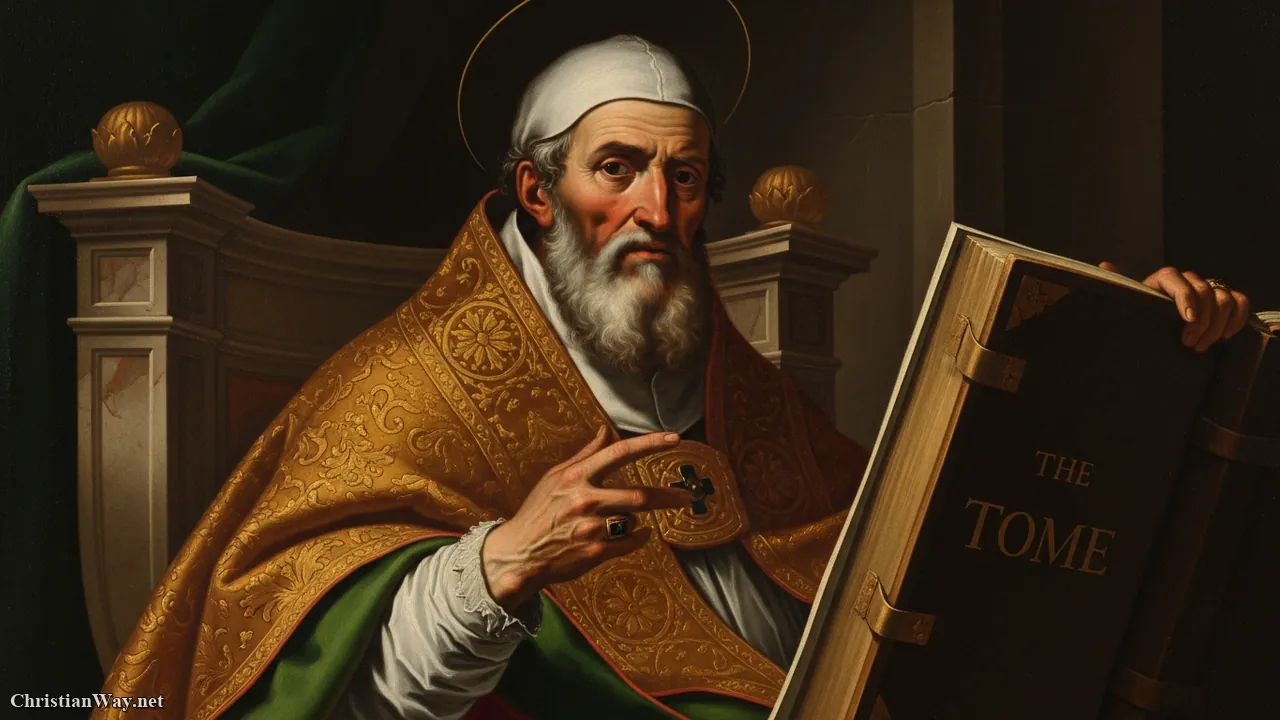
Saint Leo served as Bishop of Rome from 440 until his death in 461. His papacy became one of the most important in early Christian history because of his defense of the Incarnation, his pastoral care for the poor, his work for the unity of the Church, and his courage in times of political danger.
To remember Saint Leo the Great is not simply to look back at an impressive figure from the distant past. His life speaks gently but powerfully to every Christian who feels surrounded by uncertainty. He reminds us that truth is not a cold set of ideas. Truth has a face. Truth is Jesus Christ, true God and true man, who entered our weakness so that we might share in His life.
A Shepherd Raised Up in a Time of Crisis
The world into which Leo served as Pope was deeply unsettled. The Roman Empire, once powerful and secure, was beginning to collapse under political division, economic hardship, and military invasion. Cities were vulnerable. Families feared violence and displacement. Many people felt that the world they knew was disappearing before their eyes.
Yet the troubles outside the Church were not the only dangers. Within Christian communities, serious questions were being asked about the identity of Jesus Christ. Was He truly God? Was He truly human? Could His divine nature and human nature both be real without confusion? These questions may sound distant from the concerns of daily life, but they reach into the very heart of salvation.
If Jesus were not truly God, then He could not reveal the Father perfectly or bring humanity into divine life. If Jesus were not truly human, then He could not truly enter our suffering, our weakness, our tears, our death, and our need for redemption. The Christian faith rests upon this sacred mystery: the eternal Son of God truly became one of us without ceasing to be God.
Saint Leo understood that this was not a matter for scholars alone. It was a matter for every person who kneels in prayer, receives the Eucharist, mourns a loved one, asks forgiveness, and hopes for eternal life. The question of who Christ is becomes the question of whether God has truly drawn near to us.
Christ Is Truly God and Truly Man
The Gospel of John opens with words that continue to shine across the centuries: “And the Word was made flesh, and dwelt among us” (John 1:14). In this one sentence, the heart of Christianity is revealed. The eternal Word did not merely appear human. He did not merely visit humanity from a distance. He became flesh. He entered our world, our history, our hunger, our weariness, our pain, and even our death.
Saint Leo defended this truth with remarkable clarity. He taught that Jesus Christ is one Person, the eternal Son of God, who possesses both a complete divine nature and a complete human nature. His divinity was not diminished by His humanity, and His humanity was not swallowed up by His divinity.

This matters deeply for the soul. When we pray to Jesus, we are praying to God Himself. When we see Jesus weeping at the tomb of Lazarus, we see that God is not indifferent to human sorrow. When Jesus touches the leper, speaks to the sinner, feeds the hungry, and forgives those who crucify Him, we see the very compassion of God made visible in human life.
Saint Leo expressed this mystery in language that has nourished Christian faith for centuries. He taught that in Christ, majesty took on humility, strength accepted weakness, eternity entered mortality, and the One who could not suffer accepted suffering for our salvation.
This is the mystery of Christmas, Good Friday, Easter, and every Mass. The God who created the stars allowed Himself to be held in the arms of Mary. The Lord of heaven and earth became weary on the road. The Judge of all humanity stood before human judges. The One who gives life to the world entered death so that death would no longer have the final word.
The Tome of Leo and the Truth of the Incarnation
Saint Leo’s most famous theological work is known as the Tome of Leo. It was a letter written to Flavian, the Archbishop of Constantinople, during a time of great controversy concerning the person of Christ. In this letter, Leo explained with pastoral strength that Jesus Christ is truly one Lord, one Son, one Savior, both divine and human.
The Church needed this clarity because some were teaching that Christ’s humanity had been absorbed or overwhelmed by His divinity. Others spoke in ways that divided Christ too sharply, as though the Son of God and the man Jesus were somehow separate persons. Saint Leo guarded the faith from both errors.
He proclaimed that Christ is not divided into two persons, nor confused into one mixed nature. Rather, He is one divine Person, the Son of God, who is fully God and fully man. His humanity is real. His divinity is real. His love is real. His suffering is real. His resurrection is real.
This teaching was received at the Council of Chalcedon in the year 451, one of the great councils of the ancient Church. The council affirmed that Jesus Christ is recognized “in two natures, without confusion, without change, without division, without separation.” Leo’s letter was read there, and the bishops received it as a faithful witness to the apostolic faith.
The words of Chalcedon may seem precise and theological, but they are filled with consolation. They tell us that Jesus is close enough to understand every human weakness, yet powerful enough to redeem every human weakness. He knows hunger because He became hungry. He knows grief because He wept. He knows loneliness because He was abandoned. He knows suffering because He carried the Cross.
And because He is truly God, His mercy is not fragile. His forgiveness is not temporary. His victory over sin and death is not merely symbolic. In Christ, God has truly come among us to save us.
The Nearness of Christ in Human Suffering
Many people carry wounds that they do not speak about easily. Some carry grief after losing a loved one. Some carry disappointment after years of effort. Some carry fear for their children, their health, their future, or their marriage. Some carry the silent exhaustion of trying to appear strong when the heart feels weak.
Saint Leo’s teaching reminds us that Christ does not stand at a distance from these wounds. He is not a heavenly idea separated from the reality of ordinary life. He is Emmanuel, God with us.
When you pray in the middle of the night because your heart cannot rest, Christ is with you. When you stand beside a hospital bed, Christ is with you. When you feel ashamed of your failures and wonder whether forgiveness is still possible, Christ is with you. When you are tempted to believe that no one understands your sorrow, Christ is with you.
The Letter to the Hebrews tells us that we do not have a high priest who is unable to sympathize with our weaknesses, but One who has been tested in every way as we are, yet without sin (Hebrews 4:15). This is the faith Saint Leo defended: not a distant God, but a Savior who has entered the depth of human life.
The Christian faith does not deny pain. It does not pretend that suffering is easy. It does not offer shallow comfort. Instead, it proclaims that Jesus Christ has entered the darkness and filled it with His presence. The Cross is still painful, but it is no longer empty. The tomb is still real, but it is no longer final.
Courage Before Attila and the Threat Against Rome
Saint Leo the Great is also remembered for his courage during one of the most dangerous moments in the history of Rome. In 452, Attila the Hun invaded northern Italy, and fear spread across the peninsula. Cities had already suffered terribly, and Rome itself seemed vulnerable.
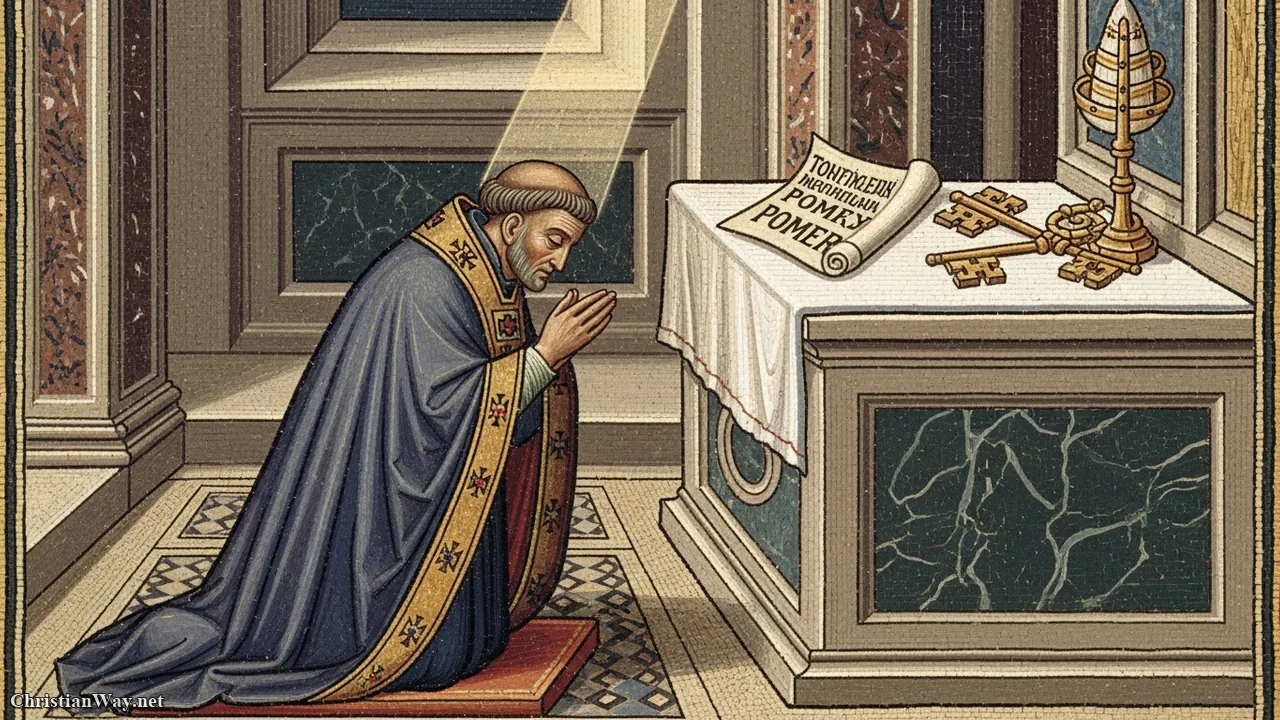
Leo went out as part of a delegation to meet Attila near the River Mincio. Ancient sources record that after this meeting, Attila withdrew from Italy. The exact political and military reasons for Attila’s decision are complex, but the meeting became a lasting symbol of Leo’s courage and willingness to stand before danger for the sake of his people.
There is a later Christian tradition that Attila saw the Apostles Peter and Paul standing beside Leo with drawn swords, warning him not to attack Rome. Whether one reads this story as history, spiritual tradition, or sacred imagination, its message is clear: the Church does not rely merely on human strength. God protects His people in ways that often remain hidden from our eyes.
Leo did not go out to meet Attila because he was certain of success. He went because love does not abandon those entrusted to its care. A shepherd does not run away when danger comes. A father does not turn away when his children are afraid. A Christian does not remain silent when others need courage.
There are many forms of courage. Sometimes courage is standing publicly for the truth. Sometimes it is defending someone who is being treated unjustly. Sometimes it is refusing to join in gossip or cruelty. Sometimes it is admitting that we are wrong. Sometimes it is remaining faithful to prayer when we feel nothing at all.
Saint Leo teaches us that courage is not the absence of fear. Courage is faithfulness in the presence of fear.
The Strength That Comes from Prayer
The courage of the saints is often misunderstood. We imagine that they never felt weakness, hesitation, or uncertainty. But the saints were human. They knew their own limitations. Their strength did not come from confidence in themselves. It came from confidence in God.
Saint Leo did not face the dangers of his age as a political hero seeking fame. He faced them as a servant of Christ. His strength was rooted in the conviction that the Church is built upon the rock of faith in Jesus Christ.
Jesus said to Peter, “Thou art Peter, and upon this rock I will build my church; and the gates of hell shall not prevail against it” (Matthew 16:18). These words do not promise that the Church will never suffer. They do not promise that Christians will never face persecution, division, weakness, or scandal. But they do promise that Christ will remain faithful to His Church.
In every century, the Church has faced storms. There have been divisions, failures, heresies, persecutions, and moments when many believed that faith was fading away. Yet Christ remains. The Gospel remains. The Eucharist remains. The communion of saints remains. The mercy of God remains.
When we look at the world today, we may also feel surrounded by instability. Families face pressure. Young people face confusion. Many hearts are lonely despite constant communication. Many people feel rich in possessions but poor in peace. Saint Leo reminds us not to surrender to despair.
The Church does not need Christians who panic at every storm. The Church needs Christians who pray, love, forgive, serve, and remain faithful to Jesus Christ.
A Pope Who Loved the Ordinary Faithful
It would be easy to remember Saint Leo only as a theologian, a pope, or a figure standing before Attila. But beneath all these great moments was the heart of a pastor. He cared deeply for the spiritual and material needs of ordinary people.
His sermons reveal a man who spoke directly to the faithful about prayer, fasting, almsgiving, humility, the sacraments, and the Christian life. He did not treat theology as something distant from daily life. For him, the mystery of Christ was meant to shape how people treated their neighbors, how they cared for the poor, how they faced temptation, and how they prepared their hearts for the great feasts of the Church.
Saint Leo lived during times of famine, poverty, injustice, and social uncertainty. He encouraged Christians not to turn inward in fear, but to care for those in need. He understood that faith becomes visible through love.
The Letter of James tells us, “Faith without works is dead” (James 2:26). Saint Leo would have understood these words deeply. To confess Jesus Christ as true God and true man must lead us to honor the dignity of every person whom Christ came to save.
This is still true today. We cannot say that we love Christ while ignoring the hungry, the lonely, the elderly, the poor, the rejected, or those who carry burdens that no one sees. The face of Christ appears in the face of those who need mercy.
The Eucharistic Life of the Christian
Saint Leo had a profound understanding of the Eucharist. He taught that in receiving the Body and Blood of Christ, we are drawn more deeply into the life of the One whom we receive. The Eucharist is not merely a reminder of Christ. It is communion with Christ.
When we receive the Lord with faith, He draws us into His death and resurrection. He teaches us to live not for ourselves alone, but for God and for others. He transforms us gradually, patiently, and lovingly.
This is why the Eucharist is so central to Christian life. We do not come to Mass merely to fulfill an obligation or preserve a tradition. We come because we need Christ. We need His mercy. We need His strength. We need His peace. We need to remember who we are when the world tries to tell us that we are only what we own, achieve, fear, or lose.
The world often tells us to build our identity on success, appearance, wealth, or approval. Christ tells us something more beautiful: you are beloved by God. You are called by name. You are forgiven. You are invited into communion. You are not alone.
Saint Leo’s faith points us back to this foundation. The Christian life begins and ends with Christ. Without Him, our efforts become heavy. With Him, even difficult duties can become acts of love.
Unity Rooted in Christ
Saint Leo cared deeply about the unity of the Church. He knew that division wounds the Body of Christ and weakens the witness of the Gospel. Yet he also knew that true unity cannot be built by ignoring truth.
There is a false kind of peace that avoids difficult questions simply to prevent conflict. But Saint Leo understood that peace without truth eventually becomes fragile. A house may look peaceful from the outside while its foundation is quietly cracking beneath it.
True unity comes from remaining close to Christ. It comes from receiving the faith handed down through Scripture, the Apostles, the early councils, and the living worship of the Church. It comes from humility, patience, repentance, and love.
Jesus prayed that His disciples might be one, “that the world may believe” (John 17:21). Christian unity is not merely an internal concern. It is part of the Church’s mission to the world. When Christians forgive one another, serve one another, and seek truth together with humility, the world sees something of Christ’s own love.
Saint Leo’s concern for unity should inspire us today. Christians of different traditions may have real differences in history, theology, and practice. These differences should not be treated carelessly. Yet we are called to speak with respect, to recognize the work of God wherever it is found, and to pray for the healing of divisions.
We must never use truth as a weapon. Truth is meant to lead us to Christ, and Christ always leads us toward love. The One who is “the way, the truth, and the life” (John 14:6) also washed the feet of His disciples.
What Saint Leo the Great Teaches Us Today
Saint Leo lived more than fifteen centuries ago, yet his witness speaks with surprising freshness to modern life.
He teaches us to remain rooted in Christ when the world becomes confused. Every day, countless voices compete for our attention. We are told what to value, what to fear, what to desire, and what to believe. Social media, news, advertising, and constant distraction can leave the soul restless and scattered.
Saint Leo calls us back to the center: Jesus Christ.
When life becomes complicated, return to Christ. When you feel uncertain, return to Christ. When you are tempted by bitterness, return to Christ. When you are tired of carrying your burdens alone, return to Christ.
He also teaches us that faith needs both conviction and tenderness. We must know what we believe, but we must also love the people around us. We must defend truth, but never with cruelty. We must remain faithful to Christ, but never become proud.
A Christian who knows doctrine but has no compassion has not yet allowed doctrine to become prayer. A Christian who speaks constantly about love but has no concern for truth has not yet understood the love of Christ. In Jesus, truth and mercy meet. Justice and peace embrace.
Saint Leo’s life also reminds us that holiness is not reserved for quiet or easy times. Some people think they can become faithful only when life becomes calmer, wealthier, safer, or more predictable. But the saints teach us that grace is available now.
You can become holy in a noisy home. You can become holy in a difficult workplace. You can become holy while caring for children, working long hours, facing illness, grieving loss, or carrying responsibilities that no one else understands.
Holiness is not escape from life. Holiness is Christ living within life.
Reflect and Pray
Dear friends, Saint Leo the Great stood in a world filled with danger, confusion, and uncertainty. Yet he did not allow fear to become his master. He remained close to Christ, defended the truth of the Incarnation, cared for the faithful, sought peace, and trusted that God would not abandon His Church.
May his example strengthen us when our own hearts feel troubled. May we remember that Jesus Christ is not distant from our struggles. He is true God, able to save us; and true man, able to understand us. He is near in every sorrow, every prayer, every act of mercy, and every moment when we choose faith over fear.
Let us pray:
Lord Jesus Christ,
You became truly human for our salvation
while remaining forever one with the Father.
Strengthen us through the example of Saint Leo the Great.
Give us courage to remain faithful in times of confusion,
humility to serve those in need,
and hearts filled with love for Your holy Church.
May Your truth guide us, Your mercy heal us,
and Your peace dwell within us always. Amen.
May the peace of Christ dwell richly in your heart, and may the witness of Saint Leo the Great lead you ever closer to the Savior who is both Lord and Brother.
— Fr. John Matthew