A pastoral reflection on the Holy Spirit as Creator, Giver of Life, and the One who renews all things in Christ’s love today.
Dear friends in Christ,
When we look upon the world with attentive eyes, we encounter a mystery that cannot be reduced to matter, motion, or physical laws alone. We see seeds opening beneath the soil, rivers winding toward the sea, clouds gathering over fields, children awakening to wonder, and human beings reaching for truth, beauty, love, and meaning. Creation is not merely something that happened in a distant beginning. It is a living gift, continually upheld by the wisdom and generosity of God.
At the heart of this mystery is the Holy Spirit.
Many Christians know the Spirit primarily through Pentecost, personal prayer, spiritual gifts, or the sanctifying work of grace. We speak of the Spirit comforting the sorrowful, guiding the Church, convicting us of sin, and forming Christ within us. All of this is true. Yet Scripture reveals that the Holy Spirit’s work reaches much further back than Pentecost and extends far beyond the interior life of the believer. Before there was a Church, before Israel crossed the Red Sea, before Abraham heard the divine call, and before the first human breath entered Adam, the Spirit of God was active in creation.
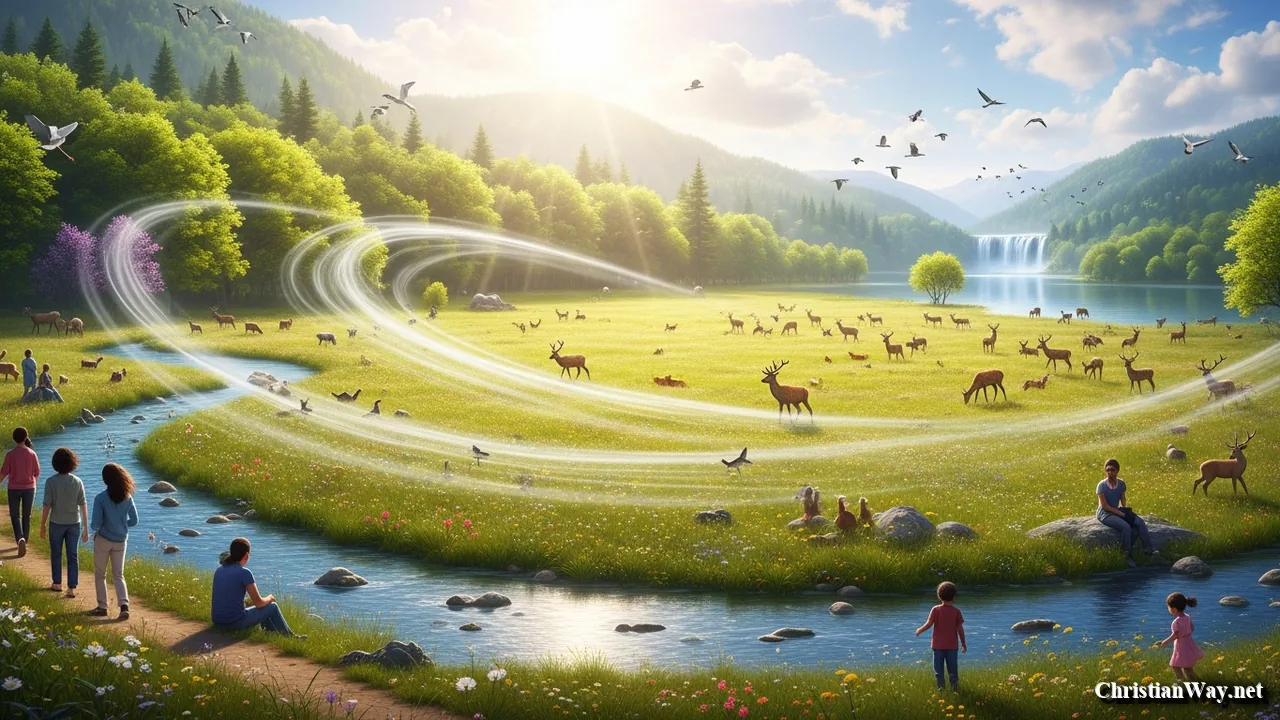
The opening verses of the Bible place the Spirit before us at the very threshold of existence. The earth is described as formless and empty, darkness lies over the deep, and “the Spirit of God was hovering over the waters” (Genesis 1:2). The image is gentle and powerful. The Spirit does not stand far away from the world God is forming. He hovers over it with nearness, intention, and life-giving presence.
To ask, “How does the Spirit work in creation?” is therefore to ask how the living God gives existence, order, vitality, beauty, purpose, and renewal to all that He has made. It is also to ask how creation points beyond itself toward the Creator, how human beings receive the breath of life, and how the same Spirit who moved over the first creation is now preparing a new creation in Christ.
Let us approach this mystery with reverence. We are not merely studying a doctrine. We are learning to recognize the nearness of God in the world around us and to receive creation again as a sacred gift entrusted to our care.
The Holy Spirit Is Present at the Beginning of Creation
The Bible begins not with an argument for God’s existence, but with a declaration: “In the beginning God created the heavens and the earth” (Genesis 1:1). Everything that exists owes its being to God. Nothing created is self-originating, self-sustaining, or independent of Him.
Immediately after this declaration, Scripture tells us that the Spirit of God hovered over the waters. The Hebrew expression can also communicate the sense of wind or breath, and throughout the Bible these images remain closely connected to the Spirit. Wind cannot be seen directly, yet its effects are unmistakable. Breath is hidden within the body, yet it is the sign that life is present. In a similar way, the Holy Spirit works invisibly while bringing forth visible life, order, movement, and fruitfulness.
The Spirit’s presence over the waters reveals that creation is not the work of a distant deity who makes the universe and then withdraws. God is intimately present to what He creates. The world is not abandoned at birth. From the beginning, the Spirit surrounds creation with divine attention.
Some early Christian writers saw in the Spirit’s hovering an image like that of a bird brooding over its young, warming and preparing them for life. This image does not explain the mystery completely, but it helps us feel something of its tenderness. The Spirit is not merely exerting power upon lifeless material. He is bringing creation toward fullness, harmony, and fruitfulness according to the loving will of God.
Creation Is the Work of the Triune God
Christian faith confesses one God in three divine Persons: the Father, the Son, and the Holy Spirit. We must therefore avoid imagining that the Father created one part of the world, the Son another, and the Spirit another. The works of God toward creation are the undivided works of the Trinity.
The Father creates through the Son in the Holy Spirit. The Father is the eternal source, the Son is the divine Word through whom all things are made, and the Spirit is the Lord and Giver of Life who brings creation into living fullness.
The Gospel of John says of the eternal Word, who became flesh in Jesus Christ, “Through him all things were made” (John 1:3). Saint Paul similarly teaches that all things were created through Christ and for Christ (Colossians 1:16). At the same time, Scripture repeatedly presents the Spirit as the One who gives life, sustains creatures, and renews the face of the earth.
These teachings do not compete with one another. They reveal the beautiful unity of God’s action. Creation comes from the Father, through the Son, in the Holy Spirit. The universe bears the mark of divine communion because it proceeds from the God who is eternally Father, Son, and Holy Spirit.
This is one reason creation is relational. Nothing exists entirely by itself. Stars form within galaxies. Trees depend upon soil, water, sunlight, and air. Human beings are born into relationship and grow through love. Creation reflects, in a limited and creaturely way, the wisdom of the God whose own life is perfect communion.
The Spirit Brings Order from Formlessness
Genesis describes the earth as formless and empty before God speaks creation into its ordered beauty. The Spirit hovers over the deep as divine order begins to unfold. Light is separated from darkness. Waters are gathered. Dry land appears. Vegetation springs forth. Living creatures fill sea, sky, and earth.
The biblical account is not intended to function as a modern scientific textbook. Its purpose is deeper: to proclaim that creation is neither divine nor accidental, neither evil nor meaningless. It exists because God freely wills it, orders it wisely, and calls it good.
The Spirit’s work in creation is therefore connected not only with life, but also with harmony. He brings forth distinction without division and diversity without chaos. Day is not night, sea is not land, and humanity is not identical with the other creatures. Yet all belong within one ordered creation and share dependence upon the Creator.
This pattern teaches us something important about the Holy Spirit. The Spirit does not erase the identities of created things. He enables each creature to become what God intends it to be. A cedar glorifies God by being a cedar. A river glorifies God by flowing according to its nature. A bird glorifies God through the life it has received. Human beings glorify God by freely knowing, loving, worshiping, creating, serving, and caring for the world entrusted to them.
The Spirit’s Unity Does Not Destroy Diversity
Sometimes people imagine spiritual unity as sameness. Yet the work of the Spirit in creation shows another kind of unity—a harmony enriched by difference.
A forest is not beautiful because every tree is identical. A human body does not live because every organ performs the same function. Music is not made from one note endlessly repeated. Creation flourishes through an astonishing variety of forms, colors, sounds, movements, and relationships.
The same Spirit who gives unity also delights in abundance. Scripture speaks of creatures “small and great,” of mountains and seas, wild animals and birds, fruit trees and stars, all joining in praise of their Maker. Psalm 104 celebrates this diversity and then declares, “When you send your Spirit, they are created, and you renew the face of the ground” (Psalm 104:30).
The Spirit does not produce a lifeless uniformity. He creates communion. This truth can help Christians understand life within the Church as well. The Spirit does not make every believer identical in personality, culture, vocation, or gift. He draws many members into one body under Christ. The unity of the Spirit is not the destruction of difference, but the healing and ordering of difference in love.
The Spirit Is the Giver of Life
In the Nicene Creed, Christians confess the Holy Spirit as “the Lord, the Giver of Life.” This ancient confession gathers together the testimony of Scripture. Life is not an autonomous possession sealed within creation. It is received from God.
Psalm 104 expresses this dependence with striking clarity. When God hides His face, creatures are troubled. When He takes away their breath, they die and return to dust. When He sends forth His Spirit, they are created, and the earth is renewed.
Every living creature exists because God wills and sustains its life. The Spirit is not one force among other forces within the universe. He is not a hidden form of biological energy, nor is He identical with nature. He is the divine Person who gives life to creation while remaining distinct from everything created.
This distinction matters. Christians cherish the natural world, but we do not worship it. The earth is sacred in the sense that it belongs to God and reveals His wisdom; it is not itself God. The Spirit is present and active within creation, yet He infinitely transcends creation.
The Breath of Life in Humanity
Genesis gives special attention to the creation of the human person. God forms the man from the dust of the ground and breathes into his nostrils the breath of life, and the man becomes a living being (Genesis 2:7).
Here we see both the humility and dignity of humanity. We are formed from dust. We share the material world with other creatures. Our bodies belong to the earth, depend upon the earth, and eventually return to the earth.
Yet human life is also received through the breath of God. Humanity is created in the image and likeness of God, capable of knowing the Creator, responding freely to His love, and exercising responsible care within creation.
The biblical image of divine breath should not be pressed into a simplistic explanation of human biology. Its meaning is theological and spiritual. Human beings are not self-made. Life is breathed into us as a gift. Our deepest identity cannot be understood apart from the One who gives us being.
Every breath can therefore become a quiet reminder of grace. We do not earn the air that fills our lungs. We receive it. We awaken each morning not because we have commanded life to continue, but because life has again been entrusted to us.
This recognition can soften pride. It can also deepen gratitude. The Spirit who gives life calls us to live not as owners of existence, but as grateful stewards.
The Spirit Sustains Creation at Every Moment
It is easy to think of creation only as an event in the remote past. We may picture God setting the universe into motion and then allowing it to proceed on its own. Christian theology offers a richer vision.
To create means not only to begin the existence of something, but also to sustain it in being. If God ceased to uphold creation, it would not merely weaken or decay; it would cease to exist. Everything depends upon Him at every moment.
The Spirit’s work in creation is therefore continuous. The Spirit who hovered over the waters is still the Giver of Life. The same divine generosity that called creation into being continues to preserve, animate, and renew it.
This does not mean that God replaces the ordinary processes of nature. Rather, He gives created things real powers and allows them to act according to their natures. Fire gives heat. Rain nourishes the soil. Living organisms grow and reproduce. Human reason investigates patterns within the world. These created causes are genuine, but they remain dependent upon the primary causality and sustaining will of God.
God Works Through the Laws and Processes of Nature
Faith in the Spirit’s activity does not require Christians to deny scientific explanations. Science asks how created processes operate: how stars form, how cells divide, how ecosystems function, and how physical forces interact. Theology asks why anything exists at all, why the universe is intelligible, what creation means, and how it relates to God.
These questions need not be enemies. The more deeply we understand the complexity and order of the created world, the more reason we may have for wonder.
The Spirit ordinarily works through the structures, capacities, and relationships God has given to creation. A seed becomes a tree through natural processes, yet the whole reality of seed, soil, growth, life, and natural order remains a gift of God. Medicine heals through biological mechanisms and human skill, yet healing can still be received with thanksgiving. A child develops within the womb according to a wondrous pattern of embodied life, and Christians rightly perceive this life as upheld by the Creator.
The Spirit’s action does not compete with created causes, as though more divine action meant less natural action. God is not another object inside the universe. His activity enables created things to exist and act according to their God-given nature.
The Spirit Fills Creation with Beauty and Wisdom
Creation is not only functional. It is beautiful.
There are colors no human eye may ever see in remote regions of the sea. There are stars whose light traveled through immense distances long before any person observed them. Flowers bloom where no one has planted a garden. Birds sing without human applause. Snow settles on silent mountains, and waves break upon shores whether or not anyone is present to admire them.
Why such abundance? Why does the universe contain not merely what is necessary, but what awakens wonder?
Christian faith sees creation as the expression of divine wisdom and generosity. The Spirit brings created things into their proper harmony, and beauty arises when form, purpose, diversity, and order shine together.
Beauty is not proof that the world is untouched by suffering. Creation groans under corruption, violence, decay, and death. Yet even within a wounded world, beauty remains a sign that creation has not been abandoned.
A single leaf lit by the morning sun can become a quiet sermon. The laughter of a child, the faithful presence of an old friend, or the stillness of a chapel can awaken within us a longing that no created beauty can fully satisfy. The beauty of creation is real, but it is also sacramental in the broad sense: it points beyond itself.
Wonder Opens the Heart to Worship
Modern life often trains us to view creation primarily as material to be consumed, measured, sold, or controlled. We see forests as timber, rivers as resources, animals as products, and time itself as an economic unit.
The Spirit invites another way of seeing.
To receive creation spiritually is not to reject its practical use. Human beings must cultivate land, build homes, prepare food, and develop technology. Yet use without wonder easily becomes exploitation. Knowledge without reverence may become domination. Possession without gratitude may harden into greed.
Wonder interrupts our desire to control. It allows us to stand before something and recognize that its value does not depend entirely upon its usefulness to us.
The person who learns to wonder may begin to pray. Praise arises when the heart recognizes goodness as gift. The Psalms repeatedly call the heavens, seas, mountains, animals, and peoples to glorify God. Creation does not speak in human sentences, yet its existence bears witness to the wisdom and generosity of the Creator.
The Spirit Gives Gifts for Human Creativity and Work
The Spirit’s creative activity is not limited to the formation and sustaining of the natural world. Scripture also shows the Spirit empowering human beings to participate in creative work.
In the Book of Exodus, Bezalel is filled with the Spirit of God and given wisdom, understanding, knowledge, and skill for artistic craftsmanship in the construction of the tabernacle (Exodus 31:1–5). This passage is remarkable. The Spirit’s gifts include not only prophecy or preaching, but also design, artistry, craftsmanship, and practical intelligence.
Human creativity reflects our creation in the image of God. We do not create from nothing as God does, but we receive materials, abilities, imagination, and opportunities, then shape them into new forms. A carpenter forms wood into a table. A musician orders sound into melody. A teacher awakens understanding. A farmer cultivates the earth. A scientist studies patterns in creation. A parent helps form the moral and spiritual life of a child.
Such work can become cooperation with the Spirit when it serves truth, goodness, beauty, and love.
Ordinary Labor Can Participate in God’s Care
We may be tempted to divide life into “spiritual” and “ordinary” activities, imagining that the Spirit is present only in prayer meetings, churches, or explicitly religious work. Yet the Spirit who works in creation is not absent from daily labor.
When work is honest and ordered toward the good, it participates in God’s providential care for creation. A nurse tending a patient, an engineer designing a safe bridge, a sanitation worker protecting public health, and a mother preparing a meal are all serving forms of life that God has made.
Sin can distort work through greed, exploitation, vanity, or neglect. Work may also become painful because creation itself is wounded. Yet labor can still be sanctified. Offered to God, performed with integrity, and directed toward service, even hidden work can become an act of love.
The Spirit’s creative work teaches us that human vocation is not passive. We are called to cultivate what we have received. We are not creators in the absolute sense, but we are responsible participants within creation.
The Spirit Upholds Human Reason and the Search for Truth
The intelligibility of creation is itself a wonder. Human beings can observe the world, recognize patterns, form concepts, test ideas, and grow in understanding. The universe is not merely there; it is, to a remarkable degree, open to rational investigation.
Christian faith understands reason as a gift of God. The Spirit does not oppose truth wherever truth is found. Since all creation comes from God, honest investigation into the created world can become a form of reverence.
This does not mean that every human theory is correct or that knowledge automatically produces wisdom. Reason can be distorted by pride, ideology, self-interest, and moral blindness. Yet the capacity to seek truth belongs to the dignity of the human person.
Scientists, philosophers, theologians, artists, and ordinary observers may approach reality through different methods, but all depend upon a world that possesses order and a mind capable of receiving it.
The Spirit Leads Knowledge Toward Wisdom
Knowledge tells us what can be done. Wisdom asks whether it should be done, for what purpose, and with what consequences.
Humanity has developed extraordinary power over the material world. We can alter landscapes, manipulate biological processes, communicate across continents, and create machines of immense capability. These achievements reveal genuine intelligence and creativity. They also increase our moral responsibility.
The Spirit of wisdom calls us to use knowledge in service of life rather than destruction. Technology must remain accountable to human dignity, the common good, care for the vulnerable, and respect for creation.
Not everything possible is good. Not everything profitable is just. Not everything efficient is humane.
When the Spirit renews our minds, we begin to ask better questions. Does this action honor the Creator? Does it protect life? Does it serve only the powerful, or also the poor? Does it preserve the earth for those who will come after us? Does it strengthen communion or deepen isolation?
The Spirit who gives intelligence also desires to give wisdom, so that our participation in creation may become loving rather than destructive.
Creation Bears the Wounds of Sin
The world is good because God created it, yet the world as we experience it is also wounded. Human beings suffer illness, disaster, violence, injustice, and death. Animals experience pain. Ecosystems can be damaged. The harmony between humanity, God, one another, and the earth has been fractured by sin.
Scripture does not deny this sorrow. Saint Paul writes that creation has been subjected to frustration and is groaning as in the pains of childbirth (Romans 8:20–22). This groaning is not merely destruction. It is also longing. Creation waits for liberation and restoration.
The Spirit is present within this groaning.
Paul says that believers who have the firstfruits of the Spirit also groan inwardly as they await the redemption of their bodies. A few verses later, he explains that the Spirit helps us in our weakness and intercedes with groanings beyond words (Romans 8:23–26).
The Spirit’s work in creation is therefore not limited to the beauty of an untouched garden. He is also present in a suffering creation, drawing it toward redemption.
The Spirit Does Not Abandon a Broken World
There are moments when the goodness of creation feels difficult to believe. A family stands beside a hospital bed. A community loses homes to flood or fire. A species disappears because its habitat has been destroyed. A field once fertile becomes poisoned. A person struggling with depression feels cut off from the beauty others seem able to see.
In these places, Christians must not offer shallow answers. We should not use the doctrine of creation to minimize grief or pretend that everything happening in the world directly expresses God’s perfect will.
The cross of Christ shows that God does not remain distant from creation’s suffering. The eternal Son enters the material world, assumes a real human body, bears pain, and passes through death. The Spirit who overshadowed Mary, descended upon Christ, and raised Him from the dead is the Spirit who remains near to suffering creation.
God’s answer to a wounded world is not abandonment, but redemption.
The Spirit works quietly in every movement toward healing: in compassion shown to the suffering, in courage that resists injustice, in care that restores damaged land, in repentance that changes destructive habits, and in hope that refuses to surrender to despair.
The Spirit and Humanity’s Calling to Care for Creation
Genesis presents humanity as entrusted with responsibility within creation. Human beings are called to “work” and “take care of” the garden (Genesis 2:15). Authority over creation is therefore not permission for reckless domination. It is a vocation of stewardship under God.
The earth belongs to the Lord. We do not own creation in an absolute sense. We receive it for a time, depend upon it for life, and pass it on to future generations.
The Spirit who gives life teaches us to protect life. Care for creation is not a fashionable addition to Christian faith; it flows from the confession that the world is made by God, sustained by God, loved by God, and destined for renewal in Christ.
Ecological Responsibility Is Also a Spiritual Matter
Environmental harm often begins within the human heart. Greed demands more than is needed. Pride refuses limits. Indifference ignores the suffering of distant neighbors. Consumerism trains us to treat everything as disposable.
The ecological crisis is therefore not only technical. It is moral and spiritual.
The Spirit calls us to conversion—a change in how we see, desire, consume, and relate. This conversion does not require romanticizing nature or rejecting human development. It asks whether development truly serves integral human flourishing and respects the limits built into creation.
Small actions matter when they arise from a transformed heart: reducing waste, avoiding needless consumption, caring for local places, supporting responsible practices, teaching children gratitude, and considering how our choices affect the poor.
Yet personal habits alone are not enough. Communities, businesses, churches, and governments also carry responsibility. The Spirit forms not only private virtue but shared moral courage.
Care for creation should never become a substitute for care for human beings. Nor should concern for humanity become an excuse to destroy the natural systems upon which human life depends. The two belong together because both flow from the same Creator.
The Spirit Prepares Creation for the Incarnation
The deepest dignity of the created world is revealed in Jesus Christ. The eternal Son did not merely appear to be human. He truly became flesh.
The Holy Spirit worked within this mystery. The angel told Mary that the Holy Spirit would come upon her and that the power of the Most High would overshadow her (Luke 1:35). Through the Spirit, the Son of God assumed human nature in her womb.
The material world, created through the Word and enlivened by the Spirit, became the place of God’s personal self-giving. Christ received a human body. He was nourished by the earth’s food, carried by human hands, baptized in water, anointed with oil, and crucified upon wood. After His resurrection, He did not discard His body but rose bodily in glory.
This means matter is not beneath God’s concern. Christianity does not teach salvation from creation, as though embodiment were a prison. It proclaims the salvation and transformation of creation.
The Incarnation Reveals Creation’s Sacred Purpose
The Spirit who hovered over the first creation also overshadowed Mary in the beginning of the new creation. There is a profound harmony between Genesis and the Gospel.
In Genesis, the Spirit prepares the world for life. In the incarnation, the Spirit prepares Mary’s womb for the human life of the eternal Son. At the resurrection, the Spirit brings forth incorruptible life from the tomb.
Creation finds its meaning in Christ. All things were created through Him and for Him. The world is not moving toward emptiness but toward the fulfillment God has revealed in the risen Lord.
This does not mean that we understand every detail of the world’s future transformation. Scripture often speaks through images: a new heaven and a new earth, creation set free, the renewal of all things, and God dwelling with His people. The central promise is clear: God will not abandon the work of His hands.
The Spirit Brings About the New Creation
After His resurrection, Jesus appeared to His disciples and breathed on them, saying, “Receive the Holy Spirit” (John 20:22). This moment deliberately recalls the breathing of life into Adam.
The risen Christ breathes the Spirit upon His disciples because a new humanity is being formed. Sin is forgiven. Communion with God is restored. The Church is sent into the world as a sign and instrument of reconciliation.
At Pentecost, the Spirit comes with the sound of a mighty wind and rests upon the disciples as tongues of fire. People from many nations hear the mighty works of God. The confusion and division of humanity begin to be healed, not by erasing languages and cultures, but by drawing them into a shared confession of Christ.
The Spirit’s work in salvation is therefore creative. Grace does not merely repair us externally. The Spirit renews the heart, gives new birth, forms new desires, and makes believers participants in the life of Christ.
New Creation Begins Within Us
Saint Paul writes, “If anyone is in Christ, the new creation has come” (2 Corinthians 5:17). The renewal promised for the whole creation begins already within those who are united to Christ.
The Spirit takes hearts made formless by confusion and brings order. He shines light into hidden places. He softens what has become hardened. He awakens love where resentment has ruled. He creates courage where fear has taken root.
This renewal is usually gradual. We may wish for instant transformation, but the Spirit often works as quietly as a seed beneath the soil. Prayer may feel dry, yet patience is growing. A difficult act of forgiveness may seem small, yet a new freedom has begun. A person who once lived only for self-interest may slowly become attentive to the needs of others.
The Spirit’s hidden work should not be mistaken for inactivity. Much of creation develops in silence. Roots deepen before branches spread. Dawn begins before the sun is visible. The Spirit patiently forms Christ within us, often beneath the level of our immediate awareness.
The Sacraments Reveal the Spirit’s Use of Creation
Across the historic Christian traditions, material elements hold an important place in worship. Water is used in baptism. Bread and wine stand at the heart of the Lord’s Supper or Eucharist. Oil is used in anointing. Hands are laid upon those receiving prayer, blessing, ordination, or healing.
These practices reveal a deeply biblical truth: the Spirit works through creation rather than teaching us to despise it.
In baptism, ordinary water becomes a sign and means of cleansing, death, resurrection, and new birth. In the Eucharistic life of the Church, the fruits of earth and human labor are offered in thanksgiving and become central to communion with Christ according to the understanding of each Christian tradition. In anointing, oil signifies healing, consecration, strength, and the presence of the Spirit.
Christians differ in how they explain the precise sacramental action of God, but the broad witness is shared: the Holy Spirit meets embodied people through embodied signs.
Spiritual Life Is Not Disembodied
We may sometimes imagine holiness as escape from ordinary bodily existence. Yet the Spirit teaches us to offer our bodies to God, to use our senses rightly, to serve through concrete actions, and to receive the created world with thanksgiving.
Prayer involves breath, posture, voice, silence, and time. Love requires presence, attention, work, and sacrifice. Mercy often takes material form: food for the hungry, clothing for the poor, shelter for the vulnerable, and care for the sick.
The Spirit does not save an abstract fragment of us called the “soul” while disregarding the body. Christian hope includes the resurrection of the body. The whole person is called into communion with God.
This bodily hope gives dignity to daily life. Rest, food, health, sexuality, labor, aging, sickness, and death all belong within the sphere of discipleship. The Spirit desires to sanctify not an imaginary life, but the life we actually live.
The Spirit Teaches Us to Receive Creation with Gratitude
One of the simplest and most powerful ways to recognize the Spirit’s work in creation is to practice thanksgiving.
Gratitude changes the posture of the heart. Instead of asking only, “What can I take?” we begin to ask, “What have I received?” Instead of rushing past ordinary gifts, we pause to notice them.
A meal becomes more than fuel. It represents soil, rain, sunlight, labor, transportation, preparation, and community. A home becomes more than property. It is shelter and hospitality. Time becomes more than a resource to maximize. It is a field in which love may be offered.
Thanksgiving does not deny suffering. A person can grieve and still be grateful. Indeed, gratitude may become especially precious when life is difficult because it protects the heart from being wholly consumed by darkness.
Creation Can Become a School of Prayer
The created world can teach us to pray when we receive it rightly.
The changing seasons teach patience. Seeds teach hidden growth. Rivers teach movement toward a destination. Trees teach rootedness and generosity. Night teaches trust when vision is limited. Dawn teaches that darkness is not final.
These are analogies, not rigid formulas. Nature should not be forced to carry meanings we invent. Yet Jesus Himself often used creation in His teaching: birds, flowers, seeds, vines, soil, wind, water, bread, and light.
He invited people to see the world around them as a place where divine wisdom could be recognized.
A simple walk can therefore become prayer. We may breathe slowly and thank the Spirit for life. We may notice a living creature and remember that it exists because God delights in creation. We may allow silence to loosen the grip of anxious thoughts.
The Spirit who works in creation can use creation to awaken us to His presence.
Discerning the Spirit Without Confusing Him with Nature
Because the Spirit is active throughout creation, some may be tempted to identify God with the universe. Christian faith does not do this.
God is present to every creature, yet He is not contained by creation. The Spirit gives life to the world, but the world is not the Spirit. A mountain may awaken awe, but it is not divine. The ocean may communicate power and mystery, but it is a creature.
This distinction protects both faith and creation. When nature is worshiped, it is burdened with a divinity it does not possess. When nature is viewed as spiritually meaningless, it becomes easier to exploit. Christianity offers a third way: creation is neither God nor godless. It is the good work of God, dependent upon Him and filled with signs of His wisdom.
Not Every Natural Event Directly Reveals God’s Will
We must also be cautious about interpreting every event in nature as a direct message or punishment from God. Storms, earthquakes, illness, and other natural events occur within a world governed by physical processes and marked by fragility.
Jesus warned against assuming that those who suffer tragedy are necessarily more sinful than others. Christians should therefore respond to disaster with compassion, practical help, prayer, and humility—not with confident claims that God has revealed a specific judgment.
The Spirit may speak to our hearts through events, calling us to repentance, solidarity, or trust. Yet such discernment must remain rooted in Scripture, the character of Christ, the wisdom of the Church, and humble love.
The Spirit does not lead us into superstition. He leads us into truth.
Living in the Spirit Means Living as Part of God’s Creation
Modern human beings often live as though we were detached observers of the earth. Yet we remain creatures. We need water, food, air, rest, community, and grace. Our bodies remind us that we belong to creation.
To live in the Spirit is not to rise above creaturely limits, but to receive them in humility. We cannot be everywhere. We cannot do everything. We must sleep. We must accept help. We age. We depend.
Sin often resists these limits. We want control without vulnerability, productivity without rest, pleasure without consequence, and freedom without responsibility.
The Spirit restores us to truthful creatureliness. He teaches us that dependence upon God is not humiliation but peace. Limits can become places of communion rather than signs of failure.
The Spirit Forms a Gentle and Responsible Life
A person attentive to the Spirit may gradually become gentler toward creation and toward other people. This gentleness is not weakness. It is strength freed from the need to dominate.
The Spirit forms patience with the slow processes of life. He teaches us to care for what is small, hidden, and vulnerable. He helps us resist the restless demand for endless consumption. He creates within us a desire to bless rather than possess.
Such a life may appear ordinary. It may involve tending a garden, caring for children, repairing rather than discarding, sharing resources, resting on the Lord’s Day, supporting a struggling neighbor, or praying beside someone who is ill.
Yet these ordinary acts participate in the Spirit’s work of renewal. The kingdom of God often grows through mustard seeds—small beginnings filled with divine promise.
Creation’s Future Is Held in the Spirit’s Hope
Christian hope is not optimism based on human progress. We know that human achievements can be corrupted and that history contains terrible suffering. Nor is Christian hope an expectation that the present earth will continue unchanged forever.
Our hope rests in the faithfulness of God.
The Spirit who began the work of creation will bring God’s purposes to fulfillment. The Spirit who raised Jesus from the dead will give life to our mortal bodies (Romans 8:11). The resurrection of Christ is the beginning of the world’s promised renewal.
Jesus rises with a transformed body. He is not a ghost, nor simply returned to ordinary mortal life. His resurrection reveals continuity and transformation: the crucified One is raised, His wounds are not erased, yet death no longer has dominion over Him.
In Christ, we glimpse the destiny of redeemed creation.
Nothing Offered to God in Love Is Wasted
Because creation is destined for renewal, our faithful labor matters. Acts of mercy matter. Beauty matters. Justice matters. Care for the earth matters. Prayer matters. The formation of children matters. The patient work of reconciliation matters.
We cannot build the kingdom of God by our own power, yet the Spirit allows our work to participate in what God is doing. Much of what we accomplish may remain incomplete. Some seeds will be planted by one generation and harvested by another. Some sacrifices will be known only to God.
Still, nothing offered in love is wasted.
The Spirit gathers our fragile obedience into the greater work of Christ. He purifies, completes, and transforms what we cannot perfect. This gives us freedom to serve without pretending that everything depends upon us.
Creation is God’s project before it is ours. We are invited to participate, not to carry the world as though we were its savior.
Reflect and Pray
Dear friends, the Holy Spirit is at work wherever life is given, sustained, ordered, healed, sanctified, and drawn toward fulfillment in Christ. He hovered over the waters in the beginning. He breathed life into humanity. He gave wisdom for craftsmanship and strength for service. He spoke through the prophets, overshadowed the Virgin Mary, descended upon Jesus, raised Him from the dead, and filled the Church at Pentecost.
The Spirit has not ceased to work.
He is present in creation’s quiet fruitfulness and in its longing for renewal. He is present whenever truth is sought humbly, beauty is received gratefully, life is protected, suffering is met with compassion, and damaged relationships are restored. He works within believers, making them new creations, and He prepares the whole created order for the day when all things will be united in Christ.
Perhaps we have moved through the world too quickly. Perhaps we have treated gifts as possessions, creation as raw material, or our own lives as achievements. The Spirit calls us back to gratitude.
Pause for a moment and breathe.
The breath within you is not self-created. The ground beneath you, the light around you, the body you inhabit, and the time entrusted to you are gifts. They are fragile, but they are not meaningless. They belong to the creation God has made, loves, and promises to renew.
May we learn to recognize the Spirit’s hidden presence without confusing the Creator with creation. May we use the earth’s gifts without greed, receive beauty without possessing it, pursue knowledge without pride, and exercise power with wisdom. May our homes, churches, workplaces, and communities become places where life is protected and creation is treated with reverence.
Let us pray:
Holy Spirit, Lord and Giver of Life,
You hovered over the waters at the beginning
and filled creation with order, beauty, and fruitfulness.
Breathe upon the places within us
that have become empty, wounded, or afraid.
Bring light where there is confusion,
peace where there is disorder,
and new life where hope has grown weak.
Teach us to receive the world with gratitude,
to care for the earth with humility,
and to honor every person made in the image of God.
Give wisdom to those who study creation,
integrity to those who shape its resources,
courage to those who defend the vulnerable,
and patience to all who labor for healing.
Unite us more deeply to Jesus Christ,
through whom all things were made
and in whom all things will be renewed.
May our lives become a quiet offering of praise
until creation is set free
and all things rejoice in the glory of God.
Amen.
May the Holy Spirit renew your heart, deepen your wonder, and teach you to recognize the loving presence of God throughout creation.
— Fr. John Matthew