A pastoral reflection on how the Holy Spirit joins believers to Christ, to one another, and to the living communion of God in grace.
Dear friends in Christ,
At the heart of the Christian faith lies a promise almost too wonderful for the human mind to grasp: God does not merely forgive us from a distance, offer us moral instruction, or show us a path that we must walk alone. He draws us into His own life. Through the Holy Spirit, the living God comes near, dwells within us, joins us to Jesus Christ, and makes us participants in the communion of love that eternally exists between the Father, the Son, and the Holy Spirit.
Many believers understand that the Spirit comforts, guides, strengthens, and gives spiritual gifts. These truths are precious. Yet the work of the Holy Spirit reaches even deeper. The Spirit does not merely give us help from God; He unites us to God. He does not simply teach us about Christ; He makes Christ present within us. He does not only gather Christians into a community with shared beliefs; He forms them into one living body whose life comes from the risen Lord.
This is why the Christian life cannot be reduced to religious knowledge, ethical effort, church attendance, or private devotion. All these things have their rightful place, but beneath them lies a greater mystery: the life of grace is the life of God communicated to us through the Holy Spirit. We are invited not only to imitate Jesus from afar, but to abide in Him, to receive His life, and to be transformed by His love.
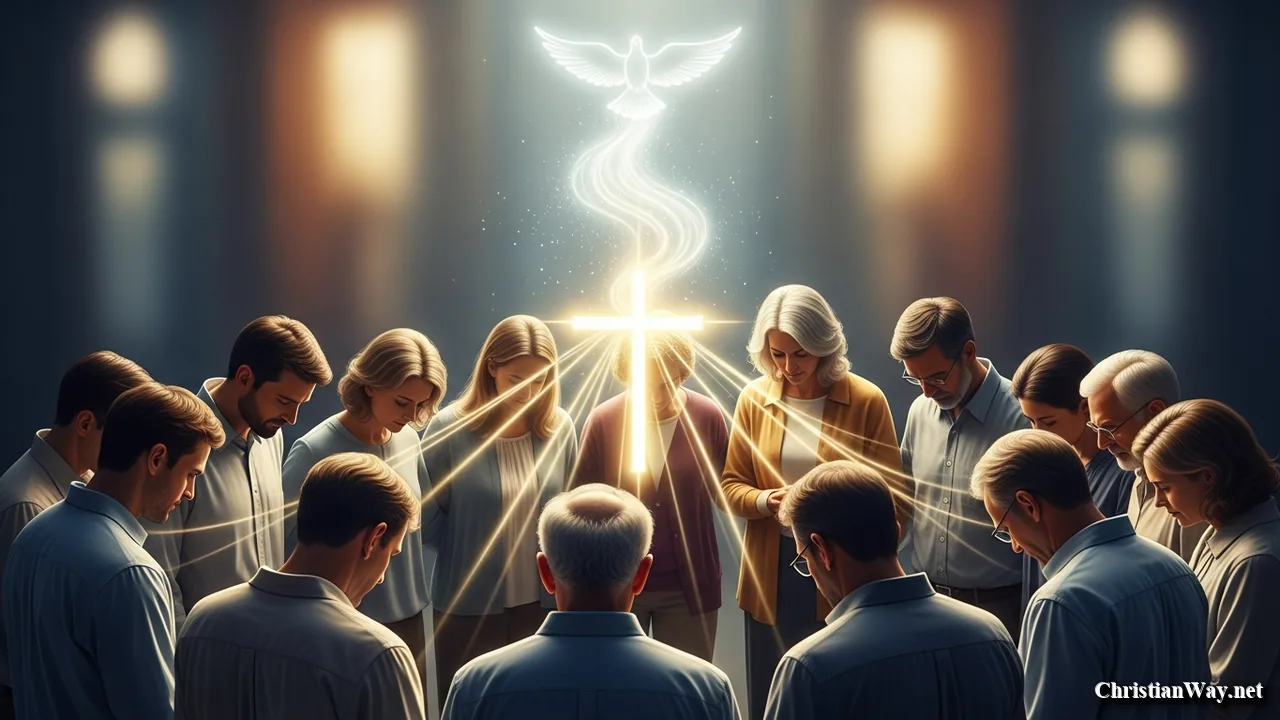
To ask, “How does the Spirit unite believers to the life of God?” is therefore to ask about the very heart of salvation. It is to ask how sinners become children of the Father, how separate individuals become the Body of Christ, how human prayer becomes participation in the prayer of Jesus, and how ordinary lives can slowly become radiant with divine love.
The answer begins not with what we do for God, but with what God graciously does in us.
The Holy Spirit Is God’s Living Presence Within Us
The Holy Spirit is not an impersonal energy, a religious atmosphere, or a poetic way of describing human inspiration. He is the third Person of the Holy Trinity: fully divine, eternally one with the Father and the Son, and personally active in creation, redemption, and sanctification.
When the Holy Spirit dwells within believers, God Himself is present. This does not mean that we become God by nature or cease to be human. Rather, by grace, we are brought into a real communion with the divine life. The Creator remains the Creator, and the creature remains the creature, yet the distance created by sin is overcome through love.
Jesus promised His disciples:
“I will pray the Father, and he shall give you another Comforter, that he may abide with you for ever.”
— John 14:16
The Spirit’s presence is not temporary, like a passing emotion during prayer. Nor is it limited to extraordinary moments of spiritual intensity. The Holy Spirit comes to abide. He makes the heart of the believer a place of encounter, a dwelling in which God’s grace quietly works through joy and sorrow, certainty and confusion, strength and weakness.
We may not always feel this presence. There are seasons when prayer feels dry, when faith seems fragile, and when God appears hidden. Yet the life of the Spirit does not depend upon our changing emotions. A tree remains alive in winter even when no leaves are visible. In a similar way, the Spirit may be working most deeply in us during times when we sense Him least.
He may be teaching us to trust without consolation, to love without reward, to remain faithful without immediate answers, and to seek God for God’s own sake. The absence of spiritual feeling is not necessarily the absence of spiritual life.
The Spirit Makes the Human Heart a Temple
Saint Paul writes:
“Know ye not that ye are the temple of God, and that the Spirit of God dwelleth in you?”
— 1 Corinthians 3:16
In the biblical world, the temple was the sacred place of God’s presence. To call believers temples of the Holy Spirit is therefore an astonishing declaration. It means that God has chosen to dwell not only in sacred buildings, holy places, or dramatic manifestations, but within fragile human persons.
The Spirit enters lives marked by wounds, memories, fears, temptations, and unfinished struggles. He does not wait for us to become perfect before coming near. He comes in order to heal, purify, strengthen, and transform us.
This truth gives sacred dignity to every Christian life. The elderly believer who prays quietly in a small room, the parent exhausted from caring for children, the worker who tries to remain honest in a difficult workplace, the young person struggling to resist despair, and the suffering person who can offer God only a whispered prayer may all be living temples of the Spirit.
The holiness of such lives may be hidden from the world, but it is not hidden from God.
The Spirit Unites Us to Jesus Christ
The Holy Spirit unites believers to the life of God by joining them to Jesus Christ. There is no life in the Spirit apart from the Son, because the Spirit’s work is always Christ-centered. He reveals Christ, glorifies Christ, conforms us to Christ, and communicates the life of the risen Christ to us.
Jesus described this communion through the image of the vine and the branches:
“Abide in me, and I in you. As the branch cannot bear fruit of itself, except it abide in the vine; no more can ye, except ye abide in me.”
— John 15:4
A branch does not produce life by effort alone. It bears fruit because the life of the vine flows through it. In the same way, Christian holiness is not primarily the result of human determination. We do not become loving, patient, merciful, and faithful merely by commanding ourselves to behave better. True spiritual fruit grows when the life of Christ is communicated to us through the Holy Spirit.
The Spirit does not erase our personality or turn us into copies of one another. Instead, He heals and fulfills the person God created each of us to be. Christ’s life takes form within different cultures, temperaments, vocations, and circumstances. One believer may reflect Christ through quiet endurance, another through courageous service, another through teaching, another through hospitality, and another through hidden intercession.
The source is one, though the expressions are many.
The Spirit Makes Christ More Than a Memory
Without the Holy Spirit, Jesus might remain for us only a figure of the past: a teacher whose words we admire, a moral example we attempt to follow, or a religious founder whose influence continues through history.
Through the Spirit, however, Christ is encountered as the living Lord.
The Holy Spirit makes the words of Jesus living and personal. A familiar Gospel passage may suddenly speak directly into our present need. The forgiveness Christ offered to sinners becomes hope for our own guilty conscience. His compassion for the suffering becomes a call to notice the wounded people around us. His obedience to the Father becomes strength for our own surrender.
The Spirit does not give us a different Christ from the Christ revealed in Scripture. Rather, He opens our minds and hearts to recognize the living reality of the biblical Christ. He leads us beyond mere information into communion.
This is why Christian faith is not simply agreement with doctrines, though doctrine is essential. It is not merely reverence for a historical event, though the events of Christ’s incarnation, death, and resurrection are foundational. Faith is a living union with the crucified and risen Lord, made possible by the Holy Spirit.
The Spirit Joins Us to Christ’s Death and Resurrection
To be united with Christ means that His saving death and victorious resurrection become the pattern and power of our lives.
Saint Paul writes:
“If we have been planted together in the likeness of his death, we shall be also in the likeness of his resurrection.”
— Romans 6:5
Through baptism and faith, believers are brought into the mystery of Christ’s Passover: His passage through death into life. The Holy Spirit applies this saving mystery to us. He teaches us to die to sin, pride, resentment, false identity, and self-centered ambition. At the same time, He raises us into a new way of living marked by faith, hope, charity, and freedom.
This dying and rising is not confined to one dramatic moment. It unfolds throughout the Christian life.
Whenever we forgive someone who has wounded us, something of the old self dies and the life of Christ rises within us. Whenever we choose truth over self-protection, generosity over selfishness, or fidelity over convenience, we participate in the pattern of the cross and resurrection. Whenever we entrust suffering to God rather than allowing it to harden our hearts, the Spirit draws life out of what seemed barren.
The Christian does not seek suffering for its own sake. Yet when suffering comes, the Spirit can unite it to Christ’s suffering, transforming it from meaningless pain into an offering of love.
The Spirit Brings Us to the Father
The work of the Holy Spirit is deeply Trinitarian. He unites us to the Son and, through the Son, brings us to the Father. The Christian life is therefore a movement of grace: from the Father, through the Son, in the Holy Spirit, and back to the Father in worship and love.
Saint Paul expresses this mystery simply:
“Through him we both have access by one Spirit unto the Father.”
— Ephesians 2:18
The Spirit does not leave us standing outside God’s household as fearful servants. He gives us the confidence of children. He places within us the prayer of Jesus Himself.
“God hath sent forth the Spirit of his Son into your hearts, crying, Abba, Father.”
— Galatians 4:6
The word “Abba” expresses intimate trust. It does not make God casual or ordinary. The Father remains infinitely holy, beyond all creation. Yet through Christ and in the Spirit, His holiness no longer drives us away in terror. It draws us near in reverence, trust, and love.
The Spirit Heals Our Image of God
Many people carry distorted images of God. Some imagine Him as distant and uninterested. Others fear Him as an impatient judge waiting for them to fail. Some see Him as a powerful ruler who must be persuaded to care. Others quietly assume that divine love must be earned through religious performance.
The Holy Spirit reveals the face of the Father shown in Jesus Christ.
He teaches us that God’s correction is not rejection, that His holiness is not cruelty, and that His authority is not domination. The Father’s desire is to restore His children, not to crush them. His commands flow from wisdom and love, because He knows what leads to life.
This healing often takes time. A person who has experienced abandonment, harsh parenting, spiritual manipulation, or betrayal may find it difficult to trust God as Father. The Spirit works gently within these wounds. He does not shame us for our difficulty. He brings the compassion of Christ into places where fear has taken root.
Sometimes He does this through Scripture. Sometimes through the faithful presence of another believer. Sometimes through the sacraments, worship, confession, silence, or a long season of prayer. Often, His healing is gradual, like sunlight entering a room at dawn.
The Spirit teaches the soul to say, perhaps hesitantly at first, “Father, I belong to You.”
The Spirit Gives Us a Share in the Communion of the Trinity
God is not solitary. The Father eternally loves the Son, the Son eternally receives and returns the Father’s love, and the Holy Spirit is eternally present in this perfect communion. Christian theology speaks carefully here, because the mystery is greater than human language. Yet the central truth is clear: within the one God there is eternal communion, self-giving, and love.
When the Spirit unites believers to the life of God, He brings them into this divine communion.
We do not stand outside the Trinity as observers studying a mystery. By grace, we are welcomed into fellowship with the Father through the Son in the Holy Spirit. The love with which the Father loves the Son begins to shape our own lives. The obedience of the Son becomes the pattern of our surrender. The unity of the Spirit becomes the source of our communion with one another.
This does not mean that human beings become members of the Trinity. We remain creatures who receive everything as gift. Yet the gift is astonishingly intimate. Saint Peter speaks of believers becoming “partakers of the divine nature” through God’s promises.
The Christian traditions have described this reality in different but complementary ways. Eastern Christianity often emphasizes participation in divine life and speaks of the believer’s transformation by grace. Western Christianity frequently speaks of sanctifying grace, adoption, communion with God, and growth in holiness. Protestant traditions strongly emphasize union with Christ, the indwelling Spirit, justification, and the believer’s new life in the risen Lord.
Though the language and theological emphases may differ, Christians share the conviction that salvation is more than an external change of status. God truly renews the person. He comes near, gives new life, and draws believers into communion with Himself.
The Spirit Forms Believers into the Body of Christ
The Spirit never unites us to God in a way that isolates us from other believers. Divine life is communion, and those who share in that life are drawn toward communion with one another.
Saint Paul writes:
“By one Spirit are we all baptized into one body.”
— 1 Corinthians 12:13
The Church is not merely an organization formed by people who happen to hold similar opinions. Nor is it simply a social gathering centered on shared religious customs. At its deepest level, the Church is the Body of Christ, made alive by the Holy Spirit.
This spiritual unity does not erase genuine differences. The Church includes people of many nations, languages, cultures, social conditions, personalities, and spiritual traditions. The Spirit does not produce uniformity. He creates harmony, much as different notes can form one beautiful song.
Each member receives gifts for the good of the whole. Some teach, some serve, some lead, some encourage, some give generously, some show mercy, and some carry hidden burdens in prayer. No gift makes one person superior to another. Every true gift comes from the same Spirit and is given for love.
Unity Is More Than Agreement
Christian unity does not mean that every disagreement is unimportant. Truth matters, doctrine matters, worship matters, and the painful divisions among Christians should not be treated lightly. At the same time, unity is not created merely by reaching intellectual agreement on every question.
Before unity is a human achievement, it is a divine gift.
The Holy Spirit creates a real bond among all who belong to Christ. This bond may be wounded by sin, pride, historical division, and misunderstanding, but its source is deeper than human preference. Believers are united because they receive life from the same Lord.
This spiritual reality should lead Christians toward humility. We may hold our convictions firmly while refusing contempt. We may seek truth without treating fellow Christians as enemies. We may acknowledge real differences while recognizing the work of Christ beyond the boundaries familiar to us.
The Spirit of God never leads us to rejoice in division, mock sincere faith, or use doctrine as a weapon of pride. The same Spirit who is the Spirit of truth is also the Spirit of love.
The Spirit Teaches Us to Bear One Another’s Burdens
The life of God is revealed through self-giving love. Therefore, union with God inevitably changes how we respond to other people.
A church community may possess beautiful worship, careful teaching, and strong traditions, yet fail to reflect the life of the Spirit if its members ignore the lonely, judge the wounded, or compete for honor. Spiritual gifts without love can become noise. Correct words without compassion can become heavy burdens.
The Spirit teaches believers to notice one another.
He may prompt someone to call a grieving friend, welcome a stranger, apologize after speaking harshly, provide practical help to a struggling family, or remain present with a person whose pain cannot be quickly solved. These actions may seem ordinary, but they are signs of divine life.
When one member suffers and others choose to suffer with them, the communion of Christ becomes visible. When one member rejoices and others rejoice without jealousy, the freedom of the Spirit appears. When believers forgive one another, they reveal that the mercy of God is not merely an idea but a living power.
The Spirit Prays Within Us
Prayer is one of the clearest ways believers participate in the life of God. Yet even prayer is not something we accomplish by our own strength. The Holy Spirit awakens prayer, sustains it, purifies it, and carries it into the communion of the Trinity.
Saint Paul writes:
“The Spirit also helpeth our infirmities: for we know not what we should pray for as we ought.”
— Romans 8:26
There are moments when words come easily. We know what to ask, what to confess, or how to give thanks. At other times, prayer feels impossible. Grief may be too deep, confusion too great, guilt too heavy, or exhaustion too complete.
The Spirit does not abandon us in such moments.
He receives the sigh, the tear, the silence, and the unfinished sentence. He prays within the weakness of the believer. Our inability to form eloquent words does not prevent us from being held within the prayer of Christ.
The Spirit Draws Us into the Prayer of Jesus
Jesus lives eternally in loving communion with the Father. When the Spirit teaches us to pray, He draws us into the Son’s own relationship with the Father.
This is why Christian prayer is offered through Christ. We do not approach God on the basis of our worthiness, spiritual success, or emotional intensity. We come because the Son has opened the way. The Spirit joins our small and imperfect prayers to the perfect self-offering of Jesus.
Even the Lord’s Prayer reveals this participation. We say “Our Father,” not merely “My Father.” The prayer is personal, yet never private. It places us within the family of God and teaches us to seek bread, forgiveness, holiness, and deliverance not only for ourselves but for others.
The Spirit slowly frees prayer from self-absorption. We begin by bringing our needs to God, as we rightly should. Over time, however, prayer becomes larger. We begin to desire God’s name to be honored, His kingdom to come, His will to be done, and His mercy to reach people we may never meet.
Prayer becomes participation in the loving purpose of God.
The Spirit Transforms Us into the Likeness of Christ
Union with the life of God is not merely a comforting doctrine. It has transforming power. The Spirit works within believers so that the character of Jesus gradually becomes visible in them.
Saint Paul describes the fruit of the Spirit as:
“Love, joy, peace, longsuffering, gentleness, goodness, faith, meekness, temperance.”
— Galatians 5:22–23
These qualities are not spiritual decorations added to an otherwise unchanged life. They are signs that the life of Christ is taking root within us.
The fruit grows slowly. A person may experience a powerful moment of conversion and still need years of healing and formation. Old habits do not always disappear immediately. Wounds may continue to influence reactions. Temptations may remain strong. Growth in holiness is often less like a sudden flash of lightning and more like the patient ripening of fruit.
The Spirit is patient, but He is not passive. He convicts us of sin, exposes falsehood, and calls us away from whatever resists the love of God. His conviction is different from despair. Despair says, “You are beyond hope.” The Spirit says, “This is not the life for which you were created. Come back to Christ.”
Divine Life Does Not Destroy Human Freedom
The Spirit does not transform us through coercion. Grace awakens and strengthens freedom rather than abolishing it. God works within us, yet we are invited to respond.
We can resist the Spirit through stubbornness, repeated compromise, bitterness, dishonesty, or indifference. We can also cooperate with grace through repentance, prayer, obedience, and acts of love.
This cooperation does not mean that we save ourselves. Even our ability to respond is sustained by grace. Yet God treats us as persons, not objects. He invites a real relationship of trust and surrender.
The Spirit may quietly ask us to release a resentment we have protected for years. He may reveal that our ambition has become an idol. He may call us to seek reconciliation, tell the truth, change a harmful habit, or accept a humble task that brings no recognition.
In these moments, participation in divine life becomes concrete. Holiness is not an abstract state. It is love taking form in decisions.
The Spirit Gives Life Through Word, Sacrament, and Worship
The Holy Spirit works freely and cannot be confined to human methods. Yet throughout Christian history, believers have recognized particular means through which the Spirit nourishes communion with God.
He speaks through the Holy Scriptures, making the written word a living witness to Christ. He gathers believers in worship, where praise, confession, thanksgiving, and intercession become the prayer of the whole Church. He acts through baptism, the Lord’s Supper or Eucharist, and the sacramental life as understood within different Christian traditions.
Christians do not all describe these mysteries in exactly the same way. Yet across Catholic, Orthodox, Anglican, and Protestant traditions, baptism is closely connected with entry into Christ, reception of grace, and life in the Spirit. The breaking of bread is received as a sacred participation in Christ, a remembrance of His sacrifice, a proclamation of His death, and a sign of the unity of His people.
The Spirit Makes Scripture a Place of Encounter
The Bible can be studied historically, linguistically, and theologically, and such study is valuable. Yet Scripture reaches its deepest purpose when the Spirit uses it to lead us to Christ.
A passage may correct us, comfort us, expose our motives, strengthen our hope, or enlarge our understanding of God. The Spirit does not usually bypass the text’s true meaning to give private and unrelated messages. Rather, He opens us to the truth God has revealed and applies that truth to our lives.
Reading Scripture in the Spirit requires humility. We come not merely to master the text, but to be mastered by the truth. We ask not only, “What does this passage mean?” but also, “How is God calling me to trust, repent, worship, or love?”
The goal is communion, not information alone.
The Spirit Makes Worship Participation in Heaven’s Praise
When believers gather for worship, the visible congregation may seem ordinary. People arrive carrying distractions, family concerns, physical fatigue, financial pressure, grief, and unresolved questions. Yet through the Spirit, earthly worship participates in something greater than itself.
The Church joins the praise of Christ. The prayers of believers are lifted into the worship of heaven. The Gospel is proclaimed, and the risen Lord ministers to His people. Bread is broken, hymns are sung, sins are confessed, and peace is shared.
Not every worship service feels powerful. Music may be imperfect, preaching may be simple, and attention may wander. Yet the Spirit is able to work through humble means. The effectiveness of worship does not depend solely upon emotional intensity. God often nourishes His people through faithful repetition, teaching the heart to remain rooted in truth.
The Spirit Unites Believers Through Love
The clearest sign that believers share in the life of God is not spiritual excitement, intellectual brilliance, or public influence. It is love.
Jesus prayed that His disciples would be one so that the world might believe. This unity is not sentimental. It is cruciform, shaped by the self-giving love revealed at Calvary.
The Spirit teaches us to love those we did not choose. It is easy to feel close to people who share our background, opinions, personality, and preferences. The Church brings together people who might never naturally become friends. In that difficult communion, the Spirit forms something new.
He teaches the strong to make room for the weak, the confident to listen to the hesitant, the educated to honor the simple, and the wounded to receive care without shame. He confronts prejudice, spiritual pride, rivalry, and the desire for control.
Love does not require us to deny truth or ignore harmful behavior. Genuine love can set boundaries, correct wrongdoing, and protect the vulnerable. Yet even correction must seek restoration rather than humiliation.
Forgiveness Reveals the Life of God
Few things reveal participation in divine life more clearly than forgiveness. God’s mercy reaches us while we are still sinners. When that mercy enters the heart, it begins to reshape our relationships.
Forgiveness does not mean pretending that evil was harmless. It does not always restore trust immediately, remove consequences, or require remaining in an unsafe situation. Forgiveness means surrendering the right to hatred and personal vengeance. It places judgment into the hands of God and asks for freedom from the poison of resentment.
This is often impossible by human strength alone.
The Spirit brings the forgiveness of Christ into our wounds. Sometimes He gives grace to forgive in a decisive moment. More often, forgiveness unfolds through repeated surrender. We may need to pray many times, “Lord, I give this pain to You again.”
Each act of surrender opens the heart more fully to divine life.
The Spirit Meets Us in Suffering and Weakness
Participation in the life of God does not remove believers from the sorrows of the world. Christians still experience illness, bereavement, disappointment, injustice, temptation, and uncertainty. Sometimes faith itself seems to intensify the questions, because we wonder why the God we love permits such pain.
The Spirit does not always give immediate explanations. Often, He gives presence.
He reminds us that Christ entered human suffering rather than observing it from afar. At the cross, the Son of God carried rejection, injustice, physical agony, loneliness, and death. In the resurrection, He revealed that suffering and death do not have the final word.
The Spirit unites our suffering to this mystery of Christ. He does not call evil good, but He can bring grace from what is painful. He can deepen compassion, loosen our attachment to false securities, teach us dependence, and prepare us to comfort others.
Weakness Can Become a Place of Communion
Many people imagine that God is closest when they feel spiritually strong. Yet Scripture repeatedly shows God working through weakness.
When we reach the limit of our ability, we may become more open to receiving life as a gift. Self-sufficiency begins to crack. Prayer becomes less polished and more honest. We discover that grace is not a reward for strength but help for the helpless.
The Spirit does not despise our weakness. He enters it.
The person who says, “Lord, I cannot carry this alone,” may be closer to genuine communion than the person who appears confident but relies entirely upon himself. Dependence upon God is not failure. It is part of the truth of being a creature beloved by the Creator.
How Does the Spirit Unite Believers to the Life of God Today?
The Spirit unites believers to the life of God in the ordinary circumstances of daily existence.
He is present when a mother rises during the night to comfort a child, offering love when she feels she has nothing left. He is present when a worker refuses dishonesty even at personal cost. He is present when someone chooses to listen patiently instead of preparing a defensive reply. He is present when a lonely person continues to pray, when a grieving family gathers around a hospital bed, and when a believer confesses sin without making excuses.
The Spirit’s life is not limited to moments that appear religious. Every part of life can become a place of communion with God.
Work can become service. Rest can become trust. Meals can become thanksgiving. Suffering can become intercession. Success can become generosity. Failure can become humility. Relationships can become schools of patience and forgiveness.
This is how the Spirit unites believers to the life of God: not by removing them from human life, but by filling human life with the presence of Christ.
Learning to Recognize the Spirit’s Quiet Work
We often look for God in dramatic experiences, yet the Spirit frequently works quietly.
He may create a growing discomfort with a sinful habit. He may give us compassion for someone we previously judged. He may awaken a desire to pray, return to Scripture, seek reconciliation, or serve without recognition. He may give unexpected peace in a situation that remains unresolved.
Not every inner feeling comes from the Holy Spirit. Christians are called to discernment. The Spirit’s guidance will never contradict the character of Christ or the truth of the Gospel. His work produces humility, love, purity, courage, patience, and obedience.
A voice that feeds pride, contempt, panic, cruelty, or self-exaltation should not be hastily called divine. The Spirit glorifies Jesus, not the ego.
Discernment grows through Scripture, prayer, wise counsel, participation in the Church, and attention to the fruit produced over time.
Living Daily in Communion with the Spirit
We do not control the Holy Spirit, but we can become more attentive and receptive to His work.
This begins with simple surrender. Each morning, we may place ourselves before God and pray, “Holy Spirit, lead me into the life of Christ today. Teach me to love what the Father loves. Show me where I need to repent. Strengthen me to do what is faithful.”
Such a prayer does not guarantee an easy day. It opens the day to grace.
Throughout the hours that follow, we can return to God in brief acts of remembrance. Before a conversation, we can ask for patience. When temptation arises, we can call upon Christ. When beauty surprises us, we can give thanks. When another person’s pain becomes visible, we can ask how love should respond.
The life of the Spirit is cultivated through this repeated turning toward God.
Making Room for Silence
Modern life surrounds us with noise, information, urgency, and distraction. The soul can become so crowded that it no longer recognizes the gentle movements of grace.
Silence is not emptiness. It is a way of making room.
Even a few quiet minutes can become an offering. We may sit before God without trying to produce a special experience. We may repeat the name of Jesus, meditate upon a verse, or simply say, “Here I am, Lord.”
In silence, hidden anxieties often rise to the surface. We become aware of desires, fears, and resentments that activity allowed us to avoid. This can be uncomfortable, but it is also a place of healing. The Spirit brings truth into the heart not to condemn us, but to make us free.
Returning Quickly Through Repentance
Communion with God is wounded by sin, but the Spirit continually calls us back.
Repentance is not groveling before a reluctant God. It is returning to the Father whose mercy has already been revealed in Christ. It requires honesty. We stop defending what is wrong and name it before God.
The Spirit gives courage for this honesty. He leads us away from both pride and despair. Pride refuses to admit sin. Despair believes sin is greater than mercy. The Spirit teaches us to confess without hiding and to receive forgiveness without disbelief.
A repentant life is not a life without failure. It is a life that continually turns back toward grace.
The Spirit Prepares Us for the Fullness of Life with God
The believer’s present communion with God is real, but it is not yet complete. We still see dimly. We still experience temptation, suffering, division, and death. The Spirit’s presence within us is both gift and promise.
Saint Paul speaks of the Spirit as the firstfruits of what is to come. The life we receive now is the beginning of the eternal life that will one day be revealed in fullness.
The Spirit awakens hope for the resurrection of the body, the healing of creation, the communion of saints, and the final victory of God’s love. Christian hope is not a vague wish that things may somehow improve. It rests upon the resurrection of Jesus and the indwelling presence of the Spirit.
The same Spirit who raised Christ from the dead dwells in believers. Therefore, death does not possess the final claim upon those who belong to Christ.
This hope allows Christians to face mortality without pretending that death is painless. Grief remains real. Separation wounds the heart. Yet beneath grief lies the promise that those united to Christ are held in a life stronger than death.
Reflect and Pray
How does the Spirit unite believers to the life of God?
He dwells within them as the presence of God. He joins them to the crucified and risen Christ. He gives them access to the Father and teaches them to pray as beloved children. He forms them into the Body of Christ, where many members share one life. He transforms their character, nourishes them through Scripture and worship, strengthens them in suffering, and teaches them to love with a love that comes from beyond themselves.
This union is not reserved for saints whose lives appear extraordinary. It begins wherever grace is received through faith. It grows through repentance, prayer, worship, obedience, communion, and love. It is present even when the believer feels weak, distracted, or spiritually dry.
The life of God within us is often hidden, like a seed beneath the soil. Yet the Spirit is faithful. He continues to work, drawing us away from isolation and into communion, away from fear and into trust, away from self-centeredness and into the generous life of Christ.
Dear friend, perhaps you feel far from God today. Perhaps your prayer has become difficult, your faith uncertain, or your heart burdened by struggles that others cannot see. Do not assume that the Spirit has abandoned you. Turn toward Christ as honestly as you can. Offer Him your weakness, even if your offering is only a sigh.
God does not ask you to create divine life within yourself. He asks you to receive.
The Holy Spirit is already at work wherever there is a desire for truth, a longing for mercy, a movement toward repentance, or the smallest willingness to love. Trust His patient presence. Allow Him to lead you more deeply into Christ, and through Christ into the loving heart of the Father.
Let us pray:
Holy Spirit, breath of the living God,
come gently into the hidden places of our hearts.
Unite us more deeply to Jesus Christ,
and teach us to live as beloved children of the Father.
Heal what sin has wounded.
Soften what fear has hardened.
Bring peace where there is division,
hope where there is weariness,
and love where the heart has grown cold.
Make us one in the Body of Christ.
Teach us to bear one another’s burdens,
to forgive as we have been forgiven,
and to reveal the mercy of God in our daily lives.
When we do not know how to pray, pray within us.
When we are weak, become our strength.
When we wander, lead us home.
And when our earthly journey is complete,
bring us into the fullness of that divine communion
for which we were created.
May the grace of Jesus Christ, the love of the Father, and the fellowship of the Holy Spirit remain with you and draw you ever more deeply into the life of God.
— Fr. John Matthew