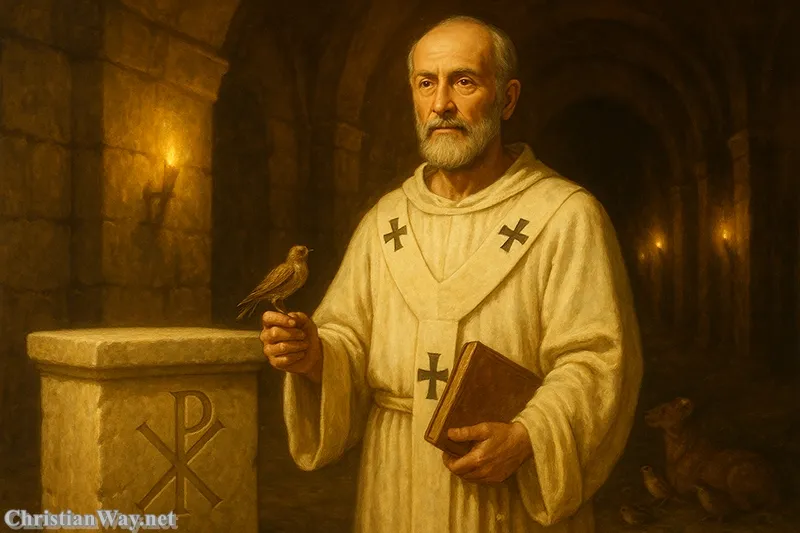
Grace and peace be with you, dear readers of Christian Way. When we speak of the giants upon whose shoulders the Catholic Church stands, few figures loom as large or cast as brilliant a theological light as Saint Leo I, universally known as Leo the Great. He was a man whose pontificate—spanning twenty-one tumultuous years from 440 to 461 A.D.—coincided precisely with the disintegration of the Western Roman Empire. Yet, rather than allowing the collapse of the temporal world to shake the foundation of the spiritual one, Leo stepped into the colossal void left by failing emperors and faltering armies.
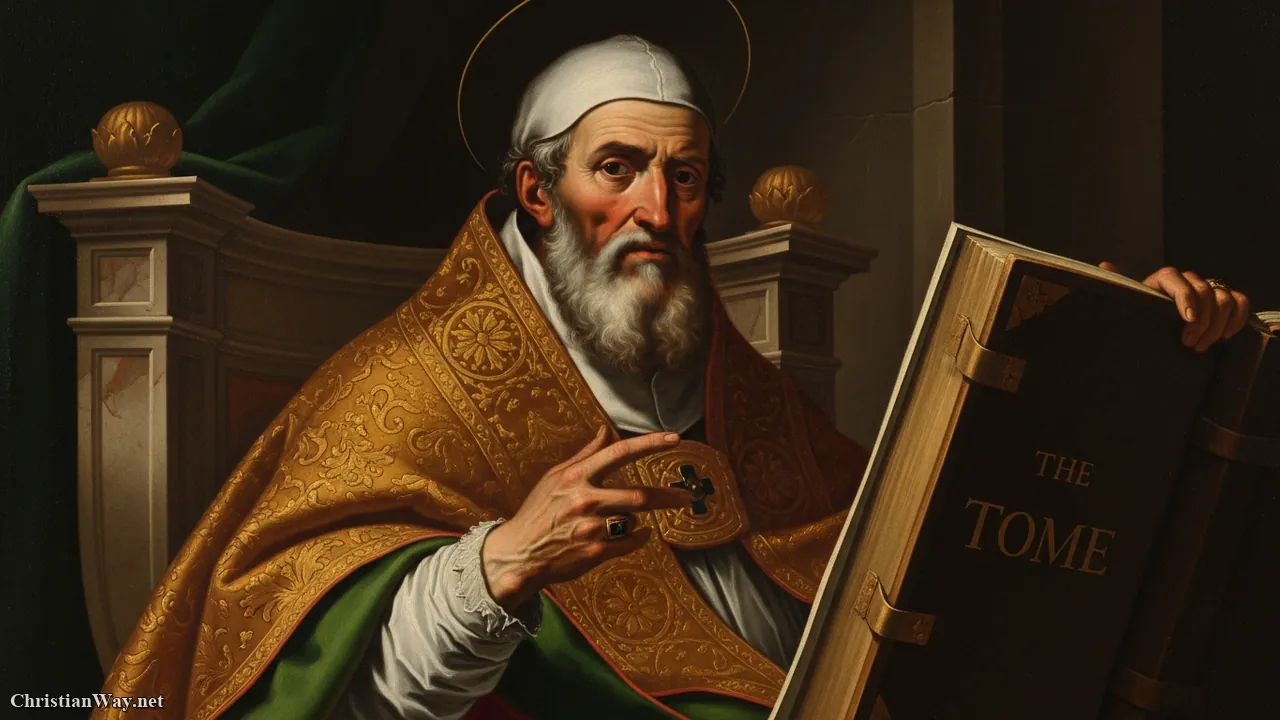
His authority was not sought through military might, but through the unshakable conviction that he was the legitimate successor of Saint Peter, entrusted by Christ Himself to “feed my lambs” (John 21:17). He was the first Roman pontiff to receive the honorific “the Great,” an appellation earned not merely for his role as a statesman who saved Rome from Attila the Hun, but primarily for his profound clarity as a theologian. His teachings at the Council of Chalcedon secured the very doctrine of the Incarnation, shaping every subsequent confession of Christian faith. In Leo, we find the perfect synthesis of pastoral tenderness and doctrinal strength, a holy Father whose voice still echoes with lion-like authority in our own challenging age.
Profile of Holiness
| Attribute | Detail |
|---|---|
| Birth Name | Leo |
| Lifespan | c. 400 A.D. – November 10, 461 A.D. |
| Birthplace | Tuscany, Western Roman Empire (Likely spent formative years in Rome) |
| Service Period | 440 – 461 A.D. (Bishop of Rome and Supreme Pontiff) |
| Feast Day | November 10 |
| Patronage | Popes, voice coaches, musicians, and Rome (for saving it from the Huns) |
| Key Virtue | Moral and Doctrinal Fortitude (The Rock of Peter) |
The Cradle of Grace: Historical Context & Early Life
To fully grasp the magnitude of Saint Leo’s service, one must visualize the world into which he was born around 400 A.D. The Pax Romana was long dead; the Western Roman Empire was not merely declining, but actively crumbling. It was an era of profound geopolitical shock. Just ten years after Leo’s likely birth, in 410 A.D., Alaric’s Visigoths sacked Rome—the Eternal City—for the first time in eight centuries. The psychological blow to Roman identity and the material damage to the ancient capital were catastrophic, fulfilling the prophecy of the world being shaken, as recorded in the Epistle to the Hebrews: “Yet once more I will shake not only the earth but also the heaven” (Hebrews 12:26).

Leo’s family were likely Tuscans, though he was raised and educated in Rome, making him a true Roman intellectual and administrator. Our earliest solid historical records reveal him to be a deeply respected archdeacon of the Roman Church by the 420s, serving under Popes Celestine I and Sixtus III. This was not a minor administrative post; the Archdeacon of Rome held immense influence, often functioning as the chief financial and diplomatic officer of the Holy See. His reputation for keen judgment and diplomatic skill spread far beyond the city’s walls, reaching the imperial court in Ravenna. This trust was dramatically demonstrated in 440 A.D., when Emperor Valentinian III dispatched Deacon Leo to Gaul (modern France) to mediate a critical and highly sensitive dispute between two powerful Roman generals, Aëtius and Albinus. The fact that the Emperor relied on a church official to stabilize the highest ranks of the military and civil government underscores Leo’s proven capability and the Church’s growing, essential secular role in the West.
He was a man steeped in the Latin Fathers, particularly Saint Augustine, whose theology of grace and critique of heretical movements profoundly influenced Leo’s later writings. He was, therefore, uniquely prepared: possessing the intellectual rigor to combat heresy and the political savvy to negotiate with emperors and barbarians alike. He was a rock of order and tradition in an age of chaotic entropy.
The Turning Point: Vocation and Conversion
Saint Leo the Great’s call to the papacy was not a slow, deliberate ascent, but a sudden, providential summoning from afar. While he was executing his delicate diplomatic mission in Gaul in the summer of 440 A.D., Pope Sixtus III passed away. In an extraordinary and unprecedented demonstration of confidence, the clergy, Senate, and people of Rome unanimously elected Deacon Leo as the next Bishop of Rome, even in his physical absence. They understood that the Church in the West needed a leader with both spiritual vision and political backbone, and for four months, they held the Apostolic See vacant, awaiting his return.
When he finally returned to Rome and was consecrated on September 29, 440, he viewed his elevation not as a political triumph, but as a weighty, terrifying burden. The gravity of the office was immediately evident in his early sermons, where he wrestled publicly with the concept of his own unworthiness and the immense duties laid upon him. This spiritual struggle was not doubt, but holy fear—a recognition that his authority flowed directly from Christ through Peter, a lineage he had to honor and defend, lest he compromise the divine mandate. As he himself preached, he was merely the heir of Peter’s jurisdiction, and his power was only as effective as his fidelity to that original commission. This conviction formed the core of his doctrine of Petrine Supremacy, stating that the Pope inherits the full authority (plenitudo potestatis) granted to Peter by Christ.
This “turning point” solidified his vocation not just as a bishop, but as the universal pastor. Leo’s theological contribution was defining the papacy itself for the medieval and modern world. The obstacle he faced was the very fragility of the West, the rising power of Constantinople, and the subtle but persistent temptation of regional bishops to undermine the central authority of Rome. He overcame these obstacles through tireless correspondence—writing approximately 150 surviving letters—and unwavering insistence on the Apostolic nature of his see. He did not ask for respect; he commanded it, because he believed Christ had commanded it through him, providing the necessary fortitude to face down not only ecclesiastical rivals but also the literal armies of darkness.
The Great Labor: Ministry and Mission
Leo’s ministry was defined by two primary fields of labor: the defense of the Faith against heresy and the defense of the City of God against the “Heresy of the Sword”—the Barbarian invasions. His theological masterpiece, the Tome, addressed the threat of Monophysitism, which denied the full humanity of Christ (a subject we will explore further). His external mission, however, made him a global hero.
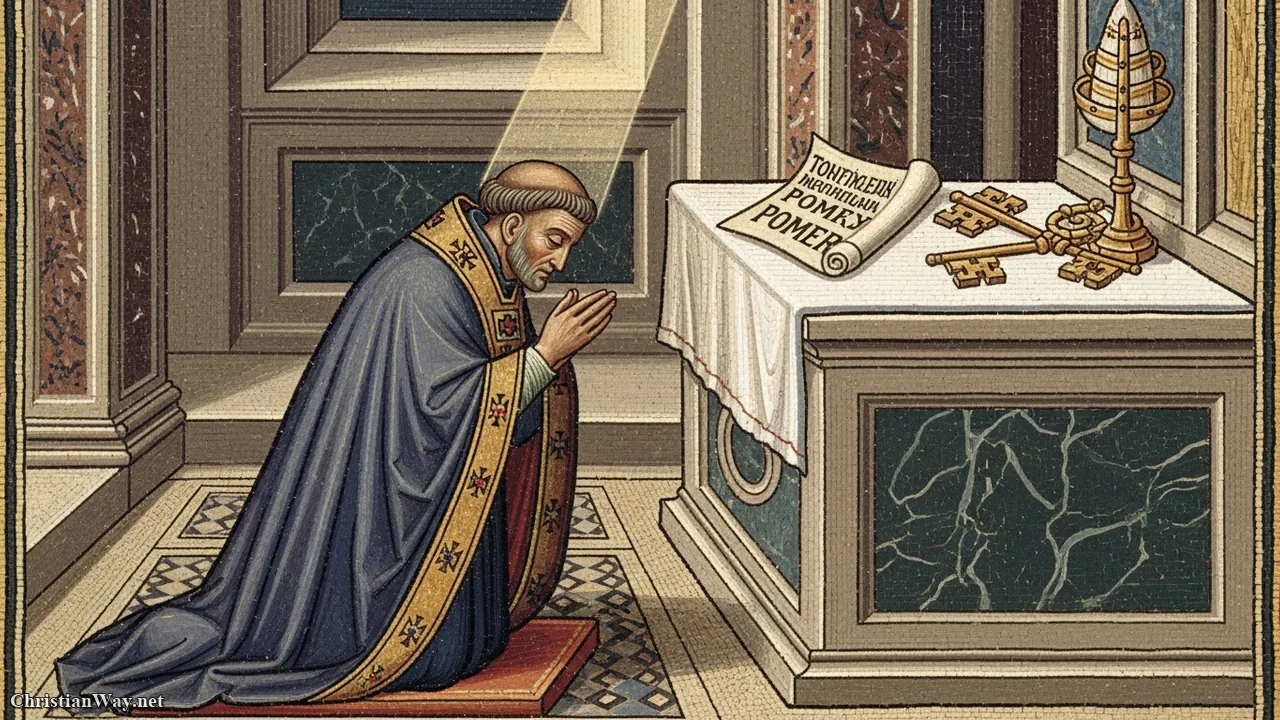
The year 452 A.D. brought the Hunnic threat. Attila, known as the “Scourge of God,” had devastated Northern Italy and was marching toward Rome. There was no imperial army capable of stopping him. The emperor, Valentinian III, and his court could offer no solution but panic. It was Leo the Great, the unarmed priest, who traveled north with a small delegation—including the consul Gennadius Avienus and the former prefect Trigetius—to meet the fearsome pagan king at the River Mincio near Mantua.
What transpired is shrouded in the mystery of history and the power of God. According to tradition, Attila was so awestruck by the majestic presence and moral authority of the Pope that he agreed to spare Rome and retreat. When his generals later asked Attila why he had obeyed the unarmed priest, he allegedly confessed that he saw two figures standing beside Leo, presumably Saints Peter and Paul, armed and threatening him should he proceed. This famous encounter was a crucial moment in history; it demonstrated that in the collapsing West, the Church alone possessed the spiritual and moral capital necessary for survival. Leo did not wield a sword, but the strength of the Keys of Peter.
A second, equally difficult labor occurred in 455 A.D. The Vandals, led by Genseric, sailed to Rome, and this time, Leo could not prevent the entry of the barbarian forces. Yet, even in defeat, he performed an act of charity and diplomacy. He met Genseric at the city gates and successfully negotiated that the Vandals would not massacre the population or burn the ancient churches, securing a promise of limited, controlled plunder. While the sack lasted fourteen days, Leo’s intervention certainly saved countless lives and preserved the spiritual heart of the city, standing firm in the face of inevitable suffering, trusting in the promise: “I will not leave you orphans; I will come to you” (John 14:18).
The Teacher of Souls: Theological & Spiritual Legacy
Saint Leo the Great’s most enduring contribution is his intellectual legacy, which earned him the title of Doctor of the Church. His writings, particularly the famed Tome (Epistle 28), served as the foundation for the central dogma of Christology affirmed at the Fourth Ecumenical Council, the Council of Chalcedon in 451 A.D. The crisis of the age was the Monophysite heresy, led by the Archimandrite Eutyches, who taught that after the Incarnation, Christ possessed only one nature (the divine), effectively dissolving His true humanity.
Leo’s Tome, addressed to Flavian, the Patriarch of Constantinople, provided the definitive, magisterial correction. He articulated the doctrine of the Hypostatic Union: that Christ is one Person (hypostasis) in two natures—fully human and fully divine—united “without confusion, without change, without division, without separation.”
“For, just as God is not changed by pity, so man is not swallowed up by dignity. The activity of each form is what is proper to it, in communion with the other: that is, the Word performs what belongs to the Word, and the flesh executes what belongs to the flesh. The one shines forth in miracles; the other succumbs to injuries.”
— Saint Leo the Great, The Tome (Epistle 28)
When this letter was read aloud at the Council of Chalcedon, 600 bishops from East and West cried out in unison, affirming its truth. Their famous acclamation became a cornerstone of papal history: “Peter has spoken through Leo!” This was the zenith of his theological authority, establishing the Bishop of Rome as the guarantor of orthodoxy for the universal Church. His key teaching, often found in his 96 surviving sermons (which are masterpieces of accessible liturgical catechesis), was the profound spiritual truth derived from the Hypostatic Union: because Christ is truly God and truly Man, humanity is reconciled to the Divine. He emphasizes the dignity of man, restored by the perfect obedience of Christ’s Incarnation, urging the faithful to live up to the standard of their divine calling, particularly through the sacraments of Baptism and the Eucharist.
The Via Dolorosa: Suffering, Death, and Sainthood
Saint Leo’s life was a continuous pilgrimage along the Via Dolorosa of imperial decay. His greatest suffering was not physical illness, but the spiritual and mental burden of leading the flock through persistent political and theological upheaval. He endured the horror of the Vandal sack (455), the persistent threat of schism from the East, and the internal strife caused by heresies such as Manichaeism and Pelagianism, which he tirelessly worked to suppress in Italy and Africa.
His final days came in the late autumn of 461 A.D. Having served the Church for over two decades with singular dedication, he died on November 10, 461. Though no definitive record of his last words exists, his sermons reveal a man whose mind was constantly fixed on the Resurrection and the triumph of the Cross. It is safe to assume he passed away as he lived, entrusting his soul to the Chief Shepherd, Christ Jesus. His death was a loss keenly felt by a Rome that had learned to rely on his courage more than on its own generals.
In a profound act of humility and devotion, Leo requested to be buried as close as possible to the tomb of the Prince of the Apostles. His body was initially interred in the entrance porch of the old Basilica of Saint Peter, a simple and powerful testimony to his deep reverence for his predecessor. In the 18th century, his relics were moved to their final resting place beneath the Altar of Saint Leo the Great in the current Basilica. His path to sainthood was one of universal, pre-congregation recognition. The people and the Church immediately revered him. The formal recognition of his intellectual achievement came much later, in 1754, when Pope Benedict XIV formally declared him a Doctor of the Church, cementing his legacy as one of the few supreme teachers whose wisdom guides the Church today. His life proves that true strength lies not in temporal power, but in the authority of the truth.
Spiritual Highlights: Lessons for the Modern Christian
Saint Leo the Great, the Pontiff of Crisis, offers indispensable spiritual guidance for the modern world, which, much like the 5th century, feels increasingly fragmented and under siege. His life provides actionable counsel on how to live out the faith with courage and intellectual clarity:
- The Primacy of Moral Authority: Leo reminds us that spiritual conviction trumps political or military power. When the world collapses, our refuge is not in shifting alliances but in the unshakeable truth of Christ. We are called to stand fast, even when unarmed, against the “Attilas” of our time—secularism, consumerism, and despair—trusting in God’s intervention.
- A Commitment to Doctrinal Precision: His battle against Monophysitism teaches us that theological details are not academic footnotes; they are the arteries of faith. To misunderstand Christ’s nature is to misunderstand salvation. The modern Christian must know and defend the Creed, realizing that truth is the highest form of charity.
- Courage in Pastoral Care: Leo literally placed himself between his flock and the destroyer. Today, this translates to spiritual leadership that confronts cultural threats head-on, protecting the vulnerable and marginalized from moral dangers and injustices.
- Living the Hypostatic Union: His teaching that Christ is fully God and fully Man urges us to treat our own lives seriously. Our humanity, redeemed and assumed by the Son of God, is worthy of profound dignity and holiness. We must avoid the “heresy” of separating our faith from our daily life.
A Prayer for Intercession
O Saint Leo the Great, Holy Father and Doctor of the Church, we turn to you in this age of confusion and peril. You were a Lion of God who stood firm against the tide of barbarism and the subtle deceit of heresy. Look upon our Holy Church, which still struggles for unity and clarity, and upon our world, which yearns for peace. Intercede for us, that we may possess your fearless courage to defend the truths of the Incarnation, acknowledging in every word and deed that our Lord Jesus Christ is truly God and truly Man. Grant us the wisdom to read and understand the mysteries of our faith, and the strength to stand as protectors of our spiritual city. May we, like you, trust in the power of the Keys of Peter and, hearing the voice of the Shepherd through his successor, remain steadfast until death. Amen.
— Fr. John Matthew, for Christian Way