My dear friends in Christ, and fellow pilgrims on the path of faith. I am Fr. John Matthew, and it is a distinct honor to welcome you to this deep dive into the life of a giant of the Roman Pontificate—a man whose quiet sanctity was matched only by his formidable resolve: Saint Nicholas I, deservedly known to history as “the Great.” In an age defined by feudal fragmentation, encroaching secular interference, and theological drift, Nicholas stood as a solitary, unyielding monolith, defending the integrity of the priesthood, the sanctity of marriage, and the universal primacy of the Successor of Peter. He took up the keys of the Kingdom during the tumultuous mid-ninth century (858–867), a period when the Carolingian Empire was crumbling, and the nascent East-West division was tragically widening. Yet, through this storm, he steered the Barque of Peter with such divine authority that his decisions shaped canon law and ecclesiastical discipline for a thousand years. His life serves as a powerful testament to the truth of Christ’s promise: that the gates of hell shall not prevail against His Church, for Nicholas proved that true spiritual power is found not in armies, but in unwavering obedience to God’s eternal law.
Profile of Holiness
| Attribute | Detail |
|---|---|
| Birth Name | Nicolaus |
| Lifespan | c. 820 – November 13, 867 |
| Birthplace | Rome, Papal States |
| Service Period | Pope (April 24, 858 – November 13, 867) |
| Feast Day | November 13 |
| Patronage | Canon Lawyers, Defenders of the Papacy, Advocates for Christian Marriage, Ecclesiastical Discipline |
| Key Virtue | Fortitude and Unyielding Justice |
The Cradle of Grace: Historical Context & Early Life
To understand the magnitude of Pope Nicholas I, we must first gaze upon the world into which he was born, likely around the year 820, in Rome, the heart of a struggling civilization. The glory days of Charlemagne’s unified empire were already fading. The Treaty of Verdun (843) had irrevocably splintered the vast Carolingian domains among the grandsons of the great emperor, creating the perpetually quarreling kingdoms of Lotharingia, West Francia, and East Francia. This political fragmentation translated directly into ecclesiastical chaos. Secular rulers—kings, dukes, and counts—saw the Church, especially the bishoprics, as mere tools for political patronage and land control. Furthermore, Rome itself was still reeling from the Saracen raids of the 840s, which had desecrated the sacred basilicas outside the Leonine Wall, leaving a palpable sense of instability and decline. The faith required a shepherd who was not only holy but militantly competent.
Nicholas’s family was noble, though not of the highest rank. His father, Theodore, served as a regionarius, an important civil and ecclesiastical official in Rome. This upbringing steeped the young Nicolaus in the workings of both the city’s administration and the curia. We are told by the Liber Pontificalis that he was distinguished from a young age for his piety, eloquence, and knowledge—qualities that pointed him naturally toward the priesthood. He was brought into the Lateran Palace by Pope Sergius II (844–847), who made him a subdeacon, recognizing his intellectual promise. Subsequently, Pope Leo IV (847–855) elevated him to the diaconate. He served his immediate predecessor, Pope Benedict III (855–858), with such loyalty and skill that he became a central and indispensable figure in the papal administration. Thus, when Benedict died, Nicholas was not an obscure choice but a known quantity: a man trained in the highest ideals of the Petrine office, yet profoundly aware of the corruption and compromises infecting the age.
The Turning Point: Vocation and Conversion
For a saint born into such high ecclesiastical office, the “turning point” is often less a dramatic moment of conversion from sin, as with St. Augustine, and more a profound spiritual acceptance of a terrifying duty. Nicholas, a deacon known for his austere and pious life, was elected on April 24, 858. His election was unanimous among the clergy, nobility, and people of Rome, but the presence of Emperor Louis II, who was in the city and supported his candidacy, signaled the very problem Nicholas would spend his papacy resolving: the overreach of temporal power into spiritual affairs.
The contemporary accounts speak of Nicholas’s intense reluctance to accept the office. When the choice fell upon him, he famously fled to St. Peter’s Basilica, attempting to hide and evade the crushing burden of the tiara. This act, far from being political theatre, reveals the deep internal struggle of a man who understood precisely the demands of the Apostolic Chair in such a lawless age. He was not a timid man, but a man profoundly humble before God, wrestling with the immense responsibility. His flight was a moment of deep spiritual reckoning, a moment where the “Call” was affirmed against his personal desire for quiet contemplative life. The Call was essentially: You must be strong. You must set the Church’s house in order.
This was his conversion, a surrender to the will of God in a public ministry he knew would involve ceaseless conflict.
The obstacles standing in his way were numerous and formidable. Internally, he faced the powerful, often corrupt, metropolitan archbishops of the West—men like John of Ravenna and Hincmar of Reims—who viewed papal oversight as an unwelcome imposition. Externally, he faced the arrogance of the Carolingian Kings and Emperors, who were accustomed to dictating Church policy. Furthermore, the burgeoning schism with the East, centered on the disputed Patriarch Photius of Constantinople, presented an immense challenge. Nicholas had to overcome not personal sin, but the systemic sin of an entire socio-political order that sought to secularize the sacred. He drew his strength from the conviction embodied in the words of St. Paul: For our struggle is not against flesh and blood, but against the rulers, against the authorities, against the powers of this dark world and against the spiritual forces of evil in the heavenly realms.
– Ephesians 6:12. This struggle for the freedom of the Church defined his pontificate.
The Great Labor: Ministry and Mission
Pope Nicholas I’s nine-year pontificate (858–867) was not marked by peace and tranquility, but by an almost continuous series of titanic struggles undertaken to consolidate and define the moral and jurisdictional authority of the papacy—what historians refer to as the plenitudo potestatis, the fullness of power. His primary achievement was establishing the Pope as the ultimate arbiter of moral law and ecclesiastical discipline, standing above all temporal rulers and even the most powerful bishops.
His ministry was essentially three-fold: correcting the West, defending the East’s true Patriarch, and converting the nations.
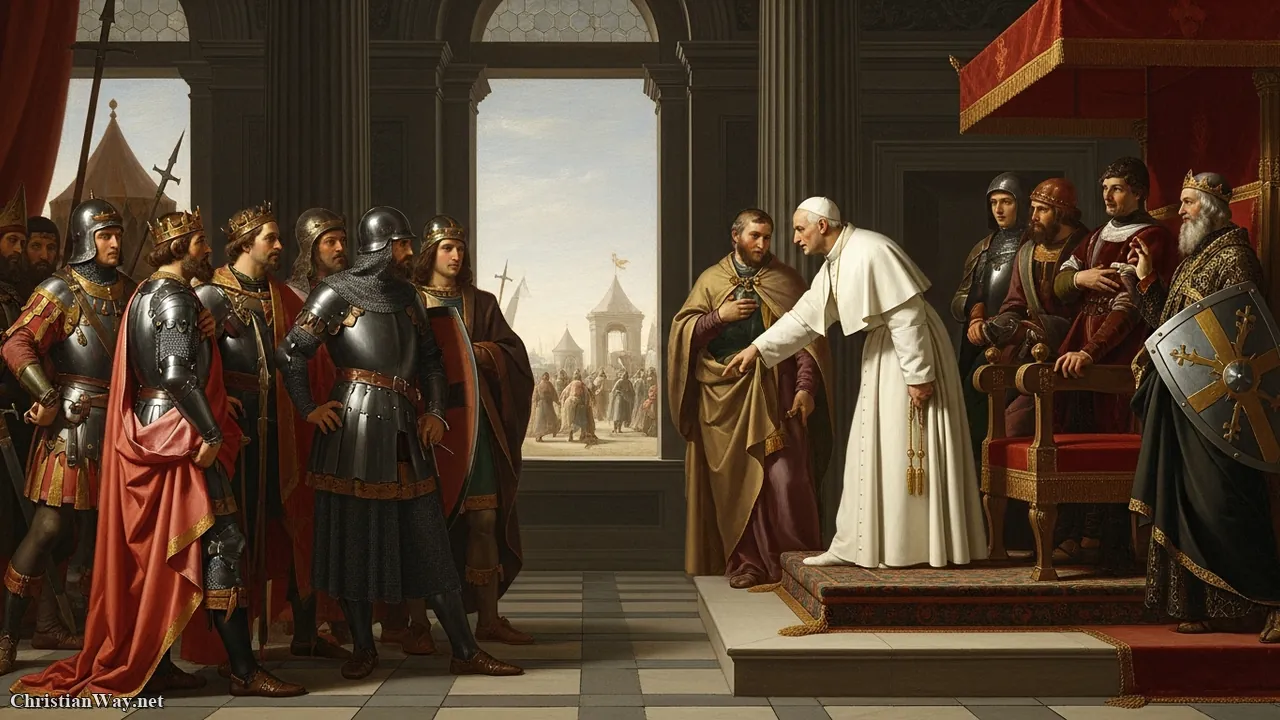
1. Correcting the West (Defending Marriage): The most famous example of his resolute labor was his confrontation with King Lothair II of Lotharingia. Lothair wished to set aside his lawful wife, Queen Teutberga, to marry his mistress, Waldrada. Despite local synods (notably the Synod of Metz) manipulated by the King to grant him an annulment, Nicholas stood firm, seeing the defense of a wronged queen as the defense of the Sacrament of Matrimony itself. He boldly voided the council’s decision, excommunicated the corrupt legates and even deposed the powerful Archbishops Gunther of Cologne and Theutgaud of Trier, who supported Lothair. When Lothair and Emperor Louis II laid siege to Rome, Nicholas remained undeterred, hiding and praying, relying on spiritual authority alone. His decision held, proving that a marriage sanctioned by God could not be dissolved by the whims of a king. This was a revolutionary act that set a standard for papal moral oversight over rulers that would endure throughout the Middle Ages.
2. Defending Papal Primacy (Archbishops John and Hincmar): Nicholas asserted Rome’s superior appellate jurisdiction over the powerful Archbishops. When Archbishop John of Ravenna behaved tyrannically—illegally imprisoning priests and extorting money—Nicholas did not just send a letter; he personally traveled to the region, investigated the complaints, and forced John to submit to the papal court. Similarly, he corrected the highly influential and capable Archbishop Hincmar of Reims, demanding the reinstatement of Bishop Rothad of Soissons, whom Hincmar had improperly deposed. Nicholas insisted that every bishop had the right of final appeal to the Apostolic See, establishing a crucial safeguard against local metropolitan tyranny.
3. Mission and Charity: While his great labors were often intellectual and jurisdictional, Nicholas was deeply committed to the poor and to the expansion of the faith. He personally oversaw the distribution of food and aid during periods of famine in Rome, acting on the scriptural injunction: If anyone has the world’s goods and sees his brother in need, yet closes his heart against him, how does God’s love abide in him?
– 1 John 3:17. Furthermore, he directed the mission to the newly converted Bulgarians, providing King Boris I with the famous Responsa Nicolai ad Consulta Bulgarorum, a detailed set of 106 answers on Christian law, morality, and liturgy. These responses shaped Bulgarian Christianity, even while the question of their ultimate jurisdiction became a point of contention with the East, demonstrating Nicholas’s determination to evangelize under Rome’s spiritual guidance.
The Teacher of Souls: Theological & Spiritual Legacy
Saint Nicholas I is not primarily remembered as a theologian in the vein of Augustine or Aquinas, but as a master of ecclesiastical governance and a powerful teacher of the Law of the Church. His intellectual contribution lies in his assertion of the absolute supremacy of the Petrine office, grounded not in political necessity, but in divine mandate. He was the great expositor of what the papacy ought to be.
Intellectual Contribution and The Pseudo-Isidorian Decretals: Nicholas’s teachings were primarily disseminated through his voluminous and powerful letters (epistolae and decretales). He was perhaps the first pope to systematically use the term decretales—papal letters of binding judicial and legislative authority—and apply them universally across the entire Western Church. Crucially, he made use of the newly emerged collection of forged documents known as the Pseudo-Isidorian Decretals. While scholars debate whether Nicholas was aware of their fraudulent nature (most agree he was not, or at least didn’t rely solely on them), he certainly grasped the core principle they articulated: that all bishops and councils were subordinate to the Pope and that metropolitan power must be checked by Roman authority. His application of these principles in the Hincmar/Rothad and Lothair cases cemented their legal weight. He synthesized existing patristic tradition with his own understanding of Petrine primacy into a cohesive teaching on Church order, ensuring the freedom of the local bishop from secular (and even overreaching metropolitan) control, by granting them the right to appeal to the highest spiritual court in Rome.
Key Teachings: The Primacy of Christ’s Law over Caesar’s Rule: The core of Nicholas’s spiritual teaching is his unshakeable insistence on the moral distinction between the two realms: the spiritual and the temporal. He was a champion of the Gelasian doctrine of the “two swords,” proclaiming that the sacred authority of the pontiffs (auctoritas), concerning eternal matters, was superior to the royal power (potestas), which governs temporal affairs. In one of his letters, he teaches this profound truth: The Lord has entrusted the direction of the Holy Church to the two-fold authority of the Pontiff and of the King. But the authority of the priests is all the more weighty, because at the divine judgment they have to render an account for the kings of men themselves.
This statement is the foundation of Catholic political theology for the next five centuries. It is an act of spiritual guidance that insists all Christians, even kings, are subjects of the moral law established by Christ. It is a teaching for the ages, reminding us today, on Christian Way, that no government, no ideology, and no political figure is above the Gospel of Jesus Christ.
The Via Dolorosa: Suffering, Death, and Sainthood
Pope Nicholas I’s life was a continuous form of suffering born of conflict. He endured persecution not in the blood of martyrdom, but in the constant warfare against the powers of this world—against arrogant rulers, defiant bishops, and the persistent threat of schism. He lived under continual political duress; the siege of Rome by Emperor Louis II’s forces forced him to rely on only God’s providence, enduring hunger and isolation. The spiritual suffering caused by the Photian Schism in the East, which saw him excommunicated by the Greeks in a retaliatory synod (a sentence he firmly ignored), was deeply painful to a Pope who longed for Christian unity.
The Final Days: The strain of these conflicts took their toll. St. Nicholas I died peacefully, though exhausted, on his feast day, November 13, 867. Unlike some of his contemporaries, whose deaths were marked by political intrigue or violence, Nicholas’s final days were characterized by the serenity of a faithful servant who had fought the good fight and kept the faith. The Liber Pontificalis praises his death, noting he was “venerated as a saint” immediately upon his passing. His body was initially interred in the portico of St. Peter’s Basilica, and later moved to the interior of the basilica by Pope Urban VIII in 1630.
Post-Mortem & Canonization: The road to his sainthood was organic, reflecting the overwhelming popular and clerical devotion to him during his life and after his death. He was known posthumously as “The Great” by his successors and chroniclers, a title he shares only with Pope St. Leo I and Pope St. Gregory I. Nicholas I was declared a saint through what is known as Pre-Congregation Canonization, meaning his cult was established and venerated by popular acclamation and confirmed by the Church before the formalization of the modern canonization process. His status was officially affirmed and his cult re-established by Pope Urban VIII in 1630. His feast day is celebrated universally on November 13. His legacy remains firm: he was a saint of law, order, and prophetic courage, whose holiness was expressed through his governance, ensuring that the earthly institution of the Church would be faithful to its heavenly commission.
Spiritual Highlights: Lessons for the Modern Christian
The life of Saint Nicholas I offers profound and practical lessons for the Christian navigating the complexities of the 21st century. We, too, live in an age of confusion, where moral authority is questioned and secular power often seeks to dominate the spiritual life. Nicholas teaches us that strength is found in adherence to unchanging truth.
- Fortitude in the Face of Power: Nicholas shows us how to resist political and social pressure when it contradicts revealed truth. If a king (or a cultural tide) demands immorality, the faithful soul must choose Christ, regardless of the consequences.
- Defense of the Sanctuary of Marriage: His unwavering defense of Queen Teutberga reminds us that Christian marriage is a sacred institution—a Sacrament—that must be protected from personal convenience, divorce, and worldly compromise.
- The Value of Disciplined Authority: We learn that true Christian leadership requires not just kindness, but the willingness to exercise corrective discipline, in persona Christi, when necessary to protect the weak and uphold justice within the Body of Christ.
- Humility in Vocation: His initial flight and reluctance to accept the papacy teaches us that true authority is rooted not in seeking power, but in humbly surrendering to the daunting duties God lays upon us, even when we feel unqualified.
A Prayer for Intercession
O Holy Father, Saint Nicholas the Great, who stood as a steadfast rock against the tides of moral decay and temporal intrusion, we humbly beseech your powerful intercession. You bravely defended the integrity of Christ’s Church and the sanctity of the Sacrament of Matrimony against kings and princes. Grant to the Church today, and especially to our Holy Father and all bishops, a measure of your own invincible fortitude and spiritual clarity. For us, the lay faithful, pray that we may have the courage to uphold the moral law in our families and in the public square, recognizing that the Kingdom of God supersedes all earthly authority. May we always choose God’s justice over human compromise. Through Christ our Lord. Amen.
— Fr. John Matthew, for Christian Way