Dear friends in Christ,
There are seasons in life when the heart grows tired of noise. We become weary of rushing from one task to another, weary of carrying worries that seem to multiply each day, weary of trying to keep pace with a world that rarely slows down. Even when life is full, something within us may feel empty. We may have work to do, people to care for, goals to pursue, and responsibilities to carry, yet still wonder where peace has gone.
Saint Benedict of Nursia speaks gently into this restlessness. He does not offer a quick escape from life. He does not promise that discipleship will remove every burden. Instead, he offers what might be called a holy rhythm: a way of living in which prayer, work, silence, Scripture, humility, community, and hospitality are gathered beneath the loving presence of God.
Saint Benedict lived in a troubled age, when the old structures of the Roman world were weakening and many people faced uncertainty, violence, and social disorder. Yet rather than surrendering to despair, he helped form communities where faith could be lived with stability, order, charity, and hope. His Rule became a guide not only for monks and nuns, but for countless Christians who have longed to bring a little more peace, prayer, and faithfulness into daily life.
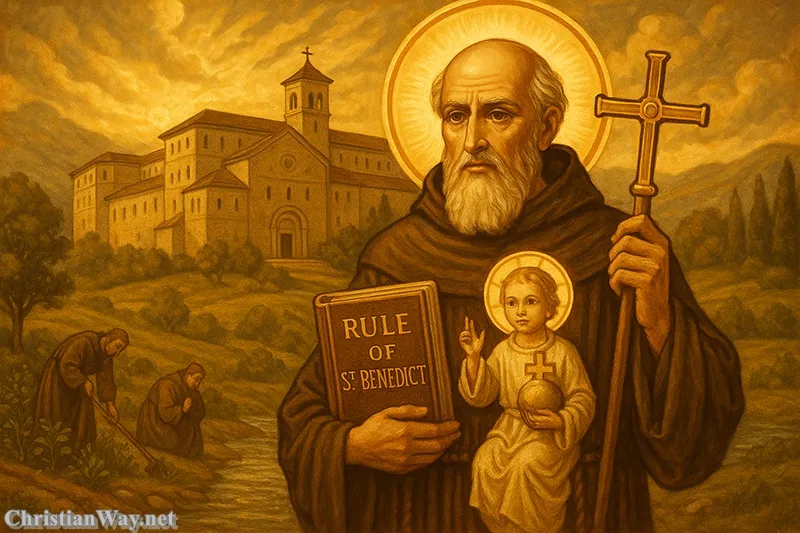
To call Saint Benedict the Father of Western Monasticism is to recognize the immense influence of his spiritual wisdom. But to call him the Master of the Rule of Life is perhaps even more personal. He teaches us that holiness is not built only in extraordinary moments. It is formed through a faithful pattern of small things: rising to pray, speaking gently, working honestly, listening carefully, receiving others with kindness, asking forgiveness, and returning to God whenever the heart wanders.
Saint Benedict reminds us that the Christian life is not meant to be scattered. Christ does not ask us to divide our lives into separate parts, with prayer in one corner and work in another, family in one place and faith in another. He calls us to let every part of life belong to Him. In the kitchen, at work, in the classroom, in the church, in moments of joy, in seasons of grief, and in the hidden struggles of the heart, God is near.
A Young Man Who Left the Noise to Seek God
Saint Benedict was born around the year 480 in Nursia, a town in central Italy. As a young man, he was sent to Rome for study, but the spiritual and moral confusion he encountered there deeply troubled him. He left the city and withdrew into a life of prayer and solitude near Subiaco, where he sought not fame, influence, or comfort, but God alone.
His choice was not a rejection of humanity. It was a refusal to allow the chaos around him to shape the deepest part of his soul. Benedict understood that when the heart is constantly distracted, it slowly loses the ability to listen. We may hear many voices, but not the voice of God. We may know many facts, but not know the truth that gives life. We may be surrounded by activity, but remain spiritually asleep.
This is a temptation in every age. We often imagine that our distractions are unique because our world is filled with technology, messages, entertainment, and endless demands upon our attention. Yet the human heart has always struggled to remain still before God. It has always been tempted to seek comfort without conversion, success without humility, and knowledge without wisdom.
Saint Benedict’s withdrawal into silence was not selfish isolation. It was preparation. God was shaping him in hiddenness before entrusting him with others. The silence of Subiaco became a school of prayer. The solitude became a place where he learned to confront his own weaknesses. He discovered that the greatest battle is not always against the world outside us. Often it is within the heart: pride, anger, impatience, fear, self-will, and the desire to live without depending on God.
Every Christian needs some form of this holy desert. It may not be a cave in the mountains. It may be ten quiet minutes before the rest of the household wakes. It may be a slow walk without a phone in hand. It may be a moment in church after everyone else has gone home. It may be the practice of opening Scripture before opening the news.
The desert is wherever we allow God to speak more loudly than the noise of the world.
Silence Is Not Empty
Many people are afraid of silence because silence can reveal what we have been trying not to feel. When the noise fades, grief may rise. Anxiety may become clearer. Regrets may return. Questions we have pushed aside may begin to speak again.
But silence with God is never empty. It is a place of encounter.
The Psalmist says, “Be still, and know that I am God” (Psalm 46:10). These words are not an invitation to passivity. They are an invitation to trust. God does not ask us to stop caring, stop working, or stop carrying responsibility. He asks us to remember that we are not the Savior of the world. We are His children.
Saint Benedict understood that a peaceful life begins not with controlling everything around us, but with allowing God to restore order within us. The soul becomes quieter when it remembers who God is. He is faithful. He is near. He is merciful. He sees what we cannot see. He holds what we cannot hold.
For someone who feels overwhelmed, this can become a simple prayer: “Lord, I cannot carry everything. Help me to carry what You have given me today.”
The Rule of Saint Benedict: A School for the Service of the Lord
After his years of solitude, Benedict became the spiritual father of communities of monks. Eventually he founded the monastery of Monte Cassino, where he wrote the Rule that would shape generations of monastic life. The Rule of Saint Benedict is not a cold collection of regulations. It is a spiritual path. It is a wise and compassionate guide for people who desire to seek God together.
Benedict described the monastery as a “school for the service of the Lord.” This phrase is deeply beautiful. A school is a place where people learn. It is a place where beginners are formed patiently. It is a place where mistakes can become lessons. It is a place where growth happens slowly.
Saint Benedict did not expect human beings to become holy overnight. He knew that the heart must be trained in love. A person learns patience by practicing patience. A person learns humility by accepting correction. A person learns prayer by returning to prayer, even when prayer feels dry. A person learns charity by choosing kindness again and again, especially when kindness feels difficult.
This is encouraging for us because many people become discouraged by their own weakness. They pray for a few days and then lose focus. They decide to become more patient and then fail in the first difficult conversation. They try to forgive but find old anger returning. They want to live faithfully but discover that the old habits remain strong.
Saint Benedict would not be surprised by this struggle. He would simply tell us to begin again.
The Christian life is not a competition to prove our spiritual strength. It is a daily return to grace. It is learning, little by little, to prefer Christ over our own self-will. It is allowing the Lord to shape us through ordinary faithfulness.
“Listen”: The First Word of the Rule
The Rule of Saint Benedict begins with a simple but powerful invitation: “Listen.” This is not merely listening with the ears. It is listening with the heart.
To listen is difficult because we often arrive before God already full of our own plans, opinions, fears, and demands. We pray, but perhaps we are mostly speaking. We ask God to bless our decisions, but perhaps we have not stopped long enough to ask what He desires.
Saint Benedict calls us to become listeners. He teaches that obedience begins with listening. In the Christian life, obedience is not blind submission to human control. It is the freedom to trust that God’s will leads us toward life. It is the willingness to believe that the One who made us knows the path toward our true good.
Jesus Himself says, “My sheep hear my voice. I know them, and they follow me” (John 10:27). To hear the voice of Christ, we must become quiet enough to recognize it.
God often speaks through Scripture. He speaks through the wisdom of the Church. He speaks through conscience formed by truth. He speaks through wise counsel. He speaks through the needs of others. He sometimes speaks through a closed door, a disappointment, or an unexpected change in our plans.
Listening does not mean that every decision becomes easy. It means that we no longer walk through life alone. We begin to ask, “Lord, what are You saying to me here? What do You desire to form in me through this moment?”
Prayer: The Heartbeat of a Holy Life
Saint Benedict placed prayer at the center of monastic life. The daily rhythm of the monastery was shaped by the Divine Office, the regular gathering of the community to pray the Psalms and praise God. Prayer was not treated as something to fit in only when there was free time. It was the center around which the rest of life was ordered.
This is a challenge for modern people. We often place prayer at the edge of the day. We pray when we feel calm enough, when the house is quiet enough, when work is finished, when our mind is less distracted, or when a crisis forces us to turn toward God. But the perfect moment rarely comes.
Saint Benedict teaches us that prayer needs a place in the pattern of life. It does not need to be long or complicated at first. What matters is that it is faithful.
A parent may pray for five minutes before the children wake. A worker may quietly offer the day to God before beginning a shift. A student may read one Psalm before studying. A family may pray together before sleep. A person carrying grief may simply sit before a crucifix and say, “Jesus, stay with me.”
Prayer is not meant to become another burden. It is meant to become a place where the burdened heart can rest.
Benedict’s wisdom reminds us that prayer changes not only the words we speak to God, but the way we live before Him. When we pray the Psalms, we learn to bring every emotion into God’s presence: joy, anger, confusion, sorrow, hope, repentance, and praise. The Psalms teach us that we do not need to hide our real hearts from the Lord.
Prayer as Returning to God
There are days when prayer feels beautiful. There are moments when Scripture seems to shine with light. There are seasons when we sense God’s nearness with great consolation.
But there are also days when prayer feels dry. We sit quietly, but the mind wanders. We speak the words, but the heart feels distant. We wonder whether God hears us at all.
Saint Benedict would remind us that faithfulness matters more than feelings. Prayer is not only a spiritual experience. It is an act of love.
A married couple does not remain faithful only on days when affection feels easy. A parent does not care for a child only when rested and cheerful. In the same way, the soul does not remain close to God only when prayer feels sweet. Love becomes real when it remains.
When you cannot pray many words, pray one word. Say, “Jesus.” Say, “Mercy.” Say, “Help.” Say, “Thank You.” Say, “I trust You.”
The Lord understands the language of the weary heart.
Ora et Labora: Prayer and Work United in God
Saint Benedict is often associated with the phrase ora et labora, “pray and work.” Though these exact words are not a formal motto written in the Rule itself, they express something essential about Benedictine spirituality: prayer and labor belong together.
Work, for Saint Benedict, was not a distraction from holiness. It was part of holiness. Manual labor, care for the monastery, study, service, and daily responsibilities were all ways of giving oneself to God. Work was not beneath the spiritual life. It could become prayer when offered with humility and love.
This is an important message for people who feel that their daily work has little spiritual value. A mother may spend the day cooking, cleaning, carrying children, organizing family needs, and responding to countless small demands. A father may work long hours, carrying the pressure of providing for those he loves. A teacher may repeat the same lesson with patience. A driver may spend long hours on the road. A caregiver may tend to someone who cannot care for themselves. A laborer may do physically exhausting work with little recognition.
Saint Benedict teaches us that none of this is unseen by God.
Work becomes holy when it is offered in love. It becomes prayer when it is joined to Christ. It becomes service when we remember that our labor can be an expression of care for others.
This does not mean that all work is easy or that injustice in the workplace should be ignored. Many people labor under heavy pressure, poor conditions, unfair treatment, or fear of financial insecurity. The Church must always care about justice, dignity, and the protection of workers. But even within difficult circumstances, the heart can remain free by offering each day to God.
“Whatever you do, do it from the heart, as for the Lord and not for others,” Saint Paul writes (Colossians 3:23). This does not make a difficult job magically pleasant. But it gives work a deeper meaning. It reminds us that our labor is not only for approval, income, or success. It can become an offering.
The Grace of Ordinary Duties
Many people think holiness must look dramatic. We imagine saints doing great public works, traveling to distant places, preaching before crowds, or performing miracles. Yet Saint Benedict reminds us that holiness is often hidden inside ordinary duties.
A task done with irritation can drain the heart. The same task, offered quietly to God, can become a path of grace.
Washing dishes can become an act of love for the family. Answering an email honestly can become an act of integrity. Preparing a meal can become an act of hospitality. Helping a child with homework can become an act of patience. Repairing something broken can become an act of stewardship. Showing up on time can become an act of faithfulness.
The question is not always, “What great thing can I do for God?”
Often the better question is, “How can I love God in the task already in front of me?”
Humility: The Ladder That Leads Upward
One of the most famous parts of the Rule of Saint Benedict is his teaching on humility. Benedict describes humility as a ladder by which the soul rises toward God. This may seem strange at first. We often think of climbing upward by becoming stronger, more successful, more admired, or more independent. Benedict says that the way upward is humility.
Humility is often misunderstood. It does not mean pretending that we have no gifts. It does not mean accepting mistreatment or allowing others to crush our dignity. It does not mean believing that we are worthless.
Humility means living in truth.
It means recognizing that everything good in us is received from God. It means remembering that we are not self-created. It means knowing that we need grace. It means being willing to learn, apologize, ask forgiveness, accept correction, and serve without demanding praise.
The humble person is free from the exhausting need to appear greater than they are. Such a person can rejoice in the gifts of others. They can admit weakness without losing hope. They can receive help without shame. They can live peacefully because they no longer need to defend an image of themselves at every moment.
Jesus gives us the perfect image of humility. Though He is Lord, He washes the feet of His disciples. Though He is without sin, He stands among sinners. Though He has all power, He enters Jerusalem not as a conqueror on a war horse, but as the gentle King riding on a donkey.
Saint Benedict teaches us that humility is not weakness. It is the strength to become like Christ.
Learning to Receive Correction
One of the hardest lessons in the spiritual life is learning to receive correction without becoming defensive. Most of us know how quickly the heart rises when someone points out a weakness, a mistake, or an area where we have failed.
Yet Benedict saw correction as a possible instrument of grace. Not every criticism is fair, wise, or spoken with love. Some words wound rather than heal, and we must learn to recognize this. But sometimes God uses another person to reveal something in us that we have not been able to see.
Perhaps we are impatient. Perhaps we speak too sharply. Perhaps we carry resentment. Perhaps we avoid responsibility. Perhaps pride has made us unable to listen.
A humble heart does not collapse when it sees its sin. It returns to God. It says, “Lord, show me who I truly am, not so that I may despair, but so that You may heal me.”
This is the beginning of freedom.
Community: Learning to Love Real People
Saint Benedict did not imagine holiness as a private journey. His Rule was written for a community. He knew that people can appear holy when they live alone but struggle when they must share life with others.
Community reveals us. It reveals our impatience, our desire for control, our tendency to judge, our need to be noticed, our difficulty forgiving, and our habit of placing ourselves at the center. But community also becomes the place where love is practiced.
The monastery, in Benedict’s vision, was not a gathering of perfect people. It was a family of imperfect people learning to seek God together. They prayed together, worked together, ate together, listened together, and carried one another’s weaknesses.
This is true of family life, parish life, friendships, workplaces, and every Christian community. We may long for a perfect community, but such a place does not exist on earth. Wherever people gather, there will be misunderstandings, differences of personality, disappointments, and moments of tension.
The question is not whether we will be wounded by others. The question is whether we will learn to love as Christ loves.
Saint Benedict teaches us that stability matters. In a world where people quickly leave when relationships become difficult, Benedict calls us to remain. This does not mean remaining in abusive or dangerous situations. Wisdom and safety matter deeply. But in ordinary struggles, he reminds us that love grows when we do not run away at the first inconvenience.
We become mature by learning to stay present, listen patiently, speak truthfully, forgive sincerely, and serve generously.
Bearing One Another’s Burdens
Saint Paul writes, “Bear one another’s burdens, and in this way you will fulfill the law of Christ” (Galatians 6:2). This is the heart of Christian community.
Some burdens are visible: illness, unemployment, bereavement, financial hardship, family crisis. Others are hidden: anxiety, loneliness, shame, fear, spiritual dryness, regret, or grief that has not yet found words.
To bear another person’s burden does not mean solving every problem. Often we cannot. It means refusing to let someone carry the weight alone.
A phone call can be a burden shared. A meal can be a burden shared. A prayer can be a burden shared. A patient conversation can be a burden shared. A quiet presence beside someone who is suffering can be a burden shared.
Saint Benedict teaches that community is not built by people who never need help. It is built by people humble enough to give help and humble enough to receive it.
Hospitality: Welcoming Christ in the Stranger
One of the most beautiful teachings in the Rule of Saint Benedict is its call to welcome guests with reverence. Benedict tells his communities to receive visitors as Christ Himself.
This is not simply a rule for monasteries. It is a Gospel truth for every Christian home and heart.
Jesus often came to people in unexpected ways. He came as a stranger on the road to Emmaus. He came as a hungry crowd needing food. He came as a sick person crying for mercy. He came as a child placed before the disciples. He came as the poor, the excluded, and the overlooked.
To welcome another person is to recognize that our lives do not belong only to ourselves. Hospitality is the willingness to make room.
Sometimes hospitality means opening the door of our home. Sometimes it means preparing a meal. Sometimes it means welcoming a new person at church. Sometimes it means listening to someone whose story is different from ours. Sometimes it means making room in our schedule for a person who is lonely.
Hospitality does not require wealth. A small home can be full of welcome. A simple meal can carry great love. A few minutes of sincere attention can become a gift.
In a world where many people feel unseen, hospitality becomes a form of evangelization. It says, “You matter. You are welcome. You are not a burden. There is room for you.”
Welcoming the Poor and the Difficult
It is easy to welcome people who are pleasant, familiar, and likely to repay us. The harder work of hospitality is receiving those who make us uncomfortable.
This may include the person whose opinions differ from ours, the relative who always seems difficult, the neighbor who needs more patience than we feel able to give, the person who has made mistakes, or the stranger who does not fit easily into our expectations.
Saint Benedict does not ask us to abandon wisdom or healthy boundaries. Love must be guided by truth. But he does call us to examine the narrowness of our hearts. Christ often enters through the person we are most tempted to avoid.
The Gospel does not tell us merely to love those who are easy to love. It calls us to become people whose hearts are being widened by grace.
Stability in a Restless World
One of the central Benedictine promises is stability. Stability means remaining faithful to the place and community where God has called us. It is a powerful word for an age marked by constant movement, distraction, and dissatisfaction.
Many people today are restless. We move quickly from one interest to another, one relationship to another, one plan to another, one spiritual practice to another. We often believe that peace lies somewhere else: in a different city, a different job, a different relationship, a different church, a different version of ourselves.
Sometimes change is necessary. God may truly call us to a new place. But Saint Benedict asks us to consider whether our restlessness sometimes comes from the inability to remain present where we are.
Stability is the courage to let God meet us in the real conditions of our lives.
It means loving the family we have, not the imaginary family we wish we had. It means serving in the community where God has placed us. It means returning to prayer even when we do not feel inspired. It means caring for the responsibilities entrusted to us. It means allowing roots to grow.
A tree cannot bear fruit if it is constantly uprooted. In the same way, the soul cannot mature if it is always fleeing from the slow work of grace.
Saint Benedict reminds us that God often transforms us not by taking us out of every difficulty, but by making us faithful within it.
The Rule of Life for Every Christian
Most Christians are not monks or nuns. We may live in families, work in offices, drive through crowded streets, care for children, study, run businesses, or carry responsibilities far from monasteries and cloisters.
Yet Saint Benedict’s wisdom belongs to all of us.
Every Christian can build a simple rule of life: a realistic rhythm that helps the heart remain close to God. This is not about creating a harsh system or becoming anxious about spiritual performance. It is about making space for what matters most.
A rule of life may include a short prayer in the morning, a few verses of Scripture, gratitude before meals, honest work offered to God, a moment of silence during the day, patience in speech, a practice of forgiveness, and evening prayer before sleep.
The rule should be gentle enough to sustain and strong enough to guide. It should not become a burden that crushes the soul. It should become a pathway of freedom.
Saint Benedict knew that people need order, not because God is rigid, but because love needs room to grow. A garden needs care. A family needs rhythms. A body needs rest. A soul needs prayer.
When life has no rhythm, the loudest things often take over. Urgency replaces wisdom. Distraction replaces attention. Anger replaces peace. Exhaustion replaces joy.
A Benedictine rule of life helps us reclaim the center.
A Simple Benedictine Rhythm for Daily Life
A Christian household can begin with very small practices.
Begin the day with a prayer before checking messages.
Read a few verses from the Gospel.
Offer work to God, especially the work that feels unnoticed.
Speak more slowly when anger rises.
Keep a small moment of quiet before sleep.
Give thanks for one blessing each day.
Ask forgiveness quickly when you have spoken harshly.
Welcome another person with attention rather than distraction.
These simple practices may not appear impressive, but they can slowly reshape the heart. They create space for God in the ordinary day.
Saint Benedict teaches us that a holy life is not usually made of dramatic moments. It is made of faithful repetitions offered with love.
Saint Benedict and the Healing of Europe
Saint Benedict is often called a patron of Europe because the monasteries shaped by his Rule became places of prayer, learning, hospitality, agriculture, service, and cultural preservation during difficult centuries. They were not perfect institutions, and history is always more complex than a simple story. Yet through generations of instability, Benedictine communities helped preserve the light of faith, learning, and human dignity.
This is why Saint Benedict is more than a saint of the past. He is a witness for every society that fears losing its moral center.
When cultures become harsh, impatient, and divided, Benedict reminds us of humility. When people become isolated, he reminds us of community. When work becomes empty, he reminds us to offer labor to God. When homes become restless, he reminds us of prayer. When the poor are overlooked, he reminds us of hospitality.
The renewal of a people often begins quietly. It begins when a family prays. It begins when someone chooses honesty. It begins when a community welcomes the stranger. It begins when children are taught that success is not the highest good. It begins when people remember that they are not made only to consume, compete, and achieve, but to know God and love one another.
Saint Benedict’s vision was not built on noise. It was built on faithfulness.
A Saint for the Restless Heart
Perhaps the greatest gift Saint Benedict offers us is peace.
Not the shallow peace that comes when everything goes according to plan. Not the temporary peace of escaping responsibility. Not the false peace of avoiding difficult truths.
He offers the peace that comes when the heart is ordered toward God.
This peace can exist even in hardship. A person may be grieving and still carry peace. A parent may be tired and still carry peace. A worker may face uncertainty and still carry peace. A person may have unanswered questions and still carry peace.
This peace comes from knowing that God is present.
Jesus says, “Peace I leave with you; my peace I give to you. I do not give to you as the world gives” (John 14:27). The peace of Christ is not dependent on perfect circumstances. It is a gift of His presence.
Saint Benedict calls us back to this gift. He invites us to stop trying to build a life on hurry, control, and self-reliance. He invites us to listen, pray, work, serve, forgive, and rest in God.
His Rule is not a prison. It is a path toward freedom.
Reflect and Pray
Dear friends, Saint Benedict of Nursia teaches us that the way to God is often found in the small and faithful things of daily life. We do not need to escape our responsibilities in order to seek holiness. We need to bring Christ into them.
Perhaps your life feels scattered today. Perhaps work has become heavy. Perhaps prayer has grown difficult. Perhaps your home feels restless, your heart feels tired, or your future feels uncertain. Bring these things before the Lord.
Ask Saint Benedict to pray for you, that you may learn to listen more deeply, pray more faithfully, work more peacefully, and welcome others more generously. Ask God to give you a holy rhythm, not one built on pressure, but one built on grace.
May Saint Benedict of Nursia teach us to prefer nothing to the love of Christ. May he guide our homes, our families, our work, and our churches toward greater humility, stability, prayer, and peace.
Lord Jesus Christ, You called Saint Benedict to seek You in silence, prayer, work, and community. Through his intercession, give us hearts that listen, hands that serve, and lives ordered by Your love. Teach us to remain faithful in small things, to welcome others with kindness, to carry our duties with peace, and to rest always in Your mercy. Amen.
— Fr. John Matthew