Dear friends in Christ,
Some saints are remembered first for the manner of their death. Their final moment becomes so powerful that it can seem to eclipse the long, quiet path that led them there. Saint Óscar Romero is often remembered as the archbishop who was killed while celebrating Mass. Yet before he became the martyr of the altar, he was a priest who prayed, listened, studied, preached, carried the burdens of his people, and slowly allowed the suffering around him to shape his heart more deeply in the likeness of Christ.
His life reminds us that Christian courage is rarely born in a single dramatic hour. It grows in the hidden places of faithfulness. It grows when a priest kneels before the Blessed Sacrament while the world outside is restless. It grows when a mother continues to pray for a child who has wandered. It grows when a father chooses honesty despite pressure at work. It grows when a believer refuses to become numb to another person’s pain. It grows whenever we allow the Gospel to disturb our comfort and enlarge our love.
Saint Óscar Romero lived in El Salvador during a time of fear, violence, inequality, and grief. Families mourned loved ones who had disappeared. The poor often felt unseen. Many people lived under the shadow of intimidation and brutality. In the midst of this suffering, Romero did not seek political power, personal fame, or the applause of crowds. He sought to remain faithful to Christ and to the people entrusted to his care.
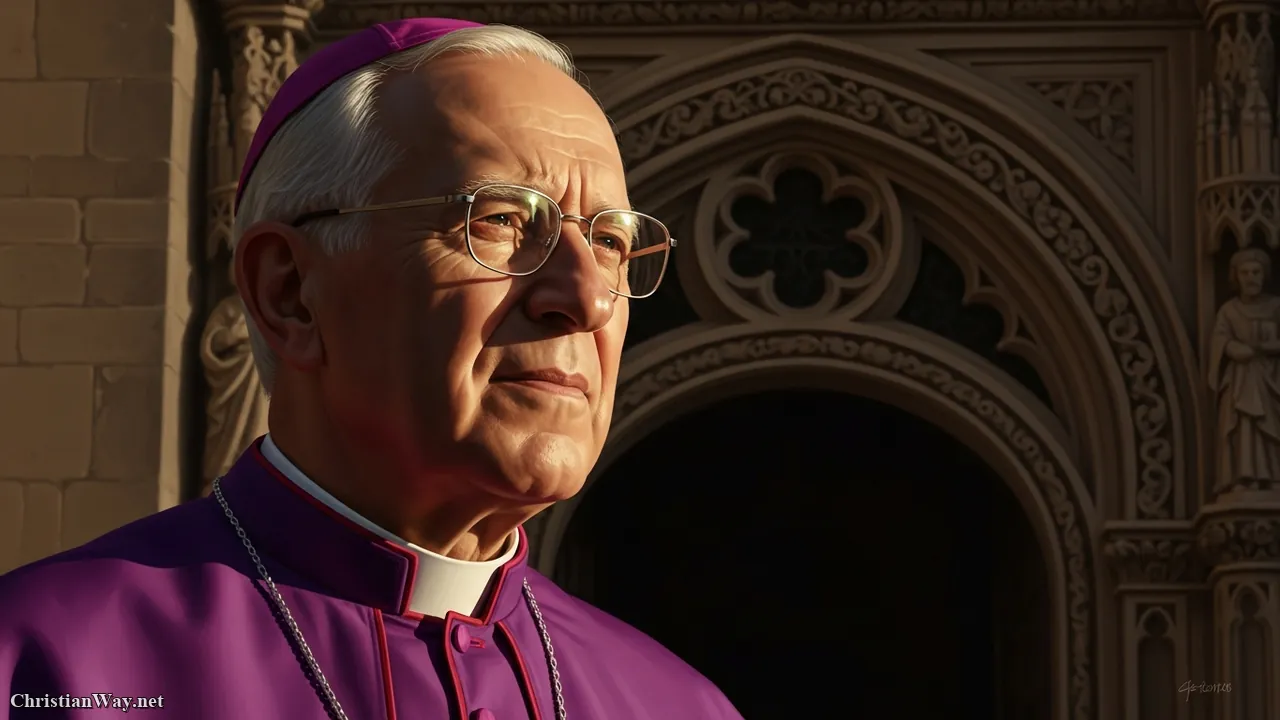
That faithfulness eventually cost him his life. But it did not begin with martyrdom. It began with a heart that learned to see the face of Jesus in the wounded, the poor, the grieving, and the forgotten. It began with a priest who realized that the Gospel cannot remain only within the walls of a church. The Word of God must enter the streets, the homes, the hospitals, the prisons, the fields, and the hidden places where people are afraid.
Saint Óscar Romero teaches us that the altar is not a place of escape from the world’s suffering. It is the place where Christ gathers the suffering of the world into His own redeeming love. At the altar, bread and wine are offered. At the altar, human weakness is brought before God. At the altar, Christ gives Himself for the life of the world. And from the altar, Christians are sent forth to love with courage, mercy, and truth.
A Priest Formed by Prayer, Study, and Ordinary Faithfulness
Óscar Arnulfo Romero was born in Ciudad Barrios, El Salvador, in 1917. As a young boy, he was trained for a time as a carpenter before entering the seminary. He later studied in Rome and was ordained to the priesthood in 1942. Long before he became known around the world, he was a quiet and serious priest, devoted to pastoral work, prayer, and the service of the Church.
There is something deeply consoling in this beginning. Romero did not begin as a public hero. He was not born into fame. He did not know that his name would one day be spoken in churches, schools, homes, and places of prayer across the world. He simply tried to be faithful to the calling God had given him.
Many of us may feel that our lives are too ordinary to matter. We may think that God works only through people with great influence, great education, great wealth, or a great public mission. But Saint Óscar Romero reminds us that holiness often begins in obscurity. It begins in the duties no one notices. It begins when we pray honestly, work faithfully, speak kindly, and remain close to God even when no one is watching.
The Lord does not ask every person to stand before thousands. He may ask us to stand patiently beside one suffering person. He may ask us to defend someone who has no voice. He may ask us to tell the truth in a difficult conversation. He may ask us to forgive someone who has wounded us. He may ask us to remain faithful in a place where faithfulness feels unseen.
These small acts are not small in the eyes of heaven.
The Hidden Formation of a Shepherd
A shepherd is not formed only through study. A shepherd is formed through love. He learns to listen to people’s burdens. He learns to recognize grief beneath silence. He learns that a person’s outward behavior may hide sorrow, fear, shame, hunger, or loneliness.
Saint Óscar Romero slowly became this kind of shepherd. He did not treat the poor merely as a social category. He saw them as persons. He saw mothers grieving their children. He saw workers carrying exhausting burdens. He saw farmers, laborers, students, families, and parishioners trying to survive in a land wounded by violence.
The Christian heart must always learn this way of seeing. It is easy to speak about “the poor” as though they were an idea. It is easy to speak about “suffering people” without allowing their suffering to touch us. But Jesus never loved people as categories. He saw the individual. He saw the blind man beside the road. He saw the widow in grief. He saw the child placed before Him. He saw the woman who had been ashamed for years. He saw the thief dying beside Him.
And He sees us still.
The Shepherd Who Could Not Look Away
When Romero became Archbishop of San Salvador in 1977, El Salvador was entering a deeply painful period of social and political violence. The murder of Father Rutilio Grande, a Jesuit priest and friend of Romero, became an important turning point in his pastoral mission. Romero spent time in prayer beside his friend’s body, and the suffering of his people became even more personal to him.

This does not mean that Saint Óscar Romero suddenly became interested in public conflict for its own sake. He was not drawn to controversy because he enjoyed it. He was drawn to the suffering of his people because Christ was there.
A true pastor cannot remain indifferent when the flock is wounded. A priest cannot preach about the Good Shepherd while refusing to see the sheep who are bleeding beside the road. A Christian cannot speak endlessly about love while ignoring hunger, injustice, fear, and human dignity.
The Gospel does not ask us to become angry for the sake of anger. It does not ask us to divide the world into people we love and people we hate. It calls us to something deeper: to recognize that every human person is created in the image of God.
This recognition changes everything.
When we see another person as a child of God, we cannot easily treat them as disposable. We cannot casually ignore their suffering. We cannot make peace with cruelty. We cannot let fear excuse indifference.
Saint Óscar Romero’s voice became important because he spoke for those whose voices had been silenced. He listened to stories that many others preferred not to hear. He allowed the pain of ordinary people to enter his prayer. And because he prayed, his compassion did not become mere sentiment. It became courage.
To Hear the Cry of the Poor
The poor cry out in many ways. Sometimes they cry with words. Sometimes they cry through silence. Sometimes their cry is heard in a mother who does not know how she will feed her children. Sometimes it is heard in an elderly person who has been forgotten. Sometimes it is heard in a worker who is treated without dignity. Sometimes it is heard in a child who is afraid to return home. Sometimes it is heard in the shame of a person who has made mistakes and now believes that no one could love them.
The poor are not only those without money. There is also the poverty of loneliness, rejection, fear, illness, addiction, grief, and spiritual emptiness.
Saint Óscar Romero teaches us to listen.
This listening is not passive. It asks something of us. It asks whether we are willing to notice people who make us uncomfortable. It asks whether we will stop long enough to hear another person’s story. It asks whether our faith has become too private, too safe, too distant from the actual wounds of the world.
Jesus says, “Whatever you did for one of the least of these brothers and sisters of mine, you did for me” (Matthew 25:40). These words are not meant to burden us with guilt. They are meant to open our eyes.
Christ is closer than we think.
The Word of God Cannot Be Chained
Saint Óscar Romero became known for his homilies, which reached people not only in churches but also through radio broadcasts. He spoke about the Word of God, the dignity of the human person, the suffering of the poor, and the need for truth and peace. His preaching did not come from hatred. It came from a conviction that the Gospel must speak into real human life.
The Word of God is not meant to remain locked inside books, buildings, or ceremonies. It is living. It enters the heart. It questions us. It comforts us. It exposes lies. It calls us back when we have wandered.
The Letter to the Hebrews says that the Word of God is “living and active.” It is not merely an ancient message for another generation. It speaks into our homes, our workplaces, our habits, our fears, and our decisions.
Sometimes the Word of God comforts us. It tells the weary heart, “Come to me, all you who are weary and burdened” (Matthew 11:28).
Sometimes the Word of God challenges us. It asks whether we have forgiven those who hurt us. It asks whether we have become selfish. It asks whether we have ignored someone in need. It asks whether we have allowed fear to become the master of our lives.
Saint Óscar Romero understood that preaching should not flatter people into spiritual sleep. The Gospel comforts the afflicted, but it also disturbs those who have become comfortable with injustice, cruelty, indifference, or pride.
In one of his final public appeals, Romero called soldiers and officials to remember that no human command can stand above the commandment of God. His message was not an invitation to hatred or rebellion for its own sake. It was a plea for conscience, mercy, and obedience to the law of God.
Courage Without Cruelty
There is a false kind of courage that is loud, angry, and eager to humiliate others. It may sound strong, but it often comes from fear. It needs enemies. It thrives on outrage. It feeds on the weakness of others.
Saint Óscar Romero offers another kind of courage.
His courage was rooted in prayer. It was the courage to speak truth without losing love. It was the courage to defend the weak without treating other people as less than human. It was the courage to refuse silence without becoming consumed by hatred.
This is the courage Christians need today.
We may need courage in our homes, when a relationship needs honest healing. We may need courage at work, when dishonesty becomes normal. We may need courage in school, when cruelty is treated as entertainment. We may need courage in church, when the wounded need to be heard with compassion and truth.
But Christian courage must always remain joined to Christian love.
Jesus did not come to crush people. He came to save them. He did not excuse sin, but He never forgot the dignity of the sinner. He spoke truth to the powerful, but He also wept over Jerusalem. He carried the Cross not with revenge, but with mercy.
The Altar Where Love Was Poured Out
On March 24, 1980, Saint Óscar Romero celebrated Mass in the chapel of the Hospital of Divine Providence in San Salvador. During the Mass, he preached about Christ’s self-giving love and the mystery of a grain of wheat that dies in order to bear fruit. After his homily, as he approached the altar, he was shot and killed.
His death at the altar is why many people call him the martyr of the altar.
But this title must be understood with reverence. It should never make violence seem beautiful. Murder is never holy. Hatred is never holy. The suffering of victims should never be turned into a dramatic symbol that makes us forget the human pain involved.
Romero’s death was tragic. It was cruel. It was a wound not only for the Church in El Salvador, but for the whole human family.
And yet, because he died while celebrating the Eucharist, his final witness became inseparable from the mystery he had spent his life proclaiming: Christ gives Himself in love.
At every Mass, the Church remembers the sacrifice of Jesus. Bread and wine become signs of His self-giving love. The altar tells us that love is not merely a feeling. Love becomes gift. Love becomes service. Love becomes the willingness to remain faithful even when faithfulness is costly.
Saint Óscar Romero did not seek death. He sought to remain faithful to Christ.
There is a great difference.
The Eucharist and the Wounds of the World
The Eucharist is never an escape from the pain of humanity. It is Christ entering the pain of humanity.
At the altar, we bring everything before God: our grief, our fear, our failures, our hopes, our family burdens, our hidden tears, and the suffering of the world. Nothing is too broken to be placed before Christ.
This is why the Eucharist can become a source of courage. We receive the love of Christ not only for ourselves, but so that we may become more like Him.
We receive His patience so that we may be patient.
We receive His mercy so that we may forgive.
We receive His courage so that we may stand with those who are weak.
We receive His peace so that we may carry peace into places of tension and fear.
Saint Óscar Romero’s final Mass reminds us that every altar is connected to the suffering of the world. When we kneel before Christ, we are not called to forget the poor. We are called to see them more clearly. When we receive Christ, we are sent to love Christ in others.
Martyrdom Means Witness
The word martyr comes from a word meaning witness. A martyr is not simply someone who dies violently. A martyr is someone whose life and death bear witness to Christ.
The Church recognized Saint Óscar Romero as a martyr, beatifying him in 2015 and canonizing him on October 14, 2018. Pope Francis presented him as a pastor who remained close to his people and who allowed the Gospel to shape his love for the poor and suffering.
Martyrdom is not a search for suffering. Christians do not seek pain for its own sake. They do not desire death. They do not glorify conflict. The Christian hope is always for life, healing, reconciliation, and peace.
But there are moments when faithfulness becomes costly.
A person may be mocked for refusing to lie.
A worker may lose an opportunity because he will not join in corruption.
A young person may feel isolated because she refuses cruelty or compromise.
A parent may carry heavy burdens because love requires sacrifice.
A believer may be misunderstood because he refuses to hate the people others tell him to hate.
In these moments, the witness of Saint Óscar Romero becomes very close to us.
He tells us that truth is worth living for.
He tells us that conscience matters.
He tells us that fear does not have to rule the heart.
He tells us that Christ is near even when faithfulness feels costly.
The Poor Are Not a Political Idea
One of the great misunderstandings that can surround saints like Óscar Romero is the temptation to reduce them to a political symbol. But Romero cannot be understood fully if we remove Christ from the center of his life.
He did not love the poor because they were useful for an argument. He loved them because Christ loved them.
He did not defend human dignity because it was fashionable. He defended it because every person is created by God.
He did not speak about justice because he wanted to divide the Church. He spoke because the Gospel does not allow the Church to become indifferent to suffering.
Jesus was not a political leader in the ordinary sense. He did not build an army. He did not seek an earthly throne. But neither was He indifferent to hunger, exclusion, illness, hypocrisy, or injustice. He touched lepers. He welcomed children. He forgave sinners. He spoke against religious pride. He fed the hungry. He wept over suffering.
To follow Jesus is to love people concretely.
This means Christians must care about the hungry, the homeless, the sick, the elderly, the unborn, the refugee, the prisoner, the lonely, and those whom society has pushed aside.
The Gospel does not ask us to choose which vulnerable people are worthy of compassion. It asks us to see Christ in every person.
A Love That Refuses to Exclude
The love of Christ is never narrow.
It does not ask whether a person has earned kindness before offering mercy.
It does not ask whether someone belongs to the right group before recognizing their dignity.
It does not ask whether another person can repay us before we serve them.
This is difficult because the human heart often prefers to love selectively. We find it easier to care for people who are familiar, grateful, agreeable, or similar to us.
But Saint Óscar Romero calls us to something larger.
He calls us to see that the poor are not interruptions in our lives. They may be the very place where Christ comes to meet us.
The lonely person at church may be Christ.
The family struggling quietly may be Christ.
The elderly neighbor who needs a conversation may be Christ.
The child who acts out because of hidden pain may be Christ.
The person who has made serious mistakes and now feels ashamed may be Christ.
This does not mean that wisdom, truth, justice, and healthy boundaries no longer matter. Love must remain truthful. But truth without mercy becomes cold, while mercy without truth becomes shallow.
Christ holds them together.
The Church Renewed by Listening and Love
Saint Óscar Romero’s life also speaks to the Church in every generation. The Church is not renewed first by reputation, influence, or public approval. She is renewed when Christians return to Christ.
She is renewed when priests become men of prayer and service.
She is renewed when parents teach their children to pray.
She is renewed when believers care for the poor.
She is renewed when people tell the truth with humility.
She is renewed when those who have been wounded are heard, protected, and treated with dignity.
She is renewed when Christians refuse gossip, contempt, and division.
The Church must never become comfortable while people suffer outside her doors. Yet she must also never allow anger to become her spirit. Her mission is the mission of Christ: truth, mercy, repentance, healing, and hope.
Saint Óscar Romero teaches us that a shepherd must smell the sorrow of his people. He must not live so far from their pain that their tears become only numbers, reports, headlines, or distant stories.
This is true not only for bishops and priests. Every Christian is called to be near to someone’s suffering.
Perhaps God has placed someone in your life who needs to be heard.
Perhaps there is a person in your family carrying a burden in silence.
Perhaps someone at work is struggling behind a smile.
Perhaps a friend needs a gentle word.
Perhaps a neighbor needs help.
Perhaps you need to ask forgiveness from someone you have hurt.
The renewal of the Church often begins in these quiet acts of attention.
Forgiveness Is Stronger Than Hatred
The world often believes that hatred is strength. Anger can feel powerful. Revenge can feel satisfying. Harsh words can make us feel as though we have regained control.
But hatred always takes something from the soul.
It may begin as a response to real pain. A person may have been betrayed, abused, ignored, or treated unfairly. Their anger may be understandable. Their wound may be deep.
Yet hatred eventually becomes another kind of prison.
Saint Óscar Romero’s witness points us toward a different path. He did not deny evil. He did not pretend that violence was acceptable. He did not tell suffering people simply to remain silent.
But he called people toward conscience, truth, mercy, and peace.
This is the way of Christ.
Jesus did not say that evil is unimportant. He died because evil is real. But He refused to let evil have the final word. On the Cross, He prayed, “Father, forgive them” (Luke 23:34).
Forgiveness does not mean calling injustice good.
Forgiveness does not mean allowing abuse to continue.
Forgiveness does not mean abandoning truth.
Forgiveness means refusing to let another person’s sin become the master of our own heart.
It means placing justice before God.
It means asking for the grace to remain human when others have acted without humanity.
This is one of the hardest teachings of the Gospel. But it is also one of the most freeing.
The Altar in Daily Life
Most of us will never stand at an altar as Saint Óscar Romero did. Most of us will not face the kind of public danger he faced. But every Christian is invited to make an offering of daily life.
The altar comes into the ordinary places of love.
It is present when a parent rises in the night to care for a sick child.
It is present when someone forgives after a painful argument.
It is present when a worker chooses honesty.
It is present when a young person refuses to join in humiliation or cruelty.
It is present when a believer takes time to pray for someone who has hurt them.
It is present when a family shares food with someone in need.
It is present when a person remains faithful to Christ in a season of darkness.
Every act of love offered to God becomes part of the offering of our lives.
Saint Paul writes, “Offer your bodies as a living sacrifice, holy and pleasing to God” (Romans 12:1). This does not mean that God wants us to live miserable lives. It means that our lives can become gifts.
The Christian life is not only about avoiding sin. It is about becoming love.
Hope in the Midst of Darkness
The death of Saint Óscar Romero was not the end of his witness. His voice continued to live in the hearts of people who had heard him preach. His courage continued to strengthen those who felt afraid. His faith became a source of hope for a people who had known sorrow.
This is the mystery of Christian hope.
The Cross is real, but it is not the end.
The tomb is real, but it is not the end.
Grief is real, but it is not the end.
Fear is real, but it is not the end.
Christ is risen.
This does not mean that Christians ignore suffering or pretend that everything will quickly become easy. It means that we believe darkness cannot defeat the light of God.
“The light shines in the darkness, and the darkness has not overcome it” (John 1:5).
Perhaps you are walking through darkness today.
Perhaps you are carrying grief.
Perhaps you are worried about your family.
Perhaps you feel discouraged by the world.
Perhaps you are tired of trying to remain faithful.
Saint Óscar Romero would gently point you back to Christ.
Bring your fear to the altar.
Bring your questions to prayer.
Bring your wounded heart to the mercy of God.
Do not carry your burden alone.
Reflect and Pray
Dear friends, Saint Óscar Romero teaches us that the Christian life is not meant to be lived in fear. He teaches us that love can become courageous, that prayer can become strength, and that the Gospel can shine even in the darkest places.
He reminds us that every person has dignity because every person is loved by God. He reminds us that the poor are not forgotten by heaven. He reminds us that the Church must always remain close to those who suffer. And he reminds us that the altar is where Christ gathers the wounds of the world into His redeeming love.
Perhaps today you are carrying a burden that no one else can see. Perhaps you are afraid to speak the truth. Perhaps you are grieving someone you love. Perhaps you are struggling to forgive. Perhaps you are simply tired.
Bring these things to Jesus.
Ask Saint Óscar Romero to pray for you. Ask him to help you become a person of courage without cruelty, truth without pride, mercy without weakness, and faith without fear.
May Saint Óscar Romero intercede for the Church, for the poor, for those who suffer violence, for families carrying hidden grief, and for all who long for justice and peace.
Lord Jesus Christ, You gave Saint Óscar Romero the courage to remain faithful to Your Gospel and close to Your suffering people. Through his intercession, give us hearts that listen, voices that speak truth with love, and hands that serve the poor with humility. Free us from fear, bitterness, and indifference. Teach us to place our lives upon Your altar each day, trusting that Your mercy is stronger than darkness and Your resurrection is stronger than death. Amen.
— Fr. John Matthew