A pastoral reflection on how the Holy Spirit formed Christ’s humanity, fulfilled God’s promise, and began creation anew.
Dear friends in Christ,
At the heart of the Christian faith stands a mystery so wonderful that the Church has never ceased to contemplate it: the eternal Son of God became truly human. He did not merely appear among us in human form, nor did He enter the world as a heavenly visitor wearing the outward likeness of humanity. He took our nature as His own. He was conceived, carried in the womb, born as an infant, and raised within a human family. The One through whom all things were made entered His own creation and became one of us.
This is the mystery we call the Incarnation. The word expresses the truth that the Word of God “became flesh and dwelt among us” (John 1:14). Jesus Christ is fully God and fully human: one divine Person possessing both a divine nature and a true human nature. He did not cease to be God when He became man, and His humanity was not incomplete or imaginary. He possessed a human body, a human mind, a human will, and a human soul. He experienced hunger, weariness, affection, sorrow, temptation, suffering, and death, yet without sin.
But how did this mystery take place within the womb of the Virgin Mary? What role did the Holy Spirit play in the Incarnation of Jesus?
The Gospels answer with reverent simplicity. Jesus was conceived in Mary not through a human father, but through the creative and sanctifying action of the Holy Spirit. The Spirit came upon Mary, the power of the Most High overshadowed her, and the eternal Son received His humanity from her. This was not an isolated miracle or a divine interruption disconnected from the rest of Scripture. It was the fulfillment of God’s promises, the beginning of a new creation, and the revelation of the saving work of the Father, the Son, and the Holy Spirit.
To understand the Spirit’s role in the Incarnation is therefore to enter more deeply into the mystery of the Triune God. The Father sends the Son. The Son freely assumes our human nature. The Holy Spirit brings about this conception within Mary. The three divine Persons act inseparably, yet each is revealed according to His personal relation within the one divine life.
The Incarnation teaches us not only who Jesus is, but also how God comes to save us. He comes quietly, humbly, and personally. He enters human history through the faithful consent of a young woman. He works through the hidden power of the Holy Spirit. He begins the redemption of the world not in a palace or on a battlefield, but within the sacred silence of Mary’s womb.
The Annunciation Reveals the Spirit’s Work
The clearest biblical account of the Spirit’s role in the Incarnation appears in the first chapter of the Gospel according to Luke. The angel Gabriel is sent by God to a virgin named Mary, who is betrothed to Joseph. Gabriel greets her with words of grace and announces that she will conceive and bear a son.
“You shall call his name Jesus,” the angel tells her. “He will be great, and will be called the Son of the Most High” (Luke 1:31–32).
Mary does not respond with unbelief, but she naturally asks how this will happen, since she has not known a man. Gabriel replies:
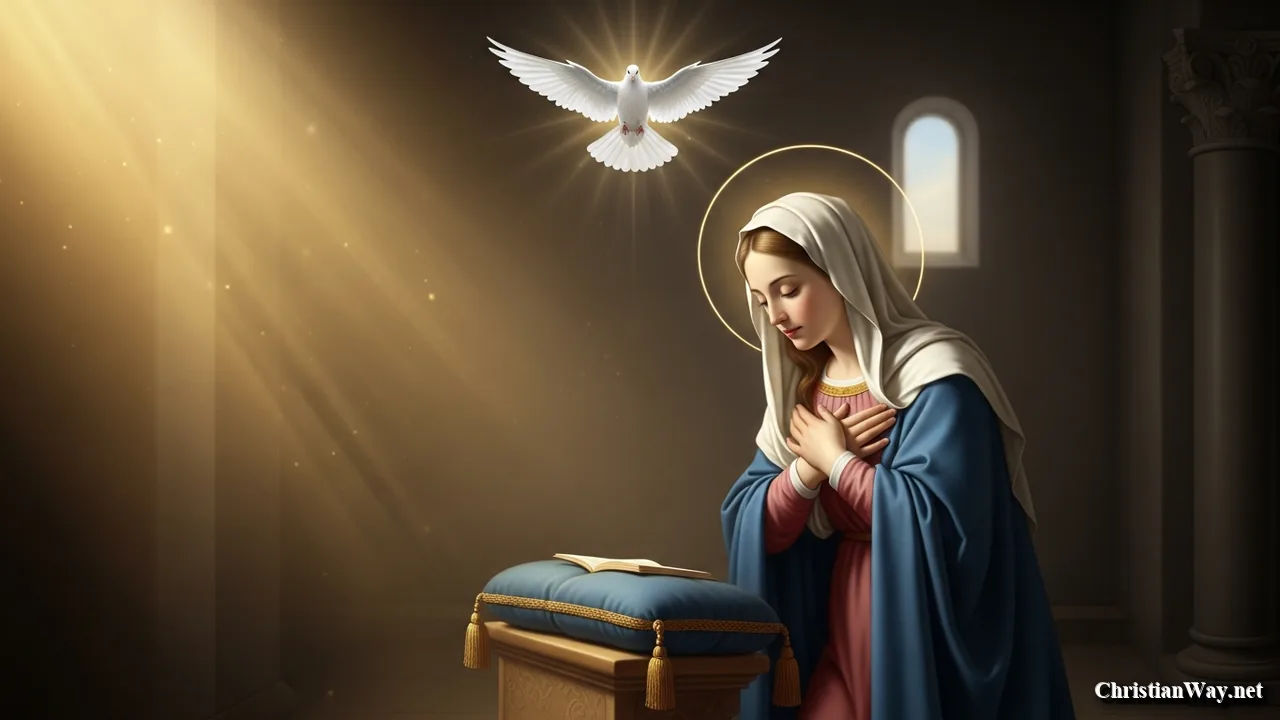
“The Holy Spirit will come upon you, and the power of the Most High will overshadow you” (Luke 1:35).
These words take us to the heart of the mystery. The conception of Jesus is the work of God. The Holy Spirit comes upon Mary, and the power of the Father overshadows her. Through this divine action, the Son of God receives a real human nature from her.
The Gospel according to Matthew confirms the same truth. When Joseph learns that Mary is expecting a child, he is troubled because he does not yet understand what God has done. An angel appears to him in a dream and says:
“Do not fear to take Mary as your wife, for that which is conceived in her is of the Holy Spirit” (Matthew 1:20).
Both accounts insist on the same essential teaching. Jesus is born from Mary, yet His conception is not the result of ordinary human generation. His humanity is truly derived from His mother, but His conception is brought about by the Holy Spirit.
The Spirit Did Not Become the Father of Jesus
It is important to understand what Scripture does and does not mean when it says that Jesus was conceived by the Holy Spirit.
The Holy Spirit did not become the biological father of Jesus. Christian faith does not imagine a physical union between God and Mary, as though the Gospel were repeating one of the pagan myths in which a deity produces a child through bodily relations with a human woman. Nothing could be further from the biblical revelation.
God is Spirit. The conception of Christ was a holy act of divine creation, not an act of physical generation between God and Mary. The eternal Father remains the Father of the Son within the life of the Trinity. The Son is eternally begotten of the Father before all ages. In time, however, that same eternal Son received His human nature from the Virgin Mary through the action of the Holy Spirit.
For this reason, the ancient creeds confess that Jesus Christ was “begotten of the Father before all worlds” according to His divinity, and that He “was incarnate by the Holy Spirit of the Virgin Mary, and was made man” according to His humanity.
The Holy Spirit did not produce a new divine person. Nor did the Spirit create another son alongside the eternal Son. Rather, the Spirit brought about the human conception through which the eternal Son entered human history.
The Child conceived in Mary was not first an ordinary human person who was later joined to God. From the first moment of His conception, He was the eternal Son living a genuinely human life. The one conceived in Mary was the same Person who had existed eternally with the Father and the Holy Spirit.
The Spirit Formed Christ’s Human Nature
The Holy Spirit’s first and most immediate role in the Incarnation was to form the humanity of Jesus within the womb of Mary.
The Letter to the Hebrews places these words upon the lips of the Son as He enters the world: “A body you have prepared for me” (Hebrews 10:5). That human body was prepared through Mary by the action of the Holy Spirit.
Jesus did not bring a heavenly body down from above. His human nature did not pass through Mary without receiving anything from her. He truly took flesh from her flesh. He belonged to the family of Abraham and the house of David. He was descended from Israel according to the flesh. He possessed the same human nature that we possess, except that He was without sin.
The Spirit’s work did not make Christ less human. It made possible His full entrance into our humanity.
Within Mary’s womb, Jesus experienced the hidden stages of human development. He began His earthly life in utter dependence. He received nourishment through His mother’s body. His human heart began to beat beneath her heart. He was carried by her, protected within her, and eventually born from her.
This truth gives extraordinary dignity to human life. The Son of God did not consider the earliest stages of human existence beneath Him. He sanctified the womb by dwelling within it. He sanctified infancy by becoming an infant. He sanctified family life by living within a family. He sanctified labor by working with human hands. He sanctified suffering by enduring it in love, and He sanctified death by passing through it into resurrection.
A Complete Humanity, Not Merely a Human Body
When we say that the Spirit formed Christ’s humanity, we must not think only of His physical body. Jesus assumed the fullness of human nature.
He had a human intellect. The Gospels tell us that He grew in wisdom (Luke 2:52). He had a human will, which He freely brought into perfect harmony with the will of the Father. In Gethsemane, He prayed, “Not my will, but yours, be done” (Luke 22:42). He possessed genuine human emotions. He loved, rejoiced, grieved, felt compassion, and wept.
The Holy Spirit’s work in the Incarnation therefore included the formation of a complete human nature: body and soul, intellect and will, emotion and capacity for relationship.
This was necessary for our salvation. As the early Christian teachers often emphasized, what Christ did not assume could not be healed. If the Son had taken only a human body but not a human mind, then the human mind would remain untouched by redemption. If He had taken outward human appearance without inward human experience, then our inner lives would not have been united to Him.
But the Word became fully human. He assumed everything that belongs to our humanity except sin. Through His obedience, death, and resurrection, every dimension of human life could be renewed.
The Spirit Preserved Christ’s Humanity from Sin
The Spirit’s action in the conception of Jesus was also holy and sanctifying. Gabriel tells Mary that “the holy one” to be born will be called the Son of God (Luke 1:35).
Jesus shared our human nature, but He did not inherit or commit sin. He entered the wounded human family without becoming a sinner. He was tempted as we are, yet He remained without sin (Hebrews 4:15).
This does not mean that physical generation or marital union is sinful. Scripture honors marriage, and the Church has always taught that the union of husband and wife belongs to God’s good creation. The virginal conception is not a rejection of marriage or the human body. It is a sign that the salvation beginning in Christ comes entirely from God’s grace and initiative.
Humanity could not produce its own Savior. No accumulation of human wisdom, moral effort, political power, or religious achievement could bring forth the Redeemer. Salvation had to be given.
The Holy Spirit therefore formed a genuine human nature for the Son while preserving that humanity from every stain of sin. Jesus belongs fully to Adam’s race, yet He begins a new humanity. He is the new Adam, the head of a renewed creation.
Jesus Entered Our Fallen World Without Possessing a Fallen Moral Nature
Christ experienced the consequences of living within a world damaged by sin. He could become tired, hungry, wounded, and sorrowful. He was misunderstood, rejected, betrayed, tortured, and killed. Yet there was no rebellion against God within Him. There was no disordered desire, deception, cruelty, pride, or selfishness.
His human freedom was not weakened by the absence of sin. It was perfected by holiness. Sin does not make us more human; it diminishes our humanity. Jesus shows us humanity as God intended it to be: free, obedient, loving, courageous, compassionate, and wholly open to the Father.
The Spirit who formed His humanity is the Spirit of holiness. From the first instant of His earthly existence, the human life of Jesus was entirely consecrated to the Father and united personally to the eternal Son.
The Spirit’s Overshadowing Signaled God’s Presence
Gabriel says that the power of the Most High will “overshadow” Mary. This word is rich with biblical meaning.
In the Old Testament, the glory of God overshadowed the tabernacle, the sacred tent in which God dwelt among His people. A cloud covered the tent, and the glory of the Lord filled it (Exodus 40:34–35). The cloud was a visible sign of God’s hidden yet powerful presence.
At the Annunciation, similar language is used. The power of God overshadows Mary, and within her the Word becomes flesh. She becomes, in a profound sense, the living dwelling place of God.
The tabernacle of old contained the signs of God’s covenant. Mary carried within herself the One who is the fulfillment of the covenant. The ark contained the tablets of the law, but Mary bore the living Word. The ark was associated with manna, but Mary carried the true Bread of Life. The ark represented the presence of God, but within Mary God personally took human flesh.
This is why many ancient Christians called Mary the new Ark of the Covenant. Such language does not place her above God. It celebrates what God did within her by grace. Her greatness is entirely received. The Spirit overshadowed her, the Son dwelt within her, and she offered herself in humble obedience to the Father.
God’s Power Appeared in Gentleness
The word “power” may cause us to imagine force, noise, and overwhelming display. Yet the power of the Most High came upon Mary in silence.
No army marched. No palace trembled. No ruler was consulted. The greatest event since creation took place in a hidden encounter between God and a young woman in an obscure town.
This is often the way of the Holy Spirit. The Spirit is almighty, yet He does not ordinarily crush human freedom. He works inwardly, quietly, and deeply. He creates without violence. He sanctifies without spectacle. He brings forth life where human beings see only impossibility.
The Incarnation reveals that divine power is not domination. God’s power is the power to give life, to enter relationship, to humble Himself, and to save through love.
The Spirit Began a New Creation
The Spirit’s action at the Incarnation recalls the opening words of the Bible. In the beginning, the earth was without form and void, darkness covered the deep, and the Spirit of God moved over the waters (Genesis 1:2). Then God spoke, and creation came into being.
At the Annunciation, the Spirit again moves creatively. The eternal Word, through whom the first creation was made, enters creation as a human being. A new beginning takes place within Mary.
This is not the destruction of the first creation but its renewal. God does not abandon what He has made. He enters it to heal it from within.
The conception of Jesus may therefore be understood as the dawn of the new creation. In Adam, humanity fell into sin and death. In Christ, humanity is gathered up and restored. The Spirit who hovered over the waters at creation now overshadows Mary. The Word through whom light first shone now becomes the Light of the world.
Jesus Is the New Adam
Saint Paul describes Christ as the new or last Adam. The first Adam’s disobedience brought sin and death into human history. Christ’s obedience brings righteousness and life.
Yet the new Adam does not simply appear as a mature man. He begins where each of us begins. He enters the human story from conception and lives the stages of human life in faithful communion with the Father.
Where humanity had turned away from God, Jesus offers perfect obedience. Where we have used freedom for self-exaltation, He uses freedom for self-giving love. Where Adam grasped, Christ empties Himself. Where sin brought death, Christ passes through death and opens the way to resurrection.
The Holy Spirit begins this new humanity in Mary’s womb. What begins there will be revealed at Bethlehem, manifested in Christ’s ministry, offered upon the cross, and glorified in the resurrection.
The same Spirit who forms Christ’s humanity will later raise His body from the dead. Creation and resurrection belong to one divine movement: God brings life where life cannot arise through human strength alone.
The Spirit Fulfilled God’s Promises to Israel
The Incarnation did not appear without preparation. The Holy Spirit had been active throughout the history of Israel, speaking through the prophets, guiding God’s people, and preparing them for the coming of the Messiah.
The Spirit inspired promises of a coming king from David’s line, a servant who would bear the sins of many, a shepherd who would gather the scattered, and a ruler whose kingdom would have no end.
Isaiah spoke of a child called Immanuel, meaning “God with us” (Isaiah 7:14). He also foretold that the Spirit of the Lord would rest upon the promised Messiah: the Spirit of wisdom, understanding, counsel, strength, knowledge, and the fear of the Lord (Isaiah 11:1–2).
The Spirit who inspired these promises is the Spirit who fulfilled them.
At the Annunciation, Israel’s long waiting reaches a decisive moment. The promised Son of David is conceived. The hope of the prophets takes flesh. God does not fulfill His promises by sending only a message, a law, or a new political arrangement. He comes Himself.
The Long Preparation of Grace
Throughout salvation history, the Spirit had prepared hearts to receive the coming of Christ.
The Spirit gave courage to judges, wisdom to kings, and speech to prophets. The Spirit inspired the psalms through which Israel prayed. The Spirit preserved hope through exile, persecution, national failure, and long periods of silence.
Yet these earlier works pointed toward something greater. In the Incarnation, the Spirit does not merely rest temporarily upon a chosen servant. The Spirit brings about the human conception of the eternal Son Himself.
The prophets spoke by the Spirit. Jesus is the Word about whom they spoke.
The kings were anointed by the Spirit. Jesus is the eternal King.
The priests offered sacrifices in the power of God’s covenant. Jesus is both the true Priest and the perfect Sacrifice.
The Spirit gathers all these lines of promise and brings them to fulfillment in Christ.
The Incarnation Reveals the Holy Trinity
The conception of Jesus is profoundly Trinitarian.
The Father sends. The Son comes. The Holy Spirit brings about the conception.
Gabriel tells Mary that the Holy Spirit will come upon her and that the power of the Most High will overshadow her; therefore, the Child will be called the Son of God. Father, Son, and Holy Spirit are present in one saving action.
Christians do not believe in three gods. The Father, Son, and Holy Spirit are one God. They possess one divine nature, one divine will, and one divine power. Every outward work of God is the work of the one Trinity.
Yet Scripture also reveals the distinct Persons through their relationships and missions. The Father is not the Son. The Son is not the Spirit. The Spirit is not the Father. The Father sends the Son, and the Son is conceived by the Holy Spirit.
The Incarnation does not involve only Jesus acting alone. It is the work of divine love flowing from the communion of the Trinity.
The Father Gives the Son
The Incarnation begins in the love of the Father. “God so loved the world, that he gave his only Son” (John 3:16).
The Father does not send a distant servant to rescue humanity. He gives His beloved Son. This gift reveals the depth of God’s desire for communion with us.
The Son Freely Assumes Our Humanity
The Son is not forced into the world. He freely humbles Himself. Saint Paul writes that Christ emptied Himself, took the form of a servant, and was born in human likeness (Philippians 2:6–8).
His self-emptying does not mean that He stopped being God. Rather, He chose not to cling to divine glory as a reason to remain distant from our suffering. He took the path of humility and obedience.
The Spirit Makes the Son’s Human Coming Present
The Holy Spirit brings this eternal purpose into human history. Through the Spirit, the Son’s humanity is conceived within Mary. The Spirit is therefore not an impersonal energy or a symbolic description of divine activity. He is the divine Person who gives life, sanctifies, and makes God’s saving presence active within creation.
The Incarnation reveals the pattern of salvation: from the Father, through the Son, in the Holy Spirit. It also opens the way for our return to the Father, through the Son, in the same Spirit.
Mary’s Consent Was a Real Human Response
The Incarnation is entirely the work of divine grace, yet God does not treat Mary as a passive instrument without freedom or dignity.
After hearing Gabriel’s message, Mary responds:
“Behold, I am the servant of the Lord; let it be to me according to your word” (Luke 1:38).
Her answer is often called her fiat, from the Latin word meaning “let it be done.” It is an act of faith, humility, courage, and surrender.
Mary does not cause the Incarnation by her own power. She does not earn the privilege placed before her. Everything begins with God’s grace. Yet her consent is genuine and necessary within God’s chosen plan.
The Holy Spirit does not destroy her freedom. He enables her to offer it fully to God.
Grace and Freedom Meet
Mary’s response shows us how divine grace and human freedom belong together. Grace does not make our response meaningless. Grace awakens, heals, and strengthens our freedom so that we may say yes to God.
The Spirit comes upon Mary, but she is not erased. She becomes more fully herself through obedience. Her humility is not weakness; it is the courage to entrust her whole life to a promise she cannot yet see fulfilled.
She knows that her pregnancy may expose her to misunderstanding, shame, or rejection. She does not know every detail of the path ahead. She will later hear Simeon’s warning that a sword will pierce her soul. She will stand near the cross and witness the suffering of the Son she carried.
Yet she says yes.
The Spirit’s work in the Incarnation therefore includes not only the miraculous conception of Christ but also the preparation and strengthening of Mary’s faithful response.
The Spirit United the Son to Our Human Story
The Incarnation means that the Son of God entered a particular family, culture, people, and historical moment.
Jesus was born as a Jewish child. He inherited the Scriptures, worship, festivals, prayers, and covenant history of Israel. He was raised by Mary and Joseph. He learned to speak a human language. He lived among neighbors and relatives. He worked, ate, traveled, rested, and prayed.
The Spirit did not create a humanity disconnected from the human family. Christ’s human life was woven into real history.
This matters because salvation is not an abstract idea. God saves humanity by entering humanity. The Son takes our nature in order to heal it, obeys in our nature in order to restore it, dies in our nature in order to overcome death, and rises in our nature in order to open eternal life to us.
The Spirit makes this union with our human story possible from the moment of conception.
He Became What We Are Without Ceasing to Be Who He Is
Christian faith carefully holds together two truths.
Jesus is truly God.
Jesus is truly human.
We must not protect His divinity by weakening His humanity, nor protect His humanity by denying His divinity. The same Jesus who sleeps in the boat commands the wind and waves. The same Jesus who weeps at Lazarus’s tomb calls Lazarus out of the grave. The same Jesus who thirsts upon the cross is the source of living water.
The Incarnation does not blend divinity and humanity into a third kind of nature. Nor does it divide Jesus into two persons. The eternal Son personally lives a true divine life and a true human life.
The Holy Spirit’s creative action in Mary establishes the beginning of this human life. The One conceived is a human child, yet His personal identity is that of the eternal Son.
The Spirit’s Work Continued Throughout Jesus’ Earthly Life
The Spirit’s role did not end at the conception of Jesus. The whole earthly mission of Christ unfolded in the power and presence of the Holy Spirit.
At His baptism in the Jordan, the Spirit descended upon Him in bodily form like a dove. This did not mean that Jesus previously lacked the Spirit. He had been conceived by the Spirit and lived in perfect communion with the Spirit from the beginning. The baptism publicly revealed and anointed Him for His messianic mission.
After His baptism, Jesus was led by the Spirit into the wilderness, where He resisted temptation. He then returned “in the power of the Spirit” to Galilee (Luke 4:14).
In the synagogue at Nazareth, He read from Isaiah:
“The Spirit of the Lord is upon me, because he has anointed me” (Luke 4:18).
Jesus healed, preached, delivered the oppressed, forgave sins, and announced the kingdom of God in the power of the Spirit. Through the eternal Spirit, He offered Himself without blemish to God (Hebrews 9:14). By the Spirit of holiness, His identity was powerfully revealed in the resurrection from the dead (Romans 1:4).
The Spirit who formed His humanity also accompanied His human mission from conception to resurrection.
The Conception and the Anointing Are Distinct but United
At the Incarnation, the Spirit forms the humanity of the Son.
At the Jordan, the Spirit publicly anoints Jesus for His messianic ministry.
At the cross, Jesus offers Himself in loving obedience.
At the resurrection, the Spirit gives life to His mortal body.
At Pentecost, the risen Christ pours out the Spirit upon the Church.
These are distinct moments, but they belong to one saving work. The Spirit brings Christ into the world, rests upon Him, empowers His mission, raises Him from death, and unites believers to Him.
The Spirit Prepared Christ to Become the Source of Our New Life
The Son did not become human merely to stand beside us as an inspiring example. He became human so that we might be united to Him and share His life.
The humanity formed by the Holy Spirit in Mary would become the instrument of our salvation. With human hands, Jesus would touch the sick. With a human voice, He would proclaim forgiveness. With a human heart, He would love His disciples. In His human body, He would bear our sins upon the cross. In that same body, He would rise from the grave.
The flesh He received from Mary would be given “for the life of the world” (John 6:51).
This is why the Incarnation cannot be separated from the cross and resurrection. Bethlehem points toward Calvary, and Calvary opens into Easter. The Child conceived by the Spirit is born in order to save.
The Spirit Who Formed Christ Also Forms Christ in Us
There is a beautiful spiritual connection between the Spirit’s work in Mary and His work in believers.
The Incarnation is unique and unrepeatable. The eternal Son became human once for all. No Christian becomes another incarnation of God, and Mary’s vocation remains entirely singular.
Yet the same Holy Spirit who formed Christ’s humanity desires to form the likeness of Christ within us.
Saint Paul writes of laboring until “Christ is formed in you” (Galatians 4:19). Through baptism, faith, prayer, the sacraments, Scripture, and a life of obedience, the Spirit conforms us to Jesus. He reshapes our desires, heals our wounds, exposes our sins, and teaches us to love as Christ loves.
Mary carried Christ physically within her. Every believer is called to bear Christ spiritually before the world.
Her words, “Let it be to me according to your word,” become a pattern for Christian discipleship. We too are invited to open our lives to the Spirit and allow God’s word to take flesh in our actions.
What the Spirit’s Role Means for Our Lives
The doctrine of the Incarnation may seem distant from the pressures of daily life, yet it speaks directly to our deepest struggles.
Many people feel that God is far away. We may imagine that He observes our suffering from a safe distance or that He understands human life only in theory. The Incarnation tells us otherwise.
God has entered our condition.
Jesus knows human vulnerability from within. He knows dependence, growth, misunderstanding, weariness, grief, bodily pain, and death. He knows what it is to live in a family, to work, to pray through anguish, and to love people who fail Him.
The Holy Spirit brought the Son into the reality of human existence. Therefore, no part of faithful human life is beneath God’s attention.
The Spirit Works in Hidden Places
The Incarnation began invisibly. For months, the mystery remained hidden within Mary. The world continued as usual. Empires issued decrees, merchants conducted business, soldiers guarded roads, and families carried out daily tasks. Yet within an unknown village, God had begun the redemption of creation.
We often expect God’s most important works to be dramatic and immediately visible. But the Spirit frequently works in hidden places: in a quiet act of repentance, a private prayer, a difficult forgiveness, a faithful marriage, a parent’s sacrifice, a lonely person’s perseverance, or a small decision to choose truth instead of deception.
The hiddenness of the Incarnation teaches us not to despise beginnings. A grace that seems small may carry within it consequences we cannot yet imagine.
The Spirit Can Bring Life Where We See Impossibility
Mary asks, “How will this be?” Humanly speaking, what Gabriel announces is impossible.
The angel does not give her a scientific explanation. He points her to the action of the Holy Spirit and declares, “Nothing will be impossible with God” (Luke 1:37).
This does not mean that God promises to satisfy every desire or remove every difficulty. It means that His saving purpose is not limited by human weakness.
We may look at a wounded relationship, a deeply rooted sin, a divided Church, a grieving family, or a heart exhausted by disappointment and believe that nothing new can come from it. The Incarnation reminds us that the Spirit creates life in places where human power cannot.
Christian hope is not optimism based on favorable circumstances. It is confidence in the God who brought the Savior into the world through the hidden work of the Spirit.
Our Bodies Matter to God
Because the Son took flesh by the Holy Spirit, the body is not a prison from which the soul must escape. Human embodiment belongs to God’s good creation.
Our bodies may be weak, aging, disabled, ill, or marked by suffering, but they are not meaningless. Christ assumed a body, redeemed us through His body, rose bodily from the dead, and promises the resurrection of the body.
The Incarnation therefore calls Christians to care for human life with reverence. The unborn, the sick, the elderly, the poor, the disabled, the dying, and those whom society overlooks all possess dignity. Human worth does not depend upon strength, independence, intelligence, wealth, or usefulness. It rests upon God’s love and the sacred character of human nature, which the Son Himself assumed.
Holiness Is Openness to the Spirit
Mary’s holiness is seen in her openness to God. She receives the word, trusts the promise, and gives herself to the work of the Spirit.
We may be tempted to think holiness requires extraordinary experiences. Often it begins with a simple willingness: “Lord, let Your will be done in me.”
This prayer is not passive resignation. It is courageous cooperation with grace. It may lead us to speak the truth, reconcile with someone, leave behind a sinful habit, care for a difficult person, accept a hidden vocation, or persevere through a season we would not have chosen.
The Spirit who overshadowed Mary continues to sanctify the Church. He does not reproduce the Incarnation, but He enables the life of Jesus to become visible in His people.
A Mystery Shared Across Christian Traditions
Catholic, Orthodox, Anglican, and Protestant Christians all confess the central truth that Jesus Christ was conceived by the Holy Spirit and born of the Virgin Mary.
The Apostles’ Creed declares:
“He was conceived by the Holy Spirit, born of the Virgin Mary.”
The Nicene Creed confesses that the Son “was incarnate by the Holy Spirit of the Virgin Mary, and was made man.”
These words unite Christians across many historical and denominational divisions. Although traditions may emphasize different aspects of Mary’s place in the life of the Church, the central Christological truth remains shared: the virginal conception reveals that Jesus is the eternal Son of God who truly assumed our human nature through the power of the Holy Spirit.
This shared confession should move us toward humility and gratitude. The Incarnation is not a doctrine given for Christians to use against one another. It is the mystery before which all believers kneel.
God became man for us and for our salvation.
Reflect and Pray
The role of the Holy Spirit in the Incarnation was creative, sanctifying, prophetic, and deeply personal. The Spirit formed the true human nature of Jesus within the Virgin Mary. He fulfilled the promises spoken through the prophets. He overshadowed Mary with the presence of God. He inaugurated the new creation and prepared the humanity through which the Son would redeem the world.
Yet the mystery is greater than any explanation.
Within Mary’s womb, the eternal entered time. The Creator became a creature without ceasing to be the Creator. The One who sustains every human life allowed Himself to be sustained by His mother. The Word who cannot be contained by heaven chose to dwell within the hidden space of a human body.
All of this took place through divine love.
The Father loved the world and sent His Son. The Son loved us and took our nature. The Spirit lovingly formed that humanity and rested upon the One who would carry our sorrows, bear our sins, and conquer our death.
When we contemplate the Incarnation, we begin to see how close God has come. He has not saved us from a distance. He has entered the depths of human existence. He has embraced our frailty, not to leave us in it, but to raise us into communion with Him.
Perhaps there are places in your life that feel empty, hidden, or impossible. Perhaps you are waiting for God to act and cannot yet see what He is doing. Remember Mary. Remember the quiet overshadowing of the Spirit. Remember that the salvation of the world began in silence before it was announced by angels.
The Holy Spirit still works in hidden hearts. He still brings light into darkness, order into confusion, courage into fear, and life into places that seem barren. He still points us toward Jesus, forms Christ within us, and teaches us to offer our own faithful yes to God.
Let us pray:
Holy Spirit, Lord and Giver of Life,
You came upon the Virgin Mary
and formed within her the sacred humanity
of our Lord Jesus Christ.
Come upon our hearts with Your grace.
Where we are afraid, give us trust.
Where we resist God’s will, give us surrender.
Where sin has wounded us, bring healing.
Where hope has grown weak, create new life.
Teach us to receive the Word of God with faith,
to carry the presence of Christ into the world,
and to say with Mary,
“Let it be to me according to your word.”
May Jesus, conceived by Your power,
be formed ever more deeply within us,
so that our thoughts, words, and actions
may reveal His mercy and truth.
May the peace of Christ dwell richly in your heart, and may the Holy Spirit guide you into the quiet wonder of God-with-us.
— Fr. John Matthew