Discover the Top 10 Modern Catholic Churches in the United States, where contemporary architecture meets ancient faith in stunning displays of sacred space.
Dear friends in Christ,
When we think of Catholic architecture, our minds often wander to the soaring gothic arches of medieval Europe or the ornate baroque facades of Rome. These structures are glorious testaments to the faith of our ancestors, designed to lift the soul toward heaven through sheer verticality and intricate detail. They are treasures of the Church universal. Yet, the Holy Spirit is not bound by a single moment in history, nor a single architectural style. The Church is a living, breathing Body, constantly renewing itself while remaining rooted in the eternal Truth of the Gospel.
In the last century, particularly following the liturgical renewals envisioned by the Second Vatican Council, we have seen the emergence of striking modern architecture within the American landscape. These are not merely buildings of concrete and glass; they are profound theological statements. They often emphasize the gathering of the community around the altar, the central importance of the Eucharist, and the use of natural light as a powerful symbol of Christ, the Light of the World. They challenge us to see God not only in the shadows of antiquity but in the clarity of the present moment.
Here at Christian Way, we believe that beauty is a pathway to the Divine. In compiling this list of modern Catholic churches in the United States, we are not just judging aesthetics; we are looking for spaces where architecture serves the liturgy and invites the modern soul into a deeper encounter with the mystery of God. Let us journey together through these sanctuaries of new life, keeping an open heart to how God speaks through the language of modern design.
A Summary of Sacred Treasures of Modern Design
| Rank | Church Name | Location | Notable Architectural Feature |
|---|---|---|---|
| 10 | St. Peter’s Church | New York, NY | Integrated into a skyscraper; an oasis of urban quiet. |
| 9 | Cathedral of the Immaculate Conception | Burlington, VT | Striking green glazed brick blending with the landscape. |
| 8 | St. Francis de Sales Church | Muskegon, MI | A Brutalist concrete masterpiece by Marcel Breuer. |
| 7 | Our Mother of Sorrows | Tucson, AZ | Southwest modernism utilizing regional materials. |
| 6 | Cathedral of St. Mary of the Assumption | San Francisco, CA | The iconic hyperbolic paraboloid roof structure. |
| 5 | Chapel of St. Ignatius (Seattle U) | Seattle, WA | Steven Holl’s “seven bottles of light” concept. |
| 4 | Cathedral of Christ the Light | Oakland, CA | A revolutionary structure of wood, glass, and light. |
| 3 | Cathedral of Our Lady of the Angels | Los Angeles, CA | A massive, postmodern interpretation of a Spanish mission. |
| 2 | Christ Cathedral | Garden Grove, CA | The redeemed “Crystal Cathedral,” transformed for the Mass. |
| 1 | Abbey Church of St. John the Baptist | Collegeville, MN | The seminal Brutalist work that anticipated Vatican II. |
Top 10. St. Peter’s Church (New York City, New York)
Nestled at the base of the towering Citigroup Center in Midtown Manhattan, St. Peter’s Church is a profound testament to the presence of God in the bustling marketplace. Completed in the late 1970s, the current structure replaced an older Gothic church, embracing a radically modern design that integrates seamlessly into the urban canyon. From the street, one notices the massive window looking down into the sanctuary, a visual invitation to the city below. Inside, the space is defined by clean lines, warm wood, and modular flexibility, designed to serve not only as a place of worship but as a center for arts and community gathering.
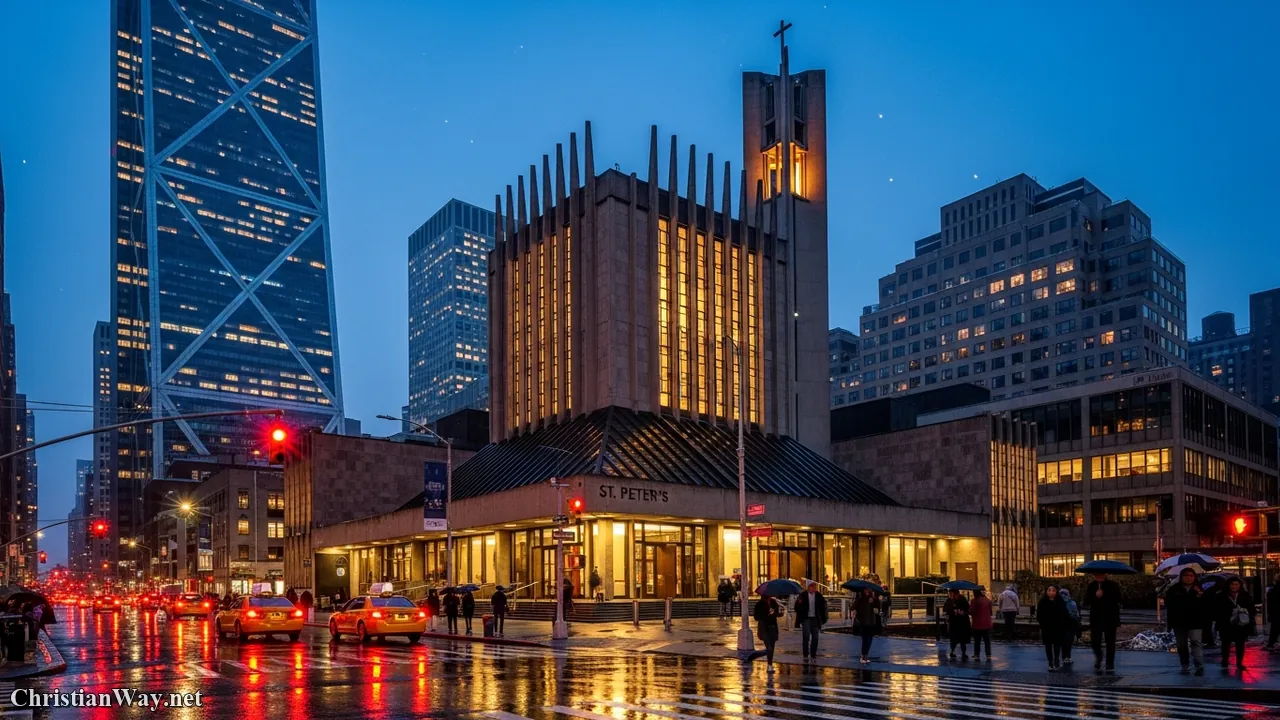
Theologically, St. Peter’s represents the Church “in the world, but not of the world.” It does not retreat from the city but plants the tabernacle right amidst the commerce and noise. The design emphasizes accessibility and transparency, suggesting that the mysteries of faith are open to all who wander in from the busy sidewalks of New York. It is a sanctuary that reminds us that sacred space need not be separated by high walls; sometimes, the most profound holiness is found integrated into the fabric of our daily lives, offering a quiet harbor in the storm of modern existence.
Spiritual Highlights:
- The Chapel of the Good Shepherd, designed by sculptor Louise Nevelson, is an immersive white environment of abstract forms meant to evoke peace.
- Scripture connection: “You are the light of the world. A city set on a mountain cannot be hidden.” (Matthew 5:14)
Top 9. Cathedral of the Immaculate Conception (Burlington, Vermont)
Tucked away in the thoughtful landscape of Vermont, the Cathedral of the Immaculate Conception, designed by Edward Larrabee Barnes and completed in 1977, is a striking example of modernism that respects its environment. Replacing an older cathedral lost to arson, this structure is distinctive for its geometric simplicity and its exterior cladding of green glazed bricks. The color allows the building to harmonize with the surrounding trees and grass during the summer, while standing out as a vibrant symbol of hope against the white snows of a New England winter. The interior is equally understated, using natural light and a semicircular seating arrangement to foster a sense of communal intimacy.
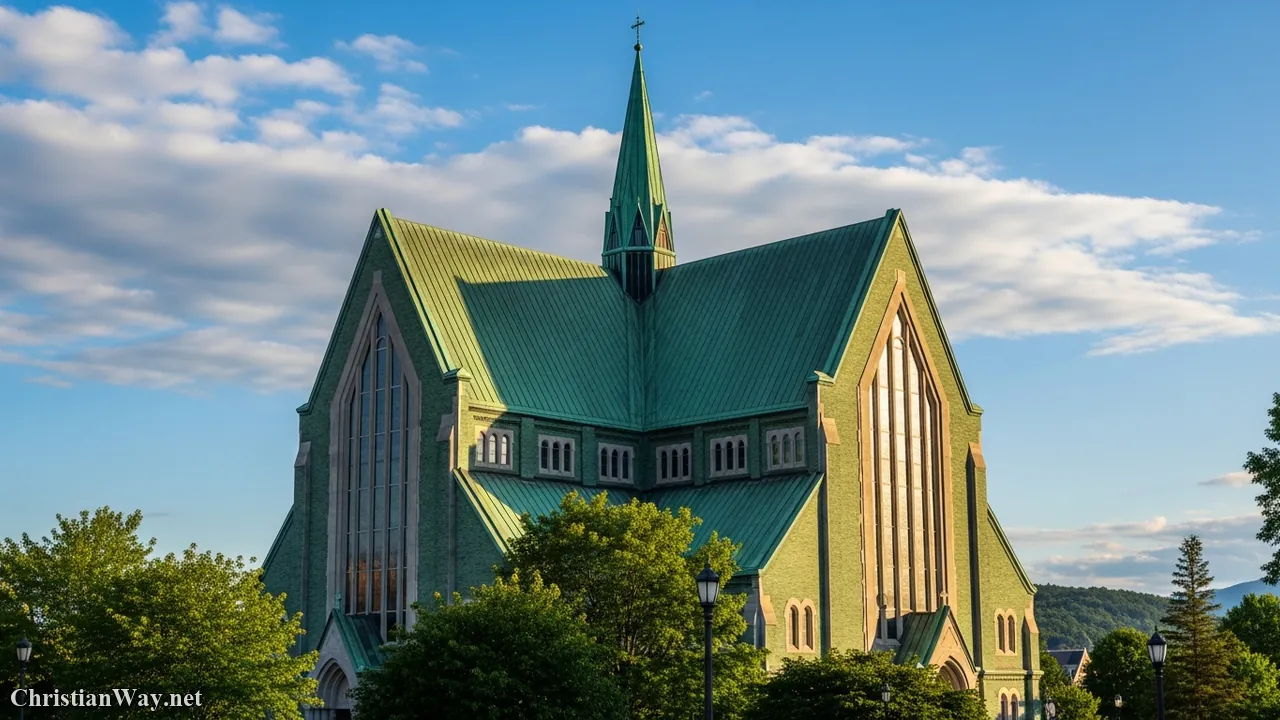
This cathedral teaches us about the humility of authentic presence. It does not dominate the landscape with aggressive spires but sits within it, a quiet yet formidable witness to the Gospel. The design reflects a post-conciliar theology where the barrier between the clergy in the sanctuary and the lay faithful in the nave is lessened. The gathered assembly is emphasized as the Body of Christ, surrounding the altar. It is a gentle reminder to us that true spiritual strength often lies not in ostentatious displays, but in a quiet, grounded consistency that weathers the changing seasons of life.
Spiritual Highlights:
- The use of a distinct copper skylight over the altar focuses attention upward during the Eucharistic prayer.
- Scripture connection: “For where two or three are gathered together in my name, there am I in the midst of them.” (Matthew 18:20)
Top 8. St. Francis de Sales Church (Muskegon, Michigan)
As we journey deeper into the heartland, we encounter St. Francis de Sales in Muskegon, a striking example of Brutalist architecture by the renowned Marcel Breuer, completed in 1966. For many, the term “Brutalist” (from the French béton brut, or “raw concrete”) sounds harsh, yet this church demonstrates the style’s profound spiritual potential. The exterior is a fortress of concrete, featuring a dramatic, cantilevered facade that seems to defy gravity. It is a bold, almost defiant assertion of faith in an industrial age. Yet, entering the nave, one is met not with coldness, but with a surprising warmth generated by the texture of the concrete walls and the strategic use of light.
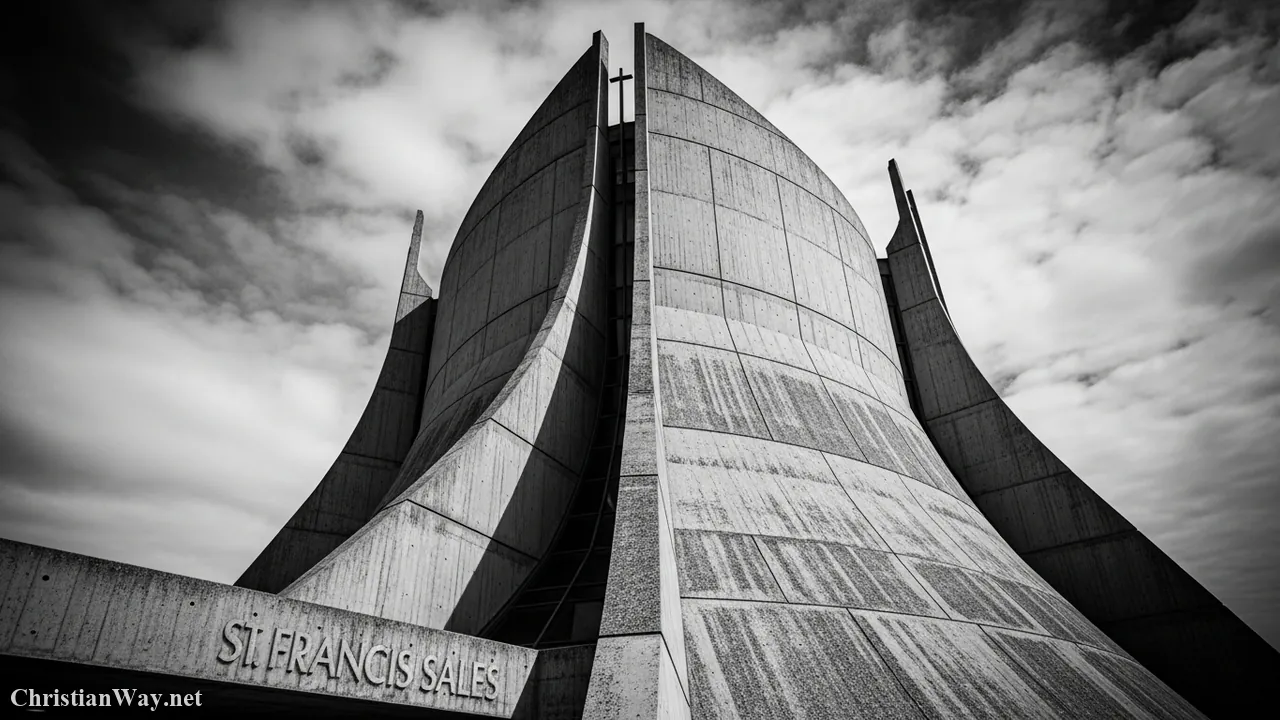
The theology here is one of strength and authenticity. The materials are not covered up with plaster or paint; they are allowed to be what they are, raw and honest. This honesty invites us to bring our own raw, unpolished selves before God. The structure feels impermeable, a mighty fortress is our God, yet the interior sanctuary is a place of refuge. It reminds the weary soul that the Church is a shelter, strong enough to withstand the pressures of the outside world while providing a secure space for the tender work of repentance and renewal.
Spiritual Highlights:
- The hyperbolic paraboloid front wall is an engineering marvel that serves as a massive architectural megaphone for the Gospel.
- Scripture connection: “The LORD is my rock, my fortress and my deliverer; my God is my rock, in whom I take refuge.” (Psalm 18:2)
Top 7. Our Mother of Sorrows Church (Tucson, Arizona)
Turning our gaze to the American Southwest, we find Our Mother of Sorrows in Tucson. While perhaps less globally famous than others on this list, it is a jewel of regional modernism. Built in the post-war era, its design acknowledges the harsh desert sun and the cultural heritage of the area. It utilizes clean, horizontal lines and local materials that blend with the arid landscape. The architecture here is less about soaring verticality and more about an expansive embrace, reflecting the wide desert horizon. The interior is characterized by a beautiful simplicity, often utilizing indigenous art forms and a color palette that reflects the earth tones of Arizona.
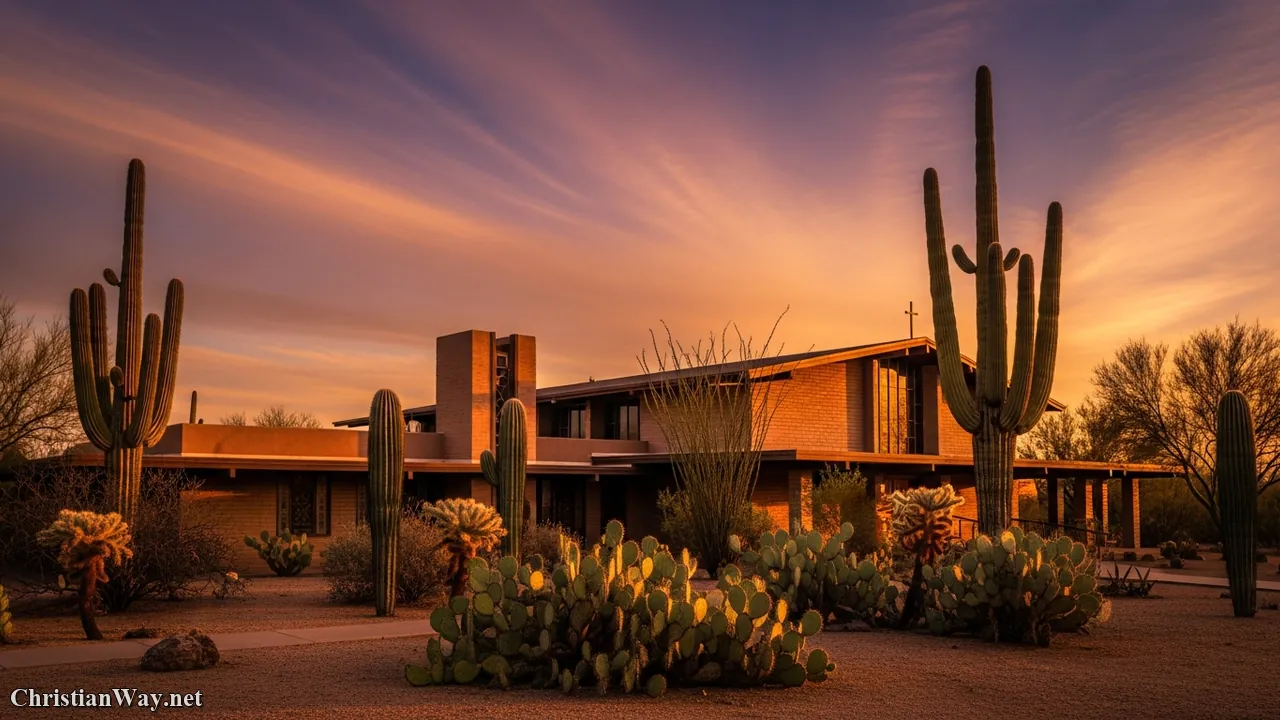
This church offers a pastoral theology of inculturation. It demonstrates that the universal Catholic faith can and should find expression through local idioms and environments. It does not try to be a European cathedral transplanted into the desert; it is authentically Catholic and authentically Arizonan. For the faithful, it is a comforting reminder that God meets us right where we are, in our specific cultural and geographical context. The “Sorrows” in the name, contrasted with the bright desert light, reminds us that even in our arid moments of suffering, the light of Christ is present and encompassing.
Spiritual Highlights:
- The architecture emphasizes horizontal breadth, suggesting the wideness of God’s mercy.
- Scripture connection: “I will make a roadway in the wilderness, rivers in the desert.” (Isaiah 43:19)
Top 6. Cathedral of Saint Mary of the Assumption (San Francisco, California)
Dominating the skyline of San Francisco’s Cathedral Hill is a structure that is impossible to ignore. The Cathedral of Saint Mary of the Assumption, completed in 1971, replaced an earlier cathedral destroyed by fire. The design is a daring feat of modern engineering, characterized by its massive hyperbolic paraboloid roof—a shape often playfully compared to a washing machine agitator, but which is, in reality, a complex geometric form creating a soaring interior volume without internal supports. The exterior is clad in gleaming white travertine, and the four corners of the roof rise to form a cross when viewed from above.
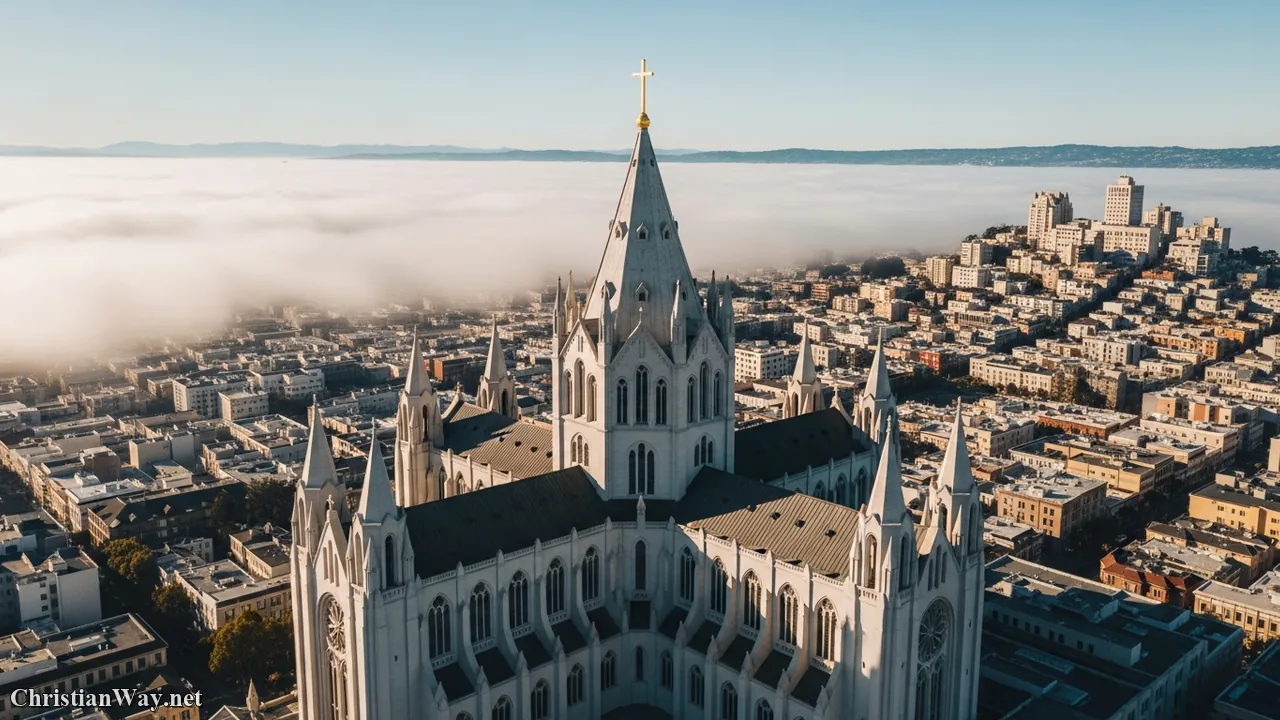
The interior is breathtakingly expansive. The four corner windows rise upward, drawing the eye toward the central apex where a cross is suspended in light. This is a cathedral that embraces the modern city and its emphasis on progress and innovation, yet orients it toward the divine. The sheer scale of the open space, unobstructed by pillars, powerfully visualizes the unity of the People of God gathered around the altar. It challenges the modern believer to dream big for God, to use the best of human intellect and engineering to create spaces that inspire awe and lift the human spirit out of the mundane.
Spiritual Highlights:
- The kinetic sculpture by Richard Lippold suspended above the altar shimmers with light, representing the divine presence ascending and descending.
- Scripture connection: “Look up at the heavens and see; gaze at the clouds so high above you.” (Job 35:5)
Top 5. Chapel of St. Ignatius at Seattle University (Seattle, Washington)
In the damp, often grey climate of the Pacific Northwest, architect Steven Holl created a miracle of light. The Chapel of St. Ignatius on the campus of Seattle University, completed in 1997, is meant to be a “gathering of different lights.” Holl’s concept was based on St. Ignatius of Loyola’s vision of the spiritual life as a discernment of different internal lights (consolations and desolations). Externally, the building is a composition of tilt-up concrete panels, simple and strong. But the roofline features various irregular skylights—the “bottles of light”—that capture sunlight at different angles and pass it through colored lenses.
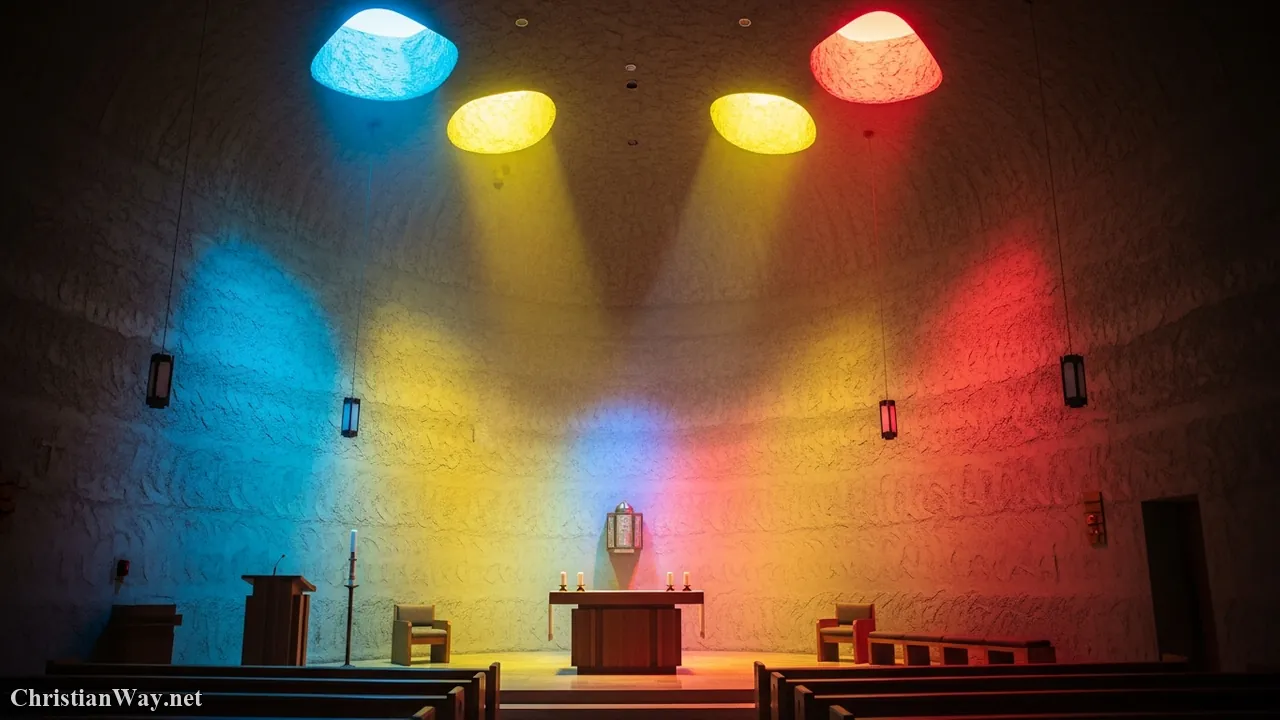
Inside, the effect is transformative. The plaster walls are washed in shifting hues of yellow, blue, red, and orange, depending on the time of day and the season. The light is not static; it is alive. This chapel is a profound theological meditation on grace. Just as the divine light is one, yet refracts differently into each of our lives depending on our needs and capacities, so too does the light in this chapel shift and change. It is a deeply comforting space for students and visitors, a visual reminder that even on the cloudiest days of the soul, God’s light is present, coloring our existence in unexpected and beautiful ways.
Spiritual Highlights:
- Each “bottle of light” corresponds to a different area of the chapel (e.g., the processional area, the Blessed Sacrament chapel), creating distinct spiritual zones.
- Scripture connection: “Every good and perfect gift is from above, coming down from the Father of the heavenly lights, who does not change like shifting shadows.” (James 1:17)
Top 4. Cathedral of Christ the Light (Oakland, California)
Following the damage of the 1989 Loma Prieta earthquake to the previous cathedral, the Diocese of Oakland sought a new home that would embody hope and renewal. The result, completed in 2008, is the stunning Cathedral of Christ the Light, designed by Craig Hartman. The structure is ecologically and visually revolutionary, composed primarily of wood, glass, and concrete. Its outer skin is a sheath of glass, while the inner sanctuary is defined by a “vesica piscis” (fish bladder) shape—an ancient Christian symbol—made of curved Douglas fir ribs. The entire structure is designed to be permeable to light.
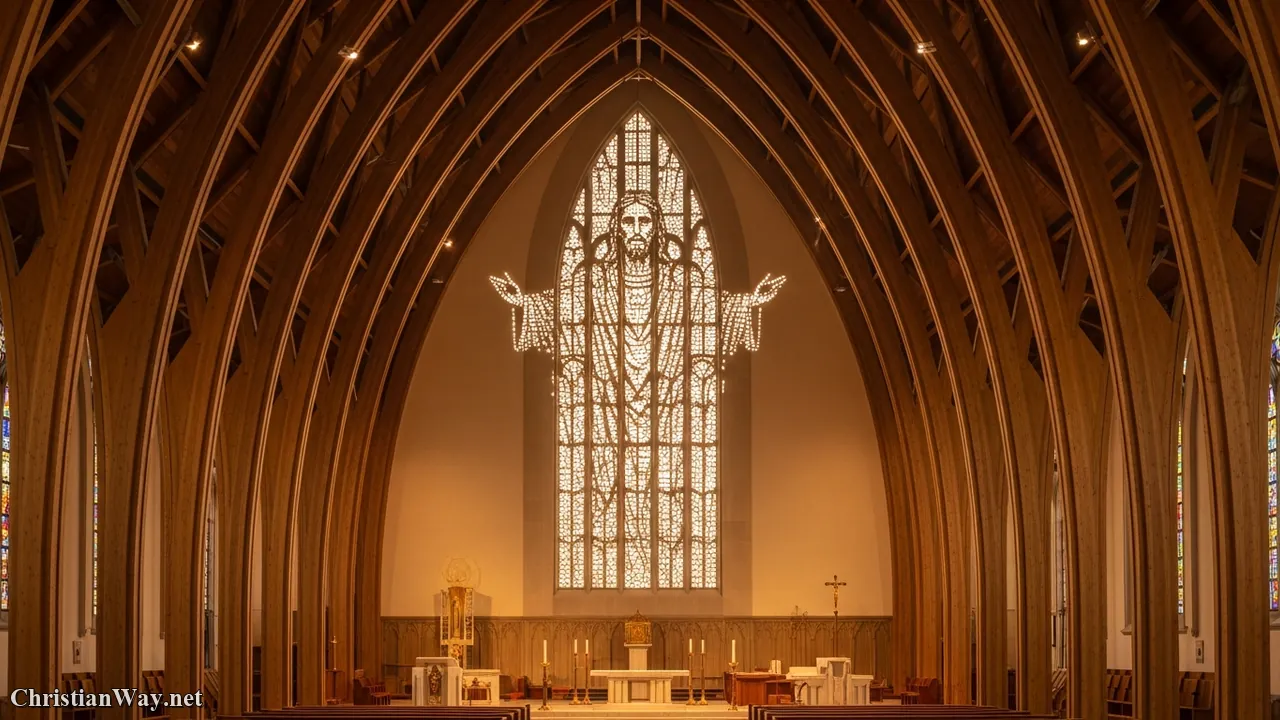
The theology of this cathedral is centered entirely on its name: Christ the Light. The use of wood brings a warmth and organic feeling rarely found in modern cathedrals, reminiscent of the ark of salvation. The way light filters through the wooden slats, creating a soft, diffused glow throughout the nave, is masterful. The defining image is the massive pixelated rendering of Christ Enthroned behind the altar, created not by pigment, but by 94,000 perforations in aluminum panels that let light pass through. It is a powerful statement: we see Christ only through the light. This cathedral calls the modern soul out of the darkness of cynicism and into the warm, healing radiance of the Savior.
Spiritual Highlights:
- The “Omega Window” image of Christ is based on a sculpture from Chartres Cathedral, bridging medieval faith with digital-age technique.
- Scripture connection: “I am the light of the world. Whoever follows me will not walk in darkness, but will have the light of life.” (John 8:12)
Top 3. Cathedral of Our Lady of the Angels (Los Angeles, California)
In the heart of one of the world’s most diverse and sprawling metropolises sits the immense Cathedral of Our Lady of the Angels, designed by Spanish architect Rafael Moneo and dedicated in 2002. Replacing the earthquake-damaged Cathedral of St. Vibiana, this new structure was controversial for its break with traditional forms. It is built of adobe-colored concrete, designed to evoke the missions of early California but on a massive, postmodern scale. The complex is not just a church but a spiritual campus, featuring a large plaza, cloisters, and gardens, insulated from the adjacent freeway by thick walls.
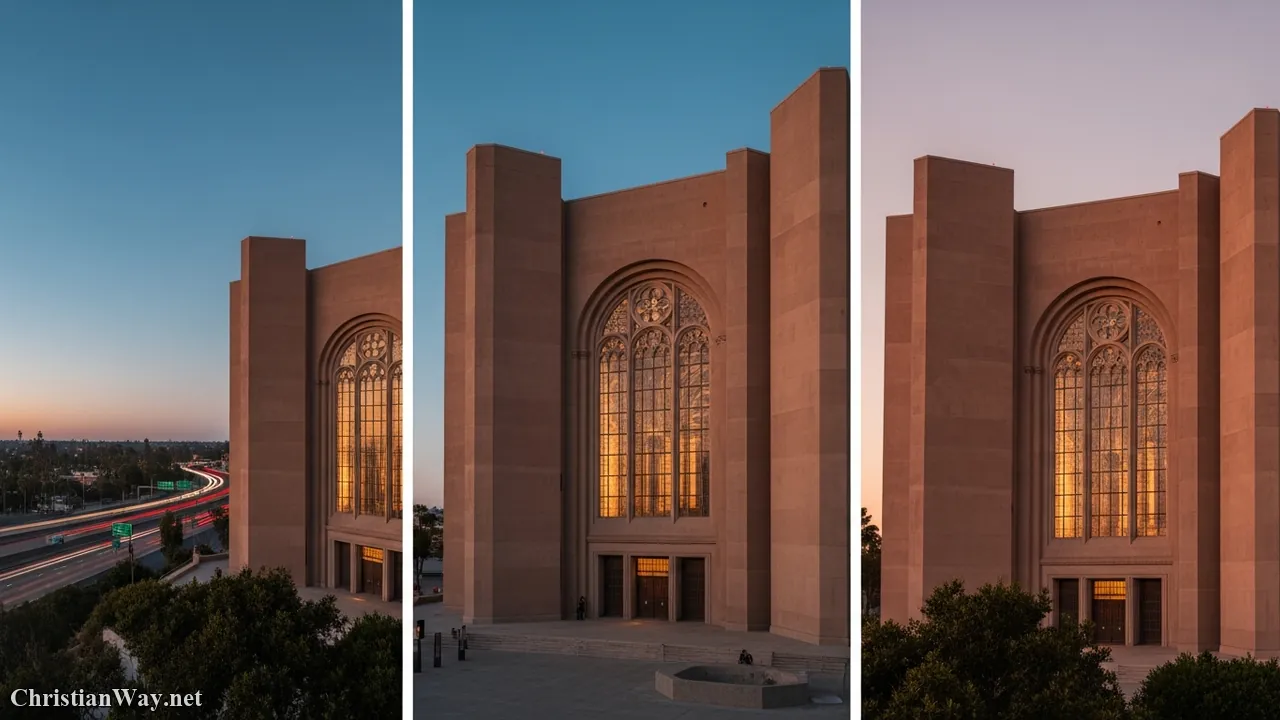
Moneo designed the cathedral so that one does not enter directly from the street; rather, the faithful must walk a “spiritual path” through the plaza and along the ambulatory before entering the nave. This journey emphasizes transition from the secular to the sacred. The interior is vast, illuminated by large windows made of Spanish alabaster, which diffuses the intense California sun into a soft, golden haze. The sloping floor draws everyone toward the altar. It is a cathedral designed for a pilgrim people, a massive gathering tent for the millions of souls in Los Angeles, reminding us that the Church is a community on a journey toward the heavenly Jerusalem.
Spiritual Highlights:
- The tapestries lining the nave depict the Communion of Saints, including modern figures, reflecting the diverse faces of the LA community looking toward the altar.
- Scripture connection: “Here we have no lasting city, but we seek the city that is to come.” (Hebrews 13:14)
Top 2. Christ Cathedral (Garden Grove, California)
This entry represents a unique story of redemption and transformation. Formerly known worldwide as the “Crystal Cathedral,” built by the televangelist Dr. Robert Schuller, this iconic glass structure was acquired by the Roman Catholic Diocese of Orange and consecrated as Christ Cathedral in 2019. The challenge was immense: how to turn a space designed for Protestant preaching and television into a sacred space centered on the Catholic Eucharist. The result of the renovation is miraculous. The thousands of glass panes were fitted with “quatrefoils” to control glare and heat, creating a translucent, inward-focused atmosphere.
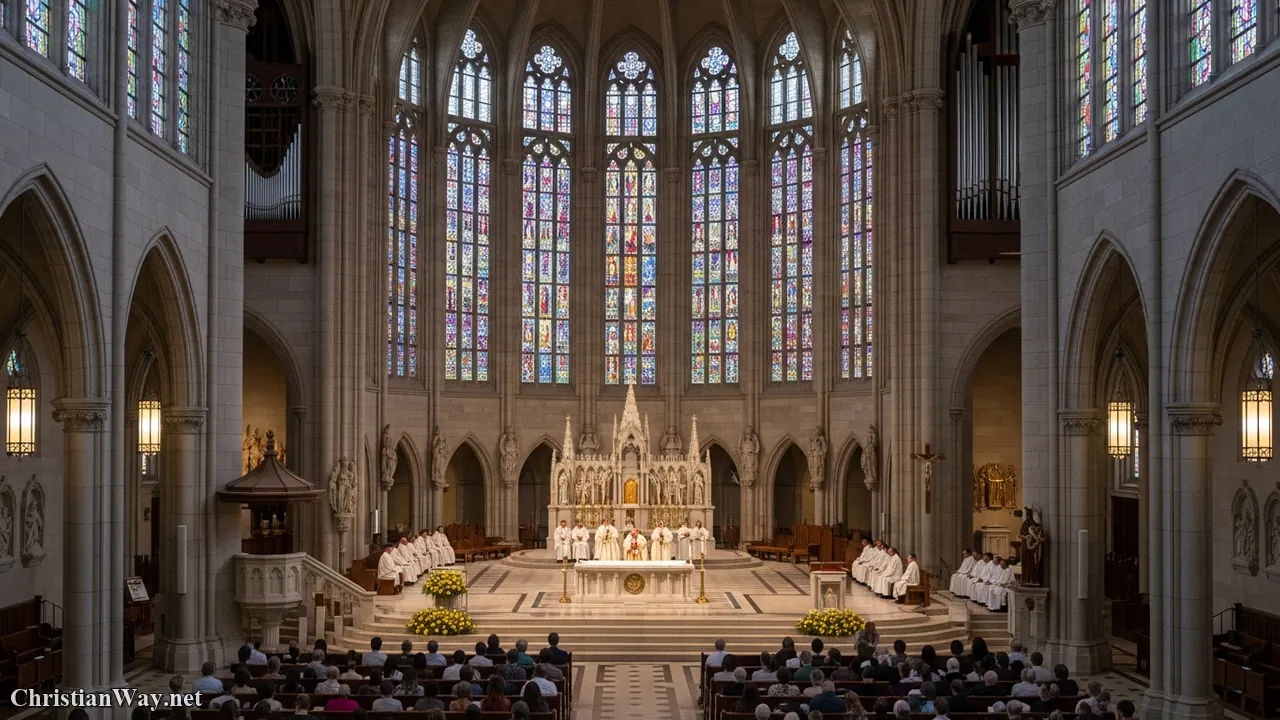
The theological significance here is profound. The acquisition and transformation of this building is a physical manifestation of the Catholic movement toward the fullness of truth. The original structure was a shell of light; the renovation placed the altar and the tabernacle at its heart, grounding the ethereal space in the sacrificial reality of the Mass. It is a striking blend of a modern American landmark with ancient Catholic liturgy. For the modern believer, Christ Cathedral is a beacon of hope, showing that any space, and indeed any soul, can be redeemed, repurposed, and consecrated anew to the glory of God.
Spiritual Highlights:
- The new stone altar, bishop’s cathedra, and ambo are positioned centrally, correcting the previous auditorium-style layout.
- Scripture connection: “See, I am doing a new thing! Now it springs up; do you not perceive it?” (Isaiah 43:19)
Top 1. Abbey Church of St. John the Baptist (Collegeville, Minnesota)
We conclude our journey at the place where, in many ways, modern Catholic architecture in America truly began. Designed by the legendary Marcel Breuer and completed in 1961, the Abbey Church at St. John’s University is a masterpiece that anticipated the liturgical reforms of Vatican II. The Benedictine monks here sought a church that would embody the “active participation” of the faithful. Breuer responded with a design that is bold, muscular, and deeply sacramental. The church is famous for its massive concrete “bell banner” standing sentinel outside, a modern campanile proclaiming the presence of God to the surrounding farmland.
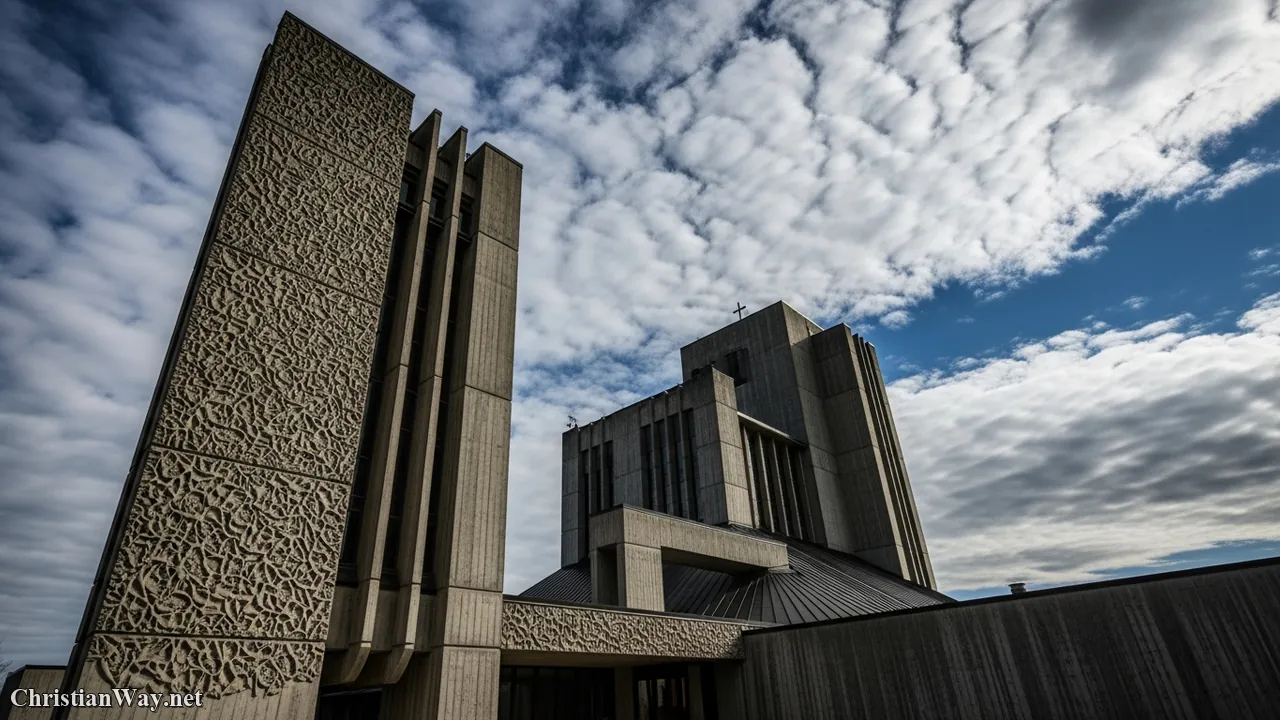
The interior is a revelation. It is a vast, fan-shaped space where no pillar obstructs the view of the altar. The congregation is not set back in a long nave but is gathered around the sanctuary in a semicircular embrace. The use of raw concrete and natural wood gives the space a feeling of elemental permanence. This church taught a generation of American Catholics that sacred space could be powerful, modern, and communal all at once. It stands as a monument to the courage to embrace the future without losing the anchor of tradition, a true sanctuary where the ancient rhythms of monastic prayer meet the stark beauty of the modern age.
Spiritual Highlights:
- The immense stained-glass window wall, designed by Bronislaw Bak, utilizes a honeycomb concrete structure to fill the church with colored light.
- Scripture connection: “Come to him, a living stone, rejected by human beings but chosen and precious in the sight of God, and, like living stones, let yourselves be built into a spiritual house.” (1 Peter 2:4-5)
Top Reflect and Pray
My dear friends, as we look back on these ten extraordinary structures, we are reminded that the Holy Spirit continues to inspire human creativity to build houses worthy of the Divine Name. Whether through the raw strength of concrete, the warmth of wood, or the transcendence of glass and light, these modern churches invite us to encounter Christ anew.
Perhaps you prefer the quiet shadows of a gothic arch, and that is good. But let us not close our hearts to the ways God speaks in our own time. I encourage you, if travel permits, to visit one of these sanctuaries. Sit in the silence. Watch how the light falls. And pray that we, too, may be living stones, modern temples of the Holy Spirit in a world that desperately needs His light.
— Fr. John Matthew, for Christian Way