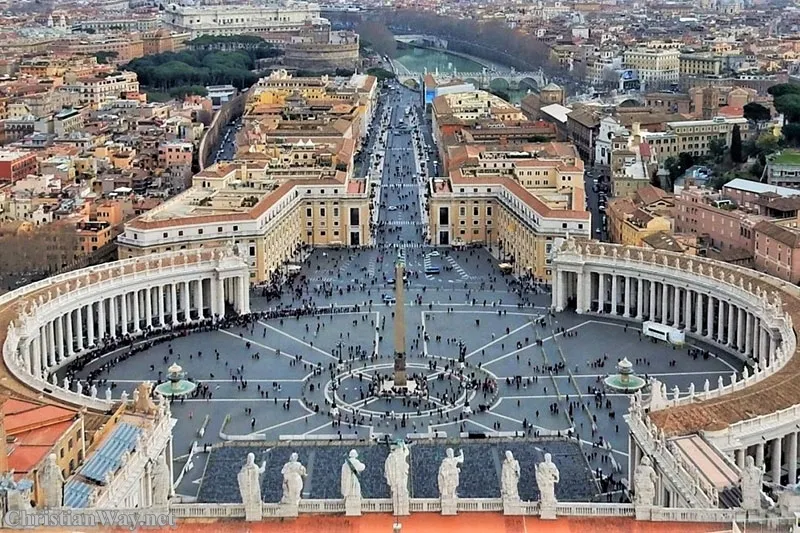
There are certain figures in the history of the Church whose influence is so profound that they do not merely participate in history; they fundamentally reshape it. Saint Gregory the Great, the first Pope to come from a monastic background and the last of the four great Latin Doctors of the Church, stands as a colossal bridge spanning the ruin of the ancient world and the birth of the medieval era. His fourteen-year pontificate (590–604) was not a period of quiet administration, but a heroic struggle against plague, famine, invasion, and ecclesiastical decay, undertaken by a man of frail health yet Herculean spiritual resolve.
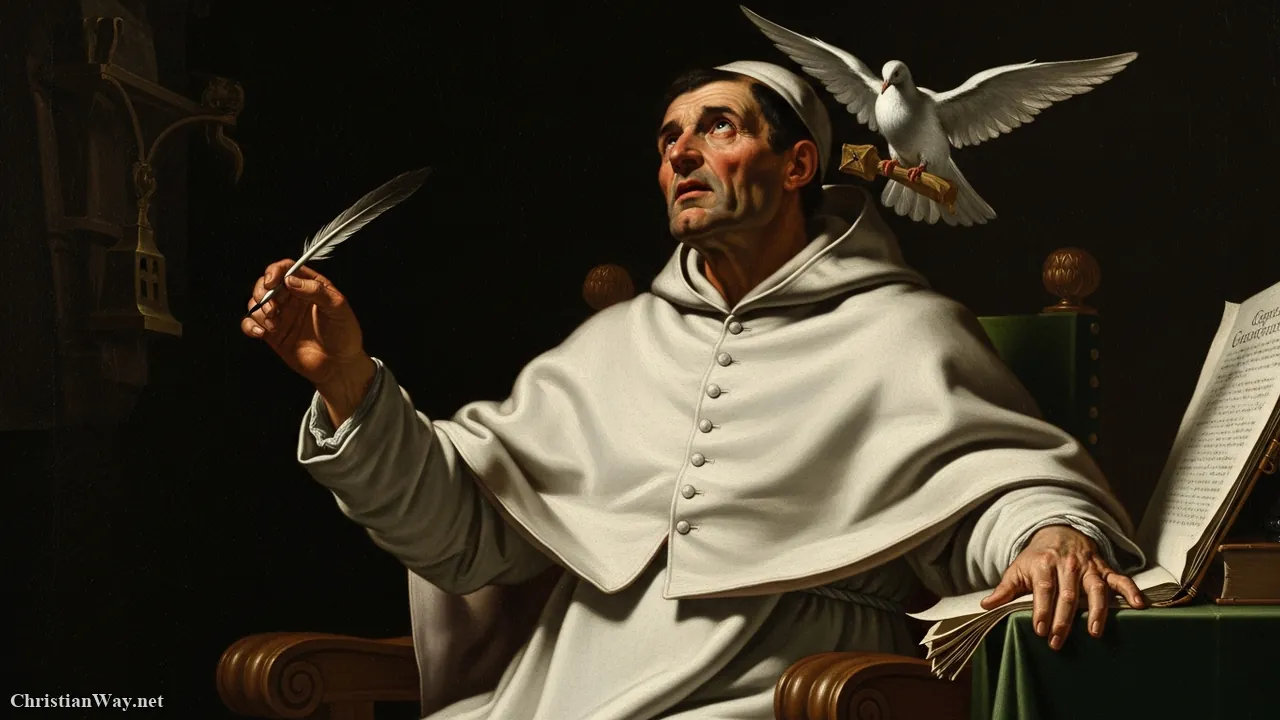
As we contemplate his life here on Christian Way, we realize that Gregory was much more than a successful administrator or a brilliant theologian; he was the consummate pastor, earning the accolade “the Great” not through military conquest or imperial decree, but through his unyielding commitment to charity, humility, and the spiritual care of souls. He famously adopted the title servus servorum Dei—”servant of the servants of God”—a profound theological statement that has defined the papacy ever since and serves as the perfect lens through which to view his monumental contribution to the universal Church. His story is a powerful reminder that true authority flows from service, especially in times of profound societal upheaval.
Profile of Holiness (The Table)
| Attribute | Detail |
|---|---|
| Birth Name | Gregorius (Latin, meaning “Watchful”) |
| Lifespan | c. 540 AD – March 12, 604 AD |
| Birthplace | Rome, Italy (Caelian Hill) |
| Service Period | Pontificate: September 3, 590 – March 12, 604 (14 years) |
| Feast Day | September 3 (Moved in 1969 from March 12 to avoid Lent) |
| Patronage | Musicians, singers, students, teachers, popes, and invoked against gout and the plague. |
| Key Virtue | Pastoral Humility (Servus Servorum Dei) |
The Cradle of Grace: Historical Context & Early Life
To understand the man, one must first understand the ruin he inherited. Gregory was born around 540 AD, not into the glory of Imperial Rome, but into its agonizing twilight. The city was a shell of its former self, having been brutally sacked and taken and retaken multiple times during the devastating Gothic Wars (535–554). He witnessed first-hand the societal collapse, the famine, and the relentless sweep of the Plague of Justinian, which periodically decimated the population. The old administrative structures of the Roman Senate were defunct, and the once-mighty Western Roman Empire was fractured, replaced by fragmented, often Arian, barbarian kingdoms, notably the aggressive Lombards who were constantly threatening Rome itself. The distant Eastern Roman Emperor in Constantinople offered little practical help, leaving the Papacy as the sole functioning authority capable of providing both civic leadership and spiritual succor.
Gregory’s heritage was impeccable. He belonged to the illustrious gens Anicia, a patrician family of immense wealth and influence, whose lineage included the Christian senator and even one of his great-great-grandfathers, Pope Felix III. His father, Gordianus, was a wealthy senator who served as the Prefect of the City of Rome, the highest civilian office. His mother, Silvia, and his paternal aunts, Trasilla and Emiliana, were all revered for their piety and are now honored as saints. This environment provided Gregory with a stellar classical education—“second to none for skill in grammar, dialectics, and rhetoric”—and a deep, practical Catholic faith. He was trained in law and governance, skills which God would later use to organize and save the Church. However, the chaos of his youth, seeing the ancient world crumble around his family’s villa on the Caelian Hill, instilled in him a profound sense of the transience of earthly power and the urgent necessity of divine reliance, prompting the famous biblical reflection: “For what does it profit a man if he gains the whole world and forfeits his soul?” – Mark 8:36
The Turning Point: Vocation and Conversion
For a man of Gregory’s class and ability, a magnificent secular career was guaranteed. Indeed, by the age of thirty-three, Gregory reached the pinnacle of civil authority, serving as the Prefect of Rome in 573. He was a master of the complexities of administration, finance, and urban management. Yet, this worldly success did not bring him peace. The spiritual longing that had been nurtured by his saintly family remained unfulfilled, and he felt keenly the “pollution” of secular life, viewing his service in the world as a necessary, but ultimately distracting, obligation.
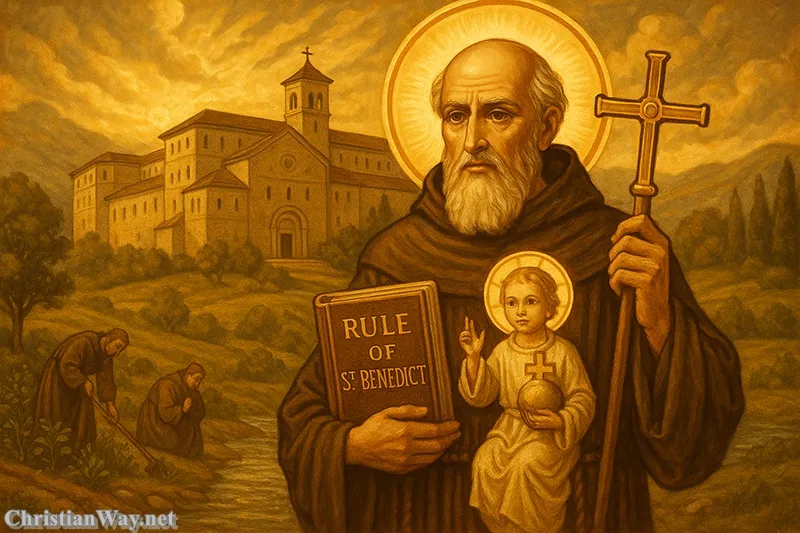
The call of God was not a sudden burst of light, but a persistent, overwhelming gravity drawing him away from the Curia and into the cloister. The internal struggle was intense: the duty to his city versus the desire for contemplative purity. Following the death of his father, Gregory decisively renounced his glittering public life. He dramatically converted his family’s ancestral home on the Caelian Hill into the Monastery of St. Andrew, dedicating it to the Benedictine Rule. He also founded six other monasteries on his vast Sicilian estates, liquidating his immense wealth to fund them and the relief of the poor. This was his true conversion—not from paganism to Christianity, but from power to poverty, from the world to the cloister. He embraced the simple cowl and the severe life of a monk, believing he had finally secured the perfect freedom to pursue prayer and study.
His quiet dream of contemplation, however, was short-lived. The Church recognized his unique gifts for leadership and organization. Pope Pelagius II abruptly pulled Gregory from the cloister in 579, ordaining him a deacon and sending him as his apocrisiarius (papal ambassador) to the Byzantine court in Constantinople. For six years, Gregory was forced to navigate the treacherous political waters of the Eastern capital, lobbying for military aid that rarely came. This period was critical: it showed him the distance and indifference of the imperial power and cemented his conviction that the Papacy, not the Emperor, must protect and feed the Italian people. This tension between his deep desire for contemplative prayer and the inescapable, burdensome duty of active service became the defining feature of his life, a struggle eloquently summarized in his later writings: “The proof of love is in the works. Where love is great, the hardships, even the great ones, are not felt; they are welcomed.”
The Great Labor: Ministry and Mission
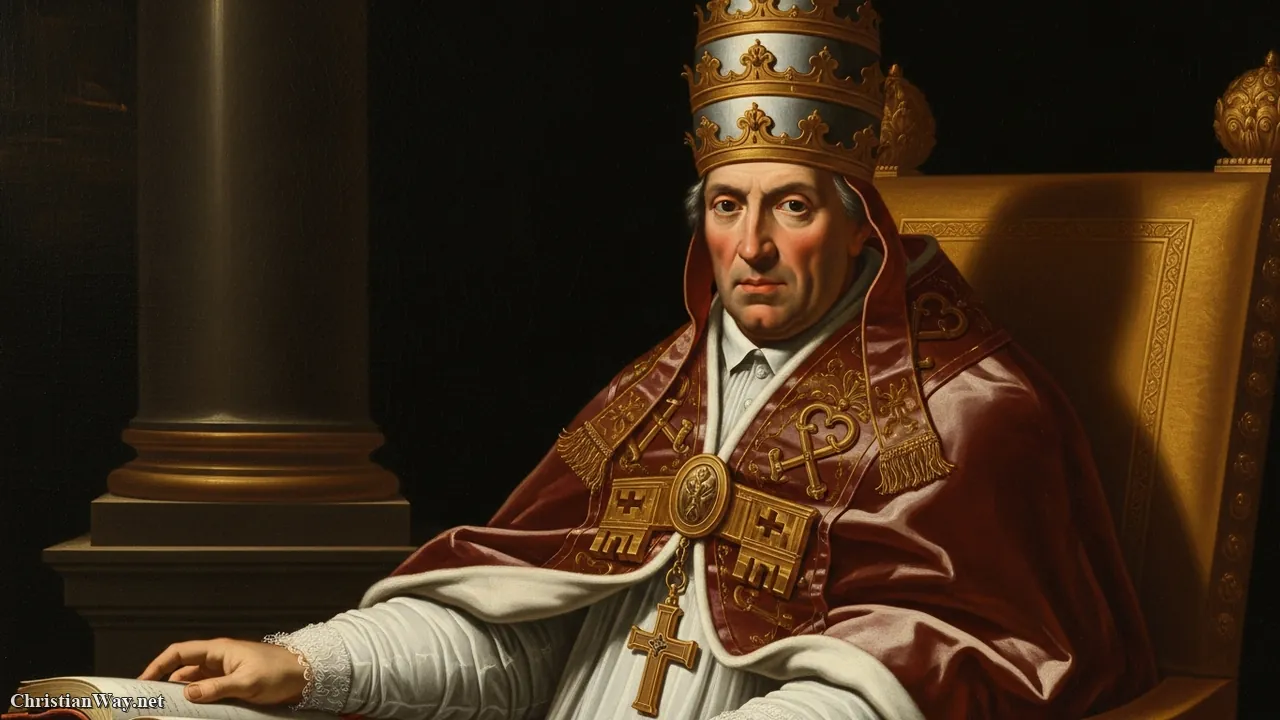
In 590, Rome was gripped by a renewed outbreak of the plague, which claimed the life of Pope Pelagius II. By near-universal acclamation of the Roman clergy and people, Gregory was chosen as his successor. He was utterly reluctant, famously writing to the Emperor Maurice begging him not to ratify his election. When his pleas failed, he reportedly disguised himself and attempted to flee the city, only to be miraculously returned, a testament to his profound, genuine humility. Upon accepting the title, he immediately defined his papacy by taking the name Servant of the Servants of God, a title of profound theological humility still used by Popes today.
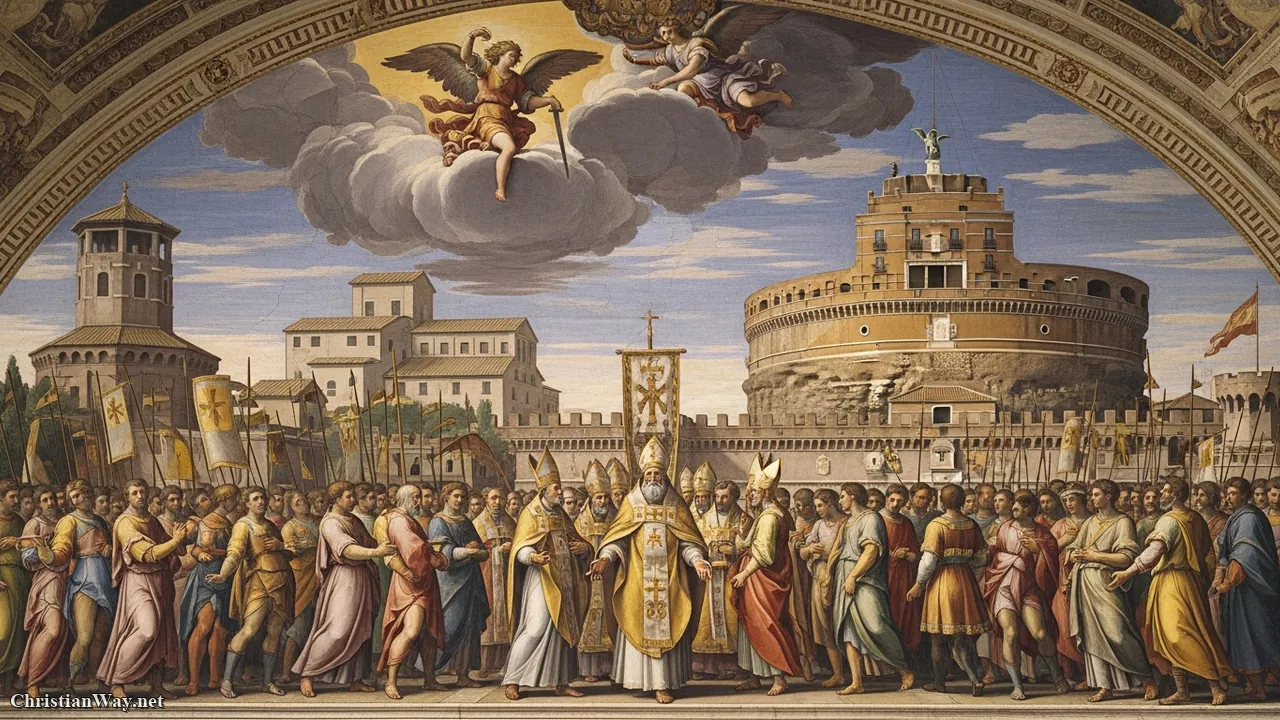
His ministry was one of ceaseless, multifaceted labor. Gregory essentially stepped into the vacuum left by the defunct civil government. He reorganized the vast Papal estates, the Patrimony of St. Peter, turning them into a highly efficient charitable organization. His instructions to his agents were revolutionary for the time: he mandated fair treatment of tenants, ordered loans of money to those in need, and ensured that the grain from Sicily and Egypt was shipped to Rome to fill the granaries, preventing mass starvation. During one severe famine, his efforts to feed the city were so organized and extensive that the Church became the most effective governing force in Italy. His commitment to the poor was absolute; once, when a beggar was found dead of starvation in Rome, Gregory was so stricken by his failure to act that he suspended himself from celebrating Mass for several days.
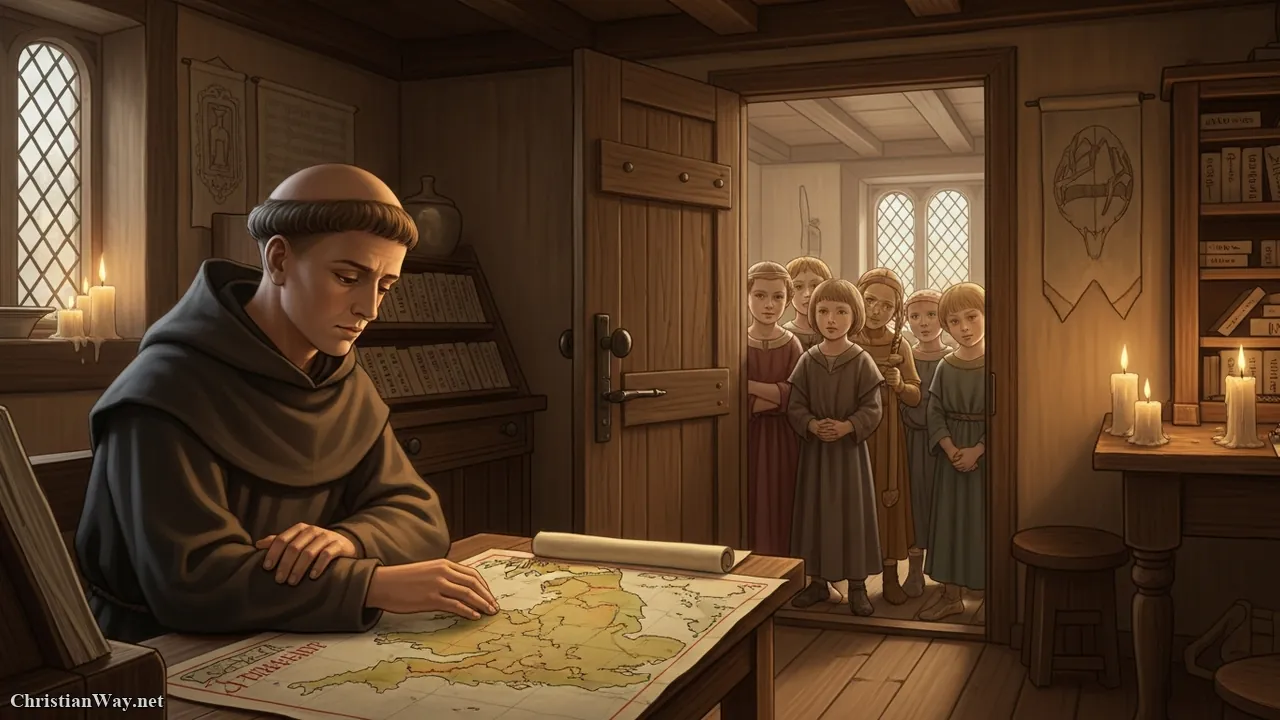
Beyond Rome, his achievements were epochal. He negotiated a tenuous but necessary peace with the invading Lombard King Agilulph in 593, saving Rome from destruction through personal intervention and payment of tribute, effectively acting as an independent temporal ruler. Most significantly, his vision extended far beyond the chaos of Italy. The famous story of Gregory encountering fair-haired youths from Britain in the Roman slave market led him to coin the phrase, “Non Angli, sed angeli” (Not Angles, but angels), sparking the greatest mission of the age. In 597, he dispatched the Abbot Augustine, later Saint Augustine of Canterbury, and forty monks to evangelize the Anglo-Saxons. This bold mission laid the foundation for the Church in England, earning Gregory the eternal title, the “Apostle of the English.” He also worked tirelessly for the reconciliation of schismatics, promoted justice for the Jews—whom he forbade from being oppressed or deprived of their synagogues—and protected the marginalized, showing that charity and justice were the core pillars of his pontificate.
The Teacher of Souls: Theological & Spiritual Legacy
Despite the crushing weight of his administrative duties, Pope Gregory I was a prolific author whose theological and spiritual teachings defined the early Middle Ages. Alongside Ambrose, Augustine, and Jerome, he is rightly designated one of the four Great Latin Fathers of the Church and a Doctor of the Church.
His most influential work is the Regula Pastoralis (Pastoral Rule), a handbook on the duties of a bishop or priest. It describes the ideal pastor as a “physician of souls,” emphasizing that the leader must be willing to transition constantly between contemplation and action. The book provided a blueprint for episcopal conduct for centuries, powerfully articulating the necessity of leading by example: the spiritual director must first heal himself. The Pastoral Rule became required reading for bishops throughout Europe, profoundly shaping the medieval concept of the priesthood.
Gregory’s homilies, especially the 40 Homilies on the Gospels, provided the faithful with accessible, practical exegesis, bridging the gap between classical learning and the popular understanding of the faith. He emphasized the interpretation of Scripture in terms of morality (how to live) and eschatology (the end of things), making the Gospel directly relevant to the lives of people facing war, plague, and poverty. His most famous quote on preaching comes from this pastoral focus:
“Let the preacher be warned to be silent when he has nothing to say, but when he is stirred to speech, let him take care not to lead his hearers in the wrong direction.”
His dialogues, particularly the Dialogues, are famous for providing accounts of the lives and miracles of Italian saints, most notably St. Benedict of Nursia, making them the primary source for the life of the Father of Western Monasticism. These stories, while sometimes viewed as medieval hagiography, served a vital purpose: they offered spiritual heroes and models of holiness to a shattered society desperately needing inspiration and hope.
Finally, Gregory’s name is permanently associated with Gregorian Chant. While he did not invent the tradition, he was instrumental in collecting, codifying, and standardizing the liturgical music of the Roman Church, ensuring uniformity and reverence. This monumental effort secured the role of sacred music as an essential element of worship, allowing the faithful to be drawn closer to the divine through beauty. He reformed the liturgy, strengthening its reverence and structure, and is credited with the important insertion of the Pater Noster (Our Father) into the Canon of the Mass before the fraction of the Bread, thereby reinforcing the communal nature of the sacred meal.
The Via Dolorosa: Suffering, Death, and Sainthood
Gregory’s greatness was forged in chronic suffering. The same body that carried the weight of the Papacy and the ruins of Rome was relentlessly afflicted by illness. Throughout his pontificate, he suffered terribly from crippling gout and severe digestive problems, likely a form of chronic arthritis. His last years were spent largely confined to his bed, dictating letters and treatises, yet never allowing his physical frailty to interrupt his pastoral duties. He often referred to his physical suffering as the cross he bore, viewing his body as a prison that prevented him from enjoying the pure, undisturbed contemplation he had desired in the monastery.
The final days of Saint Gregory the Great were marked by the same humility and service that defined his life. He died on March 12, 604 AD, in Rome. His final hours were a testament to his profound faith and enduring patience in suffering. Though we lack a precise record of his last words, his life spoke volumes: a life emptied for Christ. Upon his death, his body was laid to rest in St. Peter’s Basilica, where his relics remain to this day. The epitaph inscribed upon his tomb captured his achievement: “After the dark world, he took his flight to heaven, and his works are crowned with eternal glory.”
The road to his sainthood was swift and immediate. In an age where the processes of beatification and canonization were less formalized than today, Gregory was canonized by popular acclaim immediately following his death. The people of Rome, whom he had fed, protected, and governed, recognized instantly that a great saint had departed from their midst. He was formally recognized as a Doctor of the Church by Pope Boniface VIII in 1295, a mere formality confirming the verdict of history. In a critical liturgical update, the post-Vatican II reform of the General Roman Calendar moved his feast day from March 12 (which often falls in Lent, forbidding obligatory memorials) to September 3, the day of his consecration as Pope, allowing the universal Church to celebrate his memory with proper solemnity.
Spiritual Highlights: Lessons for the Modern Christian
The life of Saint Gregory the Great offers profound and practical wisdom for those navigating the moral and political complexities of the 21st century. His legacy is one of engaged spirituality—the monk who had to become a mayor, a general, and a diplomat, all while remaining fixed on the eternal. His life teaches us that the greatest faith is demonstrated in the most practical service.
- Embrace the Contemplative-Active Balance: Gregory shows us that prayer must precede and inform action. We must cultivate an inner life of solitude and spiritual wealth to be able to effectively minister in the world.
- Authority Must Serve: The title Servus Servorum Dei is a mandate for all Christian leaders. True power is found in the willingness to humble oneself for the sake of those entrusted to one’s care, feeding the hungry and comforting the afflicted before asserting political dominance.
- See the Mission Field in Every Face: Gregory saw the “Angels” in the Anglo-Saxon slaves and refused to let geographical boundaries limit his evangelical zeal. We too must look beyond our immediate comfort zone to the needs of the wider world.
- Lead with Virtue, Not Just Law: His Pastoral Rule stresses that a leader’s personal holiness is the most persuasive form of governance. Our character, not our position, is what truly draws others to Christ.
A Prayer for Intercession
O Holy Father Gregory, servant of the servants of God, model of humility and shepherd of the flock in times of deepest darkness, look upon the needs of the Church today. You administered the bounty of God to feed a starving city and reformed the sacred liturgy to lift hearts to heaven. Intercede for us, we pray, that we may be granted your profound spiritual wisdom, your administrative courage, and your unceasing heart for the poor. Grant, through your prayers, that our leaders may govern with justice and humility, and that we, the faithful, may balance the contemplation of the cloister with the charity required in the world, ever mindful of the eternal reward. Through Christ our Lord. Amen.
— Fr. John Matthew, for Christian Way