Dear friends and beloved pilgrims,
It is with a heart full of reverence that I invite you today to contemplate a life that defies human logic but perfectly illustrates the mystery of Divine Providence. We turn our gaze to Saint Josephine Bakhita. Her story begins not in the comfort of a Christian home, but in the terrifying darkness of abduction and enslavement. Yet, in the soil of suffering, God planted a seed of such resilience and charity that she blossomed into one of the Church’s most profound symbols of hope. She teaches us that no matter how deep our wounds, the Master—her “Paron”—is greater still.
Profile of Holiness
| Attribute | Detail |
|---|---|
| Birth Name | Unknown (Called “Bakhita” by captors) |
| Lifespan | c. 1869 – February 8, 1947 |
| Birthplace | Olgossa, Darfur (Sudan) |
| Service Period | 1896 – 1947 (Religious Life as a Canossian Sister) |
| Feast Day | February 8 |
| Patronage | Sudan, Victims of human trafficking and slavery |
| Key Virtue | Radical Forgiveness and Hope |
1. The Early Call: Finding God in the Darkness
Imagine, if you will, the lush yet volatile landscapes of Darfur in the late 19th century. It was here, around 1869, that a young girl was born into a loving family, happy and unaware of the shadows creeping across her land. However, at the tender age of seven, violence tore through her innocence. Kidnapped by Arab slave traders, the trauma was so severe that she forgot her own name. Her captors, with cruel irony, named her Bakhita, which means “The Lucky One.”
For the next twelve years, her life was a station of the cross. She was sold and resold five times in the markets of El Obeid and Khartoum. The brutality she endured is difficult to speak of; she bore 114 intricate cuts on her body—a cruel practice of scarification where salt was rubbed into fresh wounds to ensure prominent scarring. Yet, in the silence of her pain, Bakhita looked up at the moon and stars and wondered who owned them. In her heart, she felt that there was a Master above all masters, one who did not whip, but created. As St. Paul reminds us, “creation itself will be set free from its bondage to corruption and obtain the freedom of the glory of the children of God” (Romans 8:21). Even in chains, her soul was leaning toward a Freedom she had not yet met.
2. The Great Work: Meeting the True “Paron”
The arc of her life bent toward grace when she was purchased by an Italian consul, Callisto Legnani. For the first time since her abduction, she was treated not with a lash, but with human dignity. When the political situation in Sudan crumbled, she accompanied the consul to Italy. It was there, amidst the rolling hills of the Veneto region, that she was entrusted to the Canossian Sisters in Venice while her “owners” traveled. This was the moment the Holy Spirit had been preparing.
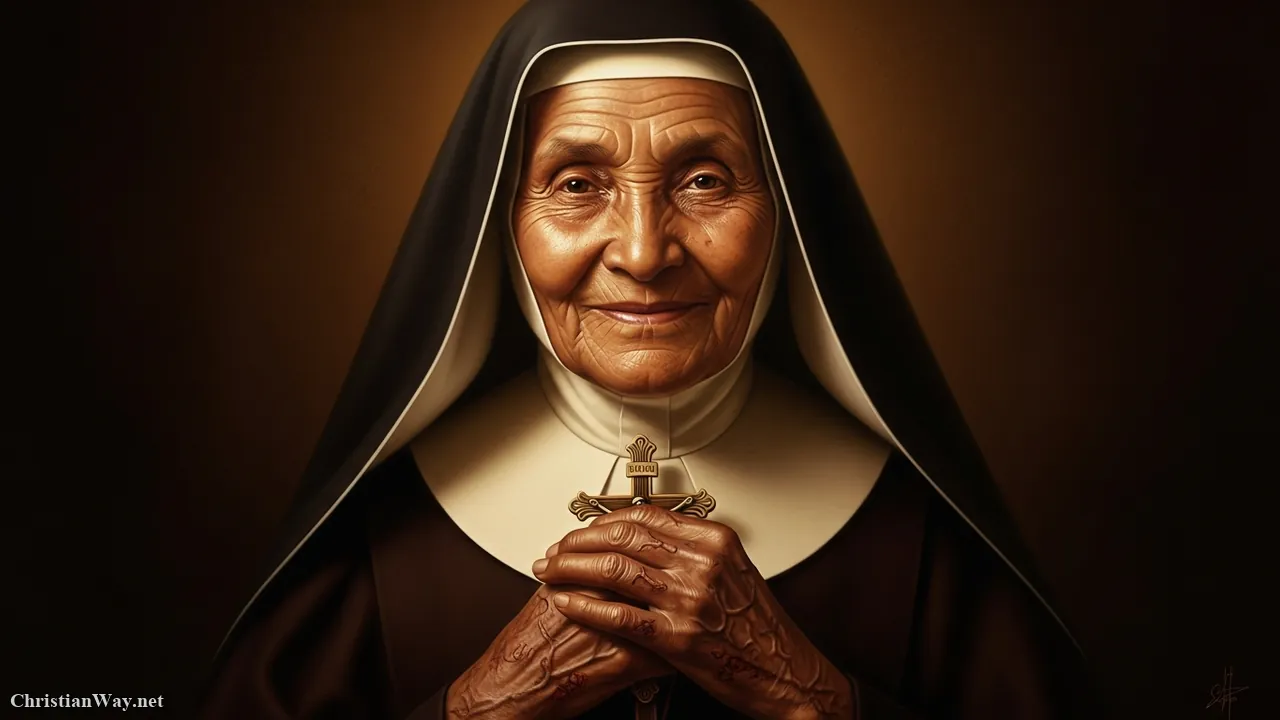
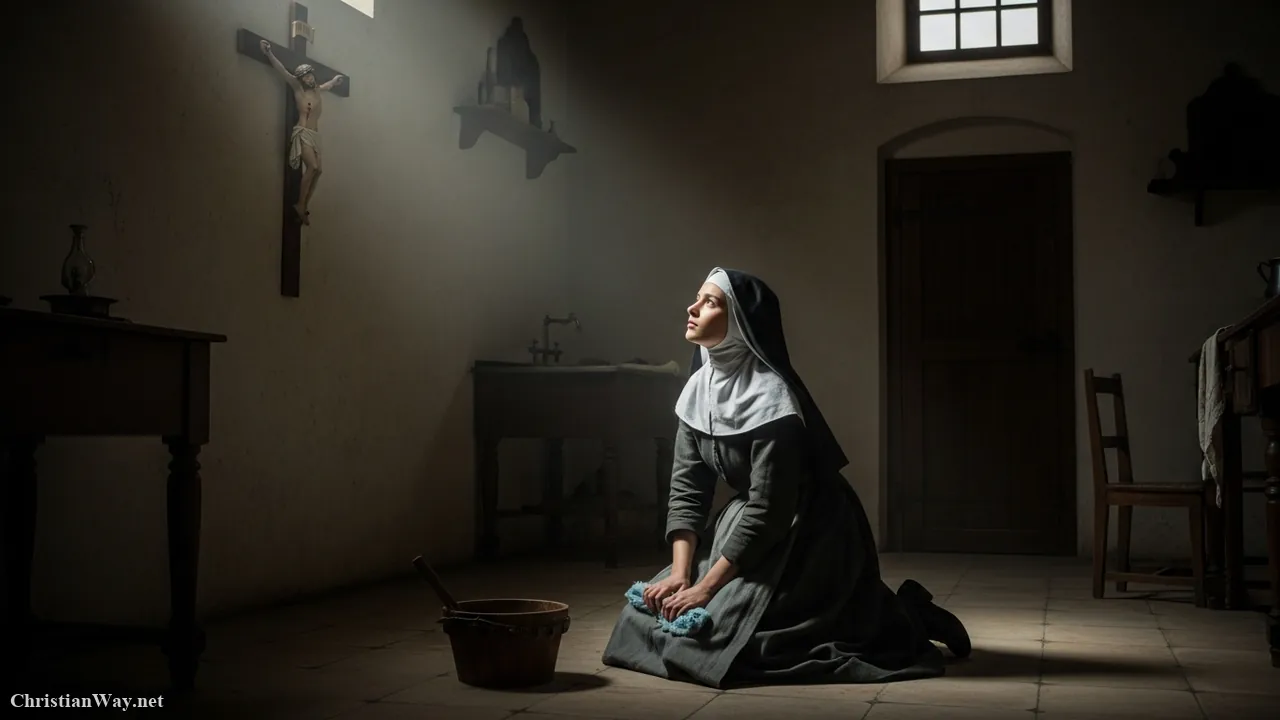
In the convent, Bakhita encountered the Crucifix. She saw a man tortured and wounded, just as she had been, yet He spoke of love. When she learned that this “Paron” (Master) loved her and died for her, her joy knew no bounds. When it came time for her to be taken back to Sudan, Bakhita, usually so submissive, stood firm with a newfound authority: she chose to remain with the Sisters. The Italian courts supported her, declaring that slavery was illegal in Italy. On January 9, 1890, she was baptized Josephine Margaret and Fortunata. She often kissed the baptismal font, saying, “Here, I became a daughter of God.” Her “great work” was not writing encyclicals, but living the ordinary life of a sister—cooking, sewing, and attending the door—with extraordinary love, becoming a living testament to the Christian Way of transformation.
3. The Cross and the Crown: A Legacy of Forgiveness
For fifty years, “Mother Moretta” (the Black Mother), as she was affectionately called, served the community in Schio. Her smile became a sanctuary for the local children and the poor. However, the shadow of the cross returned in her final years in the form of a painful illness. In her delirium, she would relive the trauma of her enslavement, crying out, “Please, loosen the chains… they are heavy!” It was a final purgation, uniting her suffering with the Passion of Christ.
Yet, her legacy is not defined by pain, but by her response to it. She famously said that if she were to meet the slave traders who kidnapped her, she would kneel and kiss their hands, for without them, she would never have become a Christian and a bride of Christ. She passed into eternity on February 8, 1947, with the words, “Our Lady! Our Lady!” on her lips. Canonized by Pope John Paul II in the Jubilee Year 2000, St. Josephine Bakhita stands today as a beacon for victims of trafficking and a doctor of forgiveness, proving that no human cruelty can extinguish the light of God.
Spiritual Treasures from St. Bakhita
- Radical Forgiveness: Bakhita teaches us that forgiveness is not about forgetting the trauma, but about refusing to let hatred have the final word.
- The Gift of Faith: She considered her faith her greatest treasure, often saying, “If you knew what great happiness it is to know God!”
- Hope in Suffering: Her life is a commentary on Romans 5:5—“Hope does not disappoint.” She shows us that our past wounds do not determine our future sanctity.
- Service in Humility: She found holiness in answering the door and smiling at strangers, reminding us that every small act is a liturgy of love.
A Prayer for Freedom and Peace
Oh, holy St. Josephine Bakhita, you who walked through the valley of the shadow of death and emerged holding the hand of the Risen Christ, hear our prayer. We bring to you all those who are enslaved today—in body or in spirit. Intercede for the victims of trafficking, that their chains may be broken. Teach us your way of gentle forgiveness, that we may not be held captive by bitterness or anger. Help us to see the “Paron” in our daily lives and to serve Him with the same joy that filled your heart. Amen.
— Fr. John Matthew, for Christian Way