Dear friends in Christ,
There are souls whose lives seem to become a window through which the light of God enters the world. Saint Teresa of Ávila is one of those souls. She was not born already free from fear, distraction, ambition, or weakness. She knew the ordinary struggles of the human heart: the longing to be loved, the pull of worldly approval, the difficulty of prayer, the burden of illness, and the uncertainty that can arise when God calls us beyond what feels safe. Yet the Lord took her restless energy, her sharp mind, her warm humanity, and even her weaknesses, and formed them into a life that still teaches Christians how to pray.
Saint Teresa of Ávila is often remembered as a mystic, a reformer, a Carmelite nun, and a Doctor of the Church. All these titles are true, but they can make her seem distant from ordinary people. In truth, Teresa was wonderfully human. She knew how easily the mind wanders in prayer. She knew how the heart can love God sincerely while still clinging to comfort. She knew what it was to be misunderstood. She knew the exhaustion of responsibility and the fear that can come when we are asked to do something beyond our strength.
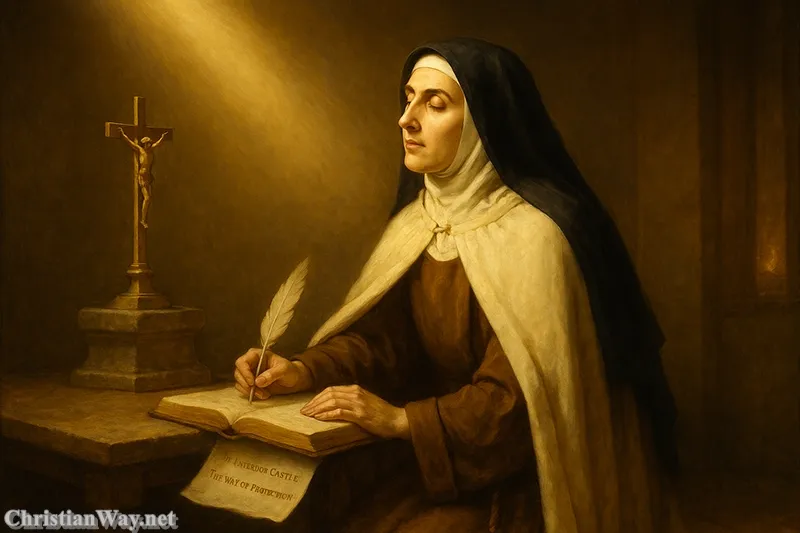
Her greatness was not that she never struggled. Her greatness was that she kept returning to Christ.
Teresa’s life speaks deeply to a world that is always rushing. Many people today are surrounded by noise but starved of silence. We carry phones, schedules, worries, responsibilities, ambitions, and endless messages into every part of the day. We may have little time to sit quietly before God. Even when we do pray, our minds can feel scattered and tired. We may wonder whether prayer truly changes anything, whether God hears us, or whether the desire for a deeper spiritual life is simply beyond our reach.
Saint Teresa answers with gentleness: begin where you are. Bring your real heart to God. Do not wait until you feel perfectly calm, perfectly holy, or perfectly prepared. Prayer is not reserved for people who have no struggles. Prayer is where our struggles are placed in the hands of Christ.
The fire of divine love that burned in Teresa’s soul was not a passing emotion. It was the steady work of grace. It purified her desires, gave her courage, deepened her humility, and made her willing to serve the Church in difficult times. Her life reminds us that God does not ask us to manufacture holiness by our own effort. He asks us to remain near Him. He asks us to make room for His love.
Biographical and Spiritual Profile
| Attribute | Detail |
|---|---|
| Birth Name | Teresa de Cepeda y Ahumada |
| Lifespan | 28 March 1515 – 1582 |
| Birthplace | Ávila, Spain |
| Religious Family | Carmelite; reformer of the Discalced Carmelites |
| Key Writings | The Life, The Way of Perfection, and The Interior Castle |
| Feast Day | 15 October |
| Doctor of the Church | Proclaimed in 1970 |
| Spiritual Emphases | Mental prayer, friendship with Christ, humility, discernment, courage, and contemplative union with God |
Teresa was born in Ávila in 1515, entered Carmelite life as a young woman, and later became a central figure in the renewal of the Carmelite tradition. Her writings on prayer and spiritual growth became enduring treasures for the Church, and Pope Paul VI proclaimed her a Doctor of the Church in 1970.
A Child of Ávila With a Heart Made for Eternity
Teresa grew up in sixteenth-century Spain, in a family where faith, books, imagination, and strong personalities all had their place. As a child, she was drawn to stories of saints and martyrs. There was something in her heart that already longed for greatness, though she did not yet understand where true greatness could be found. She loved reading, conversation, beauty, and adventure. She had a lively spirit and a natural gift for friendship.
Yet the path toward holiness was not simple. Teresa’s mother died when she was still young, and this loss touched her deeply. In the sorrow of that moment, she turned in a special way toward the Virgin Mary, asking her to become a mother to her. This early experience of grief became part of the tenderness she later showed toward others. Teresa never wrote as someone untouched by pain. She wrote as a woman who had learned that the heart can be wounded and still remain open to God.
Like many young people, Teresa also knew the desire to be admired. She cared about appearance, relationships, and the small dramas of ordinary life. There is something comforting about this. Saints are not people who were born without human desires. They are people who allowed God to purify those desires.
The world often tells us that holiness means becoming less human, less joyful, less alive. Teresa’s life tells us the opposite. The closer she came to God, the more fully herself she became. Her humor remained. Her intelligence remained. Her courage became stronger. Her capacity for friendship deepened. Her love of beauty became more rooted in the beauty of Christ.
The Lord does not erase the person He calls. He heals, purifies, and fulfills that person.
When the Heart Is Drawn in Different Directions
Many people know the experience of wanting God while also wanting the comfort of the world. We want to pray, but we also want to avoid silence. We want peace, but we do not want to release the habits that disturb our peace. We want to follow Christ, but we fear what obedience may cost.
Teresa knew this divided heart. Her early religious life was sincere, but it was also marked by inner struggle. She entered the Carmelite monastery of the Incarnation in Ávila, yet she later admitted that for many years her prayer was inconsistent and her heart was not fully surrendered.
This is a truth worth receiving with hope. A slow spiritual beginning is still a beginning. God is patient with souls. He does not abandon us because our prayer is weak, because our attention wanders, or because we need to begin again many times.
The disciples themselves often misunderstood Jesus. Peter was bold one moment and fearful the next. Thomas struggled to believe. Martha was anxious and troubled about many things. Yet Christ did not reject them. He formed them slowly.
He does the same with us.
From Familiar Religion to Living Friendship With Christ
One of Teresa’s greatest gifts to the Church was her understanding of prayer. She did not present prayer as a complicated technique for spiritual experts. She described it as a relationship of love. In her writings, she famously spoke of mental prayer as a close sharing between friends, “who we know loves us.”
This is a simple sentence, but it can change the way we approach God.
Many people pray as though God were far away. We imagine that prayer must be made of perfect words, correct feelings, or impressive thoughts. We may become discouraged when we cannot concentrate. We may think that God is disappointed in us when our minds are tired.
Teresa teaches us to begin with friendship.
A friend is someone before whom we can be honest. A friend is someone to whom we can bring joy, fear, confusion, gratitude, disappointment, and hope. Teresa did not mean that God is merely one friend among many. He is Lord, Creator, Savior, and Judge. But because Christ has loved us first, we are invited to approach Him with trust.
Jesus says to His disciples, “Henceforth I call you not servants; for the servant knoweth not what his lord doeth: but I have called you friends” (John 15:15).
These words do not remove reverence from prayer. They deepen it. We kneel before God because He is holy. But we do not kneel before a stranger. We kneel before the One who knows us, loves us, and gave Himself for us.
Prayer Is Not Escape From Life
For Teresa, prayer was never an escape from the responsibilities of life. She prayed deeply, but she also governed convents, travelled difficult roads, wrote letters, faced opposition, made decisions, encouraged sisters, and dealt with practical problems.
This is important because some people imagine prayer as something separate from ordinary life. We may believe that prayer belongs only to quiet churches, retreat houses, or special spiritual moments. But Teresa shows us that prayer can shape the whole of life.
A mother can pray while preparing food for her family.
A worker can pray while travelling to work.
A student can pray before opening a book.
A person carrying sorrow can pray while sitting in a hospital room.
A tired believer can pray with only a few words: “Jesus, stay with me.”
Prayer does not remove us from reality. It helps us meet reality with Christ.
Teresa knew that a soul rooted in prayer becomes more patient, more truthful, more humble, and more able to love. Prayer is not measured only by beautiful feelings. It is measured by the fruit it bears.
Does prayer make us gentler?
Does it make us more willing to forgive?
Does it help us become less proud?
Does it give us courage to do what is right?
Does it teach us to see Christ in others?
If the answer is slowly becoming yes, then grace is already at work.
The Wounded Christ and the Grace of Conversion
Teresa’s spiritual life deepened through a powerful encounter with the suffering Christ. In her own account, she describes being moved deeply by an image of Jesus wounded and abandoned after His Passion. She saw not only the pain of Christ, but the love that had entered that pain for the salvation of the world.
This encounter became a turning point. Teresa had known the Christian faith for years. She had participated in religious life. She had prayed, struggled, and searched. But now the Cross became personal.
It is one thing to know that Jesus died for humanity. It is another thing to allow the heart to say, “He died for me.”
The Cross speaks to every person who feels ashamed, wounded, lost, or afraid. It tells us that God does not love us from a distance. He comes into the darkness of human suffering. He carries betrayal, loneliness, exhaustion, physical pain, injustice, and death.
Saint Paul writes, “The Son of God, who loved me, and gave himself for me” (Galatians 2:20).
Teresa allowed this truth to reach her heart. The suffering Christ became not simply an image to admire, but a living Lord to love. Her conversion was not merely a change in outward behavior. It was a change in the center of her life.
She began to understand that divine love is not weak sentiment. It is a fire that burns away what keeps us from freedom. It reveals our sin, but not to humiliate us. It calls us to repentance, but not to leave us in despair. It wounds the heart only so that it may heal the heart.
The Gaze of Christ That Heals
There are times when people avoid looking at Christ because they are afraid of what they will see. We may fear that He will expose our failures, condemn our weakness, or demand more than we can give.
But Teresa discovered that the gaze of Christ is merciful.
When Jesus looked at Peter after the denial, Peter wept. Yet those tears were not the end of Peter’s story. They became the beginning of a deeper humility.
When Jesus looked at the rich young man, the Gospel says that He loved him.
When Jesus looked at Zacchaeus, He called him down from the tree and entered his home.
When Jesus looked at the woman caught in sin, He protected her from condemnation and gave her a new path.
The gaze of Christ sees the truth about us. Nothing is hidden from Him. Yet His truth is never separated from mercy.
Teresa teaches us not to run from that gaze. Bring your wounds to Christ. Bring the sin you regret. Bring the fear you cannot explain. Bring the burden you have carried for years. Do not hide from Him.
The fire of divine love does not destroy the soul that comes to God. It restores it.
The Call to Reform: Building Small Houses of Faithful Love
As Teresa grew in prayer, she began to see more clearly the need for renewal within Carmelite life. She loved her community, but she also saw that religious life could become distracted by comfort, social expectations, and the many demands of the world.
Her response was not bitterness. It was reform.
Teresa did not seek reform because she wished to judge others. She sought it because she wanted to live the Gospel more simply and faithfully. She wanted communities of prayer where sisters could support one another in humility, poverty of spirit, silence, friendship, and love for Christ.
In 1562, she established the first reformed convent, Saint Joseph’s in Ávila. From this beginning grew the reform that would become known as the Discalced Carmelites. Her desire was not to create a movement built around her personality. She wanted to create small communities where souls could pray deeply for the Church and remain faithful to Christ in a troubled world.
Teresa understood that the renewal of the Church does not begin with anger alone. It begins with holiness.
It begins when someone decides to pray more faithfully.
It begins when someone chooses humility over pride.
It begins when someone refuses gossip.
It begins when someone treats others with mercy.
It begins when someone allows Christ to purify the hidden motives of the heart.
Teresa’s reform was demanding. She faced opposition, misunderstanding, practical difficulties, and physical exhaustion. She travelled through Spain at a time when travel was difficult and often dangerous. Yet she continued because she believed that a few souls deeply rooted in Christ could become a blessing for many.
Reform Begins in the Soul
It is easy to see what is broken in the world. We see division, injustice, dishonesty, violence, spiritual confusion, and the failure of people in positions of authority. We may become angry, discouraged, or cynical.
Teresa teaches us a different response.
We should not ignore what is wrong. But before we try to reform everything around us, we must allow God to reform us.
The first place Christ wishes to renew may be our own heart.
Perhaps He wants to heal our resentment.
Perhaps He wants to free us from constant criticism.
Perhaps He wants to teach us patience.
Perhaps He wants to call us back to prayer.
Perhaps He wants us to become more faithful in the small duties we have been given.
A renewed Church is not built only through public debate. It is built through holy people. It is built through mothers who pray, fathers who serve faithfully, young people who seek purity, priests who love their people, religious who remain close to Christ, and ordinary believers who let the Gospel shape their daily choices.
The Interior Castle: Discovering God Within the Soul
One of Teresa’s most beloved works is The Interior Castle. In it, she imagines the human soul as a beautiful castle made of crystal, containing many rooms or “mansions.” At the center of the castle is the dwelling place of God.
This image is powerful because many people live as though they are strangers to their own souls. We can spend our days moving from task to task, message to message, worry to worry, without ever entering the quiet place within us where God waits.
Teresa does not suggest that the spiritual life is a journey of self-absorption. The interior life is not about becoming fascinated with ourselves. It is about discovering that God is nearer to us than we often realize.
Saint Paul writes, “Know ye not that ye are the temple of God, and that the Spirit of God dwelleth in you?” (1 Corinthians 3:16).
The soul is not empty. It is made to become a dwelling place of God.
Yet Teresa knew that entering this interior castle can be difficult. The first rooms may be full of distractions, fears, attachments, old habits, and temptations. A person beginning to pray may feel as though nothing is happening. The mind wanders. The heart feels dry. Silence can seem uncomfortable.
Teresa would tell us not to be discouraged.
Prayer is not always consolation. Sometimes it is simply fidelity.
A person who sits before God in dryness and says, “Lord, I am here,” is already praying.
A person who returns to prayer after failure is already responding to grace.
A person who cannot find words but remains silent before Christ is already receiving something deeper than words.
Do Not Be Afraid of the Quiet
Many people avoid silence because silence brings us face to face with ourselves. In silence, our fears can rise. Our regrets can become clearer. We may hear questions we have avoided for years.
But silence can also become a place of healing.
Elijah did not find God only in the wind, the earthquake, or the fire. He found God in the “still small voice” (1 Kings 19:12).
Teresa teaches us that the Lord often speaks quietly. Not always through dramatic visions or emotional experiences, but through a gentle drawing of the heart toward truth, humility, repentance, and love.
We do not need to force spiritual experiences. We do not need to compare our prayer with anyone else’s. We do not need to become anxious if God seems silent.
Remain faithful.
Open Scripture.
Speak honestly to Christ.
Sit quietly for a few moments.
Ask for the grace to love.
Then trust that God is working even when you cannot see the results.
The Fire of Divine Love: Grace That Purifies and Strengthens
The phrase “fire of divine love” can sound intense, even frightening. Fire can destroy. It can consume. Yet in Scripture, fire is often a sign of God’s presence, purification, and transforming love.
Moses encountered God in the burning bush, which burned but was not consumed.
The prophet Isaiah was touched by a burning coal and purified for his mission.
At Pentecost, tongues of fire rested upon the disciples, giving them courage to speak the Gospel.
For Teresa, divine love was not an escape from the human condition. It was the power of God entering the human heart and making it capable of deeper love.
In her writings, Teresa describes profound mystical experiences, including moments in which she felt pierced by the love of God. These experiences have often been represented in sacred art, but Teresa herself never treated them as spiritual entertainment. She was careful to submit her experiences to discernment, prayer, wise spiritual guidance, and the teaching of the Church.
This humility is important.
Not every strong feeling is the voice of God.
Not every spiritual experience should be trusted without discernment.
Not every person is called to extraordinary experiences.
The deepest sign of prayer is not emotion. It is love.
Does a person become more humble?
More patient?
More obedient to Christ?
More merciful?
More willing to carry the burdens of others?
These are the questions Teresa would ask.
Love That Makes Us Brave
Divine love made Teresa courageous. She was not naturally fearless. She had moments of anxiety and weakness. She knew what it was to feel overwhelmed by the tasks before her.
But love gave her strength.
A person may be afraid to forgive, but love gives courage.
A parent may be exhausted by responsibility, but love gives strength to continue.
A Christian may fear standing for truth, but love gives the grace to speak gently and clearly.
A person may feel unworthy of prayer, but love invites them to return.
Teresa’s spirituality was not soft or sentimental. It was strong because it was rooted in Christ. She knew that love does not always make life easy. But love makes faithfulness possible.
Jesus says, “If ye love me, keep my commandments” (John 14:15).
This is the fire of divine love: not merely a feeling that passes, but a grace that changes the way we live.
Teresa’s Courage, Humor, and Holy Realism
One of the beautiful things about Saint Teresa is that she was not a distant, gloomy saint. Her writings reveal a woman with humor, practical wisdom, common sense, and a clear understanding of human weakness.
She knew that people could become proud even of being spiritual. She knew that religious life could become difficult when personalities clashed. She knew that some people could speak beautifully about holiness while treating others without kindness.
Teresa insisted that authentic prayer must lead to love.
A person can spend hours in prayer and still become impatient, harsh, or self-centered. Teresa would say that something is missing. Prayer must not make us feel superior. It must make us more humble.
She also understood that rest, health, friendship, and ordinary human needs matter. Holiness does not mean denying that we are human. A tired person may need sleep. A troubled person may need conversation. A sick person may need care. Teresa did not teach Christians to despise the body or to pretend that human weakness does not exist.
She taught holy realism.
We are weak, but God is strong.
We are distracted, but God is patient.
We are sinners, but mercy is real.
We may be afraid, but Christ remains with us.
“Let Nothing Disturb You”
Teresa is often associated with the prayerful line, “Let nothing disturb you.” These words are beautiful, but they can be misunderstood. She was not saying that Christians should never feel sorrow, anxiety, grief, or fear.
Teresa herself knew suffering. She experienced illness, opposition, exhaustion, and the pain of seeing people misunderstand her work.
Her words point toward something deeper: nothing in this world is greater than God.
Circumstances change.
Health changes.
Human approval changes.
Plans change.
But Christ remains.
This does not mean we should ignore practical problems or refuse to seek help when we need it. It means that beneath every changing circumstance, there is a foundation that does not move.
“Jesus Christ the same yesterday, and to day, and for ever” (Hebrews 13:8).
This is why a soul of prayer can become steady even in storms. Not because the storm is unreal, but because Christ is more real.
Saint John of the Cross and the Fellowship of Spiritual Friendship
Teresa did not carry the work of reform alone. One of the most important companions in her mission was Saint John of the Cross. Though younger than Teresa, John shared her desire for a deeper renewal of Carmelite life. Together, in different ways, they helped shape the reform that would become the Discalced Carmelite tradition.
Their friendship reminds us that God often gives us companions for the road.
The spiritual life is personal, but it is not meant to be isolated. We need wise friends. We need people who remind us of Christ when we are discouraged. We need spiritual guides who can help us discern what comes from God and what comes from fear, pride, or confusion.
Teresa valued friendship deeply. Yet she also knew that friendship must lead us toward God. A friendship that feeds gossip, resentment, vanity, or sin is not a friendship that helps the soul grow. A holy friendship is one in which two people help each other become more faithful.
Saint Paul writes, “Wherefore comfort yourselves together, and edify one another” (1 Thessalonians 5:11).
This is what Teresa and John did in different ways. They encouraged one another to remain close to Christ amid resistance and hardship. They remind us that the Church is strengthened when believers do not compete for importance, but work together for the glory of God.
The Courage to Ask for Help
Some people struggle alone because they fear being judged. They may carry spiritual questions, emotional burdens, or painful sins in silence. They may believe that asking for help is weakness.
Teresa teaches us otherwise.
She sought counsel. She listened to spiritual directors. She tested her experiences. She accepted correction. She remained rooted in the life of the Church.
This is humility.
We are not meant to discern every struggle by ourselves. Sometimes God speaks through the wisdom of another person: a priest, pastor, trusted Christian friend, counselor, spouse, parent, or mentor.
There is no shame in asking for help.
A soul that asks for help is not weak. It is often taking the first step toward healing.
A Doctor of the Church and a Mother of Prayer
Teresa’s writings have guided Christians for centuries because they speak with both depth and warmth. She can be profound, yet she never forgets the ordinary person who struggles to pray. She can speak about the highest mysteries of union with God, yet she remains attentive to the smallest acts of faithfulness.
Her books do not call us to chase extraordinary spiritual experiences. They call us to love Christ.
They call us to pray honestly.
They call us to grow in humility.
They call us to serve.
They call us to remain faithful when prayer feels dry.
They call us to trust that God is working within the soul, even when we cannot see His work clearly.
In 1970, the Church formally recognized the enduring importance of Teresa’s spiritual teaching by naming her a Doctor of the Church. This title does not mean she was without human limitation. It means that her teaching has helped illuminate the path of faith for generations of believers.
Teresa belongs especially to the Catholic Carmelite tradition, yet Christians across many traditions can receive wisdom from her life. All believers are called to pray. All are called to seek Christ in Scripture. All are called to grow in holiness. All are called to let love become visible in their lives.
Her message is simple enough for a weary heart and deep enough for a lifetime of reflection: God is closer than you think.
Prayer for a Distracted and Restless Age
Our time needs Teresa’s wisdom.
We need silence in a noisy world.
We need humility in a culture of self-promotion.
We need perseverance in an age that expects immediate results.
We need prayer that is more than routine words.
We need courage to remain faithful when following Christ is difficult.
We need to remember that the soul cannot be satisfied by possessions, attention, pleasure, or success alone.
There is a place within every human person that belongs to God.
We may try to fill that place with many things. But eventually, like Teresa, we discover that only divine love can give the heart rest.
This does not mean leaving behind every responsibility. It means bringing Christ into every responsibility.
It means praying before making decisions.
It means forgiving when pride tells us to hold on to resentment.
It means listening when someone needs to be heard.
It means offering our work to God.
It means returning to prayer after distraction.
It means believing that even a small act of faithfulness can become a flame of grace in a dark world.
Reflect and Pray
Dear friends, Saint Teresa of Ávila teaches us that prayer is not a distant spiritual ideal. It is the path by which the heart learns to live in the love of God.
Perhaps you feel tired in prayer. Perhaps your mind wanders. Perhaps your life is crowded with responsibilities. Perhaps you have been seeking peace in places that cannot truly give it. Perhaps there is a quiet longing within you for something deeper, but you do not know where to begin.
Begin with Christ.
Speak to Him honestly.
Tell Him what you fear.
Tell Him what you desire.
Tell Him where you are wounded.
Sit quietly before Him, even if only for a few moments.
The Lord is not waiting for you to become perfect before He welcomes you. He is waiting for you to come.
May Saint Teresa of Ávila pray for us, that we may become souls of prayer, hearts of courage, and humble servants of the love of Christ.
Lord Jesus Christ,
You drew Saint Teresa of Ávila
from distraction and fear
into the deep peace of Your friendship.
Teach us to seek You faithfully in prayer.
Give us courage when we are afraid,
humility when pride rises within us,
and patience when the road of faith feels long.
Purify our desires through the fire of Your love.
Make our hearts places where Your Spirit may dwell.
Help us to serve others with gentleness,
to forgive with mercy,
and to remain faithful in every season of life.
May the prayerful witness of Saint Teresa
lead us ever closer to You,
who live and reign with the Father and the Holy Spirit,
God for ever and ever. Amen.
May the peace of Christ rest within your heart, and may the fire of divine love guide you into deeper prayer, courage, and joy.
— Fr. John Matthew